41 Dyadic layer decomposition, cell fans, and recursive repair geometry
This chapter follows [ 286 , Section 11 ] : sparse coordinate strips partition a finite domain into dyadic layers and fine cells, cell fans and elementary side matchings decompose the belt interfaces, and recursive boundary repairs produce the two-family partition with controlled cut clearance.
41.1 Sparse coordinate strips
Let \(F\subset \mathbb Z^2\) be finite and let \(m\ge 1\) be an integer. For residues \(a,b\in \{ 0,\ldots ,m-1\} \), define
For every finite \(F\subset \mathbb Z^2\) and integer \(m\ge 1\), there are residues \(a,b\in \{ 0,\ldots ,m-1\} \) such that
This is the finite averaging step in the sparse-strip construction of [ 286 , Section 11 ] .
For any map \(f:F\to \{ 0,\ldots ,m-1\} \), its \(m\) fibres partition \(F\). One fibre therefore has at most \(\lfloor |F|/m\rfloor \) elements. Apply this to the two coordinate residue maps and choose their residues independently. Each selected strip contains at most \(\lfloor |F|/m\rfloor \) cells, so their union satisfies \(|B_{a,b}(F)|\le 2\lfloor |F|/m\rfloor \). Multiplying by \(m\) and using \(m\lfloor |F|/m\rfloor \le |F|\) gives (2). The argument includes \(F=\varnothing \) and \(m=1\).
41.2 Finite cell counts
For a finite induced domain \(\Lambda \) and a cut \(A\subseteq \Lambda \), the boundary endpoints are the integer endpoints of the crossing edges,
For a finite set \(P\subset \mathbb Z^2\) of parent indices, its dyadic child indices are
These are the four children of each parent in a translated dyadic mesh.
For every finite \(T\subset \mathbb Z^2\), integer \(r\ge 0\), finite parent set \(P\), and finite induced domain with cut \(A\), one has
These cardinality estimates are ingredients in the layer count of [ 286 , Section 11 ] ; no connectedness assumption is needed.
Each point of \(T\) contributes an integer square with \((2r+1)^2\) sites; counting their union gives the first bound. Each crossing edge contributes at most two endpoints, giving the second. In each coordinate the remainder modulo two identifies the child label, and division by two then identifies the parent index. Thus distinct parent and child-label pairs give distinct indices, proving the last equality. All three assertions include empty sets.
41.3 Translated dyadic neighborhoods
Fix an origin \(o\in \mathbb R^2\), covering the translated origin used in [ 286 , Section 11 ] . For every integer \(k\ge 0\) and index \(z\in \mathbb Z^2\), define the half-open cell, its index map, and the parent map by
Every point \(x\in \mathbb R^2\) lies in the unique scale-\(k\) cell indexed by \(c_k(x)\), and passing to parents increases the scale by one:
For every integer \(C_0\ge 0\), two indices \(z,w\in \mathbb Z^2\) with \(\| z-w\| _\infty \le C_0\) satisfy \(\| p(z)-p(w)\| _\infty \le C_0\), so \(p\) maps the \(C_0\)-neighborhood of any finite index set \(P\subset \mathbb Z^2\) into the \(C_0\)-neighborhood of \(p(P)\). An index \(z\) belongs to the child set \(\operatorname {Ch}(P)\) if and only if \(p(z)\in P\).
The floor inequalities give the cell-membership equivalence, and \(\lfloor t/2\rfloor =\lfloor \lfloor t\rfloor /2\rfloor \) gives \(c_{k+1}(x)=p(c_k(x))\). Integer division by \(2\) preserves coordinatewise bounds of the form \(|z_i-w_i|\le C_0\). Finally, every integer \(z_i\) has a unique decomposition \(z_i=2p(z)_i+r_i\) with \(r_i\in \{ 0,1\} \).
Let \(Z\subset \mathbb Z^2\) be finite and let \(C_0\ge 0\) be an integer. For each integer \(k\ge 0\), define
The figure below illustrates one endpoint with \(C_0=1\): the layer \(D_k\) is the ring of scale-\(k\) cells in \(N_{k+1}\setminus N_k\).
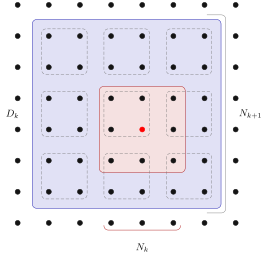
For every origin \(o\), finite \(Z\subset \mathbb Z^2\), integer \(C_0\ge 0\), and integer \(k\ge 0\),
Applying \(c_{k+1}(z)=p(c_k(z))\) to \(z\in Z\) gives \(\mathcal Z_{k+1}=p(\mathcal Z_k)\). Because the scale-\(k\) cells partition \(\mathbb R^2\), \(x\in N_k\) if and only if \(c_k(x)\in P_k\). Since \(p\) maps \(P_k\) into \(P_{k+1}\), every point of \(N_k\) has \(c_{k+1}(x)=p(c_k(x))\in P_{k+1}\), so \(N_k\subseteq N_{k+1}\). Finally, \(x\in N_{k+1}\) if and only if \(p(c_k(x))\in P_{k+1}\), that is \(c_k(x)\in \operatorname {Ch}(P_{k+1})\); removing \(N_k\) removes the indices in \(P_k\).
For every origin \(o\), finite \(Z\subset \mathbb Z^2\), integer \(C_0\ge 0\), and integer \(k\ge 0\), the layer-cell counts in [ 286 , Section 11 ] satisfy
When \(Z\) is the set of endpoints of the boundary edges \(\partial _\Lambda A\) of a cut \(A\) in a finite induced domain \(\Lambda \), with \(b=|\partial _\Lambda A|\),
Since \(|\mathcal Z_{k+1}|\le |Z|\), its \(C_0\)-neighborhood \(P_{k+1}\) has at most \((2C_0+1)^2|Z|\) elements, and \(\operatorname {Ch}(P_{k+1})\) has at most \(4|P_{k+1}|\) elements. Each edge in \(\partial _\Lambda A\) contributes at most two endpoints to \(Z\), so \(|Z|\le 2b\).
For every origin \(o\), nonempty finite set \(Z\subset \mathbb Z^2\), and integer \(C_0\ge 2\), the exhaustion property of [ 286 , Section 11 ] gives
For any \(z\in Z\) and \(x\in \mathbb R^2\), choosing \(k\ge 0\) with \(2^k{\gt}|x_1-o_1|+|x_2-o_2|+|z_1-o_1|+|z_2-o_2|\) places \((x_i-o_i)/2^k\) and \((z_i-o_i)/2^k\) in \((-1,1)\), so their floors belong to \(\{ -1,0\} \) and \(\| c_k(x)-c_k(z)\| _\infty \le 1\le C_0\). Since \(c_k(z)\in \mathcal Z_k\), it follows that \(c_k(x)\in P_k\) and \(x\in N_k\).
For every origin \(o\), integer \(k\ge 0\), cell index \(z\in \mathbb Z^2\), finite set \(Z\subset \mathbb Z^2\), and integer \(C_0\ge 0\), the closed cells and layers entering the separation estimates of [ 286 , Section 11 ] satisfy
and in particular \(\overline{C_{k,z}}\) is convex.
Since \(2^k{\gt}0\), the closure of each half-open coordinate interval is the corresponding closed interval, and closure commutes with finite products and with the finite union \(D_k=\bigcup _{z\in I_k}C_{k,z}\). As a product of closed intervals, \(\overline{C_{k,z}}\) is convex.
41.4 The half-open layer partition
The nested neighborhoods \(N_k\) define the half-open layers \(D_k=N_{k+1}\setminus N_k\), which partition \(\mathbb R^2\setminus N_{k_0}\) before closures are taken; see [ 286 , Section 11 ] .
For any origin \(o\), finite endpoint set \(Z\), and integer \(C_0\ge 0\), if \(\ell \le k\) and \(z\in F_{k,\ell }\), then \(C_{\ell ,z}\subseteq D_k\).
The layer \(D_k\) is the union of \(C_{\ell ,w}\) over \(w\in F_{k,\ell }\).
For any origin \(o\), finite endpoint set \(Z\), and integer \(C_0\ge 0\), \(D_k\cap D_h=\varnothing \) whenever \(k\ne h\).
If \(k{\lt}h\), nesting of the neighborhoods gives \(D_k\subseteq N_{k+1}\subseteq N_h\), whereas \(D_h=N_{h+1}\setminus N_h\) is disjoint from \(N_h\). The case \(h{\lt}k\) follows by symmetry.
Under the same hypotheses, for every initial layer index \(k_0\) and every \(k\ge k_0\), the neighborhood \(N_{k_0}\) is disjoint from \(D_k\).
Nesting gives \(N_{k_0}\subseteq N_k\), and \(D_k=N_{k+1}\setminus N_k\).
Suppose that \(Z\) is nonempty and \(C_0\ge 2\). For every initial layer index \(k_0\) and every \(x\notin N_{k_0}\), there is a unique \(k\ge k_0\) such that \(x\in D_k\).
Exhaustion of \(\mathbb R^2\) by the neighborhoods \(N_j\) yields a least \(K\ge 0\) with \(x\in N_K\). Since \(x\notin N_{k_0}\) and the neighborhoods \(N_j\) are nested, \(K{\gt}k_0\). Minimality of \(K\) gives \(x\notin N_{K-1}\), so \(x\in D_{K-1}\). Uniqueness follows from pairwise disjointness of the layers.
For nonempty \(Z\), integer \(C_0\ge 2\), and every initial layer index \(k_0\),
Every point of \(\mathbb R^2\setminus N_{k_0}\) lies in \(D_k\) for its unique layer index \(k\ge k_0\).
41.5 Distances between dyadic layers
Retain the cells, neighborhoods and layers of Definition 41.3.3. The origin \(o\in \mathbb R^2\) is arbitrary, \(Z\subset \mathbb Z^2\) is finite, and \(C_0\ge 0\) is an integer. All scale indices are nonnegative integers. Distances in the plane are taken in the sup metric, so \(d_\infty (x,y)=\max \{ |x_1-y_1|,|x_2-y_2|\} \).
Let \(u,v\in \mathbb Z^2\), \(x\in \overline{C_{k,u}}\), and \(y\in \overline{C_{k,v}}\). If \(|u_i-v_i|\le C_0\) for both coordinates \(i\in \{ 1,2\} \), then
If \(|u_i-v_i|{\gt}C_0\) in at least one coordinate, then
Each coordinate of a closed cell lies in its closed interval of length \(2^k\). Indices differing by at most \(C_0\) therefore give coordinate distances at most \((C_0+1)2^k\). If two integer indices differ by more than \(C_0\), they differ by at least \(C_0+1\); the corresponding closed intervals are separated by at least \(C_0 2^k\). Taking the maximum of the two coordinate distances proves both bounds.
For every \(x\in \overline{D_k}\) and every \(z\in Z\),
For every \(x\in \overline{D_k}\) there is a point \(z_*\in Z\) such that
Writing \(d_\infty (x,Z)=\inf _{z\in Z}d_\infty (x,z)\), one obtains
This is the layer-distance estimate in [ 286 , Section 11 ] .
The closure of \(D_k\) is a finite union of closed scale-\(k\) cells. Every layer index lies outside \(P_k\) and so differs from every occupied index in at least one coordinate by more than \(C_0\). Applying the closed-cell lower bound to the cell containing \(z\) gives the first inequality.
Since \(\overline{D_k}\subseteq \overline{N_{k+1}}\), the point \(x\) lies in a closed scale-\((k+1)\) cell whose index is within \(C_0\) of an occupied index. Choosing \(z_*\in Z\) in that occupied cell and applying the closed-cell upper bound at scale \(k+1\) gives the second inequality.
For every pair of scales \(k,h\), every \(x\in \overline{D_k}\), and every \(y\in \overline{D_h}\),
If \(h\ge k+2\), then
This is the nonadjacent-layer estimate in [ 286 , Section 11 ] .
Choose \(z\in Z\) with \(d_\infty (x,z)\le 2(C_0+1)2^k\). Since \(d_\infty (y,z)\ge C_0 2^h\), the triangle inequality gives the first bound. When \(h\ge k+2\), \(4\cdot 2^k\le 2^h\), so
41.6 The dummy neighborhood meets only the initial layer
The dummy tile is the initial neighborhood \(N_{k_0}\). Its distance bound distinguishes it from the later layers; see [ 286 , Section 11 ] . The conclusions below concern closures, with distances measured in the sup metric.
For any origin, finite endpoint set \(Z\), integer width \(C_0\ge 0\), and layer index \(k\), every \(x\in \overline{N_k}\) admits an endpoint \(z\in Z\) with
The point lies in a closed scale-\(k\) cell whose index is within \(C_0\) of an occupied index in each coordinate. Choose an endpoint in that occupied cell and apply the closed-cell distance bound.
Under the same hypotheses, let \(k\ge k_0+1\), \(x\in \overline{N_{k_0}}\), and \(y\in \overline{D_k}\). Then
In particular, this is a positive separation when \(C_0\ge 2\).
Choose \(z\in Z\) with \(d_\infty (x,z)\le (C_0+1)2^{k_0}\). The layer bound gives \(C_0 2^k\le d_\infty (y,z)\), while \(2^k\ge 2\cdot 2^{k_0}\). The triangle inequality now yields
Suppose that \(C_0\ge 2\) and \(k\ge k_0\). If \(\overline{N_{k_0}}\cap \overline{D_k}\) is nonempty, then \(k=k_0\).
If \(k\ne k_0\), then \(k\ge k_0+1\). A shared point has distance zero from itself, contradicting the positive separation.
41.7 Fine cells and sparse belts
The origin \(o\in \mathbb R^2\) remains arbitrary. All scale indices and refinement depths are nonnegative integers. Let \(Z\subset \mathbb Z^2\) be finite, and let \(C_0\ge 0\) be an integer. Retain the layer \(D_k\) and its index set \(I_k\) from Definition 41.3.3.
For every refinement depth \(d\) and fine index \(u\in \mathbb Z^2\), define its coarse ancestor by
For every finite set \(P\subset \mathbb Z^2\), define its refinement by
For every finite \(P\), depth \(d\), and index \(u\in \mathbb Z^2\),
For every pair of scales \(\ell \le k\) and every \(x\in \mathbb R^2\),
Euclidean division by \(2^d\) gives a unique integer quotient and a remainder in \(\{ 0,\ldots ,2^d-1\} \) in each coordinate. This proves the membership criterion and the cardinality formula, including negative indices. The identity \(\lfloor t/n\rfloor =\lfloor \lfloor t\rfloor /n\rfloor \) for a positive integer \(n\) gives the point-index identity.
For every fine scale \(\ell \le k\), set
For every \(\ell \le k\), the layer and its fine-cell count satisfy
If \(Z\) is the set of endpoints of the crossing edges of a cut in a finite induced domain and \(b\) is the number of those edges, then
Because the half-open fine cells are disjoint and nonempty, \(F_{k,\ell }\) is the set of fine indices whose cells meet \(D_k\), matching the cell count of [ 286 , Section 11 ] .
A point’s fine index belongs to \(R_{k-\ell }(I_k)\) if and only if its coarse index belongs to \(I_k\). The cell-membership criterion therefore proves the decomposition of \(D_k\). Multiplying the coarse-cell count by \(4^{k-\ell }\) and applying the endpoint and crossing-edge bounds gives the cardinality estimates.
With the fixed exponents \(\delta _0\) and \(\zeta =1-\delta _0/2\), define, for every scale \(k\),
The fine cells have side \(t_k\), while \(s_k\) is the belt pitch, as in [ 286 , Section 11 ] .
For every scale \(k\),
The inequalities \(\zeta \le 1\) and \(\delta _0\ge 0\) give \(\ell _k\le k\le p_k\), which implies the divisibility relations for the corresponding powers of two. Since each floor exceeds its argument minus one, summing the two floor bounds and substituting \(\zeta =1-\delta _0/2\) yields the exponent bound.
Let \(F\subset \mathbb Z^2\) be finite and let \(m\ge 1\) be an integer. For every pair of residues \(a,b\in \{ 0,\ldots ,m-1\} \), define
For a fine layer with pitch exponent \(p\ge k\ge \ell \), the modulus is \(m=2^{p-\ell }\), the ratio of pitch to fine-cell side.
Let \(Z\) be the crossing-edge endpoint set of a finite induced-domain cut, with crossing-edge count \(b\). For every fine scale \(\ell \le k\) and every pitch exponent \(p\ge 0\), put \(F=F_{k,\ell }\) and \(m=2^{\max (p-\ell ,0)}\). There are residues \(a,b'\in \{ 0,\ldots ,m-1\} \) such that
When \(p\ge \ell \), put \(r=2^k\), \(t=2^\ell \), and \(s=2^p\); then \(m=s/t\) and
Averaging over coordinate residues mod \(m\) selects residues \((a,b')\) with \(m|B(F;m,a,b')|\le 2|F|\). The fine-cell count gives the first inequality; dividing by \(m=2^{p-\ell }\) and using \(4^{k-\ell }/2^{p-\ell }=r^2/(st)\) gives the second.
For every scale \(k\),
The ratio equals \(2^{2k-p_k-\ell _k}\). The exponent bound gives \(2^{2k-p_k-\ell _k}\le 2^{2-\delta _0 k/2}=4\, 2^{-\delta _0 k/2}\).
Let \(Z\) be the crossing-edge endpoint set of a finite induced-domain cut, with crossing-edge count \(b\). For every scale \(k\), put \(F=F_{k,\ell _k}\) and \(m=2^{p_k-\ell _k}=s_k/t_k\). In the sparse-belt estimate of [ 286 , Section 11 ] , there are residues \(a,b'\in \{ 0,\ldots ,m-1\} \), chosen independently in each layer and with a constant depending only on \(C_0\), such that
Evaluating the belt-shift bound at exponent \(\ell =\ell _k\) and pitch \(p=p_k\) and substituting the scale-ratio bound for \(r_k^2/(s_k t_k)\) yields the inequality.
41.8 Unique fine cells outside the dummy region
The half-open fine cells refine the dyadic layer partition of [ 286 , Section 11 ] . Retain the origin \(o\), the finite endpoint set \(Z\), the integer width \(C_0\), and the fine exponents \(\ell _k\).
Suppose that \(Z\) is nonempty and \(C_0\ge 2\). For every initial layer index \(k_0\) and every \(x\notin N_{k_0}\), there is a unique pair \((k,z)\) with \(k\ge k_0\), \(z\in F_{k,\ell _k}\), and \(x\in C_{\ell _k,z}\).
The point \(x\) belongs to a unique layer \(D_k\) with \(k\ge k_0\). Since \(\ell _k\le k\), the decomposition of \(D_k\) into scale-\(\ell _k\) fine cells gives \(z\in F_{k,\ell _k}\) with \(x\in C_{\ell _k,z}\). Conversely, if \(h\ge k_0\), \(w\in F_{h,\ell _h}\), and \(x\in C_{\ell _h,w}\), then \(C_{\ell _h,w}\subseteq D_h\), so \(h=k\), and \(w=c_{\ell _k}(x)=z\).
For nonempty \(Z\), integer \(C_0\ge 2\), and every initial layer index \(k_0\),
Every \(x\in \mathbb R^2\) either lies in \(N_{k_0}\) or belongs to the fine cell \(C_{\ell _k,z}\) of its unique pair \((k,z)\) with \(k\ge k_0\) and \(z\in F_{k,\ell _k}\).
41.8.1 Capped contained dyadic squares
For \(k\in \mathbb {N}\) and \(z\in \mathbb {Z}^2\), let \(C_{k,z}\) be the integer sites of \(\lbrack 2^kz_1,2^k(z_1+1))\times \lbrack 2^kz_2,2^k(z_2+1))\).
Membership is given by coordinatewise integer division: \(x\in C_{k,z}\) if and only if \(\lfloor x/2^k\rfloor =z\). Equivalently, \(C_{k,z}=\mathbb {Z}^2\cap 2^k\bigl(z+[0,1)^2\bigr)\) consists of the integer points of the half-open cell of Definition 41.3.1 with origin \(o=0\). Thus \(|C_{k,z}|=4^k\) and \(C_{0,z}=\{ z\} \). Two intersecting squares are nested in scale order; in particular, \(C_{k,z}\subseteq C_{k+1,\lfloor z/2\rfloor }\).
The floor description of membership in the real cell at origin zero identifies \(C_{k,z}\) with its integer points. Refining a single index to unit scale gives \(|C_{k,z}|=4^k\). Because integer ancestry agrees with the floor index at origin zero, composing ancestry maps shows that all sites of a fine square share the same coarse index, which gives nesting.
In the covering selection of [ 286 , Lemma 9.4 ] , for a finite set \(S\subseteq \mathbb {Z}^2\) and \(K\in \mathbb {N}\), let \(\mathcal P_K(S)\) consist of the pairs \((k,z)\) with \(k\le K\), \(C_{k,z}\subseteq S\), and either \(k=K\) or \(C_{k+1,\lfloor z/2\rfloor }\not\subseteq S\).
The squares selected by \(\mathcal P_K(S)\) partition \(S\). In particular,
The empty set has an empty partition, and \(\mathcal P_0(S)=\{ (0,x):x\in S\} \).
For each \(x\in S\), the unit square \(C_{0,x}=\{ x\} \) is contained in \(S\). With
if \(k{\lt}K\), maximality shows that the parent \(C_{k+1,\lfloor x/2^{k+1}\rfloor }\) is not contained in \(S\), so \((k,\lfloor x/2^k\rfloor )\in \mathcal P_K(S)\). Conversely, every selected square is contained in \(S\). For \((k,u),(l,v)\in \mathcal P_K(S)\) with \(k{\lt}l\) and \(C_{k,u}\cap C_{l,v}\neq \varnothing \), nesting gives
and \(k{\lt}l\le K\), contradicting the selection of \((k,u)\), while at equal scales the common site forces equal indices. Counting the disjoint union gives the sum identity, and restricting its nonnegative summands to scale \(K\) gives the cap bound.
Let \(M_k(S)\) be the indices \(z\) for which \(C_{k,z}\) meets both \(S\) and its complement.
Let \(a,b,u\in \mathbb Z\) with \(a\le b\) and \(u{\gt}0\). Then
The interval contains \(\lfloor b/u\rfloor -\lfloor a/u\rfloor +1\) integers, and the inequalities \(u\lfloor b/u\rfloor \le b\) and \(a{\lt}u(\lfloor a/u\rfloor +1)\) yield the bound.
In the boundary-line count of [ 286 , proof of Proposition 9.5, lines 717–729 ] , let \(Q=[x_0,x_1]\times [y_0,y_1]\cap \mathbb Z^2\) be a nonempty integer rectangle, and put \(u=2^k\) for \(k\in \mathbb N\). If \(M_k(Q)\) is the set of indices of dyadic squares meeting both \(Q\) and its complement, then
Setting \(X=[\lfloor x_0/u\rfloor ,\lfloor x_1/u\rfloor ]\cap \mathbb Z\) and \(Y=[\lfloor y_0/u\rfloor ,\lfloor y_1/u\rfloor ]\cap \mathbb Z\), an inside point places a mixed square’s index in \(X\times Y\), while an outside point in the same square crosses one of the four sides of \(Q\). Monotonicity of integer division then forces the corresponding index coordinate to equal an endpoint of \(X\) or \(Y\). Consequently
and the quotient-interval estimate gives \(u\, \# M_k(Q)\le 2(x_1-x_0)+2(y_1-y_0)+8u\le 4\operatorname {size}(Q)+8u\).
If \((k,z)\in \mathcal P_K(S)\) and \(k{\lt}K\), then \(\lfloor z/2\rfloor \in M_{k+1}(S)\). Consequently,
A selected square is nonempty and contained in \(S\), so its parent contains a site of \(S\). For \(k{\lt}K\), the selection condition implies that the parent also contains a site outside \(S\). Every selected index at scale \(k\) therefore belongs to the one-step refinement of \(M_{k+1}(S)\), which has cardinality \(4|M_{k+1}(S)|\).
Let \(P\) be one of the real polygons of a template, put \(S=P\cap \mathbb Z^2\), and for \(y\in \mathbb Z\) write \(R_y(S)=\{ x\in \mathbb Z:(x,y)\in S\} \). Every nonempty real horizontal section of \(P\) is a closed interval \([a,b]\) whose lattice intersection rounds the endpoints:
When this integer interval is nonempty, its endpoints are its attained minimum and maximum; for every real \(c\) and integers \(m,y\), rounding commutes with integer shifts:
Because a finite convex hull is compact and convex, its intersection with a horizontal line is a compact interval connecting its attained extrema. Intersecting that interval with \(\mathbb Z\) rounds the lower endpoint upward and the upper endpoint downward, and integer translation commutes with both floor and ceiling, establishing the initial row step in the proof of Lemma 9.4 of [ 286 ] .
If \(C_{\rm tpl}\ge 1\), a template satisfies \(|T|\le 9ns_0\).
Each nonempty sample lies in an integer square of radius \(s_0\) centered at any one of its sites and therefore contains at most \((2s_0+1)^2\) sites, whereas empty samples contribute zero. Summing over the \(N_0\) pieces and using \((2s_0+1)^2\le 9s_0(s_0+1)\) together with \(N_0(s_0+1)\le n\) yields \(|T|\le 9ns_0\).
For a finite \(S\subset \mathbb Z^2\), let \(S_r=S+([-r,r]^2\cap \mathbb Z^2)\), so a point belongs to \(S_r\) if and only if both of its coordinate differences from some point of \(S\) are at most \(r\) in absolute value. Ambient dilation is monotone in both \(S\) and \(r\), satisfies \((S_r)_t=S_{r+t}\), and has horizontal rows
where each nonempty row \(R_z(S)\) of a sampled polygon contributes the interval from its minimum minus \(r\) to its maximum plus \(r\). When \(S=\bigcup _{i\in I}S_i\) is a finite union of possibly empty, overlapping, or disconnected pieces, every \(r,t\ge 0\) satisfy
The coordinate bounds defining \(S_r\) decompose directly into vertical and horizontal intervals to give the row formula. For a finite union \(S=\bigcup _{i\in I}S_i\), any point in \(S_r\setminus S_t\) lies within distance \(r\) of some constituent \(S_i\) while avoiding \((S_i)_t\), which gives the set inclusion and, by union subadditivity, the cardinality bound.
Each allowed polygon equals the intersection of the supporting strips for the four linear forms \(x,y,x+y,x-y\), or equivalently the intersection of all closed supporting slabs with allowed normal directions.
Every supporting slab contains the convex hull of the vertices, and the extrema of each linear form over the finite vertex set are attained. Conversely, for a triangle, dividing the three oriented side functionals by its nonzero signed determinant (of either sign) produces nonnegative barycentric coordinates, while for a rectangle the orthogonal side coordinates in \([0,1]\) produce four nonnegative convex weights; since every allowed normal is a scalar multiple of one of \(x,y,x+y,x-y\), the four supporting strips cut out the polygon.
Let \(P\subseteq \mathbb R^2\) be a closed nondegenerate triangle or rectangle whose sides have slopes in \(\{ 0,\infty ,1,-1\} \). Then \(P\cap \mathbb Z^2\) is finite.
By Theorem 41.8.1.12, there exist \(l_x,u_x,l_y,u_y\in \mathbb R\) such that \(P\subseteq [l_x,u_x]\times [l_y,u_y]\), which implies
Because each integer interval is finite, their Cartesian product and its subset \(P\cap \mathbb Z^2\) are finite.
Let \(C_{\mathrm{tpl}},C_B\in \mathbb R\) satisfy \(C_{\mathrm{tpl}}\ge 1\) and \(C_B\ge 16C_{\mathrm{tpl}}\). Fix any origin \(o\in \mathbb R^2\), scale \(\ell \in \mathbb N\), and cell index \(z\in \mathbb Z^2\), together with midpoint subdivisions and a two-coloring of the fan triangles of the closed dyadic square of side \(u=2^\ell \). For any run \(R\) whose lattice intersection \(T_R\cap \mathbb Z^2\) is nonempty, there exists a template \(T\) with parameters \(s_0=2^\ell \) and \(n=\lceil C_Bu\rceil \), formed by at most eight polygonal pieces, such that \(x\in T\) if and only if \(x\in T_R\) for every \(x\in \mathbb Z^2\).
Select the \(m\) fan triangles \(P_e\) indexed by \(R\). Because \(T_R\cap \mathbb Z^2\) is nonempty, at least one such triangle contains a lattice point, while Theorem 41.21.4 gives \(1\le m\le 8\). Assigning to each piece \(P_e\) its finite lattice sample \(P_e\cap \mathbb Z^2\) via Theorem 41.8.1.13 (allowing empty individual samples) yields a union equal to \(T_R\cap \mathbb Z^2\) across all shared edges.
By Theorem 41.21.5, every piece lies in the same closed dyadic square of side \(u\), so Theorem 41.5.1 with equal cell indices and radius zero bounds the maximum-norm diameter of each piece and of the total sample by \(u=s_0\). Since \(u\ge 1\) and \(C_B\ge 16\), both \(s_0\) and \(n\) are positive and satisfy
verifying all scale and diameter conditions of a template.
For each sampled polygon \(S\) there exist eight integers \(l_x,u_x,l_y,u_y,l_+,u_+,l_-,u_-\) such that \(R_y(S)\) is empty outside \([l_y,u_y]\) and, for \(y\in [l_y,u_y]\),
The nonempty rows \(R_y(S)\) form an integer interval of \(y\)-values across which the attained lower and upper endpoints each change by at most one per row step; restricting to a vertical window preserves consecutive occupied columns and allows any sampled point to shift to an occupied adjacent row with horizontal displacement at most one.
Rounding the real lower strip bounds upward and the upper bounds downward commutes with integer shifts in \(y\), expressing the lower row endpoint as the maximum of three affine functions of slopes \(0,-1,1\) and the upper endpoint as the minimum of three such functions. Pairwise comparisons between these lower and upper affine branches carve out an interval of nonempty rows, and because each affine branch changes by at most one per unit step in \(y\), so do their maximum and minimum.
For any sampled piece \(S\), each dilated horizontal row \(R_y(S_r)\) is an interval of at most \(2s_0+2r+1\) sites, and increasing the radius from \(r\) to \(r+1\) adds at most four sites to each nonempty row of \(S_r\). When \(S\) is nonempty, there exist integers \(a\le b\) with \(b-a\le 2s_0\) such that the occupied rows of \(S_r\) are \([a-r,b+r]\cap \mathbb Z\), and for every \(1\le j\le s_0\) (including when \(S\) is empty),
Intersecting \(S\) with a vertical radius-\(r\) window yields consecutive occupied columns whose horizontal \(r\)-neighborhood is a single interval of width bounded by \(2s_0+2r+1\). Passing from radius \(j-1\) to radius \(j\) shifts any clamped row index by at most one vertical step (moving the horizontal endpoints by at most one) and widens the horizontal radius by one, so each previously occupied row gains at most two sites per end (four in total). Summing at most four new sites across the old occupied rows and adding the two newly occupied extreme rows bounds \(|S_j\setminus S_{j-1}|\) by \(12s_0+12j-2\le 24(s_0+1)\).
If \(C_{\rm tpl}\ge 24\) and \(1\le j\le s_0\), the template satisfies
Summing the single-piece layer bound across the \(N_0\) pieces (whether overlapping, empty, or disconnected) and applying the template scale bound gives
These geometric estimates govern only the lattice cardinalities of templates and their dilations; the entropy and physical area-law bounds follow in the subsequent sections.
41.8.2 Ambient boundaries of template dilations
Write \(\mathcal N(p)\) for the four nearest neighbors of \(p\in \mathbb Z^2\). For a finite set \(S\), its ambient boundary \(\partial S\) consists of unordered nearest-neighbor edges with one endpoint in \(S\) and the other outside \(S\). These are ambient lattice edges; they are not boundary edges of an intersection with a physical cut.
Regard \(S\) as a subset of its unit sup-norm dilation \(S_1\). Take its unordered crossing edges in the induced nearest-neighbor graph on \(S_1\), and map the endpoints back to \(\mathbb Z^2\).
The boundary consists exactly of edges \(\{ p,q\} \) with \(p\in S\), \(q\notin S\), and \(q\in \mathcal N(p)\). The inside–outside orientation is unique, and mapping back from the finite enclosure preserves the number of unordered edges. Each point has at most four neighbors; a nearest-neighbor step from \(S_r\) lies in \(S_{r+1}\). The empty set has empty boundary.
Every neighbor of a point of \(S\) lies in \(S_1\), so the enclosure loses no crossing edge. Its inclusion into the lattice is injective, as is the induced map on unordered pairs. The endpoint in \(S\) determines the orientation uniquely. The four neighbors change exactly one coordinate by one, proving the radius assertion.
The neighbor relation is symmetric. If a finite set \(R\) meets every edge of \(\partial S\), then \(|\partial S|\le 4|R|\). In particular,
Covering the crossing edges by the four incident edges at each point of \(R\) gives \(|\partial S|\le 4|R|\). The first displayed bound uses the outside endpoints, while for the second, an inside endpoint in \(S_{j-1}\) would put its outside neighbor in \(S_j\), a contradiction. No connectedness or nonemptiness assumption is needed.
For finite lattice sets \(S,U\),
An edge leaving \(S\setminus U\) either leaves \(S\) or enters \(U\), and counting the union of these two sets of unordered edges gives the cardinality bound.
If \(C_{\rm tpl}\ge 24\) and \(0\le j\le s_0\), then
For positive \(j\), counting inside endpoints in \(T_j\setminus T_{j-1}\) and applying the depth-layer bound gives \(|\partial T_j|\le 4n\). At \(j=0\), using outside endpoints in \(T_1\setminus T\) gives the same bound because the template assumption \(s_0\ge 1\) permits this layer, so the largest radius \(s_0\) never needs a bound at radius \(s_0+1\). The set-difference estimate then bounds the shell boundary.
41.9 Entropy cost of a partial depth row
Let \(\Omega \) be a unit vector on a finite lattice domain with local dimension \(q\). For disjoint regions \(R,B\), one has
Subadditivity gives
Complements are taken in the physical domain. Since \(R\cap B=\varnothing \),
Applying subadditivity to this disjoint union and using purity, \(S_\Omega (X)=S_\Omega (X^c)\), gives
Let \(T\) be a template with \(C_{\rm tpl}\ge 24\), let \(1\le j\le s_0\), and let \(Y\subseteq T_j\setminus T_{j-1}\). For a unit vector \(\Omega \), local dimension \(q\ge 1\), and any physical region \(A\), the partial-row entropy step in the proof of [ 286 , Lemma 9.4 ] gives
With \(R=A\cap (T_{j-1}\setminus T)\) and \(B=A\cap Y\), these regions are disjoint and \(|B|\le |Y|\le n\). The regional increment bound and \(S_\Omega (B)\le |B|\log q\) (Theorem 42.3.1) give the claim since \(\log q\ge 0\).
41.9.1 Finite weighted dyadic summation
Let \(K\ge 0\) be an integer, \(e{\gt}0\), \(B\ge 0\), \(A\in \mathbb R\), and \(a_k\in \mathbb R\). Suppose \(2^K a_K\le A\) and \(2^k a_k\le B\) for \(0\le k{\lt}K\). In the finite summation step of [ 286 , Lemma 9.4 ] ,
Factoring each summand as \((2^k a_k)(2^k)^e\), the cap contributes at most \(A(2^K)^e\). Since \(2^e{\gt}1\), the lower scales contribute at most
41.10 Safe rectangles in template coverings
Let \(T\) be separated from the cut, let \(D_0\ge 1\) be an integer, and let \(0\le j\le s_0\), where the standing choice \(D_0{\gt}2R+10\) implies \(D_0\ge 1\). In the clearance step of [ 286 , Lemma 9.4 ] , every integer rectangle \(Q\subseteq T_j\) of size at most \(s_0\) is safe; in particular, if \(2^K\le s_0\), every selected square of the capped partitions of \(T\) and \(T_j\setminus T\) is a safe rectangle.
For \(x\in Q\subseteq T_j\), choose \(p\in T\) with \(\| p-x\| _\infty \le j\). For every cut endpoint \(z\),
Since \(j\le s_0\le D_0s_0\), this gives \(D_0\operatorname {size}(Q)\le D_0s_0{\lt}\| x-z\| _\infty \). Selected cells are contained in the partitioned set, and their sizes satisfy \(2^k\le 2^K\le s_0\).
Let \(T\) be a template with \(C_{\rm tpl}\ge 24\), let \(e{\gt}0\), and choose \(K\ge 0\) with \(2^K\le s_0{\lt}2^{K+1}\). For the capped dyadic partition \(\mathcal P\) of \(T\), the core-covering moment estimate in [ 286 , Lemma 9.4 ] gives
The side-length bounds are \(18n\) at scale \(K\) and \(4n\) below it. Applying Theorem 42.21.2 with \(L=s_0\), \(A=18n\), and \(B=4n\), and factoring out \(n\), gives the bound.
41.11 Weighted coverings of template shells
Let \(T\) be a template with \(C_{\rm tpl}\ge 24\) and \(0\le j\le L\le s_0\). Then \(|T_j\setminus T|\le nj\). If \(L{\lt}2^{K+1}\), the number \(a_K\) of cap-scale squares in the capped dyadic partition of \(T_j\setminus T\) satisfies \(2^K a_K\le 2n\).
Summing the depth-layer estimates gives \(|T_j\setminus T|\le nj\). Disjointness gives \(4^K a_K\le nj\le nL{\lt}2n2^K\), and dividing by \(2^K{\gt}0\) completes the bound.
Let \(T\) be a template with \(C_{\rm tpl}\ge 24\), \(0\le j\le L\le s_0\), \(2^K\le L{\lt}2^{K+1}\), and \(e{\gt}0\). For the maximal contained dyadic squares \(Q\) of \(T_j\setminus T\) with side capped at \(2^K\), the weighted covering step of [ 286 , Lemma 9.4 ] gives
With \(a_k\) denoting the number of selected squares of side \(2^k\), the mixed-square bound gives \(2^k a_k\le 14n\) for \(k{\lt}K\), and the cap bound gives \(2^K a_K\le 2n\). Applying Theorem 42.21.2 with \(A=2n\), \(B=14n\), and the cap bounds \(2^K\le L{\lt}2^{K+1}\), and factoring out \(n\), gives the bound.
41.12 Entropy from a box estimate at one exponent
The clearance parameter in the following estimate is real.
Fix a finite physical domain \(\Lambda \), a cut \(A\subseteq \Lambda \), a unit vector \(\Omega \), and a local dimension \(q\ge 1\). Let \(Z\) be the endpoints of the edges crossing the cut. Fix real numbers \(D_0\ge 1\), \(e{\gt}0\) and \(C\). Suppose every integer rectangle \(Q\) with \(\operatorname {dist}_\infty (Q,Z){\gt}D_0\operatorname {size}(Q)\) satisfies
Set \(C_+=\max (C,0)\). For every template \(T\) with \(C_{\rm tpl}\ge 24\) and \(\operatorname {dist}_\infty (T,Z){\gt}4D_0s_0\), the core satisfies
For all integers \(1\le L\le s_0\) and \(0\le j\le L\),
If \(1\le j\le L\le s_0\) and \(Y\subseteq T_j\setminus T_{j-1}\), then
The coefficients depend only on \(C,e\), and on \(q\) in the last-row term. Only the box bound at the chosen exponent is assumed. These are the three conditional entropy estimates of [ 286 , Lemma 9.4 ] , with the stronger range \(e{\gt}0\).
The lattice sup-norm distance, viewed as a real number, is the maximum of the absolute coordinate differences. Increasing \(C\) to \(C_+\) preserves every box bound. Partition the core into maximal contained dyadic squares, capped at the largest power of two not exceeding \(s_0\). For a shell, cap at the largest power of two not exceeding \(L\). Every selected square has side \(u\le s_0\) and lies in \(T_j\) with \(j\le s_0\). Separation gives
Thus the box bound applies at the same real clearance and exponent. Subadditivity over the physical intersections and the weighted core and shell estimates give the first two inequalities. Their factors are nonnegative because \(C_+\ge 0\) and \(2^e-1{\gt}0\). For a prefix, use the shell estimate at depth \(j-1\) and then the partial-row bound \(n\log q\) for the arbitrary subset \(Y\).
41.12.1 Physical boundaries of separated templates
Let \(\Lambda \subset \mathbb Z^2\) be any finite induced domain, \(A\subseteq \Lambda \), and \(Z\) the endpoints of its unordered crossing edges. No connectedness assumption is imposed on \(\Lambda \) or \(A\).
For any finite ambient set \(U\) disjoint from \(Z\), inclusion into the lattice sends \(\partial _\Lambda (A\cap U)\) injectively into \(\partial U\). In particular, \(|\partial _\Lambda (A\cap U)|\le |\partial U|\).
Orient a physical crossing edge from \(p\in A\cap U\) to \(q\notin A\cap U\). If \(q\notin A\), then \(p\in Z\), contrary to \(U\cap Z=\varnothing \). Thus \(q\in A\) and \(q\notin U\), and the edge crosses \(U\). Inclusion preserves unordered pairs injectively.
Suppose \(D_0\ge 1\), \(s_0\ge 1\), and \(\operatorname {dist}_\infty (T,Z){\gt}4D_0s_0\). For \(0\le j\le s_0\), the ambient dilation \(T_j\) is disjoint from \(Z\).
A point \(z\in T_j\cap Z\) would be within distance \(j\le s_0\) of a point of \(T\), contradicting \(4D_0s_0{\lt}\operatorname {dist}_\infty (T,Z)\).
Let \(T\) be a template separated from the cut, with \(C_{\rm tpl}\ge 24\) and \(D_0\ge 1\). For every \(0\le j\le s_0\),
These are the physical edge estimates in [ 286 , Lemma 9.4 ] .
The preceding separation estimate excludes cut endpoints from \(T_j\) and its shell. By Theorem 41.12.1.1 and Lemma 41.8.2.5,
The core is the case \(j=0\). The manuscript fixes \(D_0{\gt}2R+10\), which implies \(D_0\ge 1\) for \(R\ge 0\).
Suppose \(\operatorname {dist}_\infty (T,Z){\gt}4D_0s_0\). For every \(j\ge 0\), \(p\in T_j\), and \(z\in Z\),
If \(D_0\ge 1\), \(j\le s_0\), and \(u\le s_0\), this distance exceeds \(D_0u\). In particular, if \(C_{k,c}\subseteq T_j\) and \(2^k\le s_0\), every site of \(C_{k,c}\) has distance greater than \(D_0 2^k\) from every endpoint of a physical crossing edge. The square is exactly the product of integer intervals
each of which has \(2^k\) sites. This is the strict-clearance step in [ 286 , Lemma 9.4 ] .
Choose \(q\in T\) with \(\| p-q\| _\infty \le j\). The triangle inequality gives \(\| p-z\| _\infty \ge \| q-z\| _\infty -j{\gt}4D_0s_0-j\). Since \(s_0{\gt}0\), \(D_0\ge 1\), and \(j\le s_0\), we have \(4D_0s_0-j{\gt}D_0s_0\ge D_0u\). Both endpoints of every crossing edge belong to \(Z\). The integer interval description follows directly from the half-open dyadic square inequalities.
Let \(\Lambda \subset \mathbb Z^2\) be finite, \(A\subseteq \Lambda \), and \(T\subset \mathbb Z^2\) finite. For integers \(L,R\ge 0\), write \(T_L=T+[-L,L]^2_{\mathbb Z}\). Suppose \(\| t-z\| _\infty {\gt}L+R\) for every \(t\in T\) and every endpoint \(z\) of a physical crossing edge of \(A\). Then
The statement includes empty targets and disconnected domains. This is the cut-exclusion step in the proof of [ 286 , Theorem 1.1 ] ; separation from the earlier members of a family is a further geometric condition.
Let \(x\) be joined to \(y\in A\cap T_L\) by a path of length at most \(R\). Then \(T\) is nonempty. The depth \(d(v)=\min _{t\in T}\| v-t\| _\infty \) satisfies \(d(y)\le L\) and changes by at most one along each graph edge. Every endpoint of a prefix of the path therefore has depth at most \(L+R\). If the path leaves \(A\), its first crossing gives a physical cut endpoint of depth at most \(L+R\), contrary to the hypothesis. Thus \(x\in A\); the depth bound at \(x\) gives \(x\in T_{L+R}\).
Let \(\Lambda ,T\subset \mathbb Z^2\) be finite, let \(A,J\subseteq \Lambda \), and let \(L,R\in \mathbb N\). Let \(Z_A\) be the set of endpoints of the physical cut edges. Suppose \(\| t-z\| _\infty {\gt}L+R\) for every \(t\in T\) and \(z\in Z_A\), and \(\| t-x\| _\infty {\gt}L+R\) for every \(t\in T\) and \(x\in J\). Put \(S=A\cap (T+[-L,L]^2_{\mathbb Z})\). Then
Here \(N_R^\Lambda \) is the closed graph neighbourhood in the induced domain. The assertion permits disconnected domains and empty targets. In the application to [ 286 , Theorem 1.1, lines 825–838 of Section 11 ] , \(J\) is the whole union of earlier pieces of the same family.
By Theorem 41.12.1.5, every \(x\in N_R^\Lambda (S)\) belongs to \(A\) and to \(T+[-(L+R),L+R]^2_{\mathbb Z}\). Thus it lies outside \(\Lambda \setminus A\). The dilation gives a point \(t\in T\) with \(\| t-x\| _\infty \le L+R\), so the strict clearance from \(J\) implies \(x\notin J\). Both parts of the union are therefore excluded.
41.12.2 Mixed-square counts for template shells
Set \(u=2^k\). The integer sites of \(C_{k,z}\) satisfy \(uz_i\le x_i{\lt}uz_i+u\) in each coordinate. For any finite lattice sets and finite unions,
In particular, the corresponding mixed-square counts are subadditive.
A site of \(C_{k,z}\) inside a union belongs to some \(S_a\), whereas a site outside the union lies outside every \(S_a\), so \(C_{k,z}\) is mixed for \(S_a\). For \(S\setminus U\), a site inside \(S\setminus U\) lies in \(S\) and outside \(U\), while a site outside \(S\setminus U\) either lies outside \(S\) or belongs to \(U\); hence \(C_{k,z}\) is mixed for either \(S\) or \(U\).
For a sampled template piece \(S_a=P_a\cap \mathbb {Z}^2\), let \((x,y)\in (S_a)_j\). If row \(z\) of \((S_a)_j\) is nonempty and \(|z-y|\le d\), then there is \((w,z)\in (S_a)_j\) with \(|w-x|\le d\). The same holds for the undilated sample \(S_a\).
The four pairs of integer supporting inequalities describe the rows of \(S_a\). Since their slopes lie in \(\{ -1,0,1\} \), clamping \(x\) into a nonempty row \(z\) shifts the horizontal coordinate by at most \(d\). For the dilated piece \((S_a)_j\), first clamp the source row of \(S_a\) into the window of radius \(j\) around \(z\); because the nonempty rows of \(S_a\) form a consecutive interval, this row is nonempty. Applying the undilated estimate and clamping the horizontal coordinate within radius \(j\) yields \((w,z)\).
For every sampled template piece \(S_a\) of diameter at most \(s_0\), every integer \(j\ge 0\), and \(u=2^k\),
This is the single-piece mixed-square bound in the proof of [ 286 , Lemma 9.4 ] .
In an interior block of \(u\) rows, every row of \((S_a)_j\) is nonempty. Moving an inside site and the two endpoints of a reference row by at most \(u\) shows that any mixed square has column index within \(2\) of an endpoint’s column index, leaving at most \(10\) columns in each interior row block. In the first and last occupied row blocks, every mixed square meets the bounding box of \((S_a)_j\). If \(N_x\) and \(N_y\) denote the numbers of column and row blocks meeting this bounding box, then
which gives the stated bound (and when \(S_a\) is empty, \(M_k((S_a)_j)\) is empty).
Let \(T\) be a template with \(N_0\) pieces. For every \(j\ge 0\),
If \(C_{\rm tpl}\ge 24\) and \(0\le j\le s_0\), then
Integer dilation commutes with the finite union of sampled pieces. Summing the single-piece mixed-square bounds and using \(24N_0(s_0+1)\le n\) gives the bounds for \(T\) and \(T_j\); the bound for \(T_j\setminus T\) follows by subadditivity.
Suppose \(C_{\rm tpl}\ge 24\), \(0\le j\le s_0\), \(k{\lt}K\), and \(u=2^k\le s_0\). The number \(N_k\) of selected squares of side \(u\) in the capped partition of \(T_j\setminus T\) satisfies \(uN_k\le 14n\).
Each selected square at level \(k{\lt}K\) has a mixed parent at level \(k+1\), and each parent has four children, so \(uN_k\le 2(2u)|M_{k+1}(T_j\setminus T)|\). The shell mixed-square bound and \(24N_0u\le n\) give \(uN_k\le 2(3n+96N_0u)\le 14n\).
Let \(T\) be a template with \(C_{\rm tpl}\ge 24\), and suppose \(2^K\le s_0{\lt}2^{K+1}\). Write \(N_k\) for the number of selected squares of side \(2^k\) in the capped partition of \(T\). Then
This establishes the core-covering counts in the proof of Lemma 9.4.
The selected squares at the cap \(K\) are pairwise disjoint inside \(T\), so \(4^K N_K\le |T|\le 9ns_0\le 18n2^K\). For \(k{\lt}K\), every selected square has a mixed parent with four children, and \(2^{k+1}\le 2^K\le s_0\), so
using \(24N_0s_0\le n\).
41.13 Uniform separation of the dyadic scales
Retain the fixed exponents and scales of Definition 41.7.5. In particular, \(\delta _0=2\cdot 10^{-7}\), \(\zeta =1-\delta _0/2\), \(t_k=2^{\ell _k}\), \(r_k=2^k\), and \(s_k=2^{p_k}\). All indices below are nonnegative integers. The following statements give the uniform scale separation used in [ 286 , Section 11 ] .
For every pair of indices \(d,k\) satisfying \(10^7d\le k\),
The threshold gives \(d\le k\) and \(\zeta k=k-10^{-7}k\le k-d\). Taking the floor proves the first inequality. Likewise \((1+\delta _0)k\ge k+2d\ge k+d\), so its floor is at least the integer \(k+d\).
For every pair of indices \(d,k\) satisfying \(10^7d\le k\),
Applying the increasing function \(n\mapsto 2^n\) to the two index inequalities of the preceding theorem and using \(2^{a+b}=2^a2^b\) yields both bounds.
For every real number \(M\), there is a nonnegative integer \(K\), depending only on \(M\) and the fixed exponents independently of the origin, domain, cut, and neighborhood radius, such that for every nonnegative integer \(k\ge K\),
By the unboundedness of powers of two, there is a nonnegative integer \(d\) with \(M{\lt}2^d\); for \(K=10^7d\) and every \(k\ge K\), the preceding theorem gives \(2^dt_k\le r_k\) and \(2^dr_k\le s_k\). Since the cell sides are positive, replacing \(2^d\) by \(M\) proves both inequalities.
41.14 Polynomial factors in the dyadic series
With the exponent \(\delta _0=2\cdot 10^{-7}\), define for each \(p\in \mathbb R\) and integer \(k\ge 0\)
The estimates below establish convergence of the series \(\sum _{k\ge 0}w_p(k)\) used in [ 286 , Section 11 ] . Bounding the total number of repairs by this series further requires bounding the descendants of each initial mark and relating the initial marks to the sparse belts.
For every \(p\in \mathbb R\), there exists an integer \(K\ge 0\), depending only on \(p\) and \(\delta _0\), such that for all integers \(k\ge K\),
Set \(a=\delta _0\log 2/4{\gt}0\). Since \((k+1)^p\exp (-ak)\to 0\) as \(k\to \infty \), there exists \(K\ge 0\) such that \((k+1)^p2^{-\delta _0 k/4}\le 1\) for all \(k\ge K\). Multiplying by \(2^{-\delta _0 k/4}\) gives the inequality.
For every \(p\in \mathbb R\), the series
converges.
Set \(q=2^{-\delta _0/4}\in (0,1)\). By the preceding theorem, \(w_p(k)\le q^k\) for all sufficiently large \(k\), so convergence follows by comparison with the geometric series \(\sum _{k\ge 0}q^k\).
For every \(p\in \mathbb R\), there exists \(B{\gt}0\), depending only on \(p\) and \(\delta _0\), such that for every finite set \(F\) of nonnegative integers,
Let \(S\ge 0\) be the sum of the series \(\sum _{k=0}^\infty w_p(k)\) and set \(B=S+1{\gt}0\). Since \(w_p(k)\ge 0\), every finite partial sum is at most \(S{\lt}B\).
41.15 Primary birth regions and adjacent fine meshes
Retain the half-open cells \(C_{k,z}\), the layer \(D_k\), and its finite index set \(I_k\) from Definition 41.3.3. The origin \(o\in \mathbb R^2\) is arbitrary, the endpoint set \(Z\subset \mathbb Z^2\) is finite, and the neighborhood radius \(C_0\) is a nonnegative integer. All distances and diameters use the sup metric on \(\mathbb R^2\).
The primary regions in [ 286 , Section 11 ] are obtained by intersecting a pitch interior with a layer and taking its closure. All fragments in one pitch interior receive the same primary identifier, even when their union is disconnected.
Fix nonnegative integer indices \(k,\ell ,p\), put \(r=2^k\), \(t=2^\ell \), and \(s=2^p\), and choose integer shifts \(a,b\). For every \(j\in \mathbb Z^2\), set
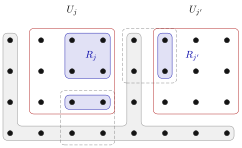
Here \(U_j\) is the open pitch interior, \(F_{j,z}\) is a closed cell fragment, and \(R_j\) is the corresponding primary birth region. These definitions also allow empty interiors and empty fragments. In the geometric construction, \(\ell =\ell _k\), \(p=p_k\), and \(a,b\) represent the selected residue classes modulo \(s/t\). In the picture below, with \(s=4t\) and \(r=2t\), the open pitch interiors \(U_j\) and \(U_{j'}\), for \(j'=j+(1,0)\), share one vertical interval and are separated by the vertical strip of width \(t\) between them, and each scale-\(r\) cell of the layer contributes one closed fragment to the primary region of each pitch interior it meets.
For every choice of the preceding data,
The exact cell union gives \(D_k=\bigcup _{z\in I_k}C_{k,z}\). Intersect this finite union with \(U_j\) and commute closure with the finite union. Empty intersections have empty closures, so retaining precisely the indices in \(J_j\) leaves the union unchanged.
For \(i\in \{ 1,2\} \), write \(\alpha _{i,z}=o_i+rz_i\) and \(\beta _{i,z}=o_i+r(z_i+1)\). If \(C_{k,z}\cap U_j\ne \varnothing \), then
Both coordinate intervals have strictly positive length. Every fragment, including an empty one, satisfies the following containment and diameter bounds. The distance bound holds for arbitrary points \(x,y\in F_{j,z}\).
A point of the nonempty intersection lies below both upper endpoints in each coordinate. It lies at or above the cell’s lower endpoint and strictly above the pitch interior’s lower endpoint. Hence the maximum lower endpoint is strictly below the minimum upper endpoint. The coordinate intersection contains the open interval between these endpoints and is contained in their closed interval. Taking closures therefore gives that closed interval. Closure commutes with products, proving the rectangle formula.
Containment in the closed cell follows from monotonicity of closure. Apply the closed-cell distance bound with identical cell indices and index radius zero. This gives the pointwise distance bound, and hence the diameter bound.
For every primary index \(j\), the following containment and diameter bounds hold. The distance bound holds for arbitrary points \(x,y\in R_j\).
For distinct indices \(i,j\), every \(x\in R_i\) and \(y\in R_j\) satisfy
Monotonicity of closure gives \(R_j\subseteq \overline{U_j}\). This closure is contained in the product of the closed intervals \([v_{j,q}+t,v_{j,q}+s]\), for \(q=1,2\). Two points in this product have coordinate differences at most \(s\), proving the distance and diameter bounds.
Distinct integer indices differ in at least one coordinate. Suppose \(i_q{\lt}j_q\). The upper endpoint for index \(i_q\) is at most \(o_q+t(a,b)_q+sj_q\), while the lower endpoint for index \(j_q\) is \(o_q+t(a,b)_q+sj_q+t\). Thus the two coordinate intervals are separated by at least \(t\). Taking the maximum coordinate distance proves the separation claim; the other ordering is symmetric.
Retain the primary birth regions of Definition 41.15.1 and the scales \(r_k,t_k,s_k\) of Definition 41.7.5, and suppose that \(C_0\ge 2\). For each layer \(k\), choose integer shifts \(a_k,b_k\), common to all primary indices in that layer, and write \(R_{k,i}\) for the resulting primary birth region indexed by \(i\in \mathbb Z^2\). Thus its fine scale is \(t_k\) and its pitch is \(s_k\). If \(k\equiv h\pmod2\) and \((k,i)\ne (h,j)\), then every \(x\in R_{k,i}\) and \(y\in R_{h,j}\) satisfy
This is an auxiliary primary separation estimate for the construction in [ 286 , Section 11 ] .
If \(k=h\), then \(i\ne j\) and the shifts agree, so Theorem 41.15.4 gives \(\| x-y\| _\infty \ge t_k\).
If \(k{\lt}h\), equality of parity gives \(k+2\le h\). The containments \(R_{k,i}\subseteq \overline{D_k}\) and \(R_{h,j}\subseteq \overline{D_h}\) and Theorem 41.5.3 give \(\| x-y\| _\infty \ge (C_0-1)r_h/2\ge r_k/2\). If \(h{\lt}k\), apply the same theorem with the layers and points exchanged to obtain \(\| x-y\| _\infty \ge (C_0-1)r_k/2\ge r_k/2\). Each case gives the stated minimum bound.
If \(k\le p\), then every primary index satisfies
This bound is independent of the endpoint set, neighborhood radius, origin, and selected shifts.
Put \(N=2^{p-k}\), so \(s=Nr\), and let \(q_i=\lfloor (v_{j,i}-o_i)/r\rfloor \). If a cell indexed by \(z\) meets \(U_j\), a point in that intersection lies above \(v_{j,i}\) and below \(v_{j,i}+s\). The half-open cell inequalities and the defining floor inequalities consequently give, for each coordinate \(i\in \{ 1,2\} \),
Thus \(J_j\) lies in an integer rectangle with \(N+1\) indices in each coordinate. Its cardinality is at most \((N+1)^2\), which is at most \((N+2)^2\).
The fixed fine exponents \(\ell _k=\lfloor \zeta k\rfloor \) are nondecreasing. For every nonnegative integer \(k\),
Since \(0\le \zeta \le 1\), multiplication by \(\zeta \) and taking floors preserve the order of the layer indices. Also \(\zeta (k+1)\le \zeta k+1\), and adding one commutes with taking the floor. Therefore \(\ell _k\le \ell _{k+1}\le \ell _k+1\). Exponentiating the two possible integer values gives the side-length assertion.
41.16 Birth templates and scanner scales of primaries
Retain the primary birth regions \(R_j\), their fragments \(F_{j,z}\) and index sets \(J_j\) from Definition 41.15.1, at a layer \(k\) with \(r=2^k\), the fine side \(t_k\) and the belt pitch \(s_k\) of Definition 41.7.5. A primary is present exactly when \(J_j\) is nonempty, in which case [ 286 , Section 11 ] assigns its scanner scale and birth template as follows.
For a constant \(C_P\), the scanner scale of a primary in layer \(k\) is
Let \(J_j\) be nonempty, and let \(n\) be a positive integer with \(C_{\rm tpl}|J_j|(r+1)\le n\) and \(2^p\le n\). The birth template of the primary is the template with parameters \(n\) and \(s_0=r\) whose pieces are the closed rectangles \(F_{j,z}\), \(z\in J_j\), and whose points are the lattice points of these rectangles.
The birth template \(T\) of a primary satisfies
It has \(N_0=|J_j|\) pieces, each of sup-norm diameter at most \(r\), and its sup-norm diameter is at most \(2^p\). At the belt pitch \(p=p_k\),
The endpoints of each nonempty fragment have the form \(o_i+m\) with integers \(m\), and the lower endpoint is strictly below the upper one. Their difference is therefore at least one, so each piece contains a lattice point and the template is nonempty. Since \(R_j\) is the union of its fragments \(F_{j,z}\), the lattice points of the pieces are exactly those of \(R_j\), and the piece and template diameters follow from the diameter bounds for \(F_{j,z}\) and \(R_j\).
Put \(m=p_k-k\). Since \(p_k\le (1+\delta _0)k\), we have \(2^m\le r^{\delta _0}\). As \(2^m\ge 1\),
For every \(C_{\rm tpl}\) the constant \(C_P=\max \{ 18C_{\rm tpl},1\} \) gives, for every primary of every layer at the belt pitch \(p_k\),
Hence the birth template is a template of Definition 39.8.36 with parameters \(n_k\) and \(s_0=r\).
If \(C_{\rm tpl}\le 0\), the first bound is trivial. Otherwise, since \(r\ge 1\),
Also \(s_k=2^{p_k}\le r^{1+\delta _0}\le r^{1+2\delta _0}\le n_k\) because \(C_P\ge 1\).
If \(4D_0{\lt}C_0\), then every primary birth template satisfies
The choice \(C_0{\gt}100(D_0+1)\) of [ 286 , Section 11 ] ensures \(4D_0{\lt}C_0\).
Every point of \(T\) lies in \(R_j\subseteq \overline{D_k}\). The layer distance estimate gives endpoint distance at least \(C_0r{\gt}4D_0r=4D_0s_0\).
Fix \(C_P\) and \(\varepsilon {\gt}0\). For all sufficiently large \(k\),
If \(C_P{\gt}0\), then for every \(n_*\) also \(n_k\ge n_*\) for all sufficiently large \(k\). The scale depends only on the layer, so these thresholds are uniform over primaries.
Put \(e=1+2\delta _0\) and \(C=\max \{ C_P,0\} +1\), so \(n_k\le Cr^e\). Whenever \(a{\lt}b\), the ratio \(Cr^a/r^b=Cr^{-(b-a)}\) tends to \(0\) as \(k\to \infty \). Because the exponent gaps give \(e(1-\ell ){\lt}1\) and \(e\beta {\lt}\zeta \), and the fine side satisfies \(r^\zeta /2\le t_k\le r\), this decay yields the three upper bounds on \(\lfloor n_k^{1-\ell }\rfloor \) and \(n_k^\beta \). When \(C_P{\gt}0\), the lower bound \(n_k\ge C_P\, r\) tends to infinity with \(k\).
41.17 The number of primary identifiers in a layer
Retain the origin, layer and pitch interiors from Definition 41.15.1. Write \(I_k\) for the layer-cell index set, \(r=2^k\), \(t=2^\ell \), \(s=2^p\), and \(o'=o+t(a,b)\). The count below is the primary count in [ 286 , Section 11 ] .
For every \(z\in I_k\), let \(L_z\) and \(H_z\) be the lower and upper corners of the closed cell of side \(r\). For each coordinate \(i\), define
Let \(B_z\) be the integer rectangle \([q_{z,1}^-,q_{z,1}^+]\times [q_{z,2}^-,q_{z,2}^+]\). The finite set of primary pitch indices is
For every choice of the nonnegative scale indices and every \(j\in \mathbb Z^2\),
Only the reverse implication needs proof. A point \(x\in D_k\cap U_j\) belongs to a cell \(C_{k,z}\) with \(z\in I_k\). Since \(L_{z,i}\le x_i\le H_{z,i}\), monotonicity of the floor gives \(q_{z,i}^-\le \lfloor (x_i-o'_i)/s\rfloor \le q_{z,i}^+\). From \(x\in U_j\) we have \(j_i{\lt}(x_i-o'_i)/s{\lt}j_i+1\), so \(\lfloor (x_i-o'_i)/s\rfloor =j_i\) and \(j\in B_z\).
If \(k\le p\), then
Since \(k\le p\), we have \(r\le s\). In each coordinate, \(H_{z,i}=L_{z,i}+r\le L_{z,i}+s\), so
Hence \(|B_z|\le 4\) for every \(z\in I_k\), and summing over \(z\in I_k\) gives \(|\mathcal P_k|\le 4|I_k|\).
Take \(Z\) to be the endpoint set of the crossing edges of a cut \(A\) in a finite domain \(\Lambda \). If \(k\le p\), then
Combine \(|\mathcal P_k|\le 4|I_k|\) with \(|I_k|\le 8(2C_0+1)^2|\partial _\Lambda A|\).
For every \(C_P{\gt}0\), there is \(M{\gt}0\) with the following property. Fix any origin \(o\in \mathbb R^2\), finite domain \(\Lambda \subset \mathbb Z^2\), cut \(A\subseteq \Lambda \), width \(C_0\in \mathbb N\), integer sequences \((a_k)\) and \((b_k)\), and finite set \(F\subset \mathbb N\). Let \(\mathcal P_k\) be the primary pitch indices with fine scale \(\ell _k\), pitch scale \(p_k\), boundary endpoint set of \(A\), and shifts \(a_k,b_k\). Set \(n_k=\lceil C_P(2^k)^{1+2\delta _0}\rceil \in \mathbb N\). Then
The coefficient \(M\) is chosen before all geometric data, the integer sequences, and \(F\).
The scale order gives \(k\le p_k\), so the primary count is at most \(32(2C_0+1)^2b\), where \(b=|\partial _\Lambda A|\). Since \(2^k\ge 1\) and \(1+2\delta _0\ge 1\), the ceiling satisfies \(n_k\ge C_P(2^k)^{1+2\delta _0}\ge C_P2^k{\gt}0\). The inequality \(100\ge \delta _0/2\) and \(k\ge 0\) give
Apply the uniform finite-sum estimate at exponent zero, obtaining \(B_0{\gt}0\) before \(F\). Multiplication by the nonnegative count bound and summation give the conclusion with \(M=32\bigl(C_P^{100}\bigr)^{-1}B_0{\gt}0\).
41.18 The marked points of belt cells
The belt construction marks each cell at its center, corners and side midpoints. We first count these points for a finite family of cells at one scale, as in [ 286 , Section 11 ] . Coincident points contribute only once to the union.
For a cell \(C_{\ell ,z}=o+t(z+[0,1)^2)\), where \(t=2^\ell \), the set of its four corners, four side midpoints and center is
For any finite cell-index set \(F\subset \mathbb Z^2\), define
Every point of \(M_{\ell ,z}\) belongs to \(\overline{C_{\ell ,z}}\).
Each coordinate of \(e/2\) lies in \([0,1]\), so both coordinates of each mark lie in the corresponding closed cell intervals.
For every origin \(o\), scale \(\ell \) and cell index \(z\), \(|M_{\ell ,z}|=9\).
Since \(2^\ell {\gt}0\), distinct elements of \(\{ 0,1,2\} ^2\) yield distinct points, and there are nine such elements.
For every finite cell-index set \(F\subset \mathbb Z^2\),
The cardinality of a finite union is at most the sum of the cardinalities of its members, each of which has nine points.
Let \(F_k(a,b)\) be the belt-cell indices in the refined layer for coordinate residues \(a,b\). Uniformly in the finite domain, cut, origin and scale, there is a pair of residues \((a,b)\) such that
For the sparse-belt pair of residues \((a,b)\), multiplying the belt-cell count by \(9\) gives the coefficient \(9\cdot 64=576\).
41.19 Separation on the translated quarter mesh
The numerical estimates used in the initial-star argument come from a common translated lattice. We record them before constructing the active boundaries; see [ 286 , Section 11 ] .
Let \(C_0\ge 2\) and \(k\ge 50{,}000{,}000\), and put \(t_k=2^{\ell _k}\). If \(x\in \overline{D_k}\), \(y\in \overline{D_h}\), and the layer indices differ by at least two, then
The threshold is uniform in the finite endpoint set and origin.
The scale-ratio estimate with exponent gap five gives \(32t_k\le 2^k\). The nonadjacent-layer bound gives \(\| x-y\| _\infty \ge (C_0-1)2^{\max (k,h)}/2\ge 2^k/2\ge 16t_k\).
Under the same conditions on \(C_0\) and \(k\), if \(x\in \overline{D_k}\), \(y\in \overline{D_h}\) and \(\| x-y\| _\infty {\lt}10t_k\), then
A difference of at least two would give distance at least \(16t_k\), contradicting the strict upper bound since \(t_k{\gt}0\).
For \(o\in \mathbb R^2\) and \(q\in \mathbb R\), define
Let \(j,\ell \) be nonnegative integers with \(\ell \le j+1\). For every finite cell-index set \(F\),
In particular, cells of sides \(t/2\), \(t\) and \(2t\), where \(t=2^\ell \) and \(\ell \ge 1\), have all their marks on the same mesh \(\mathcal M(o,t/4)\).
A mark of a cell of side \(2^j\) is \(o+2^j(z+e/2)\), where \(e\in \{ 0,1,2\} ^2\). Since \(\ell \le j+1\), the vector \(2^{j+1-\ell }(2z+e)\) is integral, and the mark equals \(o+(2^\ell /4)2^{j+1-\ell }(2z+e)\).
If \(q{\gt}0\) and \(x,y\in \mathcal M(o,q)\) are distinct, then
At least one coordinate of the integer vectors indexing \(x\) and \(y\) differs. Its difference has absolute value at least one, so the corresponding coordinate difference of \(x\) and \(y\) has absolute value at least \(q\).
Suppose \(q{\gt}0\) and \(u,v,x\in \mathcal M(o,q)\). Let \(L\) be the affine span of \(u,v\). Suppose either \(u=v\), or \(L\) has slope \(0\), \(\infty \), \(1\) or \(-1\). If \(x\notin L\), then
Thus on a quarter mesh the clearance is at least \(t/8\).
If \(u=v\), use the point-separation bound. Otherwise, the supporting line has a constant coordinate, coordinate sum or coordinate difference. Its value at a missing mesh point differs from the line’s value by a nonzero integer multiple of \(q\). A coordinate difference is bounded by the sup distance; a difference of sums or differences is bounded by twice that distance. The result follows.
Let \(q{\gt}0\) and \(a,b,p\in \mathcal M(o,q)\). Suppose that the segment \([a,b]\) is horizontal, vertical or diagonal, with coincident endpoints also permitted. If \(p\notin [a,b]\), then every \(x\in [a,b]\) satisfies \(\| p-x\| _\infty \ge q/2\). This estimate is used in the isolation arguments for the initial stars and recursive repair in [ 286 , Section 11 ] .
If \(a=b\), then \(x=a\ne p\), so mesh-point separation gives the stronger bound \(q\). Otherwise let \(L\) be the supporting line of \([a,b]\). If \(p\notin L\), apply the line-clearance estimate. If \(p\in L\setminus [a,b]\), one endpoint \(e\in \{ a,b\} \) lies between \(p\) and \(x\). Since \(p\ne e\), mesh-point separation and distance additivity give
In both cases the asserted half-spacing bound follows.
41.19.1 Clipping an incident segment
The local repair construction in [ 286 , Section 11 ] intersects the segments incident to a mark with a small closed square. After normalization, the following lemma determines their endpoints in any real normed space, and in particular for the planar maximum norm.
Let \(E\) be a real normed space and let \(a,b\in E\) satisfy \(\| b-a\| =1\). If \(0\le \eta \le 1\), then
Write a point of \([a,b]\) as \((1-t)a+tb\), where \(0\le t\le 1\). Its distance from \(a\) is \(t\| b-a\| =t\). It therefore belongs to the closed ball precisely when \(0\le t\le \eta \). These points form the segment on the right-hand side.
41.20 The finite family of initial marks
The sparse shifts may be chosen in every distance layer. Their cell counts have a summable geometric bound, so only finitely many layers contribute belt cells. We can therefore form the finite union of their marked points and assign to each point its smallest incident cell side; see [ 286 , Section 11 ] .
For every finite domain \(\Lambda \), cut \(A\), origin \(o\) and nonnegative integer \(C_0\), there are coordinate residues \(a_k,b_k\) at every scale. Write \(F_k\) for their belt-cell index set. These choices satisfy
and the set \(\{ k:F_k\ne \varnothing \} \) is finite.
Under a sparse pair of residues at each scale, the integer counts \(|F_k|\) are dominated by a fixed multiple of a summable geometric sequence. Their real-valued series is therefore summable, so its terms tend to zero and \(|F_k|{\lt}1\) eventually, forcing \(F_k\) to be empty outside finitely many indices.
There is a positive constant \(B\) such that, for every finite domain, cut, origin, nonnegative integer \(C_0\) and lower index \(k_0\), one can choose the residues from the preceding theorem and a finite set \(M\) of marks with
The chosen residues retain their per-layer cell estimate and finite support. The constant \(B\) precedes all the geometric data; the support cutoff may depend on those data.
Let \(B_0{\gt}0\) be the uniform finite-sum constant for the zero polynomial exponent, and set \(B=576B_0\). The union of the marks over the finite support restricted to \(k\ge k_0\) has the stated membership condition. Since a finite union has at most the sum of the individual cardinalities and each cell contributes at most nine marks, its count is at most
where \(H\) is the finite retained support.
Fix an origin \(o\) and a finite endpoint set \(Z\), and form all layers from these data with \(C_0\ge 2\). Let \(k,h\ge 50{,}000{,}000\). If \(x\) and \(y\) are distinct marks of fine-layer cells in layers \(k\) and \(h\), respectively, then
Cell-boundary marks are included, and the estimate applies to every fine-layer cell, hence to every selected belt cell.
Suppose that the distance is less than \(t_k/4\). Each mark is in the closure of its layer. Layer locality forces \(k\le h+1\). Monotonicity and the adjacent-scale estimate give \(\ell _k\le \ell _h+1\), so both marks lie on the translated mesh of spacing \(t_k/4\). Distinct mesh points cannot be closer than this spacing. Reversing \(k\) and \(h\) proves both lower bounds and hence their maximum.
Fix an origin \(o\), a lower index \(k_0\), and a finite set \(F_k\) of cell indices at each layer. Let
There is a positive side \(s(v)\) for every \(v\in M\), realized by a cell indexed by \(F_k\) in some layer \(k\ge k_0\) that marks \(v\). Every cell indexed by \(F_h\) in a layer \(h\ge k_0\) that marks \(v\) has side at least \(s(v)\). Neither \(M\) nor the set of nonempty layers is required to be finite.
For each \(v\in M\), the least layer index \(k(v)\ge k_0\) with an incident cell defines \(s(v)=2^{\ell _{k(v)}}{\gt}0\). Because the exponent \(\ell _k\) is nondecreasing in \(k\), \(s(v)\) is a smallest incident side realized at layer \(k(v)\).
There is \(B{\gt}0\) such that, for every finite domain, cut, origin, integer \(C_0\ge 2\) and lower index \(k_0\ge 50{,}000{,}000\), there are sparse residues with the per-layer estimates and finite support, the finite union \(M\) of their marks above \(k_0\), and a positive side \(s(v)\) for each \(v\in M\), satisfying
For each \(v\), some selected belt cell in a layer \(k\ge k_0\) has \(v\) as a mark and side \(s(v)=t_k\). Every selected belt cell in a layer \(h\ge k_0\) that has \(v\) as one of its marks has side at least \(s(v)\).
For the counted finite union and residues from the uniform initial-mark bound, taking the least layer index admitting an incident selected cell at each point of \(M\) gives a positive smallest incident side because the fine-cell exponent is nondecreasing. Applying fine-layer mark separation to the two cells realizing \(s(v)\) and \(s(w)\) then gives the pairwise distance bound (which is vacuous when \(M\) is empty).
41.21 The fan of a belt cell
The local fan is constructed before its triangles are colored. Each side may remain whole or be divided at its midpoint, according to the corners of the opposing cells. The following construction permits every such choice of subdivisions; see [ 286 , Section 11 ] .
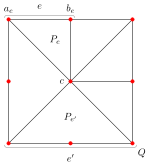
Let \(Q\) be a closed dyadic square of side \(t=2^\ell \) and center \(c\). On each of its four sides choose either the whole side or its two half sides. The resulting segments are called elementary segments. For each elementary segment \(e=[a_e,b_e]\), let
These are nondegenerate closed triangles. Their perimeter and radial edges have slopes \(0,\infty ,1,-1\). The picture below shows one admissible choice: the upper and right sides are halved, the lower and left sides are kept whole, and the fan has six triangles.
Let \(o\in \mathbb {R}^2\), \(\ell \in \mathbb {N}\) and \(z\in \mathbb {Z}^2\). Let \(Q=o+2^\ell (z+[0,1)^2)\) be the half-open dyadic cell, with center \(c=o+2^\ell (z+(1/2,1/2))\) and half-side \(r=2^\ell /2\). Then
The coordinate description of \(\overline Q\) gives \(x\in \overline Q\) if and only if \(|x_j-c_j|\le r\) for \(j=1,2\). These inequalities are equivalent to \(\| x-c\| _\infty \le r\).
The center and both endpoints of every elementary segment belong to the nine-point mark set \(M_{\ell ,z}\) of the same cell.
The center has relative coordinates \((1/2,1/2)\). Every segment endpoint is a corner or side midpoint, so both relative coordinates belong to \(\{ 0,1/2,1\} \).
Every such fan has between four and eight triangles.
Each of the four sides contributes either one or two elementary segments.
The closed fan triangles cover the closed dyadic square:
Every point of \(Q\) lies on the segment from \(c\) to some point of the perimeter. Every perimeter point belongs to an elementary segment, so it lies in the corresponding fan triangle. Conversely, every vertex lies in \(Q\), and convexity keeps each triangle in \(Q\).
For any two elementary segments \(e,e'\) of the same fan,
Thus a shared perimeter endpoint gives a shared radial segment, while disjoint elementary segments intersect only at \(c\).
A point different from \(c\) determines a unique perimeter point on the ray from \(c\). It belongs to both triangles if and only if that perimeter point lies in \(e\cap e'\). The center \(c\) belongs to every triangle.
41.21.1 The primary containing a non-belt fine cell
For nonnegative fine and pitch exponents \(\ell \le p\), integer shift representatives \(a,b\) and fine-cell index \(z\), put \(m=2^{p-\ell }\) and define
These are the coordinate indices of the shifted pitch square.
Fix an origin \(o\), finite endpoint set \(Z\), layer index \(k\) and nonnegative integer width \(C_0\). Suppose that \(\ell \le k\) and \(\ell \le p\). Choose residues \(0\le a,b{\lt}m=2^{p-\ell }\), and let \(z\) index a fine cell in layer \(k\) that is omitted by both selected belt residues. Its closed square satisfies
where \(I_{a,b}(j)\) is the corresponding open pitch interior.
Since neither residue is selected, each shifted coordinate remainder lies between \(1\) and \(m-1\). The open fine-cell interior therefore lies inside \(I_{a,b}(j(z))\) and belongs to \(D_k\). Its closure is \(\overline{Q_\ell (z)}\), so taking closures gives the inclusion even when a side of the fine cell meets the boundary of \(I_{a,b}(j(z))\).
Under the preceding hypotheses, there is a unique retained primary pitch index whose birth region contains \(\overline{Q_\ell (z)}\), namely \(j(z)\).
The open fine square is nonempty and lies in \(D_k\cap I_{a,b}(j(z))\), so the pitch index \(j(z)\) is retained. If two distinct primary birth regions contained \(\overline{Q_\ell (z)}\), an interior point would belong to both, contradicting their positive separation within the layer.
For any origin, natural exponent \(\ell \), integer cell index and optional midpoint subdivisions, let \(c\) be the cell center and \(e=[a_e,b_e]\) an elementary base. Every \(x\in e\) satisfies
This is the base-radius identity in the fan construction of [ 286 , Section 11 ] .
In the affine parametrization of a side, one relative coordinate is \(\pm 2^\ell /2\) and the other is \((2^\ell /2)u\) with \(|u|\le 1\). The whole side and either midpoint half satisfy this bound, so the maximum of the two absolute coordinates is \(2^\ell /2\).
41.22 Interiors of fan triangles
Fix an origin \(o\in \mathbb R^2\), a natural dyadic exponent \(\ell \) and an integer cell index \(z\in \mathbb Z^2\). Choose any midpoint subdivisions of the four sides. Write \(c\) for the cell center and \(P_e=\operatorname {conv}\{ c,a_e,b_e\} \) for each fan triangle; see [ 286 , Section 11 ] .
Every fan triangle satisfies
The defining determinant \(\det (a_e-c,b_e-c)\) is nonzero. Thus the two edge vectors are linearly independent and span the plane, and the three vertices affinely span \(\mathbb R^2\). Their convex hull consequently has nonempty interior.
The convex hull of these finitely many vertices is closed. A convex set with nonempty interior has the same closure as its interior, so \(\overline{\operatorname {int}(P_e)}=\overline{P_e}=P_e\).
41.23 Allowed lines and the eight open fan triangles
Fix an origin \(o\in \mathbb R^2\), a dyadic exponent \(\ell \in \mathbb N\), and a cell index \(z\in \mathbb Z^2\). Subdivide every side of the closed dyadic square at its midpoint to obtain eight triangles \(P_e\) with common center \(c\). These are the elementary sectors in the local fan construction of [ 286 , Section 11 ] . Put \(\pi _1(x)=x_1\), \(\pi _2(x)=x_2\), and \(\Phi =\{ \pi _1,\pi _2,\pi _1+\pi _2,\pi _1-\pi _2\} \). The level lines \(\phi (x)=\phi (c)\) for \(\phi \in \Phi \) are the four allowed lines through \(c\).
Each of the eight triangles \(P_e\) satisfies
Equivalently, for every \(x\in \operatorname {int}(P_e)\), the displacement \(x-c\) has none of the slopes \(0,\infty ,1,-1\).
Let \(\phi \in \Phi \). From the whole-side endpoint and midpoint-subdivision formulas, the two perimeter vertices \(a_e,b_e\) of \(P_e\) lie in a single closed half-plane through \(c\): either \(\phi (a_e),\phi (b_e)\ge \phi (c)\) or \(\phi (a_e),\phi (b_e)\le \phi (c)\).
In the first case, convexity places \(P_e\) in \(\phi ^{-1}([\phi (c),\infty ))\). Because \(\phi \) is a surjective continuous linear functional, it is an open map, so the interior of this half-plane is \(\phi ^{-1}((\phi (c),\infty ))\). Hence \(\phi (x){\gt}\phi (c)\) for every \(x\in \operatorname {int}(P_e)\). Replacing \(\phi \) by \(-\phi \) handles the second case.
41.24 Restriction of concentric dyadic fans
Endow \(\mathbb R^2\) with the maximum norm. Fix a center \(c\in \mathbb R^2\) and an exponent \(\ell \in \mathbb N\), and set \(r=2^\ell /2\). The smaller square has origin \(o_{\rm S}=c-r(1,1)\), exponent \(\ell \), and cell index \((0,0)\); the larger square has origin \(o_{\rm L}=c-2r(1,1)\), exponent \(\ell +1\), and cell index \((0,0)\). Subdivide the same sides at their midpoints in both squares, and denote corresponding fan triangles by \(P_e^{\rm S}\) and \(P_e^{\rm L}\). This restriction gives the margin in the local star construction of [ 286 , Section 11 ] .
For every pair of corresponding elementary perimeter segments \(e\),
The homothety \(H(y)=c+(y-c)/2\) fixes \(c\) and maps the two perimeter vertices of \(P_e^{\rm L}\) to those of \(P_e^{\rm S}\), so \(H(P_e^{\rm L})=P_e^{\rm S}\).
Any \(x\in P_e^{\rm L}\) has the form \(x=c+\lambda (y-c)\) with \(0\le \lambda \le 1\) and \(y\) on the base of \(P_e^{\rm L}\). Since \(\| y-c\| _\infty =2r\), we have \(\| x-c\| _\infty =2r\lambda \). Thus \(x\in \overline B_\infty (c,r)\) if and only if \(\lambda \le 1/2\), which is equivalent to \(x=c+2\lambda (H(y)-c)\in P_e^{\rm S}\).
41.25 Initial regions in eight sectors
Fix an origin \(o\in \mathbb R^2\), a finite endpoint set \(Z\subset \mathbb Z^2\), an integer width \(C\ge 2\), and an initial layer \(k_0\ge 50{,}000{,}000\). Choose valid pitch residues at every layer, and let \(\mathcal I\) be the resulting set of initial region identifiers. Write \(X_i^0\) for their closed initial regions and \(U_i=\operatorname {int}(X_i^0)\) for their open interiors. Let \(k\ge k_0\), let \(z\in F_{k,\ell _k}\) be a fine-cell index, and let \(v\) be any of the nine marks of its cell. Set
The bound \(k\ge k_0\) implies \(\ell _k\ge 5\). Endow \(\mathbb R^2\) with the maximum norm. Center two fans at \(v\), with origins \(o_{\rm S}=v-r(1,1)\) and \(o_{\rm L}=v-2r(1,1)\), exponents \(\ell \) and \(\ell +1\), and cell index \((0,0)\), subdividing every side at its midpoint. Let \(\mathcal J\) index the eight resulting elementary perimeter segments, and write \(P_s^{\rm S}\) and \(P_s^{\rm L}\) for the corresponding closed triangles, whose squares have half-sides \(r=t_k/64\) and \(2r=t_k/32\). This local construction appears in [ 286 , Section 11 ] .
Let \(c\in \mathbb R^2\) and \(m\in \mathbb N\), and set \(\rho =2^m/2\). Let \(Q=c-\rho (1,1)+2^m[0,1)^2\) be the \((0,0)\) half-open dyadic cell with origin \(c-\rho (1,1)\). In the maximum norm,
This is the centered square used in the local fan construction of [ 286 , Section 11 ] .
The closure of \(Q\) is the product of the closed coordinate intervals with lower endpoints \(c_1-\rho \) and \(c_2-\rho \) and length \(2^m=2\rho \). Their upper endpoints are \(c_1+\rho \) and \(c_2+\rho \), so their product is \(\overline B_\infty (c,\rho )\).
Let \(k\ge 50{,}000{,}000\), write \(\ell _k\) for its fine-cell exponent, and set
Then
This is the scale relation for the half-radius square in the initial-star geometry of [ 286 , Section 11 ] .
Since \(k\ge 50{,}000{,}000\), we have \(\ell _k\ge 5\) and \(2^{\ell _k}=32\cdot 2^{\ell _k-5}\). Dividing by \(128\) proves (205).
There is a unique map \(\sigma :\mathcal J\to \mathcal I\) such that every \(s\in \mathcal J\) satisfies
and every \(i\in \mathcal I\) satisfies
Since \(v\) belongs to the closed fine cell, it belongs to the closed layer \(\overline{D_k}\). The distance condition defining \(D_k\) shows that \(Z\) is nonempty, so the closed initial regions \(X_i^0\) cover \(\mathbb R^2\). From \(k\ge k_0\) we obtain \(\ell _k\ge 5\) and \(2r=t_k/32\).
Set \(S_s=\operatorname {int}(P_s^{\rm L})\) and \(W=B_\infty (v,2r)\). Because \(\bigcup _sP_s^{\rm L}=\overline B_\infty (v,2r)\), taking interiors gives \(S_s\subseteq W\). Each \(S_s\) is nonempty and connected.
No \(S_s\) meets the boundary \(\partial X_i^0\) of any initial region: a point \(x\in S_s\cap \partial X_i^0\) would satisfy \(\| x-v\| _\infty {\lt}t_k/32\), forcing \(x-v\) to lie along one of the four allowed directions through \(v\), whereas the open triangle \(S_s\) is disjoint from those four lines. Since the sets \(X_i^0=\overline{U_i}\) cover \(S_s\) and \(\partial X_i^0\cap S_s=\varnothing \), connectedness of \(S_s\) and pairwise disjointness of the open sets \(U_i\) imply that \(S_s\subseteq U_{\sigma (s)}\) for a unique \(\sigma (s)\in \mathcal I\).
Put \(D=\bigcup _sS_s\), so \(\overline D=\bigcup _sP_s^{\rm L}=\overline B_\infty (v,2r)\). For \(i\in \mathcal I\), the finite union \(E_i=\bigcup _{\sigma (s)=i}P_s^{\rm L}\) is closed and satisfies \(U_i\cap D\subseteq E_i\). Since \(U_i\) and \(W\) are open and \(W\subseteq \overline D\),
Conversely, taking closures of \(S_s\subseteq U_i\) gives \(E_i\subseteq X_i^0\). Since \(\overline B_\infty (v,r)\subseteq W\), intersecting with \(\overline B_\infty (v,r)\) and applying \(P_s^{\rm L}\cap \overline B_\infty (v,r)=P_s^{\rm S}\) yields the stated decomposition.
The initial sector assignment is the unique map \(\sigma :\mathcal J\to \mathcal I\) from Theorem 41.25.3.
41.26 Colors of adjacent initial sectors
Fix an arbitrary origin \(o\in \mathbb R^2\), a finite endpoint set \(Z\subset \mathbb Z^2\), an integer width \(C\ge 2\) and an initial layer \(k_0\ge 50{,}000{,}000\). Choose arbitrary valid pitch residues at every layer. Let \(\mathcal I\) be the resulting initial identifiers, let \(X_i^0\) be their closed birth regions, and write \(\chi (i)\in \{ 0,1\} \) for their initial colors. Let \(k\ge k_0\), let \(z\in F_{k,\ell _k}\) be a fine-cell index, and let \(v\) be one of the nine marks of its defining cell. Put \(\ell =\ell _k-5\) and \(r=2^\ell /2=t_k/64\).
Divide every side of the square \(\overline B_\infty (v,r)=v+[-r,r]^2\) at its midpoint, and join its center to the eight elementary bases. Let \(\mathcal J\) be the set of these eight bases, and denote their closed triangles by \(P_s^{\rm S}\). Write \(b_s^-\) and \(b_s^+\) for the initial and final endpoints of base \(s\) in the perimeter orientation. Let \(\sigma :\mathcal J\to \mathcal I\) be the unique assignment of Theorem 41.25.3, obtained from the working fan of half-side \(2r=t_k/32\).
This assertion concerns adjacent members of the eight fixed sectors in [ 286 , Section 11 ] .
Let \(s,t\in \mathcal J\) satisfy \(b_s^+=b_t^-\) or \(b_t^+=b_s^-\). Then
The closed restriction of the assignment gives \(P_s^{\rm S}\subseteq X_{\sigma (s)}^0\) for each \(s\): the triangle is one of the terms in the union describing \(X_{\sigma (s)}^0\cap \overline B_\infty (v,r)\).
Suppose first that \(b_s^+=b_t^-\), and put \(e=b_s^+\). The base-radius identity gives \(\| e-v\| _\infty =r{\gt}0\), so \(e\ne v\). Each triangle is the convex hull of its center and two base endpoints. Consequently,
When \(b_t^+=b_s^-\), interchange \(s\) and \(t\) to obtain the same nondegenerate shared radial segment. If \(\sigma (s)\ne \sigma (t)\), the theorem on shared boundary segments of initial regions gives \(\chi (\sigma (s))\ne \chi (\sigma (t))\). Conversely, equality of the identifiers gives equality of their colors.
41.27 Initial identifiers on sector runs
Fix an origin \(o\in \mathbb R^2\), a finite endpoint set \(Z\subset \mathbb Z^2\), an integer width \(C\ge 2\) and an initial layer \(k_0\ge 50{,}000{,}000\). Choose valid pitch residues at every layer. Let \(\mathcal I\) be the set of initial region identifiers, let \(X_i^0\) be their closed birth regions, put \(U_i=\operatorname {int}(X_i^0)\), and write \(\chi (i)\in \{ 0,1\} \) for their initial colors. Let \(k\ge k_0\), let \(z\in F_{k,\ell _k}\) be a fine-cell index, and let \(v\) be any of the nine marks of its defining cell. Put \(\ell =\ell _k-5\) and \(r=2^\ell /2=t_k/64\).
Consider the all-midpoint fans centered at \(v\), with origins \(o_{\rm S}=v-r(1,1)\) and \(o_{\rm L}=v-2r(1,1)\), exponents \(\ell \) and \(\ell +1\), and cell index \((0,0)\). Let \(\mathcal J\) index their eight corresponding elementary bases, and write \(P_s^{\rm S}\) and \(P_s^{\rm L}\) for the closed triangles. Let \(\sigma :\mathcal J\to \mathcal I\) be the unique assignment of Theorem 41.25.3. For the smaller fan, write \(b_s^-\) and \(b_s^+\) for the initial and final endpoints of the oriented base \(s\). Two bases are adjacent when \(b_s^+=b_t^-\) or \(b_t^+=b_s^-\).
Assign to base \(s\) the color \(\chi (\sigma (s))\). Form the fan graph \(G\) by joining distinct adjacent bases whenever their colors agree. Let \(\mathcal R\) be the set of connected components of \(G\), and write \([s]\) for the component of \(s\). For \(R\in \mathcal R\), define its closed run region by \(Y_R=\bigcup _{s\in R}P_s^{\rm S}\). These local runs appear in [ 286 , Section 11 ] .
There is a unique function \(\lambda :\mathcal R\to \mathcal I\) satisfying \(\lambda ([s])=\sigma (s)\) for every \(s\in \mathcal J\) and, for every \(i\in \mathcal I\),
Distinct components carrying the same identifier remain distinct terms of the union.
Each edge of \(G\) joins adjacent sectors of the same color. Because adjacent sectors with distinct identifiers have opposite colors, their assigned identifiers agree. Consequently \(\sigma \) is constant on each connected component of \(G\) and descends to a unique map \(\lambda :\mathcal R\to \mathcal I\) with \(\lambda ([s])=\sigma (s)\).
By definition of \(\sigma \), \(X_i^0\cap \overline B_\infty (v,r)=\bigcup _{\sigma (s)=i}P_s^{\rm S}\). Grouping the sectors \(s\) with \(\sigma (s)=i\) by their connected components \(R\in \mathcal R\) yields the decomposition into the run regions \(Y_R\).
Suppose that \(\sigma (s)=\sigma (t)\) for every adjacent pair \(s,t\in \mathcal J\). Then there is a unique identifier \(i\in \mathcal I\) such that \(\overline B_\infty (v,r)\subseteq U_i\).
Since adjacent bases have equal identifiers and therefore equal colors, the cyclic adjacency graph on \(\mathcal J\) is a connected subgraph of \(G\). Hence \(G\) has a single connected component, and \(\sigma \) is constant with some value \(i_0\in \mathcal I\).
For each triangle of the larger fan, \(\operatorname {int}(P_s^{\rm L})\subseteq U_{i_0}\). Taking closures and using the regularity of the fan triangles and birth regions gives \(P_s^{\rm L}\subseteq X_{i_0}^0\). The fan cover and centered-cell identities then yield
Taking interiors gives \(B_\infty (v,2r)\subseteq U_{i_0}\). Since \(r{\gt}0\), we have \(\overline B_\infty (v,r)\subseteq B_\infty (v,2r)\subseteq U_{i_0}\). Because \(v\in \overline B_\infty (v,r)\) and the open regions \(U_i\) are pairwise disjoint, \(i_0\) is unique.
41.28 Active radial boundaries near an initial mark
Fix an arbitrary origin \(o\in \mathbb R^2\), a finite endpoint set \(Z\subset \mathbb Z^2\), an integer width \(C\ge 2\), and an initial layer \(k_0\ge 50{,}000{,}000\). Choose arbitrary valid pitch residues at every layer. Let \(\mathcal I\) be the set of initial region indices, let \(X_i^0\) be their closed birth regions, and put \(U_i=\operatorname {int}(X_i^0)\). Let \(k\ge k_0\), let \(z\in F_{k,\ell _k}\) be a fine-cell index, and let \(v\) be one of the nine marks of its defining cell. Put \(\ell =\ell _k-5\) and \(r=2^\ell /2=t_k/64\).
Join \(v\) to the eight elementary bases of the all-midpoint fan in \(\overline B_\infty (v,r)\). Let \(\mathcal J\) index those bases, write \(P_s\) for the corresponding closed triangle, and write \(b_s^-\) and \(b_s^+\) for its initial and final base endpoints in the perimeter orientation. Let \(\sigma :\mathcal J\to \mathcal I\) be the unique sector assignment of Theorem 41.25.3. Thus, for every \(i\in \mathcal I\),
In the local radial-boundary construction of [ 286 , Section 11 ] , an oriented neighboring pair \((s,t)\) is active when \(b_s^+=b_t^-\) and \(\sigma (s)\ne \sigma (t)\); let \(\mathcal A\) be the set of such pairs.
For every \(x\in B_\infty (v,r)\),
In the picture below each triangle carries its index \(\sigma (s)\); the solid radial segments are the active ones, and they are exactly the boundary points of the birth regions inside the open square.
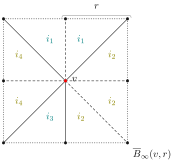
With \(K=\sigma (\mathcal J)\) and \(E_i=\bigcup _{\sigma (s)=i}P_s\) for each \(i\in K\), the sets \(E_i\) form a finite closed family covering \(\overline B_\infty (v,r)\). By (217), \(X_i^0\) and \(E_i\) agree on a neighborhood of every point of \(B_\infty (v,r)\), so their interior membership agrees there, while an index outside \(K\) has no birth-region point in this neighborhood.
Suppose that \(x\in \partial X_i^0\) and \(x\ne v\). The finite-cover frontier bound gives a distinct index \(j\in K\) with \(x\in E_i\cap E_j\), since its outer-boundary alternative is excluded by \(x\in B_\infty (v,r)\). Hence there are \(s,t\in \mathcal J\) with \(\sigma (s)=i\), \(\sigma (t)=j\) and \(x\in P_s\cap P_t\). Both triangles also contain \(v\), so their intersection is nontrivial, and the fan-triangle contact classification gives, after interchanging \(s\) and \(t\) if necessary, \(b_s^+=b_t^-\) and \(P_s\cap P_t=[v,b_s^+]\). Since \(i\ne j\), this pair is active.
If \(x=v\) and no pair is active, every adjacent pair has the same assigned index, which places the smaller closed square in a single open region \(U_j\). A point of \(U_j\) lies on no birth-region boundary: it is interior to \(X_j^0\), and disjointness of the open regions, together with \(X_i^0=\overline{U_i}\), excludes membership in \(X_i^0\) for \(i\ne j\). Thus a boundary point at \(v\) forces an active pair, whose radial segment contains \(v\).
Conversely, let \((s,t)\in \mathcal A\) and \(x\in [v,b_s^+]\). The exact fan-intersection formula includes this segment in \(P_s\cap P_t\): the common base endpoint belongs to both bases, and its radial join with \(v\) belongs to both triangles. By (217), \(x\in X_{\sigma (s)}^0\cap X_{\sigma (t)}^0\). Since the two indices are distinct, \(U_{\sigma (s)}\) is disjoint from \(X_{\sigma (t)}^0=\overline{U_{\sigma (t)}}\). Hence \(x\notin U_{\sigma (s)}\) and \(x\in \partial X_{\sigma (s)}^0\), as required.
For every \(x\in \overline B_\infty (v,r/2)\),
The closed half-side is \(r/2=t_k/128\). If the reference cell realizes the smallest incident side \(S_v=t_k\), it is \(S_v/128\).
The fan radius is positive. Consequently, \(\overline B_\infty (v,r/2)\subseteq B_\infty (v,r)\), and the open-square equivalence applies to every point of this closed square.
Retain the origin, endpoint set, width, initial layer, arbitrary valid pitch residues, fine cell, and mark fixed above. Let \(\tau \) be the perimeter successor, and put
Then
Each ray includes \(v\). If \(\mathcal A_*\) is empty, the right-hand union is empty and no birth-region boundary meets this closed square. Indices may occur in several separated sectors; the change set records successive sectors without identifying such occurrences.
Endpoint adjacency is exactly the successor relation, so the active pairs are \((s,\tau (s))\) with \(s\in \mathcal A_*\). The active radial description on the smaller closed square therefore identifies the boundary points with the segments \([v,b_s^+]\) at these changes. Since \(\overline B_\infty (v,r/2)\subseteq \overline B_\infty (v,r)\), restricting each radial segment to the square replaces \([v,b_s^+]\) by \(R_s\) throughout the smaller closed square. This includes the center, and proves 221.
41.29 Opposing corners divide a side only at its midpoint
The subdivisions induced by opposing cells follow from the common dyadic origin and neighboring-layer locality; see [ 286 , Section 11 ] .
For origin \(o\), natural exponent \(\ell \), integer cell index \(z\), and \(\varepsilon \in \{ 0,1\} ^2\), the corresponding corner is \(o+2^\ell (z+\varepsilon )\).
Fix a common origin \(o\), finite endpoint set \(Z\), and integer width \(C_0\ge 2\). Let \(z\) and \(w\) index fine cells of layers \(k\) and \(h\), respectively, with \(k\ge 50\, 000\, 000\). Write \([a,b]\) for any side of the cell indexed by \(z\). If a corner \(x\) of the cell indexed by \(w\) belongs to \([a,b]\), then \(x=a\), \(x=(a+b)/2\), or \(x=b\).
Because \(x\) belongs to both closed layers, \(|h-k|\le 1\), and thus the fine exponents satisfy \(\ell _k\le \ell _h+1\). Put \(t=2^{\ell _k}\). The corner \(x\) lies in \(o+(t/2)\mathbb Z^2\), so its coordinate along \([a,b]\), measured from \(a\) in units of \(t/2\), is an integer in \(\{ 0,1,2\} \), giving \(a\), \((a+b)/2\), or \(b\).
41.30 Ordered endpoints of a whole cell side
The four sides of a dyadic square are traversed counterclockwise, starting with the right side. The resulting endpoint identities hold at every natural scale and every integer cell index; see [ 286 , Section 11 ] .
Fix an origin \(o\in \mathbb R^2\), natural exponent \(\ell \) and integer cell index \(z\in \mathbb Z^2\). Put \(t=2^\ell \) and \(q=o+tz\). If \((a_s,b_s)\) is the ordered pair of endpoints of the unsplit side \(s\in \{ 0,1,2,3\} \), then
In particular, for every \(s\) there exist \(\varepsilon _s,\eta _s\in \{ 0,1\} ^2\) such that
Thus both endpoints are corners of the same dyadic cell.
Substituting the four side indices into the affine parametrization of the fan boundary produces the displayed coordinate pairs, with the corner pairs \((\varepsilon _s,\eta _s)\) given in the same order by \(((1,0),(1,1))\), \(((1,1),(0,1))\), \(((0,1),(0,0))\) and \(((0,0),(1,0))\).
41.31 Subdivisions determined by opposing corners
Opposing fine-cell corners determine which sides are subdivided in the cell fans of [ 286 , Section 11 ] . Fix the origin \(o\), the finite endpoint set, the dyadic layers, and an initial layer index \(k_0\). Every fine cell in a layer \(k\ge k_0\) participates in this subdivision rule.
Fix an origin \(o\in \mathbb R^2\), a natural exponent \(\ell \), and a cell index \(z\in \mathbb Z^2\). Choose an optional midpoint subdivision of each side of the cell. Write \(A_s,B_s\) for the counterclockwise endpoints of side \(s\), and set \(L_s(u)=(1-u)A_s+uB_s\). Let \(\varepsilon _s\in \{ 0,1\} \) record whether side \(s\) is subdivided, and index its elementary segments by \(h=0\) when \(\varepsilon _s=0\) and by \(h\in \{ 0,1\} \) when \(\varepsilon _s=1\). The initial and final endpoints of segment \((s,h)\) are
Parametrize side \(s\) by a signed coordinate \(u\in [-1,1]\), with affine parameter \((u+1)/2\in [0,1]\). An undivided side has initial and final signed coordinates \(-1\) and \(1\), giving affine parameters \(0\) and \(1\). Half \(h\in \{ 0,1\} \) of a subdivided side has signed coordinates \(h-1\) and \(h\), giving affine parameters \(h/2\) and \((h+1)/2\).
Fix a dyadic cell and an optional midpoint subdivision of each side. Let \([a,b]\) be a side ordered counterclockwise and \([u,v]\) one of its elementary segments. Either the side is undivided and \((u,v)=(a,b)\), or the side is subdivided and \((u,v)\) is \((a,(a+b)/2)\) or \(((a+b)/2,b)\). In all cases \([u,v]\subseteq [a,b]\).
In the affine parametrization of \([a,b]\) by \([0,1]\), the endpoints \((u,v)\) have parameters \((0,1)\) for an undivided side, \((0,1/2)\) for the first half, and \((1/2,1)\) for the second half. Each interval is contained in \([0,1]\).
For the fine cell indexed by \(z\) in layer \(k\), write \([a_s,b_s]\) for side \(s\). Set \(\varepsilon _s=1\) if the midpoint \((a_s+b_s)/2\) is a corner of some fine cell in a layer \(h\ge k_0\), and \(\varepsilon _s=0\) otherwise. The elementary segments of side \(s\) are \([a_s,b_s]\) when \(\varepsilon _s=0\), and its two halves \([a_s,(a_s+b_s)/2]\) and \([(a_s+b_s)/2,b_s]\) when \(\varepsilon _s=1\).
Side \(s\) of the fine cell indexed by \(z\) in layer \(k\) is subdivided if and only if there exist a layer \(h\ge k_0\), an index \(w\in F_{h,\ell _h}\), and a corner index \(\varepsilon \in \{ 0,1\} ^2\) such that corner \(\varepsilon \) of the fine cell \(w\) equals \((a_s+b_s)/2\).
This is the defining condition for \(\varepsilon _s=1\).
Suppose that \(C_0\ge 2\), \(k\ge 50\, 000\, 000\), and \(z\in F_{k,\ell _k}\) indexes a fine cell of layer \(k\). Let \(w\in F_{h,\ell _h}\) index a fine cell of a layer \(h\ge k_0\). If a corner of the cell indexed by \(w\) lies on an elementary segment of the cell indexed by \(z\) under the midpoint subdivision, then that corner is an endpoint of the elementary segment.
Every elementary segment lies on its full side \([a_s,b_s]\), so any corner of cell \(w\) on \([a_s,b_s]\) is \(a_s\), \((a_s+b_s)/2\), or \(b_s\). If side \(s\) is undivided, the midpoint \((a_s+b_s)/2\) cannot be a corner of cell \(w\) by definition of the subdivision rule. If side \(s\) is subdivided, each half-side excludes the opposite endpoint of \([a_s,b_s]\) and has the remaining two points as its endpoints.
The paper takes the initial layer index \(k_0\) sufficiently large without fixing a numerical value [ 286 , Section 11 ] ; the threshold \(k\ge 50\, 000\, 000\) is an explicit choice.
41.32 Contacts between fine cells
Fix an origin \(o\), finite endpoint set \(Z\) and nonnegative integer width \(C_0\). Retain the fine exponents \(\ell _k\) and index sets \(F_{k,\ell _k}\), and write \(Q_{k,z}=C_{\ell _k,z}\) for a fine cell. The common dyadic origin restricts positive-length contacts to whole sides and midpoint halves; see [ 286 , Section 11 ] .
For every exponent \(\ell \ge 0\) and cell index \(z\), number the coordinate sides of \(\overline{C_{\ell ,z}}\) counterclockwise, starting with the right side. If \(a_{\ell ,z,s}\) and \(b_{\ell ,z,s}\) are the corresponding unsplit fan endpoints, put \(S_{\ell ,z,s}=[a_{\ell ,z,s},b_{\ell ,z,s}]\). Side indices are read modulo four. Writing \(a=a_{\ell ,z,s}\) and \(b=b_{\ell ,z,s}\), its midpoint halves are \(H_{\ell ,z,s,0}=[a,(a+b)/2]\) and \(H_{\ell ,z,s,1}=[(a+b)/2,b]\).
For arbitrary \(C_0\ge 0\) and layer indices \(k,h\), suppose that \(z\in F_{k,\ell _k}\), \(w\in F_{h,\ell _h}\) and \((k,z)\ne (h,w)\). Then \(Q_{k,z}\cap Q_{h,w}=\varnothing \).
If \(k=h\), the unique cell-index criterion implies that any common point would give \(z=w\). If \(k\ne h\), the two fine cells belong to the disjoint half-open layers \(D_k\) and \(D_h\), since \(\ell _k\le k\) and \(\ell _h\le h\).
Suppose that \(C_0\ge 2\), \(k\ge 50\, 000\, 000\), \(z\in F_{k,\ell _k}\), \(w\in F_{h,\ell _h}\) and \((k,z)\ne (h,w)\). If \(I=\overline{Q_{k,z}}\cap \overline{Q_{h,w}}\) contains two distinct points, there are opposite side indices \(s,t\), with \(t=s+2\) modulo four, for which one of the following alternatives holds:
\(\ell _k=\ell _h\) and \(I=S_{\ell _k,z,s}=S_{\ell _h,w,t}\).
\(\ell _h=\ell _k+1\) and \(I=S_{\ell _k,z,s}=H_{\ell _h,w,t,n}\) for some \(n\in \{ 0,1\} \).
\(\ell _k=\ell _h+1\) and \(I=S_{\ell _h,w,t}=H_{\ell _k,z,s,n}\) for some \(n\in \{ 0,1\} \).
The opposing index \(h\) is unrestricted.
A common point belongs to both closed layers. The nearby-layer estimate gives \(h\le k+1\) and \(k\le h+1\), so the fine exponents differ by at most one. Order the cells by their fine exponents. In units of the smaller side, translate the larger cell’s lower corner to the origin. The two half-open cells are then \(\lbrack a,a+1)\times \lbrack b,b+1)\) and \(\lbrack 0,m)^2\), where \(a,b\) are integers and \(m\in \{ 1,2\} \).
Closed contact gives \(-1\le a,b\le m\). Disjointness excludes \(0\le a,b{\lt}m\), and two distinct common points exclude the case where both coordinates lie in \(\{ -1,m\} \). Thus one coordinate equals \(-1\) or \(m\), while the other is an integer in \(\lbrack 0,m)\). The common set is therefore a whole smaller side on the opposite coordinate side of the larger square. For \(m=1\) it is the whole larger side; for \(m=2\) it is one of its midpoint halves. Swapping the two cells gives the third alternative.
41.33 Dummy-neighborhood corners on fine-cell sides
Fix an origin \(o\in \mathbb R^2\), a finite endpoint set \(Z\), an integer width \(C_0\), and a lower layer index \(k_0\). Let \(P_{k_0}\) be the set of indices of the coarse cells forming \(N_{k_0}\). The results below apply to each coarse cell individually; see [ 286 , Section 11 ] .
Suppose \(C_0\ge 2\), \(k\ge k_0\), \(z\in F_{k,\ell _k}\), and \(w\in P_{k_0}\). For \(\varepsilon \in \{ 0,1\} ^2\), set \(x=o+2^{k_0}(w+\varepsilon )\). If \(x\) lies on the side \(S_{\ell _k,z,s}\), then \(x=a_{\ell _k,z,s}\) or \(x=b_{\ell _k,z,s}\).
The corner \(x\) belongs to \(\overline{N_{k_0}}\), while the side \(S_{\ell _k,z,s}=[a,b]\) lies in \(\overline{Q_{k,z}}\subseteq \overline{D_k}\), so \(k=k_0\). Set \(q=2^{\ell _{k_0}}\). Since \(\ell _{k_0}\le k_0\), the point \(x\) and both side endpoints \(a,b\) lie in the mesh \(o+q\mathbb Z^2\). If \(x\ne a\) and \(x\ne b\), mesh separation and \(x\in [a,b]\) give
contradicting \(q{\gt}0\).
Suppose \(C_0\ge 2\), \(k\ge k_0\), \(z\in F_{k,\ell _k}\), and \(w\in P_{k_0}\). Choose any midpoint subdivision of the sides of \(\overline{Q_{k,z}}\) and let \([u,v]\) be one of its elementary segments. For \(\varepsilon \in \{ 0,1\} ^2\), if the corner \(x=o+2^{k_0}(w+\varepsilon )\) belongs to \([u,v]\), then \(x=u\) or \(x=v\).
Since \([u,v]\) lies on a full side \([a,b]\) of \(\overline{Q_{k,z}}\), the preceding theorem gives \(x=a\) or \(x=b\). Whether the side is unsplit (\([u,v]=[a,b]\)) or split at \((a+b)/2\), the only endpoints of \([a,b]\) contained in \([u,v]\) are endpoints of \([u,v]\), so \(x=u\) or \(x=v\).
41.34 Matching elementary sides under midpoint subdivision
When two fine cells share a side segment, their midpoint subdivisions agree on that segment. The theorem below establishes this matching for every elementary segment under the subdivision determined by all cell corners at or above a fixed layer index \(k_0\); see [ 286 , Section 11 ] .
Fix a common origin \(o\in \mathbb R^2\), finite endpoint set \(Z\), integer width \(C_0\ge 2\) and natural indices \(k_0,k,h\) with \(k\ge 50\, 000\, 000\) and \(k_0\le k,h\). Let \(z\in F_{k,\ell _k}\) and \(w\in F_{h,\ell _h}\) be fine-cell indices with \((k,z)\ne (h,w)\), and write \(Q_{k,z}=Q_{\ell _k}(z)\) and \(Q_{h,w}=Q_{\ell _h}(w)\). Let \([a_i,b_i]\) be any elementary segment of \(Q_{k,z}\) under its midpoint subdivision relative to \(k_0\). Suppose that \([a_i,b_i]\cap \overline{Q_{h,w}}\) contains two distinct points. Then there is an elementary segment \([a_j,b_j]\) of \(Q_{h,w}\) under its midpoint subdivision relative to \(k_0\) such that
where \(s(i)\) and \(s(j)\) are their counterclockwise side indices.
The intersection \(\overline{Q_{k,z}}\cap \overline{Q_{h,w}}\) is either a full side of each cell or a full side of the smaller cell equal to one half of a side of the larger cell. Because the contact contains two distinct points and two distinct sides of a square meet in at most one point, it determines the facing side of \(Q_{k,z}\).
When the two sides have equal length, they share the same midpoint and therefore the same incident corners at layers \(\ge k_0\). If neither is subdivided, the whole sides match; if both are subdivided, the first half of one side matches the second half of the opposite side, and conversely.
When the cells have unequal sizes, a corner of the smaller cell lies at the midpoint of the larger side. Since the smaller cell belongs to a layer \(\ge k_0\), this corner forces the larger side to be subdivided. The smaller side is undivided: a corner at its midpoint would lie strictly inside the corresponding half of the larger side, contradicting the elementary-endpoint bound applied to the larger cell (whose layer index is at least \(\min (k,h)\) and whose scale is at least \(t_k\), so the late-layer bound holds).
Hence the whole smaller side matches the corresponding half of the larger side. When \(Q_{k,z}\) is the larger cell, contact in two distinct points selects that half, since the two halves meet only at their midpoint. Counterclockwise orientation along opposite facing sides reverses the endpoints, giving \(a_i=b_j\) and \(b_i=a_j\).
Theorem 41.35.1 gives an opposing closed region for every elementary segment, and Theorem 41.36.2 proves that its fine-cell or exterior identifier is unique. Consistent region labels and the isolated-star construction are established separately in the two-family argument.
41.35 An opposing closed region for every elementary side
The plane cover gives an opposing rectangle at the midpoint of each elementary segment. Corner exclusion extends this contact to containment of the whole segment; see [ 286 , Section 11 ] .
Fix a common origin \(o\in \mathbb R^2\), finite endpoint set \(Z\), integer width \(C_0\ge 2\) and natural indices \(k_0\le k\) with \(k\ge 50\, 000\, 000\). Let \(z\in F_{k,\ell _k}\) be a fine-cell index, and let \(e=[a_i,b_i]\) be any elementary segment of \(Q_{k,z}=Q_{\ell _k}(z)\) under its midpoint subdivision relative to \(k_0\). Then either
or there exist \(h\ge k_0\) and \(w\in F_{h,\ell _h}\) such that
The reference fine cell is nonempty, so its layer membership implies \(Z\ne \varnothing \). Put \(x=(a_i+b_i)/2\) and take the points in the ball of radius \(10\, 2^{\ell _k}\) about \(x\) that lie outside the closed reference cell. Their closure contains \(x\), since \(x\) belongs to a side of that square.
Every such point lies either in \(N_{k_0}\) or in a fine cell of a layer \(h\ge k_0\). Neighboring-layer locality restricts these latter indices to \(k-1\le h\le k+1\). There are finitely many fine cells at these indices, and the reference cell is excluded by the choice of points. Taking the closure of this finite cover places \(x\) either in the closed dummy neighborhood or in one distinct closed fine cell. In the dummy case, the finite union defining the neighborhood places \(x\) in one contributing closed coarse cell.
In either case the interiors of the selected rectangle and the reference square are disjoint. Since the midpoint of \(e\) belongs to the selected rectangle, its normal coordinate is a boundary coordinate of that rectangle. If the rectangle failed to contain either end of \(e\), a rectangle corner would lie strictly inside \(e\). The corresponding dummy-corner or fine-corner endpoint theorem excludes this. Thus the selected closed rectangle contains the whole segment. A contributing dummy rectangle belongs to \(\overline{N_{k_0}}\), yielding the first alternative; a distinct fine cell yields the second.
41.36 Uniqueness of the opposing region
The preceding existence assertion can be sharpened to uniqueness of the opposing fine cell or dummy neighborhood. This identifies the region containing an elementary side, before assigning primary or fan-run labels; see [ 286 , Section 11 ] .
Fix an origin \(o\in \mathbb R^2\), a natural exponent \(\ell \), a signed cell index \(z\in \mathbb Z^2\), and any optional midpoint subdivision of the sides of \(Q_\ell (z)\). Put \(t=2^\ell \), \(p=o+tz\) and \(q=p+(t,t)\). For the ordered endpoints \(a,b\) of every elementary segment, one has \(a\ne b\) and either
or
No layer-membership or late-scale assumption is required.
Each whole side has length \(t{\gt}0\) and a constant coordinate equal to a boundary coordinate of the square. An elementary segment is either this whole side or one of its two midpoint halves. Its endpoints retain that constant coordinate and differ in the other coordinate by \(t\) or \(t/2\).
Fix a common origin \(o\in \mathbb R^2\), finite endpoint set \(Z\), integer width \(C_0\ge 2\) and natural indices \(k_0\le k\) with \(k\ge 50\, 000\, 000\). Let \(z\in F_{k,\ell _k}\) index a fine cell. For any elementary segment \(e=[a_i,b_i]\) of this cell under its midpoint subdivision relative to \(k_0\), consider the identifiers
Associate to them the closed regions
There is exactly one \(P\in \mathcal I\) such that \(e\subseteq R_P\). The dummy neighborhood is a single region even when several coarse cells contribute to it. No further lower bound on the opposing layer index is imposed beyond \(h\ge k_0\).
Existence follows from the preceding opposing-region theorem. To prove uniqueness, put \(x=(a_i+b_i)/2\). The segment is nondegenerate and lies on one side of the reference square, so \(x\) is interior to that side in its tangential coordinate.
Suppose first that two distinct fine cells contain the whole segment in their closures. Their interiors and the interior of the reference cell are pairwise disjoint. Neither opposing square can have a corner at \(x\), since an opposing corner on an elementary segment must be an endpoint. Consequently the tangential coordinate of \(x\) lies strictly between the two tangential bounds of each opposing square.
Write \(x=(\xi ,\eta )\) in tangential and normal coordinates, and write the closures of the reference square and the two opposing squares as \([u_j,v_j]\times [u'_j,v'_j]\) for \(j=0,1,2\). Then
Since the tangential open intervals overlap, pairwise disjoint interiors force the normal open intervals \((u'_j,v'_j)\) to be pairwise disjoint. Each of them has positive length and contains \((\eta -\epsilon ,\eta )\) or \((\eta ,\eta +\epsilon )\) for some \(\epsilon {\gt}0\). Two of the three therefore meet, a contradiction. Interchanging the coordinates handles a horizontal elementary segment.
If both the dummy neighborhood and a distinct fine cell contain the segment, the finite union defining the dummy neighborhood gives a contributing closed coarse cell containing \(x\). Its interior is disjoint from both fine-cell interiors because their layer indices are at least \(k_0\). A dummy corner on the elementary segment is again an endpoint, so \(x\) is not such a corner. The same three-rectangle argument gives a contradiction. Thus the opposing identifier is unique.
41.37 Contact and reciprocal selection of opposing regions
The unique opposing region determines a selection for each elementary side, characterized by contact with a fine cell. When the initial layer index is sufficiently large, the corresponding elementary segments select each other; see [ 286 , Section 11 ] .
Fix a common origin \(o\in \mathbb R^2\), finite endpoint set \(Z\), integer width \(C_0\ge 2\), and integers \(k\ge k_0\ge 0\) with \(k\ge 50\, 000\, 000\). For a fine-cell index \(z\in F_{k,\ell _k}\) and a slot \(i\) of its midpoint subdivision, write \(e_i=[a_i,b_i]\). Denote by \(P_{k,z}(i)\) the unique opposing region index whose closed region contains \(e_i\): the dummy symbol \(\star \) represents \(\overline{N_{k_0}}\), while an indexed cell \((h,w)\) represents \(\overline{Q_{\ell _h}(w)}\) with \(h\ge k_0\), \(w\in F_{h,\ell _h}\), and \((h,w)\ne (k,z)\). The dummy neighborhood carries a single index.
In the same notation, let \(w\in F_{h,\ell _h}\) be a candidate fine-cell index at a layer \(h\ge k_0\). Then
If the candidate is selected, its indexed cell differs from the reference and its closure contains the whole segment. The two elementary endpoints are distinct, so both belong to the contact.
Conversely, distinct indexed cells with two-point contact have matching elementary segments with reversed endpoints. The candidate segment lies in the closed candidate square: its endpoints belong to that square and the square is convex. Thus the whole reference segment lies in the same closed square. Uniqueness of the opposing region index makes the candidate the selected opponent.
Fix a common origin and finite endpoint set, integer width \(C_0\ge 2\), and integers \(k,h\ge k_0\ge 50\, 000\, 000\). Let \(z\in F_{k,\ell _k}\) and \(w\in F_{h,\ell _h}\) be fine-cell indices. For every elementary slot \(i\) of the reference cell, \(P_{k,z}(i)=(h,w)\) holds if and only if \((k,z)\ne (h,w)\) and there exists an elementary slot \(j\) of the candidate cell such that
Here \(s(i)\) and \(s(j)\) are the counterclockwise side indices, and both subdivisions use the same lower index \(k_0\).
The lower bound on \(k_0\) gives the required lower bounds on both \(k\) and \(h\). If the candidate is selected, the contact characterization gives distinctness and two-point contact. Elementary side matching provides the slot \(j\), opposite side index, and reversed endpoints. These distinct endpoints belong to the closed reference square, which is convex. Applying the contact characterization with the cells exchanged shows that \(j\) selects the reference cell in return.
Conversely, the reversed endpoints make the two elementary segments equal. The candidate segment is nondegenerate and lies in its closed square, so the reference segment has two-point contact with that square. Distinctness and the contact characterization give \(P_{k,z}(i)=(h,w)\).
These results establish reciprocal selection of fine-cell opponents; assigning primary indices and colors, constructing the isolated stars, and completing the two-family partition are treated separately.
41.38 Opposite labels on belt-cell sides
For each belt-cell fan, the opposing region on each elementary perimeter segment determines a binary label, as in [ 286 , Section 11 ] . This assignment holds for arbitrary pitch residues at each layer and uses no sparsity estimate.
Fix an origin \(o\in \mathbb R^2\), a finite endpoint set \(Z\), an integer width \(C_0\ge 2\), and a lower layer index \(k_0\ge 50\, 000\, 000\). For every layer \(h\), choose residues \(0\le a_h,b_h{\lt}m_h\), where \(m_h=2^{p_h-\ell _h}\), \(\ell _h\) is the fine exponent, and \(p_h\) is the pitch exponent. Let \(\mathcal B_h\) be the resulting belt-cell index set. For \(k\ge k_0\) and \(z\in \mathcal B_k\), denote the elementary perimeter segments of the fan by \(e_i=[a_i,b_i]\) and their opposing region identifiers by \(P_{k,z}(i)\). Order the triples \((k,z_1,z_2)\) lexicographically, and define \(c_{k,z}(i)\in \mathbb Z/2\mathbb Z\) by
When \(P_{k,z}(i)=(h,w)\) is a fine cell, \((k,z)\ne (h,w)\), so the last two cases are exhaustive.
With the notation of the preceding definition, if an elementary segment \(e_i\) lies in \(\overline{N_{k_0}}\), then \(c_{k,z}(i)=(k_0-1)+1\ne k_0-1\) in \(\mathbb Z/2\mathbb Z\), so the incident triangle receives the label opposite that of the dummy tile.
Since \(e_i\subseteq \overline{N_{k_0}}\), uniqueness of the opposing region gives \(P_{k,z}(i)=\star \), and hence \(c_{k,z}(i)=(k_0-1)+1\ne k_0-1\) in \(\mathbb Z/2\mathbb Z\).
With the notation of the label definition, let \(h\ge k_0\) and let \(w\in F_{h,\ell _h}\setminus \mathcal B_h\) be a non-belt fine-cell index. If \(e_i\cap \overline{Q_{\ell _h}(w)}\) contains two distinct points, let \(J=j(w)\) be the shifted pitch index at residues \(a_h,b_h\). Then \(J\) belongs to the primary index set \(\mathcal P_h\), the segment \(e_i\) is contained in the primary region \(\overline{D_h\cap I_{a_h,b_h}(J)}\), and \(c_{k,z}(i)=h+1\ne h\) in \(\mathbb Z/2\mathbb Z\).
Since \(z\in \mathcal B_k\) and \(w\notin \mathcal B_h\), we have \((k,z)\ne (h,w)\). Two-point contact gives \(P_{k,z}(i)=(h,w)\) and \(e_i\subseteq \overline{Q_{\ell _h}(w)}\subseteq \overline{D_h\cap I_{a_h,b_h}(J)}\). Because \(e_i\) is nonempty, \(D_h\cap I_{a_h,b_h}(J)\) is nonempty, so \(J\in \mathcal P_h\). The second clause of the label definition gives \(c_{k,z}(i)=h+1\ne h\) in \(\mathbb Z/2\mathbb Z\).
Let \((k,z)\ne (h,w)\) be belt-cell pairs with \(k,h\ge k_0\), and let \(e_i\) and \(e_j\) be elementary segments of their respective fans. If \(e_i\cap e_j\) contains two distinct points, then \(c_{k,z}(i)\ne c_{h,w}(j)\).
Each elementary segment lies in its incident fan triangle and therefore in its own closed fine cell. Consequently \(e_i\cap e_j\) gives two-point contact of \(e_i\) with \(\overline{Q_{\ell _h}(w)}\) and of \(e_j\) with \(\overline{Q_{\ell _k}(z)}\), so \(P_{k,z}(i)=(h,w)\) and \(P_{h,w}(j)=(k,z)\). Since \((k,z_1,z_2)\ne (h,w_1,w_2)\), one triple strictly precedes the other lexicographically, and the two segments receive opposite labels in \(\{ 0,1\} \).
41.39 Merging equal-colored triangles in a cell
Fix a fan in one dyadic square \(Q\) and assign each triangle one of the two colors \(0,1\). The merging below applies to every such assignment; see [ 286 , Section 11 ] .
Write \([a_e,b_e]\) for the elementary perimeter segment of triangle \(P_e\), oriented counterclockwise, and let \(\lambda (e)\in \{ 0,1\} \) be its color. Two distinct triangles are adjacent when \(b_e=a_{e'}\) or \(b_{e'}=a_e\). Retain an adjacency precisely when the two colors agree. A run is a connected component of this retained graph. Its region is
Distinct components define distinct runs even when their colors agree.
For every dyadic cell, every choice of midpoint subdivisions of its four sides, and every assignment of the two colors to its fan triangles, the number of runs is at most eight.
The map sending a triangle to its connected run is surjective. There are therefore no more runs than triangles. Each of the four sides contributes one or two triangles, so there are at most eight.
Any two triangles in the same run have the same color.
Along every retained edge the colors agree. Following a finite path in a component gives the assertion.
The run regions cover exactly the closed square:
Every elementary segment belongs to one component. Thus the union of all run regions is the union of all fan triangles, which is \(Q\).
Suppose that two adjacent fan triangles belong to distinct runs. Their colors are different, and hence are opposite members of \(\{ 0,1\} \).
If their colors agreed, their adjacency would be retained and they would lie in the same component.
If every triangle has the same color, all triangles belong to a single run whose region is the whole closed square \(Q\).
The one or two elementary segments on each side are connected in their perimeter order. The last segment of each side is adjacent to the first segment of the next side, including the fourth-to-first transition. Under constant coloring all these adjacencies are retained, so the graph is connected. Its single component contains every triangle, whose union is \(Q\).
41.40 Geometric contacts within one cell fan
The merging of triangles in [ 286 , Section 11 ] uses their geometric contacts. The following local assertions hold for every origin, dyadic exponent, signed cell index and optional side-midpoint subdivision. They require no assignment of labels outside the cell.
Fix a fan with center \(c\) in a translated dyadic square. Write \(e_i=[a_i,b_i]\) for its elementary perimeter segments, oriented counterclockwise, and \(P_i=\operatorname {conv}\{ c,a_i,b_i\} \) for its triangles. If \(i\ne j\) and \(P_i\cap P_j\) contains two distinct points, then one of the following alternatives holds:
Thus geometric contact determines consecutive perimeter segments and identifies the complete common radial edge.
If the two perimeter segments were disjoint, the fan intersection identity would give \(P_i\cap P_j=\{ c\} \). Their intersection is therefore nonempty. Two distinct elementary segments on the same side are its first and second halves, whose intersection is the midpoint. Elementary segments on distinct sides can meet only at a common corner of consecutive sides; any segment containing that corner has it as the corresponding endpoint. In either case their intersection is the singleton of a last-to-first endpoint. Substituting into the fan intersection identity gives the asserted radial segment.
Give the triangles of this fan arbitrary labels in \(\{ 0,1\} \). Let \(R\ne T\) be two distinct runs, with regions \(T_R,T_T\). If \(T_R\cap T_T\) contains two distinct points, then every triangle in \(R\) has a different label from every triangle in \(T\).
Choose a common point \(x\ne c\). It belongs to triangles \(P_i,P_j\) in the two runs. Their indices are distinct, and both triangles also contain \(c\), so their intersection contains two distinct points. The preceding theorem gives endpoint adjacency. Distinct runs then force the two labels to differ, and label constancy on each run gives the claim for every pair of constituent triangles.
41.41 Cyclic order of the eight midpoint fan triangles
Let \(Q\) be a translated dyadic square with origin in \(\mathbb R^2\), exponent \(\ell \in \mathbb N\), and cell index in \(\mathbb Z^2\). Put \(t=2^\ell \), and write \(c\) for its center. Orient its four sides counterclockwise, with indices \(s\in \{ 0,1,2,3\} \) and ordered endpoints \(A_s,B_s\). In the perimeter order of the fan construction of [ 286 , Section 11 ] , when every side is divided at its midpoint, the elementary bases are indexed by \(\mathcal J=\{ 0,1,2,3\} \times \{ 0,1\} \), where the second index records the first or second half of the side, with ordered endpoints \(a_i,b_i\) of base \(i\) and triangles \(P_i=\operatorname {conv}\{ c,a_i,b_i\} \).
Number the eight bases by \(e(s,h)=2s+h\) modulo \(8\). Let \(\tau \) be the permutation obtained by increasing this number by one. Equivalently,
where the side index is reduced modulo \(4\).
For every \(i\in \mathcal J\), the final endpoint of base \(i\) is the initial endpoint of its successor:
The ordered whole-side coordinates give \(B_s=A_{s+1}\), with the side index reduced modulo \(4\). The indexed affine parameters give
The first pair meets the second pair at the midpoint of side \(s\). The second pair meets the first pair on side \(s+1\) at \(B_s=A_{s+1}\). These are exactly the two cases in the successor definition, including the transition from side \(3\) to side \(0\).
More generally, for any optional midpoint subdivision of the four sides of \(Q\) with elementary bases indexed by \(\mathcal E\), the map \(i\mapsto b_i\) from \(\mathcal E\) to the square perimeter is injective.
Suppose that \(i\ne j\) and \(b_i=b_j=p\). The center and \(p\) belong to both closed triangles. The base-radius identity gives \(\| p-c\| _\infty =t/2{\gt}0\), so these are two distinct intersection points. The contact classification therefore gives either \(b_i=a_j\) or \(b_j=a_i\). In the first case \(a_j=b_j\); in the second case \(a_i=b_i\). Both contradict the nondegeneracy of the corresponding elementary segment. Thus \(i=j\).
For \(i,j\in \mathcal J\) in the all-midpoint fan,
Evaluating the successor endpoint identity at \(\tau ^{-1}(j)\) gives \(a_j=b_{\tau ^{-1}(j)}\). If \(b_i=a_j\), injectivity of final endpoints gives \(i=\tau ^{-1}(j)\), and hence \(j=\tau (i)\). The reverse implication is the successor endpoint identity.
41.42 Directed rays of an elementary fan
Let \(o\in \mathbb {R}^2\), \(\ell \in \mathbb {N}\) and \(z\in \mathbb {Z}^2\) be arbitrary, and let \(Q=o+2^\ell (z+[0,1]^2)\) be the corresponding closed dyadic square. Write \(c\) for its center. On each side choose either the whole side or its two midpoint halves, and let \(\mathcal E\) index the resulting ordered elementary bases \([a_i,b_i]\). By Theorem 41.21.1.4, every final endpoint satisfies \(\| b_i-c\| _\infty =2^\ell /2{\gt}0\).
For nonzero vectors \(u,w\in \mathbb {R}^2\), write \(u\sim w\) if \(w=\lambda u\) for some \(\lambda {\gt}0\). Let \(\mathcal R=(\mathbb {R}^2\setminus \{ 0\} )/{\sim }\) be the set of directed rays, and write \([u]\) for the class of \(u\). Thus opposite nonzero vectors represent distinct directed rays. These are the directions from a cell center in the fan construction of [ 286 , Section 11 ] .
For every \(i,j\in \mathcal E\),
The vectors \(b_i-c\) and \(b_j-c\) have the same positive norm \(r=2^\ell /2\). If \(b_j-c=\lambda (b_i-c)\) with \(\lambda {\gt}0\), homogeneity of the norm gives \(r=\lambda r\), hence \(\lambda =1\) and \(b_i=b_j\). Injectivity of the final endpoints then gives \(i=j\). The converse is immediate.
Assign to each elementary base its final directed ray from the center:
Since \(\| b_i-c\| _\infty =2^\ell /2{\gt}0\), the vector \(b_i-c\) is nonzero.
The map \(\rho :\mathcal E\to \mathcal R\) is injective.
Equality \(\rho (i)=\rho (j)\) means \(b_i-c\sim b_j-c\), which is equivalent to \(i=j\).
Let \(o\in \mathbb {R}^2\), \(\ell \in \mathbb {N}\) and \(z\in \mathbb {Z}^2\). Let \(c\) be the center of the closed dyadic square \(Q=o+2^\ell (z+[0,1]^2)\), and choose independently on each side either the whole side or its two midpoint halves. For an elementary base \([a_s,b_s]\), put \(r=2^\ell /2\) and \(R_s=\{ c+\lambda (b_s-c):\lambda \ge 0\} \). Then
This is the local restriction of a radial direction used in the initial-star construction of [ 286 , Section 11 ] .
Every point of \([c,b_s]\) belongs to \(R_s\). Conversely, let \(x\in R_s\) satisfy \(\| x-c\| _\infty \le r\). Since \(x\) and \(b_s\) lie on the same ray from \(c\), either \(x\in [c,b_s]\) or \(b_s\in [c,x]\). In the second case, additivity of the norm along the segment gives
Thus \(\| x-b_s\| _\infty =0\) and \(x=b_s\in [c,b_s]\).
41.43 Parity of changes of initial sector identifiers
Fix an arbitrary origin \(o\in \mathbb R^2\), a finite endpoint set \(Z\subset \mathbb Z^2\), an integer width \(C\ge 2\), and an initial layer \(k_0\ge 50{,}000{,}000\). Choose arbitrary valid pitch residues at each layer. Let \(\mathcal I\) be the resulting set of initial region indices, write \(X_i^0\) for their closed birth regions, and write \(\chi (i)\in \{ 0,1\} \) for their initial colors. Let \(k\ge k_0\), let \(z\in F_{k,\ell _k}\) be a fine-cell index, and let \(v\) be one of the nine marks of its defining cell. Put \(\ell =\ell _k-5\) and \(r=2^\ell /2=t_k/64\).
In the all-midpoint fan of the square \(\overline B_\infty (v,r)=v+[-r,r]^2\) with eight-element index set \(\mathcal J\), let \(\tau \) be the counterclockwise successor permutation of Definition 41.41.1, and let \(\sigma :\mathcal J\to \mathcal I\) be the unique sector assignment of Theorem 41.25.3 obtained from the working fan of half-side \(2r=t_k/32\).
The number of sector-index changes around these eight fan members is even:
For \(c_s=\chi (\sigma (s))\), the successor endpoint identity makes \(s\) and \(\tau (s)\) adjacent, so opposite coloring of distinct adjacent sectors gives
Let \(A=\{ s\in \mathcal J:c_s=0\} \) and \(B=\tau ^{-1}(A)\). The binary values of \(c_s\) show that the change set is \((A\setminus B)\cup (B\setminus A)\), a disjoint union. Since \(\tau \) is a permutation, \(|A|=|B|\), and therefore \(|A\setminus B|=|B\setminus A|\). With \(d=|A\setminus B|\), the cardinality of the change set is \(d+d\), which is even.
41.44 Cardinality of the distinct active directed rays
Fix an arbitrary origin \(o\in \mathbb R^2\), a finite endpoint set \(Z\subset \mathbb Z^2\), a natural width \(C\ge 2\), and an initial layer \(k_0\ge 50{,}000{,}000\). Choose arbitrary valid pitch residues at every layer. Let \(\mathcal I\) be the resulting initial identifiers, and write \(X_i^0\) for their closed birth regions. Let \(k\ge k_0\), let \(z\in F_{k,\ell _k}\) be a fine-cell index, and let \(v\) be one of the nine marks of its defining cell. Put \(\ell =\ell _k-5\) and \(r=2^\ell /2=t_k/64\).
In the all-midpoint fan of \(v+[-r,r]^2\), with eight-element index set \(\mathcal J\) and counterclockwise successor \(\tau \), let \(\sigma :\mathcal J\to \mathcal I\) be the unique assignment of Theorem 41.25.3. Write \(P_s\) for the final endpoint of elementary base \(s\). The endpoint vector \(P_s-v\) is nonzero, and \([P_s-v]\) denotes its directed ray in the notation of Definition 41.42.2. Define
The set of distinct directed rays at changes of the initial identifier has even cardinality at most eight:
Injectivity of the fan’s directed rays gives \(|\mathcal D|=|A|\), which is even by the parity theorem and at most eight because \(A\subseteq \mathcal J\) and \(|\mathcal J|=8\).
For every \(x\in B_\infty (v,r)\), one has
The radial-boundary characterization gives two neighboring fan members \(s,t\) whose common endpoint is \(P_s\), whose assigned identifiers differ, and whose shared radial segment contains \(x\). Endpoint adjacency is equivalent to \(t=\tau (s)\). Thus these two members give \(s\in A\) and \(x\in [v,P_s]\). Conversely, \(s\in A\) and \(x\in [v,P_s]\) give the neighboring pair \(s,\tau (s)\) in the radial-boundary characterization.
41.45 Radial incidence and convexity in an elementary fan
Let \(o\in \mathbb {R}^2\), \(\ell \in \mathbb {N}\), and \(z\in \mathbb {Z}^2\), and let \(Q=o+2^\ell (z+[0,1]^2)\) be the corresponding closed dyadic square with center \(c\). On each side of \(Q\), take either the full side or its two midpoint halves, oriented counterclockwise along \(\partial Q\). Let \(\mathcal E\) index the resulting directed perimeter segments \([a_i,b_i]\), and set
These are the triangles and radial segments of the elementary fan in [ 286 , Section 11 ] . Every endpoint satisfies \(\| b_i-c\| _\infty =2^\ell /2{\gt}0\), and the directed rays in direction \(b_i-c\) for \(i\in \mathcal E\) are pairwise distinct.
For \(i,t\in \mathcal E\) and \(x\in R_t\) with \(x\ne c\),
By convexity, \(R_t=[c,b_t]\subseteq P_t\). If \(t=i\), then \(x\in P_i\); if \(b_t=a_i\), then \(R_t=[c,a_i]\subseteq P_i\).
Conversely, suppose \(x\in P_i\) and \(t\ne i\). Then \(P_t\cap P_i\) contains the distinct points \(c\) and \(x\), so the classification of contacts between distinct fan triangles gives either \(b_t=a_i\) or
In the second case, \(x\in R_t\cap R_i\setminus \{ c\} \), so there exist \(u,v{\gt}0\) with
Thus \(b_t-c\) and \(b_i-c\) define the same directed ray, forcing \(t=i\), a contradiction. This proves (275).
For every \(i\in \mathcal E\), the triple \((c,a_i,b_i)\) is an affine basis of \(\mathbb {R}^2\).
Since \(P_i\) has nonempty interior, its affine span is \(\mathbb {R}^2\), so its three vertices \((c,a_i,b_i)\) are affinely independent and span \(\mathbb {R}^2\).
For every \(i,t\in \mathcal E\), the set \(P_i\setminus R_t\) is convex.
Since \(c\in R_t\), (275) implies
Let \(\lambda _0,\lambda _1,\lambda _2\) be the barycentric coordinates on \(\mathbb {R}^2\) with respect to the affine basis \((c,a_i,b_i)\). On \(P_i\) these coordinates are nonnegative and sum to \(1\), so
Each set in (285) is the intersection of \(P_i\) with an open half-plane and is therefore convex; by (282), \(P_i\setminus R_t\) is convex.
For every \(i\in \mathcal E\) and every subset \(A\subseteq \mathcal E\), the set \(P_i\setminus \bigcup _{t\in A}R_t\) is convex.
Write
Since \(P_i\) and each \(P_i\setminus R_t\) are convex, their intersection is convex.
41.46 Connected pieces of the midpoint fan
A vector \((u_1,u_2)\in \mathbb {R}^2\) has an allowed direction if \(u_1=0\), \(u_2=0\), \(u_1=u_2\), or \(u_1=-u_2\). We apply this condition to the radial segments of the elementary fans in [ 286 , Section 11 ] .
Let \(p,q\in \mathbb {R}^2\) and suppose that \(q-p\) has an allowed direction. If \(v,x\in \operatorname {aff}\{ p,q\} \), then \(x-v\) has an allowed direction.
Write \(v=(1-r)p+rq\) and \(x=(1-s)p+sq\) with \(r,s\in \mathbb {R}\). Then \(x-v=(s-r)(q-p)\), and each of the four linear equations defining an allowed direction is preserved under scalar multiplication.
In an elementary fan, with each side of the cell either undivided or subdivided at its midpoint, the vectors \(b_i-a_i\) and \(c-b_i\) have allowed directions for every fan triangle \(P_i=\operatorname {conv}\{ c,a_i,b_i\} \).
Each fan triangle with vertices \(c,a_i,b_i\) is an allowed polygonal piece, so its edge vectors \(b_i-a_i\) and \(c-b_i\) have slopes in \(\{ 0,\infty ,1,-1\} \).
Now subdivide every side of the dyadic square at its midpoint, giving eight triangles \(P_i\) and eight radial segments \(R_i=[c,b_i]\).
Let \(A\) be any subset of the eight radial indices and let \(r{\gt}0\). For each triangle index \(i\), the set
is nonempty and connected.
Since \(P_i=\overline{\operatorname {int}(P_i)}\) and \(c\in P_i\), the ball \(B_\infty (c,r)\) contains a point \(x\in \operatorname {int}(P_i)\). The displacement \(x-c\) has none of the four allowed directions, whereas \(y-c\) has an allowed direction for every point \(y\) on any radial \(R_t\). Thus \(x\notin R_t\) for all \(t\), so the intersection is nonempty.
The triangle with the selected radials deleted is convex, as is the ball \(B_\infty (c,r)\). Their intersection is therefore a nonempty convex set, hence connected.
The connected pieces of Theorem 41.46.3 are formed from fan triangles whose base and radial directions are given by Theorem 41.46.2 and whose radial contacts are described in Theorem 41.40.1.
Let \(o\in \mathbb {R}^2\), \(\ell \in \mathbb {N}\) and \(z\in \mathbb {Z}^2\), and let \(Q=o+2^\ell (z+[0,1]^2)\) be the corresponding closed dyadic square with center \(c\) and half-side \(r=2^\ell /2{\gt}0\). Subdivide each side at its midpoint and write \(P_i=\operatorname {conv}\{ c,a_i,b_i\} \) for the eight fan triangles, indexed in perimeter order by \(\mathcal J\). Let \(\tau \) be the cyclic successor on \(\mathcal J\) and assign colors \(f_i\in \{ 0,1\} \). Define
where \(B_\infty (c,r)\) is the open maximum-norm ball. The sets \(S_i\) are the retained fan pieces; the change set \(A\) may be empty. This is the local radial deletion used in the initial-star construction of [ 286 , Section 11 ] .
Let \(S_i\) be the retained pieces of Definition 41.46.4. If \(i,j\in \mathcal J\) satisfy \(j=\tau (i)\) or \(i=\tau (j)\) and \(f_i=f_j\), then \(S_i\cap S_j\) is nonempty.
41.47 Connected fan pieces in a smaller closed square
The following local properties concern the eight-triangle fan used in the initial-star construction of [ 286 , Section 11 ] . Here the origin, dyadic exponent \(\ell \ge 0\), cell index, and binary coloring are arbitrary, and distinct runs carrying the same color remain distinct.
Let \(o\in \mathbb {R}^2\), \(\ell \in \mathbb {N}\), \(z\in \mathbb {Z}^2\) and the colors \(f_i\in \{ 0,1\} \) be arbitrary. Use the center \(c\), half-side \(r=2^\ell /2{\gt}0\), triangles \(P_i\), change set \(A\), deleted radials \(L\) and retained pieces \(S_i\) of Definition 41.46.4. Define
The closed maximum-norm ball is the closed square of radius \(r/2\), and the second equality follows from \(\overline B_\infty (c,r/2)\subset B_\infty (c,r)\). When \(A=\varnothing \), the center belongs to every \(K_i\).
If \(i,j\) are consecutive perimeter positions with \(f_i=f_j\), then \(K_i\cap K_j\) is nonempty.
Suppose first that \(j=\tau (i)\), so \(b_i=a_j\), and set \(m=(c+b_i)/2\). The base-radius identity gives \(\| m-c\| _\infty =r/2{\gt}0\), so \(m\ne c\) and \(m\in \overline B_\infty (c,r/2)\subset B_\infty (c,r)\). The noncentral radial-incidence characterization places \(m\) in both \(P_i\) and \(P_j\).
If \(m\in [c,b_t]\), then \(b_t-c\) and \(b_i-c\) have the same directed ray. The distinctness of the endpoint directions gives \(t=i\). But \(f_i=f_j=f_{\tau (i)}\), so \(i\notin A\). Thus \(m\notin L\) and \(m\in K_i\cap K_j\). For \(i=\tau (j)\), interchange the indices and use symmetry of intersection.
Every \(K_i\) is nonempty and connected.
Evaluating Theorem 41.46.3 at radius \(r/2\) produces a point of \((P_i\setminus L)\cap B_\infty (c,r/2)\), which belongs to \(K_i\). Because the deleted triangle is convex by Theorem 41.45.4 and both centered balls are convex, their intersection with the deleted triangle is a nonempty convex set and hence connected.
Retain an adjacency between consecutive triangles precisely when their colors agree. For any connected component \(R\) of this graph, put \(T_R=\bigcup _{i\in R}P_i\). Then \((T_R\setminus L)\cap \overline B_\infty (c,r/2)\) is nonempty and connected.
Each \(K_i\) is nonempty and connected by Theorem 41.47.3, and Theorem 41.47.2 gives a nonempty intersection along every retained edge. The component \(R\) is nonempty, and any two of its vertices are joined by a finite path within \(R\). Successive unions along these paths show that \(\bigcup _{i\in R}K_i\) is nonempty and connected. Distributing deletion and intersection over the union gives
so the set on the left of (292) is nonempty and connected.
With the notation of Definition 41.47.1, put
Write \(\mathcal C(\Omega _{1/2})\) for the connected components in the relative topology, and \(C_{\Omega _{1/2}}(x)\) for the component containing \(x\in \Omega _{1/2}\). There is a unique bijection \(\Phi :\mathcal C(\Omega _{1/2})\longrightarrow \mathcal R\) such that, for every \(x\in \Omega _{1/2}\) and \(R\in \mathcal R\),
Distinct runs carrying the same color correspond to distinct connected components; this provides the local component decomposition for the initial-star construction in [ 286 , Section 11 ] .
For each run \(R\), set \(V_R=T_R\cap \Omega _{1/2}\). Theorem 41.47.4 shows that \(V_R\) is nonempty and connected. These sets are pairwise disjoint by Theorem 41.49.1. The smaller closed square lies in \(\overline B_\infty (c,r)\), which is the closed cell by Theorem 41.21.2. The run cover therefore gives \(\Omega _{1/2}=\bigcup _{R\in \mathcal R}V_R\).
Each triangle is a finite convex hull, hence compact and closed, as in Theorem 41.8.1.9. Every \(T_R\) is a finite union of such triangles, so \(V_R\) is relatively closed in \(\Omega _{1/2}\). The disjoint cover gives
There are finitely many runs, so this complement is relatively closed. Thus every \(V_R\) is relatively open as well.
A connected component meeting \(V_R\) contains the connected set \(V_R\) and cannot meet its relatively open and closed complement. It is therefore exactly \(V_R\). These sets give every component exactly once. For a retained point, membership in \(V_R\) is precisely membership in \(T_R\), proving (294). Every component contains a point, so the same characterization proves uniqueness of the bijection.
41.48 Connected runs after radial deletion
The connected pieces of Theorem 41.46.3 meet across every retained adjacency by Theorem 41.46.5. This glues the pieces along each run of Definition 41.39.1 in the fan construction of [ 286 , Section 11 ] .
Consider the fan, colouring, cut set \(L\) of active radials, and pieces \(S_i=(P_i\setminus L)\cap B_\infty (c,r)\) of Definition 41.46.4. Join consecutive triangles \(P_i\) and \(P_j\) by an edge whenever their colours agree. For each connected component \(R\) of this graph, put \(T_R=\bigcup _{i\in R}P_i\). Then \((T_R\setminus L)\cap B_\infty (c,r)\) is nonempty and connected.
Each piece \(S_i\) is nonempty and connected by Theorem 41.46.3. Every edge of \(R\) joins consecutive triangles of the same colour, so Theorem 41.46.5 gives \(S_i\cap S_j\ne \varnothing \) along that edge.
Because \(R\) is a connected component, it is nonempty and any two of its vertices are joined by a finite path of edges in \(R\). Therefore \(\bigcup _{i\in R}S_i\) is nonempty and connected, and
41.49 Disjoint runs after radial deletion
Let \(o\in \mathbb {R}^2\), \(\ell \in \mathbb {N}\) and \(z\in \mathbb {Z}^2\) be arbitrary, and let \(Q=o+2^\ell (z+[0,1]^2)\) be the corresponding closed dyadic square with center \(c\). Subdivide every side at its midpoint, obtaining eight fan triangles \(P_i=\operatorname {conv}\{ c,a_i,b_i\} \) indexed in perimeter order by \(\mathcal J\). Let \(\tau \) be the cyclic successor and assign arbitrary colors \(f_i\in \{ 0,1\} \). Define the change set and its radial union by
Retain the adjacency between consecutive triangles precisely when their colors agree. For each connected component \(R\) of this graph, put \(T_R=\bigcup _{i\in R}P_i\). The sets \(T_R\setminus K\) are pairwise disjoint: if \(R\ne T\), then
The change set \(A\) may be empty. Distinct components of the retained graph remain distinct runs even when their colors agree.
Suppose that \(R\ne T\) and that \(x\in (T_R\setminus K)\cap (T_T\setminus K)\). Choose \(i\in R\) and \(j\in T\) with \(x\in P_i\cap P_j\). Since the components differ, \(i\ne j\).
First suppose that \(x=c\). Every radial contains \(c\), so \(c\notin K\) implies \(f_t=f_{\tau (t)}\) for every \(t\in \mathcal J\). The endpoint-successor equivalence then makes the colors equal across every perimeter adjacency. With constant color zero, the full perimeter graph is connected by Theorem 41.39.6. Each of its edges is also retained under the coloring \(f\). Thus \(i\) and \(j\) are connected in the retained graph, contradicting their membership in distinct components.
Now suppose that \(x\ne c\). By Theorem 41.21.6, both triangles contain \(c\). Thus \(P_i\cap P_j\) contains two distinct points. The contact classification gives either \(b_i=a_j\) and \(P_i\cap P_j=[c,b_i]\), or the reverse orientation \(b_j=a_i\) and \(P_i\cap P_j=[c,b_j]\). In the first case, \(j=\tau (i)\). Since the adjacent triangles belong to distinct runs, Theorem 41.39.5 gives \(f_i\ne f_j\). Hence \(i\in A\) and \(x\in [c,b_i]\subset K\), a contradiction. In the reverse orientation, the same argument gives \(j\in A\) and \(x\in [c,b_j]\subset K\).
When \(A\) is empty, the center and every perimeter adjacency are retained, so there is a single run as required for the initial-star construction in [ 286 , Section 11 ] .
41.50 Connected components after radial deletion
The cut fan pieces of Definition 41.46.4 combine along each equal-color run to form a connected component of the cut square, as used in the initial-star construction of [ 286 , Section 11 ] .
Let \(Q\), its midpoint-subdivided fan, its two-coloring, and the union of separating radial segments \(L\) be as in Definition 41.46.4. Keep an adjacency edge between consecutive triangles when their colors agree, and let \(\mathcal R\) be the set of connected components (runs) of this finite graph. Set \(\Omega =B_\infty (c,r)\setminus L\), and for each \(R\in \mathcal R\) define
Write \(\mathcal C(\Omega )\) for the connected components of \(\Omega \) and \(C_\Omega (x)\) for the component containing \(x\in \Omega \). Then there is a unique bijection \(\Phi :\mathcal C(\Omega )\longrightarrow \mathcal R\) such that, for every \(x\in \Omega \) and \(R\in \mathcal R\),
Equivalently, the map \(R\mapsto U_R\) is a bijection from \(\mathcal R\) onto \(\mathcal C(\Omega )\).
By Theorem 41.21.2, \(Q=\overline B_\infty (c,r)\), so \(\Omega \subset Q\). By Theorem 41.39.4, the sets \(T_R\) cover \(Q\), so the sets \(U_R\) cover \(\Omega \). By Theorem 41.49.1, the sets \(U_R\) are pairwise disjoint. Since \(U_R=(T_R\setminus L)\cap B_\infty (c,r)\), Theorem 41.48.1 shows that every \(U_R\) is nonempty and connected in \(\Omega \).
Each triangle \(P_i\) is compact and closed, so each finite union \(T_R\) is closed in \(\mathbb R^2\) and \(U_R=T_R\cap \Omega \) is closed in \(\Omega \). Since \(\mathcal R\) is finite and the sets \(U_R\) partition \(\Omega \), the complement \(\Omega \setminus U_R=\bigcup _{T\ne R}U_T\) is also closed in \(\Omega \), so each \(U_R\) is both open and closed in \(\Omega \).
Every nonempty connected subset of \(\Omega \) that is both open and closed in \(\Omega \) is a connected component. Thus \(\{ U_R:R\in \mathcal R\} \) is the set of connected components of \(\Omega \), and for \(x\in \Omega \) we have \(x\in U_R\) if and only if \(x\in T_R\), proving (303).
41.51 Connected components near an initial mark
Fix an arbitrary origin \(o\in \mathbb R^2\), a finite endpoint set \(Z\subset \mathbb Z^2\), a natural width \(C\ge 2\) and an initial layer \(k_0\ge 50{,}000{,}000\). Choose arbitrary valid pitch residues \(a_h,b_h\) modulo \(2^{p_h-\ell _h}\) at every layer \(h\). Let \(\mathcal I\) be the resulting initial identifiers, let \(X_i^0\) be their closed birth regions, put \(U_i=\operatorname {int}(X_i^0)\), and write \(\chi (i)\in \{ 0,1\} \) for their initial colors. Let \(k\ge k_0\), let \(z\in F_{k,\ell _k}\) be a fine-cell index, and let \(v\) be any of the nine marks of its defining cell. Set \(\ell =\ell _k-5\) and \(r=2^\ell /2=t_k/64\).
Use the eight triangles obtained by subdividing every side of the square centered at \(v\) with half-side \(r\) at its midpoint. Their origin is \(o_{\rm S}=v-r(1,1)\), their exponent is \(\ell \), and their cell index is \((0,0)\). Write \(\mathcal J\) for the perimeter positions, \(\tau \) for their cyclic successor, \(P_s^{\rm S}\) for the closed triangles and \(b_s^+\) for their final base endpoints. Let \(\sigma :\mathcal J\to \mathcal I\) be the assignment of Definition 41.25.4, obtained from the concentric working fan of half-side \(2r\). Color position \(s\) by \(\chi (\sigma (s))\). Retain an adjacency between distinct consecutive positions precisely when these colors agree. Write \(\mathcal R\) for the runs of this graph and \([s]\) for the run containing \(s\). Their closed regions are \(Y_R=\bigcup _{s\in R}P_s^{\rm S}\). Let \(\lambda :\mathcal R\to \mathcal I\) be the unique assignment of Theorem 41.27.1; thus \(\lambda ([s])=\sigma (s)\). Following [ 286 , Section 11 ] , define the local initial regions
Write \(\mathcal C(\Omega )\) for the connected components of \(\Omega \) in its relative topology, and \(C_\Omega (x)\) for the component containing \(x\in \Omega \). There is a unique bijection \(\Phi :\mathcal C(\Omega )\longrightarrow \mathcal R\) such that, for every \(x\in \Omega \) and \(R\in \mathcal R\),
The change set \(A\) may be empty; the center is then retained. Separated runs with the same initial identifier correspond to distinct connected components.
The smaller fan has center \(v\), since its origin is \(v-r(1,1)\) and its half-side is \(r\). The successor endpoint theorem makes \(s\) and \(\tau (s)\) adjacent. The adjacent-sector color theorem gives \(\chi (\sigma (s))=\chi (\sigma (\tau (s)))\) if and only if \(\sigma (s)=\sigma (\tau (s))\). Thus the color-change indices are \(A\), and their radial union is \(L\). Applying Theorem 41.50.1 to the smaller fan and its derived coloring (with cut square \(\Omega \) in (306), graph runs \(\mathcal R\), and closed run regions \(Y_R\)) gives the unique bijection satisfying (307).
As a local step in the initial-star construction of [ 286 , Section 11 ] , retain the choices and hypotheses fixed at the beginning of this section, including the pitch residues at every layer and the assignment \(\sigma \). With the same runs \(\mathcal R\), closed run regions \(Y_R\) and identifier-change radial union \(L\), put
Write \(\mathcal C(\Omega _{1/2})\) for its connected components in the relative topology, and \(C_{\Omega _{1/2}}(x)\) for the component containing \(x\in \Omega _{1/2}\). There is a unique bijection \(\Phi :\mathcal C(\Omega _{1/2})\longrightarrow \mathcal R\) such that, for every \(x\in \Omega _{1/2}\) and \(R\in \mathcal R\),
The change set \(A\) may be empty; the center is then retained. Separated runs carrying the same initial identifier correspond to distinct connected components.
The smaller fan has origin \(v-r(1,1)\), exponent \(\ell \) and cell index \((0,0)\), so its center is \(v\). Coloring its triangle \(s\) by \(\chi (\sigma (s))\), the successor endpoint theorem makes \(s\) and \(\tau (s)\) adjacent, and the adjacent-sector color theorem gives
Consequently its color-change indices are \(A\), and the radial union removed from the fan is \(L\).
Applying Theorem 41.47.5 to this smaller fan with the derived coloring (whose retained closed square is (308), graph runs are \(\mathcal R\), and closed run regions are \(Y_R\)) gives the unique bijection satisfying (309).
For every run \(R\in \mathcal R\) and every point \(x\in \Omega \cap Y_R\), one has \(x\in U_{\lambda (R)}\).
The run decomposition gives
The term \(T=R\) contains \(x\), so \(x\in X_{\lambda (R)}^0\). Suppose that \(x\) also belongs to \(\partial X_{\lambda (R)}^0\). Since \(x\in B_\infty (v,r)\), Theorem 41.44.2 gives an index \(s\in A\) with \(x\in [v,b_s^+]\). This places \(x\) in \(L\), contrary to \(x\in \Omega \). Hence \(x\in X_{\lambda (R)}^0\setminus \partial X_{\lambda (R)}^0 =\operatorname {int}(X_{\lambda (R)}^0)=U_{\lambda (R)}\).
As a local auxiliary to the initial-star assertion of [ 286 , Section 11 ] , retain all the choices and hypotheses fixed in this section. For every connected component \(Q\) of \(\Omega _{1/2}=\overline B_\infty (v,r/2)\setminus L\), there is a unique initial identifier \(i\in \mathcal I\) such that \(Q\subseteq U_i\). Distinct components may carry the same identifier, and the change set may be empty.
The component correspondence of the closed half-square identifies each component \(Q\) with a run \(R\) so that the points of \(Q\) are exactly the retained points of the closed run region \(Y_R\). Since \(\overline B_\infty (v,r/2)\subseteq B_\infty (v,r)\), every point of \(Q\) is a retained point of \(B_\infty (v,r)\setminus L\) lying in \(Y_R\), hence belongs to the open region \(U_{\lambda (R)}\) assigned to its run. This exhibits the identifier \(i=\lambda (R)\) with \(Q\subseteq U_i\). For uniqueness, any point of \(Q\) lies in \(U_{\lambda (R)}\); were it also contained in some \(U_{i'}\) with \(i'\neq \lambda (R)\), the two open regions would meet, contradicting their pairwise disjointness. Hence the identifier is unique.
41.52 The closed fine-cell cover of a primary region
Each primary birth region in [ 286 , Section 11 ] decomposes into a finite union of closed non-belt fine cells.
Fix an origin \(o\), a finite endpoint set, and a nonnegative integer neighborhood width. Let \(k,\ell ,p\) be natural exponents with \(\ell \le k\) and \(\ell \le p\), and set \(m=2^{p-\ell }\). Choose residues \(0\le a,b{\lt}m\). Denote the fine-layer index set by \(F_{k,\ell }\) and its belt subset by \(\mathcal B\). For each pitch index \(J\in \mathbb Z^2\), the primary birth region satisfies
Every closed non-belt fine cell \(\overline{Q_\ell (z)}\) with \(z\in F_{k,\ell }\setminus \mathcal B\) and \(j(z)=J\) lies in \(\overline{D_k\cap U_J}\). For the reverse inclusion, let \(x\in D_k\cap U_J\) and let \(Q_\ell (z)\) with \(z\in F_{k,\ell }\) be the half-open fine cell containing \(x\). In each coordinate, with residue shift \(a\) and pitch index \(J\), the strict open-square inequalities for \(U_J\) and the half-open cell inequalities for \(Q_\ell (z)\) imply \(1\le z-a-mJ{\lt}m\). Thus \(\lfloor (z-a)/m\rfloor =J\) and \(z\not\equiv a\pmod m\), so \(z\in F_{k,\ell }\setminus \mathcal B\) and \(j(z)=J\). Since the union on the right-hand side is finite, it is closed and therefore contains \(\overline{D_k\cap U_J}\).
41.53 Fan contacts along cell boundaries
In [ 286 , Section 11 ] , labels across cell sides are assigned to elementary perimeter segments. The identities below show that each fan triangle meets the sides of its own cell and any other closed fine cell only along its elementary base.
Fix a translated dyadic square, an exponent \(\ell \in \mathbb N\), a cell index \(z\in \mathbb Z^2\), and a side-midpoint subdivision. For any triangle \(P_i\) of the resulting fan with elementary base \(e_i=[a_i,b_i]\) and any full side \(E\) of the square,
Let \(Q\) be the half-open square and \(c\) its center. Since \(e_i\subseteq \overline Q\), \(P_i\) is the convex join of \(\{ c\} \) and \(e_i\), and \(c\in \operatorname {int}Q\), every point of \(P_i\setminus e_i\) lies in \(\operatorname {int}Q\). Any side \(E\) of \(\overline Q\) is disjoint from \(\operatorname {int}Q\), so \(P_i\cap E\subseteq e_i\cap E\); the reverse inclusion follows from \(e_i\subseteq P_i\).
Fix an origin, a finite endpoint set, and a nonnegative integer neighborhood width. Let \(z\in F_{k,\ell _k}\) and \(w\in F_{h,\ell _h}\) be fine-cell indices with \((k,z)\ne (h,w)\). Choose any midpoint subdivision for \(Q_{\ell _k}(z)\), and let \(P_i\) be one of its fan triangles with base \(e_i\). Then
The half-open fine cells \(Q_{\ell _k}(z)\) and \(Q_{\ell _h}(w)\) are disjoint, so \(\operatorname {int}Q_{\ell _k}(z)\) is disjoint from \(\overline{Q_{\ell _h}(w)}\). Every point of \(P_i\setminus e_i\) lies in \(\operatorname {int}Q_{\ell _k}(z)\) and therefore outside \(\overline{Q_{\ell _h}(w)}\), giving \(P_i\cap \overline{Q_{\ell _h}(w)}\subseteq e_i\cap \overline{Q_{\ell _h}(w)}\). The reverse inclusion follows from \(e_i\subseteq P_i\).
41.54 Shared boundaries of belt runs with primary regions and other belt runs
The local perimeter labels in [ 286 , Section 11 ] determine the family labels along positive-length shared boundary segments between the resulting regions.
Fix an origin \(o\), a finite endpoint set, a width \(C\ge 2\), and an initial layer \(k_0\ge 50{,}000{,}000\), with arbitrary residue choices in every layer. Let \(R\) be a run of the labelled fan in a belt cell of layer \(k\ge k_0\). For any \(h\ge k_0\) and signed pitch index \(J\), suppose that a nondegenerate closed segment \([u,v]\) with \(u\ne v\) lies in both the run region of \(R\) and the primary birth region of index \(J\) at layer \(h\). Then \(J\) is a retained primary index at layer \(h\), and every triangle of \(R\) has label \(h+1\ne h\pmod2\).
By the primary fine-cell cover, the primary birth region is a finite union of closed non-belt fine cells of layer \(h\), and the run region is the finite union of the fan triangles in \(R\). Since \([u,v]\) is infinite, at least one triangle \(P_e\) of \(R\) and one closed non-belt fine cell of layer \(h\) with pitch index \(J\) share two distinct points. Because a belt cell cannot coincide with a non-belt cell, the two cells have distinct layer-cell indices. The triangle-base contact lemma places both common points on the elementary base of \(P_e\). The non-belt contact colouring rule then shows that \(J\) is retained and assigns label \(h+1\pmod2\) to \(P_e\), and constancy of the label along \(R\) extends this label to every triangle of \(R\).
Under the same hypotheses, let \(R\) and \(T\) be runs in belt cells of layers \(k,h\ge k_0\) with distinct layer-cell pairs \((k,z)\ne (h,w)\). If a nondegenerate closed segment \([u,v]\) with \(u\ne v\) lies in both run regions, then the triangles of \(R\) and the triangles of \(T\) carry opposite labels in \(\mathbb Z/2\mathbb Z\).
The infinite segment \([u,v]\) is covered by the finitely many intersections of a triangle in \(R\) with a triangle in \(T\), so some pair of triangles shares two distinct points. Applying the triangle-base contact lemma in both directions places those two points on the elementary bases of both triangles. The belt-belt contact colouring rule assigns opposite labels to the two triangles, and constancy along each run extends this to all triangles of \(R\) and \(T\).
41.55 Contacts with the initial dummy region
The initial dummy region has label \(k_0-1\) modulo two in [ 286 , Section 11 ] . The results below pass from a contact with this region to the elementary perimeter assignment and then to the label of an entire belt run. Write \(N_0=N_{k_0}\) for the half-open initial neighborhood and \(\ell _k\) for the fine exponent at layer \(k\).
Fix a common origin, a finite endpoint set and a width \(C\ge 2\). Let \(k\ge k_0\) and let \(z\in F_{k,\ell _k}\) be a fine-cell index. Choose any optional midpoint subdivision of its sides, and let \(e_i=[a_i,b_i]\) be an elementary base of the resulting fan. If \(x\in (a_i,b_i)\cap \overline{N_0}\), then \(e_i\subseteq \overline{N_0}\).
Because \(x\in \overline{N_0}\), some coarse cell in \(N_0\) contains \(x\) in its closure, and its interior is disjoint from the interior of the reference fine cell. After interchanging coordinates if necessary, \(e_i\) is vertical. Since \(x\in (a_i,b_i)\), disjointness forces the normal coordinate of \(e_i\) to be a boundary coordinate of the coarse cell. If a tangential boundary coordinate of the coarse cell lay strictly between \(a_i\) and \(b_i\), the corresponding coarse-cell corner would lie in \((a_i,b_i)\), contradicting the endpoint rule for coarse-cell corners on elementary sides. Thus the coarse-cell closure contains \(e_i\) and lies in \(\overline{N_0}\).
Fix a common origin, a finite endpoint set and an integer width \(C\ge 0\). Let \(k\ge k_0\) and let \(z\in F_{k,\ell _k}\) be a fine-cell index. Choose any optional midpoint subdivision of its sides. Every resulting fan triangle \(P_i\), with elementary base \(e_i\), satisfies
The open interior of the reference fine cell is disjoint from \(N_0\) and hence from \(\overline{N_0}\). Any point of \(P_i\cap \overline{N_0}\) belongs to the closed reference square and therefore lies on its boundary, which is the union of its four sides; the own-side contact identity then places the point on \(e_i\). The reverse inclusion follows from \(e_i\subseteq P_i\).
Fix a common origin, a finite endpoint set, a width \(C\ge 2\) and an initial layer \(k_0\ge 50{,}000{,}000\), with valid pitch residues in every layer. Let \(R\) be a run in a belt cell of layer \(k\ge k_0\). If a closed segment with distinct endpoints lies in both the run region and \(\overline{N_0}\), then every constituent triangle of \(R\) has label \(k_0\ne k_0-1\) modulo two.
Since the shared segment has infinitely many points and the fan has finitely many elementary endpoints, the shared segment contains a point \(x\) that is not an elementary endpoint and lies in some constituent triangle \(P_i\) of \(R\). Because \(P_i\cap \overline{N_0}=e_i\cap \overline{N_0}\), \(x\) lies on the open base segment \((a_i,b_i)\) of \(P_i\), which gives \(e_i\subseteq \overline{N_0}\). The dummy-contact color rule assigns \(P_i\) label \(k_0\) modulo two, and constancy of color along a run extends this label to every triangle in \(R\).
41.56 The initial family of regions
Fix an origin \(o\in \mathbb R^2\), a finite endpoint set \(Z\subset \mathbb Z^2\), an integer width \(C\ge 2\), and an initial layer \(k_0\ge 50{,}000{,}000\). At each layer \(k\ge k_0\), choose residues \(a_k,b_k\) modulo \(2^{p_k-\ell _k}\). Retain the primary pitch indices, belt cells, midpoint subdivisions, and triangle colours of [ 286 , Section 11 ] .
Let \(G_k\) be the retained primary pitch indices and \(B_k\) the belt-cell indices at layer \(k\). For \(z\in B_k\), let \(\mathcal R_{k,z}\) be the runs of its coloured fan. The index set of initial regions is the disjoint union
where \(*\) indexes the dummy region.
Write \(N_0=N_{k_0}\) for the initial half-open neighborhood, \(R_{k,J}\) for the primary birth region of index \(J\in G_k\) at layer \(k\), and \(T_{k,z,R}\) for the belt-run region of \(R\in \mathcal R_{k,z}\). For \(i\in \mathcal I\), define the closed birth region
For \(i\in \mathcal I\), the initial open region is \(\operatorname {int}(X_i^0)\).
Define the family label \(\lambda (i)\in \mathbb Z/2\mathbb Z\) by
which is well defined by constancy of the triangle colour on each run.
For every triangle \(e\) of a belt run \(R\in \mathcal R_{k,z}\), the region label \(\lambda (k,z,R)\) equals the colour of \(e\).
By definition, \(\lambda (k,z,R)\) is the common colour of the triangles in \(R\).
If \(Z\ne \varnothing \), then the closed birth regions cover the plane:
Let \(x\in \mathbb R^2\). If \(x\in N_0\), then \(x\in \overline{N_0}=X_*^0\). If \(x\notin N_0\), the fine-cell partition gives \(k\ge k_0\) and \(z\in F_{k,\ell _k}\) with \(x\in C_{\ell _k,z}\subseteq \overline{C_{\ell _k,z}}\). If \(z\in B_k\), the belt-run regions \(T_{k,z,R}\) cover \(\overline{C_{\ell _k,z}}\). If \(z\notin B_k\), \(\overline{C_{\ell _k,z}}\) lies in a retained primary region \(R_{k,J}\).
41.57 The translated origin and integer lattice points
The geometric construction in [ 286 , Section 11 ] uses a translated origin whose coordinates, sum and difference are nonintegral.
Set \(o=(\sqrt2,\sqrt3)\in \mathbb R^2\).
None of \(o_1\), \(o_2\), \(o_1+o_2\) and \(o_1-o_2\) is an integer.
Squaring positive rational bounds gives \(4/3{\lt}\sqrt2{\lt}2\) and \(5/3{\lt}\sqrt3{\lt}2\); also \(\sqrt2{\lt}\sqrt3\). Thus \(o_1,o_2\in (1,2)\), \(o_1+o_2\in (3,4)\) and \(o_1-o_2\in (-1,0)\), and no integer lies strictly between consecutive integers.
For every \(m\in \mathbb Z\), none of the four lines
contains a point of \(\mathbb Z^2\).
If \(x\in \mathbb Z^2\) satisfies one of these equations, subtracting \(m\) expresses \(o_1\), \(o_2\), \(o_1+o_2\) or \(o_1-o_2\) as an integer, which is impossible since none of them is an integer.
41.58 Disjoint interiors of the initial regions
The initial regions in [ 286 , Section 11 ] may share boundary segments or corners, but their open interiors are pairwise disjoint.
Fix a translated dyadic square, a midpoint subdivision, and a two-coloring of its fan triangles. If \(R\ne T\) are two runs, then \(\operatorname {int}(T_R)\cap \operatorname {int}(T_T)=\varnothing \).
Distinct runs consist of disjoint sets of fan triangles. For any triangle \(P_e\) in \(R\) and \(P_f\) in \(T\), the intersection \(P_e\cap P_f\) is either a radial segment or the center of the square, and is therefore closed with empty interior. Since \(R\) and \(T\) are finite,
is a finite union of nowhere dense sets, so its interior \(\operatorname {int}(T_R)\cap \operatorname {int}(T_T)\) is empty.
Fix an origin, a finite endpoint set, an integer width \(C\ge 2\), an initial layer \(k_0\ge 50{,}000{,}000\), and valid pitch residues at every layer. For any distinct initial region identifiers \(i\ne j\), \(\operatorname {int}(X_i^0)\cap \operatorname {int}(X_j^0)=\varnothing \).
Let \(Q\) be a half-open dyadic square that is disjoint from each half-open cell \(T_m\) of a finite family. Since \(\operatorname {int}(Q)\) is open, it is disjoint from every \(\overline{T_m}\) and hence from \(\operatorname {int}\bigl(\bigcup _m\overline{T_m}\bigr)\). Taking the closure of \(\operatorname {int}(Q)\) gives
so two finite unions of closures of pairwise disjoint half-open dyadic squares have disjoint interiors.
Each primary region is a finite union of closed non-belt fine cells, each fan run is contained in the closure of its belt cell, and the dummy tile is the closure of the half-open neighborhood \(N_{k_0}\). Distinct fine cells and \(N_{k_0}\) are pairwise disjoint before closure, so the identity above shows that initial regions supported on disjoint sets of cells have disjoint interiors. The remaining case of two distinct runs in the same belt cell follows from the preceding theorem.
41.59 Initial boundaries and lattice membership
For the prescribed origin \(o=(\sqrt2,\sqrt3)\) and the initial birth regions \(X_i^0\) of [ 286 , Section 11 ] , fix a finite endpoint set, integer width \(C\ge 2\) and initial layer \(k_0\ge 50{,}000{,}000\), with arbitrary valid residue choices.
For every initial identifier \(i\), \(\partial X_i^0\cap \mathbb Z^2=\varnothing \).
First allow an arbitrary origin. Every dyadic square boundary lies on a line \(x_1=o_1+m\) or \(x_2=o_2+m\) with \(m\in \mathbb Z\), since its side length is an integer power of two. The boundary of a finite union is contained in the union of its members’ boundaries, and \(\partial \overline E\subseteq \partial E\). The dummy region and the finite closed-cell decomposition of each primary therefore have boundaries on these coordinate lines.
For a fan triangle \(P_e\) in a square \(Q\), its boundary satisfies
Indeed, the finite closed fan covers \(\overline Q\). A boundary point of \(P_e\) away from \(\partial Q\) and all other triangles would have an open neighborhood in \(\operatorname {int}(Q)\) contained in \(P_e\), a contradiction. Each intersection with another triangle is a radial segment or the common center. At every layer \(k\ge k_0\), the fine exponent \(\ell _k\) is at least one. The center and elementary endpoints are marks, and the mark-mesh theorem with spacing one places them in \(o+\mathbb Z^2\). Each radial direction has an allowed slope. Thus its segment lies on an integer translate of one of the four lines with linear forms \(x_1\), \(x_2\), \(x_1+x_2\) and \(x_1-x_2\).
A run has finitely many triangles, so its boundary is contained in their boundary union. This gives the four supporting-line forms for every initial birth boundary. At \(o=(\sqrt2,\sqrt3)\), every such integer-translated line avoids \(\mathbb Z^2\).
Every initial identifier \(i\) satisfies \(\partial \operatorname {int}(X_i^0)\cap \mathbb Z^2=\varnothing \).
The inclusion \(\partial \operatorname {int}(X_i^0)\subseteq \partial X_i^0\) transfers the birth-boundary avoidance to the open region.
For every identifier \(i\) and every \(v\in \mathbb Z^2\), \(v\in X_i^0\) if and only if \(v\in \operatorname {int}(X_i^0)\).
A point in \(X_i^0\) outside its boundary is an interior point. Birth-boundary avoidance gives this implication at every lattice point. The converse is the inclusion \(\operatorname {int}(X_i^0)\subseteq X_i^0\).
41.60 The initial partition of the integer lattice
Fix the origin \(o=(\sqrt2,\sqrt3)\), a nonempty finite endpoint set, an integer width \(C\ge 2\), and an initial layer \(k_0\ge 50{,}000{,}000\), with arbitrary residue choices at each layer. Every lattice point \(v\in \mathbb Z^2\) belongs to a unique initial open region \(\operatorname {int}(X_i^0)\) of [ 286 , Section 11 ] .
Since the closed birth regions cover the plane, \(v\in X_i^0\) for some \(i\in \mathcal I\). Because \(v\in \mathbb Z^2\), membership in \(X_i^0\) implies \(v\in \operatorname {int}(X_i^0)\). Pairwise disjointness of the initial open regions gives uniqueness of \(i\).
41.61 Colors across initial region boundaries
Retain the initial region indices, closed birth regions \(X_i^0\), and colors \(\lambda (i)\) of [ 286 , Section 11 ] . The origin, finite endpoint set, and valid residue choices are arbitrary, with \(C\ge 2\) and \(k_0\ge 50{,}000{,}000\).
Let \(i\ne j\) be distinct initial region indices. If \(u,v\in \mathbb R^2\) are distinct and their entire closed segment satisfies
then \(\lambda (i)\ne \lambda (j)\).
When the shared segment meets a belt run and either a primary region or the dummy region, the primary-contact and dummy-contact interface rules give opposite colors, since a run has the same color as each of its constituent triangles. The belt-run interface rule handles runs in distinct indexed cells. If two distinct runs lie in the same cell, the shared segment contains two distinct common points, and the same-cell geometric contact rule gives opposite colors.
Let primary regions \(i=(k,J)\) and \(j=(h,K)\) with \(k\le h\) share a point \(x\). They lie in neighboring closed layers, so \(h\in \{ k,k+1\} \). If \(h=k\), then \(J\ne K\), and positive separation gives some \(t{\gt}0\) with
which is impossible. Hence \(h=k+1\), and
A primary region \(i=(k,J)\) meeting the dummy region lies in layer \(k=k_0\), so
Two dummy indices cannot be distinct, and these cases exhaust all pairs.
The hypothesis requires a nondegenerate segment in \(X_i^0\cap X_j^0\); isolated common corners of regions do not force opposite colors.
41.62 Regularity of initial birth regions
Retain the initial family of [ 286 , Section 11 ] , with origin \(o\), finite endpoint set \(Z\), valid residues, \(C\ge 2\), and \(k_0\ge 50{,}000{,}000\).
For every initial identifier \(i\),
Each fan triangle is the closed convex hull of vertices \(a,b,c\) with
Because the edge vectors \(b-a\) and \(c-a\) have nonzero determinant, they span the plane, so the triangle has nonempty interior. Every closed convex set with nonempty interior is the closure of its interior.
Each closed dyadic square is convex and contains an unsplit fan triangle, hence also has nonempty interior and equals the closure of its interior.
A finite union of regular closed sets is regular closed: each member’s interior lies in the interior of the union, so the union lies in the closure of its interior, and closedness gives the reverse inclusion. Since the dummy region is a finite union of closed coarse squares, each primary region is a finite union of closed nonbelt fine cells, and each sector run is a finite union of fan triangles, the identity holds in all three cases.
41.63 Primitive boundaries of cell fans
The local mesh argument of [ 286 , Section 11 ] tracks the endpoints of boundary segments. Fix an origin, a dyadic exponent, an integer cell index, and optional midpoint subdivisions. Write \(Q\) for the half-open square, \(c\) for its center, \(\mathcal E\) for its cyclic fan slots, \(P_e\) for the corresponding closed triangle, and \(v_e\) for its final base endpoint.
Let \(Q\subseteq \mathbb R^2\), let \(\mathcal E\) be a finite index set, and let \(P_e\) be closed sets satisfying \(\bigcup _{e\in \mathcal E}P_e=\overline Q\). In the finite-cover inclusion entering the local geometric argument of [ 286 , Section 11 ] , every \(e\in \mathcal E\) satisfies
Let \(x\in \partial P_e\) with \(x\notin \partial Q\). Since \(P_e\) is closed, \(x\in P_e\subseteq \overline Q\), so \(x\in \operatorname {int}(Q)\). If \(x\) belonged to no \(P_f\) with \(f\ne e\), the complement of \(\bigcup _{f\ne e}P_f\) would be an open neighborhood of \(x\) whose intersection with \(\operatorname {int}(Q)\) lies in \(P_e\). That would place \(x\) in \(\operatorname {int}(P_e)\), contradicting \(x\in \partial P_e\).
For every fan slot \(e\in \mathcal E\),
Because the closed fan triangles \(P_e\) have union \(\overline Q\), Theorem 41.63.1 places every boundary point of \(P_e\) outside \(\partial Q\) in some intersection \(P_e\cap P_f\) (\(f\ne e\)). Any point in \(P_e\cap P_f\) is either the center \(c\) or a second common point distinct from \(c\); in the latter case the triangle-contact classification places it on a radial segment \([c,v_f]\), while \(c\) itself belongs to every such segment.
The inclusion retains all radial edges of the fan, including seams that disappear when neighboring triangles of the same region are merged.
41.64 Layers and meshes near a cell mark
Fix an arbitrary origin \(o\), a finite endpoint set \(Z\subset \mathbb Z^2\), and width \(C\ge 2\). Let \(\ell _k\) be the fine exponent and \(M_{k,z}\) the nine marks of the fine cell indexed by \(z\) at layer \(k\). The estimates below establish the local mesh and scale bounds in [ 286 , Section 11 ] .
Let \(k\ge 50{,}000{,}000\) and let \(z,w\) be fine-cell indices in layers \(k,h\), respectively. Suppose \(v\in M_{k,z}\) and the closed cell indexed by \(w\) meets the closed square of sup radius \(10t\) about \(v\), where \(t=2^{\ell _k}\). Then
The reference mark and a contact point belong to their respective closed layers, and their distance is at most \(10t\). Nonadjacent layers are separated by at least \(16t\), so their indices differ by at most one. Monotonicity of the fine exponent and its successor increment give the three alternatives, so both exponents are at least \(\ell _k-1\). The quarter-mesh containment of belt marks and the nesting of adjacent fine meshes therefore place both nine-point sets in the same quarter mesh.
Suppose \(k\ge 50{,}000{,}000\) and \(k_0+1\le k\). If \(x\in \overline{N_{k_0}}\) and \(y\in \overline{D_k}\), then
There is an endpoint \(u\in Z\) with \(\| x-u\| _\infty \le (C+1)2^{k_0}\), while \(\| y-u\| _\infty \ge C2^k\). The triangle inequality and \(2\, 2^{k_0}\le 2^k\) give
The scale-ratio inequality gives \(32\, 2^{\ell _k}\le 2^k\), proving the result.
41.65 Whole sides of a dyadic square
The boundary analysis in [ 286 , Section 11 ] uses whole square sides. Let \(Q\) be a translated half-open dyadic square, with arbitrary origin, exponent and integer index, and let \(S_0,S_1,S_2,S_3\) be its four closed whole sides.
For every \(x\in \partial Q\), there is an index \(s\in \{ 0,1,2,3\} \) such that \(x\in S_s\).
Write \(Q=\lbrack A,A')\times \lbrack B,B')\), where \(A{\lt}A'\) and \(B{\lt}B'\). The boundary of the product of intervals is
These four closed segments are the four whole sides \(S_0,S_1,S_2,S_3\).
41.66 Initial boundaries near a mark
Fix an origin, a finite endpoint set, and valid pitch residues for the initial region construction, with \(C\ge 2\) and \(k_0\ge 50{,}000{,}000\). The theorem below establishes the local boundary direction constraint from the mesh argument of [ 286 , Section 11 ] .
Let \(k\ge k_0\), let \(z\) be a fine-cell index in layer \(k\), and let \(v\) be one of its nine marks. Set \(t=2^{\ell _k}\). For any initial region identifier \(i\) and any \(x\in \partial X_i^0\) satisfying \(\| x-v\| _\infty {\lt}t/32\), the vector \(x-v\) has one of the four allowed slopes, so \(x\) lies on one of the four allowed lines through \(v\).
The boundary of a finite union is contained in the union of the boundaries of its pieces. For a primary region, \(x\) lies on a side of one of its closed fine cells; for a fan run, \(x\) lies on an outer square side or a radial segment of one of its triangles. In either case, \(x\) lies on a segment whose endpoints are cell marks and whose supporting line has one of the four allowed slopes.
Since \(\| x-v\| _\infty {\lt}t/32\), the closed fine cell containing that segment meets the \((t/32)\)-ball around \(v\), so the nearby-cell mesh lemma places both segment endpoints and \(v\) on the quarter mesh of scale \(t/4\). Any line of allowed slope through two points of this quarter mesh that misses \(v\) has sup-norm distance at least \(t/8\) from \(v\), contradicting \(\| x-v\| _\infty {\lt}t/32\). Thus \(v\) lies on the segment’s supporting line.
For the dummy region \(\overline{N_{k_0}}\), separation by \(16\) fine-cell sides rules out \(k{\gt}k_0\), so \(k=k_0\). Then \(x\) lies on a side of a constituent coarse cell of scale \(2^{k_0}\), whose endpoints also lie on the quarter mesh since \(\ell _{k_0}\le k_0\), and the same line-clearance bound applies.
41.67 Removal squares and repair children
In the recursive repair of [ 286 , Section 11 ] , each removal step deletes a union of closed squares from all existing regions before any replacement regions are adjoined.
Retain the fixed exponent \(\rho _0=(1+\beta )/2\). For a parent scale \(S{\gt}0\) and a center \(v\in \mathbb R^2\), define the dyadic half-side and removal square by
The exponent satisfies \(0{\lt}\rho _0{\lt}1\). For every \(S{\gt}0\),
and \(d(S){\lt}S\) whenever \(S{\gt}1\). For every \(a_0{\gt}0\) there exists \(S_0\) such that \(d(S)\le a_0S/1000\) for all \(S\ge S_0\). Hence a stopping scale \(S_*\) satisfying the margin conditions of [ 286 , Section 11 ] exists and may be chosen arbitrarily large.
Put \(x=\rho _0\log _2 S\), so that \(S^{\rho _0}=2^x\) and \(d(S)=2^{\lfloor x\rfloor }\). The inequalities \(\lfloor x\rfloor \le x{\lt}\lfloor x\rfloor +1\) give 351. Since \(\rho _0{\lt}1\), \(S^{\rho _0}{\lt}S\) for \(S{\gt}1\), and \(S^{\rho _0}/S=S^{\rho _0-1}\to 0\) as \(S\to \infty \).
For every real parent scale \(S\ge 1\), there is \(e\in \mathbb N\) such that \(d(S)=2^e\). In particular, there is \(n\in \mathbb N\) such that \(d(S)=n\).
Since \(\rho _0{\gt}0\) and \(\log _2 S\ge 0\), the integer \(e=\lfloor \rho _0\log _2 S\rfloor \) is nonnegative. Hence \(e\in \mathbb N\) and \(d(S)=2^e\). Taking \(n=2^e\) proves the natural-number conclusion.
Let \((v_j,S_j)_{j\in J}\) be a finite family of marks with centers \(v_j\in \mathbb R^2\) and scales \(S_j{\gt}0\), and let \((R_i)_{i\in I}\) be a family of regions in \(\mathbb R^2\). Define the removal set and the trimmed remnants by
Let \((v_i,S_i)_{i\in I}\) be a family of parent marks with \(v_i\in \mathbb R^2\) and \(S_i{\gt}0\), and fix a stopping threshold \(S_*\). Set \(I_+=\{ i\in I:d(S_i)\ge S_*\} \) and \(P=\{ -1,0,1\} ^2\). The child marks are indexed by \(I_+\times P\), with centers and scales
As \(p\) ranges over \(P\), the points \(v'_{i,p}\) are the center, corners, and side midpoints of \(Q(v_i,S_i)\). A parent with \(d(S_i){\lt}S_*\) is terminal and produces no children. This is the child-marking rule of [ 286 , Section 11 ] .
41.67.1 Depth and descendant count of a repair branch
Each child of a parent of scale \(S\) has scale \(d(S)\). Thus the generation-\(j\) descendants of an initial mark of scale \(S\) all have scale \(d^{j}(S)\), and generation \(j\) contains at most \(9^j\) marks.
Let \(0{\lt}\rho {\lt}1\) and \(S_*{\gt}1\), and let \(f\) satisfy \(0{\lt}f(u)\le u^{\rho }\) for every \(u\ge S_*\). If a scale \(S{\gt}0\) satisfies \(f^{i}(S)\ge S_*\) for \(0\le i{\lt}m\), then \(\log f^{i}(S)\le \rho ^{i}\log S\) for \(0\le i\le m\), and there exists a constant \(C{\gt}0\), independent of \(S\) and \(m\), such that
For every \(b\ge 0\) there also exists \(C{\gt}0\) such that \(\sum _{j=0}^{m}b^{j}\le C\bigl(\log (S+e)\bigr)^{C}\) under the same hypothesis. If \(0{\lt}f(u)\le u^{\rho }\) for all \(u{\gt}0\) and \(S_*\ge 1\), then \(f^{m}(S)\ge S_*\) implies \(f^{i}(S)\ge S_*\) for all \(0\le i\le m\).
Induction on \(i\) gives \(\log f^{i}(S)\le \rho ^{i}\log S\). If \(m\ge 1\), then \(0{\lt}\log S_*\le \rho ^{m-1}\log S\), so \(\log S{\gt}0\) and \((m-1)\log (1/\rho )\le \log \log S-\log \log S_*\le \log \log (S+e)-\log \log S_*\). For the geometric sum, set \(B=b+2\); then \(\sum _{j=0}^{m}b^{j}\le B^{m+1}\le B^{C+1}\bigl(\log (S+e)\bigr)^{C\log B}\). For the final claim, if \(x{\lt}S_*\) then \(f(x)\le x^{\rho }{\lt}S_*^{\rho }\le S_*\), so once \(f^{i}(S){\lt}S_*\) all subsequent iterates remain below \(S_*\).
For every \(S{\gt}0\) and \(j\ge 0\),
For every \(S_*{\gt}1\) there exists a constant \(C{\gt}0\) such that every \(S{\gt}0\) and \(j\ge 0\) with \(d^{j}(S)\ge S_*\) satisfy
Since \(0{\lt}d(u)\le u^{\rho _0}\) for all \(u{\gt}0\), we have \(\log d(S)\le \rho _0\log S\), and induction on \(j\) gives (354). If \(d^{j}(S)\ge S_*\), Theorem 41.67.1.1 shows that \(d^{i}(S)\ge S_*\) for all \(0\le i\le j\) and bounds \(j+1\) by \(C+C\log \log (S+e)\le C+C\log \log (e^{e}+S)\).
For every \(S_*{\gt}1\) there exists a constant \(C{\gt}0\) such that every \(S{\gt}0\) and \(m\ge 0\) with \(d^{m}(S)\ge S_*\) satisfy
For every \(M{\gt}0\) there also exists a constant \(C{\gt}0\), depending only on \(S_*\) and \(M\), such that \(\sum _{j=0}^{m}9^{j}\le C(k+1)^{C}\) whenever \(S\le M2^{k}\) for an integer \(k\ge 0\).
If \(d^{m}(S)\ge S_*\), Theorem 41.67.1.1 with \(b=9\) gives \(S\ge S_*{\gt}1\) and bounds \(\sum _{j=0}^{m}9^{j}\) by \(C\bigl(\log (S+e)\bigr)^{C}\). Since \(S+e\le e(S+2)\) and \(\log (S+2)\ge 1\), we have \(\log (S+e)\le 2\log (S+2)\), which gives the first bound. When \(S\le M2^{k}\), \(S+2\le (M+2)2^{k}\) and hence \(\log (S+2)\le (\log (M+2)+1)(k+1)\).
Let \(c_1{\gt}0\) and \(C_B\ge 0\). Every sufficiently large \(u\in \mathbb R\) satisfies
For \(u\ge 1\), \(\lceil C_Bu\rceil \le (C_B+1)u\), so \(2\lceil C_Bu\rceil ^{\beta }\le 2(C_B+1)^{\beta }u^{\beta }\). Since \(\beta {\lt}\rho _0\), we have \(u^{\beta -\rho _0}\to 0\) as \(u\to \infty \).
41.68 Replacement regions and the recursive repair family
The replacement construction of [ 286 , Section 11 ] uses the eight triangles of a square divided at its side midpoints. We retain the removal half-side \(d(S)\) and square \(Q(v,S)\) of Definition 41.67.1. Distances in the plane are maximum-norm distances, and colors are represented by \(0\) and \(1\).
Divide each side of \([-1,1]^2\) at its midpoint. Index the eight resulting perimeter segments by \(J=\{ 0,1,2,3\} \times \{ 0,1\} \) in their cyclic order, and write \([a_s,b_s]\) for segment \(s\). Its closed fan triangle is \(T_s=\operatorname {conv}\{ 0,a_s,b_s\} \).
Let \(I\) be a set of region identifiers, \(\xi :I\to \{ 0,1\} \) their colors, and \(\sigma :J\to I\) an assignment. Give triangle \(s\) the exterior color \(\lambda _\sigma (s)=\xi (\sigma (s))\). Join consecutive triangles exactly when their exterior colors agree. Write \(\mathcal R(\xi ,\sigma )\) for the connected components of this graph. For each run \(H\in \mathcal R(\xi ,\sigma )\) and any \(s\in H\), set
The common exterior color is well defined by color constancy on a run. Distinct runs retain distinct identifiers when their colors agree.
For a center \(v\in \mathbb R^2\), scale \(S\in \mathbb R\) and run \(H\), define
The birth region is the affine image of the closed triangle union \(T_H\), and its interior is taken after forming the union.
Fix a center \(v\), a scale \(S\) and an exterior assignment. Distinct runs \(H\ne K\) give disjoint current replacement regions, \(U(v,S,H)\cap U(v,S,K)=\varnothing \). The assertion includes distinct runs of the same color and reflex runs.
The map \(x\mapsto v+d(S)x\) is a homeomorphism since \(d(S){\gt}0\). A homeomorphism carries the interior of a set to the interior of its image and preserves disjointness. Apply these facts to the whole-run interiors in Theorem 41.58.1.
Set \(o=(\sqrt2,\sqrt3)\). Let \(v\in \mathcal M(o,1)=o+\mathbb Z^2\) and \(S\ge 1\). For an arbitrary identifier set \(I\), binary labels \(\xi :I\to \{ 0,1\} \) and assignment \(\sigma :J\to I\), every integer lattice point of \(Q(v,S)\) lies in the current region of a run:
Lattice points are identified with their points in \(\mathbb R^2\).
Write \(v=o+m\) with \(m\in \mathbb Z^2\), and put \(d=d(S)\). By Theorem 41.67.3, \(d\) is a positive integer. Let \(z\in Q(v,S)\cap \mathbb Z^2\). The four sides of \(Q(v,S)\) and all its fan rays lie on integer translates of the four supporting-line families in Theorem 41.57.3. They contain no lattice point. Consequently \(\| z-v\| _\infty {\lt}d\), and \(z-v\) lies on none of the fan rays.
By Lemma 41.71.1.1, \(z-v\) lies in a closed fan cone. Since it lies on neither boundary ray, it is in the corresponding open cone. Together with \(\| z-v\| _\infty {\lt}d\), this places \(z\) in \(\operatorname {int}(v+dT_s)\) for some \(s\in J\). If \(H\) is the run containing \(s\), then \(v+dT_s\subseteq B(v,S,H)\). Monotonicity of the interior gives \(z\in U(v,S,H)\).
Let \(I\) be nonempty and let \((R_i)_{i\in I}\) be the current regions. For \(v\in \mathbb R^2\), \(r\in \mathbb R\) and \(s\in J\), put \(W_s(v,r)=\{ v+rx:x\in T_s\} \). Choose
Here \(\varepsilon \) selects an element of the indicated set when it is nonempty, and an arbitrary element of \(I\) otherwise. Thus the assignment at a parent uses the current regions in the working square of half-side \(6d(S_p)\), before any removal.
Let \(j\ge 0\) be the current generation. Let \(B_i,R_i\) and \(\xi _i\) be the birth sets, current regions and colors indexed by \(I\). Let \(K\) index the current parent occurrences, with locations \(v_p\), scales \(S_p\) and assignments \(\sigma _p:J\to I\). For a threshold \(S_*\in \mathbb R\), set
With old and new identifiers distinguished by this disjoint union, for each \(i\in I\) and each new identifier \(q=(j+1,p,H)\), define
Every old current region loses the full union \(Q_K\) of closed squares, including those with \(d(S_p){\lt}S_*\), while only parents in \(K_+\) contribute replacement regions.
Use the notation of Definition 41.68.6 for one simultaneous repair, as in [ 286 , Section 11 ] . Suppose that the following hold:
The old current regions are pairwise disjoint: \(R_i\cap R_k=\varnothing \) for distinct \(i,k\in I\).
The closed removal squares are pairwise disjoint: \(Q(v_p,S_p)\cap Q(v_q,S_q)=\varnothing \) for distinct \(p,q\in K\).
For every \(p\in K_+\) and every \(H\in \mathcal R(\xi ,\sigma _p)\), \(U(v_p,S_p,H)\subseteq Q(v_p,S_p)\).
Then the next current regions \((R'_x)_{x\in I'}\) are pairwise disjoint: \(R'_x\cap R'_y=\varnothing \) whenever \(x\ne y\). Distinct runs of the same color and reflex runs are included.
Two distinct old identifiers \(i,k\in I\) satisfy \(R'_i\subseteq R_i\) and \(R'_k\subseteq R_k\), so their next current regions are disjoint by the first assumption.
For an old identifier \(i\) and a fresh identifier \(x=(j+1,p,H)\), the third assumption gives \(R'_x=U(v_p,S_p,H)\subseteq Q(v_p,S_p)\subseteq Q_K\). Since \(R'_i=R_i\setminus Q_K\), these two regions are disjoint. Here \(Q_K\) includes every parent square, including terminal squares.
Two fresh identifiers with distinct parents \(p\ne q\) have current regions contained in \(Q(v_p,S_p)\) and \(Q(v_q,S_q)\), respectively. The second and third assumptions therefore give disjointness.
Finally, two distinct fresh identifiers with the same parent have distinct runs, since both have generation \(j+1\). Theorem 41.68.3 gives disjointness of their current regions, including equal-colored or reflex runs. These cases exhaust all pairs of distinct identifiers in \(I'\).
For the parent family of Definition 41.68.6, define
The offsets \(\omega \in P\) give the center, four corners, and four side midpoints of a parent’s square. Each nonterminal parent contributes nine child marks, whereas a terminal parent contributes neither replacement regions nor child marks.
Consider one simultaneous repair at generation \(j\in \mathbb N\), with old regions \((R_i)_{i\in I}\), parent set \(K\), arbitrary binary labels and assignments, and stopping scale \(S_*\in \mathbb R\). Set \(o=(\sqrt2,\sqrt3)\), and suppose that every parent \(p\in K\) satisfies \(v_p\in \mathcal M(o,1)\) and \(S_p\ge 1\). Every integer lattice point covered by an old region belongs to a next current region or to a terminal-square interior:
Let \(z\in \mathbb Z^2\) belong to an old region \(R_i\). If \(z\) lies outside every removal square, it belongs to the retained region \(R'_i=R_i\setminus Q_K\). Otherwise choose \(p\in K\) with \(z\in Q(v_p,S_p)\). By Theorem 41.68.4, \(z\in U(v_p,S_p,H)\) for some run \(H\) of the assignment at \(p\). If \(S_*\le d(S_p)\), this is a next current region. If \(d(S_p){\lt}S_*\), the containment \(B(v_p,S_p,H)\subseteq Q(v_p,S_p)\) and monotonicity of the interior give \(z\in \operatorname {int}Q(v_p,S_p)\subseteq E_{\mathrm{term}}\).
A stage is a tuple \(\mathcal D=(I,*,B,R,\xi ,K,v,S)\) consisting of a set \(I\) of region identifiers, a distinguished identifier \(*\in I\), families \(B_i,R_i\subseteq \mathbb R^2\) and \(\xi _i\in \{ 0,1\} \), a set \(K\) of mark occurrences, and functions \(v:K\to \mathbb R^2\) and \(S:K\to \mathbb R\).
Fix a finite domain \(\Lambda \), a cut \(A\subseteq \Lambda \), an origin \(o\), an integer width \(C_0\ge 2\) and a lower layer \(k_0\ge 50{,}000{,}000\). Let \(Z\) be the set of endpoints of \(\partial _\Lambda A\). Choose once, jointly, the sparse residues \((a_k,b_k)\), their finite union \(M\) of initial marks and its least incident side function \(s\) from Theorem 41.20.5. Use these same residues for the initial identifier family \(\mathcal I\), its birth regions \(X_i^0\) and its colors \(\lambda (i)\). Define the initial stage by
Fix a threshold \(S_*\in \mathbb R\). For a stage \(\mathcal D\) and generation \(j\), let \(\Phi _{j,S_*}(\mathcal D)\) use the assignments \(\sigma ^R_p\) from (362), the region families (367), and the marks (371). Its distinguished identifier is the retained copy of \(*\). The recursive family is
At each generation the assignments are selected from that stage’s current regions before simultaneous removal.
Fix a finite domain \(\Lambda \subset \mathbb Z^2\), a cut \(A\subseteq \Lambda \), an origin \(o\in \mathbb R^2\), and integers \(C_0\ge 2\) and \(k_0\ge 50{,}000{,}000\). Let \(F_k\) be the selected belt-cell indices for the residues used in the initial repair stage, and write \(t_k=2^{\ell _k}\). Let \(K_0\) be its mark set, with locations \(v_p^{(0)}\) and scales \(S_p^{(0)}\). The choices in Definition 41.68.10 have the following properties, as in the belt and initial-mark construction of [ 286 , Section 11 ] .
For every \(k\ge 0\),
\begin{align} |F_k| & \le 64(2C_0+1)^2|\partial _\Lambda A| \, 2^{-\delta _0 k/2}.\notag \end{align}The set \(\{ k\ge 0:F_k\ne \varnothing \} \) is finite.
For every \(p\in K_0\), the scale \(S_p^{(0)}\) is positive, and there are \(k\ge k_0\) and \(z\in F_k\) such that \(v_p^{(0)}\in M_{\ell _k,z}\) and \(S_p^{(0)}=t_k\).
For every \(p\in K_0\), \(k\ge k_0\) and \(z\in F_k\), the inclusion \(v_p^{(0)}\in M_{\ell _k,z}\) implies \(S_p^{(0)}\le t_k\).
For distinct \(p,q\in K_0\),
\begin{align} \operatorname {dist}_\infty (v_p^{(0)},v_q^{(0)}) & \ge \frac14\max (S_p^{(0)},S_q^{(0)}).\notag \end{align}The location map \(p\mapsto v_p^{(0)}\) is injective.
The joint choice defining the initial stage supplies the first five assertions. Its mark set is the selected finite set of points, and the location map is its inclusion into \(\mathbb R^2\), which is injective.
For every \(P\in \mathbb R\), there is \(B{\gt}0\), depending only on \(P\) and the fixed exponent \(\delta _0\), with the following property. For every \(\lambda \ge 0\), origin \(o\in \mathbb R^2\), finite domain \(\Lambda \subseteq \mathbb Z^2\), cut \(A\subseteq \Lambda \), and integers \(C_0\ge 2\) and \(k_0\ge 50{,}000{,}000\), take the actual initial repair marks \(K_0\) and their scales \(S_p^{(0)}\) from Definition 41.68.10. Let \(w:K_0\to \mathbb R\) satisfy \(w(p)\le \lambda (k+1)^P\) for every \(p\in K_0\) and every integer \(k\ge k_0\) for which \(S_p^{(0)}\le 2^k\). Then, with \(b=|\partial _\Lambda A|\),
The weights may have either sign.
Choose \(B\) first from Theorem 41.14.3 at exponent \(P\). The actual initial mark set is finite by its construction. For each root \(p\), choose one incident selected cell at a layer \(\kappa (p)\ge k_0\). These choices retain the existing marks, scales and belt residues. Theorem 41.68.11 and the bound \(\ell _k\le k\) give \(S_p^{(0)}\le 2^{\ell _{\kappa (p)}}\le 2^{\kappa (p)}\). Thus the weight premise applies at \(k=\kappa (p)\).
Let \(J\) be the finite set of chosen layers and put \(K_k=\{ p\in K_0:\kappa (p)=k\} \). Injectivity of the location map and Theorem 41.18.5 give \(|K_k|\le 9|F_k|\), where \(F_k\) uses the residues of the actual initial choice. The sparse-cell estimate and the positivity of \((k+1)^P\) yield
The chosen budget bounds the last scale sum by \(B\). Regrouping uses the disjoint sets \(K_k\), so it requires no nonnegativity of the individual weights.
There is a constant \(B{\gt}0\) with the following property. For every origin \(o\in \mathbb R^2\), finite domain \(\Lambda \subseteq \mathbb Z^2\), cut \(A\subseteq \Lambda \), and integers \(C_0\ge 2\) and \(k_0\ge 50{,}000{,}000\), use the joint residue choices of the actual initial repair stage. Let \(F_k\) be its selected belt-cell indices and \(\mathcal R_{k,z}\) the connected runs of the prescribed colored fan at \(z\in F_k\). The belt summand \(\mathcal I_{\mathrm{belt}}=\coprod _{k\ge k_0}\coprod _{z\in F_k} \mathcal R_{k,z}\) of the initial identifier family is finite, and
Choose \(B_0{\gt}0\) from Theorem 41.14.3 at exponent zero, and set \(B=512B_0{\gt}0\) before choosing the geometric data. Theorem 41.68.11 makes \(J=\{ k\ge k_0:F_k\ne \varnothing \} \) finite. Each \(F_k\) is finite. Each run set is a quotient of the finite set of fan triangles, so it is finite; it has at most eight elements by Theorem 41.39.2. Thus the displayed belt summand is finite.
Put \(b=|\partial _\Lambda A|\). The same initial-mark facts give the sparse-cell estimate for these residue choices. Therefore
The chosen budget bounds the last scale sum by \(B_0\), which gives the required estimate with \(B=512B_0\).
Let \(I_j\) be the identifier family at generation \(j\) of the recursive repair sequence. The map \(\iota _{j,j+1}:I_j\to I_{j+1}\) is the inclusion of the retained identifiers. Define the maps between later generations recursively by
Let \(R_i^{(j)}\) be the current regions of the recursive repair family. For all \(j,n\ge 0\) and \(i\in I_j\),
Induct on \(n\). At \(n=0\) the inclusion is the identity. At each successor step, the retained current region loses the removal union, and is therefore contained in the current region at the preceding generation. The induction hypothesis completes the proof.
Let \(R_i^{(j)}\) be the current regions of the recursive repair family. For all \(j,n,m\ge 0\) and \(i\in I_j\),
Induct on \(m\). The case \(m=0\) follows from the identity inclusion. At the next step, each retained region loses the removal union at its current generation. The induction hypothesis identifies the two current regions, and \(j+(n+m)=(j+n)+m\) identifies the removal unions. Subtracting these equal unions gives the claimed equality.
Let \(K=\varnothing \) be a mark index set, with locations \(v_p\) and scales \(S_p\). Then \(\bigcup _{p\in K}Q(v_p,S_p)=\varnothing \).
The union has no members.
Let \(\mathcal D_j\) be the recursive repair family of Definition 41.68.10, with current regions \(R_i^{(j)}\) and mark index set \(K_j\). If \(K_j=\varnothing \), then every \(i\in I_j\) satisfies
The retained current region is \(R_i^{(j)}\setminus \bigcup _{p\in K_j}Q(v_p^{(j)},S_p^{(j)})\). The removal union is empty by Theorem 41.68.17.
With the same repair family, suppose \(K_j=\varnothing \). For every \(n\ge 0\) and every \(i\in I_j\),
A mark at generation \(j+n\) would have an ancestor in \(K_j\); hence every later mark family is empty. Induct on \(n\). At \(n=0\), the inclusion is the identity. For the successor step, apply Theorem 41.68.18 at generation \(j+n\) to \(\iota _{j,j+n}(i)\) and use \(\iota _{j,j+n+1}=\iota _{j+n,j+n+1}\circ \iota _{j,j+n}\).
Let \(\mathcal D_j\) be the recursive repair family, with identifier set \(I_j\), mark set \(K_j\), and current regions \(R_i^{(j)}\). For \(i\in I_j\), let \(R_i^{(\infty ,j)}\) be the intersection of its retained current regions over all generations \(j+n\), \(n\ge 0\). If \(K_j=\varnothing \), then \(R_i^{(\infty ,j)}=R_i^{(j)}\) for every \(i\in I_j\).
The retained identifiers in the defining intersection agree with the canonical inclusions. By Theorem 41.68.19, every set in this intersection is \(R_i^{(j)}\). The intersection therefore equals \(R_i^{(j)}\).
Let \(\mathcal D_j\) be the actual repair family of [ 286 , Section 11 ] , with identifier sets \(I_j\) and current regions \(R_i^{(j)}\). For \(i\in I_j\), write \(R_i^{(\infty ,j)}\) for the intersection of its retained current regions over all later generations. For every \(j,n\ge 0\) and \(i\in I_j\),
The case \(n=0\) is included.
Put \(A_m=R_{\iota _{j,j+m}(i)}^{(j+m)}\). By Theorems 41.68.15 and 41.68.16, the sequence \((A_m)_{m\ge 0}\) is decreasing. Removing its first \(n\) terms does not change its intersection. Composition of the inclusions identifies the remaining intersection with the final region at generation \(j+n\). Thus
Let \(\mathcal D_j\) be the recursive repair family of [ 286 , Section 11 ] , with identifier sets \(I_j\), mark sets \(K_j\), and current regions \(R_i^{(j)}\). For \(i\in I_j\), write \(R_i^{(\infty ,j)}\) for the intersection of its retained current regions over all later generations. Let \(j,n\ge 0\) and suppose \(K_{j+n}=\varnothing \). Then every \(i\in I_j\) satisfies
The case \(n=0\) is included.
Assign rank zero to initial primary identifiers and rank one to initial belt identifiers. Give the dummy rank zero as a convention. Write \(\operatorname {rk}_j:I_j\to \mathbb N\) for the rank at generation \(j\). For an old identifier \(i\in I_j\) and a fresh replacement identifier \(q\in I_{j+1}\), define
The dummy is excluded from the physical order. Birth rank prescribes the order of the birth classes; ties within each class may be broken arbitrarily, as prescribed before [ 286 , Lemma 11.5 ] .
Write \(E_{\mathrm{term}}(\mathcal D_j)\) for the terminal interiors contributed by the mark family at stage \(j\). Define
Let \(\Lambda \subset \mathbb Z^2\) be finite, let \(v\in \mathbb R^2\), and let \(S{\gt}0\) and \(S_*\in \mathbb R\). If \(d(S){\lt}S_*\), then
where \(K(v,r)\) is the closed square sample of Definition 42.20.1.
Since \(d(S){\gt}0\), terminality gives \(S_*{\gt}0\). The radius inequality yields \(K(v,d(S))\subseteq K(v,S_*)\). The bound follows from Theorem 42.20.4 at radius \(S_*\).
Fix the actual repair family with arbitrary origin \(o\in \mathbb R^2\) and stopping scale \(S_*\in \mathbb R\), with \(C_0\ge 2\) and \(k_0\ge 50000000\). Let \(\Lambda \subset \mathbb Z^2\) be finite and \(A\subseteq \Lambda \). Write \(K_j\) for the mark occurrences at generation \(j\), and \(E_{\mathrm{term}}(\mathcal D_j)\) for the union of the terminal-square interiors at that generation. For every \(N\in \mathbb N\),
Each \(K_j\) is finite. A site in a terminal-square interior also belongs to its closed square, which contains at most \((2S_*+1)^2\) lattice sites. The cardinality of the union is at most the sum of these individual cardinalities. At generation \(j\), the number of terminal marks is at most \(|K_j|\); summing over \(j{\lt}N\) gives the bound. Restriction to \(A\) can only decrease the count. For \(N=0\), both sides vanish.
Let \(K_j\) be the mark set at generation \(j\) of the recursive repair family, and let \(E_{\mathrm{term}}(\mathcal D_j)\) be its contribution of terminal-square interiors. If \(N\in \mathbb N\) and \(K_N=\varnothing \), then
By Theorem 41.71.1.14, every mark set from generation \(N\) onward is empty, so each corresponding terminal-interior contribution is an empty union. Removing these contributions from the defining union gives the identity. When \(N=0\), both sides are empty.
Take the actual repair family at any origin \(o\in \mathbb R^2\), under the metric hypotheses of Lemma 41.71.4. If \(N\in \mathbb N\) and \(K_N=\varnothing \), then every \(i\in I_N\) satisfies \(R_i^{(N)}\cap \mathcal E_{\mathrm{term}}=\varnothing \).
By Theorem 41.68.27, only generations \(t{\lt}N\) contribute to \(\mathcal E_{\mathrm{term}}\). Each terminal-square interior lies in its closed terminal square, so \(\mathcal E_{\mathrm{term}}\subseteq \mathcal E_N\). Theorem 41.71.6 makes every \(R_i^{(N)}\) disjoint from \(\mathcal E_N\) and hence from \(\mathcal E_{\mathrm{term}}\).
Take the actual repair family at \(o=(\sqrt2,\sqrt3)\). Assume the metric hypotheses of Lemma 41.71.4, and suppose \(S_*\ge 1\) and \(b=|\partial _\Lambda A|{\gt}0\). Let \(N\in \mathbb N\) satisfy \(K_N=\varnothing \). For \(i\in I_N\), write \(R_i^{(\infty ,N)}\) for the intersection of its retained current regions over all later generations. For each \(z\in \mathbb Z^2\), exactly one of the following holds:
\(z\in \mathcal E_{\mathrm{term}}\), and \(z\notin R_i^{(\infty ,N)}\) for every \(i\in I_N\);
\(z\notin \mathcal E_{\mathrm{term}}\), and there is a unique \(i\in I_N\) such that \(z\in R_i^{(\infty ,N)}\).
The identifiers range over all of \(I_N\), including the dummy.
By Theorem 41.68.20, each final region equals its current region at generation \(N\). If \(z\in \mathcal E_{\mathrm{term}}\), Theorem 41.68.28 therefore excludes \(z\) from every final region. Otherwise Theorem 41.71.9 puts \(z\) in a current region, since every earlier terminal contribution lies in \(\mathcal E_{\mathrm{term}}\). This gives a final-region witness. Two distinct witnesses would contradict Theorem 41.71.5 after the same final-current identification, proving uniqueness. The two alternatives are mutually exclusive by their opposite assertions of terminal-interior membership.
For a finite family \(K\) of mark occurrences, the removal set \(Q_K=\bigcup _{p\in K}Q(v_p,S_p)\) is closed.
Each removal square is closed, and the union is finite.
At every generation \(j\ge 0\), each current region is contained in its remembered birth:
Initially the current region is the interior of its birth. An old current region only decreases when removal squares are cut out, and its birth is retained. A fresh current region is again the interior of its own birth. Induction on the generation proves the claim.
In the recursive repair family, the current region \(R_i^{(j)}\) is open for every generation \(j\ge 0\) and every identifier \(i\in I_j\).
Induct on \(j\). Initial current regions are interiors. By Theorem 41.71.1.9, the mark family at each generation is finite, so Theorem 41.68.30 makes its removal union closed. Subtracting this union from an old open current region leaves an open set. Every fresh current region is the interior of its birth region and is therefore open.
Let \(\mathcal D\) be a stage with current regions \((R_i)_{i\in I}\) and distinguished identifier \(*\). For a finite cut \(A\subseteq \Lambda \), define
Here lattice sites are identified with their points in \(\mathbb R^2\). Every \(X_i(A)\) is finite. All sites of one identifier are retained together, including when its current region is disconnected.
Fix the recursive repair family with initial layer index \(k_0\) and neighborhood width \(C_0\). Write \(*_j\) for its dummy identifier at generation \(j\), and let \(b=|\partial _\Lambda A|\). For every \(j\ge 0\),
The dummy keeps its initial closed birth \(\overline{N_{k_0}}\) at every generation, and its current region is contained in that birth. Put \(r=(C_0+1)2^{k_0}\) and let \(Z\) be the boundary endpoint set. Every surviving dummy site lies within sup distance \(r\) of a point of \(Z\). Each such integer neighborhood has \((2r+1)^2\) sites. Hence
Restricting the ambient sites to \(A\) can only decrease the count.
For the recursive family and any generation \(N\), define
The terminal contribution is accumulated over all generations. The use of \(D_N(A)\) as the exceptional part of the final partition requires the repair induction, exclusion of lattice sites from the interfaces, and a generation after all terminal removals have been performed.
Fix the origin, finite domain and cut, integers \(C_0\ge 2\) and \(k_0\ge 50{,}000{,}000\), and a real stopping scale \(S_*\). Suppose that the mark family \(K_N\) at generation \(N\) is empty. Put \(C_{\mathrm{dum}}=2\bigl(2(C_0+1)2^{k_0}+1\bigr)^2\) and \(b=|\partial _\Lambda A|\). Then
Since \(K_N=\varnothing \), Theorem 41.68.27 identifies the terminal union with its contributions before \(N\). Thus
The cardinality of a union is at most the sum of the two cardinalities. Theorems 41.68.34 and 41.68.26 bound these terms by \(C_{\mathrm{dum}}b\) and \((2S_*+1)^2\sum _{0\le j{\lt}N}|K_j|\), respectively.
If the current regions \((R_i)_{i\in I}\) are pairwise disjoint, then \(I_A\) is finite for every finite cut \(A\).
The nonempty sets \(X_i(A)\) with \(i\in I_A\) are pairwise disjoint subsets of the finite set \(A\). Their index set is therefore finite.
Fix a finite domain \(\Lambda \subset \mathbb Z^2\), a cut \(A\subseteq \Lambda \), integers \(C_0\ge 2\) and \(k_0\ge 50{,}000{,}000\), and the actual repair family at \(o=(\sqrt2,\sqrt3)\). Assume the metric hypotheses of Lemma 41.71.4 for \(S_*\) and \(a_0\), and suppose \(S_*\ge 1\) and \(|\partial _\Lambda A|{\gt}0\). Let \(N\in \mathbb N\) satisfy \(K_N=\varnothing \). Then there is an ordered two-family partition \(P\) of \(A\), with pieces \((X_i)_{0\le i{\lt}m}\), labels \((f_i)_{0\le i{\lt}m}\), residual \(D\), and a bijection
such that
Here \(I_A^{(N)}\) is the set of non-dummy identifiers whose current regions meet \(A\), and \(D_N(A)\) is the exceptional set of Definition 41.68.35. In particular, the pieces are nonempty, pairwise disjoint, disjoint from \(D\), and together with \(D\) cover \(A\). The case \(m=0\) is allowed. Equal birth ranks may occur, and the same order is used for both labels.
Pairwise disjointness of current regions makes \(I_A^{(N)}\) finite. Enumerate this finite set and reorder the enumeration so that its birth ranks are nondecreasing; ties may be ordered arbitrarily. Assign to each index the corresponding actual piece and colour, and take \(D=D_N(A)\). At the empty generation, each final region equals its current region. The lattice partition theorem places every site of \(A\) either in a terminal interior or in exactly one current region. The dummy contribution belongs to \(D\); every other contribution belongs to the retained enumeration. Current regions are disjoint from terminal interiors and from one another, so the pieces are also disjoint from \(D\). These facts give the required ordered partition and all the stated identifications.
Fix the actual repair family with origin \(o\in \mathbb R^2\), stopping scale \(S_*\in \mathbb R\), \(C_0\ge 2\), and \(k_0\ge 50000000\). Let \(\Lambda \subset \mathbb Z^2\) be finite and \(A\subseteq \Lambda \). Write \(K_j\) for the mark occurrences at generation \(j\), and let \(I_A^{(j)}=\{ i\in I_j\setminus \{ *_j\} :A\cap R_i^{(j)}\ne \varnothing \} \). For every \(N\in \mathbb N\), the set \(I_A^{(N)}\) is finite and
The initial current regions are pairwise disjoint, so \(I_A^{(0)}\) is finite. At step \(j\), every old current region shrinks. An old non-dummy identifier meeting \(A\) after this step therefore already belonged to \(I_A^{(j)}\). Every fresh identifier records a nonterminal parent mark and one connected run. There are at most eight runs per parent, so there are at most \(8|K_j|\) fresh identifiers. It follows that \(I_A^{(j+1)}\) is finite and
Induction gives the stated bound. The argument counts identifiers; overlapping later regions or coincident parent locations do not affect the estimate.
There is \(B{\gt}0\) with the following property. Fix any origin \(o\in \mathbb R^2\), finite domain \(\Lambda \subset \mathbb Z^2\), cut \(A\subseteq \Lambda \), integers \(C_0\ge 2\) and \(k_0\ge 50{,}000{,}000\), stopping scale \(S_*\in \mathbb R\), and generation \(N\in \mathbb N\). Write \(r_N\) for the actual birth rank, \(K_j\) for the actual marks at generation \(j\), and \(I_N^+=\{ i\in I_N:r_N(i){\gt}0\} \). Then \(I_N^+\) is finite and, with \(b=|\partial _\Lambda A|\),
The coefficient \(B\) precedes all of these choices. The set \(I_N^+\) includes identifiers whose current regions are empty; it excludes primaries and the dummy.
At generation zero, the positive-rank identifiers are exactly the initial belt identifiers, with the same jointly chosen residues. The initial-belt theorem makes this set finite and bounds its cardinality by \(B(2C_0+1)^2b\) with uniform \(B{\gt}0\). At step \(j\), old identifiers retain their ranks, and each fresh replacement has rank \(j+2\). The fresh identifiers record a nonterminal parent mark and a connected run. There are at most eight runs per parent, and the actual mark family is finite. Hence the next positive-rank set is finite and
Induction gives the stated estimate without counting the primary identifiers or using disjointness of current regions.
For every \(S_*{\gt}1\), there is \(L{\gt}0\) with the following property. For every origin \(o\in \mathbb R^2\), finite domain \(\Lambda \subset \mathbb Z^2\), cut \(A\subseteq \Lambda \), integers \(C_0\ge 2\) and \(k_0\ge 50{,}000{,}000\), and isolation constant \(a_0\) satisfying Lemma 41.71.4, the set \(I_{A,N}^+=\{ i\in I_A^{(N)}:r_N(i){\gt}0\} \) is finite for every \(N\in \mathbb N\), and
Here \(I_A^{(N)}\) consists of the non-dummy identifiers whose current regions meet \(A\). The coefficient \(L\) is chosen before \(o\), \(\Lambda \), \(A\), \(C_0\), \(k_0\), \(a_0\), and \(N\).
Choose \(B{\gt}0\) from the positive-rank prefix bound and \(M{\gt}0\) from the uniform mark-prefix bound at the fixed stopping scale. Put \(L=B+8M\). The inclusion \(I_{A,N}^+\subseteq I_N^+\) proves finiteness and bounds the retained count by the ambient count. Applying the two prefix estimates gives, with \(b=|\partial _\Lambda A|\),
Fix \(S_*{\gt}1\). There is \(L{\gt}0\) with the following property, chosen before the scanner coefficient and all geometric data. Let \(C_B{\gt}0\), and fix an origin \(o\in \mathbb R^2\), a finite domain \(\Lambda \subset \mathbb Z^2\), a cut \(A\subseteq \Lambda \), integers \(C_0\ge 2\) and \(k_0\ge 50{,}000{,}000\), and a number \(a_0\). Assume \(0{\lt}a_0\le 1\), that \(d(S)\le a_0S/1000\) for every \(S\ge S_*\), and that every initial mark has scale at least \(S_*\). Assume also that distinct initial marks \((v,S)\) and \((w,T)\) satisfy \(\lVert v-w\rVert _\infty \ge a_0\max \{ S,T\} \). For every \(N\in \mathbb N\), put
Then
Here \(L\) may depend on \(S_*\) but is independent of \(C_B\), the geometric data, \(a_0\), and \(N\). The ceiling uses the remembered length \(u=\tau _N(i)\) for both belts and replacements, including replacements whose primitive square side is \(2u\).
Choose \(L\) from the uniform retained positive-rank count. That result makes \(I_{A,+}^{(N)}\) finite and bounds its cardinality by the displayed right-hand side. Every retained identifier is non-dummy, so its characteristic length is positive. Consequently \(C_B\tau _N(i){\gt}0\) and its natural ceiling satisfies \(n_i\ge 1\). Each summand is therefore at most one. Summing over the finite retained family proves the estimate with the same \(L\).
41.69 Characteristic lengths of the region births
For an initial identifier family, define its characteristic length \(\tau _0:I_0\to \mathbb R\) by
Here \(r_k=2^k\) is the layer-cell side and \(t_k\) is the fine-cell side in layer \(k\). The primary pitch side \(s_k\) can be larger than \(r_k\); the characteristic length uses \(r_k\).
Let \(\mathcal D_j\) be the recursive family of Definition 41.68.10, with identifier set \(I_j\). Start with the assignment above for its jointly chosen initial family. Identify each old \(i\in I_j\) with its retained copy in \(I_{j+1}\). A fresh identifier \(q=(j+1,p,H)\) records its parent mark \(p\) and run \(H\); write \(S_p^{(j)}\) for that parent’s scale at stage \(j\). For each old identifier and each fresh identifier, respectively, define
A replacement with characteristic length \(u\) has removal half-side \(u\) and scanner primitive scale \(2u\), as in the scanner-scale assignment of [ 286 , Section 11 ] .
The dummy is omitted from the retained family, so its assigned length will not be used. Birth order places primaries first, initial belt regions second, and replacements by generation, with arbitrary ties within each class.
For every \(U\in \mathbb R\) there is \(K\in \mathbb N\) with the following property. Fix an origin \(o\in \mathbb R^2\), a finite domain \(\Lambda \subset \mathbb Z^2\), a cut \(A\subseteq \Lambda \), integers \(C_0\ge 2\) and \(k_0\ge 50{,}000{,}000\) with \(k_0\ge K\), and a stopping scale \(S_*\ge U\). For every generation \(N\in \mathbb N\) and every actual identifier \(i\in I_N\) of positive birth rank, the remembered length satisfies \(\tau _N(i)\ge U\). The threshold \(K\) depends only on \(U\); one may take \(K=K_\zeta (U)=\lceil \kappa (U)/\zeta \rceil \) of Definition 41.75.1.
Take \(K=K_\zeta (U)\). Whenever \(k\ge K\), the fine side \(t_k=2^{\lfloor \zeta k\rfloor }\) satisfies \(t_k\ge U\) by Theorem 41.75.2. Induct on \(N\). Initially, positive birth rank excludes the dummy and primary identifiers. Every remaining identifier is a belt in a layer \(k\ge k_0\ge K\), with length \(t_k\ge U\). An old identifier keeps its rank and length, so the induction hypothesis applies. A fresh replacement is created only by a nonterminal parent of scale \(S\), for which \(d(S)\ge S_*\). Its remembered length is therefore \(d(S)\ge S_*\ge U\).
Fix \(C_{\rm tpl}\ge 1\). There are constants \(C_P\ge 1\) and \(C_B{\gt}0\) such that, for every \(D_0\in \mathbb R\), there is a threshold \(T_0\ge 1\) with the following property. For every \(S_*\ge T_0\) and every integer \(C_0\ge 2\) satisfying \(4D_0{\lt}C_0\), there is an integer \(K\ge 0\) such that the following holds for every origin \(o\in \mathbb R^2\), finite domain \(\Lambda \subset \mathbb Z^2\), cut \(A\subseteq \Lambda \), and integer \(k_0\ge \max \{ K,50{,}000{,}000\} \).
Let \(N\ge 0\) be an integer, let \(i\in I_N\) be distinct from the dummy \(*_N\), and let \(\mathcal B\) be its remembered closed birth region in the actual repair family. Suppose that \(\mathcal B\) contains a lattice point. Put \(u=\tau _N(i)\), and let \(q\) be its birth rank: a primary has rank \(0\), an initial belt region has rank \(1\), and a replacement created at stage \(j+1\) has rank \(j+2\). Define the scanner scale by
There are a positive integer \(s_0\) and a template \(T\) with constant \(C_{\rm tpl}\) and parameters \(n,s_0\) such that
Writing \(Z\) for the endpoints of the crossing edges of \(A\) in \(\Lambda \), every \(y\in T\) and \(z\in Z\) satisfy both bounds
These are the scanner-scale and endpoint assignments of [ 286 , Section 11 ] , expressed for every generation.
Choose \(C_P\) from the uniform primary template construction and \(C_B\) from the common belt and replacement template construction. Retain both the belt and replacement conclusions for this same \(C_B\). Choose the stopping threshold in the uniform descendant clearance estimate and enlarge it to at least one. After \(S_*\) and \(C_0\) are fixed, choose \(K\) to dominate the descendant, initial belt and primary scale thresholds.
Induct on \(N\), keeping the template, exact sample and both clearance bounds together. At stage zero use the same selected shifts as the actual initial family. For a primary, the lattice point in its birth gives a nonempty fragment-index set, so the primary construction supplies the template and its exact sample. Its first clearance follows from \(4D_0{\lt}C_0\) and endpoint distance at least \(C_0r_k\). The primary scale limit gives \(n^\beta \le r_k/4\), hence \(2n^\beta {\lt}C_0r_k\) since \(C_0\ge 2\). For an initial belt, use the retained belt conclusion for \(C_B\); its primitive size is \(t_k\), and the initial-belt clearance estimate gives both endpoint bounds.
An old non-dummy identifier comes from a non-dummy identifier of the preceding stage. Its birth, rank and characteristic length are unchanged, so the entire induction witness applies. A fresh replacement records its actual parent, has rank \(N+2\), and has characteristic length equal to that parent’s removal half-side \(u\). The retained replacement conclusion for the same \(C_B\) supplies a template with primitive size \(2u\), scanner scale \(\lceil C_Bu\rceil \), and the exact ambient birth sample. Apply the descendant clearance estimate to this template and recorded parent; its primitive and scanner bounds follow from these equalities. This gives both endpoint bounds. The given lattice point supplies nonemptiness in each construction.
Fix an origin \(o\in \mathbb R^2\), a finite domain \(\Lambda \subset \mathbb Z^2\), a cut \(A\subseteq \Lambda \), integers \(C_0\ge 2\) and \(k_0\ge 50{,}000{,}000\), and any \(S_*\in \mathbb R\). In the actual repair family, every non-dummy identifier at every generation has positive characteristic length:
Induct on the generation. Initially, primary and belt lengths are positive powers of two. An old non-dummy identifier retains its length and remains distinct from the old dummy. A fresh identifier has length \(d(S)\), which is a power of two with an integer exponent and hence positive.
Fix an origin \(o\in \mathbb R^2\), a finite domain \(\Lambda \subset \mathbb Z^2\), a cut \(A\subseteq \Lambda \), integers \(C_0\ge 2\) and \(k_0\ge 50{,}000{,}000\), and any \(S_*\in \mathbb R\). Consider the actual repair family \(\mathcal D_j\), with its jointly chosen initial residues. For every \(j,n\in \mathbb N\), the retention map \(\iota _{j,j+n}:I_j\to I_{j+n}\) is injective and satisfies \(\iota _{j,j+n}(*_j)=*_{j+n}\). For every \(i\in I_j\),
Thus retention preserves the remembered birth, its binary label, and its characteristic length, as in the repair construction of [ 286 , Section 11 ] .
Induct on \(n\). For \(n=0\) the retention map is the identity. Each subsequent step includes the old identifier family into a disjoint union, retains its dummy, and leaves all three recorded quantities unchanged. Composition preserves injectivity and the displayed identities.
For the same actual repair family, let \(j,n\in \mathbb N\) and \(x\in I_{j+n}\) satisfy \(\operatorname {rk}_{j+n}(x)=0\). There is \(y\in I_j\) such that \(\operatorname {rk}_j(y)=0\) and \(\iota _{j,j+n}(y)=x\). The assertion includes the dummy identifier.
Induct on \(n\). The case \(n=0\) follows by taking \(y=x\). At generation \(j+n+1\), a fresh identifier has rank \(j+n+2{\gt}0\). A rank-zero identifier is therefore old, and the induction hypothesis gives its ancestor at generation \(j\).
Use the same jointly chosen residues as the actual initial stage, and let \(G_k\) be its primary pitch index set at layer \(k\). For every \(n\in \mathbb N\) and every \(x\in I_n\) with \(\operatorname {rk}_n(x)=0\) and \(x\ne *_n\), there is exactly one pair \((k,J)\) with \(k\ge k_0\) and \(J\in G_k\) such that \(\iota _{0,n}((k,J))=x\). Here \((k,J)\) is the original primary identifier in \(I_0\). No finiteness of the family over all layers is assumed.
Take a rank-zero ancestor in \(I_0\). It cannot be the dummy, since retention maps the dummy to \(*_n\), and it cannot be an initial belt identifier, whose rank is one. It is therefore an original primary \((k,J)\). Injectivity of retention and of the primary summand gives uniqueness of this pair.
41.70 Isolated stars of the initial mesh
We use the normalized fan of Definition 41.68.1, with its eight triangles \(T_s\), \(s\in J\), the final endpoint \(b_s\) of segment \(s\), and the counterclockwise successor \(\tau \) of Definition 41.41.1. For \(v\in \mathbb R^2\) and \(\rho {\gt}0\) put \(W_s(v,\rho )=\{ v+\rho x:x\in T_s\} \) and \(Q_\rho (v)=v+[-\rho ,\rho ]^2\). Distances are maximum-norm distances. The endpoints \(b_s\) are the eight nonzero vectors with coordinates in \(\{ -1,0,1\} \), that is, the axis and diagonal directions.
Let \((R_i)_{i\in I}\) be open regions with colors \(\xi :I\to \{ 0,1\} \). The square \(Q_\rho (v)\) is an isolated star of this family when there is \(\sigma :J\to I\) with the following properties.
For every \(s\), \(\operatorname {int}W_s(v,\rho )\subseteq R_{\sigma (s)}\).
For every \(i\), \(\overline{R_i}\cap Q_\rho (v) =\bigcup _{\sigma (s)=i}W_s(v,\rho )\).
For every \(x\in Q_\rho (v)\), the point \(x\) lies on some frontier \(\partial R_i\) if and only if \(x-v\) is a nonnegative multiple of \(b_s\) for some \(s\) with \(\sigma (s)\ne \sigma (\tau (s))\).
For every \(s\), \(\xi (\sigma (s))=\xi (\sigma (\tau (s)))\) if and only if \(\sigma (s)=\sigma (\tau (s))\).
If \(\sigma (s)=\sigma (\tau (s))\) for every \(s\), then \(Q_\rho (v)\subseteq R_i\) for some \(i\).
The rays in the third property are the active rays. A run of triangles between consecutive active rays has one identifier, so it lies in one region together with its seams. A stage \(\mathcal D\) has isolated stars with constant \(a_0\) when \(\operatorname {dist}(v_p,v_q)\ge a_0\max (S_p,S_q)\) for distinct occurrences \(p\ne q\), and \(Q_{a_0S_p}(v_p)\) is an isolated star of the current regions for every occurrence \(p\). The initial-star assertion for the recursive family states that there is \(a_0{\gt}0\) such that, for every width \(C_0\), the initial stage has isolated stars with constant \(a_0\) whenever \(k_0\) is large enough.
The closed triangle of the fan of half-side \(\rho \) centered at \(v\) with slot \(s\) is \(W_s(v,\rho )\). For \(0{\lt}\rho '\le \rho \) one has \(W_s(v,\rho )\cap Q_{\rho '}(v)=W_s(v,\rho ')\). Hence an isolated star \(Q_\rho (v)\) gives an isolated star \(Q_{\rho '}(v)\) with the same assignment. If every scale of a stage is positive, isolated stars with constant \(a_0\) give isolated stars with every constant \(a_0'\in (0,a_0]\).
A point of \(T_s\) is \(ux\) with \(u\in [0,1]\) and \(x\) on the outer side, where \(|x|=1\). Thus \(v+\rho ux\) lies in \(Q_{\rho '}(v)\) exactly when \(\rho u\le \rho '\), that is, when it equals \(v+\rho 'u'x\) with \(u'=\rho u/\rho '\in [0,1]\). The five properties restrict to the smaller square by this identity.
Fix an origin, a finite endpoint set \(Z\), a width \(C_0\ge 2\), a lower layer \(k_0\ge 50{,}000{,}000\) and arbitrary valid residues at every layer. Let \(k\ge k_0\), let \(z\) index a fine cell of layer \(k\), and let \(v\) be one of its nine marks. Then \(Q_{t_k/128}(v)\) is an isolated star of the initial open regions with their colors.
Put \(r=t_k/64\), so that \(t_k/128=r/2\). Take \(\sigma \) to be the sector assignment. Each scaled triangle \(W_s(v,r/2)\) lies in the working triangle of half-side \(2r\), which lies in its assigned open region. Each birth region is the closure of its open region and meets \(Q_r(v)\) in its assigned triangles \(W_s(v,r)\), hence meets \(Q_{r/2}(v)\) in the triangles \(W_s(v,r/2)\). Birth and open regions have the same frontier. In the closed square \(Q_{r/2}(v)\) these frontiers are exactly the directed rays at changes of identifier. Neighboring sectors have equal colors exactly when their identifiers agree. Without a change, the whole square \(Q_r(v)\) lies in one open region.
Put \(a_0=1/128\). Fix an origin, a finite endpoint set, a width \(C_0\ge 2\), a lower layer \(k_0\ge 50{,}000{,}000\) and arbitrary valid residues at every layer. Let \(M\) be any set of marks of selected belt cells in the layers \(k\ge k_0\), and give each \(v\in M\) a positive scale \(S_v\) equal to the side of some selected belt cell that marks \(v\); for instance, \(M\) may be the set of all such marks, each with the smallest such side. Then:
distinct marks \(v,w\) satisfy \(\operatorname {dist}(v,w)\ge a_0\max (S_v,S_w)\);
every square \(Q_{a_0S_v}(v)\) is an isolated star of the initial regions.
In particular, for every finite domain and cut, the initial stage of the recursive family has isolated stars with constant \(a_0\).
Let \(S_v=t_k\) be realized by a selected belt cell of layer \(k\). The star is the preceding theorem applied to that cell, since \(a_0S_v=t_k/128\). For the separation, distinct marks of fine cells satisfy \(\operatorname {dist}(v,w)\ge \max (S_v,S_w)/4\), which exceeds \(a_0\max (S_v,S_w)\).
41.71 The uniform repair induction
We keep the recursive family \((\mathcal D_j)_{j\ge 0}\) of Definition 41.68.10, with stopping scale \(S_*\). Distances are maximum-norm distances. The square \(v+[-r,r]^2\) is the closed ball of radius \(r\) about \(v\).
A mark occurrence \(q\) of \(\mathcal D_{j+1}\) is a pair of a nonterminal parent occurrence \(p\) of \(\mathcal D_j\) and an offset; write \(\pi _j(q)=p\). For \(n\ge 0\) the ancestor at generation \(i\) of a mark of \(\mathcal D_{i+n}\) is
A fresh identifier of \(\mathcal D_{j+1}\) is born at one parent occurrence of \(\mathcal D_j\); retained old identifiers have no parent. The descendants of a mark are the marks and fresh identifiers whose ancestor it is. Finally, let \(\mathcal E_j\) be the union of the closed terminal squares of the generations \(i{\lt}j\).
Write \(S_j\) for the scale function on the marks of \(\mathcal D_j\), and let \(d^{[n]}\) denote the \(n\)-fold iterate of the removal half-side map. For \(i,n\ge 0\) and every mark \(q\) of \(\mathcal D_{i+n}\),
The case \(n=0\) is the identity. For a mark \(q\) of \(\mathcal D_{i+n+1}\), put \(p=\pi _{i+n}(q)\). Its scale is \(d(S_{i+n}(p))\). Apply the induction hypothesis to \(p\) and use \(\alpha _{i,n+1}(q)=\alpha _{i,n}(p)\).
Let \(a_0{\gt}0\). The recursive family satisfies the uniform repair induction with constant \(a_0\) when, for all generations \(i,j\) and \(n\ge 0\):
every mark \(p\) of \(\mathcal D_j\), of location \(v_p\) and scale \(S_p\), has an isolated star of radius \(a_0S_p\) in the current regions of \(\mathcal D_j\): inside \(v_p+[-a_0S_p,a_0S_p]^2\) the frontiers are the rays from \(v_p\) in the eight axis and diagonal directions at which the identifier of the eight elementary sectors changes, each sector lies in one identifier, and consecutive sectors have equal labels exactly when they have equal identifiers;
distinct marks \(p\ne q\) of \(\mathcal D_j\) satisfy \(\lVert v_p-v_q\rVert \ge a_0\max (S_p,S_q)\);
the star square of every mark of \(\mathcal D_j\) is disjoint from \(\mathcal E_j\);
distinct marks of \(\mathcal D_j\) have disjoint removal squares;
if \(x\) is a fresh identifier of \(\mathcal D_{j+1}\) and \(y\ne x\) has the same label, then the closures of their current regions meet only at mark locations of \(\mathcal D_{j+1}\);
every descendant mark of a mark \((v,S)\) of \(\mathcal D_i\) lies within distance \(2d(S)\) of \(v\), and so does every birth region of a descendant fresh identifier;
for every mark \(p\) of \(\mathcal D_i\) there is \(n\) such that no mark of \(\mathcal D_{i+n}\) has ancestor \(p\).
The statement of the uniform repair induction asserts that there are \(a_0{\gt}0\) and \(T\) such that for every \(S_*\ge T\) and every width \(C_0\) the family satisfies the uniform repair induction with constant \(a_0\) whenever the lower layer index \(k_0\) is sufficiently large. Since there are finitely many marks, the fifth item implies that every positive-length interface of a replacement with a distinct identifier joins opposite labels.
Let \(0{\lt}a_0\le 1\) and \(S_*{\gt}0\), suppose \(d(S)\le (a_0/1000)S\) for every \(S\ge S_*\), that every initial mark has scale at least \(S_*\), and that distinct initial marks satisfy the separation inequality with constant \(a_0\). Then every mark of every generation has scale at least \(S_*\), and items two, three, four, six and seven of Definition 41.71.3 hold.
Children of a parent of scale \(S\) have scale \(d(S)\ge S_*\) and lie within distance \(d(S)\) of it; distinct offsets are at distance at least one. Two children of one parent are therefore at least \(d(S)\ge a_0d(S)\) apart. For children of distinct parents of scales \(S,T\) and \(M=\max (S,T)\),
which proves separation by induction on the generation. Disjointness of the removal squares follows from \(d(S)+d(T){\lt}a_0M\). Since \(2d(S)\le S\), induction along a branch gives \(\lVert v_q-v\rVert +S_q\le 2d(S)\) for every descendant \(q\) of positive generation of \((v,S)\); a fresh birth lies in the removal square of its parent. Along a branch the scales at least halve, while they stay at least \(S_*\), so every branch terminates. Finally, let \(p\) be a mark of generation \(j\) and \(t\) a terminal mark of generation \(i{\lt}j\). The ancestor \(a\) of \(p\) at generation \(i\) is nonterminal, so \(a\ne t\), and the star square of \(p\) lies within distance \(2d(S_a)\) of \(v_a\). A common point with the terminal square of \(t\) would give \(a_0\max (S_a,S_t)\le 2d(S_a)+d(S_t)\le (3a_0/1000)\max (S_a,S_t)\).
Let \(\mathcal D_j\) be the repair family of [ 286 , Section 11 ] , with current regions \(R_i^{(j)}\) and marks \(p\in K_j\) of locations \(v_p^{(j)}\) and scales \(S_p^{(j)}\). Assume the metric hypotheses of Lemma 41.71.4: \(0{\lt}a_0\le 1\), \(S_*{\gt}0\), \(d(S)\le (a_0/1000)S\) for every \(S\ge S_*\), and \(S_p^{(0)}\ge S_*\) for every \(p\in K_0\). Suppose also that distinct initial marks \(p,q\in K_0\) satisfy
Then, for every generation \(j\ge 0\) and all distinct \(i,k\in I_j\), \(R_i^{(j)}\cap R_k^{(j)}=\varnothing \).
Induct on \(j\). At \(j=0\), apply Theorem 41.58.2 to the same jointly chosen belt residues that define \(\mathcal D_0\). Suppose the current regions at generation \(j\) are pairwise disjoint. Because Lemma 41.71.4 makes distinct parent removal squares \(Q(v_p^{(j)},S_p^{(j)})\) disjoint and each fresh current region satisfies \(U(v_p^{(j)},S_p^{(j)},H)\subseteq B(v_p^{(j)},S_p^{(j)},H)\subseteq Q(v_p^{(j)},S_p^{(j)})\), Theorem 41.68.7 gives pairwise disjointness at generation \(j+1\).
Consider the repair family at any origin \(o\in \mathbb R^2\), under the metric hypotheses of Lemma 41.71.4. For every generation \(j\ge 0\) and every identifier \(i\in I_j\), the current region avoids the union \(\mathcal E_j\) of all closed terminal squares from generations strictly before \(j\): \(R_i^{(j)}\cap \mathcal E_j=\varnothing \).
Induct on \(j\), the case \(j=0\) being immediate since \(\mathcal E_0=\varnothing \). At generation \(j+1\), an old current region avoids \(\mathcal E_j\) by the induction hypothesis and has every closed removal square of generation \(j\) subtracted from it, so it also avoids every terminal square of generation \(j\).
A fresh current region lies in the removal square \(Q(v_p,S_p)\) of its nonterminal parent \(p\). Because \(d(S_p)\le (a_0/1000)S_p\le a_0S_p\), this removal square is contained in the parent’s closed star square, which is disjoint from \(\mathcal E_j\) by Lemma 41.71.4. Since \(d(S_p)\ge S_*\) while every terminal parent of generation \(j\) has half-side strictly below \(S_*\), \(p\) differs from every terminal parent of generation \(j\), and the same lemma makes their closed removal squares disjoint. Thus the fresh region also avoids \(\mathcal E_{j+1}\).
For every \(0{\lt}a_0\le 1/4\) there is \(T\) such that for every \(S_*\ge T\) and every width \(C_0\), the hypotheses of Lemma 41.71.4 hold whenever \(k_0\) is sufficiently large.
The margin holds for all large \(S\). Initial scales are sides \(2^{\lfloor \zeta k\rfloor }\) of cells of layers \(k\ge k_0\), hence at least \(S_*\) for \(k_0\) large, and distinct initial marks are separated by a quarter of the larger scale.
Assume the hypotheses of Lemma 41.71.4, and suppose \(S_*\ge 1\). Every mark \(p\in K_j\) of every generation \(j\ge 0\) then has location \(v_p^{(j)}\in o+\mathbb Z^2\).
Each initial mark belongs to a selected belt cell in a layer \(k\ge k_0\ge 50{,}000{,}000\). Its fine exponent satisfies \(\ell _k=\lfloor \zeta k\rfloor \ge 1\), so the belt-mark mesh inclusion with spacing \(2^2/4=1\) places it in \(o+\mathbb Z^2\). Induct on the generation. Every parent scale is at least \(S_*\ge 1\), hence its removal half-side is an integer by Theorem 41.67.3. A child location is the parent location plus that half-side times a vector in \(\{ -1,0,1\} ^2\), and therefore remains in \(o+\mathbb Z^2\).
Consider the repair family at \(o=(\sqrt2,\sqrt3)\). Assume the hypotheses of Lemma 41.71.4, and suppose \(S_*\ge 1\) and \(b=|\partial _\Lambda A|{\gt}0\). For every generation \(j\in \mathbb N\),
Since \(b{\gt}0\), the endpoint set \(Z\) is nonempty. Theorem 41.60.1 applies to the residues already used in \(\mathcal D_0\), so every integer lattice point belongs to an initial current region. This proves the case \(j=0\), when there are no earlier terminal interiors.
Induct on \(j\). By Lemma 41.71.4, every parent scale is at least \(S_*\ge 1\), and Theorem 41.71.8 places every parent on \(o+\mathbb Z^2\). A point in a current region of \(\mathcal D_j\) therefore belongs to a current region of \(\mathcal D_{j+1}\) or to \(E_{\mathrm{term}}(\mathcal D_j)\) by Theorem 41.68.9. A point already in \(E_{\mathrm{term}}(\mathcal D_t)\) with \(t{\lt}j\) still has \(t{\lt}j+1\), while the new terminal contribution has index \(j{\lt}j+1\). These alternatives complete the induction.
41.71.1 The induction step
Index the eight elementary triangles of \([-1,1]^2\) cyclically, and let the triangle \(s\) have initial direction \(a_s\) and final direction \(b_s\), so that \(b_s=a_{s+1}\). With \(a\times b=a_1b_2-a_2b_1\) we have \(a_s\times b_s=1\). The closed cone of \(s\) is \(K_s=\{ y:a_s\times y\ge 0,\ y\times b_s\ge 0\} \), and its open cone is given by the strict inequalities.
Every vector lies in some closed cone. Two cones \(K_s,K_u\) with \(s\ne u\) and \(u\ne s\pm 1\) meet only at the origin, and \(K_s\cap K_{s+1}\) is the ray of \(b_s\). On \(K_s\) the sup norm equals \(y\times b_s+a_s\times y\). Hence the closed triangle of half-side \(r{\gt}0\) about \(c\) is \(\{ x:x-c\in K_s,\ \lVert x-c\rVert \le r\} \), its interior is given by the open cone and \(\lVert x-c\rVert {\lt}r\), and every point of a translated closed cone in an open set \(N\) is a limit of points of the translated open cone in \(N\).
The cone conditions are two linear inequalities with integer coefficients, and the assertions reduce to finitely many linear comparisons. A point \(y\) with \(y\times b=0\) equals \((a\times y)\, b\) when \(a\times b=1\). The triangle is the convex hull of \(0,a_s,b_s\), whose barycentric coordinates are \(y\times b_s\) and \(a_s\times y\). For the approximation move from \(x\) in the direction \(a_s+b_s\).
Let \(\tau \) assign identifiers to the eight wedges about \(c\). The closed sector of \(i\) is the union of the translated cones \(c+K_s\) with \(\tau (s)=i\), and the active rays are the rays from \(c\) in the directions \(b_s\) with \(\tau (s)\ne \tau (s+1)\). Suppose that in the open square of radius \(\rho '{\gt}\rho {\gt}0\) about \(c\) the closure of every region is its closed sector, every region contains its closed sector with the active rays removed, and consecutive wedges have equal labels exactly when they have equal identifiers. Then the closed square of radius \(\rho \) about \(c\) is an isolated star. Conversely, an isolated star of radius \(\rho \) has this description in the open square of radius \(\rho \), with the region interiors in place of the regions.
A closed sector minus the active rays is open: near such a point only cones containing it occur, and these carry one identifier, since a common point of two cones with different identifiers lies on an active ray. A point on an active ray between \(s\) and \(s+1\) lies in the closure of the region of \(\tau (s)\); were it interior to that region, nearby points of the open cone of \(s+1\) would lie in that region, against the closure description. The remaining assertions follow from the cone descriptions of the triangles.
Let \(d{\gt}0\), \(e\in \{ -1,0,1\} ^2\) and \(c=v+de\). For a noncentral child let \(k\) be the wedge whose final direction is \(e\), and for a child wedge \(t\) put \(r=t-k\bmod 8\). Its parent wedge is \(k+1\) if \(1\le r\le 4\) and \(k\) otherwise; it lies inside the removal square if \(3\le r\le 6\) at a side midpoint and if \(4\le r\le 5\) at a corner. At the center every child wedge is inside, with the parent wedge of the same index. In the open square of half-side \(d/2\) about \(c\) every child cone lies in its parent cone, inner child cones lie in \(v+[-d,d]^2\), outer ones avoid its interior, and the corresponding strict statements hold for open cones. Consecutive child wedges of the same kind have equal or adjacent parent wedges, and of different kinds equal parent wedges.
In the open square of half-side \(d/2\) about a noncentral child the only parent ray is the one through the child. Each assertion is a finite family of linear inequalities in the coordinates of \(x-v\) and \(d\), checked wedge by wedge.
Let a parent \((v,S)\) with \(d=d(S)\) have a local radial model with wedge assignment \(\sigma \) in the open square of radius \(r\ge 3d/2\) about \(v\). Let a labelled family agree, in the open square of half-side \(d/2\) about a child \(c=v+de\), with the old regions minus \(v+[-d,d]^2\), keeping their labels, and with the replacement regions \(U(v,S,H)\) of the runs \(H\) of \(\sigma \), with the opposite labels. Then \(c\) has an isolated star of every radius \(\rho {\lt}d/2\).
Give each outer child wedge the old identifier of its parent wedge and each inner one the replacement run of its parent wedge. A point of an open outer child cone lies in the open parent cone, off the parent rays and outside the removal square, so in the remnant; a point of an open inner child cone lies in the interior of the replacement triangle. Conversely, approximating by points of open parent cones places every point of a remnant or replacement in a child cone of the right kind. A parent ray between wedges of different identifiers, and a side of the removal square, lie on child rays between child wedges of different identifiers. Across a parent ray the labels are those of the parent or their reversals, and across a side of the removal square they are opposite by construction, so Lemma 41.71.1.2 gives an isolated star of every radius \(\rho {\lt}d/2\).
Under the hypotheses of Lemma 41.71.4 with \(a_0\le 1/4\), suppose every mark of \(\mathcal D_j\) has an isolated star of radius \(a_0\) times its scale. Then the assignment read from the current regions in the working square of half-side \(6d(S)\) is the wedge assignment of the star, every mark of \(\mathcal D_{j+1}\) has an isolated star of radius \(a_0\) times its scale, and a replacement meets a distinct identifier of the same label only at marks of \(\mathcal D_{j+1}\).
The working square lies in the parent star, so the chosen identifier of each working wedge contains an open wedge point and is the star’s. Removal squares of other marks avoid the open square of half-side \(2d(S)\) about a parent, so near each child the next family is the one of Theorem 41.71.1.4, with radius \(a_0d(S){\lt}d(S)/2\). For the contacts, a replacement lies in its removal square; it meets an old remnant only on the boundary of that square, a peer replacement only along the parent fan, and replacements of other parents not at all. Two different cones meet at the center or on a common ray, and the labels exclude the common rays except at the center, corners and side midpoints.
Suppose there is \(a_1{\gt}0\) such that for every width \(C_0\) and every sufficiently large \(k_0\) the initial stage has isolated stars with constant \(a_1\), as asserted by the initial isolated-star lemma. Then the statement of the uniform repair induction holds.
Put \(a_0=\min (a_1,1/4)\) and take \(S_*\) and \(k_0\) as in Lemma 41.71.7. The initial isolated stars persist for the smaller constant. By induction, Theorem 41.71.1.5 gives isolated stars with constant \(a_0\) at every generation, and the contact assertion. The other assertions are Lemma 41.71.4.
For a sufficiently small fixed choice of \(a_0\) and the corresponding threshold \(S_*\), every active mark \((v,S)\) at every generation has a terminal-square-free isolated star \(v+[-a_0S,a_0S]^2\) with the properties of the initial isolated-star lemma. Distinct active marks satisfy the same separation inequality. The simultaneous removal squares are disjoint. Each replacement has opposite labels across every positive-length interface of distinct identifiers, and its same-label contacts with old remnants or peer replacements occur only at marks of the next generation. Every descendant mark and every descendant birth region of a mark \((v,S)\) lies within sup distance \(2d(S)\) of \(v\). Each branch terminates after finitely many generations.
For a child occurrence \(q\) at generation \(j+1\), let \(e_j(q)\in \{ 0,1,2\} ^2\) index its centered offset \(e_j(q)-(1,1)\). The map
is injective.
At generation \(j+1\), a child occurrence is indexed by a nonterminal parent and one of the nine centered offsets. Equality of the parent and offset therefore gives equality of the child occurrences.
For every generation \(j\ge 0\), the mark family \(K_j\) is finite.
The initial mark family is the selected finite set \(M\). If \(K_j\) is finite, the parent and offset map of Theorem 41.71.1.8 injects \(K_{j+1}\) into the finite set \(K_j\times \{ 0,1,2\} ^2\). Induction proves the claim.
Fix a mark \(p\in K_i\). For \(n\ge 0\), let
These sets are finite. The parent and offset map restricts to an injection \(F_{n+1}(p)\longrightarrow F_n(p)\times \{ 0,1,2\} ^2\). Consequently,
Each \(F_n(p)\) is a subset of the finite mark family \(K_{i+n}\). The parent of a descendant in \(F_{n+1}(p)\) belongs to \(F_n(p)\) by the defining recursion for the ancestor map. Its parent and offset determine the child, which proves the stated injection and the first inequality. Since \(F_0(p)=\{ p\} \), induction gives the second.
For every \(S_*{\gt}1\), there is a constant \(K{\gt}0\), depending only on \(S_*\), with the following property. Consider any repair family satisfying the hypotheses of Lemma 41.71.4, and let \(p\in K_0\). For each generation \(j\ge 0\), put \(F_j(p)=\{ q\in K_j:\alpha _{0,j}(q)=p\} \). For every integer \(k\ge 0\) such that \(S_p^{(0)}\le 2^k\) and every integer \(N\ge 0\),
The constant is chosen before the domain, origin, repair parameters, initial mark, integer \(k\), and number of generations \(N\).
Choose \(K\) as the constant of Theorem 41.67.1.3 with \(M=1\), and induct on \(N\). When \(N=0\) the sum is zero, and at a successor step an empty final fiber \(F_N(p)\) adds nothing to the sum. When \(F_N(p)\) is nonempty, any \(q\in F_N(p)\) has scale \(d^{N}(S_p^{(0)})\ge S_*\) by the scale recursion and the metric lower bound, so combining \(|F_j(p)|\le 9^j\) with the scalar geometric-sum bound bounds the sum through generation \(N\) by \(K(k+1)^K\).
For every stopping scale \(S_*{\gt}1\), there is \(M{\gt}0\) with the following property. For every origin \(o\in \mathbb R^2\), finite domain \(\Lambda \subset \mathbb Z^2\), cut \(A\subseteq \Lambda \), integers \(C_0\ge 2\) and \(k_0\ge 50{,}000{,}000\), and isolation constant \(a_0\) satisfying the repair metric hypotheses of Lemma 41.71.4, let \(K_j\) be the actual mark occurrences at generation \(j\). Then, for every \(N\in \mathbb N\), with \(b=|\partial _\Lambda A|\),
The constant \(M\) is chosen before all geometric data, \(a_0\), and the cutoff \(N\).
Choose \(K{\gt}0\) from the bound for the descendants of one initial mark, and then choose the weighted initial-mark budget \(B{\gt}0\) at exponent \(K\). Put \(M=576KB\). For an initial mark \(p\), let \(F_j(p)=\{ q\in K_j:\alpha _{0,j}(q)=p\} \) and \(w_N(p)=\sum _{0\le j{\lt}N}|F_j(p)|\). Whenever \(S_p^{(0)}\le 2^k\), the per-root estimate gives \(w_N(p)\le K(k+1)^K\). Each actual mark has a unique initial ancestor, so finiteness and the weighted initial-mark estimate give
The same constants apply to every finite cutoff, including \(N=0\).
Under the hypotheses of Lemma 41.71.4, there is a generation \(N\ge 0\) for which \(K_N=\varnothing \). The generation \(N\) may depend on the initial family.
Write \(S_j(q)\) for the scale of a mark \(q\in K_j\). The initial family \(K_0\) is finite, so choose \(M\in \mathbb R\) with \(S_0(p)\le M\) for every \(p\in K_0\). This also applies when \(K_0\) is empty. Since \(S_*{\gt}0\), choose \(N\) with \(M{\lt}S_*2^N\). If \(q\in K_N\), the lower scale bound and the repeated halving estimate give
a contradiction.
If \(K_j=\varnothing \), then \(K_{j+n}=\varnothing \) for every \(n\ge 0\). This assertion needs no metric hypothesis.
The ancestor map sends every mark of \(K_{j+n}\) to a mark of \(K_j\). A map into the empty set has empty domain.
Fix \(0{\lt}a_0\le 1/4\). There is \(T\) such that for every \(S_*\ge T\) and every width \(C_0\) there is \(K\) with the following property. For every finite domain and cut, and every admissible lower layer index \(k_0\ge K\), some generation \(N\ge 0\) satisfies \(K_N=\varnothing \). The thresholds \(T\) and \(K\) precede the choice of domain and cut; the generation \(N\) may depend on them.
Choose \(T\) and then \(K\) by Lemma 41.71.7. For each resulting repair, Theorem 41.71.1.13 gives a common empty generation.
41.72 Separation of births from earlier actual regions
A replacement born at a mark is compared with the final actual regions of the older and peer identifiers of the same label, not with their births. The comparison near the mark is reduced to a fixed normalized square, where a compactness argument handles points away from the marks and an explicit angular estimate handles points near a mark. The trim that follows the birth then removes a square of radius comparable with \(u^{\rho _0}\) about every mark from every compared region.
Throughout, \(\| \cdot \| \) is the maximum norm on \(\mathbb R^2\). Normalize a removal square to \(Q=[-1,1]^2\), so that its center, corners and side midpoints are the points of \(\{ -1,0,1\} ^2\).
Let \(d,e\) be unit vectors with \(\| d-e\| \ge 1\) and let \(r,s\ge 0\). Then
For \(d\in \mathbb R^2\) let \(B(d)\) be the box with opposite corners \((\lfloor d_1\rfloor ,\lfloor d_2\rfloor )\) and \((\lceil d_1\rceil ,\lceil d_2\rceil )\). If \(B(d)\cap B(e)=\emptyset \), then \(\| d-e\| \ge 1\). If \(\| d\| =1\), then \(B(d)\) lies on the unit sphere; it is the closed elementary half-side containing \(d\), or \(d\) itself when \(d\) is one of the eight points of \(\{ -1,0,1\} ^2\setminus \{ 0\} \).
Assume \(s\le r\) and put \(D=\| rd-se\| \). The reverse triangle inequality gives \(D\ge r-s\), and \(r\le r\| d-e\| \le D+(r-s)\) gives \(D\ge s\). Hence \(D\ge \max (r-s,s)\ge r/2\). If \(\| d-e\| {\lt}1\), then each coordinate satisfies \(\lfloor d_i\rfloor \le \lceil e_i\rceil \) and \(\lfloor e_i\rfloor \le \lceil d_i\rceil \), so the point with coordinates \(\max (\lfloor d_i\rfloor ,\lfloor e_i\rfloor )\) lies in both boxes. A unit vector has an integer coordinate of absolute value one, which the box fixes, while the other coordinate stays in \([-1,1]\).
Call a set \(P\subseteq \mathbb R^2\) quarter-sectorial at \(q\) if, for \(0{\lt}\| x-q\| \le 1/4\), membership of \(x\) in \(P\) agrees with membership of \(q+(x-q)/(4\| x-q\| )\), and if, for every unit vector \(d\) with \(q+d/4\in P\), also \(q+e/4\in P\) for every \(e\in B(d)\). Arbitrary unions and intersections of sets quarter-sectorial at \(q\) are quarter-sectorial at \(q\). Every closed half-plane \(\{ x:ax_1+bx_2\le n\} \) with \(a,b,n\in \mathbb Z\) and \(|a|+|b|\le 2\) is quarter-sectorial at every point of \(\mathbb Z^2\).
Put \(f(x)=ax_1+bx_2-n\) and \(k=f(q)\in \mathbb Z\). On the closed quarter-square about \(q\), \(|f(x)-k|\le (|a|+|b|)/4\le 1/2\). If \(k\ne 0\), membership is therefore constant there. If \(k=0\), then \(f(q+w)=aw_1+bw_2\) is homogeneous, so membership is unchanged along rays from \(q\). On an open elementary half-side, say \(d=(\pm 1,t)\) with \(m{\lt}t{\lt}m+1\) and \(m\in \{ -1,0\} \), the integer bound \(|a|+|b|\le 2\) excludes a sign change of \(\pm a+bt\), so a homogeneous inequality at \(d\) persists at both endpoints \(t=m,m+1\) and hence on \(B(d)\).
Let \(P,P'\) be quarter-sectorial at \(q\), and suppose every common point \(z\in P\cap P'\) with \(\| z-q\| \le 1/4\) equals \(q\). Then every \(x\in P\) and \(y\in P'\) with \(\| x-q\| ,\| y-q\| \le 1/4\) satisfy
If \(x=q\) or \(y=q\) the bound is immediate. Otherwise write \(x=q+rd\) and \(y=q+se\) with unit vectors \(d,e\). Radial extension puts \(q+d/4\in P\) and \(q+e/4\in P'\). A common point of \(B(d)\) and \(B(e)\) would give a common point of \(P\) and \(P'\) at distance \(1/4\) from \(q\). Thus the boxes are disjoint, \(\| d-e\| \ge 1\), and (402) applies.
For each of the eight elementary wedges \(s\) of \(Q\), let \(o_s\) be the outward unit normal of its side and let \(T_s\) be the closed triangle joining the center to its side segment. For \(L\in \{ 1,2\} \), \(LT_s\) is cut out by \(o_s\cdot x\le L\) and the two homogeneous inequalities of its radial edges. The exterior trapezoid of \(s\) is \(E_s=\{ x\in 2T_s:o_s\cdot x\ge 1\} \), the part of \(2T_s\) outside the open square \(\operatorname {int}Q\). Two wedges are consecutive when they share a radial edge.
The sets \(LT_s\) and \(E_s\) are compact and quarter-sectorial at every point of \(\mathbb Z^2\). For distinct wedges \(s\ne t\), every common point of \(T_s\) and \(E_t\) lies in \(\mathbb Z^2\). If \(s\ne t\) are not consecutive, then every common point of \(T_s\) and \(T_t\) is the center \(0\). Every actual fan triangle of \(Q\) lies in its triangle \(T_s\).
All facets have integer levels and coefficients with \(|a|+|b|\le 2\), so Theorem 41.72.2 applies, and the sets are closed and bounded. The contact assertions are finitely many systems of linear inequalities, one for each pair of wedges. The actual triangle is the convex hull of its three vertices, each of which satisfies the three inequalities.
Let \(X,Y\) be compact, quarter-sectorial at every point of \(\mathbb Z^2\), and suppose \(X\cap Y\subseteq \mathbb Z^2\). There is \(\eta {\gt}0\) such that for all \(x\in X\) and \(y\in Y\), either \(\| x-y\| \ge \eta \), or there is \(q\in \mathbb Z^2\) with \(\| x-q\| ,\| y-q\| {\lt}1/4\) and \(\| x-y\| \ge \| y-q\| /2\).
The pairs \((x,y)\in X\times Y\) that do not lie together in an open quarter-square about a point of \(\mathbb Z^2\) form a compact set. If it is nonempty, \(\| x-y\| \) attains a minimum there. A zero minimum would give a common point \(x=y\in \mathbb Z^2\), which lies in its own open quarter-square. Pairs inside such a square about \(q\) meet only at \(q\) there, and Theorem 41.72.3 applies.
Call a closed half-plane \(\{ a x_1+b x_2\le n\} \) a belt half-plane if \(n\in \mathbb Z\) and \((a,b)\) is one of \((\pm 1,0)\), \((0,\pm 1)\), or if \((a,b)=(\pm 1,\pm 1)\) and \(n\) is even.
Let \(F\) be a set of belt half-planes, let \(0\le \varepsilon {\lt}1/7\), and let \(z\) satisfy \(a z_1+b z_2\le n+\varepsilon \) for every member of \(F\). Then the intersection of \(F\) contains a point within distance \(3\varepsilon \) of \(z\).
Let \(P\) and \(Q\) be intersections of belt half-planes with \(P\cap Q\subseteq \mathbb Z^2\). For all \(x\in P\) and \(y\in Q\), either \(\| x-y\| \ge 1/28\), or there is \(q\in P\cap Q\) with \(\| x-q\| ,\| y-q\| {\lt}1/4\) and \(\| x-y\| \ge \| y-q\| /2\).
For (1), suppose some member is violated at \(z\), with normal \((a,b)\) and excess \(c\in (0,\varepsilon ]\), and consider the members whose value at \(z\) exceeds their level minus \(2\varepsilon \). If one of them is not parallel to the violated one, the two boundary lines meet in a point \(v\in \mathbb Z^2\), and Cramer’s rule, with a nonzero integer determinant, gives \(\| z-v\| \le 3\varepsilon \). Each value is \(2\)-Lipschitz for the sup norm, so every member has value less than its level plus \(7\varepsilon {\lt}1\) at \(v\); this value is an integer, so \(v\) satisfies every member. Otherwise move \(z\) by \(-c(a,b)/(a^2+b^2)\), a vector of length at most \(\varepsilon \). The members parallel to the violated one then hold, because their levels differ from its level by integers; the others had value at most their level minus \(2\varepsilon \) and change by at most \(2\varepsilon \).
For (2), the values at \(x\) of the half-planes of \(Q\) exceed their levels by at most \(2\| x-y\| \). If \(\| x-y\| {\lt}1/28\), part (1) with \(\varepsilon =2\| x-y\| \) gives \(q\in P\cap Q\) with \(\| x-q\| \le 6\| x-y\| {\lt}1/4\) and \(\| y-q\| \le 7\| x-y\| {\lt}1/4\). Then \(q\in \mathbb Z^2\), belt half-planes are quarter-sectorial at every point of \(\mathbb Z^2\) by Theorem 41.72.2, and Theorem 41.72.3 applies.
The constant \(1/28\) replaces the positive minimum over the finitely many rescaled local patterns in the source’s compactness argument.
Let \(c_1=1/28\). The following holds. Let the exterior labels of the eight wedges be given, let \(C\) be one of their maximal cyclic runs of equal label, and let \(B_C=\bigcup _{s\in C}T_s\). Let \(W_C\) be the union of the exterior trapezoids \(E_t\) of the wedges whose label differs from that of \(C\), together with the sets \(B_{C'}\) of the other runs \(C'\) with the label of \(C\). Let \(v\in \mathbb R^2\) and \(u\ge 1\), and let \(Y\) be a set such that
every \(y\in Y\) with \(\| y-v\| {\lt}2u\) satisfies \((y-v)/u\in W_C\);
\(Y\) avoids the nine squares \(Q(v+up,u)\), \(p\in \{ -1,0,1\} ^2\).
Then \(\| x-y\| \ge c_1u^{\rho _0}\) for all \(x\in v+uB_C\) and \(y\in Y\).
Apply part (2) of Theorem 41.72.7 to each pair of a triangle \(T_s\), \(s\in C\), and a set \(E_t\) or \(T_t\) in \(W_C\); all of them are intersections of belt half-planes. A wedge \(t\) of different label is distinct from \(s\), and a wedge of another run with the same label is neither \(s\) nor consecutive to \(s\), so Theorem 41.72.5 gives the contact hypothesis. This gives \(\eta =1/28\), and \(c_1=\min (\eta ,1/4)=1/28\). If \(\| y-v\| \ge 2u\), then \(\| x-y\| \ge u\ge u^{\rho _0}\). Otherwise rescale: either \(\| x-y\| \ge \eta u\), or there is a mark \(q=v+up\) with \(\| x-y\| \ge \| y-q\| /2\), where \(p\) lies in \(\{ -1,0,1\} ^2\) because \(\| (x-v)/u\| \le 1\). The second hypothesis and Theorem 41.67.2 give \(\| y-q\| {\gt}d(u)\ge u^{\rho _0}/2\).
The two hypotheses on \(Y\) are the properties of the final actual region of an older or peer identifier of the same label. The first is the local description supplied by the isolated star of the parent mark, after its removal square has been cut out; the second is the removal of the next generation’s squares, including terminal ones, from every old region.
Let the closed square of half-side \(\rho \) about \(v\) be an isolated star of a labelled region family \((R_i)\), and let \(u{\gt}0\) with \(6u\le \rho \). The identifier chosen by the repair for each working wedge of half-side \(6u\) is the identifier assigned to that wedge by the star. If \(w\in R_i\) and \(u{\lt}\| w-v\| {\lt}2u\), then \((w-v)/u\) lies in the exterior trapezoid \(E_t\) of a wedge \(t\) assigned to \(i\).
The interior of a fan triangle meets no other fan triangle of the same half-side, because it satisfies both radial inequalities strictly. A point of the nonempty interior of the working triangle of \(t\) lies in the region chosen for \(t\), hence in a star triangle of a wedge assigned to that region; this wedge must be \(t\). For the second assertion, the star writes \(\overline{R_i}\) near \(v\) as the union of the triangles of the wedges assigned to \(i\). Clipping to half-side \(2u\) and rescaling gives a point of \(2T_t\) of norm greater than one; in the cone of \(t\) the norm is \(o_t\cdot x\).
Assume the conclusion of the uniform repair induction of [ 286 , Section 11 ] . There are a fixed \(c_1{\gt}0\) and a threshold \(T\) such that the following holds for every stopping scale \(S_*\ge T\), every layer width \(C_0\ge 2\), and every sufficiently large lower layer index. Define the final actual region of an identifier as the intersection of its current regions over all later generations. Let a replacement be born at a parent mark of scale \(S\). Then its closed birth has distance at least \(c_1d(S)^{\rho _0}\) from the final actual region of every other identifier of its generation with the same label. One may take \(c_1=1/28\).
Apply Theorem 41.72.8 with \(u=d(S)\ge S_*\ge 1\) to the final actual region \(Y\) of the compared identifier. Near the parent mark, an older region lies in the isolated star of the mark and avoids its removal square, so Theorem 41.72.9 places it in the exterior trapezoids of the wedges of its label, which is opposite to the exterior label of the run. A peer at the same parent lies in the birth of another run with the same exterior label. A peer at another parent lies in that parent’s removal square, at distance at least \(2u\) from the mark by the separation of marks and the removal margins. Finally, the next generation removes the squares \(Q(v+up,u)\) from every region.
This theorem covers the replacement births of Theorem 41.72.18. The births of initial belt tiles are treated next, without any assumption beyond the construction.
For an initial belt tile in a belt cell of side \(u=t_k\), normalize that cell to \([0,4]^2\), so that lengths are measured in units of \(u/4\). The cells of the same and adjacent layers have sides \(2\), \(4\) or \(8\) and corners in \((2\mathbb Z)^2\), and all their sides and fan edges lie on the lines
Two of these lines that are not parallel meet in a point of \(\mathbb Z^2\). The faces of this arrangement are the translates \(A_{c,s}=(2c_1+1,2c_2+1)+T_s\), \(c\in \mathbb Z^2\), of the eight triangles of Definition 41.72.4; we call them atoms.
Atoms are compact, convex and quarter-sectorial at every point of \(\mathbb Z^2\), and the interior of an atom meets none of the lines (404).
Let \(P\) be closed and convex with nonempty interior, and let its frontier lie on the lines (404). Then every point of \(P\) lies in an atom contained in \(P\).
Two atoms with a common point outside \(\mathbb Z^2\) share a nondegenerate segment.
If \(q\in \mathbb Z^2\) has \(q_1+q_2\) odd, then every atom containing \(q\) contains a segment \([q,q+\sigma e_1]\) and a segment \([q,q+\tau e_2]\) with \(\sigma ,\tau \in \{ \pm 1\} \).
An atom is cut out by three half-planes of the arrangement, with integer coefficients and \(|a|+|b|\le 2\), so Theorem 41.72.2 applies. Two nonparallel lines of the arrangement meet in an integer point, by Cramer’s rule and the parity of the diagonal levels. In the interior of a normalized triangle \(T_s\) the coordinates lie strictly between consecutive integers and \(x_1\pm x_2\) strictly between consecutive even integers. For (1), pick \(c\) in the interior of \(P\) and \(q\in P\). A ray from \(q\) stays for a short time in one atom, because the atoms of a square of side two are finitely many closed convex sets covering it. This atom meets the interior of \(P\) near \(q\). Its interior is connected and avoids the frontier of \(P\), so it lies in the interior of \(P\). For (2), all facets of the two atoms that are tight at a common point outside \(\mathbb Z^2\) lie on one line, which therefore carries a segment of both atoms. For (3), such a point is the midpoint of a side of its square of side two, and each of the four atoms at it has both axis edges at it.
Let \(\eta =1/28\). For any two atoms \(A,B\) with \(A\cap B\subseteq \mathbb Z^2\), and all \(x\in A\), \(y\in B\), either \(\| x-y\| \ge \eta \), or there is a common point \(q\in A\cap B\) with \(\| x-q\| ,\| y-q\| {\lt}1/4\) and \(\| x-y\| \ge \| y-q\| /2\).
Every atom is the intersection of three belt half-planes, so part (2) of Theorem 41.72.7 applies to every pair of atoms meeting only in points of \(\mathbb Z^2\).
Normalize a belt cell of layer \(k\) to \([0,4]^2\). Every fan triangle and every closed fine cell of a layer \(h\) with fine scale index at least that of layer \(k\) minus one becomes a set as in item (1) of Theorem 41.72.11. For the initial construction, take a width \(C_0\ge 2\), a lower layer \(k_0\ge 50{,}000{,}000\), and \(k\ge k_0\). If \(p\) lies in the closed cell and \(w\) lies in the closed birth region of a primary or of a belt tile, with \(\| p-w\| {\lt}t_k\), then the normalized point \(w\) lies in an atom contained in the normalized birth region.
The corners of the cells of fine scale index at least that of layer \(k\) minus one become points of \((2\mathbb Z)^2\), their centers integer points, and their sides and radial edges segments of the lines (404). A fan triangle has frontier on its cell boundary and its radial segments. A point within \(t_k\) of the reference cell belongs only to the same or an adjacent layer, whose fine scale index differs by at most one. A primary is the union of the closures of its nonbelt fine cells, and a belt tile the union of its fan triangles.
In the initial construction, fix a width \(C_0\ge 2\) and a lower layer \(k_0\ge 50{,}000{,}000\). Let \(x\) be an initial belt tile in a belt cell of layer \(k\ge k_0\), and let \(y\ne x\) be an initial identifier of the same label. If a point of \(\mathbb Z^2\), in coordinates normalized at the cell, lies in the birth region of \(x\) and in an atom contained in the normalized birth region of \(y\), then it is the normalized position of one of the nine marks of the cell.
By Theorem 41.61.1, \(x\) and \(y\) share no nondegenerate segment. If the open region of \(y\) meets the open cell, it meets the interior of a fan triangle there, so \(y\) is another run of the cell, and two distinct runs of the same label meet only at the center. Otherwise the closed birth region of \(y\) avoids the open cell and the contact lies on a side of the cell, hence on the elementary side of a fan triangle of \(x\), whose endpoints have even normalized coordinates. If both normalized coordinates of the contact are even, it is a mark. If one is odd, the contact is the midpoint of a unit subsegment of that elementary side, and item (3) of Theorem 41.72.11 gives a unit segment of that subsegment inside the atom of \(y\), a shared nondegenerate segment.
There is \(c_1{\gt}0\) with the following property. Fix an origin, a finite endpoint set, a width \(C_0\ge 2\), a lower layer \(k_0\ge 50{,}000{,}000\) and arbitrary valid residues at every layer. Let \(x\) be an initial belt tile in a belt cell of side \(u=t_k\) with \(k\ge k_0\), and let \(y\) be a primary or an initial belt tile, distinct from \(x\), of the same label. Let \(Y\) be a subset of the open region of \(y\) whose points have distance greater than \(u^{\rho _0}/4\) from each of the nine marks of the cell. Then every point of the closed birth region of \(x\) has distance at least \(c_1u^{\rho _0}\) from \(Y\). One may take \(c_1=1/112\).
Put \(c_1=\min (\eta /4,1/8)=1/112\) with \(\eta =1/28\) from Theorem 41.72.12. If \(\| p-w\| \ge u\) there is nothing to prove, since \(u\ge u^{\rho _0}\). Otherwise the normalized points \(p\) and \(w\) lie in atoms \(A\) and \(B\) contained in the normalized birth regions of \(x\) and \(y\). By item (2) of Theorem 41.72.11 and the absence of shared segments, \(A\cap B\subseteq \mathbb Z^2\). Either \(\| p-w\| \ge \eta u/4\), or there is a common integer point \(q\) with \(\| p-w\| \ge \| w-v\| /2\) for the point \(v\) of the plane at \(q\). By Theorem 41.72.14, \(v\) is a mark of the cell, so \(\| w-v\| {\gt}u^{\rho _0}/4\).
There is a fixed \(c_1{\gt}0\) such that the following holds for every finite domain, cut, origin, layer width \(C_0\ge 2\), lower layer index \(k_0\ge 50{,}000{,}000\) and stopping scale. Let \(\mathcal B\) be the closed birth region of an initial belt tile of side scale \(u=t_k\). Then its distance from the final actual region of every primary and of every other initial belt tile with the same label is at least \(c_1u^{\rho _0}\). One may take \(c_1=1/112\).
The final actual region of \(y\) lies in its open initial region and avoids every removal square of the first generation. The nine marks of the cell are initial marks. The scale \(S\) assigned to such a mark is the side of an incident selected belt cell, which belongs to the same or an adjacent layer, so \(S\ge u/2\) and \(d(S)\ge S^{\rho _0}/2\ge u^{\rho _0}/4\) by Theorem 41.67.2. Apply Theorem 41.72.15.
Assume the conclusion of the uniform repair induction of [ 286 , Section 11 ] . One fixed \(c_1{\gt}0\) and a threshold \(T\) serve both theorems above: for every stopping scale \(S_*\ge T\), every layer width \(C_0\ge 2\) and every sufficiently large lower layer index, the conclusions of Theorems 41.72.10 and 41.72.16 hold with \(c_1\). The same holds under the conclusion of the initial isolated-star lemma, from which the uniform repair induction follows. One may take \(c_1=1/112\).
Take the smaller of the two constants, \(\min (1/28,1/112)=1/112\); both lower bounds remain valid for a smaller constant.
The isolated stars of the initial stage are proved in Theorem 41.70.4, so the last theorem applies without premise and gives Theorem 41.72.18 [ 35 ] .
There is a fixed \(c_1{\gt}0\) such that the following holds, for every layer width \(C_0\ge 2\) of the construction, with the stopping scale \(S_*\) and the lower layer \(k_0\) chosen sufficiently large as in the construction. Let \(\mathcal B\) be the closed birth region of an initial belt tile of side scale \(u=t_k\), or of a replacement tile whose removal square has half-side \(u\). Then its distance from the final actual region of every earlier or peer identifier of the same label is at least \(c_1u^{\rho _0}\). A peer means another initial belt tile, or another replacement born at the same generation, respectively. One may take \(c_1=1/112\).
The isolated stars of the initial stage give the conclusion of the uniform repair induction, and Theorem 41.72.17 then gives one constant for both kinds of birth, for every sufficiently large stopping scale and lower layer index.
Consider the actual repair family \(\mathcal D_j\) of Definition 41.68.10. Write \(I_j\) for its identifier set, \(*_j\) for its dummy, \(B_i^{(j)}\) for a closed birth, and \(R_i^{(\infty ,j)}\) for the final region, obtained by intersecting all later retained current regions. Let \(\tau _j\) be its characteristic length and \(\operatorname {rk}_j\) its birth rank.
Fix \(c_1\in \mathbb R\) and assume the following two pointwise bounds. For every initial belt birth of side \(u=t_k\), every pair of points in that birth and in the final region of any other nondummy initial identifier of the same label has distance at least \(c_1u^{\rho _0}\). For every fresh replacement with removal half-side \(u\), every pair of points in that birth and in the final region of any other identifier of the same label present at its birth generation has distance at least \(c_1u^{\rho _0}\).
Let \(N\ge 0\) and \(x,y\in I_N\). Suppose that \(x\) has positive rank, that \(y\ne x\) and \(y\ne *_N\), and that \(\operatorname {rk}_N(y)\le \operatorname {rk}_N(x)\) and \(\xi _y^{(N)}=\xi _x^{(N)}\). Then every \(p\in B_x^{(N)}\) and \(q\in R_y^{(\infty ,N)}\) satisfy
Equal-rank peers are included.
The rank definition gives \(\operatorname {rk}_j(i)\le j+1\) for every \(i\in I_j\), by induction on \(j\): initial ranks are zero or one, old ranks are retained, and new ranks at generation \(j+1\) are \(j+2\).
By Theorem 41.68.21, retention preserves the final region: \(R_i^{(\infty ,j)}=R_{\iota _{j,j+1}(i)}^{(\infty ,j+1)}\).
Induct on \(N\). At \(N=0\), positive rank makes \(x\) an initial belt identifier. Its characteristic length is its fine-cell side, so the assumed initial bound applies. At \(N=j+1\), if \(x\) is fresh, its characteristic length is the removal half-side, and the assumed replacement bound applies whether \(y\) is old or fresh. If both identifiers are old, their births, labels, ranks and characteristic lengths are retained. The final-region identity permits the induction hypothesis at generation \(j\). Finally, if \(x\) is old and \(y\) is fresh, then \(\operatorname {rk}_{j+1}(x)\le j+1{\lt}j+2 =\operatorname {rk}_{j+1}(y)\), contradicting the assumed rank inequality.
If the marks at generation \(N\) are empty, Theorem 41.68.20 identifies \(R_y^{(\infty ,N)}\) with the current region \(R_y^{(N)}\).
41.73 Templates of belt tiles and replacements
The belt tiles and the replacements of [ 286 , Section 11 ] have templates in the sense of Definition 39.8.36. A belt tile of a layer \(k\) has side scale \(u=t_k\) and is a run of the fan of its fine cell. A replacement whose removal square has half-side \(u=d(S)\) is the image of a run of the normalized eight-triangle fan on \([-1,1]^2\) under \(x\mapsto v+ux\). Its triangles join the center of the removal square to its corners and side midpoints. Such a run may have angle greater than \(\pi \), and it may be the whole square. Throughout, a lattice point of the region supplies the nonemptiness required of a template; the templates are used only for regions that meet the cut. For replacements the stopping scale satisfies \(S_*\ge 1\). Both restrictions are recorded in [ 80 ] .
Let \(c\in \mathbb R^2\) and \(\ell \in \mathbb N\), and consider the closed dyadic square of side \(2^\ell \) centered at \(c\). For the same midpoint subdivisions and colors, the run graph of its fan equals the run graph of the normalized fan on \([-1,1]^2\). The image of a normalized run under \(x\mapsto c+2^{\ell -1}x\) is the union of the corresponding run of the fan of that square.
The map \(x\mapsto c+2^{\ell -1}x\) is injective. It carries the start and end of each normalized elementary side segment to those of the actual one. Hence two triangles share a segment endpoint in one fan exactly when they do in the other, and the run graphs agree. The map also carries each normalized triangle onto the actual triangle with the same index, and images commute with unions.
Let \(C_{\mathrm{tpl}}\ge 1\) and \(C_B\ge 16C_{\mathrm{tpl}}\). Let a belt tile of a layer \(k\) contain a lattice point, and put \(u=t_k\). Then there is a template \(T\) with parameters \(s_0=u\) and \(n=\lceil C_Bu\rceil \), consisting of at most eight closed fan triangles, whose points are exactly the lattice points of the tile.
The birth region of the tile is a run of the fan of a fine cell of side \(t_k\). Apply Theorem 41.8.1.14.
Let \(S_*\ge 1\), \(C_{\mathrm{tpl}}\ge 1\) and \(C_B\ge 32C_{\mathrm{tpl}}\). Let a replacement of some generation have parent mark of scale \(S\) and removal half-side \(u=d(S)\), and let its birth region contain a lattice point. Then there is a template \(T\) with parameters \(s_0=2u\) and \(n=\lceil C_Bu\rceil \), consisting of at most eight triangles from the center of the removal square to its corners and side midpoints, whose points are exactly the lattice points of the birth region. This includes a wide sector and a homogeneous square.
The parent is not terminal, so \(u\ge S_*\ge 1\). Since \(u\) is an integer power of two, \(u=2^m\) with \(m\in \mathbb N\). By Theorem 41.73.1 with \(\ell =m+1\), the birth region is a run of the fan of the square of side \(2u\) centered at the parent mark. Theorem 41.8.1.14, applied with the constant \(C_B/2\ge 16C_{\mathrm{tpl}}\), gives a template with \(s_0=2^{m+1}=2u\) and \(n=\lceil (C_B/2)2u\rceil =\lceil C_Bu\rceil \).
For every \(C_{\mathrm{tpl}}\ge 1\) there is \(C_B{\gt}0\), depending only on \(C_{\mathrm{tpl}}\) and fixed before \(S_*\) and \(k_0\), such that every belt tile and every replacement meeting the lattice has a template as in Theorems 41.73.2 and 41.73.3. In particular each of these templates satisfies
with \(N_0\le 8\) pieces.
Take \(C_B=32C_{\mathrm{tpl}}\).
For every real \(C_B\) and every \(\varepsilon {\gt}0\), every sufficiently large \(u\) satisfies
Here \(\lceil x\rceil _+=\max \{ 0,\lceil x\rceil \} \). Thus \(L=o(u)\) for the belt and replacement scanner scale \(n\).
Put \(B=\max \{ C_B,0\} +1\). For \(u\ge 1\) we have \(n\le Bu\), so \(L\le B^{1-\ell }u^{-\ell }u\). Since \(\ell {\gt}0\), the factor \(u^{-\ell }\) is eventually at most \(\varepsilon /B^{1-\ell }\).
The lattice point in Theorems 41.73.2 and 41.73.3 is available for every region used in the two-family decomposition. The decomposition retains only the identifiers whose final regions meet the cut \(A\) [ 286 , Section 11 ] , and every point of \(A\) is a lattice point.
Retaining an identifier from one repair generation to a later one keeps its remembered birth. Let an identifier of generation \(j\) be retained to a generation \(j'\ge j\), and let its current region at generation \(j'\) meet the cut \(A\). Then its birth contains a lattice point. In particular this holds for every belt tile and every replacement whose final region meets \(A\), at the generation of its birth.
Each step keeps the births of old identifiers, so the birth at generation \(j'\) is the birth at generation \(j\). A point of \(A\) in the current region is a lattice point, and the current region lies in the birth by Theorem 41.68.31.
41.74 Cut clearance of belt and descendant birth templates
The belt and replacement templates of [ 286 , Section 11 ] remain far from the cut endpoints \(Z\) compared with their size. Write \(r=2^k\) and \(t_k\) for the layer and fine sides of Definition 41.7.5, \(C_0\ge 2\) for the layer width, and \(d(S)\) for the removal half-side of Definition 41.67.1. A belt tile has side scale \(u=t_k\), piece size \(s_0=u\) and scanner scale \(n=\lceil C_Bu\rceil \); a replacement whose removal square has half-side \(u\) has \(s_0=2u\) and \(n=\lceil C_Bu\rceil \). The constants \(D_0\) and \(C_B\) are arbitrary, and the lower layer index \(k_0\) is increased after them.
Always \(t_k\le r^\zeta \). For all real \(D_0\) and \(C_B\), every sufficiently large \(k\) satisfies
The first claim is \(\lfloor \zeta k\rfloor \le \zeta k\). For a fixed \(M\) and an exponent \(a{\lt}1\), we have \(Mr^a=Mr^{-(1-a)}r{\lt}r\) once \(r^{-(1-a)}{\lt}1/(\max \{ M,0\} +1)\). Apply this with \(a=\zeta \rho _0\), \(a=\zeta \) and \(a=\zeta \beta \), all less than one because \(\zeta \), \(\rho _0\) and \(\beta \) lie in \([0,1)\). For the third inequality put \(B=\max \{ C_B,0\} +1\); since \(t_k\ge 1\), \(\lceil C_Bt_k\rceil \le Bt_k\).
Let \(T\) be a template with parameters \(n\) and \(s_0\) whose points all have endpoint distance at least \((C_0-1)r\). Suppose that \(0\le u\le t_k\), \(s_0\le 2u\) and \(n\le \lceil C_Bu\rceil \), and that the second and third inequalities of Theorem 41.74.1 hold at \(k\). Then
Since \(C_0\ge 2\), the endpoint distance is at least \(r\). If \(D_0\ge 0\), then \(4D_0s_0\le 4D_0\cdot 2t_k{\lt}r\); otherwise \(4D_0s_0\le 0{\lt}r\). Also \(n\le \lceil C_Bt_k\rceil \), because the ceiling is monotone when \(C_B\ge 0\) and \(\lceil C_Bu\rceil =0\) when \(C_B{\lt}0\). Hence \(2n^\beta \le 2\lceil C_Bt_k\rceil ^\beta {\lt}r\).
Every initial mark \(v\) of scale \(S_v\) is a mark of a belt cell of some layer \(k\ge k_0\) with \(S_v=t_k\), and
The initial mark properties give the layer \(k\) and the belt cell of fine side \(S_v\) marked by \(v\). Because \(v\) lies in this closed belt cell and the cell is contained in \(\overline{D_k}\), the layer distance estimate yields \(\operatorname {dist}_\infty (v,Z)\ge C_0r\).
Assume the descendant bound of the uniform repair induction. Let a replacement of generation \(j+1\) have parent mark \(m\) of scale \(S_m\), and let its initial ancestor have scale \(t_k\), with \(k\ge k_0\). Then \(d(S_m)\le t_k\), and every point \(y\) of its birth region satisfies
The parent scale \(S_m\) is the \(j\)-th iterate of \(d\) at \(t_k\), and \(1\le d(S)\le S^{\rho _0}\le S\) for all \(S\ge 1\) implies \(d(S_m)\le t_k\). Every point \(y\) of the birth region lies within \(2d(t_k)\) of the initial ancestor mark, so combining the triangle inequality with Theorem 41.74.3 gives the distance bound. Because this argument uses no layer of the birth region itself, the same bound holds when the replacement extends into the dummy region.
For all real \(D_0\) and \(C_B\) there is a threshold such that, whenever \(k_0\) exceeds it, every belt tile of a layer \(k\ge k_0\) has birth region at endpoint distance at least \(C_0r\), and every template \(T\) whose points lie in that birth region, with \(s_0\le 2t_k\) and \(n\le \lceil C_Bt_k\rceil \), satisfies
This covers the belt choice \(s_0=t_k\) and \(n=\lceil C_Bt_k\rceil \).
The birth region of a belt tile is one of the runs covering its closed belt cell, which lies in \(\overline{D_k}\), so the layer distance estimate gives endpoint distance at least \(C_0r\ge (C_0-1)r\). Above the threshold of Theorem 41.74.1, applying Theorem 41.74.2 with \(u=t_k\) yields both clearance inequalities.
There is a threshold for the stopping scale \(S_*\) such that the following holds for every \(S_*\) beyond it, every \(C_0\ge 2\) and all real \(D_0\) and \(C_B\). For every sufficiently large \(k_0\), each replacement of each generation, with removal half-side \(u\), has an initial ancestor in a layer \(k\ge k_0\) with \(u\le t_k\). Its birth region has endpoint distance at least \((C_0-1)r\), including when it extends into the dummy region. Every template \(T\) whose points lie in that birth region, with \(s_0\le 2u\) and \(n\le \lceil C_Bu\rceil \), satisfies
This covers the replacement choice \(s_0=2u\) and \(n=\lceil C_Bu\rceil \).
For \(S_*\) above the uniform repair-induction threshold and \(k_0\) above the threshold of Theorem 41.74.1, combining Theorem 41.74.4 with \(2d(t_k)\le 2t_k^{\rho _0}\le r\) shows that the birth region has endpoint distance at least \(C_0r-r=(C_0-1)r\). Theorem 41.74.2 then gives both template clearance bounds.
41.75 Explicit thresholds for the two-family decomposition
The proof of Proposition 11.2 of [ 286 ] chooses the stopping scale and the lower layer index above thresholds that the source describes only as sufficiently large. Each of them has a closed form. The source asserts only that the constant of the decomposition exists, so the results of this section are auxiliary to it.
For real \(C\ge 0\), \(\eta {\gt}0\) and \(d{\gt}0\) write
so that \(Cx^a\le \eta x^{a+d}\) for every real \(a\) and every \(x\ge P(C,\eta ,d)\). For real \(T\) write \(\lceil T\rceil _+=\max \{ 0,\lceil T\rceil \} \) and \(\kappa (T)\) for the least integer \(k\ge 0\) with \(\lceil T\rceil _+\le 2^k\). Thus \(\kappa (T)=0\) for \(T\le 1\) and \(\kappa (T)=\lceil \log _2\lceil T\rceil \rceil \) for \(T{\gt}1\), and \(T\le 2^k\) for every \(k\ge \kappa (T)\).
Put \(e=1+2\delta _0\). For real \(U\), \(C_P\), \(C_B\), \(c_1\), \(\varepsilon \) and an integer \(n_*\), put \(C=\max \{ C_P,0\} +1\), \(B=\max \{ C_B,0\} +1\), and define
Let \(n_k=\lceil C_P(2^k)^{1+2\delta _0}\rceil _+\) be the primary scanner scale of layer \(k\) and \(t_k=2^{\lfloor \zeta k\rfloor }\) its fine side.
If \(k\ge K_\zeta (U)\), then \(U\le t_k\).
If \(\varepsilon {\gt}0\) and \(k\ge K_P(C_P,\varepsilon )\), then \(\lfloor n_k^{1-\ell _{\rm geo}}\rfloor \le \varepsilon 2^k\), \(n_k^\beta \le \varepsilon t_k\) and \(n_k^\beta \le \varepsilon 2^k\).
If \(C_P{\gt}0\) and \(k\ge K_n(C_P,n_*)\), then \(n_k\ge n_*\).
If \(c_1{\gt}0\), \(C_B\ge 0\) and \(u\ge U_1(c_1,C_B)\), then \(2\lceil C_Bu\rceil ^\beta {\lt}c_1u^{\rho _0}\).
If \(\varepsilon {\gt}0\) and \(u\ge U_2(C_B,\varepsilon )\), then \(\lfloor \lceil C_Bu\rceil _+^{1-\ell _{\rm geo}}\rfloor \le \varepsilon u\).
For the first item, \(k\ge \kappa (U)/\zeta \) gives \(\lfloor \zeta k\rfloor \ge \kappa (U)\), hence \(t_k\ge 2^{\kappa (U)}\ge U\). For the second, \(n_k\le C(2^k)^e\), and the exponent gaps give \(e(1-\ell _{\rm geo}){\lt}1\) and \(e\beta {\lt}\zeta \); at \(x=2^k\ge P\) the two power ratios give \(C^{1-\ell _{\rm geo}}x^{e(1-\ell _{\rm geo})}\le \varepsilon x\) and \(C^\beta x^{e\beta }\le (\varepsilon /2)x^\zeta \), and \(x^\zeta \le 2t_k\). For the third, \(n_k\ge C_P2^k\ge n_*\). For the fourth, \(u\ge 1\) gives \(\lceil C_Bu\rceil \le (C_B+1)u\), so \(2\lceil C_Bu\rceil ^\beta \le 2(C_B+1)^\beta u^\beta \le (c_1/2)u^{\rho _0}{\lt}c_1u^{\rho _0}\). For the fifth, \(\lceil C_Bu\rceil _+\le Bu\) and \(B^{1-\ell _{\rm geo}}u^{1-\ell _{\rm geo}}\le \varepsilon u\).
Call \(C\) a constant of the two-family decomposition at \(n_*\) if the property of Definition 39.8.44 holds for \(n_*\) with this \(C\). For \(C_P,C_B,c_1\) and \(n_*\) put
and let the layer width be \(\lceil 4D_0\rceil _++2\). For a layer width \(C_0\), a lower layer index \(k_0\), a stopping scale \(S_*\) and coefficients \(M_t,M_p,L_q\) put
Let \(C_P\ge 1\), \(C_B{\gt}0\), \(c_1{\gt}0\), \(n_*\ge 0\), an integer layer width \(C_0\ge 2\), a stopping scale \(S_*\ge 2\) with \(S_*\ge U(c_1,C_B,n_*)\), and a lower layer index \(k_0\ge 50{,}000{,}000\) with \(k_0\ge K(C_P,C_B,c_1,n_*)\) be given. Run the repair construction at the prescribed origin with these data. Suppose that for every finite domain \(\Lambda \) and every cut \(A\subseteq \Lambda \) the following hold: the remembered birth regions have the templates of Theorem 41.69.3 with coefficients \(C_P,C_B\); the metric hypotheses hold with isolation constant \(1/4\); both birth-separation properties hold with constant \(c_1\); the marks of all earlier generations number at most \(M_t(2C_0+1)^2|\partial _\Lambda A|\); the primary error sums are at most \(M_p(2C_0+1)^2|\partial _\Lambda A|\); and the error sums of the retained identifiers of positive birth rank are at most \(L_q(2C_0+1)^2|\partial _\Lambda A|\). Then \(C_{\rm tf}\) is a constant of the two-family decomposition at \(n_*\).
This is the assembly in the proof of Theorem 39.8.47, with every threshold that the assembly itself imposes replaced by its closed form. The lower bound \(u\ge U(c_1,C_B,n_*)\) for the characteristic lengths of positive birth rank holds since \(k_0\ge K_\zeta (U)\) and \(S_*\ge U\). The primary scale limits with factor \(1/8\) and the bound \(n\ge n_*\) for primaries hold since \(k_0\ge K_P(C_P,1/8)\) and \(k_0\ge K_n(C_P,n_*)\). The fine clearance and the dilation count for the identifiers of positive birth rank hold since their lengths are at least \(U_1(c_1,C_B)\) and \(U_2(C_B,1)\). The residual set and the error sum are bounded by the two terms of \(C_{\rm tf}\).
In the proof of Theorem 39.8.47 the stopping scale is the largest of \(U(c_1,C_B,n_*)\), \(2\) and the thresholds of the template, isolation and separation estimates, the layer width is \(\lceil 4D_0\rceil _++2\), and the lower layer index is the largest of \(50{,}000{,}000\), \(K(C_P,C_B,c_1,n_*)\) and the layer thresholds of the template, isolation and separation estimates. Its constant is then \(C_{\rm tf}\).
The remaining constants of the decomposition are also explicit, except for the separation constant of the birth-separation lemma, which the following statements take as a parameter.
For real \(p\) put
For \(0{\lt}\rho {\lt}1\), a stopping scale \(S_*\) and \(b\ge 0\) put
With \(G=G_{\rho _0}(S_*,9)\), \(E=\max \{ G2^G,G\} \) and \(L=\max \{ E(\log 3+1)^E,E\} \) put
The constants of Theorems 41.14.3, 41.67.1.1, 41.67.1.3, 41.71.1.11, 41.68.12, 41.71.1.12, 41.68.13, 41.68.39, 41.68.41, 41.68.42 and 41.17.5 may be taken as follows: \(B(p)\) for the finite sums at exponent \(p\); \(D_\rho (S_*)\) for the depth and \(G_\rho (S_*,b)\) for the generation count of a power-contracting recursion; \(E\) and, at initial scales at most \(2^k\), \(L\) for the descendant count; \(576\, c\, B(P)\) for the weighted sums with weights at most \(c(k+1)^P\); \(M_t(S_*)\) for the marks of all earlier generations; \(B_{\rm belt}\) for the initial belt tiles; \(L_q(S_*)\) for the retained identifiers of positive birth rank and for their error sums; and \(M_p(C_P)\) for the primary error sums. Each bound is multiplied by \((2C_0+1)^2|\partial _\Lambda A|\) where the original statement carries this factor.
These are the constants that the proofs of the cited theorems construct, in the same order: the finite sums are bounded by the full series; the depth bound solves \(\log S_*\le \rho ^n\log S\) for \(n\); the generation count is at most \((b+2)^{m+1}\); the descendant counts follow from \(\log (S+e)\le 2\log (S+2)\) and \(\log (S+2)\le (\log 3+1)(k+1)\); and the mark, belt, retained and error-sum coefficients combine these with the sparse-cell coefficients \(576\), \(512\) and \(32\).
For a template constant \(C_{\rm tpl}\), an isolation constant \(a_0{\gt}0\), \(D_0\), \(C_P\), \(C_B\) and a stopping scale \(S_*\) put
The coefficient \(C_P(C_{\rm tpl})\) satisfies the conclusion of Theorem 41.16.3, and for \(C_{\rm tpl}\ge 1\) the coefficient \(C_B(C_{\rm tpl})\) satisfies that of Theorem 41.73.4.
If \(a_0{\gt}0\) and \(S\ge T(a_0)\), then \(d(S)\le (a_0/1000)S\).
If \(0{\lt}a_0\le 1/4\), \(S_*\ge T(a_0)\) and \(k_0\ge K_\zeta (S_*)\), the hypotheses of Lemma 41.71.4 hold for every width \(C_0\).
If \(S_*\ge T(1/128)\) and \(k_0\ge K_\zeta (S_*)\), the conclusion of Theorem 41.71.1.7 holds with isolation constant \(1/128\).
If \(k\ge K_c(D_0,C_B)\), the late-layer inequalities of Theorem 41.74.1 hold at layer \(k\); hence the conclusion of Theorem 41.74.5 holds for \(k_0\ge K_c(D_0,C_B)\), and that of Theorem 41.74.6 holds for \(S_*\ge T(1/128)\) and \(k_0\ge \max \{ K_\zeta (S_*),K_c(D_0,C_B)\} \).
If \(C_{\rm tpl}\ge 1\), \(S_*\ge T(1/128)\), \(C_0{\gt}4D_0\) and \(k_0\ge K_T(D_0,C_P(C_{\rm tpl}),C_B(C_{\rm tpl}),S_*)\), the conclusion of Theorem 41.69.3 holds with the coefficients \(C_P(C_{\rm tpl})\) and \(C_B(C_{\rm tpl})\).
The first item restates the choices in the proofs of the two cited theorems. For the second, \(d(S)\le S^{\rho _0}\le (a_0/1000)S\) once \(S^{1-\rho _0}\ge 1000/a_0\). For the third, initial scales are fine sides \(t_k\) with \(k\ge k_0\), and \(t_k\ge S_*\) for \(k\ge K_\zeta (S_*)\). The fourth combines the third with the isolated stars of the initial stage for the constant \(1/128\), as in the proof of Theorem 41.71.1.7. For the fifth, at \(R=2^k\ge P(M,1/2,1-a)\) one has \(MR^a\le R/2{\lt}R\), which gives the three inequalities with \(t_k\le R^\zeta \). The last item collects the previous ones with the primary scale limits at factor \(1/4\).
Call \(c_1{\gt}0\) a birth-separation constant if the birth of every initial belt tile of side \(u\) is at distance at least \(c_1u^{\rho _0}\) from the final actual region of every primary and every other initial belt tile of the same label, for all data, and if the conclusion of Theorem 41.72.8 holds with the constant \(c_1\). For such \(c_1\), real \(D_0\), \(C_{\rm tpl}\) and an integer \(n_*\), put \(C_{\rm tpl}'=\max \{ C_{\rm tpl},1\} \), \(C_P=C_P(C_{\rm tpl}')\), \(C_B=C_B(C_{\rm tpl}')\), \(C_0=\lceil 4D_0\rceil _++2\),
and let \(C_{\rm expl}(D_0,C_{\rm tpl},n_*,c_1)\) be the constant \(C_{\rm tf}\) of Definition 41.75.3 for \(C_0\), \(k_0\), \(S_*\) and the coefficients \(M_t(S_*)\), \(M_p(C_P)\) and \(L_q(S_*)\).
The number \(1/112\) is a birth-separation constant. If \(c_1\) is one, then for all real \(D_0\) and \(C_{\rm tpl}\) and every integer \(n_*\ge 0\) the number \(C_{\rm expl}(D_0,C_{\rm tpl},n_*,c_1)\) is a constant of the two-family decomposition at \(n_*\).
Theorem 41.72.16 separates the initial belt tiles by \(1/112\), and Theorem 41.72.8 separates the replacement births by \(1/28\ge 1/112\), so \(1/112\) is a birth-separation constant. For \(S_*\ge T(1/128)\) and \(k_0\ge K_\zeta (S_*)\) the repair induction holds with isolation constant \(1/128\), so the separation of the replacements follows from the local separation as in Theorem 41.72.10. With \(C_{\rm tpl}\ge 1\), every hypothesis of Theorem 41.75.4 at the data of Definition 41.75.9 is supplied by Theorems 41.75.6 and 41.75.8, with the metric hypotheses at isolation constant \(1/4\). For general \(C_{\rm tpl}\), a template for the constant \(C_{\rm tpl}'\) is a template for \(C_{\rm tpl}\), since the template constant enters only the scale inequality \(C_{\rm tpl}N_0(s_0+1)\le n\).