42 Two-family entropy, collar amplification, and safe-box shells
This chapter collects the entropy cancellation for ordered two-family partitions [ 286 , Section 11 ] , regional entropy continuity and Schmidt-selected bounds [ 286 , Sections 2 and 10 ] , collar amplification scales, marginal tail estimates on buffered rectangles [ 286 , Section 3 ] , and the weighted shell covers for safe-box and rounded collar entropy [ 286 , Section 5 ] .
42.1 Entropy cancellation for ordered labelled regions
Let \(\Lambda \subset \mathbb Z^2\) be finite, with local dimension \(q\), and let \(\Omega \in \bigotimes _{v\in \Lambda }\mathbb C^q\) be a unit vector. Suppose \(A=D\mathbin {\dot\cup }\bigcup _iX_i\) is an ordered two-family partition, with family labels \(f_i\in \{ 0,1\} \). Put \(B=\Lambda \setminus A\) and \(P_i=\bigcup _{j{\lt}i,\, f_j=f_i}X_j\). If \(I_\Omega (X_i:B\cup P_i)\le \varepsilon _i\) for every index, then
This is [ 286 , Lemma 11.1 ] , with no Hamiltonian or geometric hypothesis. Empty pieces, families, and residual sets are allowed. The same bound holds for a unit vector in any finite tensor product of finite-dimensional spaces with site-dependent local dimensions, and the lattice statement above specializes it to sites in \(\mathbb Z^2\) with local dimension \(q\).
Restricting the common index order to each family label gives \(P_i\) as its preceding union. Because the finite-domain partial trace agrees with the finite-product partial trace after identifying the complementary configuration bases, two-family entropy cancellation applies, and since the two disjoint family index sets exhaust the common index set, their error sums add to \(\sum _i\varepsilon _i\).
42.2 Conditional two-family entropy estimate
Let \(\Omega \) be a normalized pure state on a finite domain, and let \(G,B,C\) be pairwise-disjoint regions. Suppose an ordered two-family partition of \(G\) has remainder \(D\), pieces \(X_i\) and family labels \(f_i\in \{ 0,1\} \). Put \(P_i=\bigcup _{j{\lt}i,\, f_j=f_i}X_j\). Assume \(I_\Omega (X_i:C\cup B\cup P_i)\le \varepsilon _i\) when \(f_i=0\) and \(I_\Omega (X_i:(G\cup B)^c\cup P_i)\le \varepsilon _i\) when \(f_i=1\). Then, as in the entropy estimate preceding the geometric counting argument in [ 287 , Lemma 3.2 ] ,
Filtering the common order by the two labels identifies each family’s preceding union with \(P_i\). Since \(C\) is disjoint from \(G\cup B\), \(C\cup (G\cup B\cup C)^c=(G\cup B)^c\), giving the second-family hypothesis the required complementary-exterior form; the generic pure-state conditional two-family bound and the combined disjoint index sums then yield the displayed inequality. The finite-domain regional entropies agree with the corresponding generic finite-product reduced-state entropies.
In the setting of Theorem 42.2.1, let the local dimension be \(q\) and suppose that every piece obeys the hypothesis with the same bound \(\varepsilon _i=C_2\). If the partition has \(N\) pieces, then
The sum of the bounds is \(NC_2\), and \(S_\Omega (D)\le \lvert D\rvert \log q\) because the reduced state of \(D\) has rank at most \(q^{\lvert D\rvert }\).
Let \(\Omega \) be a normalized pure state on a finite domain with local dimension \(q\), and let \(G,B,C\) be pairwise-disjoint regions. Then
Applying Corollary 42.2.2 to the partition of \(G\) with no pieces and remainder \(G\) gives the stated bound.
In the recursion for one cell, an active square of side \(u\) has children of side \(u'=8u^{\gamma }\). For \(K{\gt}0\) and \(\gamma {\lt}\delta \) put \(U(K,\gamma ,\delta )=\max \{ 2,K^{1/(\delta -\gamma )}\} \); then \(Ku^{\gamma }\le u^{\delta }\) for all \(u\ge U(K,\gamma ,\delta )\). In particular, if \(\gamma {\lt}\gamma '\), then \(u_*=U(8,\gamma ,\gamma '){\gt}1\) satisfies \(8u^{\gamma }\le u^{\gamma '}\) for all \(u\ge u_*\). Let \(0{\lt}\gamma '{\lt}1\) and let \(u_*{\gt}1\) be any such threshold. There is a constant \(C{\gt}0\) such that, for every initial side \(s{\gt}0\) and every \(m\) for which the sides of the generations \(0,\dots ,m-1\) are at least \(u_*\),
For every branching bound \(b\ge 0\) there is also \(C{\gt}0\) such that, under the same condition and with \(s\ge 1\),
One may take \(C=\max \{ C_g2^{C_g},C_g\} \), where \(C_g\) is the generation-count constant of Theorem 41.67.1.1 for \(\rho =\gamma '\), \(S_*=u_*\) and branching bound \(b\).
For \(u\ge u_*\), the inequality \(8u^{\gamma }\le u^{\gamma '}\) amounts to \(u^{\gamma '-\gamma }\ge 8\), which holds once \(u\ge 8^{1/(\gamma '-\gamma )}\). The child map is therefore positive and at most \(u^{\gamma '}\) above the threshold, and Theorem 41.67.1.1 applies with \(\rho =\gamma '\). For \(s\ge 1\), \(\log (s+e)\le \log (e^{2}s)=2+\log s\le 2(1+\log s)\), which converts the count in \(\log (s+e)\) into one in \(1+\log s\).
Label every point of the plane as allowed or as forbidden of colour \(0\) or \(1\); boundaries of chambers and squares follow one common half-open convention. Let \(Q\) be a square of side \(u\) with at most five vertical and five horizontal lines, including its sides, distinct parallel lines at least \(u/8\) apart, such that the labels are constant on their chambers in the radius-\(u\) neighbourhood of \(Q\). Let \(t{\gt}0\) with \(1000t\le u\). Reserve the square of radius \(4t\) about every line intersection within distance \(10t\) of \(Q\). Then:
a point of \(Q\) outside the reserved squares sees within distance \(t\) at most one label different from its own;
let the tile of family \(1\) consist of the allowed points of \(Q\) outside the reserved squares within distance \(t\) of colour \(0\), and the tile of family \(0\) of the remaining such points; every point of the tile of family \(i\) is at distance greater than \(t\) from every point of colour \(i\);
the lattice points of each tile form a union of at most \(66^2\) closed lattice rectangles;
each reserved square, with the lines at offsets \(0,\pm t,\pm 4t\) from its centre, again satisfies the hypothesis on \(Q\) with side \(8t\), for the labels obtained by giving each tile the colour of its family.
A label change between two points within distance \(t\) of a point \(p\) is caused by a line within distance \(t\) of \(p\). Two distinct parallel such lines would be at most \(2t{\lt}u/8\) apart, and lines of both orientations would meet within distance \(t\) of \(p\), inside a reserved square. Hence all label changes near \(p\) come from one line, which gives the first claim, and the second follows from it. If two points lie in one chamber of the lines shifted by \(\pm t\), clamping a point near the first into the \(t\)-neighbourhood of the second keeps its chamber; so the distance test is constant on chambers of the old lines, their translates by \(\pm t\), and the sides of the reserved squares, and a set constant on chambers inside a half-open square has a rectangular lattice sample. In the radius-\(12t\) neighbourhood of a reserved square, the only old lines are the two through its centre and no other reserved square appears, so the new labels there are constant on the chambers of the lines at offsets \(0,\pm t,\pm 4t\).
A generation consists of a common side \(u\), finitely many active squares of side \(u\) at mutual distance greater than \(10u\), each satisfying the hypothesis of Lemma 42.2.5, and labels for which every allowed point lies in an active square. Initially the only active square is one cell of a grid of side \(s\), which is allowed, while every other cell carries a forbidden colour; this is a generation for every choice of exterior colours. If \(1000u^{\gamma }\le u\), giving every tile built with \(t=u^{\gamma }\) the colour of its family and taking the reserved squares as active squares of side \(8u^{\gamma }\) yields again a generation. Listing the tiles by generation and then by active square, they are pairwise disjoint, and every point of a tile is at distance greater than \(u^{\gamma }\) of its generation from every earlier tile of its family.
Children of one parent are centred at intersections at least \(u/8\) apart in one coordinate, and children of different parents lie within \(14u^{\gamma }\) of parents more than \(10u\) apart; both separations exceed \(80u^{\gamma }\). The chamber invariant passes to the children by Lemma 42.2.5, since near a parent only that parent’s tiles change labels. An allowed point left in an active square lies in no tile, hence in a reserved square. A tile keeps the colour of its family afterwards, so later tiles of the same family clear it by the second claim of Lemma 42.2.5; tiles of one generation in different active squares are more than \(10u\) apart.
Fix \(\gamma ,u_0\in \mathbb R\), and let \(U(K,\gamma ,\delta )\) and the tile-count constant be as in Theorem 42.2.4. The intermediate exponent is \(\gamma '=(\max \{ \gamma ,0\} +1)/2\). The stopping scale is
The partition exponent \(K(\gamma ,u_0)\) is the tile-count constant for the exponent \(\gamma '\), the stopping threshold \(u_*(\gamma ,u_0)\) and branching bound \(25\), and the partition prefactor is \(C(\gamma ,u_0)=(2+(u_*(\gamma ,u_0)+1)^2)K(\gamma ,u_0)\).
For all \(\gamma ,u_0\in \mathbb R\) one has \(u_0\le u_*(\gamma ,u_0)\) and \(u_*(\gamma ,u_0){\gt}1\), and \(C(\gamma ,u_0)\) and \(K(\gamma ,u_0)\) are positive. If \(\gamma {\lt}1\), then \(\gamma {\lt}\gamma '\) and \(0{\lt}\gamma '{\lt}1\).
The scale bounds hold because \(u_*\) is a maximum containing \(u_0\) and \(2\). The tile-count constant of Theorem 42.2.4 is positive, hence so are \(K\) and \(C\). For \(\gamma {\lt}1\), \(\gamma '\) is the midpoint of \(\max \{ \gamma ,0\} \) and \(1\).
Fix \(\gamma {\lt}1\) and \(u_0\), and let \(u_*=u_*(\gamma ,u_0)\), \(C=C(\gamma ,u_0)\) and \(K=K(\gamma ,u_0)\) be the constants of Definition 42.2.7. Tile the plane by an axis-parallel grid of squares of side \(s\ge 1\), choose one cell, and give every other cell a forbidden colour \(0\) or \(1\). The lattice sample of the chosen cell has an ordered two-family partition in which every piece has a scale \(u\in [u_*,s]\) such that the piece is a union of at most \(66^2\) closed lattice rectangles of sup diameter at most \(u\), and every point of the piece is at sup distance greater than \(u^{\gamma }\) from every lattice point of an exterior cell whose colour is the family of the piece and from every earlier piece of the same family. The pieces and the remainder sites number at most \(C(1+\log s)^{K}\) in total.
Iterating the recursion of Lemma 42.2.6 from the chosen cell until the side drops below \(u_*\) (for which \(1000u^{\gamma }\le u\) and \(8u^{\gamma }\le u^{\gamma '}\) hold for \(u\ge u_*\), by the choice of the two power thresholds) terminates after finitely many generations by Theorem 42.2.4. The tiles of all generations are the pieces, and the sites still allowed are the remainder. Each active square has at most \(25\) children, so there are at most \(25^{g}\) active squares in generation \(g\), two tiles per active square, and at most \((u_*+1)^2\) lattice points in a terminal square. Theorem 42.2.4 with branching bound \(25\) bounds the total.
Fix \(\gamma {\lt}1\) and \(u_0\). There are \(u_*\ge u_0\) with \(u_*{\gt}1\) and constants \(C,K\) with the following property. Tile the plane by an axis-parallel grid of squares of side \(s\ge 1\), choose one cell, and give every other cell a forbidden colour \(0\) or \(1\). The lattice sample of the chosen cell has an ordered two-family partition in which every piece has a scale \(u\in [u_*,s]\) such that the piece is a union of at most \(66^2\) closed lattice rectangles of sup diameter at most \(u\), and every point of the piece is at sup distance greater than \(u^{\gamma }\) from every lattice point of an exterior cell whose colour is the family of the piece and from every earlier piece of the same family. The pieces and the remainder sites number at most \(C(1+\log s)^{K}\) in total.
42.3 Regional entropy dimension bounds
In the regional dimension estimate used in the proof of [ 286 , Theorem 1.1 ] , let \(\Lambda \subset \mathbb Z^2\) be finite, let \(q\in \mathbb N\), and let \(\Omega \in \bigotimes _{v\in \Lambda }\mathbb C^q\) be a unit vector. Every region \(A\subseteq \Lambda \) satisfies \(S_\Omega (A)\le |A|\log q\).
The regional density matrix has trace one and is positive semidefinite, so its entropy is at most the logarithm of its rank. Its rank is at most the dimension \(q^{|A|}\) of the regional Hilbert space, giving \(S_\Omega (A)\le \log (q^{|A|})=|A|\log q\).
Under the hypotheses of Theorem 42.1.1, suppose also that \(q\ge 1\), \(|D|\le c_D|\partial _\Lambda A|\), and \(\sum _i\varepsilon _i\le c_E|\partial _\Lambda A|\). Then
Two-family entropy cancellation gives \(S_\Omega (A)\le S_\Omega (D)+\frac12\sum _i\varepsilon _i\). Applying the regional dimension bound to \(D\) and substituting the two assumed bounds with \(\log q\ge 0\) proves the claimed inequality.
42.4 Regional entropy continuity
Let \(\Lambda \subset \mathbb Z^2\) be finite, let \(q\in \mathbb N\), and let \(\Omega ,\Phi \in \bigotimes _{v\in \Lambda }\mathbb C^q\) be unit vectors. Set \(\delta =\frac12\bigl\| |\Omega \rangle \langle \Omega | -|\Phi \rangle \langle \Phi |\bigr\| _1\). For every region \(A\subseteq \Lambda \),
(When \(q=0\), the existence of unit vectors forces \(\Lambda =A=\varnothing \) and \(|A|\log q=0\).) In the scanner entropy estimate, this inequality provides the regional form of [ 286 , Lemma 2.1 ] .
Partial trace contracts trace distance, so the reduced states on \(A\) have trace distance at most \(\delta \). Since each reduced state has trace one, the subsystem space of dimension \(q^{|A|}\) is nontrivial. Applying the Fannes–Audenaert continuity bound on a space of dimension \(q^{|A|}\) bounds the entropy difference by \(4\sqrt\delta \log (e q^{|A|}) = 4\sqrt\delta \, (1+|A|\log q)\).
42.5 Entropy and dimension of a selected Schmidt spectrum
Let \(\Lambda \subset \mathbb Z^2\) be finite, let \(q\in \mathbb N\), and let \(\Omega \in \bigotimes _{v\in \Lambda }\mathbb C^q\) be a unit vector. Fix \(X\subseteq \Lambda \) and write \(S_X=S_{\Omega }(X)\). Let \((p_i)\) be the eigenvalues of the reduced state of \(\Omega \) on \(X\), and let \(E\) be a set of spectral indices with mass \(z=\sum _{i\in E}p_i{\gt}0\). Suppose that \(w\in \mathbb R\) and that every \(i\in E\) satisfies \(e^{-S_X-w}\le p_i\le e^{-S_X+w}\). In the corresponding Schmidt decomposition, write \(v_i\) for the complementary Schmidt vectors, and let \(r:E\to \{ 0,\ldots ,|E|-1\} \) be an enumeration of the selected indices. Define
Then
These are the selected-spectrum entropy estimates used in [ 286 , Section 8 ] .
Every selected eigenvalue is positive. The normalized restriction \(\rho _E=z^{-1}\sum _{i\in E}p_i|i\rangle \! \langle i|\) therefore has rank \(|E|\). The exponential window bounds both \(|\log \operatorname {rank}\rho _E-S_X|\) and \(|S(\rho _E)-S_X|\) by \(w+|\log z|\). The auxiliary marginal of \(\psi \) is diagonal with entries \(p_i/z\) in the fixed enumeration, so \(S'=S(\rho _E)\). Finally, normalization of \(\Omega \) gives \(z\le 1\), whence \(|\log z|=-\log z\).
42.6 Boundary entropy from birth-target information
Let \(\Lambda \subset \mathbb Z^2\) be finite, let \(q\ge 1\) be an integer, and let \(\Omega \in \bigotimes _{v\in \Lambda }\mathbb C^q\) be a unit vector. Suppose that
is a finite ordered two-family partition with labels \(f_i\in \{ 0,1\} \). For each piece \(X_i\), set
Let \(Y_i\subseteq \Lambda \) be birth targets satisfying
and let \(n_i\in \mathbb N\), \(c_D,c_S\in \mathbb R\), and \(c_I\ge 0\) satisfy
for every \(i\), together with
where \(I_\Omega (U:W)=S_\Omega (U)+S_\Omega (W)-S_\Omega (U\cup W)\) is the mutual information of the reduced states of \(\Omega \), and a zero scale carries the weight \(0^{-100}=0\). Then
This is the deduction of the area-law bound from the birth-target mutual-information estimates in the proof of [ 286 , Theorem 1.1, lines 838–852 of Section 11 ] , where \(Y_i=A\cap T_i\).
Since \(Y_i\subseteq A\) and \(Y_i\cap P_i=\varnothing \), the set \(Y_i\) is disjoint from \(J_i\). Strong subadditivity (data processing under discarding \(Y_i\setminus X_i\)) gives
Setting \(\varepsilon _i=c_I n_i^{-100}\) and using \(c_I\ge 0\) yields
Applying Theorem 42.3.2 with error coefficient \(c_Ic_S\) and residual coefficient \(c_D\), which combines Theorem 42.1.1 with Theorem 42.3.1, gives the bound.
Let \(\Lambda \subset \mathbb Z^2\) be finite, let \(q\ge 1\) be an integer, and let \(\Omega \in \bigotimes _{v\in \Lambda }\mathbb C^q\) be a unit vector. Let \(A=D\mathbin {\dot\cup }\bigcup _iX_i\) be a finite ordered two-family partition, and set \(P_i=\bigcup _{j{\lt}i,\, f_j=f_i}X_j\). Suppose that \(X_i\subseteq Y_i\subseteq A\), \(Y_i\subseteq N_i\subseteq \Lambda \), and \((\Lambda \setminus A)\cup P_i\subseteq \Lambda \setminus N_i\) for every \(i\). Let \(n_i\in \mathbb N\), \(c_D,c_S\in \mathbb R\), and \(c_I\ge 0\) satisfy
Then
Here again a zero scale carries the weight \(0^{-100}=0\). This is the reduction from exterior-neighborhood mutual information to boundary entropy in [ 286 , Theorem 1.1, lines 815–852 of Section 11 ] .
Put \(J_i=(\Lambda \setminus A)\cup P_i\). Since \(Y_i\subseteq N_i\) and \(J_i\subseteq \Lambda \setminus N_i\), the sets \(Y_i\) and \(J_i\) are disjoint, and monotonicity of mutual information under discarding \((\Lambda \setminus N_i)\setminus J_i\) gives
Theorem 42.6.1 then yields the bound.
42.7 Collar and radius scales
For the fixed amplification parameters, the exponent in the radius bound of [ 286 , Proposition 10.2 ] is \(\gamma =(1-\varepsilon )/\alpha \).
The fixed parameters satisfy \(0{\lt}\gamma \) and \(1-\varepsilon {\lt}\gamma {\lt}\beta \). For every real constant \(C\), \([L^{1-\varepsilon }+2CL^\gamma ]/L^\beta \to 0\) as the positive integer \(L\) tends to infinity.
Substituting the fixed parameters gives the exponent inequalities, and since each power in the numerator has exponent strictly smaller than \(\beta \), the quotient tends to zero.
For every \(C\in \mathbb R\) and \(\eta {\gt}0\), there is a threshold \(N\ge 2\) depending only on \(C\) and \(\eta \) such that every integer \(L\ge N\) and every nonnegative integer radius \(r\le CL^\gamma \) satisfy \(\lfloor L^{1-\varepsilon }\rfloor +2r{\lt}\eta L^\beta \). Consequently, for every sequence of nonnegative integer radii satisfying \(r(L)\le CL^\gamma \) eventually, \(\lfloor L^{1-\varepsilon }\rfloor +2r(L)=o(L^\beta )\).
Combining the preceding limit with \(\lfloor L^{1-\varepsilon }\rfloor \le L^{1-\varepsilon }\) yields the scale comparison in the final paragraph of the proof of [ 286 , Proposition 10.2 ] , while the geometric clearance and amplified mutual-information estimate require separate arguments.
42.7.1 The clock time and a good realization
We now choose the clock time and truncation radius in the proof of [ 286 , Proposition 10.2 ] and select a clock realization on which the excited component, the omitted events, and the radius truncation are all small, taking the three preceding averaged estimates as inputs.
For \(g{\gt}0\), real numbers \(\mathcal I,w\), and integers \(K,n\ge 1\), and for real \(C'\) and \(\alpha \), the time and radius choices of [ 286 , Proposition 10.2 ] with constant \(C=6/g\) are \(t_*=(6/g)(\mathcal I+w+K\log n)\) and \(r=\lceil (C'(t_*+K\log n))^{1/\alpha }\rceil \), so that \(gt_*\ge \mathcal I+3w+6K\log n\) whenever \(\mathcal I,w\ge 0\).
Let \(X,Y,Z\) be real random variables on a probability space, with \(Y,Z\ge 0\) almost surely and \(X^2,Y,Z\) integrable. Suppose that \(\mathbb EX^2\le a\), \(\mathbb EY\le b\) and \(\mathbb EZ\le c\), and that \(a/\varepsilon ^2+b/\varepsilon +c/\varepsilon {\lt}1\) for some \(\varepsilon {\gt}0\). Then some realization satisfies \(X,Y,Z\le \varepsilon \).
By Markov’s inequality the events \(X^2\ge \varepsilon ^2\), \(Y\ge \varepsilon \) and \(Z\ge \varepsilon \) have probabilities at most \(a/\varepsilon ^2\), \(b/\varepsilon \) and \(c/\varepsilon \). Their union has probability less than one, so its complement is nonempty.
Let \(c,\alpha {\gt}0\). There is \(B\ge 1\), depending only on \(c\) and \(\alpha \), such that \((1+r)^2e^{-cr^\alpha }\le B\) for every \(r\ge 0\).
For \(r\le 1\) the left side is at most \(4\). For \(r\ge 1\) and an integer \(m\ge 2/\alpha \), comparing with the \(m\)-th term of the exponential series gives \(e^{cr^\alpha }\ge c^mr^{\alpha m}/m!\ge c^mr^2/m!\), so the left side is at most \(4m!/c^m\).
Let \(g,c,\alpha {\gt}0\), let \(v,C,C_0\ge 0\) and let \(K\ge 1\) be an integer. Without any upper bound on \(\mathcal I\), the explicit scale control of [ 286 , Proposition 10.2 ] gives \(C'{\gt}0\) and \(N\ge 2\) such that, for every integer \(n\ge N\), all \(\mathcal I,w\ge 0\) and every integer \(0\le s\le C_0n^2\), the time \(t_*\) and radius \(r\) of Definition 42.7.1.1 and \(M_0=\exp ((\mathcal I+3w)/2)\) satisfy
The first bound follows from \(gt_*=6(\mathcal I+w+K\log n)\). Since \(\log M_0\le gt_*/4\) and \(r^\alpha \ge C'(t_*+K\log n)\), the choice \(cC'=g/2+2v+12\) leaves at most a factor \(C\, C_0\, n^2\, t_*e^{-t_*}\, n^{-6K}\) in the second bound. In the third, half of the stretched exponential absorbs \((1+r)^2\) into a constant \(B\ge 1\) depending only on \(c\) and \(\alpha \), by comparing a power of \(r^\alpha \) with the exponential series. Finally \(t_*e^{-t_*}\le 1\), and \(n\ge CC_0B\) gives the remaining factor \(n^{-3K}\).
Let \(g,c,\alpha ,v,C,C_0,K\) be as in Theorem 42.7.1.4. There are \(C'{\gt}0\) and \(N\ge 2\) such that, for all \(n\ge N\), all \(\mathcal I,w\ge 0\) and every integer \(0\le s\le C_0n^2\), the following holds with \(t_*,r,M_0\) as there. Let \(X,Y,Z\) be real random variables on one probability space, with \(Y,Z\ge 0\) almost surely, such that
Then one realization satisfies \(X,Y,Z\le n^{-K}\). In the proof of [ 286 , Proposition 10.2 ] , where \(s=|S_0|\) and the three variables are \(\| D(I-P_\Omega )\zeta \| \), \(\| (D-D_{\rm ret})\zeta \| \), and \(M_0\| D_{\rm ret}-L'\| \), taking the three averaged estimates as hypotheses yields this simultaneous bound on a single clock realization.
42.8 The cut clearance and the local restoring unitary
The proof of the amplification proposition ends with two deterministic arguments. One keeps the enlarged collar inside the cut. The other turns a good clock realization into a local unitary that nearly restores the reference state. Neither uses the clocks or the spectral estimates.
Let \(\Lambda \) be a finite induced domain, let \(A\subseteq \Lambda \), let \(T\subset \mathbb Z^2\) be finite, and let \(Z\) be the set of endpoints of the cut edges of \(A\). Put \(L=\lfloor n^{1-\varepsilon }\rfloor \) and \(S_0=A\cap T_L\). For every \(C\) there is \(N\) such that for all \(n\ge N\), every integer \(r\le Cn^{(1-\varepsilon )/\alpha }\) and every \(\Lambda \), \(A\), \(T\) with \(\operatorname {dist}_\infty (T,Z){\gt}L+n^\beta \) satisfy \(N_{2r}^\Lambda (S_0)\subseteq A\), establishing the last assertion of Proposition 10.2 of [ 286 ] from its radius bound.
For \(N\) chosen so that \(L+2r{\lt}n^\beta \) for every admissible radius, one has \(L+2r{\lt}L+n^\beta {\lt}\operatorname {dist}_\infty (T,Z)\), so a walk of length at most \(2r\) from \(S_0\) cannot cross the cut, and \(N_{2r}^\Lambda (S_0)\subseteq A\).
Fix \(q,R,J,\Delta \). Suppose that, under the hypotheses of the amplification bound, for every \(C_0{\gt}0\) and every integer \(M\ge 1\) there are \(C_M\) and \(N\) such that at every \(n\ge \max (2,N)\) some integer \(r\le C_Mn^{(1-\varepsilon )/\alpha }\) satisfies \(I_\Omega (X':J)\le C_Mn^{-M}\) for every \(X'\subseteq X\) and every \(J\subseteq \Lambda \setminus N_{2r}^\Lambda (S_0)\). Then the amplification bound holds, reducing Proposition 10.2 of [ 286 ] to its radius and output bounds.
Above the larger of the two thresholds, the preceding theorem applied to the radius from the hypothesis yields the cut-clearance clause.
Let \(D\), \(D_{\rm ret}\) and \(L'\) be square matrices on one finite-dimensional Hilbert space, let \(\zeta \) and \(g\) be vectors, and let \(M_0,\varepsilon \) be real. Suppose that \(Dg=g\), \(\| g\| \le 1\), \(\| \zeta \| \le M_0\),
With \(g\) denoting the ground component of the restoring vector in the proof of Proposition 10.2 of [ 286 ] , the two estimates preceding the polar decomposition hold: \(\| L'\zeta \| \le 1+3\varepsilon \), and if in addition \(M_0\ge 1\) and \(D_{\rm ret}^\dagger w=w\) for a vector with \(\| w\| \le 1\), then \(\| (L')^\dagger w-w\| \le \varepsilon \).
Decomposing \(L'\zeta =g+D(\zeta -g)-(D-D_{\rm ret})\zeta -(D_{\rm ret}-L')\zeta \) and using \(\| (D_{\rm ret}-L')\zeta \| \le \| D_{\rm ret}-L'\| M_0\le \varepsilon \) gives the first bound. For the adjoint, \((L')^\dagger w-w=(L'-D_{\rm ret})^\dagger w\), and the adjoint has the same operator norm, at most \(\varepsilon /M_0\le \varepsilon \).
Let \(R'\) be a square matrix on a finite-dimensional Hilbert space \(\mathcal H\), and let \(\phi ,\eta \) be unit vectors in \(\mathcal H\otimes \mathcal K\) for a finite-dimensional space \(\mathcal K\). If \(\| (R'\otimes I)^\dagger \eta -\phi \| \le a\) and \(\| (R'\otimes I)\phi \| \le 1+b\), then
and there is a unitary \(U\) on \(\mathcal H\) with \(\| (U\otimes I)\phi -\eta \| \le a+\sqrt{2a+2b+b^2}\), bounding the direct and unitary errors in the proof of Proposition 10.2 of [ 286 ] without assuming invertibility of \(R'\).
The real part of \(\langle \eta ,(R'\otimes I)\phi \rangle \) equals that of \(\langle (R'\otimes I)^\dagger \eta ,\phi \rangle \), which is at least \(1-a\), so expanding the square gives the first bound. For a unitary polar factor \(U\) of \(R'\) with \(R'=UH_+\) and \(H_+\ge 0\), \(I+H_+\otimes I\) does not decrease norms, so the distance from \((U\otimes I)\phi \) to \(\eta \) is at most the sum of the direct and adjoint errors.
Let \(R_0\) and \(L'\) be square matrices on a finite-dimensional space \(\mathcal H\), and let \(D\), \(D_{\rm ret}\) act on \(\mathcal H\otimes \mathcal K\). Let \(\phi ,\eta \) be unit vectors, put \(\zeta =(R_0\otimes I)\phi \), and suppose that \(\| \zeta \| \le M_0\), that \(D\) fixes a vector \(g\) with \(\| g\| \le 1\), that
and that \(\| ((L'R_0)\otimes I)^\dagger \eta -\phi \| \le a\). Then some unitary \(U\) on \(\mathcal H\) satisfies \(\| (U\otimes I)\phi -\eta \| \le a+\sqrt{2a+6\varepsilon +9\varepsilon ^2}\).
The first truncation estimate gives \(\| (L'R_0\otimes I)\phi \| \le 1+3\varepsilon \), so the preceding theorem with \(b=3\varepsilon \) yields \(U\).
42.9 The final entropy comparison of the amplification
The proof of [ 286 , Proposition 10.2 ] ends with a unitary \(U'\) that acts on neither the target system nor a distant region \(J\) and that moves the state close to a vector whose joint reduction on these two systems is a product. The results of this section turn that unitary estimate into the bound \(C n^{-M}\) on mutual information. They form the last step of the proof and do not by themselves establish the proposition: the construction of the unitary is a separate argument.
Throughout, \(V\) is a finite set of sites with finite local spaces \(\mathcal H_v\), and \(\mathcal H=\bigotimes _{v\in V}\mathcal H_v\). For a region \(R\subseteq V\) put \(\mathcal H_R=\bigotimes _{v\in R}\mathcal H_v\), and for a vector \(\psi \in \mathcal H\) let \(\rho _{\psi ,R}\) be the reduced state of \(|\psi \rangle \langle \psi |\) on \(R\). For disjoint regions \(X,J\) write \(I_\psi (X:J)=S(\rho _{\psi ,X})+S(\rho _{\psi ,J})-S(\rho _{\psi ,X\cup J})\). Ancillary systems are included by enlarging \(V\).
For unit vectors \(\psi ,\varphi \) in a finite-dimensional Hilbert space,
For unit vectors \(\psi ,\varphi \in \mathcal H\) and every region \(R\subseteq V\), the trace distance between \(\rho _{\psi ,R}\) and \(\rho _{\varphi ,R}\) is at most the trace distance between \(|\psi \rangle \langle \psi |\) and \(|\varphi \rangle \langle \varphi |\).
The trace distance between the two pure states is \(\sqrt{1-|\langle \psi ,\varphi \rangle |^2}\). With \(t=|\langle \psi ,\varphi \rangle |\le 1\) we have \(1-t^2\le 2-2t\le 2-2\Re \langle \psi ,\varphi \rangle =\| \psi -\varphi \| ^2\). The partial trace contracts trace distance.
Let \(R\subseteq V\) and let \(U\) be a unitary on \(\mathcal H_{V\setminus R}\). For every \(\varphi \in \mathcal H\), the vectors \(\varphi \) and \((I_R\otimes U)\varphi \) have the same reduced state on \(R\). In particular, for disjoint regions \(X,J\) with \(R=X\cup J\), they have the same mutual information \(I(X:J)\).
The reduced state of \((I_R\otimes U)\varphi \) is the partial trace over \(V\setminus R\) of \((I_R\otimes U)|\varphi \rangle \langle \varphi |(I_R\otimes U)^\dagger \). Cyclicity of the partial trace on \(\mathcal H_{V\setminus R}\) and \(U^\dagger U=I\) eliminate \(U\). The mutual information of \(X\) and \(J\) depends only on the reduced state on \(X\cup J\).
Let \(\psi ,\eta \in \mathcal H\) be unit vectors and let \(X,J\subseteq V\) be disjoint with \(I_\eta (X:J)=0\). Then
Applying [ 286 , Lemma 2.1 ] to \(S(X)\) and \(S(X|J)\) for the joint reduced states on \(X\cup J\) and using \(I(X:J)=S(X)-S(X|J)\) bounds \(I_\psi (X:J)\) by the sum of the two continuity bounds, namely \(8\sqrt\delta \log (e\dim \mathcal H_X)\), where \(\delta \) is the trace distance between the joint reductions on \(X\cup J\). Lemma 42.9.1 then gives \(\delta \le \| \psi -\eta \| \).
Let \(X,J\subseteq V\) be disjoint, let \(U\) be a unitary on \(\mathcal H_{V\setminus (X\cup J)}\), and let \(\varphi ,\eta \in \mathcal H\) be unit vectors with \(I_\eta (X:J)=0\). For \(\delta =\| (I_{X\cup J}\otimes U)\varphi -\eta \| \), the comparison in the final step of the proof of [ 286 , Proposition 10.2 ] gives
In the setting of Theorem 42.9.4, let \(n\ge 1\) be an integer and suppose that \(\delta \le C_1n^{-K/2}\) and \(\log \dim \mathcal H_X\le C_2n^2\). Then
If \(M,K\) are integers with \(K\ge 4(M+2)\) (as satisfied by the choice \(K\ge 4(M+3)\) in the proof of [ 286 , Proposition 10.2 ] ), then every \(X'\subseteq X\) satisfies \(I_\varphi (X':J)\le 8\sqrt{C_1}\, (1+C_2)\, n^{-M}\), with a constant depending only on \(C_1\) and \(C_2\).
Since \(\log \dim \mathcal H_X\ge 0\) and \(n\ge 1\), we have \(C_2\ge 0\) and \(\log (e\dim \mathcal H_X)\le 1+C_2n^2\le (1+C_2)n^2\). Multiplying by \(\sqrt\delta \le \sqrt{C_1}\, n^{-K/4}\) gives the first bound. When \(K\ge 4(M+2)\), we have \(2-K/4\le -M\) and hence \(n^{2-K/4}\le n^{-M}\). Restricting from \(X\) to \(X'\subseteq X\) does not increase mutual information.
42.10 Proof of the amplification proposition
This section assembles the proof of Proposition 10.2 of [ 286 ] from the estimates of the preceding sections. Three connections remain. The restoring operator acts on two ancillary copies \(s',e'\) of the target and on the physical system, with the target written in an eigenbasis of its reduced state, while the constraint products act on the physical system with the ancillas as spectators. The omission estimate is stated for operators applied to the ground vector and the truncation estimate for products over the retained letters of one clock word. The final entropy comparison treats the two copies as additional sites.
Let \(k_i\) be positive contractions on a finite-dimensional Hilbert space and \(G_i=(I-k_i)^{1/2}\). For a finite word \(w=(i_1,\dots ,i_m)\) the chronological product \(G_{i_m}\cdots G_{i_1}\) is the product over the reversed list of letters. The product over the letters of \(w\) satisfying a predicate \(P\) equals the product over the list of letters of \(w\) filtered by \(P\). If every \(k_i\) annihilates a vector \(\Omega \), then every such product \(D\) satisfies \(D|\Omega \rangle \langle \Omega |=|\Omega \rangle \langle \Omega |\) and \(D^\dagger \Omega =\Omega \).
We induct on the length of the word. Each factor is self-adjoint and fixes \(\Omega \) because \(k_i\Omega =0\).
Let \(U\) be the unitary whose columns are a full eigenbasis \(\{ |x\rangle \} \) of \(\rho _X\). The unitary \(\mathcal W\) maps the coordinates \(((s',e'),(X,Y)),Z'\) of the restoring operator to the coordinates \(\Lambda \times (s',e')\): it reorders the factors, undoes the basis change on the physical target, and applies the same basis change on \(e'\). An operator \(M\) on \(X\otimes Y\) in the eigenbasis gives the physical operator \(((U\otimes I)M(U\otimes I)^\dagger )\otimes I_{Z'}\).
The map \(\mathcal W\) is unitary. It maps a physical operator written in the eigenbasis of the target to the operator \(L\otimes I\) on the original physical coordinates, and \((A\otimes M)\otimes I_{Z'}\) to the physical operator obtained from \(M\) tensored with \(A\) rotated on \(e'\). The restored vector becomes \(\Omega \) tensored with the ancillary vector \((I\otimes U)\sum _x\sqrt{p_x}|x,x\rangle \), the vector with blanks on both ancillas becomes \(\Omega \) tensored with the blanks, and the copied vector becomes the vector whose value at a configuration \(c\) and an ancillary pair \((s,e)\) is \(|0\rangle (s)\, (U|0\rangle )(c_X)\, \Omega (c')\), with \(c'\) equal to \(c\) off \(X\) and to \(e\) on \(X\). The restoring operator is a sum over the selected indices of physical operators on \(X\cup Y\) tensored with \(p_x^{-1/2}|x\rangle \langle 0|_{s'}\otimes I_{e'}\), and the column operator is a sum of physical operators on \(X\cup Y\) tensored with operators on the ancillas.
The map \(\mathcal W\) is a reindexing followed by a Kronecker product of unitaries. Each image follows from the mixed-product rule for Kronecker products, the identity \(UU^\dagger =I\), and direct substitution in the copied vector.
Let \(\Omega \) be a unit vector, let \(X,Y\) be disjoint with \(S_0=X\cup Y\), and suppose that the typical projections of \(X\), \(Y\) and \(S_0\) fail with probability at most \(\delta \). In the coordinates \(\Lambda \times (s',e')\) the vectors \(\varphi \) and \(\eta \) are unit vectors, \(\| R_0\| ,\| B_0\| \le M_0=e^{(\mathcal I+3w)/2}\), the column identity \(R_0\varphi =B_0(\Omega \otimes \xi )\) holds for the image \(\xi \) of the blank pair, the physical ground component of \(R_0\varphi \) has norm at most one, and
for every physical operator \(L'\). The column operator acts on \(S_0\) and the ancillas, and the restoring operator on \(S_0\) and \(s'\).
Transferring the estimates of Theorem 44.35.5 along \(\mathcal W\) gives the bounds, since unitary equivalence preserves norms of vectors and of operators. An operator on \(X\otimes Y\) in the eigenbasis tensored with \(I_{Z'}\) acts on \(X\cup Y\) in the original coordinates, since the basis change acts on \(X\) alone.
For a bijection \(\sigma \) between finite site sets with a common local alphabet, a vector \(\psi \) is moved along \(\sigma \) by reading each configuration through \(\sigma ^{-1}\). For vectors \(f\) on the sites \(A\) and \(g\) on the sites \(B\), the product vector \(f\otimes g\) lives on the sites \(A\sqcup B\).
Relabelling the sites along \(\sigma \) moves every regional entropy along \(\sigma \). For unit vectors \(f\) and \(g\), the region \(R\sqcup T\) of \(f\otimes g\) has entropy \(S_f(R)+S_g(T)\). Consequently adjoining sites in a product state does not change the mutual information of two regions of \(A\), and a region of \(B\) has no mutual information with a region of \(A\).
The reduced state of the relabelled vector is the reduced state of the original vector on the image region, after relabelling configurations. The reduced state of \(f\otimes g\) on \(R\sqcup T\) is the Kronecker product of the two reduced states, and von Neumann entropy is additive on Kronecker products of density matrices.
The enlarged site set is \(\Lambda \sqcup (X\sqcup X)\), where the two copies of \(X\) are the ancillas \(s'\) and \(e'\), each site carrying the local dimension \(q\). Its configurations are a physical configuration together with configurations of \(s'\) and of \(e'\). The swap exchanges each site of \(X\) with its copy in \(e'\) and fixes all other sites.
On the enlarged sites, an operator \(P\otimes (b\otimes I_{e'})\) with \(P\) acting on a physical region \(S\) and \(b\) acting on \(s'\) acts on \(S\sqcup s'\), and a physical operator on \(S\) tensored with the identity on both copies acts on \(S\). For unit vectors \(\Omega \) and \(\chi \), the vector \(\Omega \otimes \chi \) has no mutual information between \(e'\) and any physical region. Let \(\varphi \) be the vector whose value at a configuration \(c\) and an ancillary pair \((s,e)\) is \(a(s)\, b(c_X)\, \Omega (c')\), with \(c'\) equal to \(c\) off \(X\) and to \(e\) on \(X\), for unit vectors \(a,b\) and a unit vector \(\Omega \). For every \(X'\subseteq X\) and every physical region \(J\) disjoint from \(X\), the mutual information of \(\varphi \) between the copy of \(X'\) in \(e'\) and \(J\) is \(I_\Omega (X':J)\).
The vector \(\varphi \) is \(\Omega \otimes a\otimes b\) relabelled by the swap, and the swap maps the copy of \(X'\) to \(X'\) and fixes \(J\), so Theorem 42.10.6 gives the equality.
On a finite set of sites with local dimension \(q\), let \(R_0\) and \(L'\) act on a region \(S\). Under the hypotheses of the deterministic steps after the choice of a good realization, there is a unitary acting on \(S\) with \(\| U\varphi -\eta \| \le a+\sqrt{2a+6\varepsilon +9\varepsilon ^2}\). If a unitary acts on a region disjoint from \(X\cup J\), \(I_\eta (X:J)=0\), \(\| U\varphi -\eta \| \le C_1n^{-K/2}\) with \(K\ge 4(M+2)\) and \(\log \dim \mathcal H_X\le C_2n^2\), then every part of \(X\) has mutual information at most \(8\sqrt{C_1}\, (1+C_2)\, n^{-M}\) with \(J\) in \(\varphi \).
An operator acting on \(S\) is \(A\otimes I\) in the coordinates of \(S\) and its complement, and an operator acting on a region disjoint from \(X\cup J\) is \(I\otimes A\) in the coordinates of \(X\cup J\) and its complement. Applying the polar correction in the first coordinates and the entropy comparison in the second gives both assertions.
Work on the physical sites enlarged by the two copies \(s',e'\) of \(X\). Let the restoring operator \(R_0\) act on \(N\sqcup s'\) and the truncated product \(L'\) act on a physical region \(N\). Under the hypotheses of the deterministic steps after the choice of a good realization, with the physical operators tensored with the identity on both copies, there is a unitary acting on \(N\sqcup s'\) with \(\| U\varphi -\eta \| \le a+\sqrt{2a+6\varepsilon +9\varepsilon ^2}\). If \(X\subseteq N\), \(\varphi \) is the copied vector built from unit blank vectors, \(\varphi \) and \(\eta \) have unit norm, \(\| U\varphi -\eta \| \le C_1n^{-K/2}\) with \(K\ge 4(M+2)\) and \(|X|\log q\le C_2n^2\), then every part of \(X\) has mutual information at most \(8\sqrt{C_1}\, (1+C_2)\, n^{-M}\) in \(\Omega \) with every physical region avoiding \(N\).
Relabelling the enlarged configurations as physical configurations together with the configurations of \(s'\) and \(e'\) makes Theorem 42.10.9 applicable on the enlarged sites. For the entropy comparison, \(\eta \) is \(\Omega \) tensored with a unit ancillary vector, so it has no mutual information between \(e'\) and a physical region, and the copy of each \(X'\subseteq X\) in \(e'\) carries \(I_\Omega (X':J)\) by Theorem 42.10.8.
Let \(g{\gt}0\), \(C'\ge 0\), \(C_0\ge 0\), \(0{\lt}\alpha \), \(0{\lt}\varepsilon \le 2/5\) and let \(K\) be an integer. There is \(C\) such that at every scale \(n\ge 1\) and for every \(0\le \mathcal I\le C_0n^{1-\varepsilon }\) the radius of Definition 42.7.1.1, chosen with \(w=n^{3/5}\), is at most \(Cn^{(1-\varepsilon )/\alpha }\).
Bounding \(n^{3/5}\) and \(\log n\) by multiples of \(n^{1-\varepsilon }\) gives \(C'(t_*+K\log n)\le C'Bn^{1-\varepsilon }\), and raising to the power \(1/\alpha \) absorbs the rounding into \(n^{(1-\varepsilon )/\alpha }\ge 1\).
In Proposition 10.2 of [ 286 ] , for every \(q,R,J\) and every gap \(\Delta {\gt}0\) the amplification bound holds.
If \(q=0\) or \(J{\lt}0\), a gapped ground vector exists only on the empty domain, where every part of the target is empty. Otherwise fix \(p=10^6\), \(\alpha =p/(p+1)\) and \(K=4(M+2)\), and take the constants of the excited-state decay, the omission and truncation estimates, the good realization and the typical projectors. At the scale \(n\), let \(w=n^{3/5}\) and \(\mathcal I=I_\Omega (X:\Lambda \setminus S_0)\), and choose \(t_*\) and \(r\) as in Definition 42.7.1.1; the radius bound holds by Theorem 42.10.11. With blank vectors on the ancillas, Theorem 42.10.4 gives the restoring operator, the column operator and the vectors \(\varphi ,\eta \) with the ancillas as spectators, at failure probability \(\delta =n^{-2K}\). On the clock words of time \(t_*\), the excited-state decay bounds the excited component of \(\zeta =R_0\varphi \), the omission estimate applied through the column identity bounds the omitted events, and the truncation estimate bounds the radius truncation; Theorem 42.10.1 identifies the retained products of the two estimates. A good realization makes all three at most \(n^{-K}\). On the enlarged sites, \(R_0\) acts on \(S_0\sqcup s'\) and the truncated product on \(N_{2r}^\Lambda (S_0)\), so Theorem 42.10.9 gives a unitary on \(N_{2r}^\Lambda (S_0)\sqcup s'\) with \(\| U\varphi -\eta \| \le 9n^{-K/2}\). For \(J\) avoiding \(N_{2r}^\Lambda (S_0)\), the vector \(\eta \) has no mutual information between \(e'\) and \(J\), and the copy of each \(X'\subseteq X\) in \(e'\) carries \(I_\Omega (X':J)\) by Theorem 42.10.8. Since \(\log \dim e'=|X|\log q\le C_0n^2\log q\), the entropy comparison gives \(I_\Omega (X':J)\le 24(1+C_0\log q)\, n^{-M}\). The cut-clearance clause is Theorem 42.8.2.
Let \(q,R\in \mathbb N\), \(J\in \mathbb R\), \(\Delta {\gt}0\), \(C_0{\gt}0\) and \(M\in \mathbb N\). Let \(C_2\) and \(N_2\) be the constant and the threshold produced by the proof of Theorem 42.10.12 at \(C_0\) and \(M\), with the locality constant and rate of the positive constraints at the power \(p=10^6\). Then the amplification bound at the input constant \(C_0\) and the order \(M\) holds with constant \(C_2\) and threshold the larger of \(N_2\) and the radius threshold of \(C_2\).
The proof of Theorem 42.10.12 produces these constant and threshold.
Suppose that for all \(q\ge 1\), \(R\ge 0\) and \(J,\Delta {\gt}0\) there are template constants \(D_0,C_{\rm tpl}\) for which the sublinear collar bound and the two-family decomposition hold. Then the conclusion of Theorem 39.8.9 holds, proving Theorem 1.1 of [ 286 ] conditionally on Propositions 9.6 and 11.2.
42.11 Coarse information outside a sublinear collar
The first information estimate of [ 287 , Section 3 ] concerns the lattice sample \(T\) of a bounded union of rectangles. Its proof reads \(T\) as a template of the area-law companion, with the whole domain as the cut, and then applies the sublinear collar bound and its amplification. The physical collar theorem provides the required bound from the original Hamiltonian and its full-system gap. Conditional forms are stated separately.
A finite set \(T\subseteq \mathbb Z^2\) is a union of at most \(N_0\) boxes when there are \(k\le N_0\) and points \(\ell _a,h_a\in \mathbb Z^2\) with \(T=\bigcup _{a{\lt}k}[\ell _a,h_a]\), where \([\ell ,h]\) is the set of lattice points \(x\) with \(\ell \le x\le h\) in both coordinates. A box may be empty.
Let \(I_a,J_a\subseteq \mathbb R\), \(a{\lt}k\le N_0\), be intervals, each of which may be open, closed or half-open. If a finite set \(T\) is the set of lattice points of \(\bigcup _a I_a\times J_a\), then \(T\) is a union of at most \(N_0\) boxes.
The integers in a real interval form an interval of integers. If both integer intervals of \(I_a\times J_a\) are nonempty, they are bounded by the finiteness of \(T\), so each is the closed interval between its infimum and supremum. Otherwise the sample of \(I_a\times J_a\) is empty, and an empty box replaces it.
An integer translate of a union of at most \(N_0\) boxes is again such a union. Let \(T\) be a nonempty union of at most \(N_0\) boxes with sup-norm diameter at most \(D\). If \(D+1\le s_0\), \(D\le n\) and \(\max (C_{\rm tpl},0)N_0(s_0+1)\le n\), then \(T\) is a template with parameters \((n,s_0)\) whose pieces are closed rectangles.
A nonempty box \([\ell ,h]\) is the lattice sample of the closed rectangle with corners \(\ell -(\tfrac 14,\tfrac 14)\) and \(h+(\tfrac 14,\tfrac 14)\), whose diameter is at most \(D+\tfrac 12\). An empty box is the lattice sample of the square \([-\tfrac 14,-\tfrac 18]^2\). The template inequalities are the hypotheses.
In Proposition 3.1 of [ 287 ] , fix an integer \(N_0\ge 1\) and a constant \(A_0\ge 1\). There are \(\beta {\lt}1\), \(C{\lt}\infty \) and \(u_0{\lt}\infty \) such that the following holds. Let \(u\ge u_0\) and let \(T\) be the full ambient lattice sample of a union of at most \(N_0\) axis-parallel rectangles, with \(\operatorname {diam}_\infty T\le A_0u\). For every physical set \(E\subseteq \Lambda \) with \(\operatorname {dist}_\infty (E,T){\gt}u^\beta \),
The same holds for every subset of \(\Lambda \cap T\) in the first argument, for rectangles with consistently assigned open or closed sides, and after a common translation of the lattice coordinates.
By Lemma 42.11.2, the lattice sample \(T\) is a union of at most \(N_0\) boxes. For a common real translation \(d\), pulling both the physical coordinates and the rectangles back by \(-d\) before taking lattice samples retains the same interval sides and preserves all diameters and separation distances. The square-grid estimate together with the physical collar theorem, Proposition 9.6 of [ 286 ] , at \(D_0=13\) and \(C_{\rm tpl}=24\) then yields the bound.
The exponent \(\beta _0\) fixed by the amplification exponents satisfies \(\beta _0{\lt}1\).
This is a numerical evaluation of the amplification exponents.
Fix a template constant \(C_{\rm tpl}\), an integer \(N_0\) and \(A_0\in \mathbb R\). The scale factor is
For a collar threshold \(N\), an amplification constant \(C_a\) and an amplification threshold \(N_a\), let \(N_r\) be the threshold of Theorem 42.7.3 for the constant \(C_a\) and \(\eta =K_{\rm c}^{-\beta _0}\), so that \(\lfloor n^{1-\varepsilon }\rfloor +2r{\lt}K_{\rm c}^{-\beta _0}n^{\beta _0}\) for \(n\ge N_r\) and every integer \(0\le r\le C_an^{(1-\varepsilon )/\alpha }\). The coarse threshold is
Fix \(q,R,J,\Delta \) and template constants \(D_0,C_{\rm tpl}\). Suppose that the sublinear collar bound holds with constant \(C\) and threshold \(N\), and that the amplification bound holds at \((\max \{ C,1\} ,1)\) with constant \(C_a\) and threshold \(N_a\). Fix \(N_0\) and \(A_0\), and let \(u_0=u_0(C_{\rm tpl},N_0,A_0,N,C_a,N_a)\) be the coarse threshold of Definition 42.11.6. Let \(u\ge u_0\), let \(\Omega \) be a unit ground vector with full-system gap \(\Delta \) of an admissible Hamiltonian of range \(R\) and bound \(J\) on a finite induced domain \(\Lambda \), and let \(T\) be a union of at most \(N_0\) boxes with \(\operatorname {diam}_\infty T\le A_0u\). Then \(I_\Omega (X:E)\le \max \{ C_a,0\} \) for every \(X\subseteq \Lambda \cap T\) and every \(E\subseteq \Lambda \) with \(\operatorname {dist}_\infty (E,T){\gt}u^{\beta _0}\).
Set \(\beta =\beta _0\). If \(T\) is empty, so is \(X\), and the information vanishes. Otherwise put \(A=\max (A_0,1)\), \(s_0=\lceil Au\rceil +1\) and \(n=\lceil c_1(Au+3)\rceil \) with \(c_1=(\max (C_{\rm tpl},0)+1)(N_0+1)\). Then \(T\) is a template with parameters \((n,s_0)\), and \(u\le n\le Ku\) with \(K=c_1(A+4)=K_{\rm c}\) once \(u\ge 2\). The cut is \(A=\Lambda \), whose crossing-edge endpoint set is empty, so the template is separated from it. When \(u^\varepsilon \ge K\),
so the collar bound applies and satisfies every hypothesis of the amplification bound with \(M=1\) and the common constant \(\max (C,1)\). Its radius \(r\) satisfies \(\lfloor n^{1-\varepsilon }\rfloor +2r{\lt}K^{-\beta _0}n^{\beta _0}\le u^{\beta _0}\) because \(n\ge u\ge N_r\). A walk of length at most \(2r\) moves by at most \(2r\) in sup norm, so every point of the graph neighborhood \(N_{2r}(S_0)\) lies within \(\lfloor n^{1-\varepsilon }\rfloor +2r\) of \(T\). Hence \(E\) avoids \(N_{2r}(S_0)\), and \(I_\Omega (X:E)\le C_an^{-1}\le \max (C_a,0)\).
Fix \(q,R,J\) and \(\Delta {\gt}0\), and assume the sublinear collar bound for some template constants \(D_0,C_{\rm tpl}\). Fix \(N_0\) and \(A_0\). There are \(\beta {\lt}1\), \(C\) and \(u_0\) with the following property. Let \(u\ge u_0\), let \(\Omega \) be a unit ground vector with full-system gap \(\Delta \) of an admissible Hamiltonian of range \(R\) and bound \(J\) on a finite induced domain \(\Lambda \), and let \(T\) be a union of at most \(N_0\) boxes with \(\operatorname {diam}_\infty T\le A_0u\). Then \(I_\Omega (X:E)\le C\) for every \(X\subseteq \Lambda \cap T\) and every \(E\subseteq \Lambda \) with \(\operatorname {dist}_\infty (E,T){\gt}u^\beta \). The constants are chosen before \(u\), \(\Lambda \), the Hamiltonian, \(T\), \(X\) and \(E\).
Choose a constant \(C\) and a threshold \(N\) for the collar bound, and by Theorem 42.10.12 a constant \(C_a\) and a threshold \(N_a\) for the amplification bound at \((\max \{ C,1\} ,1)\). Theorem 42.11.7 gives the claim with \(\beta =\beta _0{\lt}1\), the constant \(\max \{ C_a,0\} \) and the coarse threshold of Definition 42.11.6.
Fix \(q\), \(J\in \mathbb R\) and \(\Delta {\gt}0\), and assume the sublinear collar bound at range one. Fix \(N_0\) and \(A_0\). There are \(\beta {\lt}1\), \(C\) and \(u_0\) such that for every \(u\ge u_0\), every open square grid with a Hamiltonian of the model, every unit ground vector \(\Omega \) with full-system gap \(\Delta \), every translation \(c\in \mathbb Z^2\) of the lattice coordinates, every union \(T\) of at most \(N_0\) boxes with \(\operatorname {diam}_\infty T\le A_0u\), every set \(X\) of sites whose translated coordinates lie in \(T\), and every set \(E\) of sites whose translated coordinates are at distance greater than \(u^\beta \) from \(T\), one has \(I_\Omega (X:E)\le C\).
Translating \(T\) by \(-c\) and placing the Hamiltonian on the integer rectangle preserves the ground vector, the gap, and the entropies of relabelled regions, so mutual information is preserved as well and Theorem 42.11.8 applies.
Fix integers \(q\ge 1\), \(R\ge 0\) and \(N_0\ge 0\), real numbers \(J\ge 0\), \(\Delta {\gt}0\) and \(A_0\). There are \(\beta {\lt}1\), \(C\) and \(u_0\) with the following property. Let \(u\ge u_0\), let \(\Lambda \) be a finite induced domain, and let \(\Omega \) be a normalized ground vector with full-system gap \(\Delta \) of an admissible Hamiltonian of range \(R\) and bound \(J\) on \(\Lambda \). Let \(T\) be a union of at most \(N_0\) lattice boxes with \(\operatorname {diam}_\infty T\le A_0u\). Then \(I_\Omega (X:E)\le C\) whenever \(X\subseteq \Lambda \cap T\), \(E\subseteq \Lambda \) and \(\operatorname {dist}_\infty (T,E){\gt}u^\beta \). The constants precede the scale, domain, Hamiltonian, ground vector, rectangle union and physical regions. Empty sampled regions are included.
With \(D_0=2R+11\) and \(C_{\rm tpl}=24\) in the physical collar theorem, Theorem 42.11.8 applies to the cut given by the whole physical domain, whose crossing-edge endpoint set is empty.
For \(q,R\in \mathbb N\) and \(J,\Delta \in \mathbb R\), let \(C_{\rm box}(q,R,J,\Delta )\) be the safe-box constant of [ 286 , Proposition 9.5 ] at range \(R\), at the transport constants with threshold \(1/8\), entropy constant \(200000\) with exponent \(2\), and energy constant \(3(18\pi ^2+6144e^{\pi ^2+1})\) with exponent \(4\). Let \(C(q,R,J,\Delta )\) and \(N(q,R,J,\Delta )\) be the constant and threshold of the sublinear collar bound of [ 286 , Proposition 9.6 ] at range \(R\), at this safe-box constant, the truncation constant at the factor \(10\) and these transport constants.
Fix \(q,R\in \mathbb N\) with \(q\ge 1\), \(J\ge 0\), \(\Delta {\gt}0\) and \(D_0{\gt}2R+10\). The sublinear collar bound at range \(R\), clearance \(D_0\) and template constant \(24\) holds with constant \(C(q,R,J,\Delta )\) and threshold \(N(q,R,J,\Delta )\). Neither depends on \(D_0\).
For \(q,R,N_0\in \mathbb N\) and \(J,\Delta ,A_0\in \mathbb R\), put \(C=C(q,R,J,\Delta )\) and \(N=N(q,R,J,\Delta )\), and let \(C_a=C_a(q,R,J,\Delta ,C)\) and \(N_a=N_a(q,R,J,\Delta ,C)\) be the amplification constants at the collar constant. The closed coarse constant is \(C_{\rm coarse}(q,R,J,\Delta )=\max \{ C_a,0\} \), and the closed coarse threshold \(u_0(q,R,J,\Delta ,N_0,A_0)\) is the coarse threshold at the template constant \(24\), the threshold \(N\) and \((C_a,N_a)\).
Fix \(q,R,N_0\in \mathbb N\) with \(q\ge 1\), real numbers \(J\ge 0\), \(\Delta {\gt}0\) and \(A_0\), and put \(u_0=u_0(q,R,J,\Delta ,N_0,A_0)\). Let \(u\ge u_0\), let \(\Lambda \) be a finite induced domain, and let \(\Omega \) be a normalized ground vector with full-system gap \(\Delta \) of an admissible Hamiltonian of range \(R\) and bound \(J\) on \(\Lambda \). Let \(T\) be a union of at most \(N_0\) lattice boxes with \(\operatorname {diam}_\infty T\le A_0u\). Then \(I_\Omega (X:E)\le C_{\rm coarse}(q,R,J,\Delta )\) whenever \(X\subseteq \Lambda \cap T\), \(E\subseteq \Lambda \) and \(\operatorname {dist}_\infty (T,E){\gt}u^{\beta _0}\). The source states [ 287 , Proposition 3.1 ] for site and nearest-neighbour terms only, which is range one; this extends it to range \(R\).
42.12 Cuts with no crossing edge
This section proves Lemma 2.2 of [ 286 ] and the degenerate cases recorded before it in Section 2 of that preprint.
Let \(H=H_A\otimes I+I\otimes H_B\) with \(H_A,H_B\) Hermitian. If a unit vector \(\omega \) satisfies \(H\omega =E_0\omega \) and \(H-E_0I\ge \Delta (I-|\omega \rangle \langle \omega |)\) with \(\Delta {\gt}0\), then \(\omega \) is a product vector, and its reduced state on the first factor has zero entropy.
More precisely, there are real numbers \(a,b\) and normalized factor vectors \(u,v\) such that
The phase is included in the chosen factors, so the product equality is exact. Both factors retain the same lower gap bound \(\Delta \). These factor gap inequalities are the spectral step in the reduction to connected domains in [ 292 , Part I ] .
Let \(a,b\) be the least eigenvalues of \(H_A,H_B\) with unit eigenvectors \(u,v\). Then \(H\ge a+b\), so \(E_0=\langle \omega ,H\omega \rangle \ge a+b\), while \(H(u\otimes v)=(H_Au)\otimes v+u\otimes (H_Bv)=(a+b)(u\otimes v)\). The gap inequality on \(u\otimes v\) gives \(\Delta (1-|\langle \omega ,u\otimes v\rangle |^2)\le a+b-E_0\le 0\), hence \(|\langle \omega ,u\otimes v\rangle |=1\) and \(\omega \) is a multiple of \(u\otimes v\). The reduced state is then a rank-one projection.
The equality \(|\langle \omega ,u\otimes v\rangle |=1\), together with the two energy comparisons, also gives \(E_0=a+b\). Write \(z=\langle \omega ,u\otimes v\rangle \). The exact relation is \(\omega =\overline z\, u\otimes v\) with \(|z|=1\). Replacing \(u\) by \(\overline z\, u\) preserves its norm, eigenvalue equation and rank-one projection and makes \(\omega =u\otimes v\). For the isometric inclusion \(B_v\xi =\xi \otimes v\), direct compression of the gap defect gives
Positivity is preserved under rectangular compression, so the last operator is positive semidefinite. Compressing instead along \(B_u\eta =u\otimes \eta \) gives the second factor inequality. No factor is lost in \(\Delta \), since both inclusions are isometries.
Let \(k\ge 1\), and for \(i=1,\dots ,k\) let \(H_i\) be a Hermitian operator on a finite-dimensional space \(\mathcal H_i\). Put \(H=\sum _iH_i\) on \(\bigotimes _i\mathcal H_i\), each \(H_i\) acting on its own factor. If a unit vector \(\omega \) satisfies \(H\omega =E_0\omega \) and \(H-E_0I\ge \Delta (I-|\omega \rangle \langle \omega |)\) with \(\Delta {\gt}0\), then there are real numbers \(a_i\) and unit vectors \(\omega _i\) such that
Every factor keeps the gap \(\Delta \). This is the statement in the reduction to connected domains of [ 292 , Part I, Lemma 2.1 ] that each component Hamiltonian inherits the gap inequality with the same gap.
Induct on \(k\). For \(k=1\) there is nothing to prove. For \(k\ge 2\), write \(H=H_1\otimes I+I\otimes H'\) with \(H'=\sum _{i\ge 2}H_i\), which is Hermitian. Theorem 42.12.1 gives \(\omega =\omega _1\otimes \omega '\) and \(E_0=a_1+b\), with \(\omega _1\) a gapped ground vector of \(H_1\) at \(a_1\) and \(\omega '\) a gapped ground vector of \(H'\) at \(b\), both with gap \(\Delta \). The induction hypothesis applied to \(\omega '\) factors it over \(i\ge 2\) with \(b=\sum _{i\ge 2}a_i\).
Every support of finite induced-graph diameter lies in one connected component of the domain graph. If \(\partial _\Lambda A=\varnothing \), every such support lies in \(A\) or in \(\Lambda \setminus A\). The set of sites of any union of connected components has no crossing edge.
A walk inside the domain cannot pass from \(A\) to its complement without traversing an edge of \(\partial _\Lambda A\), and any two sites of a support are joined by such a walk. Adjacent sites lie in the same component.
Under the hypotheses of Theorem 39.8.9, if every admissible support \(X\) satisfies \(X\subseteq A\) or \(X\cap A=\varnothing \), then \(S_\Omega (A)=0\).
Every term of the Hamiltonian acts inside \(A\) or inside its complement. This is the hypothesis of Lemma 31.5.3 for the finite set of sites \(\Lambda \), which gives \(S_\Omega (A)=0\).
For range \(R=0\) every regional entropy of the gapped ground vector vanishes. For \(q=1\) or an empty domain every regional entropy of every unit vector vanishes. Every union of connected components, and in particular the empty region and the full domain, has zero regional entropy for the gapped ground vector.
For \(R=0\) every support is a single site and so is never split by a cut, so Theorem 42.12.4 applies. For \(q=1\) or \(\Lambda =\varnothing \) the regional Hilbert space is one-dimensional, and a unit-trace state on it has zero entropy. A union of connected components has no crossing edge by Theorem 42.12.3, so Theorem 42.12.5 applies.
42.12.1 Vertex-boundary formulations
For a finite induced domain \(\Lambda \subset \mathbb Z^2\) and \(A\subseteq \Lambda \), define
These are the conventions of [ 286 , Corollary 1.2 ] .
Both \(\partial _{\rm in}A\) and \(Z_A\) are empty when \(A=\varnothing \) or \(A=\Lambda \).
In both cases \(\partial _\Lambda A=\varnothing \), since no edge joins a site of \(A\) to a site of \(\Lambda \setminus A\).
Every site of a finite induced square-lattice domain has degree at most four.
The neighbors of \((a,b)\) form a subset of \(\{ (a+1,b),(a-1,b),(a,b+1),(a,b-1)\} \).
For every cut in a finite induced lattice domain, \(|\partial _\Lambda A|\le 4|\partial _{\rm in}A|\) and \(|\partial _\Lambda A|\le 2|Z_A|\).
Let \(G_A\) have exactly the crossing edges, with degrees \(d_A(x)\). It is bipartite between the inner boundaries of \(A\) and its complement, and its nonisolated sites are exactly \(Z_A\). Counting degrees on one side and on both sides gives
Assume that, for fixed \(q,R,J,\Delta \), a nonnegative constant \(C\) gives \(S_\Omega (A)\le C|\partial _\Lambda A|\) uniformly for the finite-domain Hamiltonians and ground vectors of Section 39.8. Then the same constant gives \(S_\Omega (A)\le 4C|\partial _{\rm in}A|\) and \(S_\Omega (A)\le 2C|Z_A|\) uniformly for those instances.
Multiply the two boundary-cardinality inequalities by \(C\ge 0\) and apply the assumed edge-boundary entropy inequality.
42.13 Marginal surprisal tails at a lattice cut
The marginal moment and tail bounds of [ 286 , Lemma 3.1 ] hold for any finite tensor product with designated supports. Here they are instantiated for the finite-range Hamiltonians of Definition 39.8.2.
For a cut \(A\subseteq \Lambda \) put \(\mathcal B_A=1+\sum _X\log ^2(\mathrm e\, q^{|X|})\), the sum running over the admissible supports \(X\) that meet both \(A\) and its complement.
Let \(\Omega \) be a unit vector satisfying (50) and (51) with \(\Delta {\gt}0\) for a Hamiltonian whose terms have norm at most \(J\ge 0\), and let \(A\subseteq \Lambda \). Let \(K\) take the value \(-\log p_j\) with probability \(p_j\) for the eigenvalues \(p_j\) of \(\rho _A\), and put \(\vartheta =J/\Delta \). Then \(\log \mathbb E\, \mathrm e^{uK}\le uS_\Omega (A)+512\mathrm e\vartheta \mathcal B_Au^2\) for \(|u|\le 1/(32\sqrt{(1+\vartheta )\mathcal B_A})\), and for every real \(w\)
Writing \(\Omega \) in the coordinates of \(\mathcal H_A\otimes \mathcal H_{A^c}\),
Both sides have entries \(\sum _{z}\Omega (x\cup z)\overline{\Omega (y\cup z)}\) over configurations \(z\) of \(A^c\).
Under the hypotheses and notation of Theorem 42.13.2, let \(n\ge 0\) be an integer and \(M\) real, and put \(w=32\sqrt{(1+\vartheta )\mathcal B_A}\, (M\log (n+2)+\mathrm e/2+\log 2)\). The positive eigenvalues \(p_j\) of \(\rho _A\) with \(|-\log p_j-S_\Omega (A)|\le w\) carry total mass at least \(1-(n+2)^{-M}\). This is the concentration statement following Lemma 3.1 of [ 286 ] .
At this width the second argument of the minimum in (5) equals \((n+2)^{-M}\), so the tail probability is at most \((n+2)^{-M}\); for \(M{\lt}0\) this bound exceeds one and the conclusion is trivial. The indices of positive weight outside the typical set are exactly those of the tail event.
Put \(v_R=1+2R(R+1)\) and \(\mu _R=2^{v_R-1}\). At most \(\mu _R\) admissible supports contain a given site, and for every \(A\subseteq \Lambda \) at most \(|\partial _\Lambda A|\, v_R\mu _R\) admissible supports meet both \(A\) and its complement.
Let \(X\) meet \(A\) in \(v\) and its complement in \(w\). A walk of length at most \(R\) from \(v\) to \(w\) in the induced graph crosses an edge \(\{ x,y\} \in \partial _\Lambda A\) with \(x\in A\), and its initial segment joins \(v\) to \(x\) in at most \(R\) steps. Thus \(X\) contains a site of the ball of radius \(R\) about the endpoint in \(A\) of a boundary edge. This ball has at most \(v_R\) sites by Theorem 40.4.2, and each of them lies in at most \(\mu _R\) admissible supports by Theorem 40.4.3.
Let \(q\ge 1\) and put \(C=v_R\mu _R\log ^2(\mathrm e\, q^{v_R})\). Then \(C\ge 1\), and for every \(A\subseteq \Lambda \),
This is the bound on the tail parameter stated after Lemma 3.1 of [ 286 ] ; the constant depends only on \(q\) and \(R\).
An admissible support has at most \(v_R\) sites, so each summand of \(\mathcal B_A\) is at most \(\log ^2(\mathrm e\, q^{v_R})\), and by Theorem 42.13.5 there are at most \(|\partial _\Lambda A|\, v_R\mu _R\) summands. Hence \(\mathcal B_A\le 1+C|\partial _\Lambda A|\le C(1+|\partial _\Lambda A|)\), the last step because \(C\ge 1\).
Under the hypotheses and notation of Theorem 42.13.2, let \(q\ge 1\), let \(n\ge 0\) be an integer and \(M\ge 0\), and put
with \(C\) as in Theorem 42.13.6. The positive eigenvalues \(p_j\) of \(\rho _A\) with
carry total mass at least \(1-(n+2)^{-M}\). This is the concentration statement following Lemma 3.1 of [ 286 ] , which is stated there for \(n\ge 1\) and \(M{\gt}0\).
Since \(\log (n+2)\ge \log 2\),
and (7) gives \(\sqrt{(1+\vartheta )\mathcal B_A}\le \sqrt{(1+\vartheta )C(1+|\partial _\Lambda A|)}\). Both factors being nonnegative, the width of Theorem 42.13.4 is at most \(C_M\sqrt{1+|\partial _\Lambda A|}\log (n+2)\), and the mass of the typical set does not decrease when the width grows.
42.14 Conditional movement and skew estimates on lattice regions
The conditional movement estimate and the conditional skew estimate of [ 286 , Lemmas 5.1 and 5.3 ] are stated for a unit vector on four finite-dimensional systems. Here the four systems are four regions partitioning a finite domain \(\Lambda \), and every operator acts on its region as in Definition 39.8.2. The vector is an arbitrary unit vector; neither estimate uses a Hamiltonian or a gap. For a positive semidefinite \(\rho \) write \(\hat\rho =\rho +\Pi _{\ker \rho }\), and let \(\rho ^{[s]}\) be the real power of \(\rho \) on its support, extended by zero on its kernel.
Let \(P,x,Y,F\) partition \(\Lambda \) and let \(\theta \) be a unit vector. Then
where \(S_\theta (x|R)=S_\theta (R\cup x)-S_\theta (R)\).
Complementary regions of a pure vector have equal entropy, so \(S_\theta (x\cup Y)=S_\theta (F\cup P)\) and \(S_\theta (Y)=S_\theta (x\cup F\cup P)\), which gives the first identity; the second follows by exchanging \(P\) and \(Y\). Nonnegativity is strong subadditivity.
There are universal constants \(C,c{\gt}0\) such that the following holds. Let \(P,x,Y,F\) partition a finite domain with local dimension \(q\), let \(\theta \) be a unit vector, let \(\sigma \ge 0\) on \(P\cup x\) and \(\tau \ge 0\) on \(x\cup Y\) have trace at most one, put \(\ell =\log (\mathrm e\, q^{|x|})\), and let \(0{\lt}a\ell \le c\). Then
This is [ 286 , Lemma 5.1 ] with \(U=Y\).
Ordering the site configurations as \((x\times Y)\times (P\times F)\) identifies the regional reduced states with the four-system marginals of \(\theta \), operators on a region with tensor products with the identity, and the exponent with \(\eta _\theta \). Specializing [ 286 , Lemma 5.1 ] to the sites of \(\Lambda \) with local dimension \(q\) gives the bound.
Let \(P_0,P_1,x,U,F\) partition a finite domain with local dimension \(q\), put \(P=P_0\cup P_1\) and \(Y=x\cup U\), let \(\theta \) be a unit vector and let \(0\le h\le 1\) act on \(P_0\cup x\). Put
\(\ell _h=\log (\mathrm e\, q^{|P_0|+|x|})\) and \(\eta _\theta =S_\theta (x|P)+S_\theta (x|U)\). If \(0{\lt}a\ell _h\le 1/8\), then
This is [ 286 , Lemma 5.3 ] .
In the product coordinates \((P_0\times P_1)\times ((x\times U)\times F)\), \(f\) coincides with the function of [ 286 , Lemma 5.3 ] for the reordered vector, whose conditional mutual information \(I(x:F|U)\) equals \(S_\theta (x|P)+S_\theta (x|U)\) by Theorem 42.14.1. Specializing to \(\Lambda \) with local dimension \(q\) gives the estimate.
42.15 Conditional entropy in a buffered rectangle
The buffered-rectangle estimate of [ 286 , Lemma 3.2 ] concerns the finite domains of Definition 39.8.2. An integer rectangle is a product of two finite nonempty integer intervals; its size is the maximum of its side lengths, and \(Q^{+d}=Q+([-d,d]^2\cap \mathbb Z^2)\).
Let \(A\subseteq \Lambda \) and let \(Z\) be the set of endpoints of the edges crossing \(A\). For an integer \(D_0\ge 0\), a rectangle \(Q\) is safe if its sup-norm distance to \(Z\) exceeds \(D_0\operatorname {size}(Q)\), with distance to the empty set taken to be infinite. The physical region of an ambient rectangle \(Q\) is \(A\cap Q\).
Let \(D_0{\gt}R\) be an integer, let \(Q\) be safe with parameter \(D_0\), and let \(Q_0^{+d'}\subseteq Q\). An admissible support with a site of \(A\) in \(Q\) lies in \(A\). If \(d+R\le d'\), no admissible support is split by both \(A\cap Q_0^{+d}\) and \(A\cap Q_0^{+d'}\). If \(R+1\le d'\), at most \(8(R+1)\mu _R(\operatorname {size}(Q_0)+d')\) admissible supports are split by \(A\cap Q_0^{+d'}\), where \(\mu _R=2^{2R(R+1)}\) bounds the number of admissible supports containing a site.
The picture shows the nested rectangles for range \(R=1\), \(d=1\) and \(d'=2\), with two admissible supports that are each split by exactly one contour.
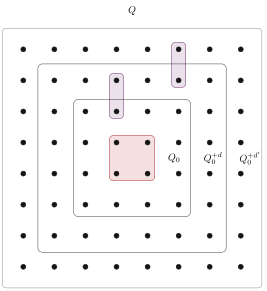
If a support had a site \(x\in A\cap Q\) and a site outside \(A\), a walk of length at most \(R\) between them would cross an edge of the cut at sup-norm distance at most \(R{\lt}D_0\operatorname {size}(Q)\) from \(Q\). The ambient diameter of a support is at most its graph diameter \(R\), so a support split by \(A\cap Q_0^{+d}\) lies in \(Q_0^{+(d+R)}\) and is not split by \(A\cap Q_0^{+d'}\). A support split by \(A\cap Q_0^{+d'}\) has a site in the boundary layer \(Q_0^{+d'}\setminus Q_0^{+(d'-R-1)}\), which has at most \(4(R+1)(\operatorname {size}(Q_0)+2d')\) lattice points.
For \(q\ge 1\), \(R\), \(J\ge 0\) and \(\Delta {\gt}0\) there are an integer \(C_{\mathrm{pad}}\ge 1\) and a constant \(C_{\mathrm{buf}}\ge 0\) with the following property, uniformly over every real \(D_0{\gt}2R+10\). Let \(\Omega \) be a unit vector satisfying (50) and (51). For a cut \(A\subseteq \Lambda \), let \(Z\) be the set of endpoints of its crossing edges. Let \(Q\) satisfy \(\operatorname {dist}_\infty (Q,Z){\gt}D_0\operatorname {size}(Q)\), let \(r\ge 1\) be an integer, and let \(Q_0\) be a rectangle of size at most \(r\) with \(Q_0^{+C_{\mathrm{pad}}r}\subseteq Q\). For \(X=A\cap Q_0\) and \(T=(A\cap Q_0^{+C_{\mathrm{pad}}r})\setminus X\),
This is [ 286 , Lemma 3.2 ] .
Set \(D=R+1\). Since \(D{\lt}D_0\) and \(\operatorname {size}(Q)\ge 1\),
Thus \(Q\) is safe with integer parameter \(D\), and Theorem 42.15.2 applies. Put \(m=\lfloor (C_{\mathrm{pad}}-1)r/D\rfloor \) and \(X_j=A\cap Q_0^{+d_j}\) with \(d_j=r+jD\), \(1\le j\le m\). By Theorem 42.15.2 every admissible support splits at most one \(X_j\), and the number of split supports and the parameter \(\mathcal B_j\) of [ 286 , Lemma 3.1 ] are at most a constant times \(r+d_j\). The harmonic weights \(a_j=2/(Z_r(r+d_j))\) with \(Z_r=\sum _j1/(r+d_j)\) have total mass two and quadratic cost \(4/Z_r\), and \(Z_r\ge D^{-1}\log ((C_{\mathrm{pad}}+1)/(2+D))\). Choosing \(C_{\mathrm{pad}}\) makes \(a_j\le 1/2\), the energy of the optimized filters at most \(\Delta /2\), and every \(a_j/(1-a_j)\) admissible for [ 286 , Lemma 3.1 ] , uniformly in \(r\). The comparison of the optimized filter norms with Schmidt pinning then gives \(2S(X\mid T)\le S(X)+C+m\log 2\), and \(m\le C_{\mathrm{pad}}r\).
42.16 Entropy cost of a partial rectangle layer
Let \(\Lambda \subseteq \mathbb Z^2\) be finite, let \(q\in \mathbb N\) with \(q\ge 1\), and let \(\Omega \) be a unit vector on the domain with local dimension \(q\). Let \(A\subseteq \Lambda \) be arbitrary, let \(Q\) be a nonempty integer rectangle, and put \(s=\operatorname {size}(Q)\). Let \(j\in \mathbb N\) satisfy \(1\le j\le s\), and let \(Y\subseteq Q^{+j}\setminus Q^{+(j-1)}\) be arbitrary. Define \(R=A\cap (Q^{+(j-1)}\setminus Q)\) and \(R_Y=A\cap ((Q^{+(j-1)}\setminus Q)\cup Y)\). Then
This rectangle estimate follows from the partial-row argument of [ 286 , Lemma 9.4, lines 666–667 ] and is used in the rectangle covering argument in the proof of Proposition 9.5, lines 717–729. It includes an empty \(Y\), thin rectangles and missing lattice sites in the domain.
Put \(B=A\cap Y\). Then \(R\) and \(B\) are disjoint and \(R_Y=R\cup B\). The boundary-layer count recorded in the proof of Theorem 42.15.2 gives
The first inequality holds because \(B\subseteq Y\). By the regional increment and dimension bounds,
where \(\log q\ge 0\) because \(q\ge 1\).
42.17 The initial safe-box estimate
For fixed \(q,R,J,\Delta \) and an integer \(D_0{\gt}2R+10\), let \(F_{\mathrm{box}}(r)\) be the supremum of \(S_\Omega (A\cap Q)\) over all finite-range Hamiltonians on finite domains with gapped ground vectors, all cuts \(A\), and all safe rectangles \(Q\) of size at most \(r\) (Definition 42.15.1). The supremum and scale recurrence in this section use integer clearance. The source permits real clearance; its initial entropy bound is recovered in Theorem 44.24.14. The comparison is explained in [ 110 ] . The scale recurrence for every real safety parameter is not asserted here.
The restriction to integer safety parameters of the function \(F_{\mathrm{box}}\) defined before [ 286 , Proposition 3.3 ] .
For \(q\ge 1\) the function \(F_{\mathrm{box}}\) is nonnegative, nondecreasing in \(r\), and satisfies \(F_{\mathrm{box}}(r)\le r^2\log q\).
A region \(A\cap Q\) has at most \(\operatorname {size}(Q)^2\) sites, so its entropy is at most \(r^2\log q\); entropies of unit vectors are nonnegative; and enlarging \(r\) enlarges the collection in the supremum.
For fixed \(q,R,J,\Delta ,r\) with \(q\ge 1\), write \(F_{\mathrm{box},D_0}(r)\) for the safe-box entropy at safety parameter \(D_0\). If \(D_0,D_1\in \mathbb N\) and \(D_0\le D_1\), then \(F_{\mathrm{box},D_1}(r)\le F_{\mathrm{box},D_0}(r)\).
Every rectangle safe at threshold \(D_1\) is safe at threshold \(D_0\), so the supremum is taken over a smaller collection.
Partition each axis of a rectangle \(Q\) of size at most \(Mr\) into chunks of \(r\) sites and one final shorter chunk. The products of chunks are at most \(M^2\) pairwise disjoint rectangles of size at most \(r\) covering \(Q\). If a point of one child lies in the \(Cr\)-padding of another, their chunk positions differ by at most \(C\) along each axis. A child at least \(C\) positions from the first chunk and \(C+2\) from the last along both axes has its \(Cr\)-padding inside \(Q\).
Coordinates in a chunk at position \(a\) lie in \([ar,ar+r-1]\) relative to the corner of \(Q\), and the padding adds \(Cr\) on both sides.
Let \(\Omega \) be a unit vector and write \(S=S_\Omega \). Let \(X_i\) be pairwise disjoint regions carrying colors in \(\{ 0,\dots ,N-1\} \), and suppose each \(i\) in a set \(G\) has a buffer \(T_i\) contained in the union of the regions of the other colors, with \(S(X_i\mid T_i)\le S(X_i)/2+\beta \). Then
For each of the \(N\) cyclic rotations of the colors, order the regions by rotated color and apply the chain rule. Every term is at most \(S(X_i)\). For \(i\in G\), in the rotation putting the color of \(i\) last, all of \(T_i\) precedes \(X_i\), so the term is at most \(S(X_i\mid T_i)\). Average over the rotations.
Fix an integer \(D_0{\gt}2R+10\). With \(C_{\mathrm{pad}},C_{\mathrm{buf}}\) from Theorem 42.15.3, \(P=2C_{\mathrm{pad}}+1\) and \(p=1/(2P^2)\), for every \(M\) and \(r\ge 1\),
Color the children of a safe parent by their chunk positions modulo \(P\). The padding of a child meets only children within \(C_{\mathrm{pad}}\) positions, which have other colors. Children are safe and of size at most \(r\), and interior children satisfy the hypotheses of Theorem 42.15.3. At most \(2PM\) children are not interior. Apply Theorem 42.17.5 with \(N=P^2\).
For fixed \(q\ge 1\), \(R\), \(J\ge 0\) and \(\Delta {\gt}0\), there are constants \(C\) and \(e_0\in (0,1)\), depending only on \(q,R,J,\Delta \), such that for every integer \(D_0{\gt}2R+10\) and every integer \(r\ge 1\), \(F_{\mathrm{box},D_0}(r)\le Cr^{1+e_0}\). This is the integer-clearance specialization of [ 286 , Proposition 3.3 ] ; the real-clearance statement follows from Theorem 44.24.14.
Fix an integer \(D_0{\gt}2R+10\). Choose \(M=8(C_{\mathrm{pad}}+1)\), so \(2PM\le M^2/2\) and the coefficient of the recurrence is at most \(\lambda =(1-p/2)M^2\), with \(M{\lt}\lambda {\lt}M^2\). Iterating the recurrence at powers of \(M\), starting from \(F_{\mathrm{box},D_0}(1)\le \log q\), and using monotonicity in \(r\) gives \(F_{\mathrm{box},D_0}(r)\le Cr^{\log _M\lambda }\), with \(1{\lt}\log _M\lambda {\lt}2\). The constants \(M\), \(\lambda \) and \(C\) depend only on \(q,R,J,\Delta \), so the bound holds with the same \(C\) and \(e_0=\log _M\lambda -1\) at every such \(D_0\).
Let \(\Lambda \subset \mathbb Z^2\) be finite, let \(A\subseteq \Lambda \), and let \(Z\) be the endpoints of its crossing edges. Let \(D_0,j\in \mathbb N\), and let \(Q,Q'\) be integer rectangles, each a product of two finite nonempty integer intervals. Suppose that every point of \(Q\) has sup-norm distance greater than \(D_0\operatorname {size}(Q)\) from every point of \(Z\), and that
Then every point of \(Q'\) has sup-norm distance greater than \(D_0\operatorname {size}(Q')\) from every point of \(Z\). Here the size counts sites along the longer axis and \(Q^{+j}=Q+([-j,j]^2\cap \mathbb Z^2)\). This is the clearance step in [ 286 , proof of Proposition 9.5, lines 723–729 ] .
Suppose that \(p\in Q'\) and \(z\in Z\) satisfy \(\| p-z\| _\infty \le D_0\operatorname {size}(Q')\). The containment and radius inequality give
Thus some \(v\in Q\) satisfies \(\| v-z\| _\infty \le D_0\operatorname {size}(Q)\), contrary to the assumed safety of \(Q\).
Fix a local dimension \(q\ge 1\), an interaction range \(R\), a term norm bound \(J\ge 0\), and a gap \(\Delta {\gt}0\). There exist constants \(C\ge 0\) and \(e_0\in (0,1)\), depending only on \(q,R,J,\Delta \), such that for every integer \(D_0{\gt}2R+10\), every finite induced square-lattice domain \(\Lambda \), every Hamiltonian \(H\) on \(\Lambda \) as in Definition 39.8.2 with a unit ground vector \(\Omega \) at energy \(E_0\) and full-system gap \(\Delta \), every cut \(A\subseteq \Lambda \), and every safe integer rectangle \(Q\),
Here \(Q\) is a product of two finite nonempty integer intervals, \(\operatorname {size}(Q)\) is the maximum of its side lengths in sites, and safety means that every site of \(Q\) has sup-norm distance greater than \(D_0\operatorname {size}(Q)\) from every endpoint of a crossing edge of \(A\). This is the pointwise integer-clearance specialization of [ 286 , Proposition 3.3 ] . The full real-clearance conclusion follows from Theorem 44.24.14.
The initial safe-box estimate gives \(C\) and \(e_0\in (0,1)\) uniformly over all integer safety parameters \(D_0{\gt}2R+10\). At \(D_0=2R+11\) and \(r=1\),
so \(C\ge 0\). Since \(\operatorname {size}(Q)\ge 1\), the definition of \(F_{\mathrm{box},D_0}\) and the initial safe-box estimate give
which proves (25).
42.18 The gain in the initial box exponent
Write \(C_{\mathrm{pad}}\) for the padding constant used in Theorem 42.17.7. The cyclic-color recurrence uses \(p=1/(2(2C_{\mathrm{pad}}+1)^2)\) and \(M=8(C_{\mathrm{pad}}+1)\). Its ratio is \(\lambda =(1-p/2)M^2\), and its exponent is \(e_0=\log \lambda /\log M-1\). The following auxiliary estimates quantify the gain for these formalized recurrence constants. The manuscript instead uses \(p_0=(2C_{\mathrm{pad}}+5)^{-2}\) and \(\lambda =(1-p_0/4)M^2\), with \(M\ge 16(C_{\mathrm{pad}}+2)\); the numerical choices here come from the cyclic-color partition used in the initial recurrence.
For the initial recurrence parameters,
This is the logarithmic form of the exponent \(e_0\), following the exponent calculation in [ 286 , proof of Proposition 3.3, lines 651–663 ] .
Since \(0{\lt}p\le 1/2\) and \(M\ge 16\), \(\log \lambda =\log (1-p/2)+2\log M\) and \(\log M{\gt}0\). Substitute this identity into \(e_0=\log \lambda /\log M-1\).
For the initial recurrence parameters,
Put \(x=1-p/2{\gt}0\). The inequalities \(\log x\le x-1\) and \(1-x^{-1}\le \log x\) give \(p/2\le -\log (1-p/2)\le p/(2-p)\). Divide by \(\log M{\gt}0\).
42.19 An explicit budget for exponent improvement
The finite iteration in the proof of Proposition 9.5 [ 286 , lines 788–803 ] contracts an initial exponent \(e_0\) by a factor \(1-\ell \) at each round. The following auxiliary estimates bound the number of rounds in terms of the cyclic-color initial recurrence parameters of Section 42.18.
Let \(0{\lt}e_0\le 1\), \(0{\lt}\varepsilon \le 1\) and \(0{\lt}\ell {\lt}1\). Then
Since \(\log (1-\ell )\le -\ell {\lt}0\) and \(\log (1/\varepsilon )\ge 0\),
Divide by the negative logarithm and take nonnegative integer ceilings.
For the cyclic-color recurrence probability \(p\) and scale \(M\), set
These are the recurrence constants of Section 42.18, rather than the manuscript’s literal numerical choices.
The gain bound gives
Apply the logarithmic round bound and monotonicity of the ceiling.
With the initial exponent \(e_0\) and the parameters of Definition 39.12.1.1,
Since \(0{\lt}1-\ell {\lt}1\) and \(m\le B\), \((1-\ell )^B e_0\le (1-\ell )^m e_0\le e_*\).
Let \(q\ge 1\), \(R\in \mathbb N\), \(J\ge 0\) and \(\Delta {\gt}0\). Fix transport constants \(c_t,C_{\rm ent},e_{\rm ent},C_{\rm en},e_{\rm en}\) with \(c_t{\gt}0\) satisfying the finite-family transport bound. Set \(C_0\) to the explicit initial safe-box constant and let \(G\) be the physical one-round improvement with truncation constant \(C_{\rm tr}(R,J,\Delta ,2)\), as in Theorem 44.24.13. Define
There is a single integer \(m\le B\), independent of the safety parameter and scale, such that for every \(D_0{\gt}2R+10\) and \(r\ge 1\),
The coefficient is evaluated at the actual round count \(m\); no comparison of \(C_m\) with \(C_B\) is asserted.
Take the logarithmic round count in the named physical safe-box estimate of Proposition 9.5 [ 286 , lines 788–805 ] . Theorem 42.19.3 gives \(m\le B\), and the physical estimate gives the entropy inequality with its recurrence coefficient \(C_m\). This is an auxiliary quantitative deduction using the cyclic-color initial constants.
42.20 Nested square patches
Fix a finite induced lattice domain \(\Lambda \subset \mathbb Z^2\) and a centre \(c\in \mathbb R^2\). The square patches in the proof of [ 287 , Proposition 4.1 ] are samples of closed ambient squares. Intersecting with \(\Lambda \) permits clipping at the physical boundary and does not add edges to the induced graph.
For \(r\in \mathbb R\), define
Thus \(x\in K(c,r)\) exactly when \(x\in \Lambda \) and \(|x_1-c_1|\le r\), \(|x_2-c_2|\le r\). Sites on the square boundary are included. Equivalently, each integer coordinate lies between \(\lceil c_a-r\rceil \) and \(\lfloor c_a+r\rfloor \), for \(a=1,2\). The sample is empty for \(r{\lt}0\) and increases with \(r\).
For a lattice point \(x\), set \(\rho (x)=\max \{ |x_1-c_1|,|x_2-c_2|\} \). Then \(K(c,r)=\{ x\in \Lambda :\rho (x)\le r\} \).
Adjacent sites \(x,y\) satisfy \(|x_a-y_a|\le 1\) for \(a=1,2\) and \(|\rho (x)-\rho (y)|\le 1\). In particular, if \(x\in K(c,r)\), then \(y\in K(c,r+1)\). For any cut \(A\), an unordered pair belongs to \(\partial _\Lambda A\) precisely when its sites are adjacent and exactly one belongs to \(A\). Consequently, for adjacent \(x,y\),
One coordinate of adjacent sites differs by one and the other is equal, so \(|x_a-y_a|\le 1\). For \(a=1,2\) the triangle inequality gives
hence \(\rho (y)\le \rho (x)+1\); interchanging \(x\) and \(y\) gives \(|\rho (x)-\rho (y)|\le 1\). An unordered pair crosses \(A\) exactly when
For \(A=K(c,r)\), membership of a site \(z\) is \(\rho (z)\le r\), and the disjunction becomes \((\rho (x)\le r{\lt}\rho (y))\vee (\rho (y)\le r{\lt}\rho (x))\), which is (39).
If \(r\ge 0\), then \(|K(c,r)|\le (2r+1)^2\). If also \(r\le 4\), then \(|K(c,r)|\le 81\).
Each coordinate interval has at most \(2r+1\) integer points. The sample is a subset of their Cartesian product. When \(r\le 4\), its cardinality is at most \(9^2=81\).
For every \(r\ge 0\), the number of unordered induced edges crossing the sampled square satisfies \(|\partial _\Lambda K(c,r)|\le 8r+4\).
A horizontal crossing edge lies on an integer row meeting \([c_2-r,c_2+r]\). On each such row there are at most two crossing edges, one at each end of the integer interval inside the square. An interval of length \(2r\) contains at most \(2r+1\) integers. The same argument applies to vertical edges. Hence the total is at most \(2(2r+1)+2(2r+1)=8r+4\). Removing sites outside \(\Lambda \) cannot create an induced crossing edge.
For \(u\ge 0\), put \(m=\lfloor u/2\rfloor +1\). For each integer \(0\le j{\lt}m\), define
The family contains \(m\ge 1\) patches and \(m{\gt}u/2\). Every selected radius satisfies \(u\le r_j\le 2u\) and every selected patch satisfies \(|\partial _\Lambda K_j|\le 16u+4\). For indices \(i{\lt}j\), one has \(r_i+2\le r_j\). For \(i\le j\), one has \(K_i\subseteq K_j\); clipping can make these inclusions equalities.
The floor inequalities give \(u/2{\lt}m\) and \(j\le \lfloor u/2\rfloor \le u/2\). Thus \(u\le u+2j\le 2u\), and the crossing-edge estimate applies. Increasing an integer index by at least one increases the radius by at least two; inclusion follows from the closed coordinate inequalities.
Suppose \(e\in \partial _\Lambda K(c,r)\). If \(s+1\le r\), then the two sites of \(e\) are disjoint from \(K(c,s)\). If \(r+1\le t\), then both sites belong to \(K(c,t)\).
For \(e=\{ x,y\} \) with \(x\in K(c,r)\) and \(y\notin K(c,r)\), if either site belonged to \(K(c,s)\), the nearest-neighbour enlargement would put \(y\) in \(K(c,s+1)\subseteq K(c,r)\), a contradiction. Conversely, \(x\in K(c,r)\) implies \(y\in K(c,r+1)\), so both sites belong to every \(K(c,t)\) with \(r+1\le t\).
Let \(e=\{ x,y\} \) be an induced nearest-neighbour edge. If \(e\in \partial _\Lambda K_j\), then, for every \(i{\lt}j\), \(\{ x,y\} \cap K_i=\varnothing \), and, for every \(j{\lt}k\), \(\{ x,y\} \subseteq K_k\). Consequently, an edge crosses at most one patch in the family, and the crossing-edge sets of distinct patches are disjoint.
Earlier and later radii differ from \(r_j\) by at least two, so the separated-radius support statements apply. If an edge crossed two patches with indices \(i{\lt}k\), crossing \(K_i\) would place both sites in \(K_k\), contradicting \(e\in \partial _\Lambda K_k\).
The following finite example uses \(\Lambda =\{ 0,\ldots ,10\} \times \{ 0,1,2\} \), \(c=(5/4,3/2)\), and \(u=4\). Its three clipped samples are \(K_0=\{ 0,\ldots ,5\} \times \{ 0,1,2\} \), \(K_1=\{ 0,\ldots ,7\} \times \{ 0,1,2\} \), and \(K_2=\{ 0,\ldots ,9\} \times \{ 0,1,2\} \). The marked edge \(e=\{ (7,1),(8,1)\} \) crosses \(K_1\); it is disjoint from \(K_0\) and contained in \(K_2\). The rounded outlines enclose the clipped sets of physical sites; they are not the boundaries of the ambient real squares.
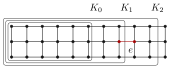
Let \(u\ge 4\), \(\kappa \in \mathbb R\), and assign each selected patch the same weight \(t_j=\kappa /m\). Then
Since \(m{\gt}u/2\) and \(u\ge 4\), one has \(16u+4\le 36m\). The constant weights satisfy \(\sum _{j=0}^{m-1}t_j^2=\kappa ^2/m\), which gives (41). Bounding each boundary size by \(16u+4\) gives
42.20.1 Patches for interactions of range \(R\)
The source treats on-site and nearest-neighbour interactions. The following statements extend the patch geometry to interactions whose supports have graph diameter at most a nonnegative integer \(R\); they are not in [ 287 ] . At \(R=1\) they select the patches of Definition 42.20.6.
For a nonnegative integer \(R\), put \(s_R=2\lceil R/2\rceil \). For \(R\ge 1\) and \(u\ge 0\), put \(m_R=\lfloor u/s_R\rfloor +1\), and for \(0\le j{\lt}m_R\) define
One has \(R\le s_R\le R+1\), and \(s_R\ge 2\) when \(R\ge 1\). At \(R=1\) the count, radii and patches are those of Definition 42.20.6. The family has \(m_R\ge 1\) patches and \(m_R{\gt}u/s_R\). If \(u\ge 0\), every radius satisfies \(u\le r_j\le 2u\). For \(i{\lt}j\) one has \(r_i+s_R\le r_j\), and for \(i\le j\) one has \(K_i\subseteq K_j\).
The bounds on \(s_R\) are integer arithmetic. The floor inequalities give \(u/s_R{\lt}m_R\) and, when \(s_R{\gt}0\), \(s_Rj\le s_R\lfloor u/s_R\rfloor \le u\) for \(j{\lt}m_R\); when \(s_R=0\) all radii equal \(u\). Increasing the index by at least one increases the radius by at least \(s_R\).
The endpoints \(x,y\) of a walk of length \(\ell \) in the induced graph satisfy \(|\rho (x)-\rho (y)|\le \ell \). Hence any two sites of a support of graph diameter at most \(R\) satisfy \(|\rho (x)-\rho (y)|\le R\). If the values of \(\rho \) on a set \(X\) differ pairwise by at most \(R\), then at most one patch \(K_j\) of Definition 42.20.1.1 both meets \(X\) and misses a site of \(X\).
Along each edge \(\rho \) changes by at most one, so along a walk it changes by at most the length. Suppose \(X\) is split by \(K_i\) and \(K_j\) with \(i{\lt}j\). Then some \(z\in X\) has \(\rho (z)\le r_i\) and some \(y\in X\) has \(\rho (y){\gt}r_j\ge r_i+s_R\ge r_i+R\), so \(\rho (y)-\rho (z){\gt}R\), a contradiction.
For \(r\in \mathbb R\) and a nonnegative integer \(R\), let \(\mathcal N(c,r,R)=\{ x\in \Lambda :r-R{\lt}\rho (x)\le r\} \).
If the values of \(\rho \) on \(X\) differ pairwise by at most \(R\), and \(X\) has a site \(y\) outside \(K(c,r)\), then every site of \(X\) in \(K(c,r)\) lies in \(\mathcal N(c,r,R)\). If \(r\ge 0\), then \(|\mathcal N(c,r,R)|\le R(8r+4)\), and for the patches of Definition 42.20.1.1 with \(u\ge 0\), \(|\mathcal N(c,r_j,R)|\le R(16u+4)\).
A site \(x\) of \(X\) in \(K(c,r)\) has \(\rho (x)\ge \rho (y)-R{\gt}r-R\). A site of \(\mathcal N(c,r,R)\) lies in one of four strips, such as \(c_1+r-R{\lt}x_1\le c_1+r\) with \(|x_2-c_2|\le r\). A half-open interval of length \(R\) contains exactly \(R\) integers and a closed interval of length \(2r\) at most \(2r+1\), so each strip has at most \(R(2r+1)\) sites. For the patches, \(r_j\le 2u\).
Let \(R\ge 1\), \(u\ge 0\) and \(\kappa \in \mathbb R\), and assign each patch of Definition 42.20.1.1 the weight \(t_j=\kappa /m_R\). Then
Since \(u{\lt}s_Rm_R\) and \(s_Rm_R\ge 2\), one has \(16u+4\le 16s_Rm_R+2s_Rm_R=18s_Rm_R\), and \(\sum _jt_j^2=\kappa ^2/m_R\).
Assume the square-grid entropy area law for a family of states with constant \(C_A\), and put \(C_S=\max \{ 1,16C_A\} \). For every \(L\), every state \(\Omega \) of the family, every centre \(c\) and all reals \(u,r\) with \(0\le r\le 2u\), the sampled square \(K(c,r)\) in the integer square of side \(L\) satisfies \(S_{U\Omega }(K(c,r))\le C_S(1+u)\).
The area law gives \(S_{U\Omega }(K(c,r))\le C_A|\partial _\Lambda K(c,r)|\), and \(|\partial _\Lambda K(c,r)|\le 8r+4\le 16u+4\le 16(1+u)\).
Assume the square-grid entropy area law for a family of states with constant \(C_A\), and put \(C_S=\max \{ 1,16C_A\} \). For every \(L\), every state \(\Omega \) of the family, every centre \(c\), every \(u\ge 0\), and every \(0\le j{\lt}m\), the nested patch \(K_j\) in the integer square of side \(L\) satisfies \(S_{U\Omega }(K_j)\le C_S(1+u)\). This is the entropy bound in the proof of Proposition 4.1 with its constant explicit.
The radius of \(K_j\) lies between \(u\) and \(2u\), so Lemma 42.20.1.7 applies.
Assume the square-grid entropy area law. Let \(q\ge 2\) be an integer and \(J,\Delta {\gt}0\). There is a constant \(C_S\ge 1\) with the following property. For every \(L\), every original square Hamiltonian \(H\) with interaction bound \(J\), every unit vector \(\Omega \) and real \(E_0\) with \(H\Omega =E_0\Omega \) and \(H-E_0I\ge \Delta (I-|\Omega \rangle \langle \Omega |)\), every centre \(c\), every \(u\ge 0\), and every \(0\le j{\lt}m\), the nested patch \(K_j\) in the integer square of side \(L\) satisfies the entropy bound in the proof of Proposition 4.1:
The constant is chosen before \(L\), \(H\), \(\Omega \), \(c\) and \(u\). The area law is a hypothesis here; its derivation from the spectral gap is the separate rectangular specialization of the finite-domain area law, which is not yet established.
The area law supplies a constant \(C_A\ge 0\) at \(q\), \(J\), \(\Delta \). Take \(C_S=\max \{ 1,16C_A\} \) and apply Theorem 42.20.1.8.
42.20.2 Dyadic counts for rectangle shells
The rectangle shell covering in [ 286 , proof of Proposition 9.5, lines 717–729 ] uses the maximal contained squares of Definition 41.8.1.3. The following estimates give the total side lengths at and below the cap, uniformly in the aspect ratio of the rectangle.
Let \(Q\) be a nonempty integer rectangle and let \(j\in \mathbb N\). Then
Write \(Q=[x_0,x_1]\times [y_0,y_1]\cap \mathbb Z^2\). Its side lengths are \(x_1-x_0+1\) and \(y_1-y_0+1\). Dilation adds \(2j\) to each, so their maximum also increases by \(2j\).
Let \(Q\) be a nonempty integer rectangle and put \(s=\operatorname {size}(Q)\). Let \(j,L,K\in \mathbb N\) satisfy \(j\le L\le s\) and \(L{\lt}2^{K+1}\). Put \(S_j=Q^{+j}\setminus Q\) and \(N_K=\# \{ (r,z)\in \mathcal P_K(S_j):r=K\} \). Then
The boundary-layer count in the proof of Theorem 42.15.2 gives
Set \(v=2^K\). The exact capped partition and \(L{\lt}2v\) imply
Cancel \(v{\gt}0\).
Let \(Q\) be a nonempty integer rectangle and put \(s=\operatorname {size}(Q)\). Let \(j,K,k\in \mathbb N\) satisfy \(j\le s\), \(k{\lt}K\) and \(2^{k+1}\le s\). Put \(S_j=Q^{+j}\setminus Q\) and \(N_k=\# \{ (r,z)\in \mathcal P_K(S_j):r=k\} \). Then
Set \(u=2^{k+1}\). The mixed-square count for a difference, the rectangle count and Theorem 42.20.2.1 give
Each selected square below the cap has a mixed parent, and a parent has four children. Hence
42.21 Weighted dyadic covering of rectangle shells
Let \(S\subseteq \mathbb Z^2\) be finite, let \(K\in \mathbb N\), and let \(f:\mathbb N\to \mathbb R\) be arbitrary. Then
In the covering argument of [ 286 , Lemma 9.4, lines 656–664 ] , this finite summation by scale holds without sign conditions on \(f\), including when \(S=\varnothing \) or \(K=0\).
Since membership in \(\mathcal P_K(S)\) implies \(r\le K\), we group its finitely many terms according to \(r\). On each group with \(r=k\), the summand is the constant \(f(k)\), so
Summing over \(k=0,\ldots ,K\) gives the identity.
Let \(S\subseteq \mathbb Z^2\) be finite and let \(K,L\in \mathbb N\) satisfy \(2^K\le L\). Let \(e,A,B\in \mathbb R\) with \(e{\gt}0\) and \(B\ge 0\). Write \(N_k=\# \{ (r,z)\in \mathcal P_K(S):r=k\} \). Suppose \(2^K N_K\le A\) and \(2^k N_k\le B\) for every \(0\le k{\lt}K\). Then
In the covering argument of [ 286 , Lemma 9.4, lines 656–664 ] , this finite moment estimate holds including when \(S=\varnothing \) or \(K=0\).
Grouping the selected squares by scale and applying the finite weighted dyadic-sum estimate gives
The cap bound gives \(A\ge 0\), while \(2^e-1{\gt}0\). Hence the coefficient is nonnegative, and the last inequality follows from \(e{\gt}0\) and \(2^K\le L\).
Let \(Q\) be a nonempty integer rectangle and put \(s=\operatorname {size}(Q)\). Let \(j,L,K\in \mathbb {N}\) satisfy \(j\le L\le s\) and \(2^K\le L{\lt}2^{K+1}\), and let \(e{\gt}0\). Set \(S_j=Q^{+j}\setminus Q\), with both rectangles viewed as sets of lattice sites. Then the capped maximal-contained dyadic partition satisfies the geometric weighted covering estimate of [ 286 , proof of Proposition 9.5, lines 717–729 ] :
Let \(N_k\) denote the number of selected squares of scale \(k\). Since \(j\le L\le s\) and \(2^{k+1}\le 2^K\le L\le s\) for \(0\le k{\lt}K\), the rectangle-shell counting estimates give, for every \(0\le k{\lt}K\),
Applying Theorem 42.21.2 with \(A=24s\), \(B=64s\), and the cap bounds \(2^K\le L{\lt}2^{K+1}\) and factoring out \(s\) gives the bound. If \(j=0\), the shell and its partition are empty. If \(K=0\), the lower-scale sum is empty and the cap inequalities force \(L=1\).
42.22 Entropy of safe rectangle shells
For \(k\in \mathbb {N}\) and \(z\in \mathbb {Z}^2\), let
This is the integer rectangle underlying the dyadic square in the covering argument of [ 286 , Lemma 9.4, lines 641–649 ] .
For every \(k\in \mathbb {N}\) and \(z\in \mathbb {Z}^2\), the lattice points of \(R_{k,z}\) are exactly \(C_{k,z}\), and \(\operatorname {size}(R_{k,z})=2^k\). For a finite physical domain \(\Lambda \) and a region \(A\subseteq \Lambda \), its physical region is \(A\cap C_{k,z}\).
The half-open coordinate interval from \(2^kz_i\) to \(2^k(z_i+1)\) contains exactly the integers from \(2^kz_i\) to \(2^kz_i+2^k-1\). Each coordinate interval contains \(2^k\) sites. Intersecting with \(A\) gives the equality of physical regions.
Fix a finite lattice domain \(\Lambda \), a region \(A\subseteq \Lambda \), a finite lattice set \(S\), and \(K\in \mathbb {N}\). The physical regions \(A\cap R_{k,z}\) for \((k,z)\in \mathcal P_K(S)\) are pairwise disjoint, and their union is \(A\cap S\). For a unit physical vector \(\Omega \) on \(\Lambda \) with local dimension \(q\in \mathbb {N}\), one has
This is the physical summation step of [ 286 , Lemma 9.4, lines 651–664 ] .
The selected ambient squares partition \(S\). Intersecting them with \(A\) preserves pairwise disjointness and gives union \(A\cap S\). Apply finite disjoint-union subadditivity, starting with the empty region, whose entropy is zero.
Fix a finite lattice domain \(\Lambda \), a physical region \(A\), and \(D_0\in \mathbb {N}\). Let \(Q\) be a safe integer rectangle and put \(s=\operatorname {size}(Q)\). Suppose \(j,L,K\in \mathbb {N}\) satisfy \(j\le L\), \(2^K\le L\), and
Then each selected square of \(\mathcal P_K(Q^{+j}\setminus Q)\), interpreted as its integer rectangle, is safe. This is a sufficient clearance condition for the covering argument in [ 286 , proof of Proposition 9.5, lines 723–729 ] .
A selected square \(R_{k,z}\) is contained in \(Q^{+j}\) and has \(k\le K\) and \(\operatorname {size}(R_{k,z})=2^k\le L\). Hence
Safety inside a dilated parent rectangle gives the result.
Fix a finite lattice domain \(\Lambda \) with local dimension \(q\), a unit physical vector \(\Omega \), and a region \(A\). Let \(S\) be a finite set of lattice sites, let \(K\in \mathbb {N}\), and let \(e,C\in \mathbb {R}\). Suppose that every square \(R_{k,z}\) selected by \(\mathcal P_K(S)\) satisfies
Then
This is the conditional summation step in [ 286 , proof of Lemma 9.4, lines 651–664 ] .
The physical regions \(A\cap R_{k,z}\) are pairwise disjoint and have union \(A\cap S\). Each \(R_{k,z}\) is an integer rectangle of size \(2^k\). Subadditivity and the assumed estimate give
Fix a finite lattice domain \(\Lambda \) with local dimension \(q\), a unit physical vector \(\Omega \), a region \(A\), and \(D_0\in \mathbb {N}\). Let \(S\) be a finite set of lattice sites, let \(K\in \mathbb {N}\), and let \(e,C\in \mathbb {R}\). Suppose that each square selected by \(\mathcal P_K(S)\) is safe, and that every safe integer rectangle \(R\) satisfies
Then
This is the conditional summation step in [ 286 , proof of Lemma 9.4, lines 651–664 ] .
Every selected square is safe, so the assumed estimate applies to it, and the preceding theorem gives the bound.
Fix a finite lattice domain \(\Lambda \) with local dimension \(q\), a unit physical vector \(\Omega \), a region \(A\), and \(D_0\in \mathbb {N}\). Let \(e{\gt}0\) and \(C\ge 0\), and assume that every safe integer rectangle \(R\) satisfies
Let \(Q\) be safe and put \(s=\operatorname {size}(Q)\). For \(j,L,K\in \mathbb {N}\) with \(j\le L\le s\), \(2^K\le L{\lt}2^{K+1}\), and \(D_0L+L\le D_0s\), one has
This is the conditional shell entropy estimate used in [ 286 , proof of Proposition 9.5, lines 717–729 ] .
The selected squares give disjoint physical rectangle regions whose union is \(A\cap (Q^{+j}\setminus Q)\). Each is safe. Subadditivity and the assumed safe-box estimate give
The last step multiplies the weighted covering estimate by \(C\ge 0\).
42.23 Initial-exponent entropy of safe rectangle shells
Fix a local dimension \(q\in \mathbb N\) with \(q\ge 1\), an interaction range \(R\in \mathbb N\), a term norm bound \(J\ge 0\), and a gap \(\Delta {\gt}0\). There exist constants \(C\ge 0\) and \(e_0\in (0,1)\), depending only on \(q,R,J,\Delta \), with the following property simultaneously for every integer safety parameter \(D_0{\gt}2R+10\). Let \(\Lambda \) be any finite induced square-lattice domain, let \(H\) be an admissible Hamiltonian on \(\Lambda \) with range \(R\) and term norm bound \(J\), and let \(\Omega \) be its normalized ground vector at energy \(E_0\) with full-system projector gap \(\Delta \). Let \(A\subseteq \Lambda \) be any cut, let \(Q\) be any safe integer rectangle, and put \(s=\operatorname {size}(Q)\). For all \(j,L\in \mathbb N\) satisfying \(j\le L\le s\) and \(D_0L+L\le D_0s\), one has
As the initial-exponent consequence of [ 286 , Proposition 3.3, lines 590–604 ] for the rectangle-shell entropy input in the proof of Proposition 9.5, lines 717–729, the constant \(C\) and exponent \(e_0\) are independent of the safety parameter, domain, Hamiltonian, ground energy, ground vector, cut, rectangle, and shell scales.
With \(C\ge 0\) and \(e_0\in (0,1)\) from Theorem 42.17.9, under the hypotheses of the theorem every safe integer rectangle \(P\) satisfies
If \(L=0\), then \(j=0\), the shell is empty, and both sides of the desired inequality vanish. If \(L{\gt}0\), setting \(K=\lfloor \log _2L\rfloor \) gives \(2^K\le L{\lt}2^{K+1}\), and applying Theorem 42.22.7 with this dyadic cap, the pointwise estimate, the normalization of \(\Omega \), and the stated clearance conditions yields the asserted bound with the same \(C\) and \(e_0\).
42.23.1 Initial entropy estimate for rounded collars
The rounded collar scale in [ 286 , Section 9, lines 32–41 ] allows the initial rectangle estimate to be expressed as a strict reduction of its exponent on the shell. The following statements provide this initial input to the proof of Proposition 9.5, lines 693–729.
Let \(C_2,\eta ,e\ge 0\) be real numbers, and let \(s\in \mathbb N\) with \(s\ge 1\). Put \(L_s=\lfloor \lceil C_2s\rceil ^\eta \rfloor \). Then
The ceiling estimate gives \(\lceil C_2s\rceil {\lt}C_2s+1\le (C_2+1)s\). Since both exponents are nonnegative, monotonicity of real powers gives
Fix a local dimension \(q\ge 1\), an interaction range \(R\in \mathbb N\), a term norm bound \(J\ge 0\), and a gap \(\Delta {\gt}0\). There exist constants \(C\ge 0\) and \(e_0\in (0,1)\), depending only on \(q,R,J,\Delta \), with the following property. For each real \(C_2{\gt}0\) there is an integer threshold \(N\ge 1\) such that the following holds.
Let \(D_0{\gt}2R+10\) be an integer, let \(\Lambda \) be any finite induced square-lattice domain, and let \(H\) be an admissible Hamiltonian on \(\Lambda \) with range \(R\) and term norm bound \(J\). Let \(\Omega \) be its normalized ground vector at energy \(E_0\) with full-system projector gap \(\Delta \). Let \(A\subseteq \Lambda \) be any cut and \(Q\) any safe integer rectangle of size \(s\ge N\). Put \(\ell =(1-e_0)/200000\), \(\eta =1-\ell \), and \(L_s=\lfloor \lceil C_2s\rceil ^\eta \rfloor \). For every integer \(0\le j\le L_s\), one has
The exponent \(1+\eta e_0\) is strictly smaller than \(1+e_0\). This estimates the shell; the improvement of the safe-box exponent still requires the remaining physical comparison argument.
Choose \(C\) and \(e_0\) from Theorem 42.23.1. The fixed parameter bounds give \(0{\lt}\ell {\lt}1\), and hence \(0{\lt}\eta {\lt}1\). For each \(C_2{\gt}0\), Theorem 39.13.1.3 gives a threshold \(N\ge 1\) for which \(2L_s\le s\) and \(D_0L_s+L_s\le D_0s\) for every allowed safety parameter. In particular, \(L_s\le s\). The initial shell estimate and the homogeneous bound now give
Finally, \(\ell e_0{\gt}0\) gives \(1+\eta e_0=1+e_0-\ell e_0{\lt}1+e_0\).
42.23.2 Uniform coefficients for rounded shell estimates
The fixed collar exponent in [ 286 , Section 9, lines 693–703 ] remains unchanged while the current entropy exponent decreases. The following auxiliary estimates make the shell coefficient uniform on any interval with a positive lower endpoint. The pointwise entropy input is stated explicitly; these estimates do not establish the physical improvement in Proposition 9.5.
Let \(b,e,e_0,\eta ,C_2\in \mathbb R\) satisfy \(0{\lt}b\le e\le e_0\), \(\eta \ge 0\), and \(C_2\ge 0\). Then
The denominator \(2^b-1\) is positive and is at most \(2^e-1\). Therefore the first factor decreases when \(b\) is replaced by \(e\). Since \(C_2+1\ge 1\) and \(\eta e\le \eta e_0\), the second factor is bounded by \((C_2+1)^{\eta e_0}\). Multiplying these two bounds, whose factors are nonnegative, gives the result.
Fix \(C_2{\gt}0\) and \(e_0\in (0,1)\), and set \(\ell =(1-e_0)/200000\) and \(\eta =1-\ell \). There is an integer \(N\ge 1\), depending only on \(C_2\) and \(e_0\), with the following property. Let \(b{\gt}0\), let \(\Lambda \) be any finite induced square-lattice domain, let \(q\in \mathbb N\), and let \(\Omega \) be a unit vector on its configurations. Let \(D_0\ge 1\) be an integer, let \(A\subseteq \Lambda \) be any cut, and let \(Q\) be any safe integer rectangle with \(s=\operatorname {size}(Q)\ge N\). Suppose that \(b\le e\le e_0\) and that \(C\in \mathbb R\) satisfies, for every safe integer rectangle \(P\),
Put \(L_s=\lfloor \lceil C_2s\rceil ^\eta \rfloor \). For every integer \(0\le j\le L_s\), one has
The fixed parameter bounds give \(0{\lt}\eta {\lt}1\). Theorem 39.13.1.3 chooses a threshold \(N\ge 1\) for which \(L_s\ge 1\), \(2L_s\le s\) and \(D_0L_s+L_s\le D_0s\) for every allowed safety parameter. In particular, \(L_s\le s\). Choose \(K=\lfloor \log _2L_s\rfloor \).
Applying the pointwise estimate to the parent rectangle and using entropy nonnegativity gives \(0\le Cs^{1+e}\). Since \(s{\gt}0\), this implies \(C\ge 0\). The conditional rectangle-shell estimate and the homogeneous rounded-power bound now yield
The last step uses the uniform coefficient theorem. The choice of threshold depends only on the rounded geometric scale.
42.23.3 Replica limits before large-scale entropy absorption
The proof of Proposition 9.5 in [ 286 , Section 9, lines 755–769 ] takes the replica limit at each fixed physical scale before choosing the large-scale threshold. The following auxiliary scalar statements express that order. The two norm comparisons and the common entropy are explicit inputs; their physical derivation remains separate.
Let \(S,C,\tau ,E,B_u,B_l\in \mathbb R\) satisfy \(S\ge 0\), \(C\ge 0\), \(\tau {\gt}0\) and
Let \(F,d,r_u,r_l,r_e\) be real sequences. Suppose that \(r_u(k),r_l(k),r_e(k)\) tend to zero as \(k\to \infty \), and that for every sufficiently large \(k\),
Then
The entropy \(S\) and all fixed coefficients are independent of \(k\). The two bounds \(B_u\) and \(B_l\) include any substitutions of the typical entropy and auxiliary dimension made before these scalar comparisons.
Since \(C,S\ge 0\) and \(\tau {\gt}0\), the defect bound gives
Combining the two comparisons therefore yields
The right-hand side tends to \(B_u+B_l\), whereas the left-hand side is constant. Passing to the limit gives the same inequality without the three remainders. Finally, \(2-C(\tau +E/\tau )\ge 1\) and \(S\ge 0\) imply the conclusion.
Fix \(e_0\in (0,1)\) and \(C,C_E\in \mathbb R\), and let \(\nu =(1-e_0)/2000\). There is an integer \(N\ge 1\), depending only on these fixed coefficients, with the following property. For every integer \(n\ge N\), put
Then
This is the numerical threshold used after the fixed-scale replica limit. It does not require a replica convergence rate uniform in \(n\).
The fixed parameter bounds give \(\nu {\gt}0\). At positive integer scales, the quotient of powers gives
Both \(\tau _n\) and the last expression tend to zero, so choosing one threshold for the bounds \(\tau _n{\lt}1/2\) and \(C(1+C_E)n^{-\nu /4}{\lt}1\) and enlarging it to at least one gives \(\tau _n{\gt}0\) and the asserted inequalities by positivity of \(n\).
Fix a unit state \(\Omega _t\) on a finite subset of the square lattice, a region \(X\), and a spectral set \(E\) for its reduced density on \(X\). Write \(S=S_{\Omega _t}(X)\). Suppose that the selected mass \(z\) is positive and that every selected eigenvalue \(p_i\) satisfies
Let \(d_*=|E|\), let \(\psi \) be the normalized selected Schmidt vector, with the selected Schmidt indices enumerated in its auxiliary register, and let \(S'\) be the entropy of that register. Put \(\eta =w-\log z\). Fix \(C\ge 0\), \(0{\lt}\tau {\lt}1/2\), \(a{\gt}0\), \(E_{\rm def}\ge 0\) and real bounds \(B_{\rm sh},B_{\rm exc}\) such that
Let \(F,d,r_u,r_l,r_e\) be real sequences. Suppose that \(r_u(k),r_l(k),r_e(k)\) tend to zero and that, for all sufficiently large \(k\),
Before the shell and mismatch terms are estimated in [ 286 , Proposition 9.5 ] , these rough comparisons imply
retaining the same physical state and selected spectrum while leaving the physical derivation of the comparisons separate.
The selected auxiliary density has nonnegative entropy, so \(\max \{ 0,2S'\} =2S'\). Applying the fixed-scale replica absorption theorem to \(S'\), with coefficient \(2C\) and additive terms
gives
The selected-spectrum bounds \(|S'-S|\le \eta \) and \(|\log d_*-S|\le \eta \) then imply \(\eta \ge 0\) and \(S\le R+(5+4C\tau )\eta \). The smallness condition and \(E_{\rm def}\ge 0\) give \(2C\tau \le 1\), hence the displayed bound.