45 Polynomial PEPS approximation of gapped square-grid ground states
This chapter follows [ 287 ] , September 24, 2026. The ground state of a gapped nearest-neighbor Hamiltonian on an \(L\times L\) square grid is approximated by a PEPS whose bond dimension is polynomial in \(L\). The sections below treat the geometry of the dyadic distribution protocol, the parties and their sources, the information estimates, the compression of the distributed density, and the routing of the party network.
45.1 Geometry of the dyadic distribution protocol
This section treats the geometric part of [ 287 , Section 7 ] , September 24, 2026, 06-geometry.tex: the bands along the edges of a repainted dyadic square, the angular separation of [ 287 , Lemma 7.2 ] (lines 254–319), the point-treatment estimates (lines 357–415), the absence of changed true vertices in the bulk operations and the tags (lines 375–398 and 610–631), and parts of the geometry of the small-patch covers, of the direct repaintings and of the hole resizings (lines 341–351 and 447–533), and the counts of the padded dyadic hierarchy behind items 1–3 of [ 287 , Proposition 7.1 ] (lines 12–53 and 633–652). The protocol of Proposition 7.1 itself, whose changes are implemented by the information estimate and the contraction gates of the earlier sections, is not treated here.
The clearance estimates are first proved for every guide with the properties that the proof of Lemma 7.2 uses: the normal word of the operation on the band \(\{ -8{\lt}x{\lt}2\} \) and no change off it, the label \(A\) on the open square, and the label \(C\) on the exterior band \(\{ -8{\lt}x{\lt}0\} \). The schedule of guides is then constructed, these properties are derived from the disjointness of the bands, and the estimates are moved to every square of the hierarchy. This gives Theorem 45.1.13, which is Lemma 7.2 for the labellings that the schedule specifies; Lemma 7.2 for the guides sampled under the source’s tie convention is Theorem 45.1.20. A guide of the source is a partition of the plane into open chambers, with labels on boundaries sampled after one small generic displacement; here a guide is a labelling of the whole plane, and two labellings that agree off finitely many interface curves represent the same guide. The source’s sampled guides are identified with readings of these labellings in Lemma 45.1.19. The earlier scope restriction and this convention are recorded in [ 67 ] . Distances are sup distances in the plane, and labels are elements of an arbitrary set; the labels \(A\), \(B\), \(C\) below are permitted to coincide.
Let \(S=[0,n]^2\). For an edge of \(S\) let \(s\) be the coordinate parallel to the edge, measured from one endpoint, and \(d\) the normal coordinate, positive into \(S\). Put
The band \(\{ \alpha {\lt}x{\lt}\beta \} \) is the set of points with \(0{\lt}s{\lt}n\) and \(\alpha w(s){\lt}d{\lt}\beta w(s)\); its closed version has \(0\le s\le n\) and \(\alpha w(s)\le d\le \beta w(s)\). The lens of the edge is the band \(Y=\{ -7{\lt}x{\lt}-7/2\} \), and the exterior neighboring square is \(\{ 0{\lt}s{\lt}n,\ -n{\lt}d{\lt}0\} \). For a point \(y\), \(d_{\mathcal V}(y)\) is its distance from the two endpoints of the edge, or from the four corners of \(S\).
The bands \(\{ -8{\lt}x{\lt}2\} \) along distinct edges of \(S\) are disjoint, and the band \(\{ -8{\lt}x{\lt}0\} \) lies in the exterior neighboring square of its edge. Two points of a closed band with \(-8\le \alpha \le \beta \le 8\) are at distance at most \(n\). Consequently the closure of the changed set of each elementary edge birth or death, and the closure of the central region of Theorem 45.1.6, have diameter at most \(n\).
Since \(w\le s/1000\) and \(w\le (n-s)/1000\), for opposite edges the bands lie within \(n/250\) of their edges. For adjacent edges a common point at distances \(r_1,r_2{\gt}0\) from the two edge lines would satisfy \(r_1{\lt}0.002\, r_2\) and \(r_2{\lt}0.002\, r_1\). On \(\{ -8{\lt}x{\lt}0\} \) one has \(0{\gt}d{\gt}-8w\ge -n/250\). The diameter bound follows from \(|d|\le 8w\le n/250\) in each closed band. The changed set of an elementary operation lies in the closed band of its changed interval, and the central region lies in \(S\).
A normal word lists labels in increasing \(x\) separated by interfaces; at an interface curve the label on its right is taken, whereas the source samples after one generic displacement; the two conventions differ only on the interface curves. An edge operation starts from the main word \(C\mid A\mid B\) with interfaces \(0,1\). On an auxiliary sheet, uniform at \(C\), the births of \(B\) in \((-6,-1)\), of \(A\) in \((-5,-2)\) and of \(C\) in \((-4,-3)\) give
After the lens exchange the main word is \(C\mid B\mid A\mid C\mid A\mid B\) at \(-6,-5,-4,0,1\). The \(C\) band \((-4,0)\) then dies into \(A\), the \(A\) band \((-5,1)\) dies into \(B\), \(C\) is born in \((-3,0)\), and the \(B\) band \((-6,-3)\) dies into \(C\), leaving \(C\mid B\) at \(0\). Each of these seven births and deaths changes its word only on a closed interval, and its surrounding word (the word before a birth, after a death) carries one label on a strictly larger open interval inside \((-8,2)\), with margins at least \(1/2\). The seven normal words are drawn below at one fixed \(0{\lt}s{\lt}n\) over \(-8\le x\le 2\): row (1) is the starting main word, row (2) the auxiliary word (2) with the lens \(Y\), row (3) the main word after the exchange, and rows (4)–(7) the main words after the death of \(C\) on \((-4,0)\), the death of \(A\) on \((-5,1)\), the birth of \(C\) on \((-3,0)\) and the death of \(B\) on \((-6,-3)\).
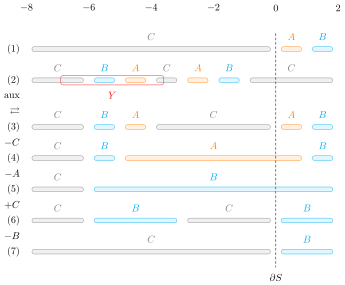
Replacing the starting main word by the auxiliary word (2) on \(-7{\lt}x{\lt}-7/2\) gives the main word \(C\mid B\mid A\mid C\mid A\mid B\) at \(-6,-5,-4,0,1\), at every value of \(x\).
Because both thresholds \(-7\) and \(-7/2\) lie in \(C\) intervals of both words, the two words agree on each interval.
Let \(a_0=1/5000\), \(\alpha \le \beta \), \(\alpha '+1/2\le \alpha \), \(\beta +1/2\le \beta '\) and \(-8\le \alpha '\), \(\beta '\le 8\). If \(y\) lies in the closed band \(\{ \alpha \le x\le \beta \} \) and \(|y-z|{\lt}a_0\min (n,d_{\mathcal V}(y))\), then \(z\) lies in the open band \(\{ \alpha '{\lt}x{\lt}\beta '\} \).
With \(m=\min (s,n-s)\) at \(y\), one has \(w=m/1000\) and \(|d|\le m\), hence \(d_{\mathcal V}(y)\le m\). If \(|y-z|{\lt}m/5000\), the parallel and normal coordinates move by less than \(m/5000\), and \(w\) is \(10^{-3}\)-Lipschitz, so \(|\beta '(w(s_z)-w(s_y))|\le 8m/(5\cdot 10^{6})\). Then \(d_z{\lt}\beta w(s_y)+m/5000\le \beta ' w(s_z)-m/2000+m/5000+8m/(5\cdot 10^6)\), and symmetrically at \(\alpha '\).
Let \(R\) be the set of points of \((0,n)^2\) with \(x{\gt}1\) for every edge, and let \(f\) be a labelling of the plane equal to \(A\) on \((0,n)^2\). For every \(y\) in the closure of \(R\) and every \(z\) with \(f(z)\ne A\),
where \(\mathcal V\) is the set of corners of \(S\) and \(a_0=1/5000\). This is the clearance estimate for the central birth in the proof of [ 287 , Lemma 7.2 ] , for any surrounding guide equal to \(A\) on the interior of \(S\). The guide after the central birth is sketched below, with the bands \(\{ 0{\lt}x{\lt}1\} \) drawn far wider than they are and their narrowing towards the corners drawn as four strings; the dots are the corners in \(\mathcal V\).
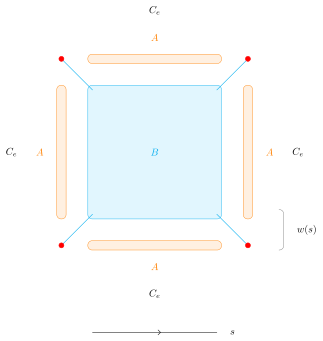
With \(u=\min (y_1,n-y_1)\) and \(v=\min (y_2,n-y_2)\), the four conditions \(d\ge w\) give \(v\ge u/1000\) and \(u\ge v/1000\). The nearest corner is at distance \(\max (u,v)\le 1000\min (u,v)\), so a point within \(a_0\min (n,d_{\mathcal V}(y))\) of \(y\) is within \(\min (u,v)/5\) of \(y\) and lies in \((0,n)^2\).
Consider one of the seven elementary births and deaths of an edge operation, and labellings \(f_b\), \(f_a\) and \(f_s\) of the plane whose normal words on \(\{ -8{\lt}x{\lt}2\} \) are its words before, after and surrounding, with \(f_b=f_a\) off that band. Let \(P_\circ \) be its surrounding label. In the clearance estimates for the edge births and deaths in the proof of [ 287 , Lemma 7.2 ] , for any guides with the stated words, every \(y\) in the closure of \(\{ f_b\ne f_a\} \) and every \(z\) with \(f_s(z)\ne P_\circ \) satisfy \(|y-z|\ge a_0\min \{ n,d_{\mathcal V}(y)\} \), where \(\mathcal V\) is the pair of endpoints of the edge.
The set \(\{ f_b\ne f_a\} \) lies in the closed band of the changed interval, which is closed. If \(|y-z|{\lt}a_0\min \{ n,d_{\mathcal V}(y)\} \), the conical band estimate puts \(z\) in the open band of the surrounding sector, where \(f_s\) equals \(P_\circ \).
Let the main labelling be \(C\) on the exterior band \(\{ -8{\lt}x{\lt}0\} \), and let the auxiliary labelling have the word (2) on \(\{ -8{\lt}x{\lt}2\} \) and be \(C\) off it. In the clearance estimate for the lens exchange in the proof of [ 287 , Lemma 7.2 ] , for any guides with the stated properties, every point \(y\) in the closure of the positions that are not \(C\) on both labellings satisfies \(|y-z|\ge a_0\min \{ n,d_{\mathcal V}(y)\} \) for every \(z\) on the boundary of the lens \(Y\).
A boundary point of \(Y\) is an endpoint of the edge, where the bound is immediate, or satisfies \(d=-7w\) or \(d=-\tfrac 72w\) with \(0{\lt}s{\lt}n\). If \(y\) lies outside the exterior band \(\{ -8{\lt}x{\lt}0\} \), then \(d_{\mathcal V}(y)\le d_{\mathcal V}(z)+|y-z|\) and \(d_{\mathcal V}(z)\le m_z=\min (s_z,n-s_z)\); a distance below \(a_0d_{\mathcal V}(y)\) is then below \(m_z/2000\), which keeps \(y\) in that band because \(-7m_z/1000\le d_z\le -\tfrac 72m_z/1000\) and \(w\) is \(10^{-3}\)-Lipschitz. If \(y\) lies in one of the closed auxiliary bands \(\{ -6\le x\le -4\} \) or \(\{ -3\le x\le -1\} \), the conical band estimate places \(z\) in the open bands \(\{ -\tfrac {13}2{\lt}x{\lt}-\tfrac 72\} \) or \(\{ -\tfrac 72{\lt}x{\lt}-\tfrac 12\} \), neither of which meets the two boundary curves.
A repainting of \(S=[0,n]^2\), \(n{\gt}0\), starts from a guide \(g\) equal to \(A\) on the open square and to one label \(C_e\) on the open exterior neighboring square across each edge \(e\). The guide after the central birth is \(B\) on the central region and \(g\) elsewhere. For a list \(E\) of edges, the completed guide replaces, for each \(e\in E\), the band \(\{ -8{\lt}x{\lt}2\} \) of \(e\) by the word \(C_e\mid B\) at \(0\). During the construction along \(e\) after the edges of \(E\), the main guide with normal word \(W\) is the completed guide with the band of \(e\) replaced by \(W\), and the auxiliary guide with normal word \(W\) is the uniform guide \(C_e\) with the band of \(e\) replaced by \(W\). The three auxiliary births and the four main births and deaths are those of Definition 45.1.3. Guides are labellings of the plane; at the start of the construction along \(e\) the schedule passes from the completed guide to the main guide with the starting word, which agrees with it off the curves \(x=0\) and \(x=1\) of the band of \(e\).
Let \(e\notin E\). On the band of \(e\), off the curves \(x=0\) and \(x=1\), the completed guide carries the word \(C_e\mid A\mid B\) at \(0,1\); so it agrees with the main guide with that word off those curves. Exchanging the starting main guide and the auxiliary guide with word (2) on the lens \(Y\) gives the main guide with word \(C_e\mid B\mid A\mid C_e\mid A\mid B\) at \(-6,-5,-4,0,1\). The auxiliary births start from the uniform word \(C_e\), the main operations start from that main word, consecutive operations on one sheet match, and the last main death leaves the completed guide for the list \(E\) with \(e\) added. Once all four edges are completed, the open square carries \(B\), and every point outside the closed square keeps its starting label.
On the band of \(e\), the bands of the completed edges are absent by the band disjointness. Where \(x{\lt}0\) the point lies in the exterior neighboring square; where \(0{\lt}x{\lt}1\) it lies in the open square and outside the central region; where \(1{\lt}x{\lt}2\) it lies in the central region, since for every other edge it lies in the open square and outside that edge’s band, so its normal ratio there is at least \(2\). The exchange is Lemma 45.1.4 on the band, and the identity off it. A point of the open square outside the central region lies in the band \(\{ 0{\lt}x\le 1\} \) of some edge, where the final word is \(B\); a point outside the closed square lies in no band or in the part \(x{\lt}0\) of a band, where the final word is \(C_e\).
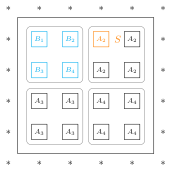
For \(n{\gt}0\) and labels \(\ell (Q)\) of the blocks \(Q\in \mathbb Z^2\), the block guide has label \(\ell (\lfloor p_1/n\rfloor ,\lfloor p_2/n\rfloor )\) at \(p\). The repainting of the block \(S=(r,s)\) to the label \(B\) starts from the block guide moved by \(-(nr,ns)\), which is \(\ell (S)\) on the open square and \(\ell \) of the neighboring block across each edge; all its guides are then moved back by \((nr,ns)\). During the pass to level \(n\), with a set of already repainted blocks, a repainted block of the root square carries its new label, another block of the root square the label of its parent \(2n\)-block, and a block outside the root square the placeholder. The picture shows one stage of the pass to level \(n\) for a root square of four blocks per side, before the repainting of the block \(S\) (labelled) to its new label; \(\ast \) is the placeholder.
Moving all guides by a vector \(o\) moves the changed regions and the obstructing sets by \(o\), and the mark distances become the distances from the moved marks; sup distances are translation invariant. A lower bound on the distance from a point to every point of a set holds for its closure.
Translation is a homeomorphism, so it commutes with closures and boundaries, and \(|(y-o)-(z-o)|=|y-z|\). The set of points at distance at least \(c\) from \(y\) is closed.
Let \(a_0=1/5000\), \(n{\gt}0\), and consider the repainting of a block \(S\) of side \(n\) from a block guide, with any block labels and any final label, through the guides that the schedule specifies at each operation. Every elementary birth or death of its schedule, the central birth and the seven births and deaths along each edge after any completed edges, has changed region \(R\) of diameter at most \(n\), and its surrounding guide \(f\) satisfies, at every point \(y\in \overline R\),
where \(\mathcal V\) is the set of corners of \(S\) for the central birth and the two endpoints of the edge otherwise. For each lens exchange, every point \(y\) in the closure of the positions that are not common \(C_e\) on its two guides before the exchange satisfies \(\operatorname {dist}(y,\partial Y)\ge a_0\min \{ n,d_{\mathcal V}(y)\} \). This is [ 287 , Lemma 7.2 ] for the labellings that the schedule specifies; for the guides sampled under the source’s tie convention it is Theorem 45.1.20. The positions inside \(Y\) that are not common \(C_e\) before the exchange, which contain the positions the exchange changes, also form a set whose closure has diameter at most \(n\); the source uses this bound in its proof of the exchange step, lines 421–424.
The guides of an edge construction are obtained from one guide of their sheet by replacing the band of the edge by a word, so they have the properties assumed in Theorems 45.1.6, 45.1.7 and 45.1.8: such a guide carries its word on the band, two such guides of one sheet agree off the band, and the starting main word is \(C_e\) on \(\{ -8{\lt}x{\lt}0\} \); the starting guide of the central birth is \(A\) on the open square. Lemma 45.1.10 identifies these guides with the guides reached by the schedule. The diameter bound is Lemma 45.1.2. The exchange changes the main guide from the starting guide to the guide with the main word, and the auxiliary guide to the starting main guide on \(Y\), so it changes only points of \(Y\) where the two sheets differ; these are not common \(C_e\). The closure of \(Y\) lies in the closed band \(\{ -7\le x\le -7/2\} \), of diameter at most \(n\) by Lemma 45.1.2, and Lemma 45.1.12 translates all estimates to \(S\).
Once the four edges of a block \(S\) of the root square are completed, the main guide agrees, off the boundary of \(S\), with the block guide in which \(S\) also carries its new label. The block guide of side \(2n\) at the end of the pass to level \(2n\) equals the block guide of side \(n\) at the start of the pass to level \(n\). The block labels of a level are the placeholder, old labels or new labels; at the start of the level no new label occurs and at its end no old label. Every normal word of an edge construction, the starting word and the words before, after and surrounding each of its births and deaths, takes only the values \(A\), \(B\), \(C_e\). Hence every value of every main or auxiliary guide of a repainting is the placeholder, an old label or a new label, and outside the closed square and its exterior bands \(\{ -8{\lt}x{\lt}0\} \) the main guides keep their starting values. The labels \(A\), \(B\), \(C_e\) of the repainting of \(S\) are owned by \(S\), its parent, a neighboring block or its parent, or the placeholder; a neighboring block differs from \(S\) by at most one in each index. These are the guide part of the invariant on active labels in [ 287 , Section 7 ] , lines 597–618; its part on tags is Lemma 45.1.28.
Inside the open square the final guide is \(B\) by Lemma 45.1.10; outside the closed square it is the starting block guide, and there the block index differs from \(S\). For the level transition, \(\lfloor x/(2n)\rfloor =\lfloor \lfloor x/n\rfloor /2\rfloor \) and a block lies in the root square of \(2M\) blocks per side if and only if its parent lies in that of \(M\) blocks. The words use only \(A\), \(B\), \(C_e\), which are values of the starting guide or the final label.
Let the side \(n\) be an integer. No cell center \((i+\tfrac 12,j+\tfrac 12)\) lies on the boundary of a block, or on the curves \(x=0\) and \(x=1\) of the band of an edge of a block. Hence, at every cell center, the guide reached at the start of the construction along an edge equals the main guide with the starting word, and the guide left by a repainting equals the block guide of the next repainting. The two replacements of guides in the schedule therefore leave the labels at the lattice sites unchanged, as in the sampling convention of [ 287 , Section 7 ] , lines 62–80.
Say that a labelling \(f'\) of the plane reads a labelling \(f\) after the displacement \(v\) if \(f'(p)=f(p+\varepsilon v)\) for every point \(p\) and all sufficiently small \(\varepsilon {\gt}0\). If \(f_1'\) and \(f_2'\) read \(f_1\) and \(f_2\) after the same \(v\), then the set where \(f_1'\ne f_2'\) lies in the closure of the set where \(f_1\ne f_2\); the set where \(f'\ne c\) lies in the closure of the set where \(f\ne c\); and the positions, inside an open set or anywhere, that are not common \(C\) on \(f_1'\) and \(f_2'\) lie in the closure of those on \(f_1\) and \(f_2\). Hence the estimates of Theorem 45.1.13 hold, with the same constant \(a_0=1/5000\), for any labellings that read the guides of the schedule after one displacement \(v\), whatever \(v\) is.
If \(f_1=f_2\) near \(p\), then \(f_1(p+\varepsilon v)=f_2(p+\varepsilon v)\) for all small \(\varepsilon {\gt}0\), so \(f_1'(p)=f_2'(p)\). Off the closure of the set where \(f_1\ne f_2\) the two labellings agree near every point. A constant labelling reads itself. All estimates of Theorem 45.1.13 are stated for closures, which can only shrink.
Let \(v\) be any vector. The block guide, every guide of the repainting of a block (after the central birth, after completed edges, and along an edge with a normal word on its band, on the main or on the auxiliary sheet), and each of these guides homogenized on the open squares of radius \(t\) about finitely many grid corners, have exactly one reading after \(v\): at every point \(p\) the label at \(p+\varepsilon v\) is the same for all small \(\varepsilon {\gt}0\).
Along a ray \(\varepsilon \mapsto p+\varepsilon v\) the coordinates, the parallel and normal coordinates of an edge, and the band width \(w(s)=10^{-3}\min (s,n-s)\) agree for small \(\varepsilon {\gt}0\) with affine functions \(a+b\varepsilon \). Such a function has, for small \(\varepsilon {\gt}0\), a constant sign: that of \(a\) if \(a\ne 0\), and that of \(b\) otherwise. Hence every strict inequality between such functions, and every bound \(x{\lt}t\) on the normal ratio \(x=d/w(s)\), is eventually decided; the floor \(\lfloor a+b\varepsilon \rfloor \) is eventually \(\lfloor a\rfloor \) if \(b\ge 0\) and \(\lceil a\rceil -1\) if \(b{\lt}0\). The bands, the central region, the sup squares and the blocks are finite Boolean combinations of such conditions, and a guide is a finite choice among them. Two readings agree, since both are the eventual label.
The source specifies each guide by its open polygonal chambers and reads it at a point after one small generic displacement into an incident chamber ( [ 287 , Section 7 ] , lines 69–80). The guides of the schedule take, on an interface curve \(x=t\), the label for \(x\ge t\), while a fixed displacement \(v\) whose two components are not small relative to each other crosses to \(x{\gt}t\) along two edges of a square and to \(x{\lt}t\) along the other two; the two conventions differ on the interface curves of those two edges. Lemma 45.1.17 shows that the guides of the schedule have readings after every displacement, and Lemma 45.1.16 gives the clearance estimates of Lemma 7.2 for every such reading, on all four edges. The next three results identify the source’s sampled guides with these readings and state Lemma 7.2 for them.
The open chamber of a label \(l\) of a labelling \(f\) of the plane is the interior of \(f^{-1}(l)\). A labelling \(g\) is sampled from the open chambers of \(f\) after the displacement \(v\) if, at every point \(p\), the point \(p+\varepsilon v\) lies in the open chamber of the label \(g(p)\) for all sufficiently small \(\varepsilon {\gt}0\); such a \(g\) reads \(f\) after \(v\), and two of them agree. The source’s open polygonal chambers are modelled in this way as the interiors of the label regions of the labellings that the schedule specifies: these agree with the source’s descriptions on every open chamber, merging adjacent chambers of one label does not change the sampled label, and a label confined to boundaries is never sampled. Let \(T=\{ -8,-6,-5,-4,-3,-2,-1,0,1,2\} \), the values of the normal ratio at which a guide of the schedule, or the region of a band that a word replaces, can have a boundary, and let \(\mathcal N\) be the set of the vectors \((\pm t,1000)\) and \((1000,\pm t)\) with \(t\in T\). A displacement \(v\) is generic if \(N\cdot v\ne 0\) for every \(N\in \mathcal N\): it is parallel to none of the lines with normals in \(\mathcal N\), so it avoids finitely many lines through the origin. The vector \((1,1)\) is generic, and so is every nonzero multiple of a generic vector.
The block guide, every guide of the repainting of a block (after the central birth, after completed edges, and along an edge with a word of the construction on its band, on the main or on the auxiliary sheet), and each of these homogenized on the open squares of radius \(t\) about finitely many grid corners, is constant near every point off a set that lies near every point in finitely many lines with normals in \(\mathcal N\). So its open chambers are the open sets on which it is constant, off a locally finite family of segments. Consequently, for every generic displacement \(v\), each of these guides has exactly one guide sampled from its open chambers after \(v\), and a labelling is sampled from its open chambers after \(v\) if and only if it reads it after \(v\).
In the edge coordinates of a square of side \(n\), the interface curve \(x=t\) of a band is \(1000\, d=t\min (s,n-s)\), a union of two segments on lines with normals \((\pm t,1000)\) or \((1000,\pm t)\), and \(w(s)=0\) only on the lines \(s=0\) and \(s=n\). The edges, the sides of the treated squares and the grid lines are lines with \(t=0\), and near every point only two grid lines in each direction can occur. A strict inequality between continuous functions is locally constant where the two sides differ; the bound \(d/w(s){\lt}t\) is locally constant where \(w(s)\ne 0\) and \(d\ne t\, w(s)\); the integer part of a continuous function is locally constant where the function is not an integer. The guides are finite Boolean combinations and choices among such conditions, and the thresholds of the bands and of the words of the construction lie in \(T\). A line not parallel to \(v\) meets the ray \(p+\varepsilon v\) in at most one point, so for generic \(v\) and small \(\varepsilon {\gt}0\) the point \(p+\varepsilon v\) avoids the walls, where the guide is locally constant; with the eventual label of Lemma 45.1.17 it lies in the open chamber of that label.
Let \(a_0=1/5000\), \(n{\gt}0\), and let \(v\) be a generic displacement. The guides of the repainting of a block \(S\) of side \(n\), read as in the source by sampling their open chambers after \(v\), exist, and the estimates of Theorem 45.1.13 hold for them: every elementary birth or death has changed region of diameter at most \(n\) and satisfies 4 for its sampled surrounding guide, and every point \(y\) in the closure of the positions that are not common \(C_e\) on the two sampled guides before a lens exchange satisfies \(\operatorname {dist}(y,\partial Y)\ge a_0\min \{ n,d_{\mathcal V}(y)\} \). This is [ 287 , Lemma 7.2 ] under the source’s tie convention, lines 69–80, with the source’s hypotheses. It covers every elementary birth and death, the central birth and the three auxiliary births and four main births and deaths along each edge after any completed edges, and every lens exchange. The block labels and the final label are arbitrary, so any of the labels \(A\), \(B\), \(C_e\) may coincide, also with the placeholder carried by the blocks outside the root square. Distances are sup distances in the plane, and the obstructing sets are closures in the plane. The constant \(a_0\) is an absolute number, fixed before the scale \(D\) of the information estimate is chosen.
Let \(0{\lt}t\le n\) and \(h_n=\epsilon _0\min (n,t)=\epsilon _0t\). Homogenize every involved guide of an elementary operation to its surrounding label (to \(C_e\) for an exchange) on the open sup squares of radius \(t\) about its marks. In this logarithmic floor from [ 287 , Section 7 ] (lines 357–367, with \(a_1=a_0\)), every point \(y\) of the closure of the remaining changed region satisfies \(|y-z|\ge a_0\max \{ t,\min (n,d_{\mathcal V}(y))\} \) for every position \(z\) of another label in the homogenized surrounding guide, and every point \(y\) of the closure of the remaining positions that are not common \(C_e\) satisfies the same bound for every point \(z\) of \(\partial Y\).
Homogenization only removes changed positions, only inside the treated squares, and only removes other-label positions. A point of the closure of the remaining changed region lies outside the open treated squares, so \(d_{\mathcal V}(y)\ge t\) and \(\min (n,d_{\mathcal V}(y))\ge t\), and Theorem 45.1.13 gives the bound.
A true vertex, a point in the closures of the regions of three distinct labels, lies in the closure of the positions of labels other than any given label. In the enlargement of [ 287 , Section 7 ] (lines 368–373), if \(2\epsilon _0\le a_0/2\), every point within \(2\epsilon _0t\) of a true vertex of the homogenized surrounding guide lies at distance at least \(\tfrac {a_0}2\max \{ t,\min (n,d_{\mathcal V}(y))\} \) from every point \(y\) of the closure of the remaining changed region, for the central birth and for every birth or death along an edge.
Of three distinct labels at least one differs from the given label. With \(Q=\max \{ t,\min (n,d_{\mathcal V}(y))\} \ge t\), the floor gives \(|y-c|\ge a_0Q\) at the vertex \(c\), hence \(|y-x|\ge a_0Q-2\epsilon _0t\ge a_0Q-\tfrac {a_0}2t\ge \tfrac {a_0}2Q\).
Let \(g\) and \(h\) be \(1\)-Lipschitz functions, \(a,t{\gt}0\) and \(2\epsilon _0(a+1)\le a/2\). If a center \(c\) satisfies \(g(c)\ge aQ_c\) with \(Q_x=\max \{ t,\min (n,h(x))\} \), then every \(x\) with \(|x-c|\le 2\epsilon _0t\) satisfies \(g(x)\ge \tfrac a2Q_x\). As in [ 287 , Section 7 ] (lines 400–415), with \(g\) the distance from a point of the lens boundary, \(h\) the mark distance, and \(2\epsilon _0(a_0+1)\le a_0/2\), every point within \(2\epsilon _0t\) of a true vertex of either homogenized sheet of an exchange lies at distance at least \(\tfrac {a_0}2\max \{ t,\min (n,d_{\mathcal V}(x))\} \) from the lens boundary.
With \(\delta =|x-c|\) one has \(Q_x\le Q_c+\delta \) and \(g(x)\ge g(c)-\delta \), so \(g(x)\ge aQ_x-(a+1)\delta \ge aQ_x-2\epsilon _0(a+1)t\ge aQ_x-\tfrac a2Q_x\). A true vertex of either sheet lies in the closure of the noncommon-\(C_e\) positions, so it has the floor of Lemma 45.1.21.
A closed sup square every point of which is at distance at least \(b{\gt}0\) from the boundary of a set \(Y\) lies in \(Y\) or in its complement. In particular, let \(0{\lt}t\le n\) and \(2\epsilon _0(a_0+1)\le a_0/2\); then the outer hole square of radius \(2\epsilon _0t\) about a true vertex of either homogenized sheet of an exchange lies in the lens \(Y\) or in its complement. As in [ 287 , Section 7 ] (lines 403–405 and 421–429), a point \(x\) at distance at least \(b\) from every point of the boundary of \(Y\) is at distance at least \(b\) from every point on the other side of \(Y\).
A preconnected set missing the boundary of \(Y\) is covered by the disjoint open sets \(\operatorname {int}Y\) and the complement of \(\overline Y\), so it lies in one of them; closed squares and segments are convex. By Lemma 45.1.23 every point of an outer hole square is at distance at least \(\tfrac {a_0}2t{\gt}0\) from \(\partial Y\). The segment from \(x\) to a point \(z\) on the other side meets \(\partial Y\) at some \(w\) with \(|x-w|+|w-z|=|x-z|\).
The labels incident at a point \(c\) of a guide are those whose region has \(c\) in its closure; a true vertex is a point with three distinct incident labels. A label may hold the tag of a true vertex if it is incident there and is not the placeholder. A tag rule chooses one such label at every true vertex, as in [ 287 , Section 7 ] , lines 109–125.
Two guides that agree near \(c\) have the same incident labels at \(c\), and a point with at most two incident labels is not a true vertex.
Let the closure of the set where two guides differ lie in an open set \(U\) on which both take only the values \(P\) and \(Q\). Then the two guides have the same true vertices; each lies outside \(U\) and has the same incident labels in both guides.
Let two guides \(h_1,h_2\) both equal \(C\) on an open set \(U\) containing \(\partial Y\), and let \(h\) be \(h_2\) on \(Y\) and \(h_1\) off \(Y\). Then \(h\) has a true vertex at \(c\) if and only if \(c\in Y\) and \(h_2\) has one there, or \(c\notin Y\) and \(h_1\) has one there; it then has the incident labels of that guide at \(c\).
A true vertex of a guide homogenized to \(P\) on an open set \(U\) is either a true vertex of the guide off \(\overline U\), or a point of \(\partial U\) at which two distinct labels other than \(P\) of the guide meet.
Closures at \(c\) depend only on a neighborhood of \(c\). In the first case a point outside \(\overline{\{ f\ne g\} }\) has a neighborhood where the guides agree, and a point of \(U\) has one where both take only two values. In the second, a point of \(U\) has only the incident label \(C\), and a point off \(\partial Y\) lies in the interior of \(Y\) or of its complement. In the third, a point of \(U\) has only the incident label \(P\), a point off \(\overline U\) has a neighborhood where homogenization does nothing, and homogenization adds at most the label \(P\) to the incident labels.
For a repainting baseline of side \(n\) and any real \(t\le n\), let \(g_0\) and \(g_1\) be its starting and central guides homogenized to the old label \(A\) on the open corner squares of radius \(t\). If a point \(p\) is at distance strictly less than \(a_0t\) from some point where \(g_0\ne g_1\), then \(g_0(p)=A\) and \(g_1(p)\in \{ A,B\} \), where \(B\) is the final label. Since \(a_0{\gt}0\), this assertion is vacuous for \(t\le 0\).
Now let \(0{\lt}t\le n\). Each of the seven births and deaths of an edge construction introduces a single label: at every changed normal ratio the words before and after take only the surrounding label and one further label. Homogenize the guides of an elementary birth or death, the central birth included, to its surrounding label on the treated squares of radius \(t\). Then the guides before and after have the same true vertices, each at distance at least \(a_0t\) from the closure of the remaining changed region and with the same incident labels, so with the same tag holders; its outer hole square, of radius \(2\epsilon _0t\), misses the closed change once \(2\epsilon _0{\lt}a_0\). Homogenize both sheets of a lens exchange to \(C_e\) on the treated squares. Both are \(C_e\) on the open neighborhood of radius \(a_0t\) of \(\partial Y\), and each exchanged guide has inside \(Y\) exactly the true vertices and incident labels of the sheet it takes there, and outside \(Y\) those of the other sheet. These are the statements of [ 287 , Section 7 ] , lines 375–382 and 389–398.
By the logarithmic floor of Lemma 45.1.21, the homogenized surrounding guide is \(P_\circ \) on the open neighborhood of radius \(a_0t\) of the remaining changed region. On that neighborhood both guides take only the values \(P_\circ \) and the inserted label (off the changed region they agree with the surrounding guide, and on it they carry the operation’s words outside the treated squares), so the first part of Lemma 45.1.26 applies. For the exchange, a point within \(a_0t\) of \(\partial Y\) that is not common \(C_e\) would contradict the floor, so the second part applies. A point within \(2\epsilon _0t{\lt}a_0t\) of a retained true vertex is closer to it than any point of the closed change.
The source’s further conclusions at lines 383–387, that the physical target of the bulk change lies outside all holes, satisfies the tapering hypothesis and leaves a single-owner physical buffer, so that the birth lemma implements it, belong to the protocol and are not formalized here.
A true vertex has at least two incident labels other than the placeholder, so a tag holder exists, and guides with the same incident labels at a point have the same tag holders there. Tag holders are values of the guide other than the placeholder. Hence at the start of the pass to level \(n\) only labels of \(2n\)-blocks hold main tags; at every repainting boundary during it, and in every main or auxiliary guide of a repainting, only labels of \(2n\)- and \(n\)-blocks do; and at its end only labels of \(n\)-blocks: a party of side \(2n\) has disappeared from every main tag by the end of level \(n\). During the edge construction along an edge \(e\), the label \(C_e\) with which its auxiliary sheet is initialized is a value of the main guide at that moment. These are the tag part of the invariant on active labels, with a tag held by an incident label other than the placeholder, and the selection of \(C\) in the statement on frozen auxiliary frames, of [ 287 , Section 7 ] , lines 610–612 and 625–627.
Of three distinct incident labels at most one is the placeholder. An incident label is a value of the guide, and the block labels of a level are described by Lemma 45.1.14. The current main guide agrees with the starting guide outside the closed square and outside the outer band of \(e\), and the starting guide is \(C_e\) on the neighboring block across \(e\), which reaches outside that band.
Here the tag of a true vertex is identified with an incident label other than the placeholder chosen by a tag rule. The source’s statement that the protocol updates the stored tag at a junction by the corner rewrite of its last incident child square (lines 613–614), and the retirement of frozen frames (lines 620–631), concern the registers of the protocol of Proposition 7.1 and are not formalized here.
Let finitely many compact sets \(F_c\) in a metric space be such that no three with distinct labels have a common point. Then there is \(\delta {\gt}0\) such that no closed ball of radius \(\delta \) meets three of them with distinct labels. If the \(F_c\) are compact sets of pairs of a parameter and a point, one \(\delta \) works for all values of the parameter. In particular, let a guide take finitely many values, let \(W\) be a compact working neighborhood, and let every true vertex in \(W\) lie in one of the open inner hole squares. Then there is \(\delta {\gt}0\) such that every closed footprint of radius \(\delta \) meets at most two labels at its points of \(W\) outside the open inner holes. This is the abstract compactness argument of [ 287 , Section 7 ] , lines 453–462 and 475–479, and its parametric form, lines 464–469, for compact joint sets.
For three compact sets without a common point, \(\max (|y_1-y_2|,|y_1-y_3|)\) attains a positive minimum on their product; take a third of the smallest of these minima over the finitely many triples. For the parameters, apply this in the product space, where points with the same parameter are at the distance of their second coordinates. For the guide, take \(F_c\) the closure of the region of \(c\) in \(W\) with the open inner holes removed; a common point of three of them would be a true vertex outside every inner hole.
Say that a guide satisfies the two-owner condition with working set \(W\), hole centers \(H\), inner radius \(r\) and footprint radius \(\delta \) if every closed footprint of radius \(\delta \) meets at most two labels at its points of \(W\) outside the open inner holes of radius \(r\) about the points of \(H\). This condition survives shrinking \(\delta \), identifying labels, and enlarging some of the inner holes, so it holds as well when the holes have different radii, all at least \(r\). It is carried by the similarity \(u\mapsto v+su\), \(s{\gt}0\), to the image guide, working set and hole centers with the radii \(sr\) and \(s\delta \). For a guide with finitely many values and a compact \(W\), the pairs of a radius \(r\in [r_0,r_1]\) and a point of \(W\) in the closure of the region of one label and outside the open inner holes of radius \(r\) form a compact set. Hence, if every true vertex in \(W\) lies in an open inner hole of radius \(r_0{\gt}0\), one footprint radius works for every \(r\in [r_0,r_1]\). Consequently, for finitely many template guides with this property there is one ratio \(\nu {\gt}0\) such that every relabelled image of a template under a similarity of ratio \(s{\gt}0\) satisfies the two-owner condition with inner radius \(sr\), \(r\in [r_0,r_1]\), and footprint radius \(\nu s\). This is the uniformity argument of [ 287 , Section 7 ] , lines 464–479, with the joint sets of lines 465–468 and the minimum over finitely many label-equality types of lines 469–471.
Being outside an open square is the non-strict inequality \(r\le |y-h|\), which is closed in the pair \((r,y)\); with \(r\in [r_0,r_1]\) and \(y\in W\) the joint sets are compact. Three of them with distinct labels have no common point, since a common point \(y\) would be a true vertex with \(r_0\le r\le |y-h|{\lt}r_0\) for some \(h\); the parametric form of Lemma 45.1.29, minimized over the finitely many templates and pushed forward by the similarity (which multiplies all sup distances by \(s\)), gives \(\nu \).
Let \(u{\gt}0\). Every point is within distance less than \(u\) of the net \(u\mathbb Z^2\). A set inside a closed ball of radius \(\rho \) is covered by the inner squares of radius \(u\) about at most \((2(\rho +u)/u+1)^2\) net points, each within \(u\) of the set, and the outer square of radius \(2u\) about such a net point lies within \(3u\) of the set. For a fixed ratio \(\nu {\gt}0\), with \(u=\nu t\) and \(\rho =O(t)\), or \(u=\nu n\) and \(\rho =O(n)\), the number of patches is bounded independently of the scale, as in [ 287 , Section 7 ] , lines 491–499 and 520–525.
Rounding each coordinate down to the net places every point within \(u\) of \(u\mathbb Z^2\), and the net coordinates within \(\rho +u\) of a coordinate of the center form an interval of at most \(2(\rho +u)/u+1\) integers.
As in [ 287 , Section 7 ] (lines 511–516 and 529–533), for \(\epsilon _0\ge 0\) and \(h_n=\epsilon _0\min (n,t)\), if \(0{\lt}n\le K_0t\) with \(t{\gt}0\), then \(\epsilon _0/\max (K_0,1)\le h_n/n\le \epsilon _0\); if \(n,t\ge 0\), then \(h_n\le \epsilon _0\min (2n,t)\le 2h_n\), and the two radii differ only when \(n{\lt}t\).
If \(n\le t\) the ratio is \(\epsilon _0\); otherwise it is \(\epsilon _0t/n\), which lies between \(\epsilon _0/K_0\) and \(\epsilon _0\), while comparing \(\min (2n,t)\) with \(\min (n,t)\) in the two cases \(n\le t\) and \(t\le n\) gives the resizing bounds.
Let \(n{\gt}0\). The true vertices of a block guide are grid corners \((na,nb)\). Changing the label of one block \(S\) changes the true-vertex status, and the incident labels at a true vertex, only at the four corners of \(S\); in particular this holds for the direct repainting of a block of the root square during a level. Every other grid corner is at distance at least \(n\) from the closed block \(S\). These are the facts on true vertices and untouched holes used for the direct repainting in [ 287 , Section 7 ] , lines 507–527.
Near a point whose first coordinate is not a multiple of \(n\), the first block index is constant and the second takes at most two values, so at most two labels occur; similarly for the second coordinate. Off the closed block \(S\) the two guides agree near the point. A grid corner in the closed block is one of its corners, and a grid corner differing by at least \(2\) or by \(-1\) in a block index is at distance at least \(n\) in that coordinate.
Distinct grid corners are at distance at least \(n\). Hence for \(n{\gt}20t\) the squares of radius \(10t\) about distinct grid corners are disjoint and contain no other grid corner. Let \(\sigma \) be the parallel distance from an endpoint of an edge, so \(\sigma =s\) at the first endpoint and \(\sigma =n-s\) at the second. In the open square of radius \(n/2\) about the endpoint, a band \(\{ \alpha {\lt}x{\lt}\beta \} \) is the cone \(\{ \sigma {\gt}0,\ \alpha \sigma /1000{\lt}d{\lt}\beta \sigma /1000\} \), so its interfaces are straight rays. A point of the curve \(x=\alpha \), \(|\alpha |\le 8\), with \(0{\lt}\sigma \le n/2\), on the rim of the square of radius \(t\) about the endpoint is the point \(\sigma =t\), \(d=\alpha t/1000\); rays of one edge with \(|\alpha -\alpha '|\ge 1/2\) meet that rim at points at distance at least \(t/2000\), and the closed squares of radius \(2\epsilon _0t\) about them are disjoint once \(\epsilon _0{\lt}1/8000\). These are among the separations used for the choice of \(K_0\) and \(\epsilon _0\) in [ 287 , Section 7 ] , lines 341–351.
Distinct grid corners differ by at least \(1\) in some block index. On \(\sigma \le n/2\) one has \(w=\sigma /1000\). On the curve \(|d|=|\alpha |\sigma /1000{\lt}\sigma \), so the distance from the endpoint is \(\sigma \). The two rim points differ only in \(d\), by \(|\alpha -\alpha '|t/1000\).
Call a guide of the repainting of a block from a block guide unmodified if it is the starting block guide, the guide after the central birth, a guide after completed edges, or a main or auxiliary guide along an edge whose band carries one of the normal words of that sheet. The auxiliary words are the uniform word, the words after the three auxiliary births, and the word \(C\mid A\mid B\mid C\) with interfaces \(-3,-2,-1\) left by the lens exchange, to which the point treatment of the exchange is removed before the auxiliary sheet is retired. Every unmodified guide takes at most two labels near every point that is not a grid corner, so all its true vertices are grid corners. Consequently, for \(n{\gt}20t\), the closed square of radius \(10t\) about a grid corner contains no true vertex of an unmodified guide other than that corner. This is the observation of [ 287 , Section 7 ] , lines 321–326, and the clause of the choice of \(K_0\), lines 341–343, that the tenfold enlargements contain no other unmodified true vertex.
A normal word is constant just below every point and from the point on, so near a point it takes at most two values. Inside the open band of an edge a guide carrying a word therefore takes at most two labels near each point. On the curve \(x=-8\), away from the endpoints, the word is \(C_e\) and the guide beyond the band is the label \(C_e\) of the neighboring block. On the curve \(x=2\) the word of the main sheet is \(B\), and the curve lies in the open central region and off the closed bands of the other edges, so the guide beyond the band is \(B\) as well; the auxiliary sheet is \(C_e\) on both sides. Off the closed band nothing changes. The closure of the central region meets the boundary of the square only at its corners, so near any other point of that closure the guide takes only \(A\) and \(B\). The corners of the square are grid corners, a block guide takes at most two labels near every other point, and distinct grid corners are at distance at least \(n\) by Lemma 45.1.34.
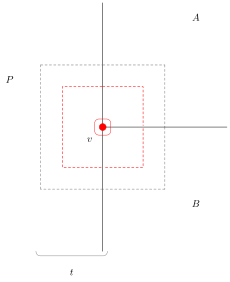
For a point \(v\) and \(t{\gt}0\), the rim pattern about \(v\) consists of the points \(v+(\sigma t,jt/1000)\) and \(v+(jt/1000,\sigma t)\) with \(\sigma =\pm 1\) and \(j\in \mathbb Z\), \(|j|\le 6\): on each side of the rim of the square of radius \(t\) about \(v\), thirteen points at spacing \(t/1000\) about the midpoint of the side. It is finite, its points are at distance \(t\) from \(v\), and distinct points are at distance at least \(t/1000\). Off the grid lines and off the curves \(x=k\), \(k\in \{ -6,\dots ,1\} \), of the bands of the four edges, every unmodified guide is constant near each point. Let \(2t{\lt}n\). A point at distance \(t\) from a grid corner that lies on a grid line, or on one of these curves of an edge of the block, lies in the rim pattern of that corner: the grid line passes through the corner, and the curve belongs to one of the two edges ending at the corner. Hence every point of the rim about a grid corner at which an unmodified guide has two distinct incident labels lies in the rim pattern. This is the finite pattern of rim intersection points of [ 287 , Section 7 ] , lines 344–349, with the rays of both adjacent edges and the grid lines. The source’s illustration of a point treatment for three distinct labels is redrawn below in units of \(t\): homogenizing the open square of radius \(t\) about the true vertex to \(P\) moves the meeting point of \(P\), \(A\) and \(B\) to the midpoint of the right side of the rim, a point of the rim pattern.
 \(\longrightarrow \)
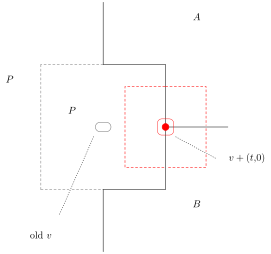
A word is constant near every point other than its interfaces, and the interfaces of the main and auxiliary words are integers from \(-6\) to \(1\); the boundary of the central region lies on the curves \(x=1\). For a point on a grid line, the line is within \(t{\lt}n/2\) of the corner, so it passes through the corner, and the point is the midpoint of a side of the rim. For a point on a curve of an edge, its normal coordinate is at most \(6\cdot 10^{-3}\min (s,n-s)\) in absolute value, so the corner has normal coordinate \(0\) and parallel coordinate \(0\) or \(n\); the straight-ray chart of Lemma 45.1.34 then places the point at parallel distance \(t\) and normal coordinate \(kt/1000\). Distinct pattern points on one side differ by at least \(t/1000\) along it, and points on different sides differ by at least \((1-6/1000)t\) in one coordinate.
Let \(20t{\lt}n\), let \(\mathcal M\) be a finite set of grid corners and \(P\) a label, and homogenize an unmodified guide to \(P\) on the open squares of radius \(t\) about the corners of \(\mathcal M\). Every true vertex of the resulting guide is a grid corner or a point of the rim pattern of a corner of \(\mathcal M\), and distinct true vertices are at distance at least \(t/1000\). Hence for \(\epsilon _0{\lt}1/4000\) the closed outer hole squares of radius \(2\epsilon _0t\) about distinct true vertices are disjoint. The same holds for every reading of the homogenized guide after a displacement, and such a reading exists after every displacement. This is the conclusion of [ 287 , Section 7 ] , lines 347–351, that the outer holes are disjoint in the temporary guides, for the separations of the true vertices; the further smallness of \(\epsilon _0\) compared with \(a_0\) enters through Lemma 45.1.22.
By Lemma 45.1.26 a true vertex of the homogenized guide is an old true vertex off the closed treated squares, a grid corner by Lemma 45.1.35, or a point of a treated rim with two incident labels, in the rim pattern by Lemma 45.1.36. Two rim points about one corner are separated by the pattern. Otherwise the two points belong to distinct grid corners, at distance at least \(n\), and each lies within \(t\) of its corner, so they are at distance at least \(n-2t{\gt}t/1000\). A point of the region of a label in a reading is a limit of points of that region in the guide, so a true vertex of a reading is a true vertex of the guide; readings exist by Lemma 45.1.17.
Fix \(\epsilon _0{\gt}0\). There is a ratio \(\nu {\gt}0\) with the following property. Let \(8t{\lt}n\), consider the repainting of a block \(S\) of side \(n\) from a block guide, an unmodified guide of it, a corner \(v\) of \(S\), and either no homogenization or the homogenization, on the open square of radius \(t\) about \(v\), to the final label or to the label of one of the nine blocks around \(S\). Then the resulting guide satisfies the two-owner condition with working set the closed square of radius \(2t\) about \(v\), holes at its true vertices within \(3t\) of \(v\), inner radius \(\epsilon _0t\) and footprint radius \(\nu t\). The same holds, about each corner of \(S\) in a finite set \(\mathcal M\) of grid corners, for the guide homogenized to one such label on the open squares of radius \(t\) about all corners of \(\mathcal M\) at once. This is the uniformity of the patch ratio near a mark in [ 287 , Section 7 ] , lines 464–479 and 481–505: in units of \(t\) the guides come from finitely many ray patterns, with or without the square clearing. Its patches have inner radius \(u=\nu t/2\), since their outer squares have radius at most \(2u\). The same ratios hold for the readings of these guides after a small displacement (Theorem 45.1.40).
Scaling by \(1/n\) carries the bands, their normal ratios and the central region of the block of side \(n\) to those of the unit square, so every unmodified guide is an unmodified guide of the repainting of the unit square composed with the scaling. Relabelling commutes with replacing a band by a word and with the central birth, so near the corner the guide is the relabelling by the window labels of an unmodified guide of one reference repainting, whose labels are the nine blocks around \((0,0)\) and the final label. On the unit square the bands, the normal ratios, the central region and the block guide are conical about each corner within distance \(1/2\), by the straight-ray charts of Lemma 45.1.34; so are the unmodified guides, and the scale \(t/n{\lt}1/8\) can be replaced by \(1/32\). The reference repainting has finitely many unmodified guides, since a guide after completed edges depends only on which edges are completed. Choosing for each label-equality type a representative map of the finitely many slots expresses the guide near \(v\) as an injective relabelling of one of finitely many templates; since injective relabellings and similarities preserve true vertices, Lemma 45.1.30 applies. Near one corner of \(\mathcal M\) the other treated squares are at distance more than \(n-5t{\gt}3t\), so homogenizing on all of them agrees with homogenizing on its square alone within distance \(4t\) of the corner, which contains the working set and the holes.
Fix \(\rho \) and \(0{\lt}r_0\le r_1\). There is a ratio \(\nu {\gt}0\) such that every guide uniform on the blocks of side \(s{\gt}0\), about every grid corner \(v\) and for every inner radius \(r\in [r_0s,r_1s]\), satisfies the two-owner condition with working set the closed square of radius \(s\rho \) about \(v\), holes at its true vertices within \(s(\rho +1)\) of \(v\), and footprint radius \(\nu s\). In particular, for fixed \(\epsilon _0{\gt}0\) and \(K_0\), one ratio serves every direct repainting of a square of side \(0{\lt}n\le K_0t\), before and after, with inner radius \(h_n\) and working set the closed square of radius \(2n\) about a corner of the square; and one ratio serves every resizing with \(0{\lt}n{\lt}t\), with both radii \(h_n\) and \(h_{2n}\) on the guide uniform on the blocks of side \(2n\) and working set of radius \(2n\), and also when some holes have radius \(h_n\) and the others \(h_{2n}\). These are the compactness arguments of [ 287 , Section 7 ] , lines 515–520 and 534–538, in units of \(n\), with the intermediate configurations of lines 538–540.
In units of \(s\) about a grid corner, a block guide is the block guide of side one whose labels are those of a fixed square window of blocks, so it is an injective relabelling of one of finitely many templates (one for each label-equality type of the window), to which Lemma 45.1.30 and Lemma 45.1.32 apply for the radius ratios; when \(n{\lt}t\) the radius \(h_n=\epsilon _0n\) and \(h_{2n}=\epsilon _0\min (2n,t)\) lie between \(\epsilon _0n\) and \(2\epsilon _0n\). Since \(h_n\le h_{2n}\), a configuration with some holes resized has larger holes than the one with all radii \(h_n\).
There is a ratio \(\nu {\gt}0\), depending only on the fixed constants, such that for every generic displacement \(v\) the conclusions of Theorems 45.1.38 and 45.1.39 hold for every labelling that reads the guides concerned after \(v\), with holes at its own true vertices. These are the source’s sampled guides, by Lemma 45.1.19; the point-treated guides are also constant off finitely many lines with normals in \(\mathcal N\) near every point, so the same holds for them. As in [ 287 , Section 7 ] , lines 73–77 and 559–563, the ratio is chosen before the displacement, which is chosen only after all the guides are specified.
A reading takes only values of the labelling. If a guide agrees on an open square about \(c\) with \(u\mapsto \sigma (T((u-c)/s))\) for a template \(T\), then every reading of the guide after \(v\) agrees there with \(u\mapsto \sigma (T'((u-c)/s))\) for the reading \(T'\) of \(T\) after \(v\), since \((u+\varepsilon v-c)/s=(u-c)/s+(\varepsilon /s)v\). The templates of the point treatment and of the block guides are eventually constant along rays, so they have readings after \(v\). They are also constant off walls on lines with normals in the finite set \(\mathcal N\). Let \(v\) and \(w\) lie strictly on the same side of each line through the origin with normal in \(\mathcal N\). For a point \(p\) and small \(\varepsilon {\gt}0\), the segment from \(p+\varepsilon v\) to \(p+\varepsilon w\) stays near \(p\) and avoids the walls that miss \(p\); a wall through \(p\) with normal \(N\) meets it only where \(N\cdot ((1-a)v+aw)=0\) for some \(a\in [0,1]\), which is impossible because \(N\cdot v\) and \(N\cdot w\) have the same sign. So the template is locally constant along the segment, hence constant on it, and its readings after \(v\) and after \(w\) agree. A template therefore has at most one reading for each choice of sides of the finitely many wall directions, and only finitely many readings after generic displacements, so the compactness argument of Lemma 45.1.30 applies to these finitely many readings of the finitely many templates.
Let \(g'\) be a labelling that reads, after any displacement, the guide uniform on the blocks of side \(s{\gt}0\), and let every true vertex of \(g'\) within \(s\) of the working set \(W\) be a hole center. Then every footprint radius \(\delta \) with \(2\delta {\lt}r\) and \(2\delta {\lt}s\) gives the two-owner condition with working set \(W\) and inner radius \(r\).
In particular, let \(\epsilon _0{\gt}0\), \(\nu _1=\min (\epsilon _0,1)/8\) and \(\nu \le \nu _1\). For \(0{\lt}n{\lt}t\), every reading of a guide uniform on the \(2n\)-blocks satisfies the two-owner condition with working set the closed square of radius \(2n\) about a grid corner, holes at its true vertices within \(4n\) of that corner, each of radius \(h_n\) or \(h_{2n}\), and footprint radius \(2\nu n\). Hence the ratio of Theorem 45.1.40 for the resizings can be taken equal to \(\nu _1\), in place of the minimum given by the compactness observation of [ 287 , Section 7 ] , lines 447–479 and 529–541.
A reading of a block guide carries the label of a block on the open interior of that block, so a grid corner lies in the closure of the label of each of its four blocks. Let three points of a footprint outside the holes carry three labels. Move them by the displacement, by less than \(\min (r-2\delta ,s-2\delta )/4\); the moved points are pairwise closer than \(s\), so their block indices differ by at most one in each coordinate. Three distinct labels need three distinct blocks among the four blocks about one grid corner, and two of them are diagonal to each other. That corner is a true vertex, and it lies within \(2\delta \) plus the displacement of a footprint point, hence within \(r\) and within \(s\) of it. So the corner is a hole center and the footprint point lies in its hole, a contradiction. For the resizings, \(s=2n\) and the smallest radius is \(h_n=\epsilon _0n\), so \(\nu \le \nu _1\) gives \(2\cdot 2\nu n\le \epsilon _0n/2{\lt}h_n\) and \(2\cdot 2\nu n\le n/2{\lt}2n\). A true vertex within \(2n\) of the working set lies within \(4n\) of the corner. Holes of radius \(h_{2n}\ge h_n\) only enlarge the excluded set.
For \(\epsilon _0{\gt}0\) and any \(K_0\), let \(\nu _3=\min (\epsilon _0/\max (K_0,1),1)/4\). Every \(\nu \in (0,\nu _3]\) serves as the ratio of Theorem 45.1.40 for the direct repaintings at levels \(n\le K_0t\). This is a smallness condition on \(\nu \) given \(K_0\) and \(\epsilon _0\), so the constants of Theorem 45.10.11 can be chosen in the order of [ 287 , Section 7 ] , 06-geometry.tex, lines 559–570, with such a \(\nu \).
Fix such constants and \(t{\gt}0\) at which the separations of Theorem 45.10.11 hold, for instance \(t=D\log L\) with \(L\ge 2\). Let \(0{\lt}n\le K_0t\), let the holes have radius \(h_n=\epsilon _0\min (n,t)\) and the patches radius \(u=\nu n/2\), and let \(b\) be the patch bound of Theorem 45.10.11. For the readings after a generic displacement of two guides uniform on the \(n\)-blocks that differ only on one block, the two-owner conditions for footprints of radius \(2u=\nu n\) assumed in Theorem 45.10.10 hold, and the direct repainting of the block is one gate as there, with this \(b\) and at most \(2b\) pair sources in each monomial. The remaining hypotheses of that theorem on the input vector, true-vertex sets, disjoint holes and patch data are retained; no further geometric condition is imposed (lines 507–527 and 574–583).
The hole radius satisfies \(h_n\ge \epsilon _0n/\max (K_0,1)\) by Lemma 45.1.32, so \(\nu \le \nu _3\) gives \(2\nu n\le h_n/2{\lt}h_n\) and \(2\nu n\le n/2{\lt}n\), and Theorem 45.1.41 gives the two-owner condition with footprint radius \(\nu n\). The separation \(3u+4r{\lt}n\), the patch count and \(18\le b\) are those of Theorem 45.10.11. The source-bounded rewrite gives the same circuit with at most \(2b\) pair sources in each monomial.
At level \(n=1\), a closed square of radius less than \(1/2\) about a grid corner contains no cell center. With \(\epsilon _0{\lt}1/4\) the outer hole squares, of radius \(2\epsilon _0\), contain no lattice site, so their encodings are trivial, as in [ 287 , Section 7 ] , lines 669–672.
A half-odd number is at distance at least \(1/2\) from every integer.
For \(N=2^k\) the hierarchy consists of the aligned squares of \([0,N]^2\) of side \(2^j\), \(0\le j\le k\), indexed by \(j\) and two block indices below \(2^{k-j}\); the junctions at scale \(j\) are the grid corners, indexed by two integers at most \(2^{k-j}\). A square of side \(2^j\) with block index \(r\) has address coordinate \(2^jr+2^{j-1}\) for \(j\ge 1\) and \(r\) for \(j=0\), the anchor coordinate of Definition 45.8.1.
The hierarchy has \((4^{k+1}-1)/3\) squares, and three times the number of junctions over all scales is at most \(4^{k+2}\). If \(2^k{\lt}2L\), the hierarchy has fewer than \(16L^2/3\) squares, and \(M\) times the number of squares plus junctions is at most \(80ML^2/3\), and for \(L\ge 1\) at most \(80ML^3/3\). This is the count behind a schedule using at most \(M\) changes for each repainting of a square and each junction resize; the schedule of changes and gates of the protocol is not constructed here.
The scale \(j\) contributes \(4^{k-j}\) squares and \((2^{k-j}+1)^2\le 4\cdot 4^{k-j}\) junctions, and \(3\sum _{i{\lt}k+1}4^i+1=4^{k+1}\) by induction. Finally \(4^k=(2^k)^2{\lt}4L^2\).
In each coordinate: an address coordinate lies in \([2^jr,2^jr+2^j)\), hence below \(2^k\). If the intervals \([2^jr,2^j(r+1)]\) and \([2^{j'}r',2^{j'}(r'+1)]\) are within distance \(g\) and \(j'\le j+1\), the address coordinates differ by less than \(g+3\cdot 2^j\). In particular, for two blocks of side \(2^j\) with equal or adjacent indices, each block or its parent of side \(2^{j+1}\) has an address coordinate within \(3\cdot 2^{j+1}\) of the other’s. The intervals of side \(b\) meeting \([V,U]\) number at most \(\lfloor U/b\rfloor +2-\lfloor V/b\rfloor \). With Lemma 45.1.14, these are ingredients of item 3 and of the bounded lifetime participation in [ 287 , Proposition 7.1 ] ; the gates and parties of the protocol are not treated here.
The first two claims follow from the position of the address in its block and \(2^{j'}\le 2\cdot 2^j\). For adjacent blocks, the interval of a block or of its parent contains the block’s own interval, and the two blocks’ intervals touch, so the second claim applies with \(g=0\). For the count, \(r\mapsto r+1\) maps the meeting blocks injectively into \([\lfloor V/b\rfloor ,\lfloor U/b\rfloor +1]\).
Fix a block of side \(2^j\) with block indices \((r,s)\) and a constant \(c\). A square of the hierarchy of scale \(j'\) is near the block if \(j'\in \{ j-1,j\} \) and, in each coordinate, its closed interval is within distance \(c\, 2^j\) of the closed interval of the block. A junction of scale \(j'\) is near the block if \(j'\in \{ j-1,j\} \) and each of its two coordinates is within distance \(c\, 2^j\) of the closed interval of the block in that coordinate.
For every depth \(k\), every block and every constant \(c\), at most \(2(4c+4)^2\) squares and at most \(2(4c+4)^2\) junctions of the hierarchy are near the block. Consequently, if every repainting of a square and every junction resize consists of at most \(G\) gates, a party all of whose gates belong to repaintings and junction resizes near its block participates in at most \(4G(4c+4)^2\) gates. This is the final count of the bounded lifetime participation in [ 287 , Proposition 7.1, item 2 ] (lines 611–618): a party of side \(m\) occurs in linked gates only at levels \(m\) and \(m/2\), and at these scales there are only a fixed number of repaintings or junctions within distance \(O(m)\) of its block. That a block party occurs only in such gates is the hypothesis here; the gates of the protocol are not constructed.
In one coordinate, with \(b=2^{j'}\ge 2^{j-1}\) and \(g\le c\, 2^j\), the blocks of side \(b\) meeting \([2^jr-g,2^j(r+1)+g]\) number at most \(\lfloor U/b\rfloor +2-\lfloor V/b\rfloor \) by Lemma 45.1.46, and \(b\lfloor U/b\rfloor \le U\le V+2^j+2g{\lt}b(\lfloor V/b\rfloor +1)+b(4c+2)\) bounds this by \(4c+4\). A junction coordinate within distance \(g\) of the interval lies in such a block. There are at most two scales \(j'\in \{ j-1,j\} \), so the near squares and the near junctions number at most \(2(4c+4)^2\) each. Finally, the gates of the party are distributed over the at most \(4(4c+4)^2\) near repaintings and junction resizes, at most \(G\) to each.
Index the block parties by their scale and block indices \((j,r,s)\). At level \(2^{j'}\) the block of side \(2^{j'}\) with indices \((q,t)\) is owned by its own party \((j',q,t)\) and by the party \((j'+1,\lfloor q/2\rfloor ,\lfloor t/2\rfloor )\) of its parent; these are its new and its old label. The repainting of the square of scale \(j'\) with indices \((r',s')\) uses the owners of the blocks whose indices differ from \((r',s')\) by at most one in each coordinate. The resize at the grid corner \((2^ju,2^jv)\) uses the parties of the nine blocks of side \(2^j\) whose indices differ from \((u-1,v-1)\) by at most one in each coordinate; these contain the four blocks at the corner and every block whose label the resize reads.
Label the blocks by an injective assignment of parties, none of them the placeholder. At the start and end of each repainting of level \(2^{j'}\), when every block carries its old or its new label, a block party that labels a block of side \(2^{j'}\) labels a block of the root square and owns it; in particular it has scale \(j'\) or \(j'+1\). At the start of the level only parties of scale \(j'+1\) occur, and once every block of the root square is repainted only parties of scale \(j'\). At these times the block party labelling a block adjacent to a square, or the square itself, is used by the repainting of that square; this covers the labels \(A\), \(B\), \(C_e\) of its edge constructions and the labels at its corners. At the end of the pass to level \(2^j\), the block parties incident at a grid corner of the block guide, among them its tag holder, are used by the resize of the hole there. This is the invariant on active labels in [ 287 , Section 7 ] , lines 597–609, at the transition times between repaintings, where the guide is a block guide, together with the block-guide part of lines 585–594. The labels and tags inside a repainting (the edge and point diagrams, the auxiliary initial owners, the tag updates by corner rewrites) are not covered, because the repainting gates are not constructed.
A block label of the level is the placeholder, the new label of the block, or the old label of its parent, and the new labels do not occur at the start nor the old ones at the end of the level; injectivity of the party assignment identifies the party. Near a grid corner \((nu,nv)\), within distance \(n/2\), every point lies in one of the four blocks with indices \(u-1\) or \(u\) and \(v-1\) or \(v\), so every incident label is one of their labels.
A block party used by a repainting or by a junction resize has the scale of the event or the next larger one, and the event is near its block, with constant \(c=0\) for a repainting and \(c=1\) for a junction resize. A block party is used by at most nine junction resizes. Consequently, if every repainting and every junction resize consists of at most \(G\) gates and each gate involves only parties its event uses, every block party participates in at most \(64G\) gates. This is the bounded lifetime participation for block parties in [ 287 , Proposition 7.1, item 2 ] , lines 597–618, under the stated hypothesis on the gates; the gates of the protocol are not constructed.
A party of side \(2^j\) owning a block adjacent to a square of scale \(j\) has index within one of the square’s in each coordinate, so the closed intervals touch. For a square of scale \(j-1\), a block adjacent to it has a parent with index \(\lfloor q/2\rfloor \), and \(2\lfloor q/2\rfloor \le q\le 2\lfloor q/2\rfloor +1\) gives touching intervals again. A junction resize using the party \((j,r,s)\) has scale \(j\) and indices \(u,v\) with \(r\le u\le r+2\) and \(s\le v\le s+2\), so the corner is within \(2^j\) of the closed interval of the block, and there are at most nine such junctions. By the proof of Theorem 45.1.48 with \(c=0\), at most \(2\cdot 4^2=32\) repaintings use the party, so its gates are distributed over at most \(41\) events, at most \(G\) to each, and number at most \(64G\).
An event of the protocol on the hierarchy of \([0,2^k]^2\) is the repainting of a square of scale \(j{\lt}k\), performed at level \(2^j\), or the resize of the hole at a grid corner of scale \(j+1\ge 1\), performed on entering level \(2^j\). The events are performed by descending level, and within a level the resizes precede the repaintings; the order of the blocks within a level is arbitrary. A resize and a direct repainting are one change each; at a grid corner that carries no hole, such as a corner of the root square, or whose radius does not change, the resize is the identity change. A large-scale repainting consists of the central birth and then, along each of the four edges, the initialization of a fresh auxiliary sheet, three auxiliary births, the lens exchange and four main births or deaths. Each of these bulk operations is preceded by the homogenization of each involved sheet at each of its marks, one mark and one sheet at a time, and followed by the removal of these homogenizations; the central birth has four marks and the edge operations two, and the exchange involves two sheets and the others one. This is the schedule of [ 287 , Proposition 7.1 ] (06-geometry.tex, lines 82–100, 127–131, 142–221, 328–339 and 507–541), with the set of squares repainted by the large-scale construction left as a parameter.
Every scheduled event, that is every repainting of a non-root square and every resize at a junction of positive scale, occurs exactly once in the schedule, in the order of the definition, and no other event occurs. A bulk operation with \(m\) marks on \(\sigma \) sheets has \(2m\sigma +1\) changes, an edge has \(45\), and a large-scale repainting \(189\); so every event has at most \(189\) changes, at most \(189\) changes of the schedule belong to any one event, and if \(2^k{\lt}2L\) the schedule has at most \(5040L^3\) changes. Every event initializes at most four auxiliary sheets, so the schedule initializes at most four times as many auxiliary sheets as there are squares and junctions. This is the bound on the number of changes in [ 287 , Proposition 7.1, item 2 ] for this schedule.
The schedule sorts the scheduled events by their position in the level order, so it contains each of them once. A bulk operation lists its homogenizations, one for each of its \(m\) marks and \(\sigma \) sheets, then the operation, then the removals, so it has \(2m\sigma +1\) changes: nine for the central birth and for the exchange, and five for each other bulk operation. An edge has one initialization, three auxiliary births, the exchange and four main steps, so \(1+15+9+20=45\) changes, and a large-scale repainting has \(9+4\cdot 45=189\); a direct repainting and a resize have one change. The only initializations are those of the edges, one for each, so an event has at most four. The schedule of changes lists the changes of each event in turn, and each event occurs once, so at most \(189\) changes belong to an event and the length is at most \(189\) times the number of squares and junctions, and the number of initializations at most four times that number. Finally Theorem 45.1.45 with \(M=189\) gives \(3\cdot 189\, (\# \text{squares}+\# \text{junctions})\le 80\cdot 189\, L^3\).
Exchanging the starting main guide and the auxiliary guide on the lens leaves on the auxiliary sheet the auxiliary guide whose band carries the word \(C\mid A\mid B\mid C\) with interfaces \(-3,-2,-1\). Every true vertex of the guide of the auxiliary sheet of an edge, with any of the auxiliary words, is one of the two endpoints of that edge. Hence a frozen auxiliary sheet, whose final guide is the auxiliary guide of its edge with the word left by the lens exchange, translated to its block, has at most two true vertices and so carries at most two holes. Assign to each initialization of an auxiliary sheet in the schedule any repainting, block and edge. Then the frozen sheets carry in all at most eight holes for each square and junction of the hierarchy, and if \(2^k{\lt}2L\) at most \(214L^3\) holes. This is the count of frozen auxiliary holes of [ 287 , Section 7 ] , lines 653–656, used for the final reference vector at lines 676–678.
On the lens the band coordinate lies in \((-7,-7/2)\), where the starting main word and the word \(C\mid A\mid B\mid C\) both take the value \(C\); off the lens the auxiliary word \(C\mid B\mid A\mid C\mid A\mid B\mid C\) with interfaces \(-6,\dots ,-1\) agrees with that word. By Lemma 45.1.35 the auxiliary guide takes at most two labels near every point other than the endpoints of its edge, and such a point is not a true vertex. Translation is a homeomorphism, so it carries true vertices to true vertices and preserves their number. Each initialization contributes at most two holes, and by Theorem 45.1.53 there are at most four initializations for each square and junction. Finally Theorem 45.1.45 with \(M=8\) gives \(3\cdot 8\, (\# \text{squares}+\# \text{junctions})\le 640\, L^3\), so three times the number of frozen holes is at most \(640L^3\le 3\cdot 214\, L^3\), and the number of frozen holes is at most \(214L^3\).
The parties of the protocol are a block party for every square of the hierarchy and a placeholder party for the repainting of every non-root square, the fresh additional party that represents the exterior label during that repainting. Every party is attached to its square: a placeholder has the scale and address of the square whose repainting it serves. The guides carry the block labels \((j,r,s)\) and one placeholder label. During the repainting of \(S\), the label of a square of the hierarchy is held by its block party and the placeholder label by the placeholder party of \(S\). A block party is used by the repaintings and junction resizes that use its block (Definition 45.1.49), and the placeholder party of \(S\) only by the repainting of \(S\). This follows [ 287 , Proposition 7.1, item 1 ] and 06-geometry.tex, lines 91–100 and 627–643.
Every party lies in the padded square \([0,2^k]^2\), at most two parties are attached to any square, and there are at most twice as many parties as squares; if \(2^k{\lt}2L\) there are fewer than \(32L^2/3\) parties. During a repainting, distinct labels of squares of the hierarchy and the placeholder label are held by distinct parties. At every level \(2^j\) with \(j{\lt}k\), every block label of the level is the placeholder label or the label of a square of the hierarchy. These are the counts of [ 287 , Proposition 7.1, item 1 ] for these parties.
A block of side \(2^j\) with index \(r{\lt}2^{k-j}\) ends at \(2^j(r+1)\le 2^j\cdot 2^{k-j}=2^k\). The parties at a square are its block party and, for a non-root square, its placeholder, since a square is determined by its scale and block indices. The count follows from Theorem 45.1.45. During the repainting of \(S\), the label of a square \(Q\) is held by the block party of \(Q\), and a square is recovered from its label, so distinct squares give distinct block parties; the placeholder label is held by the placeholder party of \(S\), which is not a block party. A block of the root square at level \(2^j\) has indices below \(2^{k-j}\), and its parent has scale \(j+1\le k\) and indices below \(2^{k-j-1}\).
In the repainting of a block of the root square at level \(2^j\) with \(j{\lt}k\), every value of the main guide after the central birth and any completed edges, and of every main or auxiliary guide of an edge construction, is the placeholder label or the label of a square of the hierarchy (06-geometry.tex, lines 82–100 and 585–609).
At level \(2^j\) with \(j{\lt}k\), the block guides of the level take only the placeholder label and labels of squares of the hierarchy; these are the guides before and after a direct repainting. The guides of Theorem 45.1.57, placed on a block and homogenized on any set to such a label, take only such labels, and so does every reading of such a guide after a small displacement. For a guide with such labels, two sites of its encoded frame, with labels read as the parties of a repainting, have the same site owner exactly when they carry the same label (06-geometry.tex, lines 82–100, 328–339 and 507–527).
Homogenizing, placing and reading after a displacement take values among the values of the guide and the new label. The map from labels to parties is injective on the placeholder and the labels of the squares of the hierarchy, by Theorem 45.1.56.
Establishing the locality clause of [ 287 , Proposition 7.1, item 3 ] for the parties an event uses, any two parties used by one event have equal or adjacent scales, and in each coordinate their addresses differ by at most \(12\) times the side of the square of either party.
A party used by the repainting of a square \(S\) of scale \(j\) owns a block of side \(2^j\) adjacent to \(S\) or its parent, or is the placeholder of \(S\); by Lemma 45.1.46 its address is within \(3\cdot 2^{j+1}\) of the address of \(S\) in each coordinate, and its scale is \(j\) or \(j+1\). A party used by the resize at a junction of scale \(j\) owns one of the four blocks at the corner, so its address is within \(3\cdot 2^{j+1}\) of the address of a fixed block there. The triangle inequality gives \(12\cdot 2^j\).
The patch data of a candidate small-patch rewrite of one sheet consists of its old and new guide, the centres of finitely many patches with a common inner radius \(u\), and the centres of its affected old and new holes with one outer radius covering each of them. Its footprint is the union of the outer patch squares, of radius \(2u\), and of the outer squares of the affected holes. Its parties are the labels of the old and of the new guide on the footprint, and the tag holders of both guides at the affected holes; these are the site owners and the affected tag owners named in condition 4 of the small-patch rewrite lemma in [ 287 , Section 6 ] . Conditions 1–3 of that lemma, the two-owner tests outside the old and new inner holes and the avoidance of the untouched hole footprints, are not part of the patch data.
The patch data is that of the resize at the grid corner \((2^ju,2^jv)\) when both guides are the block guide uniform on blocks of side \(2^j\) at the end of the pass to level \(2^j\), its only affected hole is at the corner, and its footprint lies within sup distance \(2^j\) of the corner. It is that of the direct repainting of the square \(S\) with indices \((r,s)\) and side \(2^{j'}\) when its old guide is the block guide of level \(2^{j'}\) at a transition time, its new guide is the one in which \(S\) also carries its new label, its affected holes lie at corners of \(S\), and its footprint lies within sup distance \(2^{j'}\) of the closed square \(S\).
Let \(n{\gt}0\). A point within sup distance \(n\) of the grid corner \((nu,nv)\) lies in a block with indices \(u-1\) or \(u\) and \(v-1\) or \(v\). A point within sup distance \(n\) of the closed block with indices \((r,s)\) lies in a block whose indices differ from \((r,s)\) by at most one in each coordinate.
Since \(na-n{\lt}y{\lt}nb+n\) implies \(a-1{\lt}y/n{\lt}b+1\) and hence \(a-1\le \lfloor y/n\rfloor \le b\), evaluating each coordinate with \(a=b=u\) near a corner and with \(a=r\), \(b=r+1\) near the closed block gives both claims.
Label the blocks by an injective assignment of parties, none of them the placeholder. If the outer radius of the affected holes is positive, the parties of the patch data are labels of its old or new guide on its footprint. Every block party of the patch data of the resize at a grid corner is one of the four block parties at the corner, and every block party of the patch data of the direct repainting of a square is used by the repainting of that square. This is “Resizing uses the current block labels near its junction” and the locality of the direct repaintings in [ 287 , Section 7 ] , lines 500–541 and 585–594.
An outer hole square of positive radius is a neighbourhood of its centre, so an incident label there, in particular a tag holder, is a label on the footprint. A point of the footprint of a resize lies in one of the four blocks at the corner, and a point of the footprint of a direct repainting lies in a block adjacent to the square or in the square itself, by Theorem 45.1.61. The party labelling such a block is identified by Theorem 45.1.50; at the end of a pass only the parties of the blocks themselves occur.
Let \(\epsilon _0,\nu ,t{\gt}0\) with \(2\epsilon _0+3\nu {\lt}1\). The resize at the grid corner \(c=(2^ju,2^jv)\) of the block guide at the end of the pass to level \(2^j\), from the hole radius \(\epsilon _0\min (2^j,t)\) to \(\epsilon _0\min (2^j/2,t)\), has patch data whose patches form a square net of mesh \(u=\nu 2^j\). There are at most \((2(2\epsilon _0+\nu )/\nu +1)^2\) patches, and their inner squares cover both outer squares of the hole. The direct repainting of a square \(S\) of side \(n=2^{j'}\) at a transition time of level \(n\), with affected holes at the four corners of \(S\) and hole radius \(\epsilon _0\min (n,t)\), has patch data whose patches form a square net of mesh \(\nu n\). There are at most \((2(1/2+2\epsilon _0+\nu )/\nu +1)^2\) patches, and their inner squares cover the closed square \(S\) and the outer squares of the four holes. Both counts are independent of the scale. These are the fine nets of the direct repainting and of the hole resizing in [ 287 , Section 7 ] , lines 500–541. Conditions 1–3 of the small-patch rewrite lemma are not verified for these nets. The source repaints directly only for \(n\le K_0t\); that restriction enters the two-owner condition on the patches, not the nets or their parties.
The hole radius at scale \(m\) is at most \(\epsilon _0m\), and the new radius of a resize is at most the old one. The set to be covered lies in the closed square of radius \(2\epsilon _0\, 2^j\) about the corner, or of radius \((1/2+2\epsilon _0)n\) about the centre of \(S\), and Lemma 45.1.31 gives a net of mesh \(u\) with the stated number of patches and with centres within \(u\) of the covered set. An outer patch square is then within \(3u\) of a point of the covered set, and every point of the covered set is within \(2\epsilon _0m\) of the corner or of the closed square \(S\). Since \(2\epsilon _0+3\nu {\lt}1\), the footprint lies within sup distance \(2^j\) of the corner, or \(n\) of the closed square \(S\).
Let the gates of a schedule on the hierarchy belong to repaintings and junction resizes, at most \(G\) to each event, and let each gate carry the patch data of its event: a direct repainting of its square or the resize at its junction, at a level \(j\) whose root square \([0,2^k]^2\) has \(2^{k-j}\) blocks per side. If a block party participates in a gate only when it is a party of the gate’s patch data, it participates in at most \(64G\) gates. The bound is conditional on this hypothesis, which is the conclusion of the small-patch rewrite lemma and is not derived here from it. This is a conditional form of the bounded lifetime participation of [ 287 , Proposition 7.1, item 2 ] for schedules consisting of direct repaintings and junction resizes; the large-scale repaintings, with their births, deaths, exchanges and point treatments, are not covered.
Let a repainting of \(S=[0,n]^2\) start from the guide \(g\) with final label \(B\). Its local labels are \(B\) and the values of \(g\) within sup distance \(n\) of the closed square. A guide is local over a base guide, the starting guide \(g\) of the main sheet or the uniform guide \(C_e\) of an auxiliary sheet, if it takes only local labels within sup distance \(n\) of the closed square and agrees with the base guide outside the open neighbourhood of radius \(n/2\) of the closed square. For the repainting of the square with indices \((r,s)\) and side \(2^{j'}\) during the pass to level \(2^{j'}\), the starting guide is the block guide of the level at a transition time, moved to the origin, with final label the new party of the square. Patch data is that of a gate of this large-scale repainting when its old and new guides are local guides over one base, moved back to the square, and its footprint lies within sup distance \(2^{j'}\) of the closed square.
The labels \(A\), \(B\) and \(C_e\) are local labels, and so is every value of a normal word of an edge construction. The starting guide and the guide after the central birth, every completed guide, and every main guide of an edge construction with any of its normal words are local over the starting guide; the uniform guide \(C_e\) and every auxiliary guide of the construction along \(e\) with any of its normal words are local over the uniform guide \(C_e\). Homogenizing a local guide to a local label on a set inside the neighbourhood of radius \(n/2\), as the point treatment does on the treated squares of radius \(t\le n/2\), and replacing it on a set inside that neighbourhood by a local guide over another base give local guides over the same base. The lens lies in that neighbourhood, so after the lens exchange along \(e\), for \(t\le n/2\), the main sheet is local over the starting guide and the auxiliary sheet is local over the uniform guide \(C_e\). Two local guides over one base differ only inside the neighbourhood of radius \(n/2\). This is the locality of the large-scale repaintings in [ 287 , Section 7 ] , lines 585–596: “An auxiliary uses only the labels of the local edge and point diagrams; its uniform initial owner \(C\) is the actual neighboring-block owner.”
A point of the band \(\{ -8{\lt}x{\lt}2\} \) of an edge lies in the closed square when \(x\ge 0\), and otherwise within \(8w(s)\le n/250\) of the edge. The treated squares of radius \(t\le n/2\) are centred at corners of the square, and the central region lies in the open square. The labels \(A\) and \(C_e\) are values of the starting guide at the centre of the square and at distance \(n/2\) across the edge \(e\). Each guide of the schedule is obtained from the starting guide or from the uniform guide \(C_e\) by finitely many changes, on the central region or on a band, to labels among \(A\), \(B\), \(C_e\), and a change inside the neighbourhood of radius \(n/2\) to local labels preserves locality. The lens \(\{ -7{\lt}x{\lt}-7/2\} \) lies in the band, and on it each exchanged sheet takes the values of the other sheet, which are local labels.
Label the blocks by an injective assignment of parties, none of them the placeholder. In the repainting of the square with indices \((r,s)\) and side \(2^{j'}\), every local label that is a block party is used by the repainting, and so is every block party of the patch data of a gate of the large-scale repainting. This is “every active main owner is an \(n\)- or \(2n\)-block owner. On the affected footprints those blocks lie at distance \(O(n)\) from the repainted square” in [ 287 , Section 7 ] , lines 585–596.
The final label is the new party of the square. A value of the starting guide within sup distance \(2^{j'}\) of the closed square is the label of a block whose indices differ from \((r,s)\) by at most one in each coordinate, and such a label is used by the repainting by Theorem 45.1.62. A party of the patch data is a label of its old or new guide on its footprint, hence a local label.
Let \(n=2^{j'}\) and consider two local guides over one base of the repainting of a square of side \(n\). If \(0{\lt}t\), \(2t\le n\), \(\epsilon _0,\nu {\gt}0\), \(2\epsilon _0+3\nu {\lt}1\) and \(c\) is a point of the closed square, a homogenization or removal of a point treatment about \(c\) with affected holes centred within \(t\) of \(c\) and of outer radius \(2\epsilon _0t\) has patch data of a gate of the large-scale repainting whose patches form a square net of mesh \(\nu t\). There are at most \((2(1+2\epsilon _0+\nu )/\nu +1)^2\) patches, and their inner squares cover the treated square of radius \(t\) about \(c\) and the affected outer holes. If \(0{\lt}\nu \le 1/12\) and \(0{\lt}R\le n/4\), a bulk birth, death or exchange with affected holes of outer radius \(R\) centred within \(n/2\) of the square has patch data of a gate of the large-scale repainting whose patches form a square net of mesh \(\nu n\), at most \((2(5/4+\nu )/\nu +1)^2\) of them, covering the changed set and the affected outer holes. The point-treatment nets are those of [ 287 , Section 7 ] , lines 482–505. The bulk step is implemented by the birth or exchange lemma, not by its net; the net bounds its parties, the owners on the changed set “compactly located in diameter \(O(n)\)” and on the affected holes, lines 383–387 and 421–430.
Lemma 45.1.31 gives a net of mesh \(u\) over the set to be covered, with centres within \(u\) of it, so an outer patch square lies within \(3u\) of the covered set. For a point treatment the covered set lies within \((1+2\epsilon _0)t\) of \(c\), and \((1+2\epsilon _0+3\nu )t{\lt}2t\le n\). For a bulk step the covered set is the neighbourhood of radius \(3n/4\) of the square, which contains the changed set by Theorem 45.1.66 and the affected outer holes, and \(3n/4+3\nu n\le n\).
Let the gates of a schedule on the hierarchy belong to repaintings and junction resizes, at most \(G\) to each event, and let each gate carry patch data: for a repainting, the direct repainting of its square or a gate of its large-scale repainting; for a junction, the resize of its hole. If a block party participates in a gate only when it is a party of the gate’s patch data, it participates in at most \(64G\) gates. The bound is conditional on this hypothesis, the conclusion of the small-patch rewrite lemma and of the birth and exchange lemmas for the parties of the patch data. This is a conditional form of the bounded lifetime participation of [ 287 , Proposition 7.1, item 2 ] .
Let the gates of a schedule belong to events, at most \(G\) gates to each. If every gate in which a party participates belongs to an event that uses the party, then the party participates in at most \(64G\) gates. In particular this holds when each gate carries the patch data of its event, a block party participates in a gate only when its label is a party of the gate’s patch data, and a placeholder party only in gates of its own repainting. The bound is conditional on this hypothesis on the gates; it is a conditional form of the bounded lifetime participation of [ 287 , Proposition 7.1, item 2 ] . If the gates belong to the changes of the protocol schedule, at most \(b\) to each change, then at most \(189b\) belong to each event, and the bound is \(64\cdot 189b\).
45.1.1 The distribution protocol of Proposition 7.1
The following definition states the clauses of [ 287 , Proposition 7.1 ] (06-geometry.tex, lines 12–53) as a statement about distributed constructions in the sense of Definition 45.48.1 whose chronology is cut into changes; see [ 131 ] . The existence of such a protocol is Proposition 45.1.1.2.
A dyadic distribution protocol on the square of side \(L\) with local dimension \(q\) consists of a finite set \(P\) of parties, each attached to a dyadic square by its scale and block indices, a finite-dimensional private memory \(H_p\) and a unit vector \(x_p\in H_p\) for each party, a number \(n\) of changes, a register layout \(M_t\) of the memory at each stage \(t\le n\), and for each \(t{\lt}n\) a contraction circuit \(W_t\colon M_t\to M_{t+1}\) whose nonprivate gates carry their monomial expansions and their participating parties. The first memory is \(\bigotimes _pH_p\), and the last consists of one physical register of dimension \(d_p\) for each party, followed by the private registers to be discarded. Each genuine site \(v\) has its own party, attached to the unit square with address \(v\), with \(d_p=q\); every other party has \(d_p=1\). Finally there is a reference vector \(r_t\in M_t\) at each stage, with \(r_0=\bigotimes _px_p\). The protocol assigns a party to each aligned square of the padded hierarchy, and records for each change the square of the repainting it belongs to, if any, and a list of encoded frames at each stage, the encoded copies of \(\Omega \). The circuit vector is \(\Psi _0=r_0\) and \(\Psi _{t+1}=W_t\Psi _t\).
For a count constant \(C_N\), an expansion constant \(C_K\), an error constant \(C_E\), constants \(b\), \(k\), \(r\) and a unit vector \(\Omega \), the protocol satisfies the Section 8 bounds if the following hold.
Every party is attached to a square of the padded hierarchy, there are at most \(C_NL^2\) parties, and at most \(b\) of them are attached to any square. A different party is assigned to each aligned square of the padded hierarchy, including the root square, at the scale and address of that square. Every other party belongs to the repainting of a square of the hierarchy other than the root square: it has the scale and address of that square, and it participates only in changes of that repainting. The changes of the repainting of a square \(S\) of side \(2^j\) form one contiguous segment of the schedule, and every party of such a change has scale \(j\) or an adjacent scale and an address within \(b\, 2^j\) of the address of \(S\) in each coordinate. The initial encoded frames are copies of \(\Omega \) without holes, each held entirely by one party, and the initial memory and vector of each party are those of the copies it holds; the party holding the first frame holds the main copy.
There are at most \(C_NL^3\) changes. Each change has at most \(b\) nonprivate gates, each involving at most \(b\) parties. Every nonprivate gate is a sum of at most \(C_KL^k\) monomials with absolute coefficient sum at most \(C_KL^k\), at most \(r\) pair effects and at most \(r\) pair sources in each monomial. Every party participates in at most \(b\) nonprivate gates over the whole schedule.
Two parties of a nonprivate gate have equal or adjacent scales, and their addresses differ in each coordinate by at most \(b\) times the side of the square of either party.
\(\lVert W_tr_t-r_{t+1}\rVert \le C_EL^{-20}\) for every \(t{\lt}n\), and in the physical and private coordinates of the last memory \(r_n=\Omega \otimes \Xi \) with \(1-C_EL^{-57}\le \lVert \Xi \rVert \le 1\). Every intermediate reference vector is the product over the encoded frames \(F\) of stage \(t\), at least one,
\[ r_t=\bigotimes _F\Omega _F,\qquad \Omega _F=K_F\Omega , \qquad \lVert \Omega _F\rVert \le 1,\qquad 0{\lt}t{\lt}n, \]and before the last change the first frame, the main copy, has its raw registers held by the parties of the genuine sites. At the first stage a circuit \(c\) of private maps alone carries \(r_0\) to \(\bigotimes _F\Omega _F\) over the initial frames. In the constructed protocol the last change only reads out the registers; it has no counterpart in the source.
The existence assertion is that for every \(q\ge 2\) and \(J,\Delta {\gt}0\) there are constants \(C\), \(b\), \(k\), \(r\) and \(L_0\), chosen before the size, the Hamiltonian and the ground vector, such that for every \(L\ge \max \{ 2,L_0\} \) and every \((H,E_0,\Omega )\in \mathcal G_{q,J,\Delta }(L)\) there is a protocol with these bounds at \(C_N=C_K=C_E=C\), the single constant of the source. The same requirement at given constants and a given threshold is stated for any family of states, consisting for each side \(L\) of some vectors on the square of side \(L\); the existence assertion concerns the family of ground vectors of the model. Every bound is monotone in each of the three constants, so this assertion is equivalent to the one with separate constants \(C_N\), \(C_K\), \(C_E\): given those, take \(C=\max \{ C_N,C_K,C_E\} \). The constants are kept apart because the prefactor of the polynomial expansions is much larger than the counts and the errors.
These bounds carry every clause of [ 287 , Proposition 7.1 ] . Every intermediate reference vector \(r_t\), \(0{\lt}t{\lt}n\), has at least one frame (06-geometry.tex, lines 38–40), and read per stage, being the main copy carries no content beyond the designations at the first stage and before the last change. The pair-source bound of [ 287 , Theorem 5.2 ] , item 3 (04-compression.tex, lines 143–147), is part of item 2 above, with the same constant \(r\) as the pair effects; the recorded monomials contain no messages, since messages are expanded before a gate is recorded (04-compression.tex, lines 42–45). The gates \(W_t\) are the selected contractions, as in Section 8 (07-assembly.tex, lines 29–34). Each nonprivate gate \(G\) of \(W_t\) equals its recorded expansion, \(G=\sum _\xi c_\xi M_\xi \), so \(\lVert G-\sum _\xi c_\xi M_\xi \rVert =0\le L^{-a}\) for every \(a\), as required of expansions accurate to every fixed inverse power of \(L\) (06-geometry.tex, lines 29–30).
For every \(q\ge 2\) and \(J,\Delta {\gt}0\) there are constants, uniform in the Hamiltonian and in \(L\), such that for every sufficiently large \(L\) and every \((H,E_0,\Omega )\in \mathcal G_{q,J,\Delta }(L)\) there is a protocol that distributes \(\Omega \) through the padded dyadic hierarchy with all four items of [ 287 , Proposition 7.1 ] , applied with patch and information power \(60\) (07-assembly.tex, line 11). In particular, the existence assertion of Definition 45.1.1.1 holds.
Let \(\epsilon _0=1/30000\) and \(K_0=20\), and let \(\nu \) be the smaller of \(\nu _2=\min (\epsilon _0,1)/20000\) and \(\nu _3=\min (\epsilon _0/\max (K_0,1),1)/4\). Then \(\nu =1/600000000\), and \(0{\lt}\nu \le \nu _1=\min (\epsilon _0,1)/8\) and \(\nu \le 1/6\). So \(\nu \) serves the resizings, the point treatments and the direct repaintings of the protocol at once, and satisfies the smallness condition of the constants (06-geometry.tex, lines 447–541 and 559–570).
Here \(\nu _2=1/600000000\) and \(\nu _3=1/2400000\). Since \(\nu _2\le \nu _1\) and \(\nu _2\le 1/20000\), both bounds hold.
Fix \(q\ge 2\) and \(J,\Delta {\gt}0\), let \(\epsilon _0=1/30000\), and let \(\nu =1/600000000\) be the mesh ratio of Lemma 45.1.1.3. There are an information scale \(D\ge 1\), constants \(C,c{\gt}0\) with which Proposition 4.1 supplies adaptive patches at the radius constant \(B_0=20D\) and power \(60\), and a threshold \(L_1\), with the following property. Let
\(C'=\lceil C\rceil \) and \(c'=\lceil c\rceil \), and put
For every count constant \(C_N\ge 5042\), expansion constant \(C_K\ge G\) and error constant \(C_E\ge \max \{ 10080,2b+1\} \), every \(L\ge \max \{ 2,L_1\} \) and every \((H,E_0,\Omega )\in \mathcal G_{q,J,\Delta }(L)\), there is a protocol with the Section 8 bounds of Definition 45.1.1.1 at the constants \(C_N\), \(C_K\), \(C_E\), the bound \(64\cdot 189\) on the lifetime participation, the parties per gate and the address distances, the exponent \(k_K\), and \(2b\) pair effects and pair sources per monomial. The prefactor \(G\) of the small-patch rewrites enters only the expansion constant; the threshold \(L_1\) is that of Proposition 3.4.
This is the explicit form of Theorem 45.15.82, whose hypothesis holds by Theorem 45.11.8. The schedule has at most \(5040L^3\) changes, so with the initial and final changes the protocol has at most \(5042L^3\) changes, and it has fewer than \(11L^2\) parties. Each frozen auxiliary frame has at most two holes, hence at most \(10080L^3\) holes in all, and each change has reference error at most \((2b+1)L^{-20}\). Each gate is a small-patch rewrite with at most \(GL^{k_K}\) monomials and coefficient sum at most \(GL^{k_K}\).
Let a protocol satisfy the Section 8 bounds of Definition 45.1.1.1 with \(C_E\ge 0\), on a square of side \(L\ge 1\), for a unit vector \(\Omega \). Then:
the physical density of the final circuit vector satisfies \(\lVert \operatorname{Tr}_{\rm private}|\Psi _n\rangle \langle \Psi _n| -|\Omega \rangle \langle \Omega |\rVert _1\le (2C_NC_E+2C_E)L^{-10}\);
every party network whose links join two parties of a common nonprivate gate has link anchors differing in each coordinate by at most \(b\) times the side of either endpoint square.
In addition, for every protocol, let the nonprivate gates belong to the repaintings and junction resizes of the hierarchy, at most \(G\) to each. If a party represents a block party that participates only in gates of events using it, in the sense of Definition 45.1.49, it participates in at most \(64G\) nonprivate gates.
The changes are contractions, \(\lVert r_0\rVert =1\), and the circuit and reference vectors agree at the first stage, so the first item is Theorem 45.7.1.2 with \(C_{\rm ch}=C_N\) and \(C_{\rm step}=C_{\rm hole}=C_E\). The second is the address bound of item 3 applied to the two endpoints of a link. For the last, the participation of a party is the number of nonprivate gates of all changes in which it participates, and Theorem 45.1.51 bounds it.
Let a protocol satisfy the Section 8 bounds of Definition 45.1.1.1 with \(C_E\ge 0\), on a square of side \(L\ge 1\), for a unit vector \(\Omega \). Then the final circuit vector \(\Psi _n\) and its physical density \(\rho =\operatorname{Tr}_{\rm private}|\Psi _n\rangle \langle \Psi _n|\) satisfy
No upper bound on the losses is assumed, and no vector is renormalized; this is the sense in which the protocol does not rely on renormalizing an exponentially small success amplitude [ 287 , Section 8.1 ] .
45.2 Finite incidence in distributed PEPS compression
The finite counting statements below are those used in the proof of [ 287 , Theorem 5.2 ] , September 24, 2026, 04-compression.tex, lines 342–381 and 565–588.
For an index set of source positions, let \(e\mapsto (a_e,b_e)\) assign an ordered pair of parties. Define \(E_e=\{ a_e,b_e\} \). Thus \(p\in E_e\) if and only if \(p=a_e\) or \(p=b_e\); coincident endpoints are counted once.
For a finite set \(S\) of source positions, define \(A_S=\bigcup _{e\in S}E_e\), the set of parties that are endpoints of some position \(e\in S\).
Let \(G\) be a finite set of nonprivate gate occurrences and let \(P_g\) be the finite participant set of occurrence \(g\). Identifiers distinguish repeated occurrences of the same operation. Define \(G(p)=\{ g\in G:p\in P_g\} \) using the entire gate list.
For a finite party set \(A\), define \(\Gamma (A)=\bigcup _{p\in A}G(p)\). Thus \(g\in \Gamma (A)\) precisely when \(g\in G\) and some \(p\in A\) participates in \(g\).
Every source position satisfies \(|E_e|\le 2\).
A set containing two specified elements has cardinality at most two.
For every finite correction set \(S\), \(|A_S|\le 2|S|\).
The cardinality of a finite union is at most the sum of the constituent cardinalities, so \(|A_S|\le \sum _{e\in S}|E_e|\le 2|S|\).
If \(|G(p)|\le b\) for every \(p\in A\), then \(|\Gamma (A)|\le b|A|\).
The union bound gives \(|\Gamma (A)|\le \sum _{p\in A}|G(p)|\le b|A|\).
If \(|G(p)|\le b\) for every \(p\in A_S\), then \(|\Gamma (A_S)|\le 2b|S|\).
The two finite-union bounds give \(|\Gamma (A_S)|\le b|A_S|\le 2b|S|\).
Let \(o(e)\) be the owner of a source position. If \(e\in S\), \(o(e)\in G\), and \(a_e\in P_{o(e)}\), then \(o(e)\in \Gamma (A_S)\).
Since \(e\in S\), the party \(a_e\) belongs to \(A_S\); since \(a_e\in P_{o(e)}\), the gate \(o(e)\) belongs to \(\Gamma (A_S)\).
If \(g\in G\setminus \Gamma (A)\), then \(P_g\cap A=\varnothing \).
Any party in \(P_g\cap A\) would place \(g\) in \(\Gamma (A)\), a contradiction.
For a finite party set \(P\), let \(U(P)\) be the unordered pairs of distinct elements of \(P\). Equivalently, an unordered pair belongs to \(U(P)\) when both its endpoints lie in \(P\) and it is not diagonal. The pair \(\{ p,q\} \) belongs to \(U(P)\) precisely when \(p,q\in P\) and \(p\ne q\).
For a specified root \(r\), define the disjoint label set \(T(P,r)=(P\setminus \{ r\} )\sqcup U(P)\). The first summand indexes star links and the second indexes sample links.
For a star label \(q\) put \(F(r,q)=\{ r,q\} \). For a sample label \(\{ p,q\} \) put \(F(r,\{ p,q\} )=\{ p,q\} \). The two cases retain their disjoint summand labels.
For chosen roots \(r_g\), define \(\mathcal L_g=\{ (g,t):t\in T(P_g,r_g)\} \). The gate tag preserves distinct occurrences even if their participant sets and operations agree.
Define \(\mathcal L=\bigcup _{g\in G}\mathcal L_g\). A pair \((g,t)\) belongs to \(\mathcal L\) exactly when \(g\in G\) and \(t\in T(P_g,r_g)\). Parallel links remain distinct.
For a tagged link \(\ell =(g,t)\) define \(V(\ell )=F(r_g,t)\).
Define \(I(p)=\{ \ell \in \mathcal L:p\in V(\ell )\} \). Parallel links are counted separately.
Define \(T_p(P,r)=\{ t\in T(P,r):p\in F(r,t)\} \).
Define \(\mathcal L_g(p)=\{ \ell \in \mathcal L_g:p\in V(\ell )\} \).
If \(|P|=n\), then \(|U(P)|=\binom n2\).
The off-diagonal ordered pairs map two-to-one onto unordered pairs, giving \(|U(P)|=n(n-1)/2=\binom n2\).
If \(p\in P\), then the sample labels containing \(p\) are exactly the image of \(P\setminus \{ p\} \) under \(q\mapsto \{ p,q\} \). Consequently their number is \(|P|-1\).
The map is injective. Every distinct unordered pair containing \(p\) has a unique other endpoint in \(P\setminus \{ p\} \).
If \(r\in P\) and \(|P|=n\), then \(|T(P,r)|=n-1+\binom n2\). If \(n\le b\), this is at most \(b-1+\binom b2\).
Adding the cardinalities of the disjoint star and sample summands gives \(n-1+\binom n2\), which is monotone in \(n\).
If \(r,p\in P\), then \(|T_p(P,r)|\le 2(|P|-1)\).
The star contribution is at most the whole star size \(|P|-1\). The sample contribution is exactly \(|P|-1\).
If \(r\in P\) and \(t\in T(P,r)\), then \(F(r,t)\subseteq P\).
A star label lies in \(P\setminus \{ r\} \), and a sample label has both endpoints in \(P\).
For every \(t\in T(P,r)\), \(|F(r,t)|=2\).
Star labels exclude the root; sample labels are off-diagonal.
For every gate occurrence \(g\) and party \(p\), \(|\mathcal L_g|=|T(P_g,r_g)|\) and \(|\mathcal L_g(p)|=|T_p(P_g,r_g)|\).
The injection \(t\mapsto (g,t)\) preserves cardinality, including after filtering by party incidence.
Suppose \(r_g\in P_g\) for every \(g\in G\). If \(\ell =(g,t)\in \mathcal L\), then \(V(\ell )\subseteq P_g\). In particular any two endpoints \(p,q\in V(\ell )\) participate in a common original occurrence \(g\in G\).
The gate tag gives \(g\in G\), and gate-local endpoint locality gives \(V(\ell )\subseteq P_g\).
Every \(\ell \in \mathcal L\) satisfies \(|V(\ell )|=2\).
Membership in \(\mathcal L\) places the link label in \(T(P_g,r_g)\), where the gate-local count gives \(|V(\ell )|=2\).
Suppose \(r_g\in P_g\) for every \(g\in G\). Then \(I(p)\subseteq \bigcup _{g\in G(p)}\mathcal L_g(p)\).
For an incident link the original gate tag belongs to \(G\), and locality puts \(p\) in that gate’s participant set.
Suppose \(r_g\in P_g\) and \(|P_g|\le b\) for every \(g\in G\). For a party \(p\) with \(|G(p)|\le b\), the constructed link family satisfies \(|I(p)|\le 2b(b-1)\).
Each participating gate contributes at most \(2(b-1)\) links incident to \(p\). Taking their union gives \(|I(p)|\le \sum _{g\in G(p)}|\mathcal L_g(p)|\le 2b(b-1)\).
For a finite label set \(\Xi \) and nonnegative coefficient weights \(a_\xi \), put \(W(\Xi ,a)=(\sum _{\xi \in \Xi }a_\xi )^2\).
The coefficient cost satisfies \(W(\Xi ,a)=\sum _{\xi \in \Xi }\sum _{\zeta \in \Xi }a_\xi a_\zeta \).
Distributing the product of the two finite sums yields the double sum.
For finite gate label sets \(\Xi _g\), nonnegative weights \(a_{g,\xi }\), and physical dimensions \(n_p\in \mathbb N\), define
Suppose \(B,d\ge 1\), \(|G(p)|\le b\) for every \(p\in A_S\), \(\sum _{\xi \in \Xi _g}a_{g,\xi }\le B\) for every \(g\in \Gamma (A_S)\), and \(n_p\le d\) for every \(p\in A_S\). Then \(\mathcal C(S)\le (B^{4b}d^4)^{|S|}\).
The coefficient product is at most \(B^{2|\Gamma (A_S)|}\le B^{4b|S|}\), and the physical-entry product is at most \(d^{2|A_S|}\le d^{4|S|}\), so multiplying the two bounds and collecting the common exponent \(|S|\) gives \((B^{4b}d^4)^{|S|}\).
Let \(L,B,d,C,D\) be nonnegative real numbers and \(a,c,b\in \mathbb N\). If \(B\le CL^a\) and \(d\le DL^c\), then \(B^{4b}d^4\le C^{4b}D^4L^{4ba+4c}\).
Raising each monomial bound to its nonnegative integer power and multiplying adds the exponents of \(L\).
45.3 Exact operator contraction for distributed PEPS compression
This is the finite operator representation used in [ 287 , Theorem 5.2 ] , September 24, 2026, 04-compression.tex, lines 565–579. Let \(P\) be a finite party set, \(G\) a finite set of gate occurrences, \(P_g\subseteq P\) the participant set of \(g\), and \(r_g\in P_g\) its chosen root. Let \(\Lambda _g\) be any finite branch alphabet, possibly empty, and \(J_k=\{ 0,\ldots ,k-1\} \) for \(k\in \mathbb N\). The physical input and output alphabets \(Y_p,X_p\) may be arbitrary sets; the finite-dimensional density application uses finite ones.
The active gate occurrences are the elements of the finite set \(G\). Occurrences are distinguished even when their operations and participant sets coincide.
The link family \(\mathcal L\) is the disjoint union over \(g\in G\) of the star labels \(q\in P_g\setminus \{ r_g\} \) and the unordered distinct pairs in \(P_g\). Every link retains both its gate occurrence and its star or sample kind.
For \(p\in P\), let \(G_p=\{ g\in G:p\in P_g\} \). These are precisely the gate labels visible at \(p\).
Let \(S=\bigsqcup _{g\in G}\{ \{ p,q\} \subseteq P_g:p\ne q\} \), retaining the gate occurrence in each position. Put \(S_p=\{ s\in S:p\in s\} \). Positions do not depend on chosen monomial branches.
For \(g\in G\) and \(q\in P_g\setminus \{ r_g\} \), the star edge is \((g,\mathrm{star},q)\in \mathcal L\). For \(s=(g,\{ p,q\} )\in S\), the sample edge is \((g,\mathrm{sample},\{ p,q\} )\in \mathcal L\).
Orient a star from \(r_g\) to \(q\). Choose an ordered representative \((s^-,s^+)\) of each sample pair and orient its edge accordingly. For every \(\ell \in \mathcal L\), write \(u_\ell ,v_\ell \) for these endpoints. Then \(\{ u_\ell ,v_\ell \} \) is the party endpoint set of \(\ell \).
Put \(I_p=\{ \ell \in \mathcal L:p\in \{ u_\ell ,v_\ell \} \} \). The star \((g,\mathrm{star},q)\) belongs to \(I_p\) when \(p=r_g\) or \(p=q\); either case gives \(g\in G_p\). Every \(g\) belongs to \(G_{r_g}\). A sample position in \(S_p\) gives its sample edge in \(I_p\).
Assign the alphabet \(D_\ell =\Lambda _g\) to a star edge of \(g\) and \(D_\ell =J_k\) to a sample edge. These alphabets are finite, including when empty. Private memory and garbage coordinates are absent from \(D_\ell \).
A global gate assignment is \(\kappa \in \prod _{g\in G}\Lambda _g\), and a local assignment at \(p\) is \(\xi _p\in \prod _{g\in G_p}\Lambda _g\). The restriction of \(\kappa \) to \(G_p\) is denoted \(\kappa _p\).
A global virtual assignment is \(\eta \in \prod _{\ell \in \mathcal L}D_\ell \). Its restriction \(\eta _p\) to \(I_p\) is a party-local virtual assignment.
A global sample assignment is \(j\in J_k^S\), whose restriction to \(S_p\) is \(j_p\). A local virtual assignment \(\eta _p\) gives the sample assignment \(j(\eta _p)_s=\eta _p(g,\mathrm{sample},s)\) for \(s\in S_p\).
The pair \((\eta _p,\xi _p)\) is consistent if \(\eta _p(g,\mathrm{star},q)=\xi _p(g)\) for every star edge incident to \(p\). No condition is imposed on sample or physical indices.
At each incident star both labels are \(\kappa _g\).
Let \(c_g:\Lambda _g\to \mathbb C\) be arbitrary deterministic coefficients. For a local assignment \(\xi _p\), put \(C_p(\xi _p)=\prod _{g:r_g=p}c_g(\xi _p(g))\). A gate with one participant has no star edge, but its label and coefficient are still present at its root.
Let \(X_p,Y_p\) be the output and input alphabets, and fix arbitrary rectangular matrices \(T_p(\xi _p,j_p):Y_p\to X_p\). Define the local tensor by
No positivity, Hermiticity, normalization or bound on the entries of \(T_p\) is required.
A globally consistent configuration is a pair \((\eta ,(\xi _p)_{p\in P})\) such that \((\eta _p,\xi _p)\) is consistent at every party.
For a globally consistent configuration, define \(\kappa _g=\xi _{r_g}(g)\) and let \(j_s\) be the virtual label on the sample edge of \(s\).
In a globally consistent configuration, \(\xi _p(g)=\kappa _g\) whenever \(g\in G_p\).
If \(p=r_g\) this is the definition of \(\kappa _g\). Otherwise \((g,\mathrm{star},p)\) is a star edge, and consistency at its two endpoints gives \(\xi _p(g)=\eta _{(g,\mathrm{star},p)}=\xi _{r_g}(g)\).
If \((\kappa ,j)\) is recovered from a globally consistent configuration \((\eta ,(\xi _p))\), then \(\eta (\kappa ,j)=\eta \).
A star edge is determined by consistency at its root, and a sample edge is determined by the definition of \(j_s\).
The map \((\kappa ,j)\mapsto (\eta (\kappa ,j),(\kappa _p)_{p\in P})\) is a bijection from \((\prod _{g\in G}\Lambda _g)\times J_k^S\) onto the globally consistent configurations. Its inverse is recovery at the participating roots and sample links. The two inverse identities follow from root agreement and recovery of every virtual label. Singleton gates and empty alphabets are included.
Give each edge independent labels at its two endpoints. At a party \(p\), read the first endpoint when \(u_\ell =p\) and the second otherwise. This assigns a local virtual label to every \(\ell \in I_p\).
If both endpoints of each edge carry the same global label \(\eta _\ell \), then the labels read at \(p\) are \(\eta _p\).
Either endpoint choice reads \(\eta _\ell \).
By the definition of the shared assignment, the sample edge of \(s\) reads \(j_s\).
For every global gate assignment \(\kappa \), \(\prod _{p\in P}C_p(\kappa _p)=\prod _{g\in G}c_g(\kappa _g)\).
Regrouping the gate product by the fibers of \(g\mapsto r_g\) gives the equality because every active gate has a unique root.
Apply the endpoint reader to a party’s independent endpoint configuration and evaluate \(A_p\) on the resulting local virtual labels. The physical argument remains the output-input pair \((x_p,y_p)\).
Use identity bond matrices on every \(D_\ell \), the endpoint form of \(A_p\), and physical output-input pairs. The resulting contraction defines the rectangular operator \(\sigma :\prod _pY_p\to \prod _pX_p\).
The identity-bond contraction satisfies
The identity matrix on each edge forces its two endpoint labels to coincide, and reindexing the remaining diagonal assignments by one label per edge makes the endpoint reader yield \(\eta _p\).
Let a finite directed multigraph \((V,E)\) have endpoints \(t(e),h(e)\), finite virtual alphabets \(D_e\), and local tensors \(A_v\) with physical alphabet \(P_v\). Let \(Z\) be its contraction with identity bond matrices. For \(S\subseteq V\), let \(\partial S\) be the tagged edges with one endpoint in \(S\) and one in \(S^c\), and set \(K_S=\prod _{e\in \partial S}D_e\). Let \(U_S(x,\eta )\) be the partial contraction on \(S\), summing the labels of all edges internal to \(S\) and keeping \(x\in \prod _{v\in S}P_v\) and \(\eta \in K_S\) open. Define \(U_{S^c}\) in the same way. Let \(F_S\) be the matrix reshaping of \(Z\), with rows indexed by the physical configurations on \(S\) and columns by those on \(S^c\). Then
If the physical alphabets \(P_v\) are finite, then
Thus each tagged crossing edge contributes its own alphabet once. This is the finite contraction step in [ 292 , Part II, proof of Theorem B ] .
With every bond matrix equal to the identity, the network is the plain contraction of the local tensors (Corollary 45.6.9). The factorization of its flattening across \(S\) (Theorem 45.6.6) sums over the labels of the crossing edges, which gives (11). Matrix rank is bounded by the number of columns of the left factor, namely \(|K_S|\), which gives (12).
Let \(\sigma \) be the distributed operator contraction with tagged link family \(\mathcal L\), virtual alphabets \(D_\ell \), physical output alphabets \(X_p\), and input alphabets \(Y_p\). For any product-basis input \(z\in \prod _pY_p\), fix that input locally as in Definition 45.7.5. For a party subset \(S\), write \(F_{S,z}\) for the coefficient matrix of \(x\mapsto \sigma (x,z)\) across \(S\mid S^c\), and write \(U_{S,z},U_{S^c,z}\) for the two partial contractions of these actual input-fixed local tensors. Then
If every \(X_p\) is finite, then
The edge set, alphabets and identity bond matrices are unchanged by fixing \(z\), as in [ 287 , Lemma 8.1 ] .
The input-fixed local tensor is \(A_{p,z}(\eta ,x_p)=A_p(\eta ;(x_p,z_p))\). Its identity-bond contraction is exactly \(\sigma (x,z)\). Apply Theorem 45.3.29 to these tensors on the same tagged star and sample links. The local sums and the coefficient at each chosen root stay inside their original tensors. No normalization or injectivity condition is required.
The constructed operator has entries
The identity permits empty branch alphabets, empty link families, singleton gates and \(k=0\).
Expanding the product of the local sums in (10) via (9) makes the consistency indicators restrict the sum to globally consistent configurations. Reindexing by the bijection with \((\kappa ,j)\) and applying the shared-sample identity together with the root-coefficient product identity then gives the display.
The operator identity corresponding to (15) is
The tensor product here has entry \(\prod _pT_p(\kappa _p,j_p)_{x_p,y_p}\) and allows different input and output alphabets at each party.
Evaluating both sides at \((x,y)\), distributing the finite matrix sums and scalar multiplication, and applying the entrywise identity gives the operator equality.
A star edge belonging to \(g\) has dimension \(|\Lambda _g|\), and every sample edge has dimension \(k\). These dimensions contain no private-memory or source-support factor.
The two cardinalities follow directly from the two cases in the definition of \(D_\ell \).
If \(|\Lambda _g|\le M\) for every \(g\in G\), then every virtual edge satisfies \(|D_\ell |\le \max \{ M,k\} \).
A star edge inherits the given bound at its active gate, and a sample edge has dimension \(k\).
Let \(\Lambda _g=K_g\times B_g\) be the complete ordered ket/bra label pair. For coefficient functions \(a_g,b_g\) and a gate-owned weight \(w_g\), put \(c_g(\xi ,\zeta )=w_g a_g(\xi )\overline{b_g(\zeta )}\). Any averaging factor for a sample position is included once in its gate’s \(w_g\).
For arbitrary finite \(K_g,B_g\), the star shares the entire pair \((\xi _g,\zeta _g)\). The contracted operator is
Each gate-owned weight appears once, including at a singleton gate.
Specializing the rectangular matrix identity to the complete ket/bra alphabet and the stated coefficient function gives the claim.
Multiplying the tensor \(A_p\) at one vertex \(p\) by \(s\in \mathbb {C}\) and leaving the other tensors unchanged multiplies the contraction \(\mathcal N_A(B)(\sigma )\) of Definition 38.9.7.3 by \(s\). The links and their dimensions are unchanged.
Every summand of the contraction in Definition 38.9.7.3 contains exactly one factor \(A_p\).
45.3.1 Finite coordinates for the distributed network
In a finite change of coordinates for the construction in [ 287 , proof of Theorem 5.2 and Lemma 8.2 ] , use the distributed links and their finite alphabets \(A_e\) from Definition 45.3.27. For each link choose a bijection \(\vartheta _e:A_e\to [|A_e|]\), where \([m]=\{ 0,\ldots ,m-1\} \). Fix \(q\in \mathbb N\) and physical readouts \(u_p:[q]\to X_p\) and \(v_p:[q]\to Y_p\) at each party \(p\). The enumerated network has the same links and endpoints, virtual dimension \(|A_e|\) on \(e\), and local tensors
Here \((s,t)\) is read as one index in \([q^2]\).
Let \(V\) be any set, and assign a site \(a_p\in V\) to each party. For \(x,y:V\to [q]\), the operator of the network in Definition 45.3.1.1, read at these sites, satisfies
The readouts and site assignment need not be injective or surjective.
45.4 Degree of the distributed link family
The links constructed in the compression argument retain their gate and kind labels. Thus distinct links between the same parties are counted separately. The following comparisons give the degree bound used in [ 287 , Section 8.1 ] .
Let \(I(p)\) be the set of constructed links incident to a party \(p\). If \(|I(p)|\le d\) for every party, the constructed network has degree at most \(d\), counting parallel links separately.
The endpoints of each oriented link give precisely its participating set. The links whose source or target is \(p\) therefore correspond bijectively to \(I(p)\), with every gate and kind label retained.
Suppose the chosen root of each gate belongs to its participating set, each gate involves at most \(b\) parties, and each party participates in at most \(b\) gates over the entire construction. Then the constructed network has degree at most \(2b(b-1)\).
The distributed incidence bound gives \(|I(p)|\le 2b(b-1)\) for every party, so the degree comparison bounds the network degree by \(2b(b-1)\).
45.5 Physical configurations at carrying parties
Let \(P\) and \(V\) be sets of parties and sites, let \(A\) be a physical coordinate alphabet, and let \(X_p\) be the coordinate alphabet of party \(p\). Assign a site \(a_p\in V\) to each party and a carrying party \(r_v\in P\) to each site, with \(a_{r_v}=v\). Let \(f_p:A\to X_p\) be readouts such that \(f_{r_v}\) is bijective at every site \(v\) and \(X_p\) has at most one element when \(p\) is not a carrying party. Then the full configuration map
is bijective. The site assignment need not be injective. Applied to the physical outputs at unit parties, this is an auxiliary coordinate identification for the final construction in [ 287 , Section 8.1 ] .
The inverse reads each carrying party:
Since \(a_{r_v}=v\), the identities \(\Psi \Phi (x)=x\) and \(\Phi \Psi (y)_{r_v}=y_{r_v}\) follow from the inverse equations for \(f_{r_v}\). At every other party, both coordinates lie in the same subsingleton alphabet, so \(\Phi \Psi (y)_p=y_p\) there as well.
45.6 Whole-group tensor bound and simultaneous truncation
This section presents the whole-group tensor bound of [ 287 , Lemma 6.2 ] , September 24, 2026, 05-frames.tex, lines 125–179, together with the two dimension-free matrix inequalities used in its proof. All index sets are finite. For a matrix \(M\), write \(\lVert M\rVert _1\) for the sum of its singular values and \(\lVert M\rVert _2\) for its Hilbert–Schmidt norm.
For a finite rectangular complex matrix \(M\), the nuclear norm \(\lVert M\rVert _1\) is the sum of the singular values of \(M\).
For finite complex matrices \(A\) and \(B\) with the same column index set, \(\lVert AB^{\mathsf T}\rVert _1\le \lVert A\rVert _2\lVert B\rVert _2\).
Let \(w_i\) be an orthonormal basis of right singular vectors of \(M=AB^{\mathsf T}\), and let \(u_i\) be the normalized images \(Mw_i\) when \(Mw_i\ne 0\). The \(i\)th singular value of \(M\) is \(\langle u_i, A(B^{\mathsf T}w_i)\rangle =\langle A^{*}u_i, B^{\mathsf T}w_i\rangle \), so by the Cauchy–Schwarz inequality it is at most \(\lvert \langle A^{*}u_i, B^{\mathsf T}w_i\rangle \rvert \le \lVert A^{*}u_i\rVert \, \lVert B^{\mathsf T}w_i\rVert \). Summing over \(i\) and applying the Cauchy–Schwarz inequality gives \(\lVert M\rVert _1\le (\sum _i\lVert A^{*}u_i\rVert ^2)^{1/2}(\sum _i\lVert B^{\mathsf T}w_i\rVert ^2)^{1/2} \le \lVert A\rVert _2\lVert B\rVert _2\).
Let \(M\) be a finite complex matrix and \(k\ge 0\) an integer. There exists an orthonormal family of at most \(k\) vectors in \(\mathbb C^n\), where \(n\) is the number of columns of \(M\), whose orthogonal projection \(Q\) satisfies \((k+1)\lVert M-MQ\rVert _2^2\le \lVert M\rVert _1^2\). If \(M\) has at most \(k\) columns, then \(MQ=M\).
Let \(Q\) be the orthogonal projection onto the first \(\min (k,n)\) right singular vectors of \(M\), where \(n\) is the number of columns. Then \(\lVert M-MQ\rVert _2^2=\sum _{j{\gt}k}s_j^2\), where \(s_1\ge s_2\ge \cdots \ge 0\) are the singular values of \(M\). Since the singular values are nonincreasing, \((k+1)s_{k+1}\le \sum _j s_j\) and \(\sum _{j{\gt}k}s_j^2\le s_{k+1}\sum _j s_j\), so \((k+1)\sum _{j{\gt}k}s_j^2\le (\sum _j s_j)^2=\lVert M\rVert _1^2\).
Let \((V,E)\) be a finite graph whose edges \(e\in E\) have endpoints \(t(e),h(e)\in V\) and finite index sets \(D_e\). At each vertex \(v\in V\), let \(A_v\) be a tensor with one leg for each edge incident to \(v\) and one group of open legs with finite configuration set \(P_v\). The coordinate contraction is
where \(\beta \) runs over all edge labellings and \(\beta |_v\) is the restriction of \(\beta \) to the edges incident to \(v\). The norm \(\lVert A_v\rVert \) is its Euclidean norm over all incident and open legs.
Suppose that no edge joins a vertex to itself and every vertex tensor satisfies \(\lVert A_v\rVert \le 1\). Then \(\lVert Z\rVert \le 1\). The same bound holds for the partial contraction over any subset of vertices, with the open legs of the subset and the edges leaving it kept open.
Induct on the vertex subset by adding one vertex at a time. Contracting the edges between two disjoint vertex subsets amounts to multiplying their partial contractions, reshaped as matrices with the shared edges as the contracted index, so submultiplicativity \(\lVert AB\rVert _2\le \lVert A\rVert _2\lVert B\rVert _2\) preserves the norm bound. A single vertex has no self-loops and thus has norm \(\lVert A_v\rVert \le 1\), while the empty subset has norm \(1\).
Under the hypotheses of Theorem 45.6.5, for every subset \(T\subseteq V\), the matrix reshaping of \(Z\) with rows indexed by the open-leg groups of \(T\) and columns indexed by those of \(V\setminus T\) has nuclear norm at most \(1\).
By Theorem 45.6.5, the partial contractions \(A\) on \(T\) and \(B\) on \(V\setminus T\) satisfy \(\lVert A\rVert _2\le 1\) and \(\lVert B\rVert _2\le 1\). Grouping the edges between \(T\) and \(V\setminus T\) into a single column index writes the reshaping of \(Z\) as \(AB^{\mathsf T}\), so Lemma 45.6.2 gives \(\lVert AB^{\mathsf T}\rVert _1\le \lVert A\rVert _2\lVert B\rVert _2\le 1\).
Let \(Z\in \bigotimes _{v\in V}\mathbb C^{P_v}\) be a tensor with \(\lVert Z\rVert \le 1\) whose matrix reshaping across each single factor \(v\) and \(V\setminus \{ v\} \) has nuclear norm at most \(1\). Let \(G\subseteq V\) contain every \(v\) with \(|P_v|{\gt}1\), and let \(k\ge 1\). Then there exist orthonormal families of at most \(k\) vectors in the factors \(\mathbb C^{P_v}\) whose tensor-product projection maps \(Z\) to a tensor \(Z_k\) satisfying \(\lVert Z-Z_k\rVert \le |G|/\sqrt{k}\). Expanded in these orthonormal families, \(Z_k\) is a sum of at most \(k^{|G|}\) product terms with coefficients of modulus at most \(1\).
For each \(v\in V\), applying Lemma 45.6.3 to the reshaping across \(\{ v\} \) and \(V\setminus \{ v\} \) yields an orthogonal projection \(Q_v\) of rank at most \(k\) on \(\mathbb C^{P_v}\) with \(\lVert Z-Q_v Z\rVert \le 1/\sqrt{k+1}\le 1/\sqrt{k}\), and \(Q_v Z=Z\) whenever \(|P_v|\le 1\). Because the projections \(Q_v\) act on distinct tensor factors, they commute and have operator norm at most \(1\), so telescoping over \(v\in G\) gives \(\lVert Z-Z_k\rVert \le |G|/\sqrt k\). Since \(\lVert Z_k\rVert \le \lVert Z\rVert \le 1\), every coefficient of \(Z_k\) in the orthonormal product basis has modulus at most \(1\).
Let a finite loopless graph carry at each vertex \(v\) a tensor \(A_v\) of norm at most \(1\), and let \(Z\) be its coordinate contraction, with open legs grouped by their vertex \(v\in V\). Then \(\lVert Z\rVert \le 1\), and \(Z\) has nuclear norm at most \(1\) across every bipartition of \(V\). If at most \(g\) vertices have nonempty open-leg groups, then for every integer \(k\ge 1\) there exist subspaces of dimension at most \(k\) in the respective group spaces whose tensor-product projection maps \(Z\) to a tensor \(Z_k\) with \(\lVert Z-Z_k\rVert \le g/\sqrt{k}\). In orthonormal bases of these subspaces, \(Z_k\) is a sum of at most \(k^g\) product terms with coefficients of modulus at most \(1\).
Theorems 45.6.5 and 45.6.6 give \(\lVert Z\rVert \le 1\) and the nuclear-norm bound across every bipartition of \(V\). A vertex with no open legs has \(|P_v|=1\), so the set \(G\) of vertices with nonempty open-leg groups contains every \(v\) with \(|P_v|{\gt}1\), and Lemma 45.6.7 gives the truncation.
Consider a loopless tensor network in which each vertex carries one leg per incident edge endpoint and each edge carries the identity matrix. If every vertex tensor has norm at most \(1\), then the conclusions of Theorem 45.6.8 hold for the network contraction.
When every edge matrix is the identity and the graph has no self-loops, the network contraction coincides with the coordinate contraction, and the vertex norms agree, so the whole-group tensor bound applies directly.
45.7 Extracting one ket column from an operator network
We establish [ 287 , Lemma 8.1 ] , September 24, 2026, 07-assembly.tex, lines 67–94 (statement lines 67–78, proof lines 79–94). Throughout, \(\Omega \) is a unit vector in a finite-dimensional space with a distinguished orthonormal basis \(\{ |z\rangle \} \), and \(\sigma \) is an arbitrary operator on that space.
For every operator \(E\) on a finite-dimensional space with orthonormal basis \(\{ |z\rangle \} \),
The left side is the sum of the squared moduli of all matrix entries of \(E\), which is the squared Hilbert–Schmidt norm \(\lVert E\rVert _2^2\). The Hilbert–Schmidt norm is at most the trace norm.
Let \(f_z\) be vectors and \(a_z\) complex numbers indexed by a finite set, with \(\sum _z\lVert f_z\rVert ^2\le \eta ^2\) and \(\sum _z|a_z|^2=1\). Then some index \(z\) has \(a_z\ne 0\) and \(\lVert f_z\rVert ^2\le \eta ^2|a_z|^2\).
Let \(S\) be the set of indices with \(a_z\ne 0\); it is nonempty and \(\sum _{z\in S}|a_z|^2=1\). If every \(z\in S\) had \(\lVert f_z\rVert ^2{\gt}\eta ^2|a_z|^2\), summing over \(S\) would give \(\eta ^2{\lt}\sum _{z\in S}\lVert f_z\rVert ^2\le \eta ^2\), a contradiction.
Let \(\lVert \Omega \rVert =1\) and \(\eta {\lt}1\). If \(\lVert w-\Omega \rVert \le \eta \), then \(w\ne 0\) and \(\lVert w/\lVert w\rVert -\Omega \rVert \le 2\eta \). Consequently, if \(v=f+a\Omega \) with \(a\ne 0\) and \(\lVert f\rVert \le \eta |a|\), then \(v\ne 0\) and some real \(\theta \) satisfies \(\lVert v/\lVert v\rVert -e^{i\theta }\Omega \rVert \le 2\eta \).
The reverse triangle inequality gives \(|\lVert w\rVert -1|\le \eta {\lt}1\), so \(w\ne 0\). Then \(\lVert w/\lVert w\rVert -w\rVert =|1-\lVert w\rVert |\le \eta \), and the triangle inequality through \(w\) gives the bound \(2\eta \). For the second statement put \(w=v/a\), so that \(w-\Omega =f/a\) has norm at most \(\eta \). Since \(v/\lVert v\rVert =(a/|a|)\, w/\lVert w\rVert \), the phase \(e^{i\theta }=a/|a|\) transfers the bound.
In the vector part of [ 287 , Lemma 8.1 ] , let \(\Omega \) be a unit vector and let \(\sigma \) be an operator with \(\lVert \sigma -|\Omega \rangle \langle \Omega |\rVert _1\le \eta {\lt}1\). Then some basis column \(v=\sigma |z\rangle \) is nonzero, and some real \(\theta \) satisfies
Setting \(E=\sigma -|\Omega \rangle \langle \Omega |\), \(f_z=E|z\rangle \), and \(a_z=\langle \Omega | z \rangle \), Theorem 45.7.1 gives \(\sum _z\lVert f_z\rVert ^2\le \eta ^2\), while \(\sum _z|a_z|^2=\lVert \Omega \rVert ^2=1\). Theorem 45.7.2 then selects \(z\) with \(a_z\ne 0\) and \(\lVert f_z\rVert \le \eta |a_z|\). The column satisfies \(\sigma |z\rangle =f_z+a_z\Omega \), and Theorem 45.7.3 completes the proof.
Consider a contraction on a directed multigraph with edge-dependent virtual alphabets \(X_e\) and bond matrices \(B_e\), whose physical index at each vertex \(v\) is an output-input pair \((s_v,r_v)\). Its contraction defines an operator \(\sigma \) with entries \(\sigma _{\tau \rho }\) indexed by output and input configurations. For an input configuration \(z\), the fixed-input network has, at each vertex \(v\), the tensor \((\eta ,s)\mapsto A_v(\eta ,(s,z_v))\), on the same multigraph with the same alphabets and bond matrices. Its contraction at \(\tau \) equals \(\sigma _{\tau z}\), so the resulting state vector is the column \(\sigma |z\rangle \).
In the directed-multigraph model of [ 287 , Lemma 8.1 ] , let \(\sigma \) be the operator of an operator network as in the preceding definition, with the same local physical space for output and input at each vertex, and let \(\Omega \) be a unit vector with \(\lVert \sigma -|\Omega \rangle \langle \Omega |\rVert _1\le \eta {\lt}1\). Then for some product-basis input \(z\) the fixed-input network, on the same multigraph with the same virtual alphabets and bond matrices, evaluates to the column \(\psi =\sigma |z\rangle \), which is nonzero and satisfies \(\lVert \psi /\lVert \psi \rVert -e^{i\theta }\Omega \rVert \le 2\eta \) for some real \(\theta \).
Applying the vector statement to \(\sigma \) and identifying the selected column with the fixed-input contraction coordinate by coordinate gives the result.
Let \(A\) be a tensor on a finite simple graph with physical dimension \(d^2\), each physical index read as an output-input pair in \(\{ 0,\dots ,d-1\} ^2\). Its coefficients define an operator \(\sigma \) on \((\mathbb {C}^d)^{\otimes V}\). For an input configuration \(z\), the fixed-input tensor has physical dimension \(d\) and, at each vertex \(v\), the components of \(A\) with input index \(z_v\). Its bond dimensions are those of \(A\) on every edge, and its state is the column \(\sigma |z\rangle \).
In the simple-graph tensor model of [ 287 , Lemma 8.1 ] , let \(\sigma \) be the operator of an operator tensor \(A\) on a finite simple graph, and let \(\Omega \) be a unit vector with \(\lVert \sigma -|\Omega \rangle \langle \Omega |\rVert _1\le \eta {\lt}1\). Then for some product-basis input \(z\) the fixed-input tensor has the bond dimensions of \(A\), and its state \(\psi =\sigma |z\rangle \) is nonzero and satisfies \(\lVert \psi /\lVert \psi \rVert -e^{i\theta }\Omega \rVert \le 2\eta \) for some real \(\theta \).
Applying the vector statement to \(\sigma \) selects the column; fixing inputs leaves every bond dimension unchanged, and the state of the fixed-input tensor is the selected column.
The final construction of [ 287 , §8 ] (07-assembly.tex, lines 9–99) applies the column lemma to an operator network and then realizes the resulting ket network as a PEPS on the open \(L\times L\) square in the sense of [ 287 , §1.1 ] (00-introduction.tex, lines 20–34). The statements below instantiate the column lemma on both presentations of square-grid tensors from the exact square-grid contraction. An operator tensor on the open square is a square-grid tensor with physical dimension \(q^2\), each physical index read as an output-input pair in \(\{ 0,\dots ,q-1\} ^2\).
Let \(A_v\) be operator tensors on the open square with edge dimensions \(D_e\). Their contraction defines an operator \(\sigma \) with entries \(\sigma _{\tau \rho }\) indexed by output and input configurations. For an input configuration \(z\), the fixed-input tensors are \(A_v((s,z_v),\, \cdot \, )\) in the physical-first presentation and \(A_v(\, \cdot \, ,(s,z_v))\) in the virtual-first presentation, with the same edge dimensions \(D_e\) (in the virtual-first presentation, the same positive dimensions and hence the same maximum bond dimension). Their contraction is the column \(\sigma |z\rangle \). On a \(3\times 3\) square, fixing the inputs closes the input leg of every site tensor with the basis vector \(|z_v\rangle \) and leaves every bond in place.
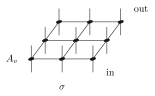 \(\quad \longmapsto \quad \)
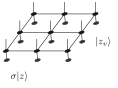
Fixing the inputs commutes with the conversion of square-grid tensors to tensors on the open square graph, and the operator of a square-grid operator network equals the operator of the corresponding graph tensor.
Both sides of the first identity have the same dimension on every edge and the same components, coordinate by coordinate. The second identity is the equality of square-grid contractions applied at each pair of output and input configurations.
On the open \(L\times L\) square ( [ 287 , Lemma 8.1 ] ), let \(\sigma \) be the operator of an operator network with edge dimensions \(D_e\), and let \(\Omega \) be a unit vector with \(\lVert \sigma -|\Omega \rangle \langle \Omega |\rVert _1\le \eta {\lt}1\). Then for some product-basis input \(z\) the fixed-input tensors, with the same edge dimensions \(D_e\), evaluate to the column \(\Phi =\sigma |z\rangle \), which is nonzero and satisfies \(\lVert \Phi /\lVert \Phi \rVert -e^{i\theta }\Omega \rVert \le 2\eta \) for some real \(\theta \).
Applying the vector statement to \(\sigma \) and identifying the selected column with the contraction of the fixed-input tensors yields the claim.
Let an operator network on the open \(L\times L\) square have edge dimensions \(D_e\le B\), and let its operator \(\sigma \) satisfy \(\lVert \sigma -|\Omega \rangle \langle \Omega |\rVert _1\le \eta {\lt}1\) for a unit vector \(\Omega \). Then for every \(\varepsilon \ge 2\eta \) there is a nonzero PEPS \(\Phi \) on the same grid with edge dimensions \(0{\lt}D_e\le B\) and
With \(B=CL^c\) and \(\varepsilon =L^{-1}\) the conclusion is that of [ 287 , Theorem 1.1 ] (00-introduction.tex, lines 36–57) for one lattice size. The source applies the column lemma on the party graph and then routes the ket network onto the grid (07-assembly.tex, lines 96–177). To use the corollary instead, the routing is applied to the operator network before the column is fixed; the two steps commute because fixing the inputs acts site by site on physical indices while routing leaves physical coordinates unchanged (07-assembly.tex, lines 125–126 and 159–160). Sizes \(L{\lt}L_0\) are treated separately in the source by an exact spanning-tree PEPS (07-assembly.tex, lines 205–212).
The fixed-input tensors of the preceding theorem have the same edge dimensions as the operator network. These dimensions are positive because the column is nonzero: if some \(D_e\) vanished, the contraction would be an empty sum.
45.7.1 Error and normalization of the protocol
The following estimates are the calculation of [ 287 , Section 8.1 ] . The reference trajectory, its step errors, the number of changes, the private factor, and the compressed operator are given as inputs from the protocol proposition, the small-patch rewrite lemma, and the compression theorem.
Let \(E_0,E_1,\dots \) be normed spaces, let \(S_t\colon E_t\to E_{t+1}\) be linear maps with \(\lVert S_tv\rVert \leq \lVert v\rVert \) for \(t{\lt}n\), and let \(r_t\in E_t\). Put \(x_0=r_0\) and \(x_{t+1}=S_tx_t\). Then
Proceeding by induction on \(n\), since \(x_{n+1}-r_{n+1}=S_n(x_n-r_n)+(S_nr_n-r_{n+1})\) and \(S_n\) is a contraction, the error grows by at most \(\lVert S_nr_n-r_{n+1}\rVert \), and the norm bound follows from the same induction.
Let \(L\geq 1\) and \(C_{\rm ch},C_{\rm step},C_{\rm hole},C_{\rm comp}\) be constants with \(C_{\rm step},C_{\rm hole}\geq 0\). Suppose that, in the notation of Lemma 45.7.1.1, there are \(n\leq C_{\rm ch}L^3\) contractions, \(\lVert r_0\rVert \leq 1\), and \(\lVert S_tr_t-r_{t+1}\rVert \leq C_{\rm step}L^{-20}\) for \(t{\lt}n\). Suppose that \(E_n\) is identified isometrically with the physical and private coordinates, so that \(r_n=\Omega \otimes \Xi \) with
Then \(\Psi =x_n\) satisfies \(\lVert \Psi \rVert \leq 1\),
If in addition \(\lVert \sigma -\operatorname{Tr}_{\rm private}|\Psi \rangle \langle \Psi |\rVert _1 \leq C_{\rm comp}L^{-5}\), then
By Lemma 45.7.1.1, the vector error is at most \(n\, C_{\rm step}L^{-20}\leq C_{\rm ch}C_{\rm step}L^{-17}\), and \(\lVert \Psi \rVert \leq \lVert r_0\rVert \leq 1\). The partial trace of the product reference is \(\lVert \Xi \rVert ^2|\Omega \rangle \langle \Omega |\), so the pure-density error bound gives a density error of at most \(2C_{\rm ch}C_{\rm step}L^{-17}+2C_{\rm hole}L^{-57}\), which is at most the stated multiple of \(L^{-10}\) because \(L\geq 1\). The last bound follows from the triangle inequality through \(\operatorname{Tr}_{\rm private}|\Psi \rangle \langle \Psi |\).
As a consequence of the error and reference-norm bounds in [ 287 , Section 8.1 ] , under the hypotheses of Theorem 45.7.1.2, put
and let \(\Psi \) be the final vector in physical and private coordinates. Its physical density \(\rho =\operatorname{Tr}_{\rm private}|\Psi \rangle \langle \Psi |\) satisfies
with no upper bound on \(\delta +\varepsilon \) and no division by the norm of a vector required.
The reverse triangle inequality and \(\lVert \Omega \rVert =1\) give
Writing \(s=\lVert \Psi \rVert \), one has \(\operatorname{tr}\rho =s^2\) and \(1-s^2\leq 2(1-s)\), since \((1-s)^2\geq 0\). The first estimate therefore gives \(1-\operatorname{tr}\rho \leq 2(\delta +\varepsilon )\), even when \(1-\delta -\varepsilon \) is negative.
45.7.2 Column selection after discarding a product reference
Combining the normalization calculation of [ 287 , Section 8.1 ] with its Lemma 8.1, let \(\Omega \) be a unit vector on the open \(L\times L\) square. Let \(\Psi \) be a joint vector on its physical and private coordinates, and \(\Xi \) a private vector such that
Let \(\sigma \) be the operator of a given operator network on the same square, with edge dimensions \(D_e\), satisfying
Then some product-basis input \(z\) gives fixed-input tensors whose contraction is the nonzero column \(\Phi =\sigma |z\rangle \), with
for some real \(\theta \), while the edge dimensions remain \(D_e\), are positive, and preserve any given bounds \(D_e\leq B\). Because the network is already on the square, the routing order is as in Corollary 45.7.12; this separation from the protocol construction is recorded in [ 102 ] .
The partial trace of the product-reference density is \(\lVert \Xi \rVert ^2|\Omega \rangle \langle \Omega |\). The pure-density error bound and contraction under partial trace give
The triangle inequality through \(\operatorname{Tr}_{\rm private}|\Psi \rangle \langle \Psi |\) gives \(\lVert \sigma -|\Omega \rangle \langle \Omega |\rVert _1\leq \alpha {\lt}1\), so Theorem 45.7.11 applies. Fixing the input changes only physical entries of the given tensors, leaving every virtual dimension unchanged, and a zero virtual dimension would make the selected contraction vanish, so all \(D_e\) are positive.
45.8 Dyadic routing of a party network into a square-lattice PEPS
This section treats the routing step of [ 287 , Lemma 8.2 ] , September 24, 2026, 07-assembly.tex, lines 102–177: the links of a finite tensor network whose parties sit at anchors of dyadic blocks are routed on the square grid with constant edge congestion, folded into the genuine \(L\times L\) square, and the routed network is contracted into a PEPS on that square. In [ 287 , Proposition 7.1 ] , three properties of the party network (boundedly many parties per block, bounded degree, and link separation bounded by a fixed multiple of the endpoint scales) are derived from the distribution protocol, and a fourth (all anchors lying in the padded square) from attaching each party to the anchor of its dyadic block. Here these four properties are stated as hypotheses on an arbitrary party network, and the lemma is proved in that generality. The four properties are verified for the network produced by the protocol and its density compression in Theorem 45.63.1.6, with constants independent of the side length and the Hamiltonian [ 92 ] . Although the two endpoint scales of every link in the protocol network are equal or adjacent, the congestion bound below does not use this property, so it is not assumed.
For \(L\ge 1\) let \(N=2^{\lceil \log _2L\rceil }\) be the least power of two with \(N\ge L\). A dyadic block of side \(2^j\) with block index \(r\) in one coordinate has anchor coordinate
A party attached to the block of scale \(j\) and block indices \((r,s)\) sits at the anchor \((a_j(r),a_j(s))\).
For \(L\ge 1\) one has \(L\le N{\lt}2L\).
By minimality of the exponent, \(2^{\lceil \log _2L\rceil -1}{\lt}L\) whenever the exponent is positive, so \(N{\lt}2L\); the case \(L=1\) gives \(N=1\).
For \(j\ge 1\) the two-adic valuation of \(a_j(r)=2^{j-1}(2r+1)\) is exactly \(j-1\). Consequently, if \(j,j'\ge 1\) and \(a_j(r)=a_{j'}(r')\), then \(j=j'\) and \(r=r'\).
The factor \(2r+1\) is odd, so the valuation of \(2^{j-1}(2r+1)\) is \(j-1\). Equal anchors therefore have equal scales, and dividing by \(2^j\) recovers the block index.
On padded coordinates define \(f(x)=x\) for \(0\le x\le L-1\) and \(f(x)=2(L-1)-x\) for \(x\ge L\).
Let \(L\ge 1\). The fold fixes \(\{ 0,\ldots ,L-1\} \) and takes values there. For \(x+2{\lt}2L\) the coordinates \(f(x)\) and \(f(x+1)\) are adjacent. For \(x+1{\lt}2L\) every value \(u=f(x)\) forces \(x\in \{ u,\, 2(L-1)-u\} \), and for \(x+2{\lt}2L\) every unit interval \(\{ u,u+1\} \) that is the image of \(\{ x,x+1\} \) forces \(x\in \{ u,\, 2L-3-u\} \).
Each statement is a case distinction on whether \(x\) and \(x+1\) lie below \(L\), followed by linear arithmetic.
A party network with physical dimension \(d\) consists of finite sets of parties and links, a dimension \(D_\ell \) for each link \(\ell \), two endpoint parties for each link, and for each party \(p\) a tensor reading one label of every link incident to \(p\) and one physical index. When the physical index of party \(p\) is read at a site \(\iota (p)\) of a finite simple graph \(G\), the coefficient at a physical configuration \(\sigma \) is the sum over all link labellings of the product of the party tensors evaluated at \(\sigma (\iota (p))\). A routing of the network through \(G\) assigns to every link a walk in \(G\) from the site of its first party to the site of its second party.
Let a party network be routed through a finite simple graph \(G\). If every link has dimension at most \(D\) and every edge of \(G\) is traversed at most \(\chi \) times by the walks, counted with repetition, then there is a PEPS on \(G\) with exactly the coefficients of the party network and every bond dimension at most \({\max (D,1)}^\chi \).
Every step of a walk carries an identity tensor on the label of its link. At a vertex, the labels of all walks passing through it are kept independently, so crossings are permitted, and the party tensors located there are multiplied; zero-length links and coincident parties are contracted inside the vertex tensor. All traversals of one edge are grouped into a product alphabet, whose size is the product of the link dimensions, hence at most \(D^m\) for \(m\) traversals. Consistent configurations of the routed network are in bijection with link labellings, since the identity tensors force one label along each walk, so the contraction reproduces the coefficients of the party network.
Attach every party to a dyadic block, and so to its anchor. Each link, oriented arbitrarily, is routed from the anchor of its first party horizontally to the column of the anchor of its second party, then vertically to that anchor. The load of a unit edge of the padded square is the number of steps of all these walks that traverse it, counted with repetition. On the padded square of side \(N=8\), with \(L=5\), the square, the rounded marks and the large dots below are the anchors of scales \(3\), \(2\) and \(1\), the solid path is one routed link from \(P\) to \(Q\), and the shaded square is the genuine \(L\times L\) square, onto which the fold \(f\) of Definition 45.8.4 maps the endpoint \(Q\).
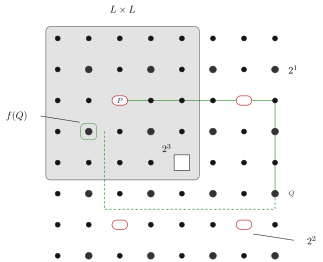
Suppose at most \(B\) parties are attached to any dyadic block, every party has at most \(\Delta \) incident links, and the two anchors of every link differ in each coordinate by at most \(c\) times the side of either endpoint block. Then every horizontal and every vertical unit edge of the padded square has load at most \(2(2c+1)B\Delta \).
A horizontal step lies on the row of the anchor of the first party of its link, and each link traverses a given edge at most once. For a scale \(j\ge 1\) the row \(2^{j-1}(2s+1)\) determines \(j\) and \(s\) by its two-adic valuation. Anchors of one scale on one row are \(2^j\) apart, so at most \(2c+1\) blocks of that scale lie within horizontal distance \(c2^j\) of the edge; scale zero gives a second bound of the same form. Each block carries at most \(B\) parties, each the first endpoint of at most \(\Delta \) links. Vertical steps are treated in the same way using the column of the second party.
Establishing the congestion bound of [ 287 , Lemma 8.2 ] for any party network satisfying the hypotheses stated above, let \(L\ge 1\) and let every dyadic block lie in the padded square of side \(N\). Under the hypotheses of the previous theorem, applying the fold in both coordinates turns the padded walks into walks of the open \(L\times L\) square lattice, the party at an anchor is placed at its fold, and every edge of the genuine square is traversed at most \(8(2c+1)B\Delta \) times, counted with repetition.
Since \(N{\lt}2L\), every padded walk point has coordinates below \(2L-1\), so adjacent padded points fold to adjacent genuine points. A horizontal edge of the genuine square has at most two padded preimages in each coordinate, hence at most four padded unit-edge preimages, and likewise for vertical edges. Summing the padded bound over these preimages gives \(4\cdot 2(2c+1)B\Delta \).
Let \(L\ge 1\) and consider a party network on dyadic anchors of the padded square with at most \(B\) parties per block, at most \(\Delta \) links per party, link separation at most \(c\) times either endpoint scale, and link dimensions at most \(D\). Then there is a PEPS on the open \(L\times L\) square lattice whose coefficients equal those of the party network, with the physical index of each party read at the fold of its anchor, and whose bond dimensions are all at most \({\max (D,1)}^{\chi }\) with \(\chi =8(2c+1)B\Delta \). The exponent \(\chi \) depends neither on \(L\) nor on the number of dyadic scales.
Applying the routed contraction to the folded routing, whose congestion is at most \(\chi \) by the previous theorem, yields the square-lattice PEPS. Because the fold fixes genuine coordinates, a party whose anchor is a genuine site is read at that site.
45.8.1 Fixing a column before routing
Following [ 287 , Section 8.2–8.3 ] (07-assembly.tex, lines 96–177), one fixes an input column of the compressed operator network on the party graph and routes the resulting ket network afterwards. The statements below follow this order. The operator network, its placement, the four routing properties, and the trace-norm estimate are hypotheses of the statements below; they are verified for the compressed protocol network in Theorem 45.63.1.6, as recorded in [ 102 ] .
An operator party network is a party network whose physical index at each party is an output-input pair in \(\{ 1,\ldots ,q\} ^2\). When the pair of party \(p\) is read at the site \(\iota (p)\), the operator \(\sigma \) of the network has the entry \(\langle \tau |\sigma |\rho \rangle \) equal to the coefficient of the network at the configuration \(v\mapsto (\tau (v),\rho (v))\). For a product-basis input \(z\), fixing the input of every party \(p\) to \(z(\iota (p))\) gives a party network with physical dimension \(q\), the same links, and the same link dimensions.
In the party-graph setting of [ 287 , Lemma 8.1 ] , the coefficient vector of the network with input fixed to \(z\) is the column \(\sigma |z\rangle \). If \(\Omega \) is a unit vector and \(\lVert \sigma -|\Omega \rangle \langle \Omega |\rVert _1\le \eta {\lt}1\), then for some \(z\) this column \(\psi \) is nonzero and \(\lVert \psi /\lVert \psi \rVert -e^{i\theta }\Omega \rVert \le 2\eta \) for some real \(\theta \), where the operator \(\sigma \) need not be positive or Hermitian.
Fixing the input of every party selects the entries of \(\sigma \) in the column of \(z\) without changing any link. The vector form of the column lemma, Theorem 45.7.4, applied to \(\sigma \) gives the column.
Let \(L\ge 1\) and let an operator party network on dyadic anchors of the padded square satisfy the hypotheses of Theorem 45.8.11, with link dimensions at most \(D\) and \(\chi =8(2c+1)B\Delta \). Read the physical pair of each party at the fold of its anchor, and suppose that the resulting operator satisfies \(\lVert \sigma -|\Omega \rangle \langle \Omega |\rVert _1\le \eta {\lt}1\) for a unit vector \(\Omega \). Then there is a nonzero PEPS \(\Phi \) on the open \(L\times L\) square, with every bond dimension in \(\{ 1,\ldots ,{\max (D,1)}^\chi \} \), and a real \(\theta \) such that \(\lVert \Phi /\lVert \Phi \rVert -e^{i\theta }\Omega \rVert \le 2\eta \). The same conclusion holds with \(\eta =\kappa +2\varepsilon +2\delta \) when the hypotheses of Theorem 45.7.2.1 hold for this operator.
Selecting a column of the party network by Theorem 45.8.1.2 and routing the resulting ket network by Theorem 45.8.11 produces a routed PEPS whose coefficients equal those of the input-fixed network, hence the selected column. A zero bond dimension would make the sum over virtual configurations empty and the contraction zero, so every bond dimension is positive. In the second form, the estimate in the proof of Theorem 45.7.2.1 gives \(\lVert \sigma -|\Omega \rangle \langle \Omega |\rVert _1\le \kappa +2\varepsilon +2\delta \).
In the final bond bound of [ 287 , Section 8.3 ] (07-assembly.tex, lines 164–170) for the routed column, in the setting of Theorem 45.8.1.3, suppose that every link dimension is at most \(C_1L^k\) with \(C_1\ge 1\) and \(k\ge 0\), and that \(2\eta \le L^{-1}\). Then the nonzero PEPS has every bond dimension at most
and normalized error at most \(L^{-1}\), up to a phase.
Since \(L\ge 1\) and \(k\ge 0\), one has \(1\le C_1L^k\), so every link dimension is at most \(D=\lfloor C_1L^k\rfloor \) and \(\max (D,1)\le C_1L^k\). Applying Theorem 45.8.1.3 and raising this bound to the power \(\chi \) gives the polynomial bond bound.
45.9 Encoded frames and small-patch rewrites
The statements below formalize Definition 6.1 and the first assertion of Lemma 6.3 of [ 287 ] , September 24, 2026, 05-frames.tex, lines 11–97 and 182–252, the registers of a frame with one register per site and per tag, together with the steps of the proof of the second assertion listed below. The expansion of the branches into allowed monomials on these registers is in Section 45.21, and the second assertion with its polynomial count is Theorem 45.9.27.
Throughout, \(\Lambda \) is a finite set of sites with positions in the plane, each site carries a site register \(\mathbb {C}^q\) with \(q\ge 1\), and \(\mathcal H_\Lambda =\bigotimes _{x\in \Lambda }\mathbb {C}^q\). For \(D\subseteq \Lambda \) and an operator \(X\) on \(\mathcal H_D\), write \(X_D\otimes \operatorname{id}\) for the operator acting as \(X\) on the sites of \(D\) and as the identity elsewhere. Operators supported on disjoint sets of sites commute. A vector \(\Omega \) is fixed, and \(\lVert \cdot \rVert \) denotes the Euclidean norm of vectors and the operator norm of matrices, rectangular ones included.
For a center \(c\in \mathbb {R}^2\) and a scale \(h{\gt}0\), the inner and outer squares \(Q^-(c,h)\) and \(Q^+(c,h)\) are the closed sup-norm balls of radii \(h\) and \(2h\); their physical samples are the sites whose positions lie in them. Square cylinder data at \((c,h)\) consist of radii \(h\le r_1\le \cdots \le r_n\le 2h\), the samples \(D_j\) of the squares of radius \(r_j\), and unit vectors \(v_{j\ell }\in \mathcal H_{D_j}\) for \(\ell \le d_j\), such that the cylinder projectors \(\bigl(|v_{j\ell }\rangle \langle v_{j\ell }|\bigr)_{D_j}\otimes \operatorname{id}\) have mutually orthogonal ranges. Their sum is
Every \(D_j\) contains the inner sample and is contained in the outer sample. If the outer sample is empty, then \(P_{c,h}=\operatorname{id}\), whatever the cylinder data. In 05-frames.tex, lines 26–48, with the cylinder data of [ 287 , Proposition 4.1 ] , the accuracy \(\lVert (\operatorname{id}-P_{c,h})\Omega \rVert \le \varepsilon \) enters as a hypothesis where it is used, while the count of branches below takes a uniform bound on the number of cylinder terms of each patch rather than recording a polynomial bound on \(\sum _jd_j\).
Let \(\mathcal J_{c,h}\) be a tag register with orthonormal basis \(\{ |j,\ell \rangle \} \) and let \(|0\rangle \) be a fixed one-site unit vector. The hole encoder is
It keeps a site register at every site, inside the hole as well. If the outer sample is empty, the tag register is one-dimensional and \(K_{c,h}\) is the identity encoding, as in 05-frames.tex, lines 67–69. On a square grid of unit spacing with \(c\) a site and \(h=3/2\), the inner sample, one sample \(D_j\) of radius \(r_j=2\), and the outer sample are nested squares of sites, and the encoder maps the site registers to a tag together with the site registers.
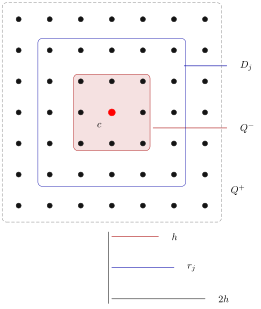
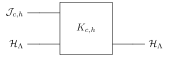
As in 05-frames.tex, equation (encoder-contraction), lines 62–64, the operator \(P_{c,h}\) is an orthogonal projection, \(K_{c,h}^\dagger K_{c,h}=P_{c,h}\), and \(\lVert K_{c,h}\rVert \le 1\).
If the outer sample is empty, \(K_{c,h}\) is the identity encoding and all three claims are immediate. Otherwise, each cylinder projector is Hermitian and idempotent because \(v_{j\ell }\) is a unit vector, and products of distinct cylinder projectors vanish by orthogonality; hence \(P_{c,h}\) is an orthogonal projection. Orthogonality of the tag basis gives \(K_{c,h}^\dagger K_{c,h}=\sum _{j,\ell } (|v_{j\ell }\rangle \langle 0^{\otimes D_j} | 0^{\otimes D_j} \rangle \langle v_{j\ell }|)_{D_j} \otimes \operatorname{id}=P_{c,h}\). Finally \(\lVert K_{c,h}\rVert ^2=\lVert K_{c,h}^\dagger K_{c,h}\rVert =\lVert P_{c,h}\rVert \le 1\).
Following [ 287 , Definition 6.1 ] (05-frames.tex, lines 71–82), an encoded frame \(\mathcal F\) consists of a site ownership assignment on one sheet, a list of holes \((c,h)\) with square cylinder data and pairwise disjoint outer samples, and a specified party holding each hole’s tag. The order of the list is the fixed ordering of the appended tags. The encoding \(K_{\mathcal F}\) is the product of the hole encoders, with the tags appended in that order, and the reference vector is \(\Omega _{\mathcal F}=K_{\mathcal F}\Omega \); a frame without holes is an unencoded sheet. While the source requires the outer squares to be disjoint in the plane, only the resulting disjointness of their physical samples is used.
For two lists of holes with disjoint outer footprints, the site parts of their encodings commute on every pair of tag configurations. The tags of a concatenated list are the pairs of tags of the two parts, and on such a pair the site part of the encoding of the concatenation is the product of the site parts of the two encodings. Hence the encodings commute after the natural identification of tag orderings (05-frames.tex, lines 84–85).
The site part on a tag configuration is a product of operators supported in the outer footprints of the holes of the list, so the two products are supported on disjoint sets of sites. The factorization follows by induction on the first list.
For a frame with hole projectors \(P_1,\dots ,P_r\), \(K_{\mathcal F}^\dagger K_{\mathcal F}=P_1\cdots P_r\), this product is an orthogonal projection, and \(\lVert K_{\mathcal F}\rVert \le 1\).
Proceeding by induction on the list, write the site part on the tags \((s,t)\) as \(B_sR_t\), with \(B_s\) from the first hole. Summing \(R_t^\dagger B_s^\dagger B_sR_t\) over \(s\) gives \(R_t^\dagger P_1R_t\), and \(P_1\) commutes with \(R_t^\dagger \) by disjointness of supports; the sum over \(t\) is then \(P_1\) times the identity for the remaining holes. The projectors commute pairwise, so their product is an orthogonal projection of norm at most one.
For contractions \(A_1,\dots ,A_s\) and every vector \(\psi \),
In particular, if each of \(r\) projectors has error at most \(\varepsilon \) on \(\psi \), so does their product up to \(r\varepsilon \); no commutation is assumed (05-frames.tex, lines 237–248).
Induction on \(s\), from \((A_1R-\operatorname{id})\psi =A_1(R-\operatorname{id})\psi +(A_1-\operatorname{id})\psi \) and \(\lVert A_1\rVert \le 1\).
As in 05-frames.tex, equation (frame-norm), lines 86–94, a frame with \(r\) holes satisfies \(\lVert \Omega _{\mathcal F}\rVert =\lVert P_1\cdots P_r\Omega \rVert \). If \(\lVert \Omega \rVert =1\) and every hole projector satisfies \(\lVert (\operatorname{id}-P_a)\Omega \rVert \le \varepsilon \), then
The two vectors have the same squared norm \(\langle \Omega | P_1\cdots P_r\Omega \rangle \), because the product of the projectors is an orthogonal projection. The upper bound is contractivity, and the lower bound is the reverse triangle inequality with the telescoping lemma.
For an owner \(o\) of each site of a finite set \(\Lambda \) and a list \(\ell \) of sites, the site registers of \(\ell \) are one register \(\mathbb {C}^q\) for each entry of \(\ell \), held by the owner of that site, in the order of \(\ell \). A fixed list of the sites of \(\Lambda \) contains every site exactly once, so taking the site at a position gives a bijection from its positions to \(\Lambda \). If every site of a list has owner \(p\), every site register of the list is held by \(p\).
Immediate from the definitions.
The registers of a frame \(\mathcal F\) are one register \(\mathbb {C}^{\mathcal J_a}\) for each hole \(a\), held by the party holding its tag, listed in the order of the holes, followed by one site register \(\mathbb {C}^q\) for each site \(x\in \Lambda \), held by the site owner of \(x\), listed in a fixed order of the sites. This list contains every site exactly once, so taking the site at a position gives a bijection from its positions to \(\Lambda \). More generally, if all sites in any list have site owner \(p\), every site register of that list is owned by \(p\). Matching the sheet of 05-frames.tex, lines 13–20 (one site register at each site with a specified owner, together with the tags of Definition 6.1, lines 71–82), the tensor product of the frame’s registers is its memory in the sense of Theorem 5.2 of [ 287 ] .
For a list \(\ell \) of sites, including lists with repetitions, write \(|c\rangle _\ell \) for the product basis vector of a configuration \(c\) on the site registers of \(\ell \). If \(c(x)=c'(x)\) for every site in \(\ell \), then \(|c\rangle _\ell =|c'\rangle _\ell \). If \(\ell \) has length \(n\), a unitary identifies its site registers with \(\mathbb {C}^{[q]^n}\) and sends \(|c\rangle _\ell \) to the basis vector of the configuration \(k\mapsto c(\ell _k)\) read along the list. More generally, for a bijection \(e\) from the positions of \(\ell \) to a finite set \(K\) and a map \(f:K\to \Lambda \) with \(\ell _k=f(e(k))\) for every position \(k\), the grouping along \(e\) is a unitary onto \(\mathbb {C}^{[q]^K}\) sending \(|c\rangle _\ell \) to \(|c\circ f\rangle \). Under the canonical unitary for concatenating register lists, \(|c\rangle _{\ell _1\ell _2}\) is identified with \(|c\rangle _{\ell _1}\otimes |c\rangle _{\ell _2}\); the empty list contributes the scalar one.
By induction on the list of registers, identifying \(\mathbb {C}^\alpha \otimes \mathbb {C}^\beta \) with \(\mathbb {C}^{\alpha \times \beta }\) at each step.
The tensor product of the registers of a frame is identified, by a unitary, with \(\mathbb {C}^{\mathcal J\times [q]^\Lambda }\), the space of the tags and the sheet on which the encoding \(K_{\mathcal F}\) and its operators act: the product basis vector \(|\tau \rangle \otimes \bigotimes _x|c(x)\rangle \) is sent to \(|\tau ,c\rangle \). More generally, the site registers of a list of distinct sites enumerating a set \(A\) are identified with \(\mathbb {C}^{[q]^A}\) in the same way. These are the canonical site and sheet coordinates of 05-frames.tex, lines 94–96, in which vectors are compared while the owners of their registers are specified separately. For any list \(\ell \) of sites, including lists with repetitions, write \(|c\rangle _\ell \) for its product basis vector. If \(c(x)=c'(x)\) for every site in \(\ell \), then \(|c\rangle _\ell =|c'\rangle _\ell \). Under the canonical unitary for concatenating register lists, the basis vector \(|c\rangle _{\ell _1\ell _2}\) is identified with \(|c\rangle _{\ell _1}\otimes |c\rangle _{\ell _2}\). The empty list contributes the scalar one.
By induction on the list of registers, identifying \(\mathbb {C}^\alpha \otimes \mathbb {C}^\beta \) with \(\mathbb {C}^{\alpha \times \beta }\) at each step; product basis vectors are sent to standard basis vectors, and a list of distinct sites enumerating \(A\) gives a bijection between its positions and \(A\). Configurations agreeing on a list give the same basis vector at every position, hence the same product vector, even if sites repeat. The same induction splits the vector at any prescribed list boundary; its empty-list case is \(1\otimes v\mapsto v\).
Old and new one-sheet frames share their untouched holes, with the same encodings and tag owners; the remaining holes are the affected old holes and the affected new holes, \(r_{\rm old}\) of the former. There are \(m\) additional square patches \((c_i,u_i)\) with cylinder data, and a specified finite list of parties; the source requires this list to be bounded, and its size enters, with \(m\) and the numbers of affected holes, the polynomial count of Theorem 45.9.27. Write \(H^\mp (\mathcal F)\) for the unions of the physical samples of the inner and outer hole squares. The four conditions of [ 287 , Lemma 6.3 ] (05-frames.tex, lines 193–207) are:
every patch’s outer square, and every affected old or new hole, avoids the physical outer footprints of the untouched holes;
the union of the patch inner squares contains every site whose site owner changes and the entire outer footprint of every affected old or new hole;
in each patch’s outer square, the sites outside \(H^-(\mathcal F_{\rm old})\) have at most two old owners, and the sites outside \(H^-(\mathcal F_{\rm new})\) have at most two new owners;
all old and new site owners on the patch footprints and the affected-hole footprints, and all affected tag owners, belong to the specified list.
Patches may overlap, and affected old holes may overlap affected new holes. In the canonical coordinates used below, the tags of the untouched holes come first in both frames; Theorem 45.9.18 also covers arbitrary tag orderings.
With \(K_{\rm old}\) and \(K_{\rm new}\) the encodings of the affected old and new holes alone and \(P_1,\dots ,P_m\) the patch projectors in a fixed order,
acting as the identity on the tags of the untouched holes. Its input layout is that of \(\mathcal F_{\rm old}\) and its output layout that of \(\mathcal F_{\rm new}\) (05-frames.tex, lines 222–232).
For complex matrices \(A\) and \(B\), not necessarily square, and identity matrices \(I\) of any size, \(\lVert A\otimes I\rVert \le \lVert A\rVert \) and \(\lVert I\otimes B\rVert \le \lVert B\rVert \).
For a vector \(x=\sum _k x_k\otimes e_k\) one has \((A\otimes I)x=\sum _k Ax_k\otimes e_k\), so \(\lVert (A\otimes I)x\rVert ^2=\sum _k\lVert Ax_k\rVert ^2 \le \lVert A\rVert ^2\lVert x\rVert ^2\). The second bound follows by exchanging the two tensor factors, which reindexes rows and columns.
\(\lVert M\rVert \le 1\).
Every factor is a contraction. Tensoring with the identity on the untouched tags and relabelling coordinates do not increase the operator norm; the first estimate sums squared norms over the untouched tag slices and introduces no dimension factor.
Under condition (1), \(MK_{\mathcal F_{\rm old}}=K_{\mathcal F_{\rm new}}P_m\cdots P_1 Q_1\cdots Q_{r_{\rm old}}\), where \(Q_1,\dots ,Q_{r_{\rm old}}\) are the projectors of the affected old holes.
On untouched tags \(u\), affected old tags \(b\) and affected new tags \(a\), write \(U_u\), \(A_b\) and \(B_a\) for the site parts of the encodings. By condition (1) and disjointness of the old frame, \(U_u\) commutes with \(A_b^\dagger \), with every patch projector, with \(B_a\) and with the affected old projectors. Summing over \(b\), \(\sum _bA_b^\dagger U_uA_b=U_u\sum _bA_b^\dagger A_b =U_uQ_1\cdots Q_{r_{\rm old}}\) by the frame Gram identity; then \(U_u\) commutes to the left of \(B_aP_m\cdots P_1\).
Under the four conditions, if every patch projector and every affected old-hole projector has error at most \(\varepsilon \) on \(\Omega \), the canonical map \(M\) is a contraction and
The same holds for frames whose tags are listed in any order, with \(M\) relabelled along the identification of the two tag orderings. In this first assertion of [ 287 , Lemma 6.3 ] , the error estimate uses condition (1) only: no smallness of the errors of the untouched holes is assumed, and the projectors of overlapping patches need not commute.
By the intertwining lemma, \(M\Omega _{\mathcal F_{\rm old}}-\Omega _{\mathcal F_{\rm new}} =K_{\mathcal F_{\rm new}}(P_m\cdots P_1Q_1\cdots Q_{r_{\rm old}}-\operatorname{id})\Omega \). The encoding is a contraction, and the telescoping lemma bounds the remaining vector by \((m+r_{\rm old})\varepsilon \). For another ordering of the tags, the site parts of the encodings of holes with disjoint outer footprints commute, so moving every tag to the new position of its hole is a relabelling of the tag basis that carries one encoding to the other. Relabelling the coordinates of \(M\) along it keeps \(M\) a contraction and changes neither norm in the estimate.
A complete branch \(\beta =(a,s,b)\) chooses a tag \(a\) of the affected new holes, one cylinder term of every patch, and a tag \(b\) of the affected old holes. With \(C_s\) the product of the chosen cylinder projectors, \(M=\sum _\beta M_\beta \), where \(M_\beta \) is \(|a\rangle \langle b|\otimes B_aC_sA_b^\dagger \) extended by the identity on the untouched tags. If every affected hole and every patch has at most \(D\) cylinder terms, there are at most \(D^{\, r_{\rm new}+m+r_{\rm old}}\) branches (05-frames.tex, lines 254–257).
Expanding every patch projector as the sum of its cylinder projectors identifies the entries of \(K_{\rm new}P_m\cdots P_1K_{\rm old}^\dagger \) on the tag basis. The number of tag configurations of a list is the product of the numbers of cylinder terms of its members.
Assume the four conditions and fix a branch \((a,s,b)\). The selected square of a term \((j,\ell )\) is \(D_j\), and that of the identity term of a square with empty outer sample is empty; the selected squares are read off from the terms of the branch position by position in the lists, so a patch listed twice may carry two different terms. Every site of a selected affected old-hole square, and of a selected affected new-hole square, lies in a selected patch square. The sites of a selected patch square not consumed by a selected old-hole square have at most two old owners, and those not received by a selected new-hole square have at most two new owners. A site in no selected patch square has the same old and new owner. All old and new owners of sites in selected squares belong to the specified list (05-frames.tex, lines 267–305).
Every selected square contains its inner square and lies in its outer square (for an empty outer sample both are empty), so condition (2) gives the first statement and the statement on direct sites. A site of a patch outer square in \(H^-(\mathcal F_{\rm old})\) is not in an untouched hole by condition (1), hence lies in the inner square of an affected old hole and so in its selected square; condition (3) bounds the owners of the remaining sites. The new case is symmetric, and condition (4) gives the last statement.
Let \(M=\sum _\beta M_\beta \) be a contraction with \(N\) branches and let \(\lVert M_\beta -\widetilde M_\beta \rVert \le \eta \) for every branch. If \(N\eta \le \tfrac 12\delta \), then \(M_\delta =(1+\tfrac 12\delta )^{-1}\sum _\beta \widetilde M_\beta \) satisfies \(\lVert M_\delta \rVert \le 1\) and \(\lVert M_\delta -M\rVert \le \delta \). For \(N,g\ge 0\) and \(\delta {\gt}0\) there is an integer \(k\ge 1\) with \(Ng/\sqrt k\le \tfrac 12\delta \) (05-frames.tex, lines 331–341).
The sum \(\widetilde M\) is within \(\tfrac 12\delta \) of \(M\), so \(\lVert \widetilde M\rVert \le 1+\tfrac 12\delta \). Splitting \(M_\delta -M=(1+\tfrac 12\delta )^{-1}(\widetilde M-M) -\tfrac {\delta /2}{1+\delta /2}M\) bounds the error by \(\delta /(1+\tfrac 12\delta )\le \delta \), and \(k=\lceil (2Ng/\delta )^2\rceil +1\) satisfies the final inequality.
Under condition (1), if \(\lVert \Omega \rVert \le 1\) and \(\lVert M_a-M\rVert \le \delta \), then \(\lVert M_a\Omega _{\mathcal F_{\rm old}}-\Omega _{\mathcal F_{\rm new}}\rVert \le \delta +(m+r_{\rm old})\varepsilon \). With \(\varepsilon =L^{-60}\), \(\delta =L^{-30}\) and \(m+r_{\rm old}+1\le L^{10}\), this is at most \(L^{-20}\) (05-frames.tex, lines 217–218 and 343–344).
Splitting \(M_a\Omega _{\mathcal F_{\rm old}}-\Omega _{\mathcal F_{\rm new}}\) as \((M_a-M)\Omega _{\mathcal F_{\rm old}}\) plus the small-error rewrite difference and using \(\lVert \Omega _{\mathcal F_{\rm old}}\rVert \le 1\) gives the general bound; the specialization uses \(L^{-60}\le L^{-30}\).
Let \(L_0,\dots ,L_{n-1}\) be operators \(L_j=|k_j\rangle \langle b_j|_{S_j}\otimes \operatorname{id}\) on the site registers, where each \(k_j\) and \(b_j\) is a vector on the configurations of the finite set \(S_j\) or the product zero vector. Form the network whose vertices are the bras \(\langle b_j|\) and the kets \(|k_j\rangle \), kept distinct, and whose internal edges join the output of a ket at a site to the input of the next bra containing that site, in the order \(L_{n-1},\dots ,L_0\) of application. The input of a bra at a site contained in no earlier factor is an open input leg, and the output of a ket at a site contained in no later factor is an open output leg, except that the legs of a product zero vector are fixed to \(0\). Then the entry of \(L_0\cdots L_{n-1}\) at output configuration \(\sigma \) and input configuration \(\tau \) vanishes unless \(\sigma \) and \(\tau \) agree at the sites contained in no factor and carry \(0\) at the fixed legs, and otherwise equals the contraction of the network evaluated at the open legs read off from \(\sigma \) and \(\tau \). No edge joins a vertex to itself (05-frames.tex, lines 274–281).
Expanding the product as a sum over paths of intermediate configurations, a path of nonzero weight keeps the value of a site across factors that do not contain it, so it is determined by the values on the internal edges, and conversely every labelling of the internal edges determines such a path; along it the weight is the product of the vertex tensors.
In the setting of the previous lemma, let every \(k_j\) and \(b_j\) have norm at most one, and let \(G\) be a set of vertices containing every vertex with an open leg. For every \(k\ge 1\) there are orthonormal families of at most \(k\) vectors on the open-leg groups and coefficients of modulus at most one such that \(L_0\cdots L_{n-1}\) differs in operator norm by at most \(|G|/\sqrt k\) from the sum of the corresponding product terms, of which there are at most \(k^{|G|}\). Each product term is the tensor product of one normalized vector on the open output legs of each ket, one normalized covector on the open input legs of each bra, the product zero vectors at the fixed legs, and the identity on the sites contained in no factor. No constant depends on the dimensions of the sites (05-frames.tex, lines 306–329).
The vertex tensors are normalized, so the whole-group truncation lemma applies to the contraction \(Z\). An operator read off from a tensor \(W\) on the open legs is \(W\), reshaped as a matrix from inputs to outputs, tensored with the identity on the remaining sites, so its operator norm on \(W=Z-Z_k\) is at most the largest Hilbert–Schmidt norm of its diagonal blocks, hence at most \(\lVert Z-Z_k\rVert \).
Assume the four conditions and fix a branch \((a,s,b)\). Its site operator \(B_aC_sA_b^\dagger \) is the ordered product of the factors \(|0\rangle \langle u'_r|\) of the affected new holes, \(|w_i\rangle \langle w_i|\) of the patch terms, and \(|u_t\rangle \langle 0|\) of the affected old holes. In its network only the bras and kets of the patch terms have open legs, so at most \(2m\) vertices do; the open input legs of a patch bra have at most two old owners, the open output legs of a patch ket have at most two new owners, and all these owners belong to the specified list (05-frames.tex, lines 257–305).
The factorization follows from the definitions of the hole encodings and the cylinder projectors. A decoded old-hole ket meets a later patch bra at every site of its square, and a new-hole bra meets an earlier patch ket at every site of its square, by the wire classification; the zero vectors carry no open legs. An open input of a patch bra is consumed by no selected old-hole square, so the wire classification bounds its old owners; the output case is symmetric.
Assume the four conditions, and let \(N\) be the number of branches and \(k=\lceil (4Nm/\delta )^2\rceil +1\) for \(\delta {\gt}0\), for instance \(\delta =L^{-a}\). Every branch is approximated in operator norm within \(2m/\sqrt k\) by at most \(k^{2m}\) product terms with coefficients of modulus at most one, and the rescaled sum \(M_\delta =(1+\tfrac 12\delta )^{-1}\sum _\beta |a\rangle \langle b|\otimes \bigl(\sum _ic_{\beta ,i}T_{\beta ,i}\bigr)\), extended by the identity on the untouched tags, is a contraction with \(\lVert M_\delta -M\rVert \le \delta \). Each product term \(T_{\beta ,i}\) is the tensor product of normalized vectors on the open output groups of the patch kets, normalized covectors on the open input groups of the patch bras, product zero vectors on the selected hole squares, and identities; by Lemma 45.9.25 each open group lies on at most two parties of the specified list. This formalizes the branch-network, truncation and rescaling steps of the proof of the second assertion of [ 287 , Lemma 6.3 ] . The reading of the product terms as allowed monomials is Theorem 45.21.8, and the polynomial bound on the number of terms is Theorem 45.9.27.
Applying the chain truncation to the network of each branch with the patch vertices as groups and combining with the rescaling lemma via \(N\cdot 2m/\sqrt k\le \tfrac 12\delta \) gives both bounds.
In the setting of the frame construction, where the projector of every hole and every additional patch is a sum of \(\sum _jd_j\le CL^c\) cylinder projectors for fixed \(C\) and \(c\) (05-frames.tex, lines 34–46), assume the four conditions with boundedly many affected holes and additional patches and a bounded specified list of parties. Then for every fixed \(a{\gt}0\) the canonical map \(M\) admits a contractive approximation \(M_a\) with \(\lVert M_a-M\rVert \le L^{-a}\) and a polynomial sum expansion into monomials allowed by [ 287 , Theorem 5.2 ] , whose participating parties all lie in the specified list, of bounded size. In particular, when \(\lVert \Omega \rVert \le 1\) and every additional patch projector and every affected old-hole projector has error at most the accuracy \(\varepsilon =L^{-60}\) fixed for the frame construction (05-frames.tex, lines 21–25), the choice \(a=30\) gives \(\lVert M_{30}\Omega _{\mathcal F_{\rm old}}-\Omega _{\mathcal F_{\rm new}} \rVert \le (2b+1)L^{-20}\), where \(b\) bounds \(m\), \(r_{\rm old}\), \(r_{\rm new}\) and the number of specified parties; as in the second assertion of [ 287 , Lemma 6.3 ] , the rewrite is a bounded change with reference-vector error \(O(L^{-20})\).
Expand \(M\) into its polynomially many branches. In a branch \(\beta =(a,s,b)\), let the old affected holes carry the terms with selected squares \(D^{\rm old}_t\) and unit vectors \(u_t\), the new affected holes the terms with selected squares \(D^{\rm new}_r\) and unit vectors \(u'_r\), and the patches the terms with selected squares \(E_i\) and unit vectors \(w_i\). Then \(M_\beta =|a\rangle \langle b|\otimes B_aC_sA_b^\dagger \) with
the factors of \(C_s\) taken in the order of the patches. Factor out the tag ket \(|a\rangle \) and bra \(\langle b|\), the zero bras on the squares \(D^{\rm old}_t\), the zero kets on the squares \(D^{\rm new}_r\), and the identity on the sites outside \(\bigcup _iE_i\), whose old and new owners agree. The residual network \(Z\) has the vertices \(|u_t\rangle \), \(\langle w_i|\), \(|w_i\rangle \) and \(\langle u'_r|\), the bra and the ket of each patch term being distinct vertices; each site wire joins a ket to the next bra containing that site, so there are no self-contractions. By the wire classification, \(|u_t\rangle \) has no open output legs and \(\langle u'_r|\) has no open input legs. The open legs of \(Z\) are the input legs of \(\langle w_i|\) at sites of \(E_i\) outside \(\bigcup _tD^{\rm old}_t\) not reached by an earlier ket, which have at most two old owners, and the output legs of \(|w_i\rangle \) at sites of \(E_i\) outside \(\bigcup _rD^{\rm new}_r\) not met by a later bra, which have at most two new owners. The whole-group truncation lemma (Theorem 45.6.8) approximates its tensor within \(g/\sqrt k\) by at most \(k^g\) product terms with coefficients of modulus at most one, each an allowed monomial, and the Hilbert-space error bounds the operator error of the branch. The rescaling lemma forms \(M_a\), and the reference estimate with \(a=30\) gives the final assertion. The branch network, its truncation and the rescaled sum are formalized in the approximation by product terms (Theorem 45.9.26), and the reading of each product term as an allowed monomial on the registers of the frames, with at most \(Nk^{2m}\) monomials, in Theorem 45.21.8. With \(\sum _jd_j\le CL^c\), \(m,r_{\rm old},r_{\rm new}\le b\) and at most \(b\) specified parties, the number of branches is at most \(\bigl((C+1)L^c\bigr)^{3b}\), and for \(\delta =L^{-a}\), \(L\ge 1\) the count is at most \((C+1)^{3b}\bigl(16b^2(C+1)^{6b}+1\bigr)^{2b}L^{3bc+4b(3bc+\lceil a\rceil )}\), with at most \(2b\) normalized pair sources and \(2b\) normalized pair effects in each monomial, and every monomial uses only the at most \(b\) specified parties. The bound on the participating parties is the boundedness of the list in the fourth condition and does not follow from the other three: every site of a selected hole square receives a zero bra at its old owner and a zero ket at its new owner, and the third condition does not restrict the owners inside the inner holes [ 169 ] .
In the setting of Theorem 45.9.27 with \(a=30\), suppose that the specified list of at most \(b\) parties is nonempty and that the memory of the registers of \(\mathcal F_{\rm old}\) is nonzero. Then the contraction \(M_{30}\) is the operator of a circuit from the registers of \(\mathcal F_{\rm old}\) to those of \(\mathcal F_{\rm new}\) with at most one gate that is not private to one party. Every party taking part in a gate of the circuit lies in the specified list, and the expansion of the gate into monomials allowed by [ 287 , Theorem 5.2 ] —the form in which the changes of [ 287 , Proposition 7.1 ] are composed (06-geometry.tex, lines 574–583)—has at most \(K L^e\) terms, each with at most \(2b\) normalized pair effects, and coefficients of total modulus at most \(K L^e\), with \(K\) and \(e\) as in Theorem 45.9.27.
The registers held by parties outside the specified list are the same in the two frames: every affected tag is held by a specified party, and a site register whose owner changes lies in a patch footprint, where both owners are specified. Each monomial of the expansion uses only specified parties, and every exchange of tensor factors in it moves a register of a specified party, because the registers are moved only to bring the registers of the acting parties together. Hence each monomial acts as the identity on the other registers, and the sum of the monomials, restricted to the registers of the specified parties, is one gate of these parties.
45.9.1 Pair sources of the rewrite gates
The third assumption of [ 287 , Theorem 5.2 ] bounds, by one constant \(r\), the numbers of pair sources, pair effects and messages in every monomial of every gate expansion (04-compression.tex, lines 143–147). The rewrite gates above already carry the bound on pair effects; this subsection adds the bound on pair sources with the same constant.
An original circuit satisfies the pair-source bound with constant \(r\) when every monomial \(M_{j,\xi }\) in the expansion of every nonprivate operation contains at most \(r\) normalized pair sources.
The pair-source bound with constant \(r\) implies the bound with every larger constant. It is preserved by composition and by placing a circuit beside untouched registers, and a circuit without nonprivate operations satisfies it with every constant. An allowed monomial read operation by operation, each local contraction a private map and each normalized pair source or pair effect a two-party gate, satisfies it with every constant \(r\ge 1\).
Every gate of the monomial read operation by operation is a single pair source or a single pair effect, with coefficient one.
Let \(\sum _\xi c_\xi M_\xi \) be a contraction expanded into allowed monomials that use only the parties of a nonempty finite set \(S\) and act as the identity on the other registers. Then the sum is the operator of a circuit with at most one gate, whose parties lie in \(S\), as in the proof of Theorem 45.9.28, such that the circuit satisfies the pair-source bound with constant \(r\) whenever every \(M_\xi \) has at most \(r\) pair sources.
The monomials of the gate are the parts of the \(M_\xi \) on the registers of \(S\), with owners relabelled by the parties of \(S\). A monomial that uses only parties of \(S\) has all of its pair sources between parties of \(S\), so its part on these registers keeps every pair source, and relabelling owners turns a pair source into a local preparation at most. The exchanges of tensor factors that bring the registers of \(S\) to the front and back contain no gate.
In the setting of Theorem 45.9.28, the circuit can be chosen to satisfy, besides the conclusions of that theorem, the pair-source bound with constant \(2b\). The same holds for the rewrites between frames of guides and, in the dyadic protocol of [ 287 , Proposition 7.1 ] , for the direct repainting of a block, the resize of a hole and the point treatment of a mark, including their forms with one footprint ratio (Theorems 45.10.14 and 45.10.16). Hence every monomial of these gates has at most \(2b\) pair sources and at most \(2b\) pair effects.
Each monomial of the expansion of Theorem 45.9.27 has at most \(2m\le 2b\) normalized pair sources, one for each patch vertex with open output legs. Lemma 45.9.1.3 keeps this bound on the gate. The rewrites between frames of guides compose this gate with exchanges of tag registers, which contain no gate. The direct repainting, the resizes and the point treatments are such rewrites.
45.10 Encoded frames of guides
The statements below set up the encoded frames used in the proof of Proposition 7.1 of [ 287 ] , September 24, 2026, 06-geometry.tex, lines 62–125 and 669–672: the initial site owners are read from a guide at the sampled sites, the holes sit at given centers with the patches provided by Proposition 4.1 of the same source, and the tags are held by a canonical incident label. Proposition 4.1 itself is stated here and enters as a hypothesis; its proof is not part of this section.
We keep the setting of Section 45.9. For square cylinder data with radii \(r_1,\ldots ,r_n\) and vectors \(v_{j\ell }\), write
for the sum of the cylinder projectors, without the convention for an empty outer sample.
Let \(\Lambda _L=\{ 1,\ldots ,L\} ^2\) with its sites at their integer positions. The adaptive patch constraint ( [ 287 , Proposition 4.1 ] , 03-patches.tex, lines 26–49, with the parameters of the main theorem fixed as in 01-preliminaries.tex, lines 3–10) is the following assertion. Fix \(q\ge 2\), \(J,\Delta {\gt}0\), \(B_0{\gt}0\) and \(p{\gt}0\). There are constants \(C,c{\gt}0\) such that for every \(L\ge 2\), every square Hamiltonian with local bounds \(J\) and every unit ground vector \(\Omega \) with gap \(\Delta \), every center \(z\in \mathbb {R}^2\) and every \(0{\lt}u\le B_0\log L\) admit square cylinder data at \((z,u)\) with
The sum \(\Pi \) is an orthogonal projection supported on the sample of the square of radius \(2u\) because the cylinder projectors have orthogonal ranges.
If the outer sample of square cylinder data is nonempty, its projector \(P_{c,h}\) is \(\Pi \); in all cases \(\lVert (\operatorname{id}-P_{c,h})\Omega \rVert \le \lVert (\operatorname{id}-\Pi )\Omega \rVert \) and the number of tags is at most \(\max \{ 1,\sum _jd_j\} \). Translating the site positions and the center by one vector does not change the samples, so the conclusion of the adaptive patch constraint is translation invariant. Hence, if the adaptive patch constraint holds, then with the same constants it holds on the sites placed at the cell centers \((i+\tfrac 12,j+\tfrac 12)\), \(0\le i,j{\lt}L\), as in 06-geometry.tex, lines 62–63. Fixing one such patch for each center and scale, the projector of the patch at \((z,u)\) has error at most \(L^{-p}\) on \(\Omega \) and at most \(\max \{ 1,CL^c\} \) tags. The patch depends only on the center and the scale, so a given center and radius receive the same patch on every sheet, as required at 06-geometry.tex, lines 114–118. For every natural \(L\) and every site of the \(L\times L\) lattice, its cell-center position is its integer site position minus \((1/2,1/2)\).
With a nonempty outer sample the tags are the pairs \((j,\ell )\); with an empty one the projector is the identity. A translation preserves sup-norm distances, and the coordinate identity is the pointwise form of the translation between integer lattice positions and cell centers.
In the construction of [ 287 , Section 7 ] (06-geometry.tex, lines 69–80 and 109–125), fix a ranking of the labels by natural numbers and a placeholder label. The canonical tag holder of a point \(c\) of a guide is the incident label at \(c\) other than the placeholder of least rank. Given a guide read at the sites, an assignment of parties to labels, a finite set \(V\) of centers and a square patch at each center, with pairwise disjoint outer samples, the frame of the guide assigns to each site the initial owner equal to the party of the label read at its position, and has one hole at each center of \(V\), carrying its patch, with tag held by the party of the canonical tag holder.
Fix finite physical sites, their positions and local dimension, a guide, an assignment of owners to labels, a placeholder and a label ranking. Two patch families on the same finite set \(V\) of hole centers give equal guide frames if they agree at every point of \(V\) and each family has pairwise disjoint outer physical samples. In particular, equal sets of centers and equal patch functions give equal guide frames, with the same remaining data, regardless of the chosen disjointness proofs.
The initial site owners agree, and the lists of holes agree term by term because every center receives the same patch and canonical tag holder. Equality of center sets and patch functions then gives the second conclusion from the first.
At a true vertex the canonical tag holder is an incident label other than the placeholder, and it has least rank among such labels. Guides with the same incident labels at a point have the same canonical tag holder there, so the tag of a hole accompanies it through every change that keeps the incident labels, as at 06-geometry.tex, lines 123–125.
A true vertex has an incident label other than the placeholder, so the set of candidates is nonempty and has an element of least rank. The set of candidates depends only on the incident labels.
Patches whose closed outer squares are disjoint in the plane have disjoint outer samples. Let \(\lVert \Omega \rVert =1\). If every patch at a center of \(V\) has projector error at most \(\varepsilon \) on \(\Omega \), the reference vector of the frame of a guide satisfies \(1-\lvert V\rvert \varepsilon \le \lVert \Omega _{\mathcal F}\rVert \le 1\); with adaptive patches one may take \(\varepsilon =L^{-p}\). At the last level \(n=1\) of 06-geometry.tex, lines 669–672, where \(2h_1\le 2\epsilon _0{\lt}\tfrac 12\), if the sites lie at cell centers, every center of \(V\) is a corner of a unit block, and every outer radius is less than \(\tfrac 12\), then every hole has empty physical outer sample, the encoding is an isometry, and \(\lVert \Omega _{\mathcal F}\rVert =\lVert \Omega \rVert \).
The first claim is the definition of the outer samples. The bound is Theorem 45.9.8, since the frame has \(\lvert V\rvert \) holes. A cell center is at sup distance at least \(\tfrac 12\) from every integer point, so the outer samples at \(n=1\) are empty and every hole projector is the identity.
Let \(I\) be a finite set of sites with positions \(p_x\in \mathbb R^2\), and let \(q\) be any natural local dimension. Fix any guide, owner map, placeholder label and ranking of the labels. Let \(V\) be a finite indexing set of plane points, and assign a square patch \(P_z\) to each \(z\in V\), with pairwise-disjoint outer samples. Write \(c_z\) and \(r_z\) for the center and scale of \(P_z\); the center \(c_z\) need not equal its index \(z\). For any set \(T\subseteq I\), if \(2r_z{\lt}\operatorname {dist}(c_z,p_x)\) for every \(z\in V\) and \(x\in T\), then \(T\) is disjoint from the union of the outer samples of all holes of the guide frame.
Every hole is the patch assigned to some \(z\in V\). A site in its outer sample satisfies \(\operatorname {dist}(p_x,c_z)\le 2r_z\), contradicting the strict separation when \(x\in T\). Thus each outer sample is disjoint from \(T\), and taking their union proves the claim.
Consider an old and a new guide with one assignment of parties to labels, a finite set of untouched hole centers, finite sets of old and new affected hole centers, hole patches of the two frames, finitely many additional patches and a specified list of parties. The old frame is the frame of the old guide with holes at the untouched and the old affected centers, and similarly for the new frame. Suppose the following conditions in the plane. The untouched holes have the same patches and the same incident labels in the two guides. Every outer patch square and every affected outer hole square is disjoint from every untouched outer hole square. The inner patch squares cover every point at which the owner changes and every affected outer hole square. In every outer patch square, the points outside the open inner holes of a frame carry at most two labels of its guide. The owners on the outer patch squares and on the affected outer hole squares, and the affected tag holders, are specified parties. Then the four conditions of [ 287 , Lemma 6.3 ] hold on the sampled sites. Under the bounds of Theorem 45.9.28, the rewrite is a circuit from the registers of the old frame to those of the new frame with at most one gate that is not private to one party, every participant a specified party, and reference-vector error at most \((2b+1)L^{-20}\).
A site lies in a sampled square exactly when its position lies in the closed square, so each condition in the plane gives the corresponding condition on the sites. A site outside the inner hole samples lies outside the open inner hole squares, and a function that takes at most two values on every three points takes at most two values. The frame form of Lemma 6.3 lists the untouched holes first, while a frame of a guide lists its holes in a fixed order of the centers; the two listings are identified by exchanges of tag registers, which preserve norms and carry the reference vector of one listing to that of the other. Composing these exchanges with the circuit of Theorem 45.9.28 yields the rewrite circuit.
Let \(\lVert \Omega \rVert =1\) and \(L\ge 2\), and let every additional patch and every hole patch of a rewrite between frames of guides be a patch provided by the adaptive patch constraint with test exponent \(60\) and constants \(C,c\), as at [ 287 , Section 7 ] , 06-geometry.tex, lines 109–118. Let \(C'\ge \max \{ 1,C\} \) and \(c'\ge c\) be natural numbers. Then every affected hole and every additional patch has at most \(C'L^{c'}\) tags, every additional patch and every old affected hole has projector error at most \(L^{-60}\) on \(\Omega \), and every hole of the old frame has at least one tag. Hence, under the plane conditions and the counting bounds of Theorem 45.10.8, the rewrite is a circuit with at most one gate that is not private to one party, every participant a specified party, and reference-vector error at most \((2b+1)L^{-20}\), the constants \(C,c\) of that theorem being \(C',c'\).
The error and the tag count are those of the adaptive patches, with \(\max \{ 1,CL^c\} \le C'L^{c'}\) for \(L\ge 1\). A patch with empty outer sample has its one identity tag. If an adaptive patch with nonempty outer sample had no tag, its cylinder sum would vanish, and its error on \(\Omega \) would be \(\lVert \Omega \rVert =1{\gt}L^{-60}\).
The plane conditions of Theorem 45.10.8 hold in the following three cases, with the patches on a square net of mesh \(u\).
Direct repainting [ 287 , Section 7 ] , 06-geometry.tex, lines 507–527. The two guides are the readings of guides uniform on the \(n\)-blocks that differ only on one block, with holes of radius \(r\) at their true vertices and \(3u+4r{\lt}n\). The affected holes are those at the corners of the block, and the specified parties are those of the labels of the nine blocks around it.
Resize, lines 529–541. The guide is a reading of a guide uniform on the \(N\)-blocks. Only the hole at one grid corner changes, all radii are at most \(R\), and \(4R+3u{\lt}N\).
Local rewrite, such as a point treatment, lines 481–505. The two guides agree outside a ball of radius \(\rho _0\), the affected holes lie within \(\rho _1\) of its center and the untouched ones at distance at least \(\rho _2\), with \(\max (\rho _0,\rho _1+2r)+3u+4r{\lt}\rho _2\). For the point treatment, or its removal, of a grid corner \(Q_0\) of the repainting of a block, every true vertex of a treated guide is within \(t\) of \(Q_0\) or at distance at least \(n-t\) from it, since it is a grid corner or lies on the rim of a treated square, so one may take \(\rho _0=\rho _1=t\) and \(\rho _2=n-t\) when \(2t+6r+3u{\lt}n\).
In each case the two-owner condition near the event, for footprints of radius \(2u\), is a hypothesis; for the readings it is the footprint-ratio theorems of Section 45.1 with \(2u=\nu n\). In the first case the rewrite is a circuit as in Theorem 45.10.8, between the frames with holes at the true vertices, whose participants lie among at most \(18\) parties.
Readings of two guides differ only in the closure of the set where the guides differ, so the owner changes only on the closed block, or in the closed ball of radius \(\rho _0\). The net covers that set and the affected outer holes. An outer patch square lies within \(3u\) of the covered set, while every untouched hole is at distance at least \(n\), \(N\) or \(\rho _2\) from it, which gives the avoidance. The two-owner condition applies because every hole center of the frame near the event is one of its centers, and a point within \(n\) of a closed block carries the label of one of the nine blocks around it.
Fix the constants in the order of [ 287 , Section 7 ] , 06-geometry.tex, lines 559–570: after the clearance constant \(a_0\) of the band templates, choose \(K_0\ge 20\), then \(\epsilon _0{\gt}0\) with \(2\epsilon _0(a_0+1)\le a_0/2\), then \(\nu {\gt}0\) with \(2\epsilon _0+3\nu {\lt}1\), then \(0{\lt}a\le a_0/2\), then \(D{\gt}0\), and finally \(B_0\ge K_0D\). Any further conditions of the same kind, each a largeness condition on \(K_0\) or \(B_0\), a smallness condition on \(\epsilon _0\), \(\nu \) or \(a\), or the existence of a positive \(D\) for each positive \(a\), and each depending only on the earlier constants, can be met in this order.
Let \(t=D\log L\) with \(L\ge 2\), let \(r=h_n=\epsilon _0\min (n,t)\) be the hole radius at scale \(n\), let \(u=\nu s/2\) be the inner patch radius at scale \(s\), so that \(2u=\nu s\), and let \(b=\max \bigl(18,\lceil ((4+8\epsilon _0+2\nu )/\nu +1)^2\rceil \bigr)\). Then the separations of Theorem 45.10.10 hold at every scale at once:
for a direct repainting at level \(n{\gt}0\), with \(s=n\): \(3u+4r{\lt}n\) and \((2(n/2+2r+u)/u+1)^2\le b\);
for the resize of a hole of a guide uniform on the \(N\)-blocks, with \(R=h_N\) and \(s=N\): \(4R+3u{\lt}N\) and \((2(2R+u)/u+1)^2\le b\);
for a point treatment at a level \(n{\gt}K_0t\), with \(s=t\): \(2t+6r+3u{\lt}n\), \(\max (t,t+2r)+3u+4r{\lt}n-t\) and \((2(t+2r+u)/u+1)^2\le b\);
\(18\le b\), every outer hole radius \(2h_n\) is at most \(B_0\log L\), and so is every outer patch radius \(\nu s\) with \(s\le K_0t\).
The order is met by taking \(K_0\) the larger of the given bound and \(20\), and each of \(\epsilon _0\), \(\nu \) and \(a\) the smaller of the given bound and a fixed small number. For the separations, \(h_n\le \epsilon _0n\), \(h_n\le \epsilon _0t\), and \(h_n=\epsilon _0t\) when \(t\le n\). Then \(3u+4r\le (3\nu /2+4\epsilon _0)n{\lt}n\), and similarly for the resize. For a point treatment \((2+6\epsilon _0+3\nu /2)t{\lt}20t\le K_0t{\lt}n\). Each patch count is the square of a number at most \((4+8\epsilon _0+2\nu )/\nu +1\). Finally \(2h_n\le t\le K_0t\le B_0\log L\) and \(\nu s\le K_0t\).
Let a guide be uniform on the \(n\)-blocks and carry the placeholder on every block outside the root square of \(M\times M\) blocks. Then every true vertex of its reading along a small displacement is a grid corner \((na,nb)\) with \(0\le a,b\le M+1\). The true vertices therefore form a finite set, the set of hole centers of the frame of the guide (06-geometry.tex, lines 62–67 and 109–118).
A true vertex of the reading is a true vertex of the guide, hence a grid corner. Near a grid corner outside this range the reading carries only labels of blocks outside the root square, which are all the placeholder.
Let \(2t{\lt}n\), let the labels of the level be the placeholder on every block outside the root square of \(M\times M\) blocks, and let \(S\) be a block of the root square. Consider an unmodified guide of the repainting of \(S\), homogenized to one label on the open squares of radius \(t\) about finitely many grid corners, the marks, and its reading along a small displacement (06-geometry.tex, lines 328–351).
Every true vertex of the reading is a grid corner \((na,nb)\) with \(0\le a,b\le M+1\) or a point of the rim pattern of a mark, which has at most \(52\) points. The true vertices therefore form a finite set, the set of hole centers of the frame of the temporary guide.
A true vertex within \(t\) of a mark is the mark or a point of its rim pattern; there are at most \(53\) of them.
If two sets of marks differ at most at one mark, the two readings agree at every point at distance more than \(t\) from it, and have the same true vertices there.
By the true-vertex dichotomy for treated guides, a true vertex is a grid corner or lies on the rim of a treated square, in the rim pattern of its mark. Outside the \(n/2\)-neighbourhood of the square, an unmodified guide is the starting guide or the uniform auxiliary label. Near a grid corner outside the box, the starting guide carries only labels of blocks outside the root square, which are the placeholder; so the homogenized guide carries at most two labels there and the corner is not a true vertex. Distinct grid corners are at distance at least \(n\), and a rim point of another mark is at distance at least \(n-t{\gt}t\) from the given mark. Away from the closed square of radius \(t\) about the mark the two homogenized guides coincide, so their readings agree near every such point.
Assume the bounds of Theorem 45.9.28 on the holes and the patches: at most \(CL^c\) cylinder terms, error at most \(L^{-60}\) on \(\Omega \) with \(\lVert \Omega \rVert \le 1\), and a tag for every hole.
In the setting of the resize in Theorem 45.10.10, with \(b\) at least \(9\) and the number of net patches, the resize is a circuit as in Theorem 45.10.8 from the frame with the old hole patches to the frame with the new ones, whose participants lie among the parties of the labels of the nine blocks around the block below and to the left of the resized corner.
Every value of an unmodified guide of a repainting is a value of its starting guide, the old label, the final label \(B\) or a label across an edge. For the repainting of a block \(S\) of a block guide, the labels of a treated guide within \(n\) of the closed block \(S\), and its tag holders there, are therefore \(B\) or labels of the nine blocks around \(S\), provided the homogenizing label is one of these.
In the setting of the point treatment in Theorem 45.10.10, for a mark at a corner of \(S\), a homogenizing label as in the second item, and \(b\) at least \(53\) and the number of net patches, the point treatment or its removal is a circuit as in Theorem 45.10.8, whose participants lie among the at most ten parties of \(B\) and of the nine blocks around \(S\) (06-geometry.tex, lines 481–505).
The plane conditions of Theorem 45.10.10 give the circuit of Theorem 45.10.8, between the frames of the rewrite, which are the frames of the guides with holes at the given centers. For the resize there is one affected hole in each frame and at most nine specified parties. For a point treatment the affected holes are true vertices within \(t\) of the mark, at most \(53\) of them by Lemma 45.10.13. The unmodified guides are built from the starting guide by band updates with normal words, whose letters are the old, final and neighbouring labels, so the second item follows; a point within \(n\) of the closed block lies in one of the nine blocks around it, and a tag holder is a label of the reading at points arbitrarily close to the vertex. Since \(t+2r+3u{\lt}n\), the owners within \(t+2r+3u\) of the mark and the tag holders within \(t\) of it are specified parties.
Let \(\epsilon _0{\gt}0\) and \(\nu _2=\min (\epsilon _0,1)/20000\). In units of \(t\) about a mark, every reading after a generic displacement of a template of the point treatment, treated or not, has the two-owner condition with working set the closed square of radius \(2\), holes of radius \(\epsilon _0\) at its true vertices within \(3\), and every footprint radius at most \(\nu _2\). Hence the ratio of Theorem 45.1.40 for the guides near a mark can be taken equal to \(\nu _2\), in place of the minimum given by the compactness observation of [ 287 , Section 7 ] , lines 447–479 and 481–505.
Near the mark a template is constant along the rays from the mark, and its walls lie on lines with normals \((\pm \theta ,1000)\) and \((1000,\pm \theta )\), where \(\theta \) is an integer with \(|\theta |\le 8\). Such a guide is locally constant off the lines through the mark with these normals. One of four isometries, each exchanging or reversing the coordinate axes, carries a given point into the cone \(|y|\le x\). There the guide is a function of the slope \(y/x\), and the wall slopes are multiples of \(1/1000\). Let three points of a footprint of radius at most \(\nu _2\) carry three labels. Move them by the displacement, by less than \(\nu _2\), off every wall direction. The moved points are pairwise within \(2\nu _2\) of each other. If they lie at distance at least \(\rho \) from the mark with \(3001\cdot 2\nu _2{\lt}\rho \), their slopes lie in a window of length less than \(1/1000\), which contains at most one wall slope, so they carry at most two labels. If the mark is not treated, it is a true vertex, so the footprint points lie at distance at least \(\epsilon _0\) from it and \(\rho =\epsilon _0-\nu _2\) applies. If the mark is treated and no moved point lies in the treated square, then \(\rho =1\) applies. If exactly one lies in the treated square, the other two labels are separated by one wall. That wall meets the rim of the square at a point within \(10\nu _2\) of a moved point, and this point is a true vertex. The corresponding footprint point lies within \(11\nu _2{\lt}\epsilon _0\) of it, and so in its hole.
Fix \(0{\lt}\epsilon _0\le \tfrac 1{16}\). Each of the following two statements holds with its own threshold \(\nu '{\gt}0\), independent of the scales: for the first the threshold is \(\nu '=\min (\epsilon _0,1)/8\), and for the second it is \(\nu '=\min (\epsilon _0,1)/20000\). For every ratio \(0{\lt}\nu \le \nu '\) and every generic small displacement, with the bounds on the holes and the patches of Theorem 45.10.14 and every \(b\) at least an explicit bound depending only on \(\epsilon _0\) and \(\nu \),
For \(0{\lt}n{\lt}t\), the resize of the hole at a grid corner of a reading of a guide uniform on the \(2n\)-blocks, between hole radii \(\epsilon _0\min (n,t)\) and \(\epsilon _0\min (2n,t)\), with patches of radius \(\nu n\), is one gate as in Theorem 45.10.14 (06-geometry.tex, lines 529–541).
For \(0{\lt}t\) and \(8t{\lt}n\), the point treatment, or its removal, of a corner of the repainted block, with holes of radius \(\epsilon _0t\) at sets of true vertices of the two readings that contain those within \(3t\) of the mark and agree at distance at least \(n-t\) from it, and patches of radius \(\nu t/2\), is one gate as in Theorem 45.10.14 (lines 481–505).
The compactness observation gives one footprint ratio for the readings of block guides at every intermediate radius, and one for the readings of the temporary guides near a corner of the block; by Theorem 45.1.41 the former is \(\min (\epsilon _0,1)/8\), and by Theorem 45.10.15 the latter is \(\min (\epsilon _0,1)/20000\). Near a corner that is not a mark, the homogenization about the marks changes nothing, since the other marks are at distance at least \(n{\gt}8t\). Every smaller ratio, at most \(\tfrac 14\), keeps the two-owner condition and gives the separations required by Theorem 45.10.14. The number of net patches is then bounded by a constant depending only on \(\epsilon _0\) and the ratio.
Assume the conclusion of Proposition 4.1 at test exponent \(60\) on the sheet, and choose every hole patch and every net patch as the patch it provides at its center and its radius, which must lie in \((0,B_0\log L]\). Let \(\lVert \Omega \rVert =1\), \(L\ge 2\), and let \(C'\ge \max (1,C)\) and \(c'\ge c\) be natural numbers. Then the two statements of Theorem 45.10.16 hold, with the same thresholds, with constants \(C'\) and \(c'\) and without the hypotheses on the tags and the errors of the patches. For the resize, the old and the new hole radii are chosen among \(\epsilon _0\min (n,t)\) and \(\epsilon _0\min (2n,t)\) and agree away from the resized corner. Every monomial of these gates has at most \(2b\) pair sources (06-geometry.tex, lines 109–133, 481–505 and 529–541; 04-compression.tex, lines 143–147).
The chosen patch at a center depends only on the center and the radius, so the old and new holes agree where their radii do. Each such patch has at most \(C'L^{c'}\) tags, error at most \(L^{-60}\) on \(\Omega \), and a tag. These data discharge the patch hypotheses of the source-bounded reading-step results in Theorem 45.9.1.4. The same gates retain at most \(2b\) pair sources in every monomial.
45.11 Square patches from nested cylinders
The statements below supply the last step of the proof of Proposition 4.1 of [ 287 ] , 03-patches.tex, lines 563–603: a vector in the sum of nested cylinder spaces is turned into square cylinder data at the same radii.
For a finite set \(\Lambda \subseteq \mathbb {Z}^2\) with its sites at their integer positions, the sample of the closed sup-norm square of center \(c\) and radius \(r\) is the set of sites \(x\in \Lambda \) with \(|x_1-c_1|\le r\) and \(|x_2-c_2|\le r\), for every center and radius. Translating the integer positions of the open \(L\times L\) square, which start at zero, by \((1,1)\) gives the lattice positions of [ 287 ] , 00-introduction.tex, lines 21–25.
The sup-norm distance is the larger of the two coordinate distances.
Let \(0{\lt}u\) and let \(u\le r_0\le \cdots \le r_{m-1}\le 2u\). For each \(j\) let \(S_j\) be a subspace of the Hilbert space of the sample \(D_j\) of the square of radius \(r_j\) about \(z\). If a vector \(v\) lies in the sum of the cylinder spaces \(S_j\otimes \mathcal H_{D_j^c}\), then for every vector \(\Omega \) there are square cylinder data at \((z,u)\) with the radii \(r_0,\ldots ,r_{m-1}\), with \(\sum _jd_j\le \sum _j\dim S_j\), and with
where \(\Pi \) is the sum of the cylinder projectors. No assumption is made on repeated radii, zero subspaces or an empty family.
Write \(P_X\) for the orthogonal projection onto a subspace \(X\). Let \(W_j\) be the sum of the earlier spaces extended to \(D_j\), that is, the span of the ranges of \(P_{S_i}\otimes \operatorname{id}_{D_j\setminus D_i}\) for \(i{\lt}j\), a subspace of \(\mathcal H_{D_j}\). The \(j\)-th innovation is the projected image, formed inside \(\mathcal H_{D_j}\),
which need not equal \(S_j\cap W_j^{\perp }\). Being an image of \(S_j\), it satisfies \(\dim T_j\le \dim S_j\). Let \(d_j=\dim T_j\), and let \(v_{j0},\ldots ,v_{j,d_j-1}\) be an orthonormal basis of \(T_j\). The cylindrical extensions \(\bigl(|v_{j\ell }\rangle \langle v_{j\ell }|\bigr)_{D_j}\otimes \operatorname{id}\) have mutually orthogonal ranges, and these ranges span the sum of the cylinder spaces \(S_j\otimes \mathcal H_{D_j^c}\). Hence
is the orthogonal projection onto that sum. Since \(v\) lies in its range,
(03-patches.tex, lines 563–603).
Let \(\Lambda \subseteq \mathbb {Z}^2\) be finite with its sites at their integer positions, let \(q\ge 1\), \(z\in \mathbb {R}^2\) and \(0{\lt}u\le 4\). For every vector \(\Omega \) there are square cylinder data at \((z,u)\) with
The domain and the sample may be empty.
Apply Theorem 45.11.2 with one radius \(r_0=u\), the whole space \(S_0=\mathcal H_{D_0}\) and \(v=\Omega \), which lies in the cylinder space \(S_0\otimes \mathcal H_{D_0^c}\). The error is then at most \(\lVert \Omega -\Omega \rVert =0\), and
since a closed square of radius at most four contains at most \(81\) integer points ( [ 287 ] , 03-patches.tex, lines 53–54).
For an integer \(q\) and reals \(J,\Delta ,B_0,p,C_A\), put
where \(R_0\) is the radius exponent of Definition 39.18.29. These are the constants of [ 287 , Proposition 4.1 ] , 03-patches.tex, lines 53–55 and 595–601.
Let \(q\ge 1\), \(L\ge 2\), \(B_0{\gt}0\) and \(R_0\ge 0\). Suppose that for each \(u\) there are \(m(u)\) nondecreasing radii between \(u\) and \(2u\), with \(m(u)\le \frac{B_0}{2}\log L+1\) when \(0\le u\le B_0\log L\), and that for every centre and every \(4\le u\le B_0\log L\) the samples of these radii carry subspaces of dimension at most \(L^{R_0}\) whose cylinders contain a vector within \(L^{-p}\) of \(\Omega \). Then every centre and every \(0{\lt}u\le B_0\log L\) admit an adaptive square patch with at most \(C(q,B_0)L^{R_0+1}\) cylinder terms and error at most \(L^{-p}\).
Work on the integer domain and translate by \((1,1)\) at the end. If \(u\ge 4\), the square patch built from the cylinders has error at most \(L^{-p}\) and at most \(m(u)L^{R_0}\le (1+\frac{B_0}{2})L^{R_0+1}\) terms. If \(u{\lt}4\), the exact patch at bounded radius has error zero and at most \(q^{81}\) terms.
Let \(q\ge 2\) be an integer, \(J,\Delta {\gt}0\) and \(B_0,p{\gt}0\), and assume the square-grid entropy area law for the ground states of the model at \(J\) and \(\Delta \) with constant \(C_A\). Then the constants \(C=C(q,B_0)\) and \(c=c(q,J,\Delta ,B_0,p,C_A)\) of (47) are positive, and for every \(L\ge 2\), every original square Hamiltonian \(H\) with interaction bound \(J\), and every unit vector \(\Omega \) and real \(E_0\) with \(H\Omega =E_0\Omega \) and \(H-E_0I\ge \Delta (I-|\Omega \rangle \langle \Omega |)\), every center and every \(0{\lt}u\le B_0\log L\) admit an adaptive square patch with at most \(CL^c\) cylinder terms and error at most \(L^{-p}\). This is [ 287 , Proposition 4.1 ] , 03-patches.tex, lines 26–54 and 534–603, at a given area-law constant.
Let \(R_0=R_0(q,J,\Delta ,B_0,p,C_A)\), which is positive by Theorem 39.18.31. The nested patches have radii between \(u\) and \(2u\), and \(m=\lfloor u/2\rfloor +1\le \frac{B_0}{2}\log L+1\) for \(0\le u\le B_0\log L\). The approximation theorem supplies the cylinders for \(4\le u\le B_0\log L\), and Lemma 45.11.5 gives the patches with \(c=R_0+1\).
If the square-grid entropy area law holds, then the adaptive patch constraint holds. This is the implication proved in [ 287 , Proposition 4.1 ] , 03-patches.tex, lines 26–54 and 534–603, with the area law taken as an assumption.
The area law supplies a constant \(C_A\ge 0\) at \(q\), \(J\), \(\Delta \). The constants \(C(q,B_0)\) and \(c(q,J,\Delta ,B_0,p,C_A)\) of Theorem 45.11.6 witness the adaptive patch constraint.
45.11.1 Adaptive patches at interaction range \(R\)
The following statements extend [ 287 , Proposition 4.1 ] to the gapped ground states of Hamiltonians whose terms have supports of graph diameter at most \(R\ge 1\). They are not in the source. They use the patches of Definition 42.20.1.1 and the filter exponent \(\kappa _R\) of Definition 39.17.3.
For integers \(q,R\) and reals \(J,\Delta ,B_0,p,C_A\), let \(R_0^{(R)}\) be the radius exponent at \(C_0=16\max \{ 1,16C_A\} +\log 8\), \(B_0\), \(p\) and \(\kappa _R(q,J,\Delta )\), and put \(c_R=R_0^{(R)}+1\).
Let \(q,R\ge 1\) be integers, \(J,\Delta {\gt}0\) and \(B_0,p{\gt}0\), and assume the square-grid entropy area law with constant \(C_A\) for the gapped ground states of range-\(R\) Hamiltonians on the square with term bound \(J\) and gap \(\Delta \). Then \(R_0^{(R)}\) and \(c_R\) are positive, and:
every range-\(R\) patch \(K_j\) about every centre at every \(u\ge 0\) satisfies \(S_{U\Omega }(K_j)\le \max \{ 1,16C_A\} (1+u)\);
for every \(L\ge 2\), every such state \(\Omega \), every centre and every \(0\le u\le B_0\log L\), there are subspaces of dimension at most \(L^{R_0^{(R)}}\) on the range-\(R\) patches whose cylinders contain a vector within \(L^{-p}\) of \(U\Omega \);
every centre and every \(0{\lt}u\le B_0\log L\) admit an adaptive square patch with at most \(C(q,B_0)L^{c_R}\) cylinder terms and error at most \(L^{-p}\).
The radii \(u+s_Rj\) are nondecreasing and lie between \(u\) and \(2u\), so Lemma 42.20.1.7 gives the first item. Theorem 39.18.28 at \(\kappa _R\) and the first item give the second item by Lemma 39.18.30. Since \(s_R\ge 2\), \(m_R\le u/2+1\le \frac{B_0}{2}\log L+1\), and Lemma 45.11.5 gives the third item.
45.12 Relabelling the sites of a square patch
Let \(e\colon V\to W\) be a bijection of finite site sets, and give each site \(w\in W\) the position of \(e^{-1}(w)\). Square cylinder data on \(V\) at \((z,u)\) give square cylinder data on \(W\) at \((z,u)\) with the same radii and the same inside dimensions, whose sum of cylinder projectors is the image of the original sum under conjugation by the configuration unitary induced by \(e\). Consequently the conclusion of the adaptive patch constraint at \((z,u)\) for a vector \(\Omega \) on \(V\) holds, with the same dimension bound and error, for the relabelled vector on \(W\). No nonemptiness condition is imposed on the sites or samples.
Since the site \(w\) has the position of \(e^{-1}(w)\), the sample of every square on \(W\) is the image \(e(D)\) of the sample \(D\) of the same square on \(V\). For a finite set \(D\subseteq V\) let \(U_D\) be the unitary that carries a configuration \(\sigma \colon D\to [q]\) to \(\sigma \circ e^{-1}\) on \(e(D)\), so that
Assigning the relabelled patch data the radii \(r_j\), the samples \(e(D_j)\), and the unit vectors \(v'_{j\ell }=U_{D_j}v_{j\ell }\) gives
so the relabelled cylinder projectors retain mutually orthogonal ranges and sum to
Because \(U_V\) is unitary,
while the radii and the dimensions \(d_j\) are unchanged, establishing both assertions of [ 287 ] , 03-patches.tex, lines 24–49 and 563–603.
45.13 Changes of ownership in encoded frames
Changes of site and hole ownership in encoded frames ( [ 287 , Lemmas 6.5 and 6.6 ] , September 24, 2026, 05-frames.tex, lines 347–570) take the mutual-information bounds as hypotheses and realize the maps constructed in their proofs as bounded changes: allowed monomials of [ 287 , Theorem 5.2 ] (Section 45.22) on the registers of the frames, one per site and per tag (Definition 45.9.10). The monomials are first constructed on registers in which the site registers of a region held by one party are grouped into one register, and then placed on the registers of the frames by reorderings of tensor factors and grouping unitaries.
We keep the setting of Section 45.9. For a set \(S\subseteq \Lambda \) write \(\mathcal H_S=\bigotimes _{x\in S}\mathbb {C}^q\). For a vector \(\Omega \in \mathcal H_\Lambda \) and disjoint sets \(T,E\subseteq \Lambda \), the mutual information \(I_\Omega (T:E)\) is \(S(\rho _T)+S(\rho _E)-S(\rho _{TE})\) with natural logarithms, where the \(\rho \) are the reduced density matrices of \(|\Omega \rangle \langle \Omega |\).
45.13.1 Splitting a sheet
Let \(\Lambda \) be a finite site set and \(q\) any natural number. For \(S\subseteq \Lambda \), identify \(\mathcal H_\Lambda \) with \(\mathcal H_S\otimes \mathcal H_{\Lambda \setminus S}\) and, for disjoint \(T,E\subseteq \Lambda \) with \(U=\Lambda \setminus (T\cup E)\), with \((\mathcal H_T\otimes \mathcal H_E)\otimes \mathcal H_U\). The latter identification reads a configuration \(c\) as \(((c|_T,c|_E),c|_U)\). An operator acting on the sites of \(S\) is \(A'\otimes \operatorname{id}\), an operator acting on a set disjoint from \(S\) is \(\operatorname{id}\otimes A'\), an operator acting on \(T\cup E\) is \(A'\otimes \operatorname{id}_U\), and an operator acting on a subset of \(E\) is \(\operatorname{id}_T\otimes A'\otimes \operatorname{id}_U\). An operator supported on a set disjoint from \(T\) has the form \(\operatorname{id}_T\otimes V\), where \(V\) acts on \(\mathcal H_E\otimes \mathcal H_U\), after canonical reassociation into the same coordinates. These assertions include \(q=0\) and empty regions.
A product operator \(\bigotimes _xm_x\) is, in these coordinates, the tensor product of its restrictions to the parts, and \(m_x=\operatorname{id}\) off the support. Both sides are linear in the operator. For an operator supported disjointly from \(T\), first split off \(T\) to write it as \(\operatorname{id}_T\otimes B\) on \(\mathcal H_T\otimes \mathcal H_{\Lambda \setminus T}\). Since \(\Lambda \setminus T=E\sqcup U\), express \(B\) in the coordinates \(\mathcal H_E\otimes \mathcal H_U\) and call the resulting operator \(V\). For configurations \(t,t'\) on \(T\), \(e,e'\) on \(E\) and \(u,u'\) on \(U\), the entries in the three-region coordinates are
This is precisely \(\operatorname{id}_T\otimes V\) after reassociation. The coordinate identities remain valid when a configuration set is empty.
Let \(\Lambda \) be a finite site set, let \(q\) be any natural number, and let \(T,E,D\subseteq \Lambda \) satisfy \(T\cap E=\varnothing \) and \(D\subseteq T\cup E\). Put \(U=\Lambda \setminus (T\cup E)\), and let \(A\) be an operator supported on \(D\). There is an operator \(B\) on \(\mathcal H_T\otimes \mathcal H_E\) such that, in the three-region coordinates of Lemma 45.13.1.1,
The rank is taken across \(\mathcal H_T:\mathcal H_E\), allowing an empty sum in the operator Schmidt decomposition. The statement includes \(q=0\) and empty regions. In particular, \(|D\cap T|=1\) gives the bound \(q^2\). This support estimate applies to the local terms in the nearest-neighbour Hamiltonian decomposition of [ 4 , Section 4.1 ] .
If there is no global configuration, then \(A=0\), and take \(B=0\). Otherwise choose a global configuration and let \(u_0\) be its restriction to \(U\). Take \(B\) from Lemma 45.13.1.1. The support criterion of Theorem 28.1.2 and the matrix-unit decomposition across a cut [ 253 , “Matrix-unit decomposition across a cut” ] give
in the coordinates \(\mathcal H_T\otimes \mathcal H_{\Lambda \setminus T}\). For a configuration \(e\) on \(E\), let \(\gamma (e)\) be the configuration on \(\Lambda \setminus T=E\sqcup U\) equal to \(e\) on \(E\) and to \(u_0\) on \(U\). Restricting the outside factors at this fixed \(u_0\) yields
The identity on \(U\) has entry \(1\) at \((u_0,u_0)\), so this restriction gives the same \(B\). Its operator Schmidt rank is at most \(M\).
Let \(\Lambda \) be a finite site set, let \(q\) be any natural number, and let \(T,E,D\subseteq \Lambda \) satisfy \(T\cap E=D\cap T=\varnothing \). Put \(U=\Lambda \setminus (T\cup E)\), and let \(A\) be an operator supported on \(D\). There is an operator \(V\) on \(\mathcal H_E\otimes \mathcal H_U\) such that, in the three-region coordinates of Lemma 45.13.1.1,
The tensor product is read after canonical reassociation into \((\mathcal H_T\otimes \mathcal H_E)\otimes \mathcal H_U\). Here the operator Schmidt rank is the least number of simple operator tensors in a decomposition, allowing the empty sum. The statement includes \(q=0\) and empty regions. In particular, \(|D\cap E|=1\) gives the bound \(q^2\).
If there is no global configuration, then \(A=0\), and take \(V=0\). Otherwise choose a global configuration and let \(t_0\) be its restriction to \(T\). The support criterion of Theorem 28.1.2 and the matrix-unit decomposition across a cut [ 253 , “Matrix-unit decomposition across a cut” ] give, in the coordinates \(\mathcal H_E\otimes \mathcal H_{\Lambda \setminus E}\),
The count is the square of the number of configurations on \(D\cap E\); no factor-norm estimate is needed. Take \(V\) from Lemma 45.13.1.1. For a configuration \(u\) on \(U\), let \(\gamma (u)\) be the configuration on \(\Lambda \setminus E=T\sqcup U\) equal to \(t_0\) on \(T\) and to \(u\) on \(U\). Evaluating both tensor decompositions at the same first-region configuration \(t_0\) gives
Thus the same \(M\) summands give a decomposition of \(V\) and bound its operator Schmidt rank. No injectivity of \(\gamma \) is required.
Let \(T,E\subseteq \Lambda \) be disjoint, \(U=\Lambda \setminus (T\cup E)\), \(\lVert \Omega \rVert =1\) and \(b=I_\Omega (T:E)\). There are finite-dimensional spaces \(\mathcal B_T,\mathcal B_E\), an isometry \(V\colon \mathcal H_U\to \mathcal B_T\otimes \mathcal B_E\) and unit vectors \(s\in \mathcal H_T\otimes \mathcal B_T\), \(s'\in \mathcal H_E\otimes \mathcal B_E\) with
In particular, for the sheet splitting of [ 287 , Lemma 6.4 ] (05-frames.tex, lines 352–368), \(b\le L^{-60}\) gives an error of at most \(L^{-30}\); more generally, for \(L\ge 0\) and real \(p\), \(b\le L^{-2p}\) gives an error of at most \(L^{-p}\).
The relative entropy of \(\rho _{TE}\) with respect to \(\rho _T\otimes \rho _E\) is \(b\). The splitting estimate for a unit vector on three systems, with \(\mathcal B_T=\mathcal H_T\) and \(\mathcal B_E=\mathcal H_E\oplus \mathcal H_U\), applies in the coordinates \(\mathcal H_T\otimes \mathcal H_E\otimes \mathcal H_U\).
45.13.2 Homogeneous birth and death
With the data of the splitting lemma put \(\mathcal V=\operatorname{id}_{TE}\otimes V\) and let \(S\colon \mathcal H_E\otimes \mathcal B_E\to \mathcal H_{TE}\otimes \mathcal B_T\otimes \mathcal B_E\) insert \(s\) on \(T\mathcal B_T\). The birth map is
(05-frames.tex, equation (birth-map), lines 414–426). It is the effect \(S^\dagger \mathcal V\), which applies \(V\) on \(U\) and contracts \(T\mathcal B_T\) with \(\langle s|\), followed by its adjoint, which inserts \(s\) and applies \(V^\dagger \).
The map \(B\) is a Hermitian contraction, it acts as the identity on \(\mathcal H_E\), so it commutes with every operator acting on a subset of \(E\), and for every vector \(\psi \)
Since \(s\) is a unit vector, \(S^\dagger S=\operatorname{id}\), so \(\Pi =SS^\dagger \) is an orthogonal projection with \(\Pi (s\otimes s')=s\otimes s'\). As \(\mathcal V^\dagger \mathcal V=\operatorname{id}\), \((B-\operatorname{id})\psi =\mathcal V^\dagger (\Pi -\operatorname{id})(\mathcal V\psi -s\otimes s')\), and \(\operatorname{id}-\Pi \) is a projection. In the coordinates \(\mathcal H_E\otimes (\mathcal H_T\otimes \mathcal H_U)\) the effect \(S^\dagger \mathcal V\) is \(\operatorname{id}_E\otimes K\) with \(K=\langle s|(\operatorname{id}_T\otimes V)\), so \(B=\operatorname{id}_E\otimes K^\dagger K\).
If a sheet operator \(B\) commutes with the sheet part of the encoding of a frame on every tag configuration, then \((\operatorname{id}_{\rm tags}\otimes B)K_{\mathcal F}=K_{\mathcal F}B\) and \(\lVert (\operatorname{id}\otimes B)\Omega _{\mathcal F}-\Omega _{\mathcal F}\rVert \le \lVert B\Omega -\Omega \rVert \).
Comparing the two sides on each tag gives the intertwining identity, and contractivity of the encoding gives the norm bound.
For an encoded frame \(\mathcal F\), a party \(P_\circ \) and a set \(T\) of sites, let \(\mathcal F'\) be the frame in which the site registers of \(T\) are owned by \(Q_\circ \), with every hole, encoding and tag owner kept, and
(05-frames.tex, equation (birth-partition), lines 400–405).
Every register outside \(E\) is owned by \(P_\circ \) in \(\mathcal F\), and by \(P_\circ \) or \(Q_\circ \) in \(\mathcal F'\). If \(T\) is owned by \(P_\circ \) and avoids every outer hole footprint, then \(T\) and \(E\) are disjoint (05-frames.tex, lines 397–405).
A register outside \(E\) has old owner \(P_\circ \) by the definition of \(E\); in \(\mathcal F'\) its owner is \(Q_\circ \) if it lies in \(T\) and its old owner otherwise. A register of \(T\) has old owner \(P_\circ \) and lies in no outer hole footprint, so it is in neither part of \(E\).
In an encoded frame \(\mathcal F\), let \(T\) be owned by \(P_\circ \) and disjoint from every outer hole footprint, let \(E\) be as in the birth partition, and let \(\lVert \Omega \rVert =1\). If \(I_\Omega (T:E)\le L^{-60}\), the birth map \(B\) of splitting data with error at most \(L^{-30}\) is a Hermitian contraction, acts as the identity on \(E\) and on all tags, satisfies \((\operatorname{id}\otimes B)K_{\mathcal F}=K_{\mathcal F'}B\), and
Since \(\mathcal F\) and \(\mathcal F'\) differ only in site owners, \(K_{\mathcal F'}=K_{\mathcal F}\) and \(\Omega _{\mathcal F'}=\Omega _{\mathcal F}\), so the intertwining identity says that \(B\) commutes with the encoding; the change of owner is the content of the bounded-change assertion below. In the operator statement of [ 287 , Lemma 6.5 ] , the death is the same map with the reverse input and output ownership, subject to the conditions of the frame after the death.
Every hole encoder acts on \(H^+(\mathcal F)\subseteq E\), so it commutes with \(B\). Hence \(\lVert (\operatorname{id}\otimes B)\Omega _{\mathcal F}-\Omega _{\mathcal F}\rVert \le \lVert (B-\operatorname{id})\Omega \rVert \le \lVert \mathcal V\Omega -s\otimes s'\rVert \le L^{-30}\), and \(\Omega _{\mathcal F'}=\Omega _{\mathcal F}\) in product coordinates, since only site owners change.
An allowed monomial on parties uses only the parties of a set \(S\) when each of its local maps acts at a party of \(S\) and each of its pair sources and pair effects joins two parties of \(S\); reorderings of tensor factors use no party. Its numbers of pair sources and of pair effects are counted along the composition.
Let \(M\) be an allowed monomial using only parties in \(S\). Let \(W_0\) and \(W_1\) be allowed compositions containing no pair effects, also using only parties in \(S\), whose output and input registers respectively match the input and output registers of \(M\). Let \(M_0\) be the monomial formed by preceding \(M\) by \(W_0\), and \(M_1\) the monomial formed by following \(M\) by \(W_1\). Both are allowed and use only parties in \(S\). If \(F_N\) denotes the operator of a monomial \(N\), then \(F_{M_0}=F_M\circ F_{W_0}\) and \(F_{M_1}=F_{W_1}\circ F_M\). Writing \(s(N)\) and \(e(N)\) for its numbers of pair sources and pair effects, the counts satisfy
For the preceding composition, combine \(W_0\) with the first segment containing no pair effects. For the following composition, induct along the effects of \(M\) and combine its final segment with \(W_1\). The local contraction and normalized-source conditions are preserved by composition, the source counts add, and every original effect is kept exactly once. The operators compose in the stated order.
Identify one register \(\mathbb {C}^\alpha \) with \(\mathbb {C}^\alpha \), and two registers \(\mathbb {C}^\alpha \), \(\mathbb {C}^\beta \) with \(\mathbb {C}^{\alpha \times \beta }\). A matrix \(A\) from \(\mathbb {C}^{\alpha \times \beta }\) (or \(\mathbb {C}^\alpha \)) to \(\mathbb {C}^{\gamma \times \delta }\) (or \(\mathbb {C}^\gamma \)) defines a local map of a party \(p\) on registers of \(p\) of these dimensions, of norm at most \(\lVert A\rVert \). Placed in front of an arbitrary list of further registers, its operator is \(A\otimes \operatorname{id}\) in these identifications. For any finite row and column index sets, the action of a matrix and its associated continuous linear operator agree: both send \(\psi \) to the vector with coordinate \(\sum _i A_{ji}\psi _i\) at \(j\).
Both sides agree on pure tensors and extend by linearity.
Let \(K=\langle s|(\operatorname{id}_T\otimes V)\colon \mathcal H_T\otimes \mathcal H_U\to \mathcal B_E\), with the data of the splitting lemma. Consider a register \(\mathcal H_U\) of \(P_\circ \) and further registers left untouched. For \(Q_\circ \neq P_\circ \), the birth monomial starts from a register \(\mathcal H_T\) of \(P_\circ \): it applies the private contraction \(K\) at \(P_\circ \) from \(\mathcal H_T\otimes \mathcal H_U\) to a register \(\mathcal B_E\) of \(P_\circ \), prepares the normalized pair vector \(s\) on a new register \(\mathcal H_T\) of \(Q_\circ \) and a new register \(\mathcal B_T\) of \(P_\circ \), and applies the private contraction \(V^\dagger \) at \(P_\circ \) from \(\mathcal B_T\otimes \mathcal B_E\) to \(\mathcal H_U\) (05-frames.tex, lines 413–419). The death monomial starts from a register \(\mathcal H_T\) of \(Q_\circ \): it applies the private isometry \(V\) at \(P_\circ \) from \(\mathcal H_U\) to \(\mathcal B_T\otimes \mathcal B_E\), contracts \(\mathcal H_T\) and \(\mathcal B_T\) with the normalized pair effect \(\langle s|\), and applies the private contraction \(K^\dagger \) at \(P_\circ \) from \(\mathcal B_E\) to new registers \(\mathcal H_T\), \(\mathcal H_U\) of \(P_\circ \) (lines 439–446). For \(Q_\circ =P_\circ \) both are the private contraction \(K^\dagger K\) at \(P_\circ \) (lines 447–449).
The birth and death monomials are allowed and use only \(P_\circ \) and \(Q_\circ \); for \(Q_\circ \neq P_\circ \) the birth has one pair source and no pair effect, and the death one pair effect and no pair source. With the registers \(\mathcal H_T\) and \(\mathcal H_U\) identified with \(\mathcal H_T\otimes \mathcal H_U\), the operator of each is \(K^\dagger K\otimes \operatorname{id}\) on the untouched registers, and on the sheet \(B=\operatorname{id}_E\otimes K^\dagger K\).
The contraction \(K\) is the effect \(S^\dagger \mathcal V\) with \(E\) trivial, so \(\lVert K\rVert \le 1\), and \(\lVert V\rVert \le 1\). For the birth, on \(t\otimes u\otimes w\) the first contraction gives \(k=K(t\otimes u)\); preparing \(s=\sum t'\otimes b\) and applying \(V^\dagger \) to \(b\otimes k\) gives \(\sum t'\otimes V^\dagger (b\otimes k)=K^\dagger k\), by comparing coordinates and using linearity in the prepared vector. For the death, \(V u=\sum b\otimes e\) and the effect gives \(\sum \langle s,t\otimes b\rangle e=K(t\otimes u)\), after which \(K^\dagger \) is applied.
In the setting of the birth map, with its hypotheses, there are splitting data with the reference error of Theorem 45.13.2.6 such that \(B=\operatorname{id}_E\otimes K^\dagger K\) with \(K=\langle s|(\operatorname{id}_T\otimes V)\), the registers of \(U\) are owned by \(P_\circ \) before and after the birth, and those of \(T\) by \(P_\circ \) before and by \(Q_\circ \) after it. Group the site registers of \(T\) into one register \(\mathcal H_T\) and those of \(U\) into one register \(\mathcal H_U\), followed by an arbitrary list of further registers. On these registers there is an allowed monomial using only \(P_\circ \) and \(Q_\circ \), with at most one normalized pair source, from \(\mathcal H_T\) held by \(P_\circ \) to \(\mathcal H_T\) held by \(Q_\circ \), whose operator is \(K^\dagger K\otimes \operatorname{id}\); for \(Q_\circ \neq P_\circ \) it is a private contraction at \(P_\circ \), one pair source between \(Q_\circ \) and \(P_\circ \), and a private contraction at \(P_\circ \). The death is the same with no pair source and at most one normalized pair effect. These grouped monomials are the middle steps of the bounded changes on the registers of the frame in Theorem 45.13.2.19.
With the splitting data of Theorem 45.13.2.6, the registers of \(U\) lie outside \(E\), so they are owned by \(P_\circ \) before and after, while those of \(T\) are owned by \(P_\circ \) before and by \(Q_\circ \) after. The birth and death monomials have operator \(K^\dagger K\) on \(\mathcal H_T\otimes \mathcal H_U\), and \(B=\operatorname{id}_E\otimes K^\dagger K\).
For a list \(\ell \) of sites and a condition \(f\), let \(\ell _+\) and \(\ell _-\) retain the sites satisfying \(f\) and not satisfying it, in their original order; if \(\ell \) has no repeated site, neither part has one. The following compositions of exchanges of adjacent tensor factors use no party and no pair resource, and each sends product basis vectors to the indicated product basis vectors: moving the site registers of the sites satisfying a condition in front of the others, keeping the order within both parts, and back; reassociating and interchanging blocks of registers; adjoining or removing an empty trailing list; renaming a register with an equal owner label. They may be performed before arbitrary untouched registers. Adjoining untouched registers before a composition without pair effects preserves whether it is allowed, whether it uses only the parties of a given set, and its number of pair sources, and its operator becomes the identity on the added registers tensored with the original operator.
Each composition is built by induction on the lists: one step of the partition leaves a selected register first and moves an unselected one past the selected list. Adjoining untouched registers changes none of the operations, so induction on the added list preserves each property.
For a list of sites \(\ell \) and a condition \(f\), let \(\ell _+\) and \(\ell _-\) retain the sites satisfying \(f\) and not satisfying \(f\), respectively, in their original order. Thus \(x\in \ell _+\) exactly when \(x\in \ell \) and \(f(x)\), and \(x\in \ell _-\) exactly when \(x\in \ell \) and \(\neg f(x)\). If \(\ell \) has no repeated site, neither part has one. The following compositions of exchanges of adjacent tensor factors are allowed monomials that use no party and no pair resource, and each sends product basis vectors to the indicated product basis vectors: moving the site registers of the sites satisfying a condition in front of the others, keeping the order within both parts, and back; reassociating and interchanging blocks of registers; splitting the tag registers of a concatenated list of holes into those of the two parts, and merging them. These reorderings may be performed before arbitrary untouched registers. One step of the site partition starts with a register \(x\) followed by the already separated lists \(A,B\): it leaves \(x\) first in \(A\) if selected, and otherwise moves it past \(A\) to the front of \(B\). The inverse step reverses this move. Adjoining or removing an empty trailing list is an identity and uses no party or pair resource. Naming a register with an equal owner label moves nothing. If a second list of holes is a reordering of the first, with pairwise disjoint outer footprints, there are a relabelling of the tags that preserves the sheet part of the encoding and such a composition sending \(|\tau \rangle \) to the relabelled \(|\tau \rangle \) (the identification of tag orderings in 05-frames.tex, lines 84–85).
More generally, adjoining untouched registers before any composition containing no pair effects preserves whether it is allowed, whether it uses only the parties of a given set, and its number of pair sources. Its operator is the identity on the added registers tensored with the original operator, under the prescribed tensor identifications.
Each composition is built by induction on the lists. For the partition step, let \(A,B\) be two site lists and \(C\) an arbitrary untouched register list. In concatenations below, site lists and sites denote their site register lists and individual site registers. Write \(J_{A,C}\) for the isometry separating concatenated lists, and let \((A,C)\) denote their concatenation. For the product basis vectors \(u=|c(x)\rangle \), \(a=|c\rangle _A\), \(b=|c\rangle _B\) and any \(y\) in the memory of \(C\), put \(t=J_{B,C}^{-1}(b\otimes y)\) and \(z=J_{A,(B,C)}^{-1}(a\otimes t)\). The selected and unselected steps satisfy
The inverse steps read (58) from right to left. They are the identity and the move of \(x\) back past \(A\), respectively. This proves the partition identities by induction; the two lists are obtained by retaining sites with the indicated condition, which gives the membership and non-repetition assertions. For a reordering of the holes, induct on the reordering: an exchange of two adjacent holes is an exchange of their tag registers, and the sheet parts of the encodings of the two holes commute by disjointness of supports. Adjoining untouched registers changes none of the original operations, so induction on the added list preserves each of the stated properties.
Let \(\ell \) be any list of sites, \(T,E\subseteq \Lambda \), and \(U=\Lambda \setminus (T\cup E)\). Retain the sites of \(T\) in \(\ell _T\) and the remaining sites in \(\ell _R\); then retain the sites of \(U\) in \(\ell _R\) to obtain \(\ell _U\), with the remaining sites forming \(\ell _E\). All these lists keep their original order. If \(\ell \) contains every site of \(\Lambda \), then
If also \(T\cap E=\varnothing \), then \(x\in \ell _E\) if and only if \(x\in E\). If \(\ell \) has no repetitions, neither \(\ell _T\) nor \(\ell _U\) has any.
When \(\ell \) contains every site exactly once, taking the site at a position gives bijections from the positions of \(\ell _T\) to \(T\) and of \(\ell _U\) to \(U\). For every configuration \(c\) and any assignment of owners to the sites, the corresponding grouping isometries \(G_T,G_U\) satisfy
Filtering gives the membership assertions and preserves the absence of repetitions. Outside \(T\), membership in \(T\cup E\) is membership in \(E\); disjointness ensures that all sites of \(E\) remain. Completeness and non-repetition make the position maps bijective. The product-coordinate identification sends a product basis vector to the configuration read along that position map, giving (60).
Let \(T,E\subseteq \Lambda \) be disjoint and \(U=\Lambda \setminus (T\cup E)\). For \(a\in [q]^T\), \(b\in [q]^U\), and \(c\in [q]^\Lambda \), define \(m(a,b;c)\) by the inverse of the three-part coordinate identification applied to \(((a,c|_E),b)\). Its restrictions are
For every configuration \(c'\), these restrictions characterize it: \(c'=m(a,b;c)\) if and only if \((c'|_T,c'|_U)=(a,b)\) and \(c'|_E=c|_E\). In particular, \(c^u=m(c|_T,u;c)\) equals \(c\) on \(T\cup E\) and equals \(u\) on \(U\), for any \(u\in [q]^U\).
The inverse coordinate map assigns the prescribed value on each of the three disjoint regions, proving (61). Every site belongs to exactly one region, so equality of the restrictions is equivalent to equality of the configurations. Taking \(a=c|_T\) gives the last assertion.
Let \(T,E\subseteq \Lambda \) be disjoint and \(U=\Lambda \setminus (T\cup E)\), let the site registers of \(T\) be held by one party and those of \(U\) by one party, before a change of site owners that keeps the owners on \(E\), and similarly after it. Moving the site registers of \(T\) and of \(U\) in front by exchanges of tensor factors and grouping each block into one register by a unitary at its owner is an allowed monomial using only these owners and no pair resource; ungrouping has the same properties. Naming the untouched site registers of \(E\) by their equal owner labels also uses no party or pair resource. If a map acts on the two grouped registers, followed by the tag registers and the site registers of \(E\), as \(M\otimes \operatorname{id}\), then grouping at the owners before, applying it, and ungrouping at the owners after acts on the registers of the frame, in product coordinates, as \(\operatorname{id}_{\rm tags}\otimes (\operatorname{id}_E\otimes M)\).
By (60), on the product basis vector of a configuration \(c\), grouping gives \(|c|_T\rangle \otimes |c|_U\rangle \) in front of the remaining registers; the map gives \(\sum _{a,b}M_{(a,b),(c|_T,c|_U)}|a\rangle \otimes |b\rangle \); ungrouping turns each term into the basis vector of the configuration equal to \(a\) on \(T\), to \(c\) on \(E\) and to \(b\) on \(U\), namely \(m(a,b;c)\) by (61). These are the columns of \(\operatorname{id}_{\rm tags}\otimes (\operatorname{id}_E\otimes M)\), and both sides are linear.
Let \(\sigma \) be splitting data for disjoint sets \(T,E\) of sites, with canonical map \(B\), and let \(U\) be the complement of \(T\cup E\). Let the owners before the change hold \(T\) and \(U\) at \(P_\circ \), and the owners after it hold \(T\) at \(Q_\circ \) and \(U\) at \(P_\circ \), the two agreeing on \(E\). For any block of front registers, identified with \(\mathbb {C}^\kappa \), there is an allowed word from this block followed by the site registers with the first owners to the same block followed by the site registers with the second owners, using only \(P_\circ \) and \(Q_\circ \) and at most one normalized pair source, whose operator in canonical coordinates is the identity on the front block tensored with \(B\). With the roles of the two owner functions reversed, the death is an allowed monomial with the same properties, but without pair sources and with at most one normalized pair effect.
Group the site registers of \(T\cup U\) at \(P_\circ \), apply the birth or death monomial on the grouped registers, and ungroup at the new owners; the reorderings are exchanges of tensor factors and the grouping maps are unitary.
In an encoded frame \(\mathcal F\), let \(T\) be a set of sites owned by \(P_\circ \) and disjoint from every outer hole footprint, let \(E\) and \(U\) be as in the birth partition, let \(\lVert \Omega \rVert =1\), and suppose \(I_\Omega (T:E)\le L^{-60}\). Then the birth is a bounded change involving only \(P_\circ \) and \(Q_\circ \), with reference-vector error at most \(L^{-30}\): there are splitting data and an allowed monomial from the registers of \(\mathcal F\) to those of the frame in which \(T\) is owned by \(Q_\circ \), using only \(P_\circ \) and \(Q_\circ \) and at most one normalized pair source, whose operator in product coordinates is \(\operatorname{id}_{\rm tags}\otimes B\) for the birth map \(B\), and which maps the reference vector of \(\mathcal F\) within \(L^{-30}\) of the reference vector of the new frame. In [ 287 , Lemma 6.5 ] (05-frames.tex, lines 396–410), the reversed death obeys the same bound when these conditions hold in the frame after the death, using one normalized pair effect and no pair source.
With the splitting data of Theorem 45.13.2.6, the registers of \(T\) and \(U\) are held by \(P_\circ \) before the birth, and those of \(T\) by \(Q_\circ \) and those of \(U\) by \(P_\circ \) after it, while the owners on \(E\) are unchanged. Composing the grouping at \(P_\circ \), the birth or death monomial on grouped registers, and the ungrouping at the owners after the change produces the required monomial. By Lemma 45.13.2.17 its operator is \(\operatorname{id}_{\rm tags}\otimes (\operatorname{id}_E\otimes K^\dagger K)=\operatorname{id}_{\rm tags}\otimes B\), and the reference error is that of Theorem 45.13.2.6, read through the unitary identification of the registers. For \(Q_\circ \neq P_\circ \) the monomial so built consists of a private contraction at \(P_\circ \), one normalized pair source between \(Q_\circ \) and \(P_\circ \) (one pair effect for the death), and a private contraction at \(P_\circ \), together with reorderings and grouping unitaries.
45.13.3 Exchanging assignments between two sheets
For \(S\subseteq \Lambda \), \(F_S\) is the unitary swapping the two sheets at the positions in \(S\) (05-frames.tex, lines 476–477).
For a permutation \(\sigma \) of a finite set, its complex permutation matrix \(P_\sigma \) satisfies \(P_\sigma P_\sigma ^\dagger =P_\sigma ^\dagger P_\sigma =I\).
The adjoint of \(P_\sigma \) is \(P_{\sigma ^{-1}}\), and \(P_\sigma P_{\sigma ^{-1}}=P_{\sigma \sigma ^{-1}}=I\).
\(\| F_S\| \leq 1\).
\(F_S\) is the matrix of a permutation of the two-sheet configurations, so it maps the standard basis bijectively onto itself and preserves the Euclidean norm.
If \(Y\) is the disjoint union of \(T\) and \(A\), then \(F_AF_Y=F_T\). The swap \(F_S\) commutes with \(R_1\otimes R_2\) whenever \(R_1\) and \(R_2\) act on a set disjoint from \(S\) (05-frames.tex, lines 512–520).
The swaps are permutation matrices of the two-sheet configurations. On a configuration, swapping at \(Y\) and then at \(A\subseteq Y\) swaps exactly at the sites of \(Y\) outside \(A\), that is, at \(T\). For the second claim, \(R_1\) and \(R_2\) are the identity on \(S\) tensored with operators \(R_1'\) and \(R_2'\) on the complement, so in the coordinates splitting off the two copies of \(S\) both \(F_S\) and \(R_1\otimes R_2\) act on different factors.
Let \(R\subseteq \Lambda \), and let \(A\) and \(B\) be operators on \(\mathcal H_\Lambda \) supported on \(R\). Then the replica-term exchange identity of [ 287 ] (02-information.tex, lines 416–424) holds:
Splitting each sheet into \(R\) and its complement expresses \(A=A_R\otimes I\) and \(B=B_R\otimes I\) by the support assumptions. The swap interchanges the two copies of \(R\) and fixes the complementary factors. Writing each configuration as \(x=(x_R,x_{R^c})\), both sides have the entry
in row \((y_1,y_2)\) and column \((x_1,x_2)\).
Let \(q\geq 0\) be a local dimension and \(R,S\subseteq \Lambda \). Let \(A\) be an operator supported on \(S\), and let \(F_R\) exchange two copies at the sites in \(R\). If \(S\subseteq R\) or \(S\cap R=\varnothing \), then the noncrossing cancellation of the boundary perturbation argument in [ 287 ] gives
If \(S\subseteq R\), the exchange identity applied with \(B=I\) on both sides gives
If \(S\cap R=\varnothing \), the swap commutes with \(A\otimes I\) and with \(I\otimes A\). In either case \(F_R(A\otimes I+I\otimes A)=(A\otimes I+I\otimes A)F_R\), and multiplying on the right by \(F_R^\dagger =F_R^{-1}\) gives the stated identity.
Let \(q\) be a natural local dimension, let \(\Lambda \) be a finite set of sites, and let \(R,S\subseteq \Lambda \). Suppose that \(A\) and \(B\) are operators supported on \(S\). If \(F_R\) exchanges the two copies at the sites in \(R\), then
In particular, writing \(T(A)=A\otimes I+I\otimes A\), one has
This is the support reduction used in the boundary perturbation argument of [ 287 ] . Neither Hermiticity nor a positive local dimension is required.
Put \(K=R\cap S\), \(O=R\setminus S\), and \(M=A\otimes B\). Composition of the swaps gives \(F_K F_R=F_O\), hence \(F_R=F_K^\dagger F_O\) by unitarity. Since \(O\) is disjoint from \(S\), the swap \(F_O\) commutes with \(M\), and \(F_O M F_O^\dagger =M\). Consequently,
Apply this identity to \((A,I)\) and \((I,A)\) and add the two equations to obtain the assertion for \(T(A)\).
Let \(H=\sum _v h_v+\sum _e h_e\) be an open-square Hamiltonian with the original bounded site and edge interactions, and let \(R\) be any set of vertices. For an operator \(A\), write \(T(A)=A\otimes I+I\otimes A\). Let \(F_R\) exchange the two copies at the sites of \(R\), and let \(\partial R\) be the set of edges with exactly one endpoint in \(R\). Then the crossing-edge reduction in the boundary perturbation argument of [ 287 ] gives
Write \(\delta (A)=F_RT(A)F_R^\dagger -T(A)\), which is linear in \(A\). By Theorem 45.13.3.6, \(\delta (h_v)=0\) for every site \(v\), since \(\{ v\} \subseteq R\) or \(\{ v\} \cap R=\varnothing \), and \(\delta (h_e)=0\) for every edge \(e\notin \partial R\), since both endpoints of \(e\) lie in \(R\) or neither does. Hence
Let \(q\geq 0\) be a local dimension and \(R\subseteq \Lambda \). For an arbitrary operator \(A\) on \(\mathcal H_\Lambda \), write \(T(A)=A\otimes I+I\otimes A\). Then the single-interaction estimate for the boundary perturbation in [ 287 ] gives
The two identity-factor estimates give \(\| T(A)\| \leq \| A\otimes I\| +\| I\otimes A\| \leq 2\| A\| \). Since \(\| F_R\| \leq 1\) and \(\| F_R^\dagger \| =\| F_R\| \), submultiplicativity gives \(\| F_RT(A)F_R^\dagger \| \leq \| T(A)\| \). The triangle inequality proves the assertion.
Let \(q\geq 0\) be a local dimension and \(R\subseteq \Lambda \). Identify two configurations of local dimension \(q\) with one configuration of local dimension \(q^2\) by pairing the two values at each site. In these coordinates for the doubled Hamiltonian in [ 287 ] , the sheet swap \(F_R\) is supported on \(R\).
In paired coordinates the swap is the permutation \(\sigma \) of configurations \(x=(x_i)_{i\in \Lambda }\), \(x_i=(a_i,b_i)\), given by
Thus \(\sigma \) fixes every coordinate outside \(R\), and its coordinates in \(R\) depend only on the coordinates of \(x\) in \(R\). The permutation matrix of such a permutation is supported on \(R\).
Let \(\Lambda \) be a finite site set, let \(q\) be a natural local dimension, and let \(R,S\subseteq \Lambda \). Suppose that \(A\) and \(B\) are supported on \(S\). Express the two-copy operators in paired-site coordinates, and write \(\widetilde F_R\) and \(\widetilde M\) for the matrices of \(F_R\) and \(A\otimes B\) in these coordinates. Then \(\widetilde F_R\widetilde M\widetilde F_R^\dagger \) is supported on \(S\). In particular this holds for the paired matrix of \(T(A)=A\otimes I+I\otimes A\), as used in the boundary perturbation argument of [ 287 ] . Zero local dimension and empty site sets are included.
Put \(K=R\cap S\). Restricting the swap gives \(F_R(A\otimes B)F_R^\dagger =F_K^\dagger (A\otimes B)F_K\). In paired-site coordinates, \(F_K\) is supported on \(K\subseteq S\), and \(A\otimes B\) is supported on \(S\). The operators supported on \(S\) are closed under adjoints and products, which proves the first assertion. Apply it to \((A,I)\) and \((I,A)\) and use closure under sums to obtain the assertion for \(T(A)\).
Let \(V=\{ 0,\ldots ,L-1\} ^2\), where \(L\geq 0\) is an integer, and let the local dimension be an integer \(q\geq 0\). Let \(H=\sum _{v\in V}h_v+\sum _e h_e\) be a Hermitian open-square Hamiltonian. Each original site interaction is supported on its site, each original edge interaction is supported on its endpoints, and all these interactions have norm at most \(J\in \mathbb {R}\). For \(R\subseteq V\), let \(\partial R\) consist of the edges with exactly one endpoint in \(R\), and put
In paired-site coordinates, let \(K\) be the matrix of \(H\otimes I+I\otimes H\), and let \(F\) be the matrix of the operator exchanging the two copies at the sites in \(R\). Then the boundary perturbation of [ 287 ] , \(FKF^\dagger -K\), is supported on \(Z\) with local dimension \(q^2\) and satisfies
The crossing-edge expansion expresses the perturbation as a sum over \(e\in \partial R\). Each doubled interaction, before and after the regional swap, is supported on the endpoints of \(e\). Closure of the supported operators under subtraction and finite sums proves the support assertion.
If \(L=0\), both original interaction sums vanish and the estimate is \(0\leq 0\). Otherwise, any site \(v\in V\) gives \(0\leq \| h_v\| \leq J\). Each crossing-edge contribution has norm at most \(4\| h_e\| \leq 4J\). The triangle inequality and the square-edge count give
Relabelling the two-copy configurations by paired-site configurations preserves the operator norm.
Consider two encoded frames \(\mathcal F_1,\mathcal F_2\) and the physical sample of a plane region \(Y\), such that every hole’s outer square lies on one side of \(\partial Y\); that side classifies the hole as outside or inside \(Y\). The holes of each frame are listed as those outside \(Y\) followed by those inside \(Y\), each in its original order, which differs from the given listing by the identification of tag orderings (05-frames.tex, lines 84–85). The exchanged frames \(\mathcal F_1',\mathcal F_2'\) carry, inside \(Y\), the site ownership assignment and the holes, with their tag owners, of the other frame (05-frames.tex, lines 461–464). The renaming \(\mathcal R\) exchanges the sheet names of the site registers inside \(Y\) and of the tags of the holes inside \(Y\); every register keeps its party.
For a set \(S\) of sites, in the coordinates \(\mathcal H_S\otimes \mathcal H_{S^c}\) of both sheets, swapping the two sheets at \(S\) exchanges the \(S\)-parts and keeps the others. The product of an operator acting off \(S\) and an operator acting on \(S\) is, in these coordinates, the tensor product of the two restricted operators.
Both statements are checked on product basis vectors.
With \(K_{\rm in}=K_{\mathcal F_1}\otimes K_{\mathcal F_2}\) and \(K_{\rm out}=K_{\mathcal F_1'}\otimes K_{\mathcal F_2'}\),
(05-frames.tex, equation (exchange-intertwining), lines 490–498).
On every pair of tags the sheet part of each encoding is the product of an operator acting outside \(Y\) and an operator acting on \(Y\), which is a tensor product in the coordinates \(\mathcal H_Y\otimes \mathcal H_{\Lambda \setminus Y}\). Swapping the sheets at \(Y\) exchanges the \(Y\)-parts, and the four factors match.
With the data of the splitting lemma, the buffer correction on the two copies of \(U\) is
where \(F_{\mathcal B_T}\) swaps the two copies of \(\mathcal B_T\) (05-frames.tex, equation (exchange-buffer-correction), lines 503–510). It acts as the identity on the two copies of \(T\cup E\).
Let \(V:\mathcal H_U\to \mathcal B_T\otimes \mathcal B_E\) be any linear map, put \(\mathcal V=\operatorname{id}_{TE}\otimes V\), and let \(D_U=(V^{\otimes 2})^\dagger F_{\mathcal B_T}V^{\otimes 2}\) act on the two copies of \(\mathcal H_U\). In the coordinates in which the two copies of \(\mathcal H_T\otimes \mathcal H_E\) come first, \(F_T=F_T\otimes \operatorname{id}\) and \(F_{T\mathcal B_T}=F_T\otimes F_{\mathcal B_T}\), and
In the coordinates of \(T\), \(E\) and \(U\) on both sheets, swapping two sheets at \(T\) exchanges the \(T\)-components.
In these coordinates \(\mathcal V^{\otimes 2}=\operatorname{id}\otimes V^{\otimes 2}\), so both sides equal \(F_T\otimes D_U\).
With \(\mathcal V=\operatorname{id}_{TE}\otimes V\),
(05-frames.tex, equation (exchange-net-map), lines 516–526).
In the coordinates in which the two copies of \(\mathcal H_T\otimes \mathcal H_E\) come first, \(\mathcal V^{\otimes 2}=\operatorname{id}\otimes V^{\otimes 2}\), \(F_{T\mathcal B_T}=F_T\otimes F_{\mathcal B_T}\), \(F_T=F_T\otimes \operatorname{id}\) and \(D_U=\operatorname{id}\otimes D_U\), so both sides equal \(F_T\otimes D_U\).
For a unit vector \(\omega \) and \(\delta =\lVert \mathcal V\omega -s\otimes s'\rVert \),
Both \(\mathcal V\omega \) and \(\zeta =s\otimes s'\) are unit vectors, so \(\lVert (\mathcal V\omega )^{\otimes 2}-\zeta ^{\otimes 2}\rVert \le 2\delta \). The swap \(F_{T\mathcal B_T}\) exchanges the two identical factors \(s\) of \(\zeta ^{\otimes 2}\) and fixes it, so by the net map the difference is \((\mathcal V^{\otimes 2})^\dagger (F_{T\mathcal B_T}-\operatorname{id})\bigl((\mathcal V\omega )^{\otimes 2}-\zeta ^{\otimes 2}\bigr)\), of norm at most \(2\cdot 2\delta \) (05-frames.tex, lines 534–553).
For a party \(P_\circ \) put
\(T=Z\cap Y\), \(E=Z\setminus Y\), \(U=\Lambda \setminus Z\) and \(A=Y\cap U\) (05-frames.tex, equations (exchange-Z) and (exchange-partition), lines 466–473). The implemented map is \(C=D_UF_A\mathcal R\), with \(D_U\) and \(F_A\) acting on site registers and as the identity on all tags.
Every register of \(U\) is a site register held by \(P_\circ \) on both sheets, before and after the exchange (05-frames.tex, lines 500–501).
A register of \(U\) is outside \(Z\), so both its old site owners are \(P_\circ \) and it lies in no outer hole footprint. The exchanged frames take their site owners at each site from one of the two old frames, so both new site owners are \(P_\circ \) as well.
In the setting of the exchange partition, let \(\lVert \Omega \rVert =1\). If \(I_\Omega (T:E)\le L^{-60}\), then for splitting data with error at most \(L^{-30}\) the map \(C\) is a contraction satisfying \(CK_{\rm in}=K_{\rm out}D_UF_T\) and the operator bound of [ 287 , Lemma 6.6 ] (when the holes of each frame are listed as those outside \(Y\) followed by those inside \(Y\)):
The corrections act on \(U\), away from every hole of both sheets, so they commute with \(K_{\rm out}\); with \(F_AF_Y=F_T\) and the intertwining of the renaming, \(CK_{\rm in}=K_{\rm out}D_UF_T\). The encoding \(K_{\rm out}\) is a contraction, and the exchange error on the reference with \(\delta \le L^{-30}\) gives the bound.
Let \(\mathcal F_1,\mathcal F_2\) be encoded frames whose holes are listed in any order, each hole classified as outside or inside \(Y\) as in the exchange data, and let \(\lVert \Omega \rVert =1\) and \(I_\Omega (T:E)\le L^{-60}\). There are a relabelling \(G\) of the tags of both frames with \(G(K_{\mathcal F_1}\otimes K_{\mathcal F_2})=K_{\rm in}\), the encodings of the regrouped listings, and splitting data with error at most \(L^{-30}\), such that \(CG\) is a contraction, \(CG(K_{\mathcal F_1}\otimes K_{\mathcal F_2})=K_{\rm out}D_UF_T\), and
Encodings of distinct holes commute after the identification of tag orderings (05-frames.tex, lines 84–85), which gives the contraction \(G\). Applying the exchange to the regrouped listings and composing with \(G\) completes the proof.
Let \(\sigma \) be splitting data for disjoint sets \(T,E\) of sites, with isometry \(V\), let \(U\) be the complement of \(T\cup E\), and let \(A\subseteq U\). Write \(F_A\) for the exchange of two copies of the configurations at the sites of \(A\) and \(D_U\) for the buffer correction. In the coordinates of \(T\), \(E\) and \(U\) on both sheets, \(F_A\) is the identity on the two copies of \(\mathcal H_T\otimes \mathcal H_E\) tensored with the exchange of the \(A\)-parts of the two copies of \(\mathcal H_U\), and \(D_UF_A=\operatorname{id}\otimes W\) with \(W=(V^{\otimes 2})^\dagger F_{\mathcal B_T}V^{\otimes 2}F_A\) acting on the two copies of \(\mathcal H_U\) and \(\lVert W\rVert \le 1\). On two registers \(\mathcal H_U\) held by \(P_\circ \), followed by any further registers, \(W\) is applied by one private map at \(P_\circ \).
Since \(A\subseteq U\), the exchange \(F_A\) moves only the \(A\)-parts of the two copies of \(\mathcal H_U\). Each factor of \(W\) is a contraction: \(V^{\otimes 2}\) is an isometry and the two exchanges are permutation matrices.
In the setting of the exchange partition, the corrections are \(D_UF_A=\operatorname{id}\otimes W\) in the coordinates in which the two copies of \(\mathcal H_T\otimes \mathcal H_E\) come first, where \(W=(V^{\otimes 2})^\dagger F_{\mathcal B_T}V^{\otimes 2}F_A\) acts on the two copies of \(\mathcal H_U\) and \(\lVert W\rVert \le 1\). The registers of \(U\) are held by \(P_\circ \) on both sheets before and after the exchange. On two registers of \(P_\circ \), each grouping the site registers of \(U\) on one sheet, followed by an arbitrary list of further registers, \(W\otimes \operatorname{id}\) is the operator of one allowed private contraction at \(P_\circ \) (05-frames.tex, lines 503–515).
Since \(A\subseteq U\), the swap \(F_A\) exchanges only the \(A\)-parts of the two copies of \(\mathcal H_U\), so \(F_A=\operatorname{id}\otimes F'_A\), and \(D_U=\operatorname{id}\otimes (V^{\otimes 2})^\dagger F_{\mathcal B_T}V^{\otimes 2}\). Each factor of \(W\) is a contraction.
The registers of two frames, those of the first followed by those of the second, are identified with the product of the coordinates of the two frames, product basis vectors going to standard basis vectors. Two operators on these registers agree as soon as they agree on product basis vectors.
Combining the identifications of the two frames and expanding a vector in the standard basis yields both claims.
Let each of two sheets carry a block of front registers for the outside of a region \(Y\), a block for its inside, and its site registers. Moving the site registers of the sites of \(Y\) of each sheet next to its inside block, exchanging these pairs of blocks between the two sheets, and merging back is a composition of exchanges of tensor factors that uses no party and no pair resource. Every register keeps its party, and on product basis vectors the configurations inside \(Y\) and the inside blocks of the two sheets change places.
Each step is an exchange of adjacent tensor factors, and the moved site registers carry their owners to the new sheet.
The renaming \(\mathcal R\) is the operator of a composition of exchanges of tensor factors from the registers of the two frames to the registers of the two exchanged frames, using no party and no pair resource. It splits the tags of each frame into those of the holes outside and inside \(Y\), moves the site registers of the sites of \(Y\) next to the inside tags, exchanges these blocks between the sheets, and merges back; every register keeps its party (05-frames.tex, lines 485–490).
Under these reorderings, the configurations inside \(Y\) and the inside tags of the two sheets change places on each product basis vector, and the owners of the moved site registers become the new owners at those sites, producing the basis vector of the renamed configuration.
Let \(T,E\subseteq \Lambda \) and \(U=\Lambda \setminus (T\cup E)\), with two arbitrary assignments of site owners. Retain the sites of \(U\) in the fixed site order; every site in the complementary list belongs to \(T\cup E\). Let \(|c\rangle _{U,j}\) be the product basis vector on these site registers on sheet \(j\), and let \(\iota _U\) be the inverse of the concatenation isometry separating their two consecutive lists. Grouping both lists gives an isometry \(Q_U\) to \(\mathbb {C}^{[q]^U\times [q]^U}\) satisfying
If \(T\cap E=\varnothing \), take any configurations \(c_1,c_2\) and \(u_1,u_2\in [q]^U\), and set \(c_j^{u_j}=m(c_j|_T,u_j;c_j)\). Then
Grouping the two lists by their position bijections and identifying the tensor product of their coordinate spaces with the space indexed by pairs of configurations proves (74), while the complementary list contains only sites outside \(U\). For the inverse, \(c_j^{u_j}|_U=u_j\) by (61), so substituting into (74) and applying \(Q_U^{-1}\) gives the inverse formula.
Let \(T,E\) be disjoint sets of sites, let \(U\) be the complement of \(T\cup E\), and let two sheets each consist of a block of front registers followed by their site registers, those of \(U\) held by \(P_\circ \) on both. Moving the site registers of \(U\) of both sheets to the front, applying an operator \(W\) of norm at most one on the two copies of \(\mathcal H_U\) as one private contraction at \(P_\circ \), and moving them back is an allowed word using only \(P_\circ \) and no pair source, whose operator in product coordinates is the identity on the front blocks and on the two copies of \(T\cup E\), tensored with \(W\).
On a product basis vector the moved registers carry the two configurations on \(U\), the contraction gives the column of \(W\), and moving back replaces these configurations; the configurations on \(T\cup E\) are unchanged.
Let \(T,E\subseteq \Lambda \) be disjoint and let the site registers of \(U=\Lambda \setminus (T\cup E)\) be held by \(P_\circ \) on both frames. Moving the site registers of \(U\) of both sheets to the front, applying a contraction \(W\) of the two copies of \(\mathcal H_U\) as one private contraction at \(P_\circ \), and moving them back is an allowed monomial using only \(P_\circ \) and no pair resource, whose operator in product coordinates is the identity on the tags and on the two copies of \(T\cup E\), tensored with \(W\).
By (74) and (75), on a product basis vector the moved registers carry the two configurations on \(U\), the contraction gives the column of \(W\), and moving back gives the basis vectors with these configurations replaced. The reconstructed configurations agree with the originals on \(T\cup E\), so the remaining site registers and all tags are unchanged.
Consider two encoded frames and a region \(Y\) such that every hole’s outer square lies on one side of \(\partial Y\), a party \(P_\circ \) with \(Z\), \(T\), \(E\), \(U\) as in the exchange partition, and \(\lVert \Omega \rVert =1\) with \(I_\Omega (T:E)\le L^{-60}\). The exchange is implemented by private contractions and register renaming, with reference-vector error at most \(4L^{-30}\): there are splitting data and an allowed monomial from the registers of the two frames to those of the two exchanged frames, consisting of exchanges of tensor factors and private contractions at \(P_\circ \), so using only \(P_\circ \) and no pair resource, whose operator in product coordinates is the implemented map \(C=D_UF_A\mathcal R\) (composed with the relabelling \(G\) of the tags when the holes are listed in any order), and which maps the product of the two reference vectors within \(4L^{-30}\) of the product of the new ones. In particular, the exchange of [ 287 , Lemma 6.6 ] (05-frames.tex, lines 460–479) is a bounded change in the sense of [ 287 , Theorem 5.2 ] , without using the additional owners of the renamed registers and tags allowed by the source.
We compose the renaming as reorderings with the corrections on the registers of the exchanged frames, whose site registers of \(U\) are held by \(P_\circ \) on both sheets. The operators compose to \(D_UF_A\mathcal R\), since \(D_UF_A\) is the identity on the tags and on the two copies of \(T\cup E\) tensored with one contraction of the two copies of \(\mathcal H_U\). For holes in any order, precede by the identification of tag orderings via reorderings, whose operator is \(G\); these exchanges of tag registers move the tag of each hole to the position of that hole in the new list, and \(G\) is the corresponding relabelling of the tags, which preserves the sheet part of each encoding. The reference error is that of Theorems 45.13.3.22 and 45.13.3.23, read through the unitary identification of the registers.
45.13.4 Sheets without holes
None of the monomials above acts on the tag registers: the birth and death monomials and the renaming of the sites act behind the tag registers, which may be replaced by any block of registers in front of the site registers. With the empty block they act on a sheet without holes, an owner for each site of a finite set \(\Lambda \), whose reference vector is \(\Omega \) placed in the site registers. This is the setting of the one-dimensional protocol, where no three owners meet and no encoded holes are needed.
A sheet on \(\Lambda \) is an owner for each site; its registers are one register \(\mathbb {C}^q\) per site, held by its owner, identified with \(\mathcal H_\Lambda \) in product coordinates, and its reference vector is \(\Omega \). These coordinates are those of the empty block of registers in front of the site registers. For a party \(P_\circ \) let \(E\) be the set of sites not owned by \(P_\circ \). For two sheets and a region \(Y\), the exchange gives the first sheet the owners of the second inside \(Y\) and conversely; with \(Z\) the set of sites whose two owners are not both \(P_\circ \), \(T=Z\cap Y\), \(E=Z\setminus Y\) and \(A=Y\setminus Z\), the implemented map is \(C=D_UF_AF_Y\).
Placed in the plane, a sheet is the encoded frame without holes with the same owners. Its registers are those of the frame, its product coordinates are those of the frame without the trivial tag coordinate, and handing a set of sites to another party commutes with the passage to frames. For \(q\ge 1\), where the reference vector of an encoded frame is defined, the two reference vectors agree.
With no holes the encoder is the identity, so the frame places \(\Omega \) in the site registers.
In a sheet, let \(T\) be a set of sites owned by \(P_\circ \), let \(E\) be the set of sites not owned by \(P_\circ \), let \(\lVert \Omega \rVert =1\), let \(L\ge 0\) and let \(p\) be real, and suppose \(I_\Omega (T:E)\le L^{-2p}\). There are splitting data and an allowed monomial from the registers of the sheet to those of the sheet in which \(T\) is owned by \(Q_\circ \), using only \(P_\circ \) and \(Q_\circ \) and at most one normalized pair source, whose operator in product coordinates is the birth map \(B\), and which maps the reference vector within \(L^{-p}\) of the reference vector of the new sheet. The reversed death obeys the same bound when these conditions hold in the sheet after the death, using one normalized pair effect and no pair source. For \(p=30\) this is the case without holes of [ 287 , Lemma 6.5 ] (05-frames.tex, lines 396–410); in one dimension the exponent is a free parameter, used for instance with \(2p=24\).
Every site outside \(T\cup E\) is owned by \(P_\circ \) before and after the birth, and the sites of \(E\) keep their owners. The monomials of Lemma 45.13.2.18, placed behind the empty block of registers, act in product coordinates as \(B\), and \(\lVert (B-\operatorname{id})\Omega \rVert \) is at most the splitting error, at most \(L^{-p}\) by Lemma 45.13.1.4.
For two sheets, a region \(Y\), a party \(P_\circ \) with \(Z\), \(T\), \(E\), \(U\) as above, \(\lVert \Omega \rVert =1\), \(L\ge 0\) and real \(p\) with \(I_\Omega (T:E)\le L^{-2p}\), there are splitting data and an allowed monomial from the registers of the two sheets to those of the two exchanged sheets, consisting of exchanges of tensor factors and one private contraction at \(P_\circ \), so using only \(P_\circ \) and no pair resource, whose operator in product coordinates is \(C=D_UF_AF_Y=D_UF_T\), and which maps \(\Omega \otimes \Omega \) within \(4L^{-p}\) of \(\Omega \otimes \Omega \). For \(p=30\) this is the case without holes of [ 287 , Lemma 6.6 ] (05-frames.tex, lines 460–479), where the renaming acts in product coordinates as \(F_Y\); in one dimension the exponent is a free parameter.
The renaming of Lemma 45.13.3.27 with empty blocks of tags exchanges the configurations of the two sheets inside \(Y\), so its operator is \(F_Y\); the corrections act as \(D_UF_A\). Since \(Y\) is the disjoint union of \(T\) and \(A\), the product is \(D_UF_T\), and Lemma 45.13.3.19 bounds the reference error.
An original circuit is a bounded change from a vector \(x\) to a vector \(y\), with participants in a set \(S\), bounds \(r\) and \(K\) and error \(\varepsilon \), if it has at most one nonprivate gate, every participant of that gate lies in \(S\), every monomial of its expansion has at most \(r\) pair effects, its coefficient sum and its number of monomials are at most \(K\), and it takes \(x\) within \(\varepsilon \) of \(y\); every original circuit is a contraction. Let each sheet \(F\) of some type carry a list of registers and a reference vector \(\omega _F\) on them. The memory of a list \(F_1,\dots ,F_m\) of sheets followed by further registers \(\ell \) is the tensor product of their registers, in order, and for a vector \(\xi \) of \(\ell \) its reference vector is \(\omega _{F_1}\otimes \cdots \otimes \omega _{F_m}\otimes \xi \), whose norm is the product of the norms of the factors; if every \(\omega _F\) has norm at most one, this norm is at most \(\lVert \xi \rVert \). Without further registers, the memory of the sheets is the whole private memory of a party holding them, and the reference vector of two sheets is \(\omega _{F_1}\otimes \omega _{F_2}\) on their concatenated registers. A bounded change of the sheets \(F_1,\dots ,F_m\) into \(F'_1,\dots ,F'_n\) is an original circuit between the two memories, with the same further registers, that is a bounded change from one reference vector to the other; the variant with bounded pair sources also requires at most a given number of pair sources in each monomial.
The norm of a tensor product of vectors is the product of their norms, and the operator of an original circuit is a composition of contractions.
Let every reference vector of a sheet and the vector \(\xi \) of the further registers have norm at most one.
A bounded change remains one after enlarging its participant set, its bounds or its error. Composing it, on either side, with a circuit without nonprivate gate that satisfies the same pair-effect, coefficient-sum and monomial bounds gives a bounded change with the same data, between the transported vectors. The circuit without operations is a bounded change between equal vectors, for every participant set and all bounds, and so is the change of a sheet into an equal sheet.
The memory and the reference vector of a concatenation of two lists of sheets are the tensor products of those of the two lists. A permutation of the sheets is implemented by a word of exchanges of tensor factors, without nonprivate gate, carrying the reference vector of the first list exactly to that of the second; so it is a bounded change without error and without pair sources, and a permutation before or after a bounded change of the sheets gives a bounded change with the same data.
A change of one sheet, or of two adjacent sheets, lifted to the whole stack with the other sheets and the further registers as spectators, has the same nonprivate gates, participants, pair-effect, coefficient-sum, monomial and pair-source bounds, and its reference error on the stack is at most its error on the sheets it acts on. Hence a bounded change of these sheets is a bounded change of the stack with the same data, also after a permutation of the stack that brings these sheets into place.
An allowed word using only the parties of \(S\) with at most one pair source is a bounded change with its own error, for every \(r\) and every \(K\ge 1\). An allowed chain using only the parties of \(S\), without pair sources and with at most one pair effect, is a bounded change for every \(r\ge 1\) and \(K\ge 1\).
The spectator sheets of a lifted change have reference vectors of norm at most one, so the error on the stack is the error on the acting sheets times norms at most one. Composing with a circuit without nonprivate gate adds no gate and keeps the bounds. A permutation of the sheets is a composition of exchanges of adjacent blocks of registers. The resource bounds of the original circuit of a word or a chain follow from its counts of pair sources and pair effects.
Let every sheet of a list be held entirely by one party: all its registers belong to that party. Give each party, as its whole initial private memory, the registers of its sheets in the order of the list, and as its initial vector the product of their reference vectors, assumed of norm one. Then one private map per party, followed by a reordering of the sheets, carries the product of the initial vectors of all parties exactly to the reference vector of the list, with no nonprivate gate.
Each private map identifies the whole memory of a party with the memory of its sheets. The concatenation, over the parties, of their lists of sheets is a permutation of the list, which a reordering implements.
The memory of a list of sheets and its reference vector are those of Definition 45.13.4.5, with the reference vector \(\Omega \) of each sheet placed in its site registers. A bounded change of a list of sheets is a bounded change, in the sense of Definition 45.13.4.5, between these reference vectors; the variant with bounded pair sources also bounds the number of normalized pair sources.
If \(\lVert \Omega \rVert \le 1\), the reference vector of every sheet has norm at most one; if \(\lVert \Omega \rVert =1\), the reference vector of a list of sheets without further registers has norm one. The reference vector of two adjacent sheets is \(\Omega \otimes \Omega \) in the product coordinates of the two sheets. Every register of a list of sheets is \(\mathbb {C}^q\), so it is finite-dimensional.
The reference vector of a sheet is the image of \(\Omega \) under an isometry, and the norm of a tensor product of vectors is the product of their norms.
Let \(\lVert \Omega \rVert =1\) and let every sheet of a list be held entirely by one party. Then the product of the reference vectors of the sheets of every party has norm one, and one private map per party followed by a reordering carries the product of these vectors exactly to the reference vector of the list, with no nonprivate gate. This is the case without holes of Theorem 45.13.4.7.
45.14 Bulk births, deaths and lens exchanges
In the proof of [ 287 , Proposition 7.1 ] , 06-geometry.tex, lines 357–445, every bulk birth, death and lens exchange of the repainting schedule is implemented by the birth lemma (Theorem 45.13.2.19) or the exchange lemma (Theorem 45.13.3.32). Both ask for \(I_\Omega (T:E)\le L^{-60}\), and [ 287 , Proposition 3.4 ] yields this bound from a tapering separation of \(T\) from \(E\). That proposition is proved in Theorem 39.5.2. The bulk changes below are formulated for one slope and threshold; such a pair can be chosen uniformly from the original spectral gap, above any prescribed lower bounds. The successive frames and geometric conditions are required for Proposition 7.1.
Distances are sup distances in the plane. The sites of the open square of side \(L\) are placed at \(\Lambda _L=\{ 1,\dots ,L\} ^2\), and the capped mark distance \(\delta (x)=\min \{ n,d_{\mathcal V}(x)\} \) is that of Definition 39.3.3.
Fix \(q\), \(J\) and \(\Delta \). Following [ 287 , Proposition 3.4 ] (02-information.tex, lines 635–658) with the separation and the diameter bound written pointwise, the statement of information under angular separation is the following. For every \(a{\gt}0\), \(A_0\ge 1\), integer \(m_0\ge 0\) and \(p{\gt}0\) there are \(D\) and \(L_0\) such that for every \(L\ge L_0\), every Hamiltonian of the model on the open square of side \(L\) with a unit ground vector \(\Omega \) and full-system gap \(\Delta \), every set \(\mathcal V\) of at most \(m_0\) marked points, every pair of disjoint sets \(X,E\subseteq \Lambda _L\) and every scale \(n\) with \(D\log L\le n\le A_0L\) and \(\operatorname {diam}_\infty X\le A_0n\): if \(X\) and \(E\) satisfy the angular separation condition (22) with constant \(a\) and floor \(t=D\log L\), then \(I_\Omega (X:E)\le L^{-p}\).
Let a family of states be given, consisting for each side \(L\) of some vectors on the open square of side \(L\). For an integer \(p\), a pair \((D,L_0)\) is a slope and a threshold at accuracy \(L^{-p}\) for the family if the conclusion \(I_\Omega (X:E)\le L^{-p}\) of Definition 45.14.1 holds for every \(L\ge L_0\), every state \(\Omega \) of the family on the square of side \(L\), and every placement of the sites at a common translation of \(\Lambda _L\), with the separation and diameter measured in that placement. The statement of Definition 45.14.1 concerns the family of unit ground vectors, with full-system gap \(\Delta \), of the Hamiltonians of the model.
The angular separation condition is invariant under a common translation of \(X\), \(E\) and the marked points. It passes to unions and subsets of \(E\), to subsets of \(X\), and, for \(t\ge 0\), to smaller constants. If \(X\) and \(E\) lie on opposite sides of a plane set \(K\) and every \(x\in X\) satisfies \(a\max \{ t,\delta (x)\} \le \operatorname {dist}_\infty (x,z)\) for every point \(z\) of the boundary of \(K\), then \(X\) and \(E\) satisfy the condition. The capped mark distances of an edge operation and of the central birth are those of the two endpoints of the edge and of the four corners of the square.
Translations preserve sup distances. For the boundary, as observed in 06-geometry.tex (lines 418–426), the segment from \(x\in X\) to \(y\in E\) is connected and meets both \(K\) and its complement, so it meets the boundary of \(K\) at a point \(z\) with \(\operatorname {dist}_\infty (x,z)\le \operatorname {dist}_\infty (x,y)\). The mark distances agree because both are the least of \(n\) and the distances to the marked points.
Let \(p\) be an integer, \(D,L_0\) real numbers, and fix a family of states. Suppose that for every \(L\ge L_0\), every state \(\Omega \) of the family on the open square of side \(L\), every set \(\mathcal V\) of at most \(m_0\) marked points, every pair of disjoint sets \(X,E\subseteq \Lambda _L\) and every scale \(n\) with \(D\log L\le n\le A_0L\) and \(\operatorname {diam}_\infty X\le A_0n\), the angular separation condition (22) with constant \(a\) and floor \(t=D\log L\) implies \(I_\Omega (X:E)\le L^{-p}\). Then \((D,L_0)\) is a slope and a threshold at accuracy \(L^{-p}\) for the family.
For sites placed at \(\Lambda _L+c\), translating the marked points by \(-c\) leaves all distances, the diameter of \(X\), and the separation condition unchanged.
Assume the statement of Definition 45.14.1. For \(a{\gt}0\), \(A_0\ge 1\), an integer \(m_0\ge 0\) and an integer \(p{\gt}0\) there is a slope and a threshold at accuracy \(L^{-p}\) for the unit gapped ground vectors of the model.
Take \(D\) and \(L_0\) from the statement with exponent \(p\) and apply Lemma 45.14.4.
Fix \(q\ge 1\), \(J\ge 0\), \(\Delta {\gt}0\), \(a{\gt}0\), \(A_0\ge 1\), integers \(m_0\ge 0\) and \(p{\gt}0\), and real lower bounds \(D_{\min },L_{\min }\). There are \(D\ge \max (D_{\min },1)\) and \(L_0\ge \max (L_{\min },2)\) such that \((D,L_0)\) is a slope and a threshold at accuracy \(L^{-p}\) for the unit gapped ground vectors of the model. These constants precede every finite system, Hamiltonian, ground vector, translated placement, marked set and pair of physical regions.
From the slope \(D_1\) and threshold \(L_1\) provided by angular information, setting \(D=\max (D_1,D_{\min },1)\) and \(L_0=\max (L_1,L_{\min },2)\) ensures \(\log L\ge 0\) and hence \(D_1\log L\le D\log L\) for every \(L\ge L_0\). The larger logarithmic floor strengthens the separation assumption and the lower scale bound; the estimate for \(D_1\) therefore applies while all translations, marked points, and physical regions remain the same.
Let \((D,L_0)\) be a slope and a threshold at accuracy \(L^{-60}\) for constants \(a\), \(A_0\), \(m_0\) and a family of states, let \(L\ge L_0\), and let \(\Omega \) be a unit vector of the family on the open square of side \(L\), with the sites placed at a common translation of \(\Lambda _L\). Let \(D\log L\le n\le A_0L\) and let \(\mathcal V\) be at most \(m_0\) marked points.
In an encoded frame, let \(T\) be a set of physical sites owned by \(P_\circ \) and outside every outer hole, of diameter at most \(A_0n\), satisfying the angular separation condition with floor \(D\log L\) against the exterior \(E\) of the birth partition. Then the birth of \(T\) at \(Q_\circ \) is an allowed word using only \(P_\circ \) and \(Q_\circ \), with at most one pair source and reference-vector error at most \(L^{-30}\). When these conditions hold in the frame after a death, the death is an allowed monomial using only \(P_\circ \) and \(Q_\circ \), without pair sources, with at most one pair effect and the same error.
For two encoded frames and the physical sample \(Y\) of a lens, with every hole outside or inside \(Y\), let \(T\) and \(E\) be the sets of the exchange partition for a party \(C\). If \(T\) has diameter at most \(A_0n\) and satisfies the angular separation condition against \(E\), the exchange is an allowed word using only \(C\), without pair resources, with reference-vector error at most \(4L^{-30}\). The condition holds when \(Y\) is the sample of a plane set \(K\) and every point of \(T\) satisfies the floor against the boundary of \(K\).
Following the application of the two lemmas in 06-geometry.tex (lines 357–445), the slope and threshold give \(I_\Omega (T:E)\le L^{-60}\), from which the birth and exchange lemmas yield the stated bounded changes; in the second item the sites of \(T\) lie in \(K\) and those of \(E\) outside it, so Lemma 45.14.3 establishes the required angular separation.
Let \(0\le t\le n\), let \(a_0\) be the clearance constant of the repainting schedule, and let the involved guides be homogenized on the treated squares of radius \(t\). For an edge birth or death, with the two endpoints of the edge as marked points, and for the central birth, with the four corners of the block, the closure of the remaining changed region and the union of the positions of other labels in the surrounding guide with the points within \(2\epsilon _0t\) of its true vertices satisfy the angular separation condition with constant \(a_0/2\) and floor \(t\), provided \(2\epsilon _0\le a_0/2\). For the lens exchange, with \(t{\gt}0\) and \(2\epsilon _0(a_0+1)\le a_0/2\), every point of the closure of the positions that are not common \(C_e\), and every point within \(2\epsilon _0t\) of a true vertex of either sheet, satisfies \(a_0/2\cdot \max \{ t,\min (n,d_{\mathcal V})\} \le \operatorname {dist}_\infty (\cdot ,z)\) for every point \(z\) of the boundary of the lens. As in the plane separation premise of Theorem 45.14.7 (06-geometry.tex, lines 357–426), all three statements persist under a common translation of the sets, the marked points, and the lens.
Rewriting the capped mark distance of the marked points as \(\min (n,d_{\mathcal V})\) and combining the logarithmic floor (weakened from \(a_0\) to \(a_0/2\)) with the outer-hole enlargement on each part of the exterior establishes the bounds before translation, and translation invariance completes the proof.
In the setting of Theorem 45.14.7, let \(t=D\log L\) with \(0\le t\le n\), let \(a\le a_0/2\), and let \(m_0\ge 2\) for the edge operations and \(m_0\ge 4\) for the central birth. Place the repainted block at a translation \(d\), and let the guides be homogenized on the treated squares of radius \(t\).
For an edge birth or death, or the central birth, with \(2\epsilon _0\le a_0/2\), let \(T\) be physical sites owned by \(P_\circ \), outside every outer hole, of diameter at most \(A_0n\), placed in the remaining closed changed region. If the sites of other owners are placed at positions of other labels of the surrounding guide, and every hole is centered at a true vertex of that guide with inner radius at most \(\epsilon _0t\), the birth or death is the bounded change of Theorem 45.14.7.
For the lens exchange of an edge, with \(t{\gt}0\) and \(2\epsilon _0(a_0+1)\le a_0/2\), let \(Y\) be the sites placed in the lens. If the sites not held by \(C\) on either sheet are placed at labels of that sheet’s guide other than \(C_e\), every hole of either sheet is centered at a true vertex of its guide with inner radius at most \(\epsilon _0t\), and \(T\) has diameter at most \(A_0n\), the exchange is the bounded change of Theorem 45.14.7.
As in 06-geometry.tex (lines 102–108 and 357–445), no separation condition remains among the hypotheses.
An outer hole site lies within twice the inner radius of its center, hence within \(2\epsilon _0t\) of a true vertex. The target therefore lies in the translated closed changed region, and the exterior in the translated union of other labels and the vertex zone, or on the two sides of the translated lens. Lemma 45.14.8, restricted to these sets and weakened from \(a_0/2\) to \(a\), gives the separation condition of Theorem 45.14.7.
In the setting of Theorem 45.14.9, homogenizing the guide of the repainted block on the open squares of radius \(t\) about the grid corners at the ends of an edge, or at the four corners of the block, is homogenizing it on the treated squares of that operation and moving it to the block. Let each frame be the encoded frame of the sampled guide: the owner of a site is the party of the label read there after a small generic displacement, common to all guides, and the holes sit at true vertices of the sampled guide, centered there with inner radius at most \(\epsilon _0t\). Then the three descriptions of the frames hold.
Every hole is centered, moved back to the origin, at a true vertex of the homogenized guide, with inner radius at most \(\epsilon _0t\).
A site at which the sampled guides before and after a birth or death differ lies, moved back, in the remaining closed changed region; the sites of the lens are those placed in the translated lens.
A site not owned by the party of a label \(l\) lies, moved back, in the closure of the positions of labels other than \(l\).
The third description holds in closure form only: on a boundary of a guide the sampled label may differ from the label the guide assigns there. Since the separation condition passes to the closure of the exterior, the bulk changes of Theorem 45.14.9 hold for these frames. For a birth or death the target may be any set of physical sites owned by \(P_\circ \), outside every outer hole and of diameter at most \(A_0n\), at which the sampled guides before and after the operation differ. For the exchange the target is the one determined by the lens, the owners of the two sheets and the classification of the holes, with \(Y\) the sites placed in the translated lens, and it is assumed to have diameter at most \(A_0n\). As in 06-geometry.tex (lines 69–80, 102–125, and 328–445), no owner map need be injective.
The open squares about the moved corners are the moved treated squares, and homogenization commutes with the translation. A true vertex of a sampled guide is a true vertex of the guide, and translation carries true vertices; this gives the first description. Sampled labels differ only in the closure of the region where the guides differ, which gives the second, and a sampled label other than \(l\) occurs only in the closure of the positions of other labels, which gives the third. The separation condition of Lemma 45.14.8 is a closed condition in the exterior point, so it holds against the closure of the translated exterior, and Theorem 45.14.7 applies.
45.15 The memory of several sheets
In the protocol of [ 287 , Proposition 7.1 ] the memory holds the main sheet, the active auxiliary sheets, the frozen auxiliary sheets and the copies of \(\Omega \) not yet in use. Every copy of \(\Omega \), including the main copy at the root, is initialized privately at its future owner, and the reference vector at every stage is the tensor product of the reference vectors of the encoded frames of the sheets, every factor of norm at most one (06-geometry.tex, lines 653–681). This section collects the bookkeeping of this memory: the initial private maps, the reorderings of the sheets, the changes that leave a frame unchanged, and the norm of the reference vector. The initialization assumes that the product of the reference vectors of the frames of each party has norm one; for the raw frames of the initial memory, which have no holes, this is the normalization of \(\Omega \).
For a list of encoded frames \(\mathcal F_1,\dots ,\mathcal F_m\) and a list \(\ell \) of further registers, the memory of the sheets is the tensor product of the registers of the frames, in order, followed by those of \(\ell \). For a vector \(\xi \) of the registers of \(\ell \), the reference vector of the sheets is \(\Omega _{\mathcal F_1}\otimes \cdots \otimes \Omega _{\mathcal F_m}\otimes \xi \).
Let \(\mathcal F'_1,\dots ,\mathcal F'_m\) be a permutation of the frames \(\mathcal F_1,\dots ,\mathcal F_m\). There is a word of exchanges of tensor factors from the memory of the first list, followed by \(\ell \), to that of the second list, followed by \(\ell \), which carries the reference vector of the first list to that of the second for every vector \(\xi \) of \(\ell \). As an original circuit it has no nonprivate gate. In particular an auxiliary sheet can be moved next to the main sheet before a lens exchange.
Induct on the permutation. Prepending a common frame frames the word by its registers, and two adjacent frames are interchanged by exchanging their two blocks of registers.
Let every frame of a list be held entirely by one party: all its registers, raw and tag, belong to that party. Give each party, as its whole initial private memory, the registers of its frames in the order of the list, and as its initial vector the product of their reference vectors, assumed of norm one. Then one private map per party, followed by a reordering of the frames, carries the product of the initial vectors of all parties exactly to the reference vector of the list. The resulting circuit has no nonprivate gate. This is the pure product initialization of 06-geometry.tex, lines 658–662.
Each private map identifies the whole memory of a party with the memory of its frames. The concatenation, over the parties, of their lists of frames is a permutation of the list: a frame occurs in the list of its party exactly as often as in the list. Theorem 45.15.2 reorders the frames.
A frame without holes has reference vector of norm \(\lVert \Omega \rVert \). Let \(\lVert \Omega \rVert =1\) and let every frame of the list have no hole and be held entirely by one party: the main copy at the root and the auxiliary copies at their future owners. Then the product of the reference vectors of the frames of every party has norm one, and the initial private maps of Theorem 45.15.3 apply (06-geometry.tex, lines 658–667).
Without holes the product of the hole projectors is the identity, so \(\lVert \Omega _{\mathcal F}\rVert =\lVert \Omega \rVert =1\), and the norm of a product of reference vectors is the product of their norms.
A change between equal frames, such as a birth or death whose raw target is empty or the resize of a hole whose radius does not change, is the circuit without operations: it has no nonprivate gate and carries the reference vector of the frame to itself. Changing the owner of an empty set of raw registers leaves a frame unchanged (06-geometry.tex, lines 432–438 and 529–541).
Immediate.
Let \(\lVert \Omega \rVert =1\), and let every hole of every frame \(\mathcal F_1,\dots ,\mathcal F_m\) satisfy \(\lVert (\operatorname{id}-P)\Omega \rVert \le \varepsilon \). If the frames have \(r\) holes in total, then
In particular, if \(\varepsilon =L^{-60}\), \(r\le CL^3\) and \(\lVert \xi \rVert =1\), the reference vector has norm between \(1-CL^{-57}\) and \(1\). The bound \(r\le CL^3\) on the total number of holes is a hypothesis here; in the source it is the count of frozen auxiliary holes, 06-geometry.tex, lines 653–656 and 674–678.
By Theorem 45.9.8, the frame \(\mathcal F_i\) with \(r_i\) holes has \(1-r_i\varepsilon \le \lVert \Omega _{\mathcal F_i}\rVert \le 1\). For \(1-a\le x\le 1\) and \((1-b)z\le y\le z\) one has \(xy=y-(1-x)y\ge y-az\ge (1-a-b)z\); induct over the frames.
Let the main frame \(\mathcal M\) be the first sheet of the memory. The final regrouping moves the raw registers of \(\mathcal M\) in front of its tag registers, renames the raw register of each site, by a private map at its party, as the physical register of that party, and lets every party without a site prepare a physical register of dimension one by a private map. The physical registers are listed in the order of the sites, followed by the parties without a site; the private registers are the tags of \(\mathcal M\) followed by the registers of the other sheets and of the idle copies (06-geometry.tex, lines 48–51 and 669–681).
The final regrouping has no nonprivate gate. Let the raw owner of the main frame \(\mathcal M\) be injective, and let every hole of the main frame \(\mathcal M\) have empty physical outer sample, let the physical dimension be \(q\) at the party of every site and one at every other party, and read the physical configurations of the parties as configurations of the sites. Then, for every \(\Omega \) and every vector \(\xi \) of the idle registers, the physical-private coordinates of the regrouped reference vector \(\Omega _{\mathcal M}\otimes \Omega _{\mathcal F_1}\otimes \cdots \otimes \Omega _{\mathcal F_m}\otimes \xi \) are those of \(\Omega \otimes \Xi \), where \(\Xi \) is the vector of the private registers and \(\lVert \Xi \rVert =\lVert \Omega _{\mathcal F_1}\otimes \cdots \otimes \Omega _{\mathcal F_m}\otimes \xi \rVert \). If moreover \(\lVert \Omega \rVert =\lVert \xi \rVert =1\), every hole of the other frames satisfies \(\lVert (\operatorname{id}-P)\Omega \rVert \le L^{-60}\) and the other frames have at most \(CL^3\) holes in total, then \(1-CL^{-57}\le \lVert \Xi \rVert \le 1\). The bound on the number of holes is a hypothesis here. For a protocol whose final layout is the output of the regrouping, the readout of the protocol is then \(\Omega \otimes \Xi \) (06-geometry.tex, lines 43–51 and 669–681).
A hole with empty outer sample has only the identity tag, with identity raw part, so \(\Omega _{\mathcal M}=\sum _c\Omega (c)\, \lvert \tau _0\rangle \otimes \lvert c\rangle \). On a basis vector \(\lvert c\rangle \) of the raw registers, the exchanges move \(\lvert c\rangle \) to the front, the renaming sends it to the physical basis vector of \(c\), and the fresh registers add the basis vector of the one-point coordinate. By linearity, the regrouped vector is \(\sum _c\Omega (c)\, \lvert c\rangle \otimes \pi \), with \(\pi \) the product of the tags and the other factors, and its coordinates are \(\Omega (c)\) times those of \(\pi \). The norm bound is Theorem 45.15.6.
Let \(L\ge 1\) and \(\lVert \Omega \rVert =1\). The initial sheets are the main copy of \(\Omega \), a frame without holes held entirely by the party of the root square, and one copy for each change of the schedule that initializes an auxiliary sheet, a frame without holes held entirely by the future owner of that copy; there are at most \(1+4(\# \text{squares}+\# \text{junctions})\) of them. Suppose that the whole initial private memory of each party of a protocol is the memory of the initial sheets it holds, and that its initial vector is the product of their reference vectors. Then one private map per party followed by a reordering of the sheets, with no nonprivate gate, carries the initial reference vector of the protocol exactly to the reference vector of the initial sheets. The future owners of the auxiliary copies are arbitrary (06-geometry.tex, lines 21–23, 576, 649–652 and 658–667).
Every initial sheet has no hole and is held by one party, so Theorem 45.15.4 applies; the initial layout of the protocol is the layout of whole party memories, identified with the memory of the frames of each party. The number of auxiliary copies is the number of changes of the schedule that initialize an auxiliary sheet, at most four for each square and junction.
Let \(L\le 2^k{\lt}2L\) and \(\lVert \Omega \rVert =1\). At the end of the last level \(n=1\) every unit block of the root square carries its own label, so the raw owner of a site, at the cell center \((i+\frac12,j+\frac12)\), is the party of its own unit square, and distinct sites have distinct owners. Let the holes of the main frame sit at grid corners with patches of outer radius below \(\frac12\). Let the other sheets be frozen auxiliary frames, one for each change of the schedule that initializes an auxiliary sheet, each with at most as many holes as its final guide has true vertices and with patches supplied by the adaptive patch constraint at accuracy \(L^{-60}\), followed by idle registers with a vector of norm one. If the unit-square party of every site of a protocol is the party of its unit square, and its final layout and final reference vector are those of the final regrouping of these sheets, then the readout of the final reference vector is \(\Omega \otimes \Xi \) with \(1-214\, L^{-57}\le \lVert \Xi \rVert \le 1\). The frozen auxiliary frames and the idle registers are otherwise arbitrary (06-geometry.tex, lines 43–51, 653–656 and 669–681).
A site at \((i+\frac12,j+\frac12)\) lies in the unit block \((i,j)\), which lies in the root square and has been repainted to its own label; that label is held by the party of the unit square \((i,j)\). By Theorem 45.10.6 every hole of the main frame has empty physical outer sample. Supplied patches have projector error at most \(L^{-60}\), and by Lemma 45.1.54 the frozen auxiliary frames carry at most \(214\, L^3\) holes in total. Theorem 45.15.8 gives the readout.
An original circuit is a bounded change from a vector \(x\) to a vector \(y\), with participants in a set \(S\) and bounds \(r\) and \(K\) and error \(\varepsilon \), if it has at most one nonprivate gate, every participant of that gate lies in \(S\), every monomial of its expansion has at most \(r\) pair effects, its coefficient sum and its number of monomials are at most \(K\), and it takes \(x\) within \(\varepsilon \) of \(y\). A bounded change of the sheets from the frames \(\mathcal F_1,\dots ,\mathcal F_m\) to the frames \(\mathcal F'_1,\dots ,\mathcal F'_{m'}\), followed by the same further registers \(\ell \) with vector \(\xi \), is a bounded change between their memories from \(\Omega _{\mathcal F_1}\otimes \cdots \otimes \Omega _{\mathcal F_m}\otimes \xi \) to \(\Omega _{\mathcal F'_1}\otimes \cdots \otimes \Omega _{\mathcal F'_{m'}}\otimes \xi \). These are the per-change requirements of items 2 and 4 of [ 287 , Proposition 7.1 ] (06-geometry.tex, lines 25–41 and 572–583).
Let \(\lVert \Omega \rVert \le 1\) and \(\lVert \xi \rVert \le 1\).
A permutation of the sheets, and the change between equal frames, are bounded changes with any participants, any bounds and any error \(\varepsilon \ge 0\). A permutation of the sheets before or after a bounded change gives a bounded change with the same data.
A bounded change of one frame \(\mathcal F\) into \(\mathcal F'\), from \(\Omega _{\mathcal F}\) to \(\Omega _{\mathcal F'}\), is a bounded change of the sheets \(\mathcal F_1,\dots ,\mathcal F,\dots ,\mathcal F_m\) into \(\mathcal F_1,\dots ,\mathcal F',\dots ,\mathcal F_m\) with the same data; so is a bounded change of two adjacent frames, from \(\Omega _{\mathcal F_1}\otimes \Omega _{\mathcal F_2}\) to \(\Omega _{\mathcal F'_1}\otimes \Omega _{\mathcal F'_2}\). In particular an idle auxiliary copy can be moved next to the main sheet and then changed together with it.
An allowed word using only the parties of \(S\) with at most one pair source is a bounded change with its own error, for every \(r\) and every \(K\ge 1\). An allowed chain using only the parties of \(S\), without pair sources and with at most one pair effect, is a bounded change for every \(r\ge 1\) and \(K\ge 1\).
A permutation of the sheets is a word of exchanges, without nonprivate gate and without error, and an original circuit is a contraction, so composing with it does not increase the error. The spectator sheets of a lifted change have reference vectors of norm at most one. A word becomes an original circuit with one two-party gate for each pair source, and a chain one more gate for each pair effect, each with a single monomial of coefficient one.
Fix the hierarchy, the sites, their positions and the local configuration size. Let \(g\) be a guide taking only valid labels, with no placeholder label at any site. Let \(\rho ,\rho '\) be any two maps from guide labels to protocol parties such that \(\rho (\ell )=\rho '(\ell )\) for every valid non-placeholder label \(\ell \). Fix the same ranking of labels, a finite set \(V\) of true vertices of \(g\), and the same square patches with pairwise disjoint physical outer samples at distinct centers in \(V\). Then the encoded frames of \(g\) read through \(\rho \) and \(\rho '\) are equal.
Read the labels of a guide as parties through the party map of a repainting: a block label by its block party and the placeholder label by the fresh placeholder party of that repainting. Suppose the guide takes only the placeholder and the labels of squares of the hierarchy, no site carries the placeholder, and every hole is centered at a true vertex. Then the encoded frame of the guide is the same for the party maps of any two repaintings, and passing from one to the other is the identity change, a bounded change for every set of participants and all bounds. At the start and at the end of each repainting of a level \(2^{j'}\) with \(j'{\lt}k\), every reading of the block guide of the level carries a block label at every point of the open root square \((0,2^k)^2\), which contains the sites \((i+1/2,j+1/2)\), \(0\le i,j{\lt}L\), when \(L\le 2^k\). So at these transition times the party map may be switched, and the fresh placeholder party of a repainting owns no site and no tag of the frame before and after that repainting (06-geometry.tex, lines 82–100, 119–125 and 627–630).
A label of a square of the hierarchy is held by its block party for every repainting. The tag holder at a true vertex is an incident label other than the placeholder. A point of the root square lies in a block of the root square at every level, and a reading at a point of the open root square is the label of the guide at a nearby point of the open root square.
Every square of the hierarchy, including the root, has its index in the root square of its level. Read the labels of the guides of the repainting of a square \(R\) as parties: a block label by its block party and the placeholder label by the fresh placeholder party of \(R\). Then the labels of the nine blocks around \(R\), at any stage of the pass to its level, its new label and the placeholder are held by parties that the repainting of \(R\) uses. Consequently, at the constants of the protocol, the direct repainting of \(R\), under the hypotheses of Theorem 45.1.42, is a bounded change of its frame whose participants are used by the repainting, with error \((2b+1)L^{-20}\) and at most \(2b\) pair sources in each monomial, where \(b\) is the protocol patch bound. A point treatment, its removal, a resize, a bulk birth or death, or a lens exchange, given in the form produced by its step theorem, is a bounded change with participants among the parties of that step theorem. A lens exchange has no nonprivate gate. Moreover the constants of the protocol satisfy \(\epsilon _0{\lt}1/4000\) (06-geometry.tex, lines 91–100, 328–541 and 559–596).
The root-index inclusion follows from the two coordinate bounds of a hierarchical square and its index formula. The labels are those of the active-label invariant: a label of a block next to \(R\) is the placeholder or the label of a square whose block is next to \(R\) or contains such a block. The reference vector of two sheets in the coordinates of the exchange is the product of their reference vectors. For the constants, \(2\epsilon _0(a_0+1)\le a_0/2\) with \(a_0=1/5000\) gives \(\epsilon _0\le 1/20004\). The bounded-change conversion keeps the direct repainting circuit, so its monomials retain the bound of \(2b\) pair sources.
Consider the resize at a grid corner \((2^ju,2^jv)\), at the end of the pass to level \(2^j\), when every block of side \(2^j\) of the root square carries its new label, and read the labels as parties through the party map of any repainting \(R\). The label of a block of the root square among the nine blocks whose indices differ by at most one from \((u-1,v-1)\) in each coordinate is held by a block party that the resize uses. Hence a set of parties of such labels, as produced by the step theorem of the resize once the blocks outside the root square are discarded, consists of parties used by the resize; without discarding them, the only further party is the placeholder party of \(R\), which holds the label of every block outside the root square (06-geometry.tex, lines 91–100, 127–131, 529–541 and 594).
A block of the root square carries the new label of its own block party, of scale \(j\), and its indices lie between \(u-2\) and \(u\), and between \(v-2\) and \(v\).
Let a sequence of lists of frames, from any initial list to any final list, have consecutive stages joined by bounded changes. Then the changes can be chosen once and for all. If \(2^k{\lt}2L\) with \(L\ge 1\), the changes are at most as many as those of the schedule, and each has error at most \(CL^{-20}\), then the actual vector, started at the initial reference vector, stays within \(5040\, CL^{-17}\) of the reference vector. If each change of the schedule has at most one nonprivate gate, whose participants are used by the event of the change, then every party participates in at most \(64\cdot 189\) nonprivate gates (06-geometry.tex, lines 25–41 and 572–631).
The errors add up because every change is a contraction, and the schedule has at most \(5040L^3\) changes. Each change of the schedule carries at most one gate, so each event carries at most \(189\) gates, and the lifetime bound of the parties applies.
An event of the hierarchy uses at most \(19\) parties. Let \(L\ge 2\), \(L\le 2^k{\lt}2L\) and \(\lVert \Omega \rVert =1\), and let lists of encoded frames on the parties of the hierarchy of \([0,2^k]^2\), read at the cell centers, be given at every stage, such that the following hold.
The initial frames have no holes, and each is held entirely by one party.
Each change of the schedule is a bounded change from the reference vector of its stage to that of the next stage, with participants used by the event of the change, at most \(r\) pair effects and at most \(r\) pair sources in each monomial, at most \(K\le C_KL^{k'}\) monomials and coefficient sum, and error at most \(C_EL^{-20}\).
At the end of the schedule the main frame is read by the unit-square parties and has trivial holes, every hole of the other sheets satisfies the frame constraint at accuracy \(L^{-60}\), and the other sheets carry at most \(C_EL^3\) holes.
If \(C_N\ge 5042\), the private initialization, the changes of the schedule and the final regrouping form a protocol with the assembly bounds of Definition 45.1.1.1 for the count constant \(C_N\), the expansion constant \(C_K\), the error constant \(C_E\), and the constants \(b=64\cdot 189\), \(k'\) and \(r\), including the bound \(r\) on the pair sources of each monomial (06-geometry.tex, lines 12–53 and 572–681). This is not Proposition 45.1.1.2: the frames along the schedule are assumed here.
The repainting of a square uses the parties of the blocks next to it at its level and at the level above, at most \(18\), and its placeholder; a junction resize uses at most nine block parties. The protocol starts with the private initialization of the raw copies, which is exact and has no nonprivate gate, performs the changes of the schedule, and ends with the final regrouping, again exact and without nonprivate gate. There are at most \(5040L^3+2\) changes and at most \(32L^2/3\) parties. Each change carries at most one nonprivate gate whose parties are used by its event, which gives the bounds on gates, on the scales and addresses of the parties of a gate, and the lifetime bound \(64\cdot 189\). The reference vectors are those of the sheets, so the errors are those of the changes, and the final reference vector is that of the final regrouping.
A bounded change of the sheets whose monomials have at most \(r_s\) pair sources is in particular a bounded change. Both properties persist after enlarging the participant set or any of the bounds \(r\), \(K\), \(r_s\) and \(\varepsilon \). Identity changes and reorderings of the sheets satisfy every such bound with \(\varepsilon \ge 0\); a reordering before or after a change preserves its bounds. The pair-source bound of a circuit is preserved when it is placed on one sheet, or on two adjacent sheets, in a larger stack. If \(\lVert \Omega \rVert \le 1\) and \(\lVert \xi \rVert \le 1\), the same lifting preserves all bounded-change data, including after a reordering of the sheets.
Let a list of events each carry a list of changes, and let the sheets pass, during each event, from its starting stack to the starting stack of the next event through as many such changes as the event has, with participants used by the event. Then one sequence of stacks runs along the whole schedule, each change with participants used by its event. If, moreover, the remaining hypotheses of Theorem 45.15.18 hold, its conclusion follows (06-geometry.tex, lines 82–100, 127–131 and 572–681; 04-compression.tex, lines 143–147).
Forget the source bound on the witnessing circuit, or enlarge its bounds. Reorderings and identity changes have no nonprivate operation. Placing a circuit beside untouched registers adds no pair source; the spectator reference vectors have norm at most one, so the error does not increase. The stacks of consecutive events are concatenated by induction on the list of events. After the last change the stack is kept constant, by identity changes, and the bounded-trajectory theorem applies.
For a labelling \(G\) of the plane, its sampled guide at \(p\) is the eventual value of \(G(p+\varepsilon (1,1))\) as \(\varepsilon \to 0^+\), when such a value exists, and is \(G(p)\) otherwise. Fix a hierarchy \(k\), a level \(0\le j\le k\), a set of already repainted blocks, a label rank and a reference repainting party map. The level guide is the sampled block guide of the level; its true vertices form a finite set of grid corners in the closed root square. Let \(P\) be an adaptive supplied-patch family with parameters \(B_0,C,c\), test exponent \(60\) and system size \(L\), and let the hole-radius function satisfy \(0{\lt}\rho (z)\le B_0\log L\) for every \(z\in \mathbb R^2\). When the supplied patches at the true vertices have pairwise disjoint outer physical samples, the level frame is their guide frame, with the stated owners and the canonical tag holders. Otherwise it is the raw frame owned by the root party (06-geometry.tex, lines 69–125).
Every reading of a labelling \(G\) after \((1,1)\) equals its sampled guide. If \(G\) is eventually constant along every ray from every point, the sampled guide is such a reading; this hypothesis holds for block guides.
For finite physical sites and local dimension \(q\ge 1\), suppose the reference vector \(\Omega \) and the additional spectator vector \(\xi \) both have norm at most one. A circuit implementing a bounded change, with participant set \(S\), at most \(r\) pair effects, monomial and coefficient-sum bound \(K\), error \(\varepsilon \) and at most \(r_s\) pair sources per monomial, lifts to a change of the whole memory with the same bounds and the same \(\xi \). This applies to a change of the main frame with any fixed list of spectator frames, or to a change of one auxiliary frame, or of the main frame together with one auxiliary frame. In the latter two cases the memory has the auxiliary frames indexed by a duplicate-free list, and the changed index belongs to that list.
For any auxiliary index list containing \(x\), the main frame followed by that auxiliary list is a permutation of the frame indexed by \(x\), the main frame and the auxiliary list with that occurrence removed. If the index list has no duplicates, updating its \(x\)-frame and moving the updated frame to the front gives the analogous permutation. These permutation identities require no norm bounds.
The finite vertex set in Definition 45.15.20 is exactly the set of true vertices of the level guide. For arbitrary finite physical sites, two guide frames with the same site positions, local dimension, owners, placeholder and label rank are equal if their guides and finite sets of hole centers are equal, their patches agree at those centers, and each family has disjoint outer physical samples. At possibly different levels and with different sets of already repainted blocks, equal sampled guides give equal level frames whenever the two globally admissible radius functions agree at all true vertices. In particular, for a fixed level and guide the frame depends on the radii only at its true vertices. If, moreover, \(\rho (z)\le r\) for every point and \(4r{\lt}2^j\), the outer physical samples of the holes are pairwise disjoint. Repainting one block changes the true vertices only at its four corners (06-geometry.tex, lines 69–125 and 507–511).
Two eventual readings have the same value at each point. Ray constancy gives such a reading, and block guides are ray-constant. The one-sheet and two-sheet lifts of Theorem 45.15.19 retain the source bound; permutations place the selected auxiliary sheet next to the main sheet.
The true vertices are the finite grid-corner set of Lemma 45.10.12. Equal guides have the same true-vertex set. After identifying the equal guides and hole-center sets, Theorem 45.10.4 identifies the guide frames with equal patches there. Equal radii give equal supplied patches and preserve the disjointness condition, including the raw-frame case. Distinct grid corners are at distance at least \(2^j\), whereas each outer sample lies within distance \(2r\) of its center, so \(4r{\lt}2^j\) gives disjointness. Away from the four corners of a repainted block, a true vertex inside the block would contradict the grid-corner criterion. Outside the closed block, the two block guides agree locally, their readings agree locally, and their incident labels and true-vertex status agree.
The common hypotheses for an individual event below are a hierarchy \(k\), integers \(L,q\) with \(2\le L\le 2^k\) and \(q\ge 1\), a unit vector \(\Omega \), protocol constants \(K_0,\epsilon _0,\nu ,a,D,B_0\) as in Theorem 45.10.11, and an adaptive supplied-patch family \(P\) for \(\Omega \) with parameters \(B_0,C,c\), test exponent \(60\) and system size \(L\). Choose any label rank, reference repainting party map and fixed list of auxiliary spectator frames, and integers \(C',c'\ge 0\) with \(C\le C'\), \(1\le C'\) and \(c\le c'\). Write \(t=D\log L\), \(h_n=\epsilon _0\min (n,t)\), and let \(b\) be the protocol patch bound of Theorem 45.10.11. For every real \(n{\gt}0\), the hole radius \(h_n\) is positive and at most \(B_0\log L\). For any set \(A\), the radius function equal to \(h_n\) on \(A\) and \(h_{2n}\) elsewhere has the same bounds. These admissibility bounds follow from the protocol constants and \(L\ge 2\), without patch or state assumptions. Define
For all such data, assume also the direct-repainting ratio condition of Theorem 45.1.42. Repainting a square of the hierarchy at level \(j{\lt}k\), of side \(n=2^j\le K_0t\), from any set of already repainted blocks to that set with this square inserted, with all holes of radius \(h_n\), gives a change from its old level frame to its new level frame with the same spectators. The change uses only participants used by the event, has at most \(2b\) pair effects and \(2b\) pair sources in each monomial, at most \(K_{\mathrm{rw}}\) monomials and coefficient sum, and error \((2b+1)L^{-20}\), with empty external spectator layout and scalar \(1\).
For \(0{\lt}\epsilon _0\le 1/16\), let \(\nu '=\min (\epsilon _0,1)/8\). For every \(0{\lt}\nu \le \nu '\), every hierarchy \(k\) and every choice of the remaining common data, the following resize has the same bounds. Let \(J\) be a junction of the hierarchy of scale \(1\le j\le k\), put \(n=2^{j-1}\), and take any set \(A\subseteq \mathbb R^2\). At the end of the pass to level \(2^j\), give the holes radius \(h_n\) at points of \(A\) and radius \(h_{2n}\) elsewhere. Replace \(A\) by \(A\cup \{ z_J\} \), where \(z_J\) is the corner of \(J\). This change has the stated bounds with the same spectators and uses only participants used by the resize. No direct-repainting ratio condition is required for this resize assertion. If the two radii agree, or the corner is not a true vertex, the frame is unchanged. The root-level guide has no true vertex. If \(Q_J\) is the junction index, its chosen offset \(\delta _J\) belongs to \(\{ -1,0,1\} ^2\), and \(\delta _J+Q_J-(1,1)\) indexes a block inside the root square. Assigning the placeholder to that block’s party makes every party of the translated nine-block window a participant used by the resize (06-geometry.tex, lines 91–133, 491, 507–541, 564–567 and 572–596).
The hole radii are positive, and at most \(\epsilon _0D\log L\le K_0D\log L\le B_0\log L\) since \(\epsilon _0{\lt}1\le K_0\) and \(K_0D\le B_0\). Between repaintings no site and no tag carries the placeholder, so the frame may be read through any party map that agrees on the block labels. The direct repainting reads it through the party map of the repainted square, whose labels near the square are held by parties the repainting uses. The resize reads the placeholder as the party of a block of the root square next to the junction, so that every party of the nine blocks about the junction is a party the resize uses. At grid spacing \(s\), the hole radii are at most \(\epsilon _0 s\), so the outer physical samples are disjoint since \(4\epsilon _0{\lt}1\). The threshold \(\nu '\) comes from the supplied small-patch rewrites of a resize and does not depend on the hierarchy.
The protocol separations and supplied-patch estimates give the hypotheses of Theorem 45.15.15 for a direct repainting, with its stated circuit and pair-source bounds. The main-sheet lift of Theorem 45.15.21 preserves these bounds beside the spectator sheets. For a resize, apply the supplied resize step of Theorem 45.10.17, then the same main-sheet lift. If the corner is absent or the radii agree, frame congruence gives an unchanged frame and the identity change of Theorem 45.15.19.
For a hierarchy of depth \(k\ge 0\), a square of level \(j\) has repainting rank \(2(k-j)+1\), and a junction of scale \(j\) has resize rank \(2(k-\max \{ j-1,0\} )\), for \(0\le j\le k\). The schedule has no repeated event and its ranks are nondecreasing. An event at an in-range index \(i\) is absent from the prefix of length \(i\). If index \(i+1\) exists, an event of strictly larger rank than the event at \(i\) is absent from the prefix of length \(i+1\). For \(k\ge 1\) the schedule is nonempty, its first rank is \(2\) and its last rank is \(2k+1\).
For \(0\le j{\lt}k\), an integer block index \(Q\) with \(0\le Q_a{\lt}2^{k-j}\) in each coordinate determines a square of level \(j\) with exactly that index. For \(0\le j\le k\), an integer corner index with \(0\le Q_a\le 2^{k-j}\) determines a junction of scale \(j\) with exactly that index. After a resize, its corner is inserted in the set of resized corners of that scale; after a repainting, its block index is inserted in the set of repainted blocks of that level. After a repainting, if the next event has larger rank or there is no next event, every block of the root square at that level has been repainted. For any fixed finite physical-site data, local dimension and party type, two frames with equal owner maps and equal hole lists are equal.
Let \(k\ge 1\), \(L\le 2^k\) and \(q\ge 1\). Fix an adaptive supplied-patch family for \(\Omega \) with parameters \(B_0,C,c\), test exponent \(60\) and system size \(L\), a label rank and a reference repainting party map. Let \(\epsilon _0,t{\gt}0\) with \(\epsilon _0t\le B_0\log L\), and put \(h_n=\epsilon _0\min (n,t)\). For every \(n{\gt}0\), \(0{\lt}h_n\le B_0\log L\). For any set \(A\subseteq \mathbb R^2\), assigning radius \(h_n\) on \(A\) and \(h_{2n}\) elsewhere gives the same strict positivity and upper bound at every point. When \(4\epsilon _0{\lt}1\), the supplied outer physical samples at the true vertices of the final unit-level guide are pairwise disjoint. Every event in the schedule is scheduled, and passing from a prefix of length \(i\) to one of length \(i+1\) appends the event at index \(i\), when that index is in range. Every rank from \(2\) to \(2k+1\) is the rank of an event, consecutive events have equal or consecutive ranks, and the events before a given one are those of smaller rank and some of its own. Before each event let the main frame be: for a resize at a junction of scale \(j\), the frame of the guide uniform on the \(2^j\)-blocks, whose holes at the corners already resized at that scale have radius \(h_{2^{j-1}}\) and the others radius \(h_{2^j}\); for a repainting of a square of level \(j\) and side \(2^j\), the frame of the guide of that level with the squares already repainted at that level, all holes of radius \(h_{2^j}\); after the last event, the frame of the unit squares. Thus before the end of the schedule the main frame is the frame of its current event, and at every index at or beyond the end it is the final frame. If a block guide has a constant label on an open neighborhood of a point, its sampled guide has that label at the point. The true vertices of these guides are grid corners of the closed root square. Then a resize leaves the frame before the next event with its own corner resized, a repainting leaves the frame before the next event with its own square repainted, the first frame is the raw copy at the root party, and in the last frame every site is held by its unit-square party and every hole has an empty outer square when \(4\epsilon _0{\lt}1\) (06-geometry.tex, lines 21–23, 82–133 and 658–673).
The schedule contains exactly the prescribed events in rank order (Theorem 45.1.53). The ranks cover the range, so no rank is skipped. The first and last ranks follow from this coverage and monotonicity. The distinctness of the schedule excludes an event from its own preceding prefix. The integer-index constructions preserve the indices, and splitting off the last event of a prefix gives the two insertion identities. Two frames with equal owners and hole lists have identical data. Positivity of \(\epsilon _0,n,t\) and \(\min (n,t)\le t\) give the radius bounds; the two cases of the resized radius satisfy the same estimate. The disjointness result of Theorem 45.15.21 applies to the final grid because its hole radii are at most \(\epsilon _0\). When the next event has a larger rank, every event of the current rank is done. The completed block guide is the starting guide of the next level by Lemma 45.1.14.
The true-vertex statements for readings and block guides, and the criterion for a locally constant guide, locate the corners (Theorem 45.1.37 and Lemmas 45.1.33 and 45.1.35). A sufficiently small positive displacement stays in an open neighborhood by Lemma 45.1.16, so reading a locally constant guide preserves its label. The equal-frame result of Theorem 45.15.21 identifies frames of equal sampled guides whose radii agree at the true vertices.
The root guide has no true vertex by Theorem 45.15.22. Cell centers lie in the open root square by Theorem 45.15.14, giving the initial raw frame. The party-label identities of Theorems 45.1.56 and 45.15.10 give the final owners. At the unit level, \(2h_1\le 2\epsilon _0{\lt}\tfrac 12\), so the unit-frame conclusion of Theorem 45.10.6 gives empty physical outer squares.
Fix \(0{\lt}\epsilon _0\le 1/16\) and let \(\nu '=\min (\epsilon _0,1)/8\). For every \(0{\lt}\nu \le \nu '\), every \(k\in \mathbb {N}\), constants of the protocol with an admissible direct-repainting ratio, \(q\ge 1\), \(L\ge 2\) with \(L\le 2^k{\lt}2L\), \(\lVert \Omega \rVert =1\) and patches supplied by the adaptive patch constraint with constants \(B_0,C,c\) at accuracy \(L^{-60}\), the following holds. Put \(t=D\log L\) and let \(b\) be the patch bound of Theorem 45.10.11. The protocol constants and \(L\ge 2\) give \(t{\gt}0\) and \(\epsilon _0t\le B_0\log L\). Let \(C',c',k'\in \mathbb {N}\) with \(C\le C'\), \(1\le C'\) and \(c\le c'\), and set
Let the memory before each event be the main frame followed by one frame for each auxiliary sheet of the schedule, frozen if its repainting is done and an idle raw copy held by its future owner otherwise. Each auxiliary index belongs to a scheduled large-scale repainting, and an event other than a large-scale repainting freezes no auxiliary sheet. Suppose that each repainting of a square of side larger than \(K_0t\) passes the memory from its state before to its state after through \(189\) bounded changes, each with at most \(2b\) pair effects and \(2b\) pair sources in each monomial, at most \(K\) monomials and coefficient sum, error at most \((2b+1)L^{-20}\), and participants used by the repainting. Suppose also that the frozen frames satisfy the frame constraint at accuracy \(L^{-60}\) and together carry at most \(C_EL^3\) holes. If \(5042\le C_N\), \(K\le C_KL^{k'}\) and \(2b+1\le C_E\), there is a protocol with the assembly bounds of Definition 45.1.1.1 for the count constant \(C_N\), the expansion constant \(C_K\), the error constant \(C_E\), and the constants \(64\cdot 189\), \(k'\) and \(2b\), including the bound \(2b\) on the pair sources of each monomial. This is not Proposition 45.1.1.2: the large-scale repaintings are assumed here, together with the frozen-frame bounds (06-geometry.tex, lines 82–241, 507–541 and 572–681).
The positivity of \(D\) and \(\log L\) gives \(t{\gt}0\), while \(\epsilon _0D\le K_0D\le B_0\) gives the radius bound. The schedule identifies the auxiliary initializations and the events containing them. By Theorem 45.15.23, its indexed events are scheduled and its main frames have the stated transitions and endpoints. Resizes and direct repaintings change only the main frame, by one small-patch rewrite from Theorem 45.15.22, and freeze no auxiliary sheet. A large-scale repainting has \(189\) changes by Theorem 45.1.53, so its supplied segment has the required length. The changes are joined by Theorem 45.15.19, starting from the raw copies and ending with the frame of the unit squares and the frozen frames.
Let \(k,L\) be natural numbers with \(2^k{\lt}2L\). Every non-root square of level \(j{\lt}k\) in the level-\(k\) dyadic hierarchy has side \(2^j\le L\).
Since \(j+1\le k\), we have \(2\cdot 2^j=2^{j+1}\le 2^k{\lt}2L\). Dividing by \(2\) gives the bound.
For any natural level \(j\), integer square index \(S\), real \(t\), finite set \(M\) of grid corners, label \(L_0\) and plane guide \(g\), place \(g\) on the square of index \(S\) and side \(n=2^j\), homogenize it to \(L_0\) on the open sup squares of radius \(t\) about the corners in \(M\), and apply the sampling convention of Definition 45.15.20: at each point take the eventual value along \((1,1)\) when it exists, and otherwise the value of the homogenized guide at that point. This total construction is the treated guide. For natural \(k,j\), put \(N=2^{k-j}\), with subtraction truncated at zero. The treated vertex set of any guide is its true vertices among the grid corners with integer indices in \([0,N+1]^2\) and the finite rim patterns of radius \(t\) about \(M\).
Let \(L,q\) be natural numbers, \(\Omega \) any vector on the \(L\times L\) system, and \(P\) an adaptive supplied-patch family for \(\Omega \) with parameters \(B_0,C,c\), test exponent \(60\) and size \(L\). Fix a label rank and a repaintable square \(R\) at level \(j{\lt}k\). For arbitrary real \(\epsilon _0,t\) satisfying \(0{\lt}\epsilon _0t\le B_0\log L\), form the supplied patches of radius \(\epsilon _0t\) at the treated vertex set of the guide placed on \(R\). If their outer sets of physical sites are pairwise disjoint, the treated frame is the encoded frame with these patches, with each site owned by the party of its read label and each tag held by the party of its canonical tag holder. If these outer sets are not disjoint, define the treated frame to be the raw frame owned by the square party of \(R\). In particular, the explicit disjointness hypothesis gives equality with the encoded guide frame for arbitrary such data.
The explicit disjointness hypothesis selects the encoded-frame branch of the definition.
For any finite decidable site set, arbitrary plane positions, any party type and natural \(q\ge 1\), a bounded change of frames \(F,F'\) with pair-source bound \(r_s\) means an original circuit from their registers that is a bounded change in the sense of Definition 45.15.11 of their reference vectors for the chosen participant set, pair-effect bound \(r\), monomial bound \(K\) and error \(\eta \), and in each nonprivate expansion every monomial has at most \(r_s\) pair sources. Here \(r,K,r_s\) are natural, \(\eta \) is real, and the reference vector \(\Omega \) is arbitrary.
For any natural \(L\ge 2\) and protocol constants \(K_0,\epsilon _0,\nu ,a,D,B_0\), the radius bound \(0{\lt}\epsilon _0D\log L\le B_0\log L\) holds, independently of any state or patch supply (06-geometry.tex, lines 564–567).
The protocol scales give \(\epsilon _0{\gt}0\) and \(D\log L{\gt}0\), and their hole bound gives the upper inequality.
Let \(L,q,k\) be natural, \(\Omega \) any vector on the \(L\times L\) system, and \(P\) an adaptive supplied-patch family for \(\Omega \) with parameters \(B_0,C,c\), test exponent \(60\) and size \(L\). Fix any natural-valued label rank and a repaintable square \(R\) at level \(j{\lt}k\). Choose protocol constants, assume \(L\ge 2\), and put \(t=D\log L\) with \(2^j{\gt}K_0t\). Take any set of already repainted blocks, any unmodified guide of the corresponding repainting baseline of \(R\), any finite mark set \(M\) and any label \(L_0\). The treated guide of Definition 45.15.26 is a \((1,1)\) reading of the homogenized guide placed on \(R\). Its true vertices are exactly the treated vertex set, the supplied outer sets are pairwise disjoint, and its treated frame is the encoded guide frame. This imposes no positivity condition on \(q\) or normalization condition on \(\Omega \) (06-geometry.tex, lines 69–80, 102–125 and 328–355).
Ray constancy gives the displaced reading. The root-index inclusion and the finite grid-and-rim description identify all true vertices. Separation of their outer squares gives disjoint physical samples. The disjointness branch of Definition 45.15.26 is therefore the encoded guide frame.
For real \(\epsilon _0\ge 0\) and \(0{\lt}\nu {\lt}1/3\), the protocol patch bound \(b\) satisfies \(b\ge 53\), without protocol hypotheses.
The assumptions give \(8\le (4+8\epsilon _0+2\nu )/\nu +1\). The square-net bound yields \(8^2\le b\), hence \(53\le b\).
Fix \(0{\lt}\epsilon _0\le 1/16\) and let \(\nu '=\min (\epsilon _0,1)/20000\). The following holds for every \(0{\lt}\nu \le \nu '\). Choose protocol constants, natural \(L\ge 2\) and \(q\ge 1\), a unit vector \(\Omega \), an adaptive supplied-patch family \(P\) for \(\Omega \) with parameters \(B_0,C,c\), test exponent \(60\) and size \(L\), and any label rank. Let \(R\) be a repaintable square of a hierarchy of any natural depth \(k\), at level \(j{\lt}k\), with integer index \(s\), side \(n=2^j{\gt}K_0t\) and \(t=D\log L\). Choose any set of already repainted blocks and an unmodified guide \(g\) of its repainting baseline. Let \(L_0\) be the new label of \(R\) or the current label of one of the nine blocks with indices \(s+u\), \(u\in \{ -1,0,1\} ^2\). Let \(M,M'\) be finite sets of grid corners with identical membership away from one corner \(Q_0\) of \(R\); equality of the two sets is allowed.
For natural \(C',c'\) satisfying \(C\le C'\), \(1\le C'\) and \(c\le c'\), put \(b\) equal to the protocol patch bound and use the bound \(K_{\mathrm{rw}}\) of (76) for these \(C',c',b,L\). Passing from the treated frame with marks \(M\) to that with marks \(M'\) is a bounded change with participants used by the repainting of \(R\), pair-effect and pair-source bounds \(2b\), monomial bound \(K_{\mathrm{rw}}\), and error \((2b+1)L^{-20}\) (06-geometry.tex, lines 328–339, 481–505 and 572–596).
The two homogenized guides agree outside the open radius-\(t\) square about \(Q_0\); after reading along \((1,1)\), their possible difference is contained in the closed radius-\(t\) square. Apply Theorem 45.15.29 to both mark sets. The supplied patches of radius \(\epsilon _0t\) at their true vertices are rewritten by the point-treatment small-patch rewrite, using auxiliary patches of radius \(u=\nu t/2\le B_0\log L\). Its footprint ratio is \((4+8\epsilon _0+2\nu )/\nu \), and \(((4+8\epsilon _0+2\nu )/\nu +1)^2\le b\) bounds the square net. Also \(b\ge 53\) since the protocol constants give \(\nu {\lt}1/3\). The resulting circuit has pair-effect and pair-source bounds \(2b\), monomial bound \(K_{\mathrm{rw}}\) and error \((2b+1)L^{-20}\). Its block parties are participants used by the repainting of \(R\).
Let \(G_b,G_a\) be plane labellings by any set, with the same true vertices, and let \(f_b,f_a\) be their readings along any common displacement. If \(\delta {\gt}0\) and every such guide vertex is at distance at least \(\delta \) from the closure of \(\{ G_b\ne G_a\} \), then \(f_b,f_a\) have the same true vertices and the same incident labels at them.
A difference of readings lies in the closure of the guide difference. The distance bound therefore makes the readings equal in a neighborhood of every guide vertex. Their incident labels agree there. Every reading vertex is a guide vertex, and the characterization by incident labels then proves both directions of the true-vertex equivalence.
For arbitrary finite decidable sites, positions, natural \(q\), labels and parties, fix two guides, a common finite center set, a patch family with disjoint outer samples, an owner map, placeholder and natural-valued rank. If the second guide assigns owner \(Q\) on a site set \(T\) and the first guide’s owners off \(T\), and their tag holders agree at every chosen center, then its guide frame is the first guide frame with \(T\) handed to \(Q\). Denote this owner change by \(F[T\mapsto Q]\).
In particular, take equal finite center sets \(V'=V\), a common patch family, and separately pairwise-disjoint outer samples for the two lists. Let \(T\) be exactly the sites where \(g\) and \(g'\) differ. For any label \(B\), if \(g'\) has label \(B\) at every changed site and the incident label sets of \(g,g'\) agree at every center in \(V\), then the guide frame of \(g'\) equals that of \(g\) with \(T\) handed to the party owning \(B\). This requires no true-vertex enumeration hypothesis.
The owner assignments agree with the prescribed change at every site. Unfolding the guide-frame holes gives the same ordered patches with the same tag holders, so equality of owners and holes proves the frame identity. For the changed-site corollary, identify the equal center sets. Away from \(T\) the labels agree, and on \(T\) the new label is \(B\). Equal incident label sets give equal tag holders, so the preceding owner-change identity applies.
Let \(H_b,H_a\) be labellings by any set, \(d\) any translation and \(\delta {\gt}0\). Suppose that throughout the open \(\delta \)-neighbourhood of \(\{ H_b\ne H_a\} \), \(H_b=A\) and \(H_a\in \{ A,B\} \). For readings \(f_b,f_a\) of their translates along \((1,1)\), every point where \(f_b\ne f_a\) has \(f_b=A\) and \(f_a=B\).
A changed reading point, translated back by \(d\), lies in the closure of the original changed set and hence in its open \(\delta \)-neighborhood. Choose a sufficiently small positive diagonal displacement where both readings and the two-label hypothesis hold. Then \(f_b=A\) and \(f_a\in \{ A,B\} \); their inequality excludes \(f_a=A\).
For any edge band operation, label set, real \(n,t\), edge and background guide, the difference of its endpoint-treated guides is contained in the open band \(\{ -8{\lt}x{\lt}2\} \) of that edge.
The two homogenized guides agree on the endpoint-treatment set. Outside the edge band both band updates equal the background guide; hence any point where the treated guides differ belongs to the band.
For an edge band operation on any label set, let \(n,t\) be real, choose any edge and background guide, and suppose that the operation inserts the single label \(Q\) and \(t\le n\). On the open \(a_0t\)-neighborhood of the difference of its endpoint-treated guides, both treated values belong to \(\{ P_\circ ,Q\} \) and the treated surrounding guide is \(P_\circ \), where \(P_\circ \) is the surrounding label and \(a_0\) is the angular constant. The assertion is vacuous when \(t\le 0\).
The treated surrounding-guide theorem gives the value \(P_\circ \). At a changed point, treatment is inactive and the point lies in the band, so the one-label insertion property gives both values in \(\{ P_\circ ,Q\} \). At an unchanged point, either choice of surrounding guide makes both values equal to \(P_\circ \).
For an elementary edge operation on protocol labels inserting \(Q\), let \(0{\lt}t\le n\) and take any background guide, translation and \((1,1)\)-readings of its treated before, after and surrounding guides. Wherever the before and after readings differ, the surrounding reading is \(P_\circ \), and both other readings lie in \(\{ P_\circ ,Q\} \). Here \(P_\circ \) is its surrounding label, and the treatment homogenizes all three local guides to \(P_\circ \) on the radius-\(t\) squares about the two endpoints before translation.
Translate the changed reading point into the closure of the local guide difference. Since \(a_0t{\gt}0\), a neighborhood lies in its \(a_0t\)-thickening. Choose one sufficiently small positive diagonal displacement for all three readings and apply Theorem 45.15.36.
For an elementary edge operation on protocol labels inserting a single label \(Q\), \(0{\lt}t\le n\), any background guide and translation, take just the two \((1,1)\)-readings of the treated before and after guides. For any real \(\epsilon _0\) with \(2\epsilon _0{\lt}a_0\), these two readings have the same true vertices and incident labels; every changed position \(p\) satisfies \(d_\infty (p,z){\gt}2\epsilon _0t\) for every such vertex \(z\), and any two changed positions satisfy \(d_\infty (p,p')\le n\). Here \(a_0\) is the angular constant. The local guides are homogenized to the surrounding label on the radius-\(t\) squares about the two endpoints before translation.
The treated guides have the same true vertices, separated by at least \(a_0t\) from the closure of their difference. Translation preserves this distance, so Theorem 45.15.32 gives equality of reading vertices and incident labels. A changed reading point lies in that closed difference, so \(2\epsilon _0t{\lt}a_0t\) gives strict clearance. By Theorem 45.15.35, its translated-back position lies in the closed edge band. The closed-band diameter bound gives \(d_\infty (p,p')\le n\).
Let \(q\ge 1\), fix a family of states, and let \(\Omega \) be a unit vector of the family. Assume that \(D\) is an angular scale as in Definition 45.14.2 for the family with parameters \(q,a,A_0,m_0\), test exponent \(60\) and threshold \(L_0'\), where \(m_0\ge 2\) and \(A_0\ge 1\). Choose protocol constants and natural \(L\ge \max (2,L_0')\) and \(k\) with \(2^k{\lt}2L\). Fix an adaptive supplied-patch family \(P\) for \(\Omega \) with parameters \(B_0,C,c\), test exponent \(60\) and size \(L\), and any label rank.
Let \(R\) be a repaintable square at level \(j{\lt}k\), with \(n=2^j{\gt}K_0t\) and \(t=D\log L\), and choose any set of already repainted blocks. An elementary edge birth involving a single label \(Q\) changes one unmodified guide of this repainting baseline into another. Its surrounding guide is the guide before. Treat both guides with the surrounding label about exactly the endpoints of the edge. If the parties of the surrounding label and of \(Q\) lie in a participant set \(S\), passing from the treated frame before to that after is a bounded change with participants in \(S\), at most one pair source and error \(L^{-30}\). This holds for all natural monomial and pair-source bounds \(K,r_s\ge 1\); the natural pair-effect bound \(r\) is arbitrary (06-geometry.tex, lines 183–221, 328–387 and 440–445).
The treated-frame specification and the geometric facts of Theorem 45.15.38 give equal true vertices and incident labels for the two readings. Their changed positions have strict clearance \(d_\infty (p,z){\gt}2\epsilon _0t\) and diameter at most \(n\), so the changed sites avoid every outer hole. Write \(F_b,F_a\) for the frames before and after, \(T\) for the changed sites, and \(Q_\circ \) for the party of \(Q\). The changed labels go from \(P_\circ \) to \(Q\), so Theorem 45.15.33 gives \(F_a=F_b[T\mapsto Q_\circ ]\). Apply the bulk birth of Theorem 45.14.10. The circuit conversion preserves the participant and monomial bounds, error \(L^{-30}\) and at most one pair source.
Let \(q\ge 1\), fix a family of states, and let \(\Omega \) be a unit vector of the family. Assume that \(D\) is an angular scale as in Definition 45.14.2 for the family with parameters \(q,a,A_0,m_0\), test exponent \(60\) and threshold \(L_0'\), where \(m_0\ge 2\) and \(A_0\ge 1\). Choose protocol constants and natural \(L\ge \max (2,L_0')\) and \(k\) with \(2^k{\lt}2L\). Fix an adaptive supplied-patch family \(P\) for \(\Omega \) with parameters \(B_0,C,c\), test exponent \(60\) and size \(L\), and any label rank.
Let \(R\) be a repaintable square at level \(j{\lt}k\), with \(n=2^j{\gt}K_0t\) and \(t=D\log L\), and choose any set of already repainted blocks. An elementary edge death involving a single label \(Q\) changes one unmodified guide of this repainting baseline into another. Its surrounding guide is the guide after. Treat both guides with the surrounding label about exactly the endpoints of the edge. If the parties of the surrounding label and of \(Q\) lie in a participant set \(S\), passing from the treated frame before to that after is a bounded change with participants in \(S\), at most one pair source and error \(L^{-30}\). This holds for all natural monomial and pair-source bounds \(K,r_s\ge 1\); the natural pair-effect bound \(r\) must satisfy \(r\ge 1\) (06-geometry.tex, lines 183–221, 328–387 and 440–445).
The treated-frame specification and the geometric facts of Theorem 45.15.38 give equal true vertices and incident labels for the two readings. Their changed positions have strict clearance \(d_\infty (p,z){\gt}2\epsilon _0t\) and diameter at most \(n\), so the changed sites avoid every outer hole. Write \(F_b,F_a\) for the frames before and after, \(T\) for the changed sites, and \(Q_\circ \) for the party of \(Q\). The changed labels go from \(Q\) to \(P_\circ \), so Theorem 45.15.33 gives \(F_b=F_a[T\mapsto Q_\circ ]\). Apply the bulk death of Theorem 45.14.10. The circuit conversion preserves the participant and monomial bounds, error \(L^{-30}\) and at most one pair source. The death uses one pair effect, which requires \(r\ge 1\).
For a repainting baseline on any label type and any real \(t\), homogenize its starting and central guides to its old label on the open sup squares of radius \(t\) about the four corners. The two resulting guides differ only in the closed square of side \(n\) of the baseline.
Treatment makes the two guides equal on the corner squares. Outside the central region the central guide equals the starting guide, and that region is contained in the closed square.
For the sampled-guide change, let \(k,L,q\) be natural numbers with \(q\ge 1\), fix a family of states, and let \(\Omega \) be a unit vector of the family on the \(L\times L\) system. Assume the exponent-\(60\) angular-scale condition for the family with parameters \(q,a,A_0,m_0,D,L'_0\), with natural \(m_0\), where \(L'_0\le L\), \(m_0\ge 4\), \(A_0\ge 1\) and \(a\le a_0/2\). Here \(a_0\) is the angular constant. Take any repainting baseline on the protocol guide labels, any translation \(d\), and real \(t,\epsilon _0\) with \(0{\lt}t=D\log L\le n\le A_0L\) and \(2\epsilon _0\le a_0/2\). Let \(f_b,f_a\) be the \((1,1)\) readings of the translates by \(d\) of the starting and central guides after homogenizing them to the old label on the four local corner squares of radius \(t\). Let \(V_b,V_a\) be finite sets consisting exactly of their true vertices. Take an adaptive patch supply at the cell centers for \(\Omega \), with parameters \(B_0,C,c\), test exponent \(60\) and size \(L\), and suppose \(0{\lt}\epsilon _0t\le B_0\log L\). Within each of \(V_b,V_a\), require the supplied patches of radius \(\epsilon _0t\) to have pairwise-disjoint outer physical samples. Fix any owner map from guide labels to the level-\(k\) protocol parties and any natural-valued label rank. The supplied guide frames of \(f_b,f_a\), with the protocol placeholder, then admit a bounded change with error \(L^{-30}\) and participants in any set containing the owners of the old and final labels, for every natural pair-effect bound \(r\) and all natural \(K,r_s\ge 1\). The bounded-change condition bounds both the number of monomials and the sum of absolute coefficients by \(K\); at most one pair source is needed.
For the protocol specialization, assume the same family, unit state and exponent-\(60\) angular-scale data with \(q\ge 1\), \(L'_0\le L\), \(m_0\ge 4\) and \(A_0\ge 1\). Assume the protocol constants \(K_0,\epsilon _0,\nu ,a,D,B_0\), \(L\ge 2\) and \(2^k{\lt}2L\), and take the exponent-\(60\) adaptive supply and any label rank as above. Let \(R\) be any repaintable square of level \(j{\lt}k\), index \(S_0\) and side \(n=2^j{\gt}K_0t\), where \(t=D\log L\). For any set \(\mathcal D\) of block indices, form the block baseline at \(S_0\) from the level-\(j\) protocol labels at \(\mathcal D\), with final label the new square party of \(R\). Passing from its starting treated frame to its central treated frame, both homogenized to its old label at the four corners of \(R\), has the same bounds for all natural \(r,K,r_s\) with \(K,r_s\ge 1\), with participants in any set containing the parties of its old and final labels. No condition \(S_0\notin \mathcal D\) is required (06-geometry.tex, lines 155–160, 328–387 and 440–445).
Write \(A,B\) for the old and final labels. As for a birth along an edge, the two treated guides have the same true vertices with the same incident labels. Their separation from the closure of the changed region gives the same true vertices and incident labels for the two readings. Let \(T\) be the positions where the readings differ. They carry \(A\) before and \(B\) after, and satisfy \(d_\infty (p,z){\gt}2\epsilon _0t\) for every \(p\in T\) and every true vertex \(z\) of either reading, and \(d_\infty (p,p')\le n\) for all \(p,p'\in T\). Thus the changed sites avoid all outer holes and have diameter at most \(n\). The frame after is the frame before with these sites handed to the party of \(B\), so the bulk birth of Theorem 45.14.10 gives the claimed change.
For any label type, translation \(d\), open sets \(Y,U\) with \(\partial Y\subseteq U\), and guides \(H_1,H_2\) both equal to a label \(C\) on \(U\), let \(f_1,f_2\) be the \((1,1)\) readings of their translates. If \(g\) is the reading of the translate of the guide equal to \(H_2\) on \(Y\) and to \(H_1\) elsewhere, then for every plane point \(p\), \(g(p)=f_2(p)\) when \(p-d\in Y\) and \(g(p)=f_1(p)\) otherwise.
Write \(H\) for the pieced guide and \(u_\eta =p+\eta (1,1)-d\). For each fixed \(p\), the reading identities hold for all sufficiently small \(\eta {\gt}0\). If \(p-d\in Y\), openness keeps \(u_\eta \) in \(Y\), and
If \(p-d\notin Y\) but \(p-d\in U\), openness keeps \(u_\eta \) in \(U\), where both guides have the common label \(C\). Thus
Since \(\overline{Y}\setminus Y=\partial Y\subseteq U\), the remaining case \(p-d\notin Y\cup U\) gives \(p-d\notin \overline{Y}\). The open complement of \(\overline{Y}\) keeps \(u_\eta \) outside \(Y\), so
For any label type, translation \(d\), label \(C\), open set \(U\) and guide \(H\) equal to \(C\) on \(U\), let \(f\) be a \((1,1)\) reading of the translate of \(H\) by \(d\). Then \(f(p)=C\) for every \(p\) with \(p-d\in U\).
For sufficiently small positive \(\eta \), the point \(p+\eta (1,1)-d\) stays in \(U\) and the reading identity holds. Hence
For arbitrary finite decidable sites, positions, natural \(q\) (including zero), labels and parties, let \(Y'\) be any set and let \(U'\) be open with \(\partial Y'\subseteq U'\). Suppose guides \(f_1,f_2\) both equal \(C\) on \(U'\). Choose exact finite true-vertex sets \(V_1,V_2,W\) for \(f_1,f_2\) and the guide equal to \(f_2\) on \(Y'\) and to \(f_1\) elsewhere. Use the same arbitrary patch family, owner map, placeholder and natural-valued rank, with pairwise-disjoint outer samples within each of the three vertex sets. If a Boolean selector selects the hole formed from the patch indexed by \(z\) and tag owner \(o\), for every plane point \(z\) and every \(o\), exactly when \(z\notin Y'\), then the selected outside holes of the first guide frame followed by the complementary inside holes of the second are a permutation of the piecewise guide frame’s holes, including their tag owners. This identity does not require \(Y'\) to be open or require whole-hole sidedness.
The true vertices of the pieced guide are the outside vertices of the first guide and the inside vertices of the second. Their incident labels and hence tag holders agree with those of the corresponding original guides. Filtering the two finite vertex lists and then concatenating them gives a permutation of the piecewise list, and mapping each vertex to its tagged hole gives the stated permutation.
Let the sites be any finite decidable set, with arbitrary plane positions, let the parties be any type, let \(q\ge 1\) be natural, and let \(\Omega \) be any vector of the physical system. Fix four frames \(F_1,F_2,F'_1,F'_2\), a participant set \(S\), natural bounds \(r,K,r_s\), and a real error \(\eta \). A bounded change of the pair with these bounds is an original circuit from the concatenated registers of \(F_1,F_2\) to those of \(F'_1,F'_2\) that is a bounded change in the sense of Definition 45.15.11 between the corresponding tensor products of reference vectors, expressed in those concatenated-register coordinates, and is source-bounded by \(r_s\). Thus it has at most one nonprivate gate, with participants in \(S\); each nonprivate expansion has at most \(K\) monomials, sum of absolute coefficients at most \(K\), and at most \(r\) pair effects and \(r_s\) pair sources per monomial. Its vector error is at most \(\eta \). The definition permits zero natural bounds and arbitrary \(\Omega \) and \(\eta \); it imposes no ground-state, normalization or geometric hypotheses.
On the domain of Definition 45.15.46, any bounded pair change into \(N_1,N_2\) is also a change into \(G_1,G_2\) whenever corresponding owners agree and corresponding hole lists are permutations. The input frames and all bounds \(S,r,K,r_s,\eta \) are unchanged.
Equal owners and permuted hole lists give tensor-factor reorderings. Combine them, placing each beside the unchanged registers of the other frame, into a circuit \(U\). Writing \(v_{N_1,N_2}\) and \(v_{G_1,G_2}\) for the pair reference vectors in concatenated-register coordinates gives
Appending \(U\) adds no nonprivate gate and preserves the reference-vector error, so all participant, expansion, monomial and source bounds remain.
For the sampled-guide exchange, let \(k,L,q\) be natural with \(q\ge 1\), fix a family of states, and suppose \(\Omega \) is a unit vector of the family on the \(L\times L\) system. Assume the exponent-\(60\) angular-scale condition for the family with parameters \(q,a,A_0,m_0,D,L'_0\), with natural \(m_0\), where \(L'_0\le L\), \(m_0\ge 2\), \(A_0\ge 1\) and \(a\le a_0/2\), with \(a_0\) the angular constant. Take any repainting baseline on protocol guide labels, any edge list \(E\), edge \(e\) and translation \(d\). Require \(0{\lt}t=D\log L\le n\le A_0L\) and \(2\epsilon _0(a_0+1)\le a_0/2\). Let \(C_e\) be the neighboring label along \(e\). Take the four \((1,1)\) readings of the translates by \(d\) of the guides after treating them with \(C_e\) on the radius-\(t\) squares about the local endpoints of \(e\): the main guide with the starting word and the auxiliary guide with the auxiliary word before, and the main guide with the first main word and the auxiliary guide with the exchanged auxiliary word after. Take their exact finite true-vertex sets and an adaptive patch supply at cell centers for \(\Omega \), with parameters \(B_0,C,c\), test exponent \(60\) and size \(L\). Suppose the supplied patches have radius \(\epsilon _0t\), with \(0{\lt}\epsilon _0t\le B_0\log L\), and require pairwise-disjoint outer physical samples within each of the four vertex sets. Choose any owner map to the level-\(k\) protocol parties and any natural-valued rank. The corresponding supplied guide frames with the protocol placeholder have a bounded pair change with error \(4L^{-30}\) and participants in any set containing the owner of \(C_e\), for every natural \(r,K,r_s\), including zero.
For the protocol specialization, assume the family, unit state and exponent-\(60\) angular-scale data just stated, with \(q\ge 1\), \(L'_0\le L\), \(m_0\ge 2\) and \(A_0\ge 1\). Assume the protocol constants \(K_0,\epsilon _0,\nu ,a,D,B_0\), \(L\ge 2\), \(2^k{\lt}2L\), the exponent-\(60\) adaptive supply, and any label rank. Let \(R\) be any repaintable square of level \(j{\lt}k\), index \(S_0\) and side \(n=2^j{\gt}K_0t\), where \(t=D\log L\). For any set \(\mathcal D\) of block indices, form the block baseline at \(S_0\) from the level-\(j\) protocol labels at \(\mathcal D\), with final label the new square party of \(R\). For any edge list \(E\) and edge \(e\), use its neighboring label \(C_e\) to treat all four guides above at the two endpoints of \(e\). Their treated frames have the same pair-change conclusion for every natural \(r,K,r_s\), with participants in any set containing the party of \(C_e\). The list \(E\) may repeat edges and may contain \(e\); no condition \(S_0\notin \mathcal D\) is required (06-geometry.tex, lines 183–221, 389–430 and 440–445).
Let \(Y\) be the lens in the local coordinates of the repainting baseline and \(d\) the translation to the square. Both treated guides are \(C_e\) on the open neighbourhood of radius \(a_0t\) of \(\partial Y\). The guides after the exchange are the treated guides pieced along \(Y\), and their readings are pieced along \(Y'=d+Y\), with the same label \(C_e\) on the translated neighbourhood. For each true vertex \(z\) of either reading before the exchange, the closed sup square \(\overline B_\infty (z-d,2\epsilon _0t)\) is contained in \(Y\) or in \(Y^c\). The positions of the outer sites of its hole lie in \(\overline B_\infty (z,2\epsilon _0t)\), so the entire outer hole lies in \(Y'\) or in \((Y')^c\). The positions of the physical exchange target lie in \(Y'\) and satisfy \(d_\infty (p,p')\le n\), by the diameter bound for the lens. Hence the exchange of the two frames on the sites of \(Y'\) is the bulk exchange of Theorem 45.14.10. The frames it produces have the owners of the pieced readings. Their holes are, up to order, those at the true vertices of the pieced readings, with the same tag holders, since the incident labels there are those of the sheet the vertex comes from. A reordering of the tensor factors without adding a nonprivate gate then gives the frames of the treated guides after the exchange.
For real \(x,c\), one has \(x+\eta \ne c\) for all sufficiently small \(\eta {\gt}0\). For real \(a,m,c\), one likewise has \(a+m\eta \ne c\) for all sufficiently small \(\eta {\gt}0\) whenever \(m\ne 0\).
If \(c=x\), positivity of \(\eta \) gives \(x+\eta \ne c\). Otherwise a neighborhood of \(0\) avoids \(c-x\). The affine assertion follows by applying the additive assertion with \(x=0\) and target \((c-a)/m\), since \(a+m\eta =c\) would imply \(\eta =(c-a)/m\).
For any real \(n\) and point \(p\in \mathbb R^2\), the displaced point \(p+\eta (1,1)\) is in \((0,n)^2\) or outside \([0,n]^2\) for all sufficiently small \(\eta {\gt}0\).
Each coordinate of \(p+\eta (1,1)\) eventually avoids \(0\) and \(n\) by Theorem 45.15.49. If the displaced point belongs to \([0,n]^2\), its four non-strict coordinate bounds are therefore strict.
For any repainting baseline, edge and point \(p\in \mathbb R^2\), the displaced point \(p+\eta (1,1)\) is off that edge’s interface for all sufficiently small \(\eta {\gt}0\) (06-geometry.tex, lines 69–80 and 161–168).
Write the normal and tangential coordinates along the diagonal as \(a+\sigma \eta \) and \(b+\eta \), where \(\sigma \in \{ -1,1\} \). The differences from \(0\), \((b+\eta )/1000\) and \((n-b-\eta )/1000\) have the respective nonzero slopes \(\sigma \), \(\sigma -1/1000\) and \(\sigma +1/1000\). Theorem 45.15.49 gives, for all sufficiently small \(\eta {\gt}0\),
On the band its width is positive, so these inequalities exclude the interface coordinates \(0\) and \(1\).
In any real module, let \(g\) read a labelling \(G\) along a displacement \(v\). If for every \(p\) the equality \(G(p+\eta v)=G'(p+\eta v)\) holds for all sufficiently small \(\eta {\gt}0\), then \(g\) also reads \(G'\) along \(v\).
Intersect the two eventual conditions to obtain \(g(p)=G(p+\eta v)=G'(p+\eta v)\) for all sufficiently small \(\eta {\gt}0\).
If \(n{\gt}0\) and \(x\in \mathbb R^2\) has block index \(S\in \mathbb Z^2\) at scale \(n\), then \(x-nS\in [0,n]^2\).
In each coordinate, \(S_i=\lfloor x_i/n\rfloor \) gives \(nS_i\le x_i{\lt}n(S_i+1)\), hence \(0\le x_i-nS_i\le n\).
Let \(R\) be a non-root repaintable square of level \(j\) in a hierarchy of depth \(k\), with index \(S\) and side \(n=2^j\). For any stage \(\mathcal D\subseteq \mathbb Z^2\), its repainting baseline is the block baseline at \(S\) with the level labels at \(\mathcal D\) and the fresh label of \(R\). Its starting guide at \(x\) is the level block guide evaluated at \(x+nS\) (06-geometry.tex, lines 82–125 and 142–160).
For any natural \(i\), index \(T\in \mathbb Z^2\), real \(t\), homogenizing label and guide, treating at no mark gives the sampled translate of the guide to the block with corner \(2^iT\). Sampling has the fallback specified in Definition 45.15.20. For the baseline of \(R\) at \(\mathcal D\), every real \(t\) and homogenizing label, and any list \(E\) containing every edge, the completed guide placed on \(R\) and treated at no mark is the level guide at \(\mathcal D\cup \{ S\} \). The list may have repetitions and need not have a prescribed order. No protocol-constant assumption is required (06-geometry.tex, lines 69–80 and 215–221).
With no marks the homogenized region is empty, giving the first identity. After all edges are completed, the guide carries the fresh label inside the open square and its original label outside the closed square. Theorem 45.15.50 places each displaced point in one of these two regions. In the first case its block index is \(S\). In the second, Theorem 45.15.53 excludes index \(S\), and inserting \(S\) leaves the block label unchanged. Thus the displaced readings agree with the level guide at \(\mathcal D\cup \{ S\} \).
Fix an adaptive patch supply, a label rank and a non-root square \(R\) as in Definition 45.15.26. For any real \(\epsilon _0,t\) with \(0{\lt}\epsilon _0t\le B_0\log L\), equal treated guides with the same finite set of marks give equal treated frames, even when their original guides and homogenizing labels differ. In particular, without marks the frame is independent of the homogenizing label. No protocol-constant assumption is required.
The frame construction depends on the original guide and homogenizing label only through the treated guide. With no marks, that guide is the sampled translate by Theorem 45.15.55, independent of the homogenizing label.
Fix an adaptive patch supply and a label rank as in Definition 45.15.26. Let \(R\) be a non-root repaintable square of level \(j\) in a hierarchy of depth \(k\), with index \(S\), side \(n=2^j\) and baseline at any stage \(\mathcal D\subseteq \mathbb Z^2\).
For any real \(\epsilon _0,t\) with \(0{\lt}\epsilon _0t\le B_0\log L\) and any edge \(e\), let \(C_e\) be the neighboring label of the baseline. The uniform auxiliary guide at \(C_e\), treated at no mark with any homogenizing label, has no hole and every site owned by the party of \(C_e\), so its frame is that party’s raw copy. This identity requires no protocol-constant assumptions.
Now assume the protocol constants, \(2\le L\), \(t=D\log L\) and \(n{\gt}K_0t\). For any edge list \(E\) and edge \(e\notin E\), the unmarked frame of the guide left by the central birth and \(E\) equals the unmarked frame of the main guide with the starting word along \(e\); the two frames may use different homogenizing labels. For the following two level-frame identifications assume in addition \(L\le 2^k\). For every non-root reference square \(R_0\) in the same hierarchy, the main frame of level \(j\) at \(\mathcal D\), computed using the party map of \(R_0\) and holes of radius \(h_n=\epsilon _0t\), is the unmarked frame of the starting guide of \(R\). For any list \(F\) containing every edge, the unmarked frame of its completed guide is the main frame at \(\mathcal D\cup \{ S\} \) with the same radius and party map. No condition \(S\notin \mathcal D\) is required (06-geometry.tex, lines 62–125, 142–221 and 328–339).
By Theorem 45.15.55, the unmarked starting guide is the sample of the translated baseline. Definition 45.15.54 identifies that translation with the level block guide, whose sample is the level guide. The completed-guide equality is Theorem 45.15.55. The true vertices therefore agree. Since \(t\le n\), their hole radii agree by \(\epsilon _0\min (n,t)=\epsilon _0t\); thus their supplied patches and outer disjointness agree as well. The frames agree after changing the reference party map by Theorem 45.15.14.
The completed guide and the main guide with the starting word agree off the two interface curves of the edge band. Theorem 45.15.51 and Theorem 45.15.52 identify their sampled readings, and Theorem 45.15.56 identifies their frames. The uniform auxiliary guide has no true vertex; its guide frame is consequently the raw frame owned by the party of \(C_e\).
Let \(\mathcal R\) be a binary relation on a set \(X\), let \(n\in \mathbb N\), and let \(a,b\in X\). A chain of \(n\) steps from \(a\) to \(b\) is the assertion that there exists a sequence \(s\colon \mathbb N\to X\) such that
No condition is imposed on the sequence after its \(n\)th term.
For any binary relation, every state has a chain of zero steps to itself, and every related pair has a chain of one step. Chains of \(m\) and \(n\) steps with a common endpoint compose to a chain of \(m+n\) steps. A map preserving the step relation sends a chain to a chain of the same length, and replacing a length by an equal natural number preserves the assertion.
Let a state \(T(M)\) be assigned to each finite set of marks, and let a list of marks have length \(m\); repetitions are allowed. If adding any mark of the list to any finite set is a step, there is a chain of \(m\) steps from \(T(\varnothing )\) to \(T(M_*)\), where \(M_*\) is the set of marks in the list. The analogous removal hypothesis gives a chain from \(T(M_*)\) to \(T(\varnothing )\). If a second family \(T'(M)\) satisfies the removal hypothesis and there is a step from \(T(M_*)\) to \(T'(M_*)\), the addition chain, that step, and the removal chain give \(2m+1\) steps from \(T(\varnothing )\) to \(T'(\varnothing )\).
For finite physical sites, local dimension \(q\ge 1\) and \(\lVert \Omega \rVert \le 1\), fix a participant set \(S\), natural bounds \(r,K,r_s\) and a real error bound \(\varepsilon \). A chain of bounded changes of the main sheet lifts to a chain of the same length in the memory with any fixed list of auxiliary sheets. For a duplicate-free list of auxiliary indices and an index in that list, a change or chain of changes of that auxiliary sheet lifts with the main sheet and all other auxiliary sheets fixed. A change of the main sheet together with that auxiliary sheet likewise lifts to the memory. Each lift preserves \(S,r,K,r_s,\varepsilon \); the memory has no additional registers and its additional scalar is \(1\) (06-geometry.tex, lines 328–339 and 572–583).
Constant sequences give zero steps, a two-valued sequence gives one step, and concatenation gives the sum of the lengths. Apply a relation-preserving map to each term for the image chain. Induction on the list of marks adds or removes one mark at a time; concatenate the two chains with the bulk step to obtain \(m+1+m=2m+1\) steps. For the memory, apply the one-sheet or two-sheet lift to each change, using the norm bound on \(\Omega \) and the scalar \(1\).
Fix a finite decidable set of physical sites with arbitrary positions, a local dimension \(q\in \mathbb N\) with \(q\ge 1\), an arbitrary party type and an arbitrary physical vector \(\Omega \). Let \(S\) be a set of participants, \(r,K,r_s\in \mathbb N\), and \(\varepsilon ,\varepsilon '\in \mathbb R\) with \(\varepsilon \le \varepsilon '\). Use the bounded frame and pair changes of Definitions 45.15.27 and 45.15.46. A change with these participants and bounds \(r,K,r_s,\varepsilon \) is also one with bounds \(r,K,r_s,\varepsilon '\), with identical endpoints. The natural bounds may be zero and \(\Omega \) need not be normalized. The same circuit still has at most one nonprivate gate. In particular, at each nonprivate expansion both the number of monomials and the sum of absolute coefficients remain at most \(K\), and each monomial retains its bounds of \(r\) pair effects and \(r_s\) pair sources.
Keep the same circuit and its pair-source bound. Monotonicity of bounded changes enlarges only the error bound.
For every block index \(S\in \mathbb Z^2\), its ordered corner list is \([S,S+(1,0),S+(0,1),S+(1,1)]\). Its bottom, right, top and left edge endpoint lists are respectively
The underlying finite sets are exactly the block corner set and the respective edge endpoint set. Every member of either list is a corner of \(S\). These statements hold for every integer block index and every square edge, without any physical or protocol hypotheses.
Unfold the lists and corner sets. Membership in the corner list gives one of its four displayed corners; for an endpoint list, inspect the four possible edges and use the same corner calculation.
Let \(k\in \mathbb N\), let \(R\) be a repaintable square of the hierarchy \(k\), and let \(\mathit{done}\subseteq \mathbb Z^2\) be arbitrary. A guide label is local if it is the new label of \(R\), or the level label at stage \(\mathit{done}\) of the block with index \(R'+\operatorname {index}(R)\) for some \(R'\) in the radius-one block window. The window includes the zero offset, so the old label of \(R\) is local. The final label and the label across every edge of \(R\) are local as well. No physical state, patch supply or protocol inequalities are assumed here.
For the old label use the zero offset; the final label is the first clause of the definition. For the neighbor label use the offset of that edge’s neighbor of the zero block, which lies in the radius-one window.
Let \(k,L,q\in \mathbb N\) with \(q\ge 1\), and let \(\Omega \) be any vector in the physical state space of the \(L\)-square. Fix real constants \(B_0,C,c\), an adaptive patch supply \(P\) at the cell-center positions for \(\Omega \), with parameters \(B_0,C,c,60,L\), and a rank from guide labels to \(\mathbb N\). Fix a repaintable square \(R\) of hierarchy \(k\), an arbitrary set \(\mathit{done}\subseteq \mathbb Z^2\), and real \(\epsilon _0,t\) with \(0{\lt}\epsilon _0t\le B_0\log L\). Let \(S\) be any set of protocol parties, \(r,K,r_s\in \mathbb N\) and \(\varepsilon \in \mathbb R\).
Bounded point treatments with these data mean that for every unmodified guide \(g\) of this repainting, every corner \(Q_0\) of \(R\), every two finite sets \(M,M'\subseteq \mathbb Z^2\) whose memberships agree at every \(Q\ne Q_0\), and every local label \(\lambda \), the treated frames \(F_M^\lambda (g)\) and \(F_{M'}^\lambda (g)\) admit a bounded frame change with participants in \(S\) and bounds \(r,K,r_s,\varepsilon \). Here the patches have radius \(\epsilon _0t\) and \(F_M^\lambda (g)\) denotes the treated frame formed from the fixed \(P\), rank and \(R\). The sets may coincide and their other marks need not be corners. The natural resource bounds may be zero; no ground-state, angular-scale or protocol-constant condition is imposed.
For natural \(L\ge 1\) and every \(b\in \mathbb N\),
For natural \(L\ge 1\) and \(b\ge 2\), one also has
The powers and inequalities are in \(\mathbb R\); there are no physical or protocol hypotheses.
Since \(L\ge 1\), monotonicity in the exponent gives \(L^{-30}\le L^{-20}=(L^{20})^{-1}\), and this inverse is nonnegative. Multiply by the nonnegative factors and use \(2b+1\ge 1\), respectively \(2b+1\ge 5\).
Let \(k,L,q\in \mathbb N\) with \(q\ge 1\) and let \(\Omega \) be an arbitrary physical vector for the \(L\)-square. Fix real \(B_0,C,c,\epsilon _0,t\), an adaptive patch supply \(P\) at the cell-center positions with parameters \(B_0,C,c,60,L\), an arbitrary natural-valued label rank, a repaintable square \(R\) of hierarchy \(k\), and an arbitrary \(\mathit{done}\subseteq \mathbb Z^2\). Assume \(0{\lt}\epsilon _0t\le B_0\log L\). Let \(S\) be any set of protocol parties, \(r,K,r_s\in \mathbb N\) and \(\varepsilon \in \mathbb R\). Assume the bounded point-treatment assertion of Definition 45.15.63 with these data. Using its treated-frame notation, let \(g,g'\) be unmodified guides, let \(\lambda \) be a local label, and let \(\mathit{marks}\) be any list of corners of \(R\), with repetitions allowed. Write \(m=|\mathit{marks}|\) and \(M\) for its underlying finite set. If there is a bounded frame change from \(F_M^\lambda (g)\) to \(F_M^\lambda (g')\) with the same participants and bounds, then there is a chain of \(2m+1\) such changes from \(F_\varnothing ^\lambda (g)\) to \(F_\varnothing ^\lambda (g')\). This holds for arbitrary \(\Omega \) and imposes no angular-scale, ground-state or protocol-constant hypotheses.
Use the generic treatment–operation–reverse-treatment chain. Adding a listed corner, or removing it in reverse, changes finite-set membership only at that corner, so bounded point treatment supplies each step. The assumed bulk change supplies the middle step.
For every \(k\in \mathbb N\), repaintable square \(R\) of hierarchy \(k\), arbitrary \(\mathit{done}\subseteq \mathbb Z^2\) and local guide label \(\lambda \), the party \(\operatorname {labelParty}(R,\lambda )\) belongs to the participant set \(\{ p\mid \operatorname {EventUses}(R,p)\} \) of the block event \(R\). There are no physical-state or protocol-scale hypotheses.
A local label’s owner belongs to the block parties of the repainting, and these block parties are contained in the participants of its block event.
Let \(k,m_0,L,b,K,q\in \mathbb N\) with \(q\ge 1\), and let all the scale constants below be real. Fix a family of states and assume the angular-scale condition for it with parameters \(q,a,A_0,m_0,60,D,L_*\) and \(L_*\le L\). Let \(\Omega \) be a unit vector of the family on the square of side \(L\). Assume \(m_0\ge 4\), \(A_0\ge 1\), the protocol-constant condition on \(K_0,\epsilon _0,\nu ,a,D,B_0\), \(L\ge 2\) and \(2^k{\lt}2L\). Set \(t=D\log L\). Fix an adaptive patch supply \(P\) at the cell-center positions for \(\Omega \) with parameters \(B_0,C,c,60,L\), and an arbitrary natural-valued label rank. Let \(R\) be a repaintable square of hierarchy \(k\), with side \(n=2^j{\gt}K_0t\), and let \(\mathit{done}\subseteq \mathbb Z^2\) be arbitrary. Assume \(0{\lt}\epsilon _0t\le B_0\log L\), so these treated frames use supplied patches of radius \(\epsilon _0t\). Let \(S\) be the participant set of the block event \(R\), put \(\delta _b=(2b+1)(L^{20})^{-1}\), and assume \(b\ge 1\) and \(K\ge 1\). Assume bounded point treatments for these data with participants \(S\) and bounds \((2b,K,2b,\delta _b)\). In the following conclusion each step has these same bounds. Write \(\mathcal B\) for the repainting baseline, \(A,B\) for its old and final labels, and \(F_M^\lambda (g)\) for its treated frame at marks \(M\) with homogenizing label \(\lambda \). Then there is a chain of \(9\) bounded frame changes from \(F_\varnothing ^A(\mathcal B.\mathrm{guide})\) to \(F_\varnothing ^A(\mathcal B.\mathrm{centralGuide})\). It consists of the four corner treatments with old label \(A\), the central birth, and removal of the four treatments.
The old and final labels are local, so their parties participate in the block event. Apply the central-birth frame change, enlarge its error \(L^{-30}\) to \(\delta _b\), and apply the generic sheet-operation chain to the four-corner list. Its underlying set is the corner set.
Let \(k,m_0,L,b,K,q\in \mathbb N\) with \(q\ge 1\), and let all the scale constants below be real. Fix a family of states and assume the angular-scale condition for it with parameters \(q,a,A_0,m_0,60,D,L_*\) and \(L_*\le L\). Let \(\Omega \) be a unit vector of the family on the square of side \(L\). Assume \(m_0\ge 2\), \(A_0\ge 1\), the protocol-constant condition on \(K_0,\epsilon _0,\nu ,a,D,B_0\), \(L\ge 2\) and \(2^k{\lt}2L\). Set \(t=D\log L\). Fix an adaptive patch supply \(P\) at the cell-center positions for \(\Omega \) with parameters \(B_0,C,c,60,L\), and an arbitrary natural-valued label rank. Let \(R\) be a repaintable square of hierarchy \(k\), with side \(n=2^j{\gt}K_0t\), and let \(\mathit{done}\subseteq \mathbb Z^2\) be arbitrary. Assume \(0{\lt}\epsilon _0t\le B_0\log L\), so these treated frames use supplied patches of radius \(\epsilon _0t\). Let \(S\) be the participant set of the block event \(R\), put \(\delta _b=(2b+1)(L^{20})^{-1}\), and assume \(b\ge 1\) and \(K\ge 1\). Assume bounded point treatments for these data with participants \(S\) and bounds \((2b,K,2b,\delta _b)\). In the following conclusion each step has these same bounds. Write \(\mathcal B\) for the repainting baseline, \(A,B\) for its old and final labels, and \(F_M^\lambda (g)\) for its treated frame at marks \(M\) with homogenizing label \(\lambda \). Let \(\mathit{op}\) be an elementary band operation that inserts or removes one label \(Q\), in the sense of the one-label operation predicate. Assume both \(Q\) and the surrounding label \(\mathit{op}.\mathrm{label}\) are local. For any edge \(e\) and arbitrary background guide \(g_0\), suppose both \(g_-=\mathrm{bandUpdate}(n,e,\mathit{op}.\mathrm{before},g_0)\) and \(g_+=\mathrm{bandUpdate}(n,e,\mathit{op}.\mathrm{after},g_0)\) are unmodified guides of \(\mathcal B\). Then there is a chain of \(5\) bounded frame changes from \(F_\varnothing ^{\mathit{op}.\mathrm{label}}(g_-)\) to \(F_\varnothing ^{\mathit{op}.\mathrm{label}}(g_+)\): the two endpoint treatments, the operation, and removal of the treatments.
Split the one-label operation into its birth and death cases. The respective band-change theorem gives the bulk change at the endpoint marks, with error \(L^{-30}\); locality supplies the participating owners. Enlarge the error to \(\delta _b\) and apply the generic sheet-operation chain to the two endpoints.
Let \(k,m_0,L,b,K,q\in \mathbb N\) with \(q\ge 1\), and let all the scale constants below be real. Fix a family of states and assume the angular-scale condition for it with parameters \(q,a,A_0,m_0,60,D,L_*\) and \(L_*\le L\). Let \(\Omega \) be a unit vector of the family on the square of side \(L\). Assume \(m_0\ge 2\), \(A_0\ge 1\), the protocol-constant condition on \(K_0,\epsilon _0,\nu ,a,D,B_0\), \(L\ge 2\) and \(2^k{\lt}2L\). Set \(t=D\log L\). Fix an adaptive patch supply \(P\) at the cell-center positions for \(\Omega \) with parameters \(B_0,C,c,60,L\), and an arbitrary natural-valued label rank. Let \(R\) be a repaintable square of hierarchy \(k\), with side \(n=2^j{\gt}K_0t\), and let \(\mathit{done}\subseteq \mathbb Z^2\) be arbitrary. Assume \(0{\lt}\epsilon _0t\le B_0\log L\), so these treated frames use supplied patches of radius \(\epsilon _0t\). Let \(S\) be the participant set of the block event \(R\), put \(\delta _b=(2b+1)(L^{20})^{-1}\), and assume \(b\ge 1\) and \(K\ge 1\). Assume bounded point treatments for these data with participants \(S\) and bounds \((2b,K,2b,\delta _b)\). In the following conclusion each step has these same bounds. Write \(\mathcal B\) for the repainting baseline, \(A,B\) for its old and final labels, and \(F_M^\lambda (g)\) for its treated frame at marks \(M\) with homogenizing label \(\lambda \). For any edge \(e\) and any homogenizing label \(\lambda \), put \(C_e=\mathcal B.\mathrm{nbrLabel}(e)\). There is a chain of \(15\) bounded frame changes, with both endpoints treated at no mark, from the auxiliary guide of \(e\) with the empty band word over \(C_e\) to its auxiliary guide with word \(\mathrm{auxWord}(A,B,C_e)\). Both endpoint frames use the arbitrary label \(\lambda \); it need not be local.
The old, final and neighboring labels are local, and all intermediate auxiliary words give unmodified guides. Apply the \(5\)-step band-operation chain to each of the three auxiliary births, using its corresponding one-label witness. Empty-mark frames are independent of the homogenizing label, so the three chains concatenate to \(15\) steps.
Let \(k,m_0,L,b,K,q\in \mathbb N\) with \(q\ge 1\), and let all the scale constants below be real. Fix a family of states and assume the angular-scale condition for it with parameters \(q,a,A_0,m_0,60,D,L_*\) and \(L_*\le L\). Let \(\Omega \) be a unit vector of the family on the square of side \(L\). Assume \(m_0\ge 2\), \(A_0\ge 1\), the protocol-constant condition on \(K_0,\epsilon _0,\nu ,a,D,B_0\), \(L\ge 2\) and \(2^k{\lt}2L\). Set \(t=D\log L\). Fix an adaptive patch supply \(P\) at the cell-center positions for \(\Omega \) with parameters \(B_0,C,c,60,L\), and an arbitrary natural-valued label rank. Let \(R\) be a repaintable square of hierarchy \(k\), with side \(n=2^j{\gt}K_0t\), and let \(\mathit{done}\subseteq \mathbb Z^2\) be arbitrary. Assume \(0{\lt}\epsilon _0t\le B_0\log L\), so these treated frames use supplied patches of radius \(\epsilon _0t\). Let \(S\) be the participant set of the block event \(R\), put \(\delta _b=(2b+1)(L^{20})^{-1}\), and assume \(b\ge 1\) and \(K\ge 1\). Assume bounded point treatments for these data with participants \(S\) and bounds \((2b,K,2b,\delta _b)\). In the following conclusion each step has these same bounds. Write \(\mathcal B\) for the repainting baseline, \(A,B\) for its old and final labels, and \(F_M^\lambda (g)\) for its treated frame at marks \(M\) with homogenizing label \(\lambda \). Let \(E\) be any list of square edges, \(e\) any edge, and \(\lambda \) any guide label. Put \(C_e=\mathcal B.\mathrm{nbrLabel}(e)\). There is a chain of \(20\) bounded frame changes from \(F_\varnothing ^\lambda (\mathcal B.\mathrm{mainGuide} (E,e,\mathrm{mainWordOne}(A,B,C_e)))\) to \(F_\varnothing ^\lambda (\mathcal B.\mathrm{completedGuide}(e::E))\). No freshness or distinctness condition is imposed on \(E\) or \(e\), and \(\lambda \) need not be local.
Use the one-label witnesses for the first death, second death, birth and last death of the main sheet. Their labels are local and their intermediate main words give unmodified guides, so each operation has a \(5\)-step chain. Replace the irrelevant homogenizing labels at empty marks by \(\lambda \) and concatenate the four chains.
Let \(k,m_0,L,b,K,q\in \mathbb N\) with \(q\ge 1\), and let all the scale constants below be real. Fix a family of states and assume the angular-scale condition for it with parameters \(q,a,A_0,m_0,60,D,L_*\) and \(L_*\le L\). Let \(\Omega \) be a unit vector of the family on the square of side \(L\). Assume \(m_0\ge 2\), \(A_0\ge 1\), the protocol-constant condition on \(K_0,\epsilon _0,\nu ,a,D,B_0\), \(L\ge 2\) and \(2^k{\lt}2L\). Set \(t=D\log L\). Fix an adaptive patch supply \(P\) at the cell-center positions for \(\Omega \) with parameters \(B_0,C,c,60,L\), and an arbitrary natural-valued label rank. Let \(R\) be a repaintable square of hierarchy \(k\), with side \(n=2^j{\gt}K_0t\), and let \(\mathit{done}\subseteq \mathbb Z^2\) be arbitrary. Assume \(0{\lt}\epsilon _0t\le B_0\log L\), so these treated frames use supplied patches of radius \(\epsilon _0t\). Let \(S\) be the participant set of the block event \(R\), put \(\delta _b=(2b+1)(L^{20})^{-1}\), and assume \(b\ge 2\); \(K\) may be zero. Assume bounded point treatments for these data with participants \(S\) and bounds \((2b,K,2b,\delta _b)\). In the following conclusion each step has these same bounds. Write \(\mathcal B\) for the repainting baseline, \(A,B\) for its old and final labels, and \(F_M^\lambda (g)\) for its treated frame at marks \(M\) with homogenizing label \(\lambda \). Let \(E\) be any list of edges and \(e\) any edge, with no freshness condition, and put \(C_e=\mathcal B.\mathrm{nbrLabel}(e)\). Let \(X\) be any decidable index type, \(l\) a list of distinct indices, \(x\in l\), and \(\mathcal A:X\to \mathrm{Frame}\) any family of auxiliary frames. The memory is the main frame followed by the auxiliary frames in the order \(l\). In its initial state the main frame is \(F_\varnothing ^{C_e}(\mathcal B.\mathrm{mainGuide} (E,e,\mathrm{edgeStartWord}(A,B,C_e)))\) and the frame at index \(x\) is \(F_\varnothing ^{C_e}(\mathcal B.\mathrm{auxGuide} (e,\mathrm{auxWord}(A,B,C_e)))\); every other auxiliary frame is \(\mathcal A(y)\). There is a chain of \(9\) source-bounded memory changes to the state obtained by replacing those two words by \(\mathrm{mainWordOne}(A,B,C_e)\) and \(\mathrm{auxWordExchanged}(A,B,C_e)\), respectively. The main frame stays first, all other auxiliary frames and their order are unchanged, and both endpoint sheets are treated at no mark. The idle-register layout is empty and its vector is the scalar \(1\).
Treat the main sheet at the two endpoints, then treat the auxiliary sheet there. Lift the bounded two-frame lens exchange into the memory at index \(x\), and remove the treatments from the main and auxiliary sheets. The ground-state hypothesis gives \(\| \Omega \| \le 1\) for these lifts; distinctness of \(l\) and \(x\in l\) identify the changed auxiliary slot. The lens error \(4L^{-30}\) is at most \(\delta _b\) because \(b\ge 2\). The resulting lengths are \(2+2+1+2+2=9\).
Let \(k,m_0,L,b,K,q\in \mathbb N\) with \(q\ge 1\), and let all the scale constants below be real. Fix a family of states and assume the angular-scale condition for it with parameters \(q,a,A_0,m_0,60,D,L_*\) and \(L_*\le L\). Let \(\Omega \) be a unit vector of the family on the square of side \(L\). Assume \(m_0\ge 2\), \(A_0\ge 1\), the protocol-constant condition on \(K_0,\epsilon _0,\nu ,a,D,B_0\), \(L\ge 2\) and \(2^k{\lt}2L\). Set \(t=D\log L\). Fix an adaptive patch supply \(P\) at the cell-center positions for \(\Omega \) with parameters \(B_0,C,c,60,L\), and an arbitrary natural-valued label rank. Let \(R\) be a repaintable square of hierarchy \(k\), with side \(n=2^j{\gt}K_0t\), and let \(\mathit{done}\subseteq \mathbb Z^2\) be arbitrary. Assume \(0{\lt}\epsilon _0t\le B_0\log L\), so these treated frames use supplied patches of radius \(\epsilon _0t\). Let \(S\) be the participant set of the block event \(R\), put \(\delta _b=(2b+1)(L^{20})^{-1}\), and assume \(b\ge 2\) and \(K\ge 1\). Assume bounded point treatments for these data with participants \(S\) and bounds \((2b,K,2b,\delta _b)\). In the following conclusion each step has these same bounds. Write \(\mathcal B\) for the repainting baseline, \(A,B\) for its old and final labels, and \(F_M^\lambda (g)\) for its treated frame at marks \(M\) with homogenizing label \(\lambda \). Let \(E\) be a list of edges and \(e\notin E\), and put \(C_e=\mathcal B.\mathrm{nbrLabel}(e)\). Let \(X\) be any decidable index type, \(l\) a list of distinct indices, \(x\in l\), and \(\mathcal A:X\to \mathrm{Frame}\) an arbitrary auxiliary-frame family whose frame \(\mathcal A(x)\) is the raw frame, all of whose registers are held by \(\operatorname {labelParty}(R,C_e)\). For arbitrary guide labels \(\lambda _1,\lambda _2\), the initial memory is \(F_\varnothing ^{\lambda _1}(\mathcal B.\mathrm{completedGuide}(E))\) followed by \(\mathcal A(y)\) in the order \(l\). There is a chain of \(45\) source-bounded memory changes to the memory whose main frame is \(F_\varnothing ^{\lambda _2}(\mathcal B.\mathrm{completedGuide}(e::E))\) and whose auxiliary frame at \(x\) is \(F_\varnothing ^{C_e}(\mathcal B.\mathrm{auxGuide} (e,\mathrm{auxWordExchanged}(A,B,C_e)))\). Every other auxiliary frame and the ordering \(l\) are unchanged. The idle-register layout is empty with vector \(1\); no locality condition is imposed on \(\lambda _1,\lambda _2\).
The initial auxiliary treated frame is the prescribed raw frame, so its initialization is one identity change. Lift the three-birth chain to its auxiliary slot, giving \(15\) changes. Since \(e\notin E\), the completed main guide can be identified with the starting-word guide. Follow with the \(9\)-step lens chain and the lifted \(20\)-step main-sheet chain. Empty-mark congruence allows the two arbitrary endpoint homogenizing labels. The length is \(1+15+9+20=45\).
Let \(k,L,q\in \mathbb N\), let \(\Omega \) be any vector in the physical state space of the \(L\)-square, and fix real \(B_0,C,c,\epsilon _0,D\). Fix a patch supply at the cell-center positions with parameters \(B_0,C,c,60,L\), a rank from guide labels to \(\mathbb N\), a repaintable square \(R\) of hierarchy \(k\), and an arbitrary set \(\mathit{done}\subseteq \mathbb Z^2\). Assume \(0{\lt}\epsilon _0D\log L\le B_0\log L\). For every edge \(e\), its final auxiliary frame \(A_e\) is the exchanged auxiliary guide of the baseline \((R,\mathit{done})\), treated at no mark and with the label across \(e\) as the homogenizing label. This is the total treated-frame construction, including its raw-frame fallback. No ground-state, angular-scale or protocol-constant hypothesis is imposed (06-geometry.tex, lines 198–214 and 620–624).
For every hierarchy \(k\in \mathbb N\) and every Boolean choice of which dyadic squares are large, the auxiliary-index list of a repainting event of \(S\) is the four pairs \((S,\operatorname {auxInit}(e))\) in edge order if \(S\) is designated large, and is empty otherwise. The list of a resize event is empty. These are combinatorial lists, with no physical or protocol-constant assumptions.
For every hierarchy and Boolean large-square choice, filtering the operations of a large repainting for auxiliary initialization gives the four edge initializations in edge order. The global auxiliary-index list is the concatenation of the lists of Definition 45.15.74 over the event schedule, and has no repetitions. Every member of an event’s list has that event as its first component. Each edge initialization of a scheduled repainting designated large belongs to the global list. Conversely, if a global auxiliary index has a repainting event \(S\) as its first component, it is \((S,\operatorname {auxInit}(e))\) for some edge \(e\).
Filter each event’s operation list. A large repainting contributes its four edge initializations, and every other event contributes none. Distinct edges give distinct pairs, and the event schedule has no repetitions, so concatenating these lists has no repetitions. Membership in a concatenation gives the stated forward and reverse descriptions.
Let \(k,L,q\in \mathbb N\) with \(q\ge 1\) and \(L\ge 2\). Fix real \(a,A_0,D,L'_0,K_0,\epsilon _0,\nu ,B_0,C,c\), \(m_0\in \mathbb N\) and a family of states. Assume the angular-scale condition for the family with parameters \((q,a,A_0,m_0,60,D,L'_0)\), \(L'_0\le L\), \(m_0\ge 4\), \(A_0\ge 1\), and the protocol-constant condition for \((K_0,\epsilon _0,\nu ,a,D,B_0)\). Let \(\Omega \) be a unit vector of the family on the square of side \(L\). Assume only the upper padding bound \(2^k{\lt}2L\).
Fix a patch supply with parameters \(B_0,C,c,60,L\) for \(\Omega \) at the cell centers, an arbitrary rank on guide labels, a repaintable square \(R\) of side \(n=2^j{\gt}K_0t\), where \(t=D\log L\), and an arbitrary stage set \(\mathit{done}\subseteq \mathbb Z^2\). Supply the radius witness \(0{\lt}\epsilon _0t\le B_0\log L\). Let \(b,K\in \mathbb N\) with \(b\ge 2\) and \(K\ge 1\), and assume bounded point treatments for the parties used by the repainting, with bounds
Let \(X\) be an arbitrary set, let \(l\) be a list in \(X\) without repetitions, and let \(e\mapsto x_e\) inject the four edges into members of \(l\). Let \(A\) assign a frame to every element of \(X\), with \(A(x_e)\) the raw frame held by the party of the label across \(e\). For any two homogenizing labels \(\lambda _1,\lambda _2\), there is a chain of \(189\) source-bounded changes, with scalar \(1\), empty idle-register layout, participants among the parties used by \(R\), and the bounds (78). It starts with the starting main guide treated at no mark with label \(\lambda _1\), followed by \(l\) mapped through \(A\). It ends with the main guide with all four edges completed, treated at no mark with label \(\lambda _2\), followed by the same list with \(A(x_e)\) replaced by the final auxiliary frame \(A_e\) of Definition 45.15.73; every other value of \(A\) is unchanged (06-geometry.tex, lines 142–221, 328–339 and 572–583).
Since \(\| \Omega \| =1\), the central birth lifts to the memory without an additional norm assumption. Concatenate its \(9\) changes with the \(45\) changes on each edge, in the order bottom, right, top, left. The distinct auxiliary indices ensure that each previous update leaves the next idle copy unchanged. Thus \(9+4\cdot 45=189\), with the same bounds at every step.
Fix \(k,L,q\in \mathbb N\), with \(q\ge 1\) and \(L\ge 2\), a family of states, and the real angular-scale parameters \((a,A_0,D,L'_0)\) with \(m_0\in \mathbb N\). Assume the angular-scale condition for the family at power \(60\), \(L'_0\le L\), \(m_0\ge 4\), \(A_0\ge 1\), and let \(\Omega \) be a unit vector of the family on the square of side \(L\). Fix protocol constants \((K_0,\epsilon _0,\nu ,a,D,B_0)\), a patch supply with parameters \(B_0,C,c,60,L\), a rank on guide labels, and a reference repaintable square \(R_0\). Assume \(L\le 2^k{\lt}2L\), and explicitly supply \(t=D\log L{\gt}0\) and \(\epsilon _0t\le B_0\log L\).
Let \(i\) be less than the event-schedule length, and suppose its \(i\)th event repaints \(S\) with side \(2^j{\gt}K_0t\). Let \(b,K\in \mathbb N\) satisfy \(b\ge 2\), \(K\ge 1\). Whenever \(j{\lt}k\), assume bounded point treatments of \(S\) at stage \(\mathit{repaintedBlocks}(k,i,j)\), with participants used by this event and bounds (78). Fix arbitrary frozen frames and idle owners for all event-operation pairs. Under the same condition \(j{\lt}k\), require, for every edge of \(S\), its frozen frame to equal Definition 45.15.73 at that stage, and its idle owner to be the party of the label across the edge. Then there is a sequence of memory lists indexed by \(\mathbb N\) whose values at \(0\) and \(189\) are the protocol states at \(i\) and \(i+1\). For every \(s{\lt}189\), the transition from \(s\) to \(s+1\) is a source-bounded change with scalar \(1\), empty idle-register layout, the same participant set and the bounds (78) (06-geometry.tex, lines 82–100, 142–221, 572–583 and 653–667).
The scheduled square has level \(j{\lt}k\). Its four auxiliary indices are distinct and present in the memory. Apply Theorem 45.15.76. The starting and completed treated main frames are the main frames before this event and before the next one. Before the event its four auxiliary copies are idle; afterward they equal the prescribed frozen frames. The event-prefix membership identity leaves all other auxiliary frames unchanged.
For any hierarchy \(k\in \mathbb N\), an event’s schedule index is its first list position, with the schedule length as its value when the event is absent. At every \(i\) less than the schedule length, the index of the \(i\)th scheduled event is \(i\).
For arbitrary \(L,q\in \mathbb N\) and physical vector \(\Omega \), fix real \(B_0,C,c,\epsilon _0,t\), a patch supply with parameters \(B_0,C,c,60,L\), a rank on guide labels, and \(0{\lt}\epsilon _0t\le B_0\log L\). At an index consisting of a repainting of \(S\) and an edge initialization, with \(S\) at level \(j{\lt}k\), the frozen frame is its exchanged auxiliary guide treated at no mark, at stage \(\mathit{repaintedBlocks}(k,\mathit{scheduleIndex}(S),j)\). Its idle owner is the party of the label across that edge at the same stage. Every other index, including the top-level case \(j=k\), has the raw frame of the root party and that party as owner. The idle-owner construction depends only on the hierarchy and index, and requires none of the patch, radius or physical-state data. If the \(i\)th scheduled event repaints \(S\) and \(j{\lt}k\), the two constructions evaluate to these same formulas with stage index \(i\) (06-geometry.tex, lines 183–187, 620–624 and 653–667).
The event schedule has no repetitions, so the position of its \(i\)th event is \(i\). Substituting this position in the definitions gives the frozen frame and idle owner at that stage.
First fix arbitrary \(k,L,q\in \mathbb N\) with \(L\ge 1\), an arbitrary physical vector \(\Omega \), real \(B_0,C,c,\epsilon _0,t\), a patch supply with parameters \(B_0,C,c,60,L\), ranks on guide labels, and \(0{\lt}\epsilon _0t\le B_0\log L\). For every index and every hole \(h\) of its frozen frame, the supplied-patch projector satisfies \(\| \Pi _h\Omega -\Omega \| \le (L^{60})^{-1}\). Neither normalization nor a ground-state or angular-scale hypothesis is required.
Separately, let \(k,L,q\in \mathbb N\) with \(L\ge 2\), keep an arbitrary vector, patch supply and rank as above, assume the protocol-constant condition for \((K_0,\epsilon _0,\nu ,a,D,B_0)\), set \(t=D\log L\), and supply \(0{\lt}\epsilon _0t\le B_0\log L\). For each member of the auxiliary index list for the choice \(2^j{\gt}K_0t\), its frozen frame has at most two holes. This count requires no padding bound, ground-state condition, angular information or point-treatment hypothesis (06-geometry.tex, lines 108–118, 620–624 and 653–655).
A raw frame has no holes. Otherwise, each hole uses the supplied patch at its center and radius, so the patch-supply bound gives the projector estimate. An auxiliary index of a large repainting is one of its four edge initializations. With no marks treated, homogenizing the exchanged auxiliary guide leaves it unchanged. Its reading has true vertices only at translates of the two edge endpoints, by Theorem 45.14.10 and Lemma 45.1.54. Thus the hole count is at most the cardinality of a two-point set, hence at most two.
For arbitrary \(q,m_0,p\in \mathbb N\), real \(a,A_0,D,L_0,D'\) and a family of states, assume the angular-scale condition for the family with parameters \((q,a,A_0,m_0,p,D,L_0)\), \(a\ge 0\) and \(D\le D'\). The angular-scale condition then holds with scale \(D'\) and threshold \(\max (L_0,1)\), with all other parameters unchanged. No positivity of \(A_0\) or \(D\) is an additional premise.
At the new threshold \(\log L\ge 0\), so \(D\log L\le D'\log L\). The lower size and angular-separation requirements at \(D'\) imply those at \(D\), since \(a\ge 0\); apply the original angular-scale condition.
For every natural \(L\ge 2\), the natural depth \(d=\lceil \log _2L\rceil \) satisfies \(d\ge 1\) and \(L\le 2^d{\lt}2L\).
Since \(L\ge 2\), positivity of the ceiling logarithm gives \(d\ge 1\). The padded-side bounds give \(L\le 2^d{\lt}2L\).
Assume the adaptive patch constraint of Proposition 4.1. For every \(q\in \mathbb N\) with \(q\ge 2\) and real \(J,\Delta {\gt}0\), there are a real constant \(C\) and natural constants \(b,\kappa ,r,L_0\), chosen before the side length and physical instance, such that for every natural \(L\ge \max (2,L_0)\), square Hamiltonian with parameters \((L,q,J)\), ground energy \(E_0\) and gapped ground vector \(\Omega \) with gap \(\Delta \), there exist a finite party type and a dyadic distribution protocol with the assembly bounds \((C,b,\kappa ,r)\) of Definition 45.1.1.1 at \(C_N=C_K=C_E=C\); with the patch constraint proved, this gives Proposition 45.1.1.2 (06-geometry.tex, lines 12–53 and 559–681). More precisely, the count, expansion and error constants may be taken as in Theorem 45.1.1.4, and \(C\) is the largest of the three.
The angular information bound of Proposition 3.4 holds by Theorem 39.5.2. Fix the constants in the order of the source: \(K_0=20\), a small \(\epsilon _0\), the mesh ratio \(\nu \) of Lemma 45.1.1.3, below the thresholds of the resizes, the point treatments and the direct repaintings, the clearance \(a=a_0/2\), the information scale \(D\) of Proposition 3.4 at that clearance, enlarged to at least \(1\), and \(B_0=K_0D\); Proposition 4.1 then supplies the patch constants. Choose the count constant \(C_N\ge 5042\), the expansion constant \(C_K\ge G\), the prefactor of the small-patch rewrites, the error constant \(C_E\ge \max \{ 10080,2b_{\rm pat}+1\} \), where \(b_{\rm pat}\) bounds the patches of one rewrite, and \(\kappa ,r,L_0\) from these constants, before \(L\) and the Hamiltonian. For \(L\ge \max (2,L_0)\) take the dyadic depth \(d=\lceil \log _2L\rceil \) and padded side \(N=2^d\), so that \(L\le N{\lt}2L\). Every aligned square of \([0,N]^2\) of side \(2^j\), including the root square, then has \(j\le d\) and block indices below \(2^{d-j}\), so it is a square of the hierarchy of depth \(d\) and its block party is a different party for each square, at the scale and address of that square. Every other party is the placeholder of a non-root square \(S\), placed at \(S\); each change is recorded as belonging to the repainting of \(S\) when its scheduled event is that repainting, and the placeholder of \(S\) takes part only in gates of that repainting. The initial encoded frames are the raw copies of \(\Omega \), each held by its designated party, and every intermediate reference vector is that of the frames of its stage, with factors of norm at most \(\lVert \Omega \rVert =1\). Every change of the schedule keeps the main sheet, so every intermediate list of frames is nonempty. The events are listed without repetition and each contributes its changes in one block, so the changes of the repainting of \(S\) form one segment; a party used by that repainting has the scale of \(S\) or the next one and an address within \(6\cdot 2^j\) of the address of \(S\), for \(S\) of side \(2^j\). The large repaintings pass the memory from one state to the next by Theorem 45.15.77, with the frozen frames and owners of Definition 45.15.78. Theorem 45.15.79 and the schedule count bound give at most \(2\cdot 5040L^3\) holes, and Theorem 45.15.24 assembles the protocol.
45.16 Local interactions after a partial swap
Fix integers \(L,q\ge 0\) and a real number \(J\ge 0\). Let \(H=\sum _i A_i\) be a Hermitian square Hamiltonian, with each \(A_i\) supported on its designated site or edge \(S_i\) and \(\| A_i\| \le J\). Let \(R\) be any set of sites. Put \(A_i^{\mathrm h}=(A_i+A_i^*)/2\) and \(D(A)=A\otimes I+I\otimes A\).
Pair the two replicas at every site, so that the local dimension becomes \(q^2\), and write \(F_R\) for the partial swap in these paired coordinates. A hat will denote this pairing of coordinates. Let \(\sigma \) be the coordinate bijection from the square-grid sites to the integer rectangle, and let \(U\) be its induced unitary on configuration spaces. There is a range-one Hermitian interaction family \(g\) on the rectangle, with interaction bound \(2J\), whose terms are
At every other admissible support the term is zero. Its sum is exactly
This is the local interaction construction for the partially swapped doubled Hamiltonian in [ 287 ] .
The Hermitian terms \(A_i^{\mathrm h}\) have their original supports and norm bounds, and their sum is \(H\). After doubling and the partial swap, each term remains supported on \(S_i\). Its norm is at most \(2J\), by the triangle inequality for the two Kronecker factors and the norm bound one for the swap. Push the resulting interactions forward to the integer rectangle and assign zero to unused supports. The supports of distinct original labels are distinct. Linearity of doubling and conjugation gives the asserted exact sum.
45.17 Buffer operators in paired physical coordinates
Let \(V\) be a finite set of sites, let \(q\ge 0\) be an integer, and let \(R,C\subseteq V\) be disjoint. Put \(Q=(R\cup C)^c\) and write \(\mathcal X_D=[q]^D\) for the configurations on a region \(D\). Use the finite enumerations of \(\mathcal X_R\) and \(\mathcal X_C\), and put \(P=[|\mathcal X_R|]\times [|\mathcal X_C|]\). Let \(s:\mathcal X_V\to P\times \mathcal X_Q\) be the resulting coordinate bijection. Define
Let \(p_D:\mathcal X_D\times \mathcal X_D\to [q^2]^D\) pair the two configuration values at each site, and put \(e=p_V\circ g^{-1}\). For every complex matrix \(W\) on \(\mathcal X_Q\times \mathcal X_Q\),
Here \(\operatorname {reindex}\) relabels both matrix indices, and \(X_Q\otimes \operatorname{id}\) acts as \(X\) on the sites of \(Q\) and as the identity elsewhere. This identity, which includes empty regions and zero local dimension, identifies the physical buffer operator in the localization argument of [ 287 ] .
Comparing matrix entries at two paired configurations \(z,z'\) with \(e^{-1}(z)=(u,x)\) and \(e^{-1}(z')=(u',x')\) for \(u,u'\in P\times P\) gives
The identity factor on \(P\times P\) requires equality of both copies of the restrictions to \(R\) and \(C\). Since the finite enumerations are bijective,
When this condition holds, both entries are the same entry of \(W\) on the two restrictions to \(Q\); otherwise both entries vanish.
45.18 A supported Gaussian operator for the physical buffer
For a real number \(J\), put \(C_\square =2C_0(1)\) and \(v_\square (J)=v(1,2J)\), with \(C_0\) and \(v\) as in Definition 40.8.3. These are the constants for range one and term-norm bound \(2J\), and
Thus \(C_\square {\gt}0\), and \(v_\square (J)\geq 0\) when \(J\geq 0\). They are the constants \(C\) and \(v\) of the Lieb–Robinson and localization bounds of [ 287 ] , 02-information.tex, lines 486–508, with decay rate \(\mu =1/2\).
Fix an integer \(q\ge 1\) and a real number \(J\ge 0\). There are positive constants \(C,v,c\) with the following property. Let \(L\ge 0\) be an integer and let \(H=\sum _x h_x+\sum _e h_e\) be a Hermitian Hamiltonian on the open square \(\mathcal V=\{ 0,\ldots ,L-1\} ^2\). Each original interaction is supported on its designated site or nearest-neighbour edge and has norm at most \(J\). Let \(R,C_0\subseteq \mathcal V\) be disjoint, and put \(Q=(R\cup C_0)^c\).
Write \(\mathcal X_D=[q]^D\). Fixed finite enumerations of \(\mathcal X_R\) and \(\mathcal X_{C_0}\) give a coordinate bijection \(s:\mathcal X_{\mathcal V}\to P\times \mathcal X_Q\), where \(P=[|\mathcal X_R|]\times [|\mathcal X_{C_0}|]\). Define the doubled regrouping by
Let \(p\) pair the two configuration values at each physical site. Let \(a:\mathcal V\to \Lambda \) be the coordinate bijection to the integer rectangle, and let \(a_*\) be its induced bijection on paired configurations. Put \(u=a_*\circ p\). For a coordinate bijection \(b\), denote matrix reindexing by \(\mathcal R_b(A)(x,y)=A(b^{-1}x,b^{-1}y)\).
Let \(F_R\) exchange the two copies at the sites in \(R\). For an arbitrary complex matrix \(W\) on \(\mathcal X_Q\times \mathcal X_Q\), define
Let \(\partial R\) be the original nearest-neighbour edges with exactly one endpoint in \(R\), and put
For each integer \(\ell \ge 0\), set \(B=N_\ell (a(Q)\cup a(Z_R))\), with distance measured in the induced graph of \(\Lambda \).
There is a differentiable path \(U\) such that
For every real \(t\), the operator \(U(t)\) is unitary and supported on \(B\). This same path has the following property for every variance \(\eta \ge 0\) and every cutoff \(T\ge 0\). With \(\gamma _\eta \) the centered Gaussian measure of variance \(\eta \), define
Then \(M_{\eta ,T}\) is supported on \(B\) and
The integrals retain the original restricted Gaussian measure, and this spatial Gaussian approximation of [ 287 ] includes empty grids and regions, zero variance, and zero cutoff. The estimate holds with \(C=C_\square \), \(v=v_\square (J)\) and \(c=1/2\), the constants of Definition 45.18.1.
Take \(C=C_\square \), \(v=v_\square (J)\) and \(c=1/2\), which are the explicit constants of Theorem 40.9.1 at local dimension \(q^2\), range one, and interaction bound \(2J\geq 0\). The existence of positive constants follows by replacing \(v\) by \(v+1\). Theorem 45.16.1 constructs a local interaction family with these parameters and total \(K'\), using the Hermitian parts of the original interactions whose sum is the given Hermitian operator \(H\).
Theorem 45.17.1 identifies \(V\) with the reindexed lift of \(W\) from \(Q\), so \(V\) is supported on \(a(Q)\). Theorem 45.13.3.12 gives support of \(K'-K\) on \(a(Z_R)\) and \(\| K'-K\| \le 8JL^2\). Coordinate reindexing preserves norms, while the tensor-product norm inequality gives \(\| V\| \le \| W\| \).
Applying Theorem 40.9.1 to these operators and the common neighbourhood \(B\) constructs the path \(U\) independently of \(\eta \) and \(T\), and hence the integral \(M_{\eta ,T}\). Its support and norm conclusions give the first assertion, and since \(|\Lambda |=L^2\) and \(T\ge 0\), its error estimate yields
45.18.1 The partially swapped Hamiltonian at interaction range \(R\)
The source treats only site and nearest-neighbour terms, which is interaction range one. The statements of this subsection extend the boundary estimate and the supported Gaussian approximation to a Hamiltonian of range \(R\) on a finite domain; the range-one statements on the open square above are unchanged.
Let \(\Lambda \) be a finite domain, \(R\ge 0\) an integer and \(A\subseteq \Lambda \). A support of range \(R\) crosses \(A\) if it meets \(A\) and is not contained in \(A\); let \(Z_R(A)\) be the union of the crossing supports. With \(v_R=1+2R(R+1)\) and \(\mu _R=2^{v_R-1}\), put \(c_R=4\mu _R\).
Every site of \(Z_R(A)\) is joined by walks of length at most \(R\) to a site of \(A\) and to a site outside \(A\). There are at most \(\mu _R|\Lambda |\) supports of range \(R\).
A site \(z\) of \(Z_R(A)\) lies in a crossing support \(X\), which contains a site \(x\in A\) and a site \(y\notin A\). Any two sites of a support of range \(R\) are joined by a walk of length at most \(R\), so this holds for \(z,x\) and for \(z,y\). Every support is nonempty, and at most \(\mu _R\) supports contain a given site by Theorem 42.13.5, so summing over the sites gives at most \(\mu _R|\Lambda |\) supports.
Let \(H=\sum _Xh_X\) be a Hamiltonian of range \(R\) on a finite domain \(\Lambda \) with Hermitian terms of norm at most \(J\ge 0\), let \(A\subseteq \Lambda \), and in paired-site coordinates let \(K=H\otimes I+I\otimes H\) and \(K'=F_AKF_A^*\). Then \(K'\) is a Hamiltonian of range \(R\) with local dimension \(q^2\), the same supports and terms of norm at most \(2J\). Moreover \(K'-K\) is the sum of the corresponding differences over the supports crossing \(A\), so it is supported on \(Z_R(A)\) and
This extends the range-one estimate of Theorem 45.13.3.12.
Conjugating a doubled term by the swap keeps its support, and changes its norm by a factor at most two. A term supported inside \(A\) or disjoint from it commutes with the swap after doubling, so only crossing supports remain. Each remaining difference has norm at most \(4J\), and there are at most \(\mu _R|\Lambda |\) of them.
Fix \(q\ge 1\) and \(J\ge 0\), and let \(H\) be a Hamiltonian of range \(R\) on a finite domain \(\Lambda \) with terms of norm at most \(J\). Let \(A,C\subseteq \Lambda \) be disjoint with buffer \(Q=(A\cup C)^c\), and define \(K\), \(K'\) and \(V\) as in Theorem 45.18.2, now directly in the coordinates of \(\Lambda \). For each integer \(\ell \ge 0\) put \(B=N_\ell (Q\cup Z_R(A))\). Then the conclusions of Theorem 45.18.2 hold, with the error bound
This extends Theorem 45.18.2, which treats range one on the open square, to range \(R\).
Theorem 45.18.1.3 writes \(K'\) as a Hamiltonian of range \(R\) with term bound \(2J\), with \(K'-K\) supported on \(Z_R(A)\) of norm at most \(c_RJ|\Lambda |\), and Theorem 45.17.1 places \(V\) on \(Q\) with \(\| V\| \le \| W\| \). Theorem 40.9.1 at range \(R\) and term bound \(2J\) then gives the claim.
45.19 The supported unitary of the information reset
The information reset of [ 287 ] combines a relative-entropy overlap bound, a two-sided Gaussian energy filter, Lieb–Robinson localization, and a polar unitary correction. Throughout, \(\mathcal X_D=[q]^D\) denotes the configurations on a region \(D\), and two replicas of a state are compared after the exchange \(F_R\) of the replicas on a region \(R\).
Let \(D\) be an operator on a finite set of sites, supported on a set \(S\). There is a unitary \(U\), also supported on \(S\), such that for all vectors \(x,y\),
Write \(D=D_S\otimes \operatorname{id}\). The polar factor of the square operator \(D_S\) extends to a unitary \(U_S\) on the space of \(S\), with \(D_S=U_S|D_S|\). Put \(U=U_S\otimes \operatorname{id}\), so that \(D=U|D|\) with \(|D|\) positive. Put \(w=U^*y\). Since \(\operatorname{id}+|D|\) does not decrease norms,
Applying the unitary \(U\) to the first and last terms gives the claim, because \(U|D|x=Dx\) and \(|D|w=D^*y\). No additional system is adjoined.
Let \(R,C\) be disjoint regions of a finite set of sites, and put \(Q=(R\cup C)^c\). In the coordinates \(\mathcal X_R\times \mathcal X_C\times \mathcal X_Q\) of each replica, the exchange \(F_R\) exchanges the two \(\mathcal X_R\) registers and fixes the remaining four registers. For a normalized vector \(\Omega \), the relative entropy of \(\rho _{RC}\) from \(\rho _R\otimes \rho _C\) equals \(I_\Omega (R:C)\).
The first assertion is a comparison of coordinates, using \(R\cap C=\varnothing \) and \(R\cap Q=\varnothing \). The second is the identity \(D(\rho _{RC}\, \| \, \rho _R\otimes \rho _C)=S(\rho _R)+S(\rho _C)-S(\rho _{RC})\), which holds without any invertibility assumption.
For real numbers \(\Delta \) and \(r\) put
If \(\Delta \neq 0\), then \(A\Delta ^2/2=30+r\), and if moreover \(r\neq -30\), then \(T_0^2/(2A)=30+r\). If \(\Delta {\gt}0\) and \(r\ge 0\), both are positive.
Direct computation.
For real numbers \(J\), \(\Delta \) and \(r\), with \(C_\square \) and \(v_\square (J)\) the constants of Definition 45.18.1 and decay rate \(\mu =1/2\), put
These are the variance coefficient, the cutoff coefficient, the localization radius coefficient, the prefactor of the localized filter and the prefactor of the unitary of the information reset. If \(\Delta \neq 0\), then \(A\Delta ^2/2=30+r\), and if moreover \(r\neq -30\), then \(T_0^2/(2A)=30+r\). If \(J\geq 0\), \(\Delta {\gt}0\) and \(r\geq 0\), all five are positive. In closed form,
The requirements on \(A\) and \(T_0\) are those of [ 287 ] , 02-information.tex, lines 443–450, and \(K\) is the coefficient \(K_{\mathrm{loc}}\) of lines 551–554.
Fix \(\Delta {\gt}0\) and \(r\geq 0\), and put \(A=A(\Delta ,r)\) and \(T_0=T_0(\Delta ,r)\) as in Definition 45.19.3. Let \(H\) be a Hamiltonian on a finite set of sites with normalized eigenvector \(\Omega \) of eigenvalue \(E_0\) and \(H-E_0\geq \Delta (\operatorname{id}-|\Omega \rangle \langle \Omega |)\). Let \(R,C\) be disjoint with \(I_\Omega (R:C)\leq b\), \(b\geq 0\), put \(Q=(R\cup C)^c\), \(\Psi =\Omega \otimes \Omega \), \(\Phi =F_R\Psi \), \(\mathbb H=H\otimes \operatorname{id}+\operatorname{id}\otimes H\) and \(\mathbb H'=F_R\mathbb HF_R^*\). Then \(\Psi \) and \(\Phi \) are unit vectors, and there are a contraction \(W\) on the two copies of \(\mathcal X_Q\) and a real number \(z\geq e^{-2b}\) such that for every \(L\geq 1\), with \(B_*=1+b+\log L\), \(h=AB_*\) and \(T=T_0B_*\), the operator
satisfies
The statement holds in any coordinates of the two replicas.
By Theorem 45.19.2, the information bound is a relative-entropy bound for the regional splitting of \(\Omega \). The overlap estimate of the purified relative entropy gives a Hermitian contraction \(W\), obtained by pulling a purifier exchange back to the original buffer, with real overlap \(z=\langle \Phi ,(\operatorname{id}\otimes W)\Psi \rangle \ge e^{-2b}\). The two doubled Hamiltonians have ground vectors \(\Psi \) and \(\Phi \) at energy \(2E_0\) and gap at least \(\Delta \). The spectral theorem gives both residuals of the full Gaussian integral at most \(e^{-h\Delta ^2/2}\), and truncation at \(T\) costs at most \(2e^{-T^2/(2h)}\). Since \(A\Delta ^2/2=30+r=T_0^2/(2A)\), both exponents are at least \((30+r)B_*\geq 10b+r\log L\), which bounds the two errors by \(e^{-10b}L^{-r}\) and \(2e^{-10b}L^{-r}\). Finally, Theorem 45.19.2 identifies the partial exchange of the regional registers with \(F_R\) in every coordinate system.
Fix \(\Delta {\gt}0\) and \(r\ge 0\). There are constants \(A,T_0{\gt}0\) with the following property. Let \(H\) be a Hamiltonian on a finite set of sites with normalized eigenvector \(\Omega \) of eigenvalue \(E_0\) and
Let \(R,C\) be disjoint with \(I_\Omega (R:C)\le b\), \(b\ge 0\), put \(Q=(R\cup C)^c\), \(\Psi =\Omega \otimes \Omega \) and \(\Phi =F_R\Psi \). Let \(\mathbb H=H\otimes \operatorname{id}+\operatorname{id}\otimes H\) and \(\mathbb H'=F_R\mathbb HF_R^*\). Then there are a contraction \(W\) on the two copies of \(\mathcal X_Q\) and a real number \(z\ge e^{-2b}\), chosen once, such that for every \(L\ge 1\), with \(B_*=1+b+\log L\), \(h=AB_*\) and \(T=T_0B_*\), the operator
satisfies
Here \(g_h\) is the centered Gaussian density of variance \(h\), and the identity acts on the two copies of \(\mathcal X_R\times \mathcal X_C\). The statement holds in any coordinates of the two replicas.
Take \(A=A(\Delta ,r)\) and \(T_0=T_0(\Delta ,r)\), which are positive, in Theorem 45.19.5.
Let \(M\) be supported on \(S\), let \(b\ge 0\), \(C\ge 0\), \(\varepsilon \ge 0\), and let \(z\ge e^{-2b}\) be real with
Then a unitary \(U\) supported on \(S\) satisfies \(\| U\psi -\varphi \| \le 2C\varepsilon \).
Applying Theorem 45.19.1 to \(D=M/z\) bounds both residuals of \(D\) by \(z^{-1}Ce^{-10b}\varepsilon \le Ce^{-8b}\varepsilon \), since \(z^{-1}\le e^{2b}\).
Fix an integer \(q\ge 1\), real numbers \(J\ge 0\), \(\Delta {\gt}0\) and \(r\ge 0\), and put \(C=C_F(J,\Delta ,r)\) and \(K=K(J,\Delta ,r)\) as in Definition 45.19.4. Let \(L\ge 1\), let \(H\) be an open \(L\times L\) square Hamiltonian with interaction bound \(J\), and let \(\Omega \) be a normalized ground vector with the full-system gap \(\Delta \). Let \(R,C_0\) be disjoint with \(I_\Omega (R:C_0)\le b\), \(b\ge 0\). Put \(Q=(R\cup C_0)^c\), let \(Z_R\) be the endpoints of the edges crossing \(R\), and let \(B\) be the graph neighbourhood of radius \(\lceil K(1+b+\log L)\rceil \) of \(Q\cup Z_R\) on the paired sites. With \(\Psi =\Omega \otimes \Omega \) and \(\Phi =F_R\Psi \), the vectors \(\Psi \) and \(\Phi \) are unit vectors, and there are a real number \(z\ge e^{-2b}\) and a contraction \(M\) supported on \(B\) with
With \(A=A(\Delta ,r)\) and \(T_0=T_0(\Delta ,r)\) from Theorem 45.19.5 in the paired site coordinates, let \(M\) be the localized integral of Theorem 45.18.2 for the buffer operator \(W\), variance \(AB_*\), cutoff \(T_0B_*\), and radius \(\ell =\lceil KB_*\rceil \), with the constants \(C_\square \), \(v=v_\square (J)\) and \(\mu =1/2\). Its distance from the truncated integral is at most
because \(\mu K=vT_0+15+r\). Both residuals change by at most this distance, because \(\Psi \) and \(\Phi \) are unit vectors, and adding the Gaussian errors \(3e^{-10b}L^{-r}\) gives the prefactor \(C_F(J,\Delta ,r)\).
Fix an integer \(q\ge 1\), real numbers \(J\ge 0\), \(\Delta {\gt}0\) and \(r\ge 0\). There are constants \(C,K{\gt}0\) with the following property. Let \(L\ge 1\), let \(H\) be an open square Hamiltonian with interaction bound \(J\), and let \(\Omega \) be a normalized ground vector with the full-system gap \(\Delta \). Let \(R,C_0\) be disjoint with \(I_\Omega (R:C_0)\le b\), \(b\ge 0\). Put \(Q=(R\cup C_0)^c\), let \(Z_R\) be the endpoints of the edges crossing \(R\), and let \(B\) be the graph neighbourhood of radius \(\lceil K(1+b+\log L)\rceil \) of \(Q\cup Z_R\) on the paired sites. With \(\Psi =\Omega \otimes \Omega \) and \(\Phi =F_R\Psi \), there are a real number \(z\ge e^{-2b}\) and a contraction \(M\) supported on \(B\) with
Take \(C=C_F(J,\Delta ,r)\) and \(K=K(J,\Delta ,r)\), which are positive, in Theorem 45.19.8.
In the setting of Theorem 45.19.8, with \(q\ge 1\), \(J\ge 0\), \(\Delta {\gt}0\), \(r\ge 0\) and \(K=K(J,\Delta ,r)\), a unitary \(U\) supported on \(B\) satisfies \(\| U\Psi -\Phi \| \le C_U(J,\Delta ,r)L^{-r}\).
In the setting of Theorem 45.19.9, there are constants \(C,K{\gt}0\) such that a unitary \(U\) supported on \(B\) satisfies \(\| U\Psi -\Phi \| \le CL^{-r}\). The constants depend only on \(q,J,\Delta ,r\); no gap of a restricted Hamiltonian and no bound on a purifying dimension is assumed.
Take \(C=C_U(J,\Delta ,r)\) and \(K=K(J,\Delta ,r)\), which are positive, in Theorem 45.19.10.
45.19.1 The supported unitary at interaction range \(R\)
The source treats only site and nearest-neighbour terms on the open square, which is interaction range one. The statements of this subsection extend the localized filter and the reset unitary to a Hamiltonian of range \(R\) on a finite domain with at most \(L^2\) sites; the range-one statements above are unchanged.
For an integer \(R\ge 0\) and real numbers \(J\), \(\Delta \) and \(r\), with \(C_0\) and \(v\) as in Definition 40.8.3, \(c_R\) as in Definition 45.18.1.1, \(T_0=T_0(\Delta ,r)\) as in Definition 45.19.4 and \(\mu =1/2\), put
If \(J\ge 0\), \(\Delta {\gt}0\) and \(r\ge 0\), all three are positive.
Fix integers \(q\ge 1\) and \(R\ge 0\), and real numbers \(J\ge 0\), \(\Delta {\gt}0\) and \(r\ge 0\). Let \(L\ge 1\), let \(\Lambda \) be a finite domain with at most \(L^2\) sites, let \(H\) be a Hamiltonian of range \(R\) on \(\Lambda \) with Hermitian terms of norm at most \(J\), and let \(\Omega \) be a normalized ground vector with the full-system gap \(\Delta \). Let \(A,C\subseteq \Lambda \) be disjoint with \(I_\Omega (A:C)\le b\), \(b\ge 0\), and let \(B\) be the graph neighbourhood of radius \(\lceil K_R(J,\Delta ,r)(1+b+\log L)\rceil \) of \((A\cup C)^c\cup Z_R(A)\). With \(\Psi =\Omega \otimes \Omega \) and \(\Phi =F_A\Psi \) on the paired sites, the vectors \(\Psi \) and \(\Phi \) are unit vectors, and there are a real number \(z\ge e^{-2b}\) and a contraction \(M\) supported on \(B\) with
and a unitary \(U\) supported on \(B\) with \(\| U\Psi -\Phi \| \le C_{U,R}(J,\Delta ,r)L^{-r}\). This extends Theorems 45.19.8 and 45.19.10 from range one to range \(R\).
The proof of Theorem 45.19.8 applies with Theorem 45.18.1.4 in place of Theorem 45.18.2. Since \(|\Lambda |\le L^2\), the localization error is at most
because \(\mu K_R=vT_0+15+r\). Theorem 45.19.7 then gives the unitary.
45.20 The information reset
The unitary of Theorem 45.19.11 acts away from two cores of the regions. Since the exchanged vector carries no information between the cores, continuity of mutual information reduces the information between the cores to an inverse power of the system size. This is Lemma 3.3 of [ 287 ] .
Identify two replicas of a finite set \(V\) of sites, each with local dimension \(q\), with \(V\) carrying the paired local dimension \(q^2\). An operator supported on a set \(S\) of paired sites is supported on both replicas of \(S\).
Write the operator as \(X_S\otimes \operatorname{id}\). Two paired configurations agree outside \(S\) precisely when both of their replicas agree outside \(S\), and the restrictions to \(S\) correspond under the pairing.
Let \(R,C\) be disjoint sets of sites of the open square, and let \(R_0\subseteq R\) and \(C_0\subseteq C\) be at sup-distance greater than \(w\) from the complements of \(R\) and \(C\) respectively. If \(\ell +1\le w\), the graph neighbourhood of radius \(\ell \) of \((R\cup C)^c\) and of the endpoints of the edges crossing \(R\) contains no site of \(R_0\cup C_0\).
A walk of length at most \(\ell \) moves by sup-distance at most \(\ell \). Every site of \((R\cup C)^c\) lies outside both \(R\) and \(C\). For an edge crossing \(R\), its endpoint outside \(R\) is more than \(w\) from \(R_0\), and its endpoint inside \(R\) lies outside \(C\), so it is more than \(w\) from \(C_0\). Each endpoint is at sup-distance at most one from the other, which costs the one-site offset.
Let \(\Omega \) be a unit vector, \(R_0\subseteq R\), and \(C_0\) disjoint from \(R\). In \(\Phi =F_R(\Omega \otimes \Omega )\), the cores \(R_0\) and \(C_0\) of the first replica have no mutual information.
The vector \(\Phi \) is \(\Omega \otimes \Omega \) read through the exchange of the two replicas on \(R\). Under this exchange the core \(R_0\) of the first replica becomes the core \(R_0\) of the second replica, while \(C_0\) is fixed. In a product of the two replicas, a region of the second replica has no mutual information with a region of the first.
Let \(X,J\) be disjoint sets of sites of a finite set \(\Lambda \), each site carrying \(\mathbb {C}^q\), and let \(\varphi \) and \(\eta \) be unit vectors with \(I_\eta (X:J)=0\). If \(U\) is a unitary supported on a set \(S\) disjoint from \(X\cup J\), then
Moreover, if the configuration space is nonempty, a unitary supported on a set disjoint from \(X\) is, in the coordinates of \(X\) and of its complement, \(\operatorname{id}\otimes U_2\) for a unitary \(U_2\) on the complement.
Write \(U=\operatorname{id}\otimes U_2\) as in the second assertion. Then \(U_2\) acts on the complement of \(X\), and the continuity of mutual information under a unitary acting away from \(X\), with only the dimension \(q^{|X|}\) of \(X\), gives the bound.
Let \(q\ge 1\), let \(\Omega \) be a unit vector on a finite set of sites \(V\), let \(A,C\subseteq V\) be disjoint, and let \(A_0\subseteq A\), \(C_0\subseteq C\). Let \(U\) be a unitary on the paired sites of \(V\), supported on a set containing no site of \(A_0\cup C_0\), with \(\| U\Psi -\Phi \| \le \delta \) for \(\Psi =\Omega \otimes \Omega \) and \(\Phi =F_A\Psi \). Then
By Theorem 45.20.1, \(U\) is a unitary on the two replicas acting away from the cores of the first replica, so \(U\Psi \) and \(\Psi \) have the same joint core marginal, with mutual information \(I_\Omega (A_0:C_0)\). The cores of \(\Phi \) are uncorrelated by Theorem 45.20.3. Continuity of mutual information, with only the dimension \(q^{|A_0|}\) of the first core, gives the bound.
Let \(q\ge 1\), let \(\Omega \) be a unit vector on the open square, let \(R,C\) be disjoint, and let \(R_0\subseteq R\), \(C_0\subseteq C\). Let \(U\) be a unitary on the paired sites, supported on a set containing no site of \(R_0\cup C_0\), with \(\| U\Psi -\Phi \| \le \delta \) for \(\Psi =\Omega \otimes \Omega \) and \(\Phi =F_R\Psi \). Then
Let \(e\) be the bijection from the points of the square to the sites of the open square, and write \(\Omega _e=\Omega \circ e\) and \(U_e\) for \(U\) with its sites relabelled by \(e\), so that
Composition with a bijection of configurations preserves the \(\ell ^2\)-norm, so \(\| \Omega _e\| =1\) and \(\| U_e(\Omega _e\otimes \Omega _e)-F_{e^{-1}(R)}(\Omega _e\otimes \Omega _e)\| = \| U\Psi -\Phi \| \le \delta \). The unitary \(U_e\) is supported on \(e^{-1}\) of the support of \(U\), which contains no site of \(e^{-1}(R_0\cup C_0)\), and \(I_{\Omega _e}(e^{-1}(R_0):e^{-1}(C_0))=I_\Omega (R_0:C_0)\) with \(|e^{-1}(R_0)|=|R_0|\). Theorem 45.20.5 applied to \(\Omega _e\) and \(U_e\) gives the bound.
Let \(C\ge 0\), \(p\) real, \(L\ge \max (1,8\sqrt C(1+\lambda ))\), \(\delta \le CL^{-(2p+10)}\) and \(0\le N\le 1+L^2\lambda \). Then \(8\sqrt\delta \, N\le L^{-p}\).
We have \(\sqrt\delta \le \sqrt CL^{-p-5}\) and \(N\le L^2(1+\lambda )\), so \(8\sqrt\delta \, N\le 8\sqrt C(1+\lambda )L^{-p-3}\le L^{-p}\).
For an integer \(q\) and real numbers \(J,\Delta ,p\), with \(K\) and \(C_U\) as in Definition 45.19.4, put
In closed form,
and \(C_p(J,\Delta ,p){\gt}0\) when \(J\ge 0\), \(\Delta {\gt}0\) and \(p{\gt}0\). The exponent \(2p+10\) is the error exponent \(r_*\) of [ 287 ] , 02-information.tex, lines 426–427. The source asks for \(C_p{\gt}K_{\mathrm{loc}}+3\) at lines 606–608; the margin \(2\) suffices here because the support radius \(\lceil KB_*\rceil \) is less than \(KB_*+1\) and \(B_*\ge 1\).
Fix an integer \(q\ge 1\) and real numbers \(J\ge 0\), \(\Delta {\gt}0\) and \(p{\gt}0\), and put \(C_p=C_p(J,\Delta ,p)\) and \(L_0=L_0(q,J,\Delta ,p)\) as in Definition 45.20.8. Let \(L\ge L_0\) and let \(\Omega \) be a normalized ground vector of an open \(L\times L\) square Hamiltonian with interaction bound \(J\) and full-system gap \(\Delta \). Let \(R,C\) be disjoint, let \(R_0\subseteq R\) and \(C_0\subseteq C\), and suppose \(I_\Omega (R:C)\le b\) with \(b\ge 0\). If
then \(I_\Omega (R_0:C_0)\le L^{-p}\).
Take \(r=2p+10\), \(K=K(J,\Delta ,r)\) and \(C=C_U(J,\Delta ,r)\) in Theorem 45.19.10, so that \(C_p=K+2\). Since \(1+b+\log L\ge 1\), the radius \(\ell =\lceil K(1+b+\log L)\rceil \) satisfies \(\ell +1\le w\). By Theorem 45.20.2, the unitary \(U\) of Theorem 45.19.10 is supported away from both cores, so Theorem 45.20.6 gives
Only the physical dimension of the core enters. Since \(\| U\Psi -\Phi \| \le CL^{-r}\) and \(|R_0|\le L^2\), Theorem 45.20.7 with \(\lambda =\log q\) gives the claim for \(L\ge L_0=\max (1,8\sqrt C(1+\log q))\).
Fix an integer \(q\ge 1\) and real numbers \(J\ge 0\), \(\Delta {\gt}0\) and \(p{\gt}0\). There are \(C_p{\gt}0\) and \(L_0\) with the following property for every \(L\ge L_0\). Let \(\Omega \) be a normalized ground vector of an open \(L\times L\) square Hamiltonian with interaction bound \(J\) and full-system gap \(\Delta \). Let \(R,C\) be disjoint, let \(R_0\subseteq R\) and \(C_0\subseteq C\), and suppose \(I_\Omega (R:C)\le b\) with \(b\ge 0\). If
then \(I_\Omega (R_0:C_0)\le L^{-p}\). Only the original full-system gap is assumed.
Take \(C_p=C_p(J,\Delta ,p)\), which is positive, and \(L_0=L_0(q,J,\Delta ,p)\) in Theorem 45.20.9.
45.20.1 The information reset at interaction range \(R\)
The source states the information reset for site and nearest-neighbour terms only, which is interaction range one. The statements of this subsection extend it to a Hamiltonian of range \(R\) on the \(L\times L\) square; the range-one statements above are unchanged.
For integers \(q,R\ge 0\) and real numbers \(J\), \(\Delta \) and \(p\), with \(K_R\) and \(C_{U,R}\) as in Definition 45.19.1.1, put
If \(J\ge 0\), \(\Delta {\gt}0\) and \(p{\gt}0\), then \(C_{p,R}(J,\Delta ,p){\gt}0\). The summand \(R\) accounts for the reach of the supports crossing a region.
The \(L\times L\) square has \(L^2\) sites.
It is the product of two intervals of \(L\) integers.
Let \(A,C\subseteq \Lambda \) be disjoint, with cores \(A_0\subseteq A\) and \(C_0\subseteq C\) farther than \(w\) in sup-distance from the complements of \(A\) and \(C\). If \(\ell +R\le w\), then the graph neighbourhood of radius \(\ell \) of \((A\cup C)^c\cup Z_R(A)\) contains no site of \(A_0\cup C_0\).
A walk of length \(\ell \) moves the sup-distance by at most \(\ell \). A buffer site lies outside both regions, and a site of \(Z_R(A)\) is within distance \(R\) of a site of \(A\) and of a site outside \(A\), which lies outside \(C\) or outside \(A\) as needed.
Fix integers \(q\ge 1\) and \(R\ge 0\), and real numbers \(J\ge 0\), \(\Delta {\gt}0\) and \(p{\gt}0\), and put \(C_p=C_{p,R}(J,\Delta ,p)\) and \(L_0=L_{0,R}(q,J,\Delta ,p)\). Let \(L\ge L_0\), let \(H\) be a Hamiltonian of range \(R\) on the \(L\times L\) square with Hermitian terms of norm at most \(J\), and let \(\Omega \) be a normalized ground vector with the full-system gap \(\Delta \). Let \(A,C\) be disjoint with \(I_\Omega (A:C)\le b\), \(b\ge 0\). If the cores \(A_0\subseteq A\) and \(C_0\subseteq C\) are at sup-distance greater than \(C_p(1+b+\log L)\) from the complements of \(A\) and of \(C\), then
The same holds on any finite domain with at most \(L^2\) sites. This extends Theorem 45.20.9 from range one to range \(R\).
Fix integers \(q\ge 1\) and \(R\ge 0\), and real numbers \(J\ge 0\), \(\Delta {\gt}0\) and \(p{\gt}0\). There are \(C_p{\gt}0\) and \(L_0\) such that, for every \(L\ge L_0\), the conclusion of Theorem 45.20.1.4 holds on the \(L\times L\) square.
Take \(C_p=C_{p,R}(J,\Delta ,p)\), which is positive, and \(L_0=L_{0,R}(q,J,\Delta ,p)\) in Theorem 45.20.1.4.
45.21 Small-patch rewrites as allowed monomials
The statements below formalize the last step of the proof of the second assertion of Lemma 6.3 of [ 287 ] , September 24, 2026, 05-frames.tex, lines 262–273 and 306–316: every product term of the truncated branch expansion (Theorem 45.9.26) is a monomial allowed by [ 287 , Theorem 5.2 ] on the registers of the frames, one register per site and per tag (Definition 45.9.10). The number of monomials is bounded by the number of branches times \(k^{2m}\); it is polynomial in \(L\) once the number of cylinder terms of each patch and each affected hole is polynomial in \(L\) and \(m\), \(r_{\rm old}\), \(r_{\rm new}\) and the specified list of parties are bounded, as shown in Theorem 45.9.27.
Throughout, \(\Lambda \) is a finite set of sites, each with a site register \(\mathbb {C}^q\), and operators on \(\mathcal H_\Lambda \) are written in the coordinates of Lemma 45.9.12.
Two allowed monomials on parties applied in succession form an allowed monomial; if both use only parties of a set \(S\), so does their composition, and the numbers of pair sources and of pair effects add up. Let \(v,w\in \mathbb {C}^\alpha \otimes \mathbb {C}^\beta \) be unit vectors. On a register \(\mathbb {C}^\alpha \) of a party \(p_A\) and a register \(\mathbb {C}^\beta \) of a party \(p_B\), the map \(|v\rangle \langle w|\), with output registers held by \(p_A'\) and \(p_B'\) and every other register untouched, is an allowed monomial using only \(p_A,p_B,p_A',p_B'\): the bra \(\langle w|\) is a normalized pair effect if \(p_A\ne p_B\) and a private contraction at \(p_A\) otherwise, and the ket \(|v\rangle \) is a normalized pair source if \(p_A'\ne p_B'\) and a private preparation at \(p_A'\) otherwise. It has at most one pair source, none if \(p_A'=p_B'\), and at most one pair effect, none if \(p_A=p_B\).
The composition of two monomials appends the second to the last source-only composition of the first. The bra applied to \(y\otimes t\) gives \(\langle w,y\rangle t\), and the ket applied to \(t\) gives \(v\otimes t\); their composite is \(\langle w,y\rangle v\otimes t=(|v\rangle \langle w|\, y)\otimes t\). A private contraction or preparation by a unit vector has norm at most one.
A rank-one block consists of disjoint sets \(T,E\subseteq \Lambda \), with \(U=\Lambda \setminus (T\cup E)\), and two vectors \(v,w\) on \([q]^T\times [q]^U\). Its operator is \(|v\rangle \langle w|\) on the sites of \(T\cup U\) tensored with the identity on \(E\); its entry at configurations \(c',c\) is \(v(c'|_T,c'|_U)\, \overline{w(c|_T,c|_U)}\) when \(c'\) and \(c\) agree on \(E\), and \(0\) otherwise. The one-site zero block of a site \(x\) has \(T=\{ x\} \), \(U=\emptyset \) and \(v=w=|0\rangle \), so its operator is \(|0\rangle \langle 0|\) at \(x\). The trivial block has \(T=U=\emptyset \), and its operator is the identity.
Let \(b_1,\dots ,b_r\) be rank-one blocks such that every site lies in \(E_{b_i}\) for all \(i\) but at most one. The entry of the product of their operators at configurations \(c',c\) is \(\prod _iv_{b_i}(c')\, \overline{w_{b_i}(c)}\) when \(c'\) and \(c\) agree on \(\bigcap _iE_{b_i}\), and \(0\) otherwise, where \(v_b(c)\) and \(w_b(c)\) denote the vectors of \(b\) read on the restrictions of \(c\).
By induction on \(r\). In the entry of \(\mathrm{op}(b_1)\, X\), where \(X\) is the product of the remaining operators, only the intermediate configuration equal to \(c'\) on \(E_{b_1}\) and to \(c\) elsewhere contributes, since every site outside \(E_{b_1}\) lies in every \(E_{b_i}\) with \(i\ge 2\); the vectors of each block depend only on the configuration outside its set \(E\).
Let \(b\) be a rank-one block with unit vectors \(v,w\), let the site registers of \(T\) be held by \(p_A\) before and by \(p_A'\) after, those of \(U\) by \(p_B\) and \(p_B'\), and those of \(E\) by the same party before and after. Then \(\operatorname{id}_{\rm tags}\otimes \mathrm{op}(b)\) is the operator of an allowed monomial between the registers of the frame with the owners before and those after, using only \(p_A,p_B,p_A',p_B'\), with at most one pair source and at most one pair effect. Consequently:
if a nonempty set \(O\) of sites has site owners in a set of at most two parties of \(S\), then for unit vectors \(v,w\) on \([q]^O\) the operator \(|v\rangle \langle w|\) on \(O\), tensored with the identity, is such a monomial using only parties of \(S\), with the same owners before and after;
for distinct sites \(x_1,\dots ,x_r\) outside of which two owner assignments agree, the product of the one-site zero blocks of the \(x_i\) is the operator of an allowed monomial from the registers with the first owners to those with the second, using only the owners of the \(x_i\) and no pair resource;
a product of operators of allowed monomials on the same registers, each using only parties of \(S\), is the operator of an allowed monomial using only parties of \(S\), with the pair sources and pair effects added up.
If \(O\) is empty, a covector or vector on \([q]^O\) is a scalar of modulus at most one.
Grouping the registers of \(T\) and of \(U\), applying the rank-one map of Lemma 45.21.1, and ungrouping by Lemma 45.13.2.17 gives the main statement. For a set \(O\) with owners in \(\{ p,p'\} \), taking \(T\) to be the sites of \(O\) held by the owner of a chosen site and \(E=\Lambda \setminus O\) identifies a vector on \([q]^O\) with a vector of the same norm on \([q]^T\times [q]^U\). For one-site zero blocks, proceeding site by site contracts with \(\langle 0|\) at the old owner and prepares \(|0\rangle \) at the new owner, and products are compositions.
In the network of a chain \(L_0\cdots L_{n-1}\) of rank-one site operators, an open input leg at a site belongs to one bra vertex, the bra of the factor applied first among those containing the site, and an open output leg to one ket vertex. A site has a fixed input leg exactly when some factor contains it and it is an open input leg of no bra, and dually for outputs. Choose one vector of the truncation on every open-leg group, and let \(W\) be the set of sites contained in some factor. Then the product term equals \(\sigma \, K_1\cdots K_n\, Z\, B_1\cdots B_n\), where \(B_j\) is the block \(|0\rangle \langle w_j|\) on the open input legs of the \(j\)-th bra, \(w_j\) being the conjugate of its covector, \(K_j\) is the block \(|v_j\rangle \langle 0|\) on the open output legs of the \(j\)-th ket, \(Z\) is the product of the one-site zero blocks of \(W\), and \(\sigma \) is the product of the values of the vectors on the vertices without open legs.
By Lemma 45.21.3 the blocks \(B_j\) have entry \(\prod _j\overline{w_j(c)}\) when \(b\) equals \(c\) off the open input legs and vanishes on them; \(Z\) has entry \(1\) when its configurations agree off \(W\) and vanish on \(W\); the blocks \(K_j\) have entry \(\prod _jv_j(c')\) when \(c'\) agrees with the intermediate configuration off the open output legs and the latter vanishes on them. Summing over the two intermediate configurations leaves one term, which is nonzero exactly when \(c'\) and \(c\) agree off \(W\), \(c\) vanishes at the fixed input legs and \(c'\) at the fixed output legs; these are the conditions of the product term.
For a branch \((a,s,b)\), contracting the tag registers of the affected old holes with \(\langle b|\) and preparing those of the affected new holes in \(|a\rangle \), each at its tag owner, is an allowed monomial using only the affected tag owners and no pair resource. In these coordinates it acts as \(|a\rangle \langle b|\otimes \operatorname{id}\) on the affected tags and the site registers, extended by the identity on the untouched tags, and placing a matrix \(Y\) on the site registers in this tag block equals this operator after \(\operatorname{id}\otimes Y\).
On the basis vector \(|\tau \rangle \otimes |c\rangle \) the monomial gives \(\delta _{\tau _{\rm aff},b}|\tau _{\rm unt},a\rangle \otimes |c\rangle \); an operator between the registers of two frames is determined by its values on basis vectors.
Assume the four conditions of Lemma 6.3, fix a branch \((a,s,b)\), and choose a unit vector on every open-leg group of its network. Then the product term placed in the tag block, \(|a\rangle \langle b|\otimes T\otimes \operatorname{id}\), is \(\sigma \) times the operator of an allowed monomial from the registers of \(\mathcal F_{\rm old}\) to those of \(\mathcal F_{\rm new}\), with \(\lvert \sigma \rvert \le 1\). The monomial uses only the specified parties and has at most \(2m\) normalized pair sources and at most \(2m\) normalized pair effects (05-frames.tex, lines 262–273 and 306–316).
Writing the product term as in Lemma 45.21.5, the open input legs of a patch bra have at most two old owners and the open output legs of a patch ket at most two new owners, all in the specified list (Lemma 45.9.25); every site contained in a selected square lies in the physical sample of a patch or an affected hole, so its old and new owners belong to the list, while a site in no selected square keeps its owner (Lemma 45.9.20). Applying Lemma 45.21.4 to the blocks \(B_j\) with the old owners, to \(Z\) changing the old owners into the new ones, and to the blocks \(K_j\) with the new owners, and following with the tag maps of Lemma 45.21.6 gives the monomial, where only patch vertices have open legs and there are at most \(2m\) of them.
Assume the four conditions of Lemma 6.3, let \(\delta {\gt}0\), let \(N\) be the number of branches and \(k=\lceil (4Nm/\delta )^2\rceil +1\). There are a contraction \(M_\delta \) with \(\lVert M_\delta -M\rVert \le \delta \) and an expansion \(M_\delta =\sum _tc_tM_t\) into at most \(Nk^{2m}\) allowed monomials \(M_t\) from the registers of \(\mathcal F_{\rm old}\) to those of \(\mathcal F_{\rm new}\), using only the specified parties, each with at most \(2m\) normalized pair sources and at most \(2m\) normalized pair effects, and with \(\lvert c_t\rvert \le 1\). If every affected hole and every additional patch has at most \(D\) cylinder terms, the number of monomials is at most \(D^Ek'^{2m}\) with \(E=r_{\rm new}+m+r_{\rm old}\) and \(k'=\lceil (4D^Em/\delta )^2\rceil +1\).
This formalizes the second assertion of [ 287 , Lemma 6.3 ] (05-frames.tex, lines 214–217) except for the polynomial count, which is stated here with \(N\) or \(D\) as a parameter. The count is polynomial in \(L\) for \(\delta =L^{-a}\) when \(D\le CL^c\) and \(m\), \(r_{\rm old}\) and \(r_{\rm new}\) are bounded (Theorem 45.9.27). The expansion is stated in the ordered coordinates of the two frames, with the tags of the untouched holes first.
Taking \(M_\delta =(1+\tfrac 12\delta )^{-1}\sum _\beta |a\rangle \langle b|\otimes \bigl(\sum _ic_{\beta ,i}T_{\beta ,i}\bigr)\otimes \operatorname{id}\) from Theorem 45.9.26 and replacing each placed product term by \(\sigma _{\beta ,i}\) times its monomial from Theorem 45.21.7 yields the expansion, with coefficients \((1+\tfrac 12\delta )^{-1}c_{\beta ,i}\sigma _{\beta ,i}\) of modulus at most one. Each branch carries at most \(k^{2m}\) terms, the branch count is at most \(D^E\), and \(k\) increases with \(N\).
45.22 Elimination of normalized pair effects
Eliminating normalized pair effects ( [ 287 , Lemma 5.1 ] , September 24, 2026, 04-compression.tex, lines 53–127), together with the stack-length selection and rescaling in the proof of [ 287 , Theorem 5.2 ] (lines 201–212), replaces each pair effect by a cyclic insertion into a fresh register stack. The estimates are first proved for monomials written as chains of recorded pair effects between arbitrary contractions. The statements about parties are then proved after assigning every register to a party. Preparing the sources before the local operations and combining them by unordered pairs gives the full conclusion of the source lemma.
Let \(G\) be a contraction with an expansion \(G=\sum _\xi c_\xi M_\xi \) into \(K\) allowed monomials on a fixed set of parties, each with at most \(r\) pair effects. For every integer \(m\ge 1\) there are a gate \(\widetilde G_m\) with additional garbage registers and a fixed normalized garbage vector \(\Gamma _m\) with \(\| \widetilde G_m-G\otimes |\Gamma _m\rangle \| \le (r/\sqrt m)\sum _\xi |c_\xi |\). The gate \(\widetilde G_m\) has an expansion using only local contractions and normalized pair sources, with at most \(Km^r\) monomials and absolute coefficient sum at most \(\sum _\xi |c_\xi |\). As in [ 287 , Lemma 5.1 ] , its additional registers are owned by the original participating parties, and all sources on the same pair of parties may be combined into one normalized pair source.
The error, normalization, expansion, and ownership conclusions follow from Theorem 45.22.2. Applying Theorem 45.23.7 to each monomial in this expansion replaces all sources on a given unordered pair by one normalized source and recovers the original registers by local isometries and exchanges. The operator of each monomial is unchanged, as are the number of monomials, their coefficients, and their common output space.
Let \(G=\sum _\xi c_\xi M_\xi \) be an expansion into \(K\) allowed monomials on parties, each with at most \(r\) pair effects, and let \(m\ge 1\). Then \(\Gamma _m\) is a unit vector prepared by normalized pair sources, and \(\| \widetilde G_m-G\otimes |\Gamma _m\rangle \| \le (r/\sqrt m)\sum _\xi |c_\xi |\). Read on the registers of the parties, \(\widetilde G_m\) is a weighted sum of at most \(Km^r\) operators of allowed source-only compositions, with absolute coefficient sum \(\sum _\xi |c_\xi |\). Its additional registers are the stacks of the effect occurrences, and the stack of an effect on the parties \((p,q)\) consists of \(m\) registers of \(p\) and \(m\) registers of \(q\). This establishes [ 287 , Lemma 5.1 ] prior to combining sources on each pair of parties, and without assuming that \(G\) is a contraction. The participating parties are the endpoint parties of the effects in the monomials.
Throughout, \(\eta \) is a unit vector of a finite-dimensional Hilbert space \(\mathcal W\), typically a pair space \(\mathcal W=\mathcal U\otimes \mathcal V\), and \(m\ge 1\).
For a position \(k\in \{ 0,\dots ,m-1\} \), let \(I_k:\mathcal W\to \mathcal W^{\otimes m}\) place its input in register \(k\) and a copy of \(\eta \) in every other register. The cyclic insertion map is the average
and the ideal insertion map is \(P_m=|\eta ^{\otimes m}\rangle \langle \eta |\).
For a permutation \(\sigma \) of the registers, \(I_{\sigma (k)}\) is \(I_k\) followed by the corresponding permutation of the tensor factors of \(\mathcal W^{\otimes m}\). Hence \(T_m\) is the average of the \(m\) cyclic register permutations applied after the insertion in the first register. For a pair space \(\mathcal W=\mathcal U\otimes \mathcal V\), the index map of a register permutation permutes the \(\mathcal U\) indices and the \(\mathcal V\) indices by the same permutation.
Both sides agree on product vectors, coordinate by coordinate. The pair statement is the corresponding identity of index maps.
The map \(T_m\) is a contraction, and \(T_m\eta =\eta ^{\otimes m}\).
Each \(I_k\) is an isometry because \(\| \eta \| =1\), so the average of the \(m\) maps has norm at most one. Each \(I_k\) sends \(\eta \) to \(\eta ^{\otimes m}\), and the average of \(m\) equal terms is that term.
Every \(v\perp \eta \) satisfies \(\| T_mv\| =\| v\| /\sqrt m\). Consequently \(\| T_m-P_m\| \le m^{-1/2}\), with equality when the orthogonal complement of \(\eta \) is nonzero, and \(T_m=P_m\) when it is zero. The same upper bound holds for \((T_m-P_m)\otimes \mathbf1_{\mathcal S}\) on any spectator space \(\mathcal S\).
For \(v\perp \eta \), the vectors \(I_jv\) and \(I_kv\) with \(j\ne k\) are orthogonal, since their inner product contains the factor \(\langle v,\eta \rangle =0\), and each has norm \(\| v\| \). Hence \(\| \sum _kI_kv\| ^2=m\| v\| ^2\) and \(\| T_mv\| =\| v\| /\sqrt m\). For a general input \(v\), the difference \((T_m-P_m)v\) equals \(T_m\) applied to the component \(v-\langle \eta ,v\rangle \eta \) orthogonal to \(\eta \), whose norm is at most \(\| v\| \). This gives the upper bound. A nonzero vector orthogonal to \(\eta \) attains it, and when no such vector exists the difference vanishes. Tensoring with the identity does not increase the operator norm.
A monomial with \(n\) recorded pair effects is a composition
where each \(F_i\) ends with a pair register \(\mathcal W_i\) beside a spectator space \(\mathcal S_i\), and \(E_i=\langle \eta _i|\otimes \mathbf1_{\mathcal S_i}\) contracts that register with a pair bra. The monomial is allowed when every \(F_i\) is a contraction and every \(\eta _i\) is a unit vector. Here the pieces \(F_i\) are arbitrary contractions; no division of registers among parties is recorded.
Give each effect occurrence \(E_i\) of a monomial \(M\) its own output stack \(\mathcal W_i^{\otimes m}\). The replaced monomial \(\widetilde M_m\) replaces each \(E_i\) by \(T_m\) for \(\eta _i\), writing into the stack of that occurrence, which stays idle afterwards. Its ideal stack content is \(\bigotimes _i\eta _i^{\otimes m}\). For a gate expansion \(G=\sum _\xi c_\xi M_\xi \), the stack space of \(G\) is the tensor product of the stacks of all effect occurrences of all monomials, and \(\Gamma _m=\bigotimes _o\eta _o^{\otimes m}\) is the product of all ideal stack contents. The replaced gate \(\widetilde G_m\) is \(\sum _\xi c_\xi \) times the branch in which \(\widetilde M_{\xi ,m}\) acts and the stacks of every other monomial are prepared in their ideal content. Selecting one insertion position \(\kappa _i\) for each occurrence in place of the average defines one term of the expansion of \(\widetilde M_m\), with weight \(m^{-n}\).
For an allowed monomial \(M\) with \(n\) recorded pair effects, \(M\) and \(\widetilde M_m\) are contractions, the ideal stack content is a unit vector, and
By induction on \(n\). Write \(M=M'\circ E_1\circ F_0\), where \(M'\) is the monomial formed by the remaining \(n-1\) effects, and let \(I_{M'}=M'\otimes |\bigotimes _{i\ge 2}\eta _i^{\otimes m}\rangle \) be its ideal replacement. Appending the ideal content of the first stack after \(E_1\) is the same as applying \(P_m\otimes \mathbf1\) in place of \(E_1\). Up to rearranging the stacks, the difference therefore splits as
where \(\mathbf1\) in the first factor of each term is the identity on the new first stack. All other factors are contractions, so the two terms contribute \((n-1)/\sqrt m\) and \(1/\sqrt m\).
The replaced monomial with \(n\) recorded pair effects equals \(m^{-n}\sum _\kappa \widetilde M_{m,\kappa }\), the sum over all choices \(\kappa \) of one insertion position per occurrence. Every term \(\widetilde M_{m,\kappa }\) is a contraction.
Expanding each average \(T_m\) by linearity and inducting on \(n\) collects the \(m^n\) choices of positions. Each term composes the contractions \(F_i\) with the isometries \(I_{\kappa _i}\) and tensor rearrangements.
Let \(G=\sum _\xi c_\xi M_\xi \) be an expansion into \(K\) allowed monomials, each with at most \(r\) recorded pair effects, and let \(m\ge 1\). Then \(\Gamma _m\) is a unit vector,
and \(\widetilde G_m\) is a weighted sum of at most \(Km^r\) contractions whose absolute coefficient sum equals \(\sum _\xi |c_\xi |\).
These are the estimates of [ 287 , Lemma 5.1 ] for monomials given as chains of recorded pair effects: the error bound, the common garbage vector, the monomial count and the coefficient sum. The statements about local contractions, normalized pair sources and ownership of the additional registers by the parties are proved in Theorem 45.22.2. The hypothesis that \(G\) is a contraction is not needed.
By induction on the list of monomials. Let \(M_\xi \) be the first monomial, with ideal stack content \(\eta _{(\xi )}\), and let \(G_L\) be the gate of the remaining monomials, with replaced gate \(\widetilde G_{L,m}\) and garbage vector \(\Gamma _{L,m}\). Up to rearranging tensor factors,
The first term is bounded by Theorem 45.22.9 and the second by induction; appending a unit vector and rearranging tensor factors are contractions. Expanding each replaced monomial by Theorem 45.22.10 gives \(m^{n_\xi }\le m^r\) terms of coefficient \(c_\xi m^{-n_\xi }\) for the monomial \(\xi \), whose absolute values sum to \(|c_\xi |\).
For pair vectors \(\eta \in \mathcal U\otimes \mathcal V\) and \(\eta '\in \mathcal U'\otimes \mathcal V'\), regard \(\eta \otimes \eta '\) as a pair vector in \((\mathcal U\otimes \mathcal U')\otimes (\mathcal V\otimes \mathcal V')\). Its norm is \(\| \eta \| \, \| \eta '\| \); in particular, normalized pair vectors combine into a normalized pair vector.
The squared norm is a sum of products of squared coordinates, which factorizes after regrouping the index set.
A register is a Hilbert space together with the party that owns it. The memory of a finite list of registers is the tensor product of their spaces. A source-only composition is a composition of the following operations: a local map from some registers of one party \(p\) to new registers of \(p\), tensored with the identity on all other registers; the preparation of a vector \(\eta \in \mathcal U\otimes \mathcal V\) on two new registers \(\mathcal U\) of a party \(p\) and \(\mathcal V\) of a party \(q\ne p\); and reorderings of the tensor factors. It is allowed when its local maps are contractions and its prepared pair vectors are unit vectors. An operator between two memories is source-only when it is the operator of an allowed source-only composition.
An allowed monomial on parties is a chain of source-only compositions separated by pair effects. Each pair effect contracts a register \(\mathbb C^\alpha \) of a party \(p\) and a register \(\mathbb C^\beta \) of a party \(q\ne p\) with a bra \(\langle \eta |\), where \(\eta \in \mathbb C^\alpha \otimes \mathbb C^\beta \); the monomial is allowed when its source-only compositions are allowed and every \(\eta \) is a unit vector. An effect on arbitrary finite-dimensional registers of \(p\) and \(q\) takes this form after local isometric identifications with \(\mathbb C^\alpha \) and \(\mathbb C^\beta \) and a reordering of tensor factors, absorbed into the preceding source-only composition. As an operator it is a monomial with recorded pair effects in the sense of Definition 45.22.7, whose pieces between effects are source-only. Together these conditions define the allowed monomials of [ 287 , Section 5.1 ] , lines 32–35.
Let \(\eta \in \mathbb C^\alpha \otimes \mathbb C^\beta \) be a unit vector on the parties \(p\ne q\), and consider a stack of \(m\) pair registers, each made of a register \(\mathbb C^\alpha \) of \(p\) and a register \(\mathbb C^\beta \) of \(q\). Preparing pair sources of \(\eta \) in the positions other than \(k\), with the input pair register in position \(k\), is a source-only composition, and it equals the insertion map \(I_k\). Preparing \(\eta \) in all \(m\) positions gives \(\eta ^{\otimes m}\).
By induction on \(m\): for \(k\) the first position, the remaining \(m-1\) positions are prepared; otherwise a source of \(\eta \) is prepared in the first position and the insertion at position \(k-1\) is applied to the remaining registers.
Let \(G=\sum _\xi c_\xi M_\xi \) be an expansion into allowed monomials on parties. Identify the stack of each effect occurrence on \((p,q)\) with \(m\) pair registers whose \(\mathbb C^\alpha \) halves belong to \(p\) and whose \(\mathbb C^\beta \) halves belong to \(q\). Then every term of the expansion of \(\widetilde G_m\) is source-only, and the garbage vector \(\Gamma _m\) is prepared by normalized pair sources on the endpoint parties of the effects.
In a term, each effect is replaced by an insertion, which is source-only by Theorem 45.22.15, and the remaining pieces are the source-only compositions of the monomial, now acting next to the idle stacks. The stacks of the other monomials are prepared in their ideal content \(\eta ^{\otimes m}\), again by pair sources. Both statements follow by induction on the monomial and on the list of monomials.
The output registers of \(\widetilde G_m\) are the output registers of \(G\) together with the stacks of all effect occurrences of all monomials. The stack of an effect on the parties \((p,q)\) consists of \(m\) pair registers, each made of one register of \(p\) and one register of \(q\).
By induction on the monomials, collecting the stacks.
Let \(\eta \in \mathcal U\otimes \mathcal V\) and \(\eta '\in \mathcal U'\otimes \mathcal V'\) be pair vectors on the parties \(p\ne q\). Preparing \(\eta '\) and then \(\eta \), and merging the two new registers of \(p\) into \(\mathcal U\otimes \mathcal U'\) and the two new registers of \(q\) into \(\mathcal V\otimes \mathcal V'\), is the preparation of the regrouped vector \(\eta \otimes \eta '\in (\mathcal U\otimes \mathcal U')\otimes (\mathcal V\otimes \mathcal V')\), whose norm is \(\| \eta \| \, \| \eta '\| \). For coordinate spaces the norm identity is Theorem 45.22.12.
Both operators agree on product vectors, and the regrouping is an isometry.
In the setting of Theorem 45.22.11, suppose that \(G\) is a contraction, and let \(\delta {\gt}0\) and \(S\ge \sum _\xi |c_\xi |\). With \(m=\lceil (rS/\delta )^2\rceil +1\), the replaced gate satisfies \(\| \widetilde G_m-G\otimes |\Gamma _m\rangle \| \le \delta \) and \(\| \widetilde G_m\| \le 1+\delta \), and \(\widetilde G_m/(1+\delta )\) is a contraction within \(2\delta \) of \(G\otimes |\Gamma _m\rangle \). The integer \(m\) depends only on \(r\), \(S\), and \(\delta \).
The choice of \(m\) gives \(\sqrt m\ge rS/\delta \), so the bound of Theorem 45.22.11 is at most \(\delta \). Since \(G\otimes |\Gamma _m\rangle \) is a contraction, the triangle inequality gives \(\| \widetilde G_m\| \le 1+\delta \). Dividing by \(1+\delta \) yields a contraction, and its distance to \(G\otimes |\Gamma _m\rangle \) is at most \(\delta /(1+\delta )+\delta \le 2\delta \).
45.23 Preparing and combining pair sources
Let \(\mathcal H_A\), \(\mathcal H_B\), and \(\mathcal H_C\) be the memories of three ordered lists of registers. Adjacent exchanges give an allowed composition that sends \(a\otimes (b\otimes c)\) to \(b\otimes (a\otimes c)\). The order within each list is preserved. This composition contains no pair-source preparations. Taking the second list to consist of one register gives the corresponding move of that register to the front.
Writing \((A,C)\) for the list \(A\) followed by \(C\), let \(J_{A,C}\) identify its memory with \(\mathcal H_A\otimes \mathcal H_C\). For a register \(r\) with vector \(x\) and vectors \(a\in \mathcal H_A\), \(c\in \mathcal H_C\), the move \(M_{r;A,C}\) of \(r\) past \(A\) satisfies
By induction on \(A\), moving \(r\) through the tail and exchanging it with the first register establishes the move identity, with the empty-list case reducing to the scalar unit identity. Inducting next on \(B\) and composing this move for its first register with the exchange of the remaining lists, while leaving that register untouched, produces an exchange \(X_{A,B;C}\) that satisfies, for \(b\in \mathcal H_B\),
Extending from elementary tensors by linearity completes the identity, and because only adjacent exchanges and identities appear, the composition is allowed and has no sources.
A pair source consists of distinct parties \(p,q\), their Hilbert spaces \(\mathcal U,\mathcal V\), and a vector \(\eta \in \mathcal U\otimes \mathcal V\). Its two registers remain assigned to \(p\) and \(q\), respectively. For a finite list \(S=(s_1,\ldots ,s_m)\) of pair sources, let \(\mathcal H_S\) be the tensor product of their registers in list order. The list is normalized when \(\| \eta _j\| =1\) for every source in \(S\); the empty list is normalized. Its preparation on a memory \(\mathcal H\) is the map
Tensor products are identified by the prescribed associativity maps. As in the source data of [ 287 , proof of Theorem 5.2 ] , 04-compression.tex, lines 233–251, the source list of a composition records each occurrence separately, including repetitions of the same vector on the same pair of parties.
Let \(F:\mathcal H_{\rm in}\to \mathcal H_{\rm out}\) be an allowed composition of local contractions, pair-source preparations, and changes of tensor-factor order. Let \(S\) be its source list. There is an allowed composition \(B:\mathcal H_S\otimes \mathcal H_{\rm in}\to \mathcal H_{\rm out}\) consisting of local contractions and changes of tensor-factor order, with no source preparations, such that
Every vector in \(S\) is normalized. The source occurrences and their endpoint parties are those of the original composition.
We proceed by induction on the composition. A local operation, an exchange, or the identity contributes no source, whereas a pair-source preparation has that source as its entire list and the identity as the remaining operation. In the composition case, moving a later preparation before an earlier operation \(A:\mathcal H\to \mathcal H'\) by adjoining its untouched registers uses the identity
which holds first on elementary tensors and then by linearity. When an untouched register precedes the composition, isometric exchanges move it in front of the newly prepared source registers before the remaining local operations act, and tensoring each original local map with an identity preserves its contraction bound.
For any composition \(W\), write \(\mathcal P(W)\) for the parties of its registers and named local operations, and let \(B_W\) be the remaining composition after its pair preparations are moved to the beginning. Then \(\mathcal P(B_W)=\mathcal P(W)\). If \(f:P\to Q\) relabels the owners, retaining a pair whose new owners coincide as a local preparation, then \(\mathcal P(W^f)=f(\mathcal P(W))\). In particular, for \(q\notin f(P)\), the restriction of \(B_{W^f}\) to \(q\) acts as the identity on the empty memory \(\mathbb {C}\). These statements require neither normalization nor nonzero source vectors. A scalar local operation retains its named party.
By induction on the composition, moving a pair preparation to the beginning replaces it by the identity on its two endpoint registers and the original spectators, with the same owners. In a concatenation, the extra spectators are source registers of the later composition, so their owners already occur there, and
Because the exchanges in the framed case involve only the framed owner and owners of the original registers and sources, no party is added or removed. Relabelling preserves register owners and named local maps, and the party sets transform through
When two endpoints acquire the same owner, \(\{ f(p),f(q)\} =\{ f(p)\} \) and that owner is still recorded in the local preparation. Finally, for \(q\notin f(P)\),
and the no-party clause of Theorem 45.24.5 gives the identity on \(\mathbb {C}\).
A source list \(G\) expands to \(S\) when, beside every spectator memory \(\mathcal H\), there is an allowed composition \(E\) with no source preparations such that \(E\circ P_{G,\mathcal H}=P_{S,\mathcal H}\). The unordered pair of a source with endpoints \(p,q\) is \(\{ p,q\} \). Reversing that source exchanges its endpoints and sends its vector through the isometry \(\mathcal U\otimes \mathcal V\to \mathcal V\otimes \mathcal U\); its unordered pair and norm are unchanged.
Expansion is reflexive and transitive, and remains valid upon placing a common source first in both lists. A list beginning with two sources \(t,s\) expands to the list beginning with \(s,t\) and the same remaining sources. A list beginning with the reversal of \(s\) expands to the list beginning with \(s\) and the same remaining sources.
Identity maps and composition prove reflexivity and transitivity. Tensoring an expansion \(E\) with the identity on a common first source’s registers, via the prescribed associativity maps, produces \(E_s\). Writing \((s,G)\) for \(s\) followed by \(G\), the preparation identity in Theorem 45.23.3 gives \(E_sP_{(s,G),\mathcal H}=P_{(s,S),\mathcal H}\) whenever \(EP_{G,\mathcal H}=P_{S,\mathcal H}\). Exchanging the entire register lists of successive sources via (86) handles the swap, while exchanging the two registers of a reversed source uses the fact that applying the tensor exchange twice is the identity. Each construction is allowed and contains no sources.
Let \(S\) be a finite list of normalized pair sources. There is a list \(G\) of normalized pair sources containing exactly one source for each unordered pair of parties occurring in \(S\), and an allowed composition \(E:\mathcal H_G\otimes \mathcal H\to \mathcal H_S\otimes \mathcal H\) with no source preparations, such that
Consequently every allowed composition admits (88) with at most one normalized source on each participating pair.
Inserting the sources successively and exchanging tensor factors brings together the sources with a prescribed unordered pair of owners, reversing the order of the two half-spaces when necessary. Two such vectors, on \(U\otimes V\) and \(U'\otimes V'\), can then be replaced by the image of their tensor product under the factor-swapping isometry \((U\otimes V)\otimes (U'\otimes V') \to (U\otimes U')\otimes (V\otimes V')\), whose norm is the product of the two original norms and is therefore one. Splitting the two local tensor factors and exchanging the middle registers recovers the original preparations by isometries. Continuing through the finite list proves (89) without introducing any other pair of owners, and composing this expansion with the local operations in Theorem 45.23.3 completes the factorization.
45.24 Collecting local operations by party
For an ordered list of registers \(\ell \) and a party \(p\), let \(\ell _p\) retain precisely the registers owned by \(p\), in their original order. Write \(\mathcal H_{\ell ,p}\) for their joint memory. The memory of an empty list is \(\mathbb C\). A finite ordered list of distinct parties \(p_1,\ldots ,p_s\) gives the grouped memory \(\bigotimes _{j=1}^s\mathcal H_{\ell ,p_j}\). Local maps between these memories act by their ordered tensor product; for an empty party list this is the identity on \(\mathbb C\). Equal register lists are identified by the identity on their memories, preserving operator norms.
In the local-space and local-operation setup of [ 287 , Theorem 5.2 ] , 04-compression.tex, lines 233–251, the parties of a composition include every register owner and the party assigned to each local operation; in particular, a scalar operation \(\mathbb C\to \mathbb C\) retains its assigned party when both its input and output register lists are empty.
For a choice of parties \(A\), there is a prescribed isometric identification
which retains the order within each selected list. It is obtained solely from associativity, exchanges of tensor factors, and the unit identifications with \(\mathbb C\).
If \(p_1,\ldots ,p_s\) are distinct and contain every owner in \(\ell \), successive partitions give a prescribed isometric identification \(U_\ell :\mathcal H_\ell \to \bigotimes _{j=1}^s\mathcal H_{\ell ,p_j}\).
We proceed by induction on \(\ell \). For the empty list, \(U_{A,\emptyset }(z)=1\otimes z\) on \(\mathbb C\). For a register \(r\) with vector \(x\) and \(y\in \mathcal H_\ell \) with \(U_{A,\ell }(y)=a\otimes b\), where \(a\in \mathcal H_{\ell |_A}\) and \(b\in \mathcal H_{\ell |_{A^c}}\), the list \((r,\ell )\) consisting of \(r\) followed by \(\ell \) has \(U_{A,(r,\ell )}\) defined by linearity from
The first case is the inverse associativity map and the second the exchange of \(x\) past \(a\), each applied after \(\operatorname {id}_r\otimes U_{A,\ell }\). For the second assertion, successively separating the registers of \(p_1,\ldots ,p_s\) uses distinctness to prevent any register from being repeated and coverage to make the final remaining register list empty.
Let \(F\) be a composition containing no pair-source preparations. For any choice of parties \(A\), retaining their registers and local operations gives a composition \(F_A\) containing no pair-source preparations. It is allowed whenever \(F\) is allowed. Its local operations occur in their original chronological order, and its parties are precisely those of \(F\) that belong to \(A\).
Retaining a local operation exactly when its assigned party belongs to \(A\), restricting every exchange to the retained registers, and restricting compositions and untouched registers recursively leaves the local contraction bounds unchanged, and induction on the composition proves the assertion about its parties, including scalar local operations.
If \(F:\mathcal H_\ell \to \mathcal H_{\ell '}\) contains no pair-source preparations, then for any choice of parties \(A\) its restrictions satisfy
This identity does not require bounds on the norms of the local maps.
By induction on the composition, let a local operation \(L\) at party \(p\) act on registers \(a\), all owned by \(p\), in front of a list \(\ell \), and let \(J_{a,\ell }\) identify the memory of \(a\) followed by \(\ell \) with \(\mathcal H_a\otimes \mathcal H_\ell \). For \(s\in \mathcal H_a\), \(x\in \mathcal H_{\ell |_A}\), and \(y\in \mathcal H_{\ell |_{A^c}}\),
Thus \(L\) acts on \(s\) inside the first factor when \(p\in A\) and inside the second otherwise, while the other restriction is the identity. Let \(S_{r,t,\ell }\) exchange the first two registers \(r,t\), whose owners are \(p_r,p_t\), and write \(S_A,S_{A^c}\) for its restrictions. For \(u\in \mathcal H_r\) and \(v\in \mathcal H_t\), with \(w=u\otimes (v\otimes U_{A,\ell }^{-1}(x\otimes y))\), the four cases give
When both registers belong to one part, its restriction exchanges them and the other restriction is the identity. When their owners belong to different parts, both restrictions are identities on the selected register lists. Elementary tensors span the memories, so (101) proves the exchange case, and tensoring with an untouched register and composition preserve the identity.
In the collection of local maps of [ 287 , proof of Theorem 5.2 ] , 04-compression.tex, lines 233–251, let \(F:\mathcal H_\ell \to \mathcal H_{\ell '}\) be an allowed composition containing no pair-source preparations, and let \(p_1,\ldots ,p_s\) be distinct parties containing every party of this composition. There are contractions \(B_{p_j}:\mathcal H_{\ell ,p_j}\to \mathcal H_{\ell ',p_j}\) such that
The tensor product is itself a contraction. The list of parties may be chosen to consist exactly of the parties of \(F\). Each map is obtained by composing the local operations at its party. A composition without parties has empty input and output register lists and is the identity on \(\mathbb C\); this is the case \(s=0\).
Applying (93) successively with \(A=\{ p_j\} \) leaves a remaining composition with no parties once all \(p_j\) have been removed, which is the identity on \(\mathbb C\). The restriction to each party is allowed, so its operator has norm at most one, and the tensor product of the resulting contractions gives (102).
Let \(P\) be the prescribed finite set of parties of a gate, and use a fixed ordering of \(P\). Let \(F:\mathcal H_{\rm in}\to \mathcal H_{\rm out}\) be an allowed composition whose register owners and assigned local parties all belong to \(P\). There is a normalized source list \(S\), containing exactly one source for each unordered source pair occurring in \(F\), and a contraction \(B_p\) at each \(p\in P\) such that
Here \(U_{S,\rm in}\) groups the prepared source registers together with the original input registers by their owners; \(U_{\rm out}\) groups the output registers in the same party order. The input and output of \(B_p\) are precisely the corresponding memories of party \(p\).
Theorem 45.23.7 gives \(F=V\circ P_{S,\mathcal H_{\rm in}}\) with \(V\) allowed and containing no sources, where every party named by \(V\) belongs to the prescribed set \(P\); applying (102) to \(V\) with all parties of \(P\) and composing on the right with the preparation map yields the factorization.
In the local-map construction of [ 287 , proof of Theorem 5.2 ] , 04-compression.tex, lines 233–251 and 351–381, let \(W:\mathcal H_\ell \to \mathcal H_m\) be a source-free composition, and let \(p_1,\ldots ,p_s\) be a list of distinct parties containing every party named by \(W\). This includes parties assigned scalar operations on empty memories. Let \(U_\ell ,U_m\) be the isometries grouping registers in this party order. Then
Thus each factor is the operator of the singleton restriction. No norm bound, nonvanishing condition or finite-dimensionality assumption on the register spaces is required, and zero maps and the empty party list are included.
We proceed by induction on the ordered party list. For an empty list, the composition has no named parties, hence has empty input and output lists and is the identity on \(\mathbb {C}\) by the no-party clause of Theorem 45.24.5. For a list beginning with \(p\), splitting the registers into those owned by \(p\) and the complementary registers and specializing (93) with \(A=\{ p\} \) splits \(W\) into \(W|_{\{ p\} }\) and \(W|_{P\setminus \{ p\} }\). Applying the induction hypothesis to the latter composition, for each remaining party \(q\ne p\) its singleton factor agrees with \(W|_{\{ q\} }\) by (149). The grouping isometries identify this split with the stated party order, so tensoring and composing the resulting operator identities proves (104).
45.24.1 Physical bases and party grouping
Let \(P\) be a finite party set and let \(p_1,\ldots ,p_m\) be an ordering containing each party exactly once. For a register list \(a\), write \(M(a)\) for its right-associated tensor memory, including a terminal factor \(\mathbb {C}\), and \(a_p\) for the registers owned by \(p\), in their original order. The party-grouping isometry \(G_a\) successively partitions off \(a_{p_1},\ldots ,a_{p_m}\), identifying \(M(a)\) with \(M(a_{p_1})\otimes \cdots \otimes M(a_{p_m})\otimes \mathbb {C}\).
For each \(p\), let \(b_p\) be an orthonormal basis of \(M(a_p)\), indexed by a finite set \(I_p\). The ordered party basis has column \(b_{p_1}(x_{p_1})\otimes \cdots \otimes b_{p_m}(x_{p_m})\otimes 1\), indexed by assignments \(x_p\in I_p\). For an empty ordering, its single column is the scalar \(1\).
Pull back the ordered party basis by \(G_a^{-1}\). Its column on the original register memory is
Let the physical space at \(p\) be \(H_p=\mathbb {C}^{d_p}\), where \(d_p\) is a nonnegative integer, and denote its standard orthonormal basis by \(e_{p,j}\). The physical register list has one register \(H_{p_i}\) owned by \(p_i\) in each position. Its labelled basis has column \(E_x=e_{p_1,x_{p_1}}\otimes \cdots \otimes e_{p_m,x_{p_m}}\otimes 1\) for each assignment \(x_p\in \{ 0,\ldots ,d_p-1\} \). The physical output list may be followed by any specified list of private registers.
Let \(P,Q\) be arbitrary sets, let \(f:P\to Q\), and let \(\delta _q\) be nonnegative integers. Let \(\mathbf p=(p_0,\ldots ,p_{m-1})\) be any ordered list in \(P\), with repetitions permitted. Fix a prescribed configuration \(y_q\in \{ 0,\ldots ,\delta _q-1\} \) for every \(q\in Q\). At position \(j\), take the physical space \(\mathbb {C}^{\delta _{f(p_j)}}\). Changing its owner from \(p_j\) to \(f(p_j)\) preserves its space and its position. Write \(U_f\) for the resulting memory isometry. Then
Here the column on the left belongs to the original register list \(\mathbf p\), whose party \(p\) carries the physical dimension \(\delta _{f(p)}\), and the column on the right belongs to the relabelled register list \((f(p_0),\ldots ,f(p_{m-1}))\).
By Theorem 45.24.2.7, changing owners leaves each tensor factor unchanged, and \(U_f\) is the tensor product of the identities on these factors. The prescribed basis column is the ordered tensor product of its local standard basis vectors. Induction on the list therefore gives (106); the empty tensor product is the scalar \(1\).
Let an ordered list of parties have no repetitions. For any party \(p\) in this list, selecting its physical registers gives its single register \(H_p\), with memory \(H_p\otimes \mathbb {C}\).
Selecting a party filters the given list by equality with \(p\). Since \(p\) occurs once, the filtered register list is the singleton containing its physical register.
Let \(p\) occur in an ordered physical list with no repetitions. On its physical memory \(H_p\otimes \mathbb {C}\), take the orthonormal basis with columns \(b_p(j)=e_{p,j}\otimes 1\). This is the image of the standard basis under the inverse of the right scalar-unit isometry.
Let the first register have owner \(p\) and Hilbert space \(H\), and let every remaining register have an owner different from \(p\). Write \(K\) for the memory of the remaining registers. Under the partition into the registers of \(p\) and their complement, every \(e\in H\) and \(y\in K\) satisfy
Partitioning the remaining registers first sends \(y\) to \(1\otimes y\) because their selected memory is \(\mathbb {C}\). Adjoining the first register and applying the associativity isometry gives \(e\otimes y\mapsto (e\otimes 1)\otimes y\).
Let \(P\) be an arbitrary set of parties, let \(d_p\) be arbitrary nonnegative integers, and let \(\mathbf p=(p_0,\ldots ,p_{m-1})\) be an ordered list without repetitions. Put \(a=a_{\mathbf d}(\mathbf p)\), with register \(\mathbb {C}^{d_{p_j}}\) at the party in position \(j\). For each party \(p\), let \(b_p\) be an orthonormal basis of the complete memory \(M(a_p)\), indexed by a finite set \(I_p\). Let \(x\in \prod _{p\in P}\{ 0,\ldots ,d_p-1\} \) and \(y\in \prod _{p\in P} I_p\).
Suppose that, at every party in \(\mathbf p\), the singleton-memory identification sends \(b_p(y_p)\) to \(e_{x_p}\otimes 1\). Then grouping the prescribed physical tensor column gives the ordered column of these local bases:
Here \(b_{\mathbf d,\mathbf p}\) is the ordered Euclidean tensor basis, \(G_{\mathbf p,a}\) successively separates the complete memories in the listed order, and \(b_{a,\mathbf p}\) is the ordered tensor basis formed from \(b_{p_0},\ldots ,b_{p_{m-1}}\). Both ordered memories retain their terminal scalar factor \(\mathbb {C}\).
By induction on the length of the ordered list, both columns are \(1\in \mathbb {C}\) for the empty list. At a nonempty list, the first party does not occur in the tail, so the selected-register partition separates its physical column as \(e_{x_p}\otimes 1\) and the induction hypothesis applies to the tail. The prescribed physical column thus groups as the ordered tensor product of its singleton columns. By the given identifications, these are \(b_{p_j}(y_{p_j})\) at every listed party. The ordered tensor basis has the same column,
Let the physical register list \(a\) and the singleton bases \(b_p\) be as above. For every physical assignment \(x\),
Thus the labelled physical basis equals the party basis on the original register order.
On any ordered list without repetitions retaining only its physical registers, induction on the list starts from the empty list, where both memories are \(\mathbb {C}\) with basis vector \(1\). In the induction step, no remaining register is owned by the first party, so Theorem 45.24.1.7 separates its basis vector as \(e_{p,j}\otimes 1\) and the induction hypothesis applies to the ordered physical basis vector on the tail. When the list exhausts \(P\), applying \(G_a^{-1}\) to the resulting equality gives equality of the two bases.
For register lists \(a,c\), choose orthonormal bases \(b_p\) of \(M(a_p)\) and \(f_p\) of \(M(c_p)\), indexed respectively by finite sets \(X_p\) and \(F_p\). Let \(J_{u,v}:M(u\mathbin {+\! +}v) \longrightarrow M(u)\otimes M(v)\) be the concatenation isometry. The joint basis at party \(p\) has column \(J_{a_p,c_p}^{-1}(b_p(x_p)\otimes f_p(y_p))\), under the identification \((a\mathbin {+\! +}c)_p=a_p\mathbin {+\! +}c_p\).
With the joint local bases just defined, let \(B^{a+c}\) denote their party basis on \(M(a\mathbin {+\! +}c)\), and let \(B^a,B^c\) be the separately grouped party bases. Then for all assignments \(x_p\in X_p\) and \(y_p\in F_p\),
The index \((x,y)\) denotes the assignment \(p\mapsto (x_p,y_p)\); equivalently, this is equality of the two bases after separating the two assignment families.
By induction on the ordered party list, partitioning a concatenation first partitions each list and then regroups its four factors, joining the two selected memories and the two complementary memories so that the selected vector is the stated joint local column. Applying the induction hypothesis to the two complementary lists and then applying \(G_{a+c}^{-1}\) completes the step, while for the empty list all memories are scalar and the assertion reduces to multiplication in \(\mathbb {C}\).
These coordinate identities apply to the local contractions in [ 287 , proof of Theorem 5.2 ] , 04-compression.tex, lines 137–151 and 565–588.
Let \(P\) be any party set, let \(Q=P\sqcup \{ *\} \), and let \(\iota :P\to Q\) assign each original party its selected owner. In the all-party selection from the proof of [ 287 , Theorem 5.2 ] , for any register list \(a\), the registers of \(\iota _*a\) at \(*\) form the empty list, and at \(\iota (p)\) their list is \(\iota _*(a_p)\) in the original order.
No original party maps to \(*\), so restriction to \(*\) is empty. An original register maps to \(\iota (p)\) exactly when its owner is \(p\). Restriction after relabelling therefore selects \(a_p\).
Let \(d:P\to \mathbb N\) specify the original physical dimensions, and let \(\mathbf p\) list every original party exactly once. Set \(X_*=\{ \bullet \} \) and \(X_{\iota (p)}=\{ 0,\ldots ,d(p)-1\} \). On the physical memory at \(*\), take the scalar basis with column \(1\). At \(\iota (p)\), map the original singleton physical basis \(b_p\) along the owner isometry and the register-list equality of Theorem 45.24.1.12. Denote the resulting basis by \(b^{\mathrm{sel}}_{\iota (p)}\).
Under these memory identifications, \(b^{\mathrm{sel}}_{*,\bullet }=1\) and \(b^{\mathrm{sel}}_{\iota (p),j}=b_{p,j}\) for every \(j\in X_{\iota (p)}\).
The scalar singleton basis has column \(1\). Equality identifications of register lists preserve vectors. The owner isometry also preserves each vector under the equality of the underlying memory spaces, so the mapped original columns have the stated values.
Write \(a\) for the original physical register list and \(c\) for the private output list. For each selected owner \(q\), choose an orthonormal basis \(f_q\) of \(M((\iota _*c)_q)\), indexed by a finite set \(F_q\). The local basis on \(M((\iota _*(a\mathbin {+\! +}c))_q)\) has indices \((x_q,e_q)\in X_q\times F_q\) and column
Here the two memories are identified using \((\iota _*(a\mathbin {+\! +}c))_q =(\iota _*a)_q\mathbin {+\! +}(\iota _*c)_q\). Thus the physical coordinate has its original dimension at each \(\iota (p)\) and a single scalar coordinate at \(*\) in (112).
The bijection \(e:\prod _{q\in Q}X_q\to \prod _{p\in P}\{ 0,\ldots ,d(p)-1\} \), given by \(e(x)_p=x_{\iota (p)}\), removes the single exterior coordinate. Its inverse assigns \(x_*=\bullet \) and \(x_{\iota (p)}=y_p\).
Let \(P\) be finite, and let \(M_q\) be arbitrary complex matrices indexed by \(X_q\). In the original physical configurations,
Separating the exterior factor from the finite product over \(Q=P\sqcup \{ *\} \) and relabelling the remaining factors by their original owners gives the stated product factorization.
From the original order \(\mathbf p=(p_0,\ldots ,p_{m-1})\), form \(\mathbf q=(*,\iota (p_0),\ldots ,\iota (p_{m-1}))\). If \(\mathbf p\) lists every original party once, then \(\mathbf q\) lists every selected owner once.
Let \(\mathbf p\) list every original party once. Group the relabelled physical memory in the selected order \(\mathbf q\), using the local bases \(b_q^{\mathrm{sel}}\). Write \(B\) for the resulting basis on the original register order, and \(U_\iota \) for the owner isometry. In each original physical configuration \(x\),
The exterior party contributes the scalar column \(1\).
Grouping the relabelled physical column along \((\iota (p_0),\ldots ,\iota (p_{m-1}))\) via the owner isometry preserves the ordered physical factors. At each listed owner the selected local column is the original singleton column, so the grouped vector is their ordered tensor product; prepending \(*\) contributes only \(1\) because it owns no register, and mapping back to the register memory gives (114).
Choose any order containing every selected owner once. Let \(C\) be the grouped basis obtained from the local columns in (112), and let \(B^{\iota _*a}\) and \(B^{\iota _*c}\) be the separately grouped physical and private bases in the same order. Separating the two coordinate families gives
The output memories are identified through \(\iota _*(a\mathbin {+\! +}c)=\iota _*a\mathbin {+\! +}\iota _*c\).
Applying the concatenation identity to the separately relabelled register lists and mapping each local column and the grouped column along the displayed equality of output lists preserves these columns, yielding (115).
45.24.2 Register identifications and tensor coordinates
A register has an owner in a set \(P\) and a complex inner product space. For a finite ordered register list \(a\), let \(M(a)\) be its right-associated tensor memory, with \(M(\varnothing )=\mathbb {C}\) and a terminal factor \(\mathbb {C}\). Write \(ab\) for concatenation, and \(J_{a,b}:M(ab)\longrightarrow M(a)\otimes M(b)\) for the concatenation isometry. For a selection \(f:P\to \{ 0,1\} \), let \(a_f\) retain the registers with \(f(p)=1\), in their original order, and write \(\bar f=1-f\). The partition isometry is \(U_f^a:M(a)\longrightarrow M(a_f)\otimes M(a_{\bar f})\). Equal register lists are identified by the natural isometry \(E_{a=b}\). All tensor products below retain these conventions.
For equal register lists \(a=a'\), the identification \(E_{a=a'}\) preserves each vector after identifying its underlying space, and \(E_{a'=a}=E_{a=a'}^{-1}\). For \(a=a'\) and \(b=b'\), the tensor \(E_{a=a'}x\otimes E_{b=b'}y\) is the same tensor as \(x\otimes y\) under the induced identification. More generally, if \(x'\) and \(y'\) agree with \(x\) and \(y\) under these identifications, then \(J_{a,b}^{-1}(x\otimes y)\) and \(J_{a',b'}^{-1}(x'\otimes y')\) agree under the identification \(M(ab)=M(a'b')\).
Identifying the equal register lists and their equal vectors turns each identification into the identity, reducing all assertions to equalities of the same vectors or isometries.
Let \(r\) be a register with space \(U\), let \(a=b\) be equal register lists, and let \(u\in U\) and \(x\in M(a)\). Then \(E_{ra=rb}(u\otimes x)=u\otimes E_{a=b}x\).
Identifying the equal tail lists reduces both sides to \(u\otimes x\).
Let \(r\) be a register with space \(U\), let \(a=a'\) and \(b=b'\) be equal register lists, and suppose \(z\in M(a)\otimes M(b)\) and \(z'\in M(a')\otimes M(b')\) agree after these identifications. Write \(\alpha \) for the tensor associativity isometry and \(L\) for the isometry exchanging the first two factors. For every \(u\in U\), after identifying the memories, \(\alpha ^{-1}(u\otimes z)=\alpha ^{-1}(u\otimes z')\) and \(L(u\otimes z)=L(u\otimes z')\). More generally, for equal complex inner product spaces \(A=B\) and vectors \(x,y\in A\) and \(x',y'\in B\) agreeing under this equality, \(x+y\) agrees with \(x'+y'\).
Identifying the equal lists or spaces and their equal vectors reduces each pair to the same tensor or sum.
For every register list \(a\), vector \(x\in M(a)\) and scalar \(z\in \mathbb {C}\), \(E_{a\varnothing =a}J_{a,\varnothing }^{-1}(x\otimes z)=zx\). In particular, \(J_{a,\varnothing }^{-1}(x\otimes 1)=E_{a\varnothing =a}^{-1}x\).
By induction on \(a\), expanding the concatenation isometry on elementary tensors moves the scalar through each tensor factor; linearity then gives the identity for arbitrary vectors, and setting \(z=1\) yields the second assertion.
Let \(q:P\to Q\) be any map. Write \(q_*a\) for the register list obtained by replacing each owner \(p\) by \(q(p)\), retaining the ordered register spaces, and let \(T_q^a:M(a)\to M(q_*a)\) be the tensor product of their identity maps.
For any selection \(g\) on \(Q\), one has \((q_*a)_g=q_*(a_{g\circ q})\).
Selecting a register after changing its owner retains it precisely when its original owner satisfies \(g\circ q\). The ordered spaces on the two sides therefore agree.
The selected-memory isometry \(T_{q,g}^a:M(a_{g\circ q})\to M((q_*a)_g)\) is \(T_q^{a_{g\circ q}}\) followed by the identification of the equal register lists in Theorem 45.24.2.5.
For any \(q:P\to Q\) and register list \(a\), the ordered tensor spaces satisfy \(M(q_*a)=M(a)\). Under this equality, \(T_q^a x=x\) for every \(x\in M(a)\).
We proceed by induction on the register list. Because relabelling leaves each head space unchanged, applying the induction hypothesis to its tail makes the isometry on the resulting tensor product act as the identity first on elementary tensors and then by linearity.
For every \(q:P\to Q\), selection \(g\) on \(Q\), register list \(a\), and \(x\in M(a)\),
After identifying the selected and complementary tensor spaces, this is the same vector as \(U_{g\circ q}^a x\).
We proceed by induction on \(a\). Since the first register has the same selection value before and after relabelling, combining the corresponding associativity or exchange isometry with the induction hypothesis on the tail—while the selected-memory isometries preserve the underlying vectors—gives (116).
If \(f\) vanishes at the owner of every register in \(a\), then \(a_f=\varnothing \), \(a_{\bar f}=a\), and, under these list identifications, \(U_f^a x=1\otimes x\) for every \(x\in M(a)\).
The filtered lists have the stated forms, and inducting on \(a\) with the complementary-head partition formula exchanges the scalar unit with each head factor before linearity extends the identity from elementary tensors to every vector.
Let \(\mathbf p\) be an ordered list without repetitions containing every owner of registers in \(a\) and \(b\). Suppose \(a=b\) and that \(x\in M(a)\) and \(y\in M(b)\) agree under this identification. Write \(G_{\mathbf p,a}\) for the isometry that successively collects the registers of each party in the prescribed order. Then \(G_{\mathbf p,a}x\) and \(G_{\mathbf p,b}y\) agree under the equality of their grouped register lists.
Identifying \(a=b\) and \(x=y\) shows that the two isometries perform the same successive partitions of the same ordered registers.
Let \(P\) be any party set and let \((p,\mathbf p)\) be an ordered list without repetitions containing every owner in the ordered register list \(a\). Write \(a_p\) and \(a_{\bar p}\) for its registers owned by \(p\) and its remaining registers, respectively. Let \(U_p^a\) be the partition isometry and \(G_{\mathbf p,a}\) the grouping isometry in the prescribed order. Each grouped memory has one memory factor per listed party, with a terminal factor \(\mathbb {C}\).
Since \(p\) is absent from \(\mathbf p\), removing its registers leaves the registers of each party in \(\mathbf p\) unchanged. Let \(E\) identify the resulting equal grouped tail memories. For every \(x\in M(a_p)\) and \(y\in M(a_{\bar p})\),
By the recursive grouping identity, \(G_{(p,\mathbf p),a}=(1\otimes E G_{\mathbf p,a_{\bar p}})U_p^a\), so cancelling \(U_p^a(U_p^a)^{-1}\) and applying the tensor product map to \(x\otimes y\) gives the result.
Let \((q,\mathbf q)\) be an ordered list of distinct parties, and let \(a\) be a register list whose owners all belong to \(\mathbf q\). Under the identifications \(a_q=\varnothing \) and \(a_{\bar q}=a\), isolating the empty exterior factor used in the proof of Theorem 5.2 of [ 287 ] , every \(x\in M(a)\) satisfies
Since the order has no repetitions and all owners lie in the tail, the first party owns no register, and the partition identity gives \(U_q^a x=1\otimes x\). Applying the first-party grouping identity to this tensor and identifying the complementary register list with \(a\) yields the tail isometry \(G_{\mathbf q,a}\).
For register lists \(a_1,a_2,b_1,b_2\), let \(K\) be the isometry that exchanges the middle two factors and concatenates the two resulting pairs. For every \(x_i\in M(a_i)\) and \(y_i\in M(b_i)\),
For any selection \(f\), register lists \(a,b\), and vectors \(x\in M(a)\), \(y\in M(b)\), identify \((ab)_f=a_fb_f\) and \((ab)_{\bar f}=a_{\bar f}b_{\bar f}\). With \(K\) from Definition 45.24.2.13 for these four lists,
We proceed by induction on \(a\) and extend by linearity in \(x\): a selected head adjoins its factor to the first joined memory, whereas an excluded head adjoins it to the second, and in each case associativity together with the exchange of the middle factors reduces the assertion to the tail.
Choose orthonormal bases \(b_A,b_E\) of \(M(a_f),M(a_{\bar f})\), and \(b_D,b_F\) of \(M(b_f),M(b_{\bar f})\), indexed by finite sets \(X,Y,I,L\), respectively. Their partition bases on the original memories are \(D^a_{x,y}=(U_f^a)^{-1}(b_A(x)\otimes b_E(y))\) and \(D^b_{i,j}=(U_f^b)^{-1}(b_D(i)\otimes b_F(j))\). On the selected and complementary concatenated memories, take \(C_{x,i}=J_{a_f,b_f}^{-1}(b_A(x)\otimes b_D(i))\) and \(F_{y,j}=J_{a_{\bar f},b_{\bar f}}^{-1}(b_E(y)\otimes b_F(j))\), transferred along the corresponding list equalities.
With the bases of Definition 45.24.2.15, every \(x\in X\), \(y\in Y\), \(i\in I\), \(j\in L\) satisfies
The second identity holds for every \(z\in M(ab)\). It also holds for a register list \(c\) with a specified equality \(c=ab\) and \(z\in M(c)\): apply \(E_{c=ab}\) before \(J_{a,b}\) on the left, and transfer \(C\) and \(F\) to \(M(c_f)\) and \(M(c_{\bar f})\) on the right, where the partition is \(U_f^c\).
For any register lists \(a,b\) and selection \(f\), let \(b_A\) be an orthonormal basis of \(M(a_f)\) indexed by a finite set \(X\). Denote its coordinate isometry by \(b_A^\# \). The selected output isometry is \(O=(b_A^\# \otimes 1)J_{a_f,b_f}\), after identifying \((ab)_f=a_fb_f\).
With the selected output isometry just defined, for any orthonormal basis \(b_D\) of \(M(b_f)\) indexed by a finite set \(I\), and any \(x\in X\), \(i\in I\),
Here \(e_x\) is the standard basis of \(\mathbb {C}^X\), \(C_{x,i}=J_{a_f,b_f}^{-1}(b_A(x)\otimes b_D(i))\) in the identified selected memory, and \(z\in M((ab)_f)\) is arbitrary.
The concatenation isometry sends \(C_{x,i}\) to \(b_A(x)\otimes b_D(i)\). Taking the coordinates of the first factor gives \(e_x\otimes b_D(i)\). Preservation of inner products gives the second identity.
Let \(q:P\to Q\), let \(a,b\) be register lists, and let \(b_A,b_D\) be orthonormal bases of \(M(q_*a),M(q_*b)\) indexed by finite sets \(X,I\). For every \(z\in M(ab)\), \(x\in X\), \(i\in I\),
with \(q_*(ab)=(q_*a)(q_*b)\) identified on the right.
Because changing owners commutes with concatenation, applying that identity to the two transferred basis columns and using preservation of inner products by the owner and concatenation isometries gives the result.
Physical register lists and regional dimensions
For a nonnegative integer \(d\), write \([d]=\{ 0,\ldots ,d-1\} \). If \(d=0\), this set is empty. Let \(\mathbf p=(p_0,\ldots ,p_{m-1})\) be an ordered list of parties. Repetitions are permitted unless excluded explicitly.
Let \(d_p\) be arbitrary nonnegative local dimensions, and write \(a_{\mathbf d}(\mathbf p)\) for the register list with space \(\mathbb {C}^{d_{p_i}}\) in position \(i\). The owner sequence of \(a_{\mathbf d}(\mathbf p)\) is precisely \(\mathbf p\). Restriction by any selection \(f\) retains exactly the corresponding subsequence:
Taking owners reads the same ordered party list. Filtering the registers commutes with assigning their spaces, giving the restriction identity.
Suppose \(\mathbf p\) has no repetitions and contains every party of \(P\), and let \(A\subseteq P\) be finite. Reading the party at each position of the filtered list \(\mathbf p_A\) is a bijection from its positions to \(A\). Reindex the ordered standard tensor basis of these registers by this bijection. Its indices are assignments \(x_p\in [d_p]\) for \(p\in A\). Transfer along the physical-list restriction identity to obtain bases on the memories selected by \(A\). The common-dimension case is obtained by setting \(d_p=d\).
For arbitrary nonnegative local dimensions \(d_p\) and finite \(A\subseteq P\),
If \(\mathbf p\) has no repetitions and contains every party of \(P\), then \(|\mathbf p_A|=|A|\) and
In particular, for a common dimension \(d_p=d\), both the number of regional configurations and the selected memory dimension are \(d^{|A|}\). If \(D\) is a nonnegative integer and \(d_p\le D\) for every \(p\in A\), the selected memory dimension is at most \(D^{|A|}\).
Counting the assignments indexing each tensor basis shows that an exhaustive ordering without repetitions contains each element of \(A\) once, so its filtered list has length \(|A|\) and the dimension equals the number of basis elements; multiplying the inequalities \(d_p\le D\) over \(A\) yields the upper bound.
For any set \(P\) and finite \(A\subseteq P\), splitting an assignment into its restrictions to \(A\) and \(P\setminus A\) is a bijection, for both constant dimension \(d\) and arbitrary local dimensions \(d_p\). Now suppose \(\mathbf p\) lists \(P\) without repetitions, and let \(b\) be a private register list with finite-dimensional memory \(M(b)\) of dimension \(r\). Fix its standard orthonormal basis \(\gamma _0,\ldots ,\gamma _{r-1}\). Let \(E_x\) denote the labelled physical standard basis, and define the coordinate isometry \(R:M(a b)\to \mathbb {C}^{\mathcal X\times [r]}\) by
where \(a\) is the chosen physical list and \(\mathcal X\) its assignment set. The regional coordinate isometry \(R_A:M(ab)\to \mathbb {C}^{\mathcal X_A\times (\mathcal X_{P\setminus A}\times [r])}\) is obtained by separating the physical assignment into its regional and exterior restrictions, with the private index retained in the latter coordinate pair.
Under the hypotheses of Definition 45.24.2.23, let \(s,t\) be assignments on \(A,P\setminus A\), respectively, and let \(s\sqcup t\) be their unique common assignment on \(P\). For every \(v\in M(ab)\) and \(i\in [r]\), both choices of physical dimensions satisfy \(R_A(v)(s,(t,i))=R(v)(s\sqcup t,i)\) and \(\| R_A\| _{\rm op}\le 1\).
Evaluating the reindexed product-basis coordinates at \((s,(t,i))\) recovers the original product-basis coordinate at \((s\sqcup t,i)\), and because the coordinate map is an isometry, its operator norm is at most \(1\).
Ordered party tensor coordinates
Let \(a_p\) select all registers of \(a\) owned by \(p\). For every \(p\), choose an orthonormal basis \(b_p\) of \(M(a_p)\) indexed by a finite set \(I_p\). For any ordered party list \(\mathbf p=(p_0,\ldots ,p_{m-1})\), let \(B^{\mathbf p}\) be its right-associated product basis on \(M(a_{p_0})\otimes \cdots \otimes M(a_{p_{m-1}})\otimes \mathbb {C}\).
The empty list has one basis index, with column \(1\), and the coordinate of \(z\in \mathbb {C}\) at this index is \(z\). If a party \(p\) is adjoined to the head of an arbitrary list \(\mathbf p\), its basis column with index \((x_0,x_{\rm tail})\) is \(b_p(x_0)\otimes B^{\mathbf p}_{x_{\rm tail}}\). For every \(u\in M(a_p)\) and tail vector \(v\),
The empty basis is the scalar singleton basis. The recursive tensor basis has the stated columns. Its coordinate on an elementary tensor is the product of the two factor coordinates.
Let \(a,c\) be register lists, and for every \(p\) choose finite orthonormal bases \(b_p,c_p\) of \(M(a_p),M(c_p)\) and a continuous linear map \(A_p:M(a_p)\to M(c_p)\). For any ordered party list, the product map \(A_{p_0}\otimes \cdots \otimes A_{p_{m-1}}\otimes 1\) has matrix entries
If \(P\) is finite and \(\mathbf p\) lists all of \(P\) without repetitions, reindex the columns by party assignments: the labelled column at \(y\) is the ordered column at \((y(p_0),\ldots ,y(p_{m-1}))\). In these labelled bases the matrix entry at \((x,y)\) equals \(\prod _{p\in P}\langle c_p(x_p),A_pb_p(y_p)\rangle \).
By induction on the party list, applying the first local map to the first basis column and using the product coordinate formula separates the head factor from the tail, with the empty product equal to \(1\). For labelled coordinates, reindexing both bases by the exhaustive ordering replaces the product over positions by the product over \(P\).
These are the tensor-coordinate identities used in [ 287 , proof of Theorem 5.2 ] , 04-compression.tex, lines 137–151, 233–267, 383–450 and 565–588.
Let \(P\) be finite, fix an ordering of all parties without repetitions, and let \(W:\mathcal H_a\to \mathcal H_z\) be a source-free composition. For each \(p\), choose finite orthonormal bases \((b_p(i))_{i\in I_p}\) and \((c_p(j))_{j\in J_p}\) of its input and output memories. Let \(B_y,C_x\) be the corresponding product basis columns, mapped to the original register orders by the inverse grouping isometries. Then
Thus the matrix of \(W\) is the product of the matrices of its singleton restrictions.
Applying the operator factorization (104) to the input basis column cancels the grouping isometry against its inverse in the definition of \(B_y\). Taking coordinates in the output product basis then gives (132) by the tensor-coordinate formula, from which equality of the matrices follows entrywise.
In the same bases and party order, let \(W,V:\mathcal H_a\to \mathcal H_z\) and \(U:\mathcal H_a\to \mathcal H_a\) be three independently chosen source-free compositions. Denote their matrices by \(M_W,M_V,M_U\), and the matrices of their restrictions at \(p\) by \(A_p,B_p,X_p\), respectively. Then
These are auxiliary identities for [ 287 , proof of Theorem 5.2 ] , 04-compression.tex, lines 409–434 and 565–588.
45.24.3 Restrictions with excluded registers
Let \(P,Q\) be arbitrary sets of party labels. A register consists of an owner and a complex inner product space. For an ordered finite register list \(\ell \), let \(\mathcal H_\ell \) be its right-associated tensor memory, including a terminal factor \(\mathbb {C}\); the empty list has memory \(\mathbb {C}\). For a selection \(s:Q\to \{ 0,1\} \), let \(A=\{ p\in Q:s(p)=1\} \) and write \(\ell |_A\) for the ordered sublist of registers whose owners lie in \(A\). An owner map \(q:P\to Q\) changes the labels in \(\ell \), retaining its spaces and order; denote the resulting list by \(\ell ^q\).
Let \(q:P\to Q\) be any map and \(s:Q\to \{ 0,1\} \) any selection. Suppose \(s(q(p))=0\) for every \(p\in P\). Then, for every register list \(\ell \) with owners in \(P\), the selected sublist \((\ell ^q)|_A\) is empty.
If a register belonged to the selected sublist, it would come from a register with some original owner \(p\in P\) and would satisfy \(s(q(p))=1\). This contradicts the hypothesis.
A source-free composition is a finite composite of local linear operations, register exchanges, and identities, containing no pair-source preparations. Its restriction to selected parties retains their local operations and registers and restricts the exchanges accordingly. For a source-free composition \(W\) from register list \(\ell \) to register list \(m\), write \(W|_A:\mathcal H_{\ell |_A}\to \mathcal H_{m|_A}\) for its selected operator. If \(\rho \) is a spectator register list, write \(\widetilde W\) for the composition obtained by adjoining \(\rho \) unchanged to every step of \(W\), from \(\rho \ell \) to \(\rho m\). Concatenation of register lists is denoted by juxtaposition.
Let \(s:Q\to \{ 0,1\} \) be any selection, let \(\rho \) be a register list with \(\rho |_A=\varnothing \), and let \(W:\ell \to m\) be any source-free composition with owners in \(Q\). Under the identifications \((\rho \ell )|_A=\ell |_A\) and \((\rho m)|_A=m|_A\), \(\widetilde W|_A=W|_A\).
By induction on the spectator list \(\rho \), for the empty list the two compositions coincide. Writing a nonempty list as \(r\sigma \), let \(W_\sigma \) denote \(W\) with the remaining spectators \(\sigma \). The owner of \(r\) is excluded because \(\rho |_A=\varnothing \). If \(H_r\) is the register space, adjoining \(r\) acts as \(\operatorname {id}_{H_r}\otimes W_\sigma \), and restriction gives
Applying the induction hypothesis to the remaining spectator registers then completes the induction.
These identities concern the register selections used in [ 287 , proof of Theorem 5.2 ] , 04-compression.tex, lines 233–267 and 351–381.
Let \(P\) be any set of parties and let \(W:\ell \to m\) be a source-free composition. Let \(A,B\subseteq P\) with \(B\subseteq A\). Under the natural identifications of the selected register lists, restricting first to \(A\) and then to \(B\) gives the same composition as restricting directly to \(B\):
In particular, their linear operators coincide.
A register retained by \(B\) is also retained by \(A\), so its position and space are identical after either selection: \((\tau |_A)|_B=\tau |_B\) for every register list \(\tau \). By induction on the composition, identities and composition respect this equality of selected lists. Writing \(\Lambda _p(M;\tau )\) for a local map \(M\) at party \(p\) beside the unchanged registers \(\tau \), its restriction to \(C\) is \(\Lambda _p(M;\tau |_C)\) when \(p\in C\) and \(\operatorname {id}_{\tau |_C}\) otherwise. Since \(p\in B\) implies \(p\in A\), and \((\tau |_A)|_B=\tau |_B\),
Writing \(S_{r,s}(\tau )\) for the exchange of registers \(r,s\) with owners \(o(r),o(s)\) before \(\tau \), its restriction to \(C\) keeps the exchange when both owners lie in \(C\), and otherwise is the identity on the retained registers among \(r,s\) followed by \(\tau |_C\). Hence
Writing \(F_r(w)\) for a composition \(w\) beside an unchanged register \(r\), its restriction to \(C\) is \(F_r(w|_C)\) when \(o(r)\in C\) and \(w|_C\) otherwise. Since \(o(r)\in B\) implies \(o(r)\in A\), the induction hypothesis \((w|_A)|_B=w|_B\) gives
This proves (135) as an identity of compositions and hence of their operators.
Let \(p,q\in P\) be distinct and let \(W\) be any source-free composition. Under the natural register identifications,
as linear operators.
Since \(q\ne p\), the set \(\{ q\} \) is contained in \(P\setminus \{ p\} \), so (135) gives the claim.
In the scalar-restriction identities used in [ 287 , proof of Theorem 5.2 ] , 04-compression.tex, lines 246–251 and 351–381, let \(W:\ell \to m\) and \(V:m\to n\) be chronological compositions, possibly containing pair preparations. Fix a selection for which \(\ell ,m,n\) and both source-register lists restrict to the empty list. Suppose the corresponding remaining operations restrict to \(\alpha \operatorname {id}_{\mathbb C}\) and \(\beta \operatorname {id}_{\mathbb C}\). The remaining operations of \(VW\) then restrict to \(\alpha \beta \operatorname {id}_{\mathbb C}\).
If \(W\) instead is extended by an untouched register whose owner is excluded, its remaining operations have the same scalar restriction \(\alpha \operatorname {id}_{\mathbb C}\).
Writing \(A\) for the selected registers and \(W^{\mathrm r},V^{\mathrm r}\) for the remaining operations of \(W,V\), in the remaining operations of \(VW\) the sources of \(V\) are untouched registers beside those of \(W\), and every one of them is excluded. By Theorem 45.24.3.2 they disappear under restriction, and restriction of a composition is the composition of the restrictions, so
Let \(\widetilde W\) be \(W\) extended by an untouched register \(r\) with excluded owner and register space \(H_r\). Its remaining operations first move \(r\) past the prepared sources by an exchange \(E\) and then adjoin \(r\) unchanged, so \(\widetilde W^{\mathrm r}=(\operatorname {id}_{H_r}\otimes W^{\mathrm r})\circ E\). Every register in \(E\) is excluded, so \(E|_A=\operatorname {id}_{\mathbb C}\), and (134) gives
45.25 One-dimensional sources on unused pairs
For distinct parties \(p,q\), the trivial pair source has the complex line at each endpoint and vector \(1\otimes 1\in \mathbb C\otimes \mathbb C\). Both endpoint spaces have dimension one, and the source vector is normalized. This is the one-dimensional source assigned to an unused pair in [ 287 , proof of Theorem 5.2 ] , 04-compression.tex, lines 242–246.
A trivial pair source can be removed by an allowed composition of local maps containing no source preparations. For any remaining source list \(S\) and any original memory \(\mathcal H\), this composition recovers \(P_{S,\mathcal H}\) exactly from the preparation with the trivial source placed before \(S\).
At each endpoint, apply the unit-multiplication isometry \(\lambda _{\mathcal K}:\mathbb C\otimes \mathcal K\to \mathcal K\), \(\lambda _{\mathcal K}(1\otimes x)=x\), as a local map at that endpoint; here \(\mathcal K\) is the memory of the registers following it. These maps are isometries and therefore contractions. On the prepared vector the two removals give
for every \(x\) in the remaining memory \(\mathcal K\). Taking \(x=P_{S,\mathcal H}(y)\) for \(y\in \mathcal H\) recovers \(P_{S,\mathcal H}\).
Let \(P\) be a finite set of parties. Suppose that \(S\) is a normalized source list on \(P\) with no repeated unordered pair. There is a list \(U\) of sources with one-dimensional endpoint spaces such that the list \(T\) obtained by placing \(U\) before \(S\) is normalized and contains exactly one source for every unordered pair of distinct parties in \(P\).
Every pair of a source in \(U\) is absent from \(S\). Thus the original sources are retained with their vectors, spaces, endpoint order, and list order unchanged. For every original memory, an allowed composition containing no sources recovers its preparation by \(S\) from its preparation by \(T\).
List the unordered pairs of distinct parties that are absent from \(S\). For each such pair, choose either endpoint order and adjoin the corresponding trivial source. The pairs are distinct, and every pair occurs in exactly one of the original and added lists. Repeatedly apply Theorem 45.25.2 to remove the added sources. This also covers empty and singleton party sets, for which no distinct pair exists.
Let \(P\) be the prescribed finite set of gate parties, with a fixed ordering. Let \(F:\mathcal H_{\rm in}\to \mathcal H_{\rm out}\) be an allowed composition whose register owners and assigned local parties all belong to \(P\). There is a normalized source list \(T\) containing exactly one source on every unordered pair of distinct parties in \(P\), and a contraction \(B_p\) at each \(p\in P\), such that
The identifications group registers by party in the prescribed order. The input of \(B_p\) consists of that party’s original input registers and its halves of the sources in \(T\); its output consists of that party’s original output registers. A source in \(T\) whose pair does not occur among the original sources of \(F\) has one-dimensional endpoint spaces.
First prepare and combine the sources of \(F\) to obtain \(F=V\circ P_{S,\mathcal H_{\rm in}}\), with \(V\) allowed and containing no sources. Complete \(S\) to \(T\) by Theorem 45.25.3. The local maps removing the added sources, followed by \(V\), form another allowed composition containing no sources. Collect its local maps by party using Theorem 45.24.5.
45.26 Common private source spaces
Following [ 287 , proof of Theorem 5.2 ] (04-compression.tex, lines 253–267), fix an ordered list of pairs \((p_e,q_e)\) with \(p_e\ne q_e\). Assign complex inner product spaces \(U_e,V_e\) to the respective parties and a vector \(\eta _e\in U_e\otimes V_e\) to each pair. These data define an ordered source list. Its register layout depends only on the parties and halfspaces, and its unordered pairs are the prescribed pairs. The list is normalized when each \(\eta _e\) is normalized. The empty list prepares no registers; separating the first pair separates its two registers from those of the remaining sources.
For any original memory \(\mathcal H\), write \(Q_{\eta ,\mathcal H}\) for preparation of these sources, using the fixed register layout and the standard associativity identifications. Thus \(Q_{\eta ,\mathcal H}x=(\bigotimes _e\eta _e)\otimes x\).
Let \(R\) be a reference source list with distinct unordered pairs, and let \(S\) be a normalized source list with precisely the same distinct unordered pairs. There are normalized sources in the pair order and endpoint orientations of \(R\) whose preparation can be transformed into the preparation of \(S\) by allowed operations containing no sources, for every spectator memory. Permuting whole source blocks also gives such a transformation.
By induction on the reference list, selecting the source on its first unordered pair and moving this source block to the front (applying the norm-preserving tensor-factor exchange \(U\otimes V\to V\otimes U\) if its endpoint order is reversed) leaves the remaining list after removing the matched pair. Equal pair sets and distinctness ensure that every source is used exactly once.
For the common-space construction in [ 287 , proof of Theorem 5.2 ] (04-compression.tex, lines 253–267), let \(\Xi \) be a finite set and let \(U_\xi \) be complex inner product spaces. Their common space is the orthogonal sum \(\widehat U=\bigoplus _{\xi \in \Xi }U_\xi \). Denote its coordinate inclusion by \(j_\xi :U_\xi \to \widehat U\) and its coordinate projection by \(\pi _\xi :\widehat U\to U_\xi \). The norm is given by \(\| (u_\xi )_{\xi \in \Xi }\| ^2=\sum _{\xi \in \Xi }\| u_\xi \| ^2\).
Each \(j_\xi \) is isometric, \(\| \pi _\xi \| \le 1\), and \(\pi _\xi j_\xi =\mathbb {1}\). For a second family \(V_\xi \), use inclusions \(k_\xi \) and projections \(\rho _\xi \) on its orthogonal sum. If \(\eta _\xi \in U_\xi \otimes V_\xi \), set \(\widehat\eta _\xi =(j_\xi \otimes k_\xi )\eta _\xi \). Then
In particular, normalized sources remain normalized in the common spaces.
A coordinate inclusion has exactly one nonzero coordinate, so it preserves norms. Every coordinate norm is bounded by the norm of the orthogonal sum, proving the projection bound. Tensor products of linear isometries preserve norms. The recovery identity follows first on elementary tensors from \(\pi _\xi j_\xi =\mathbb {1}\) and \(\rho _\xi k_\xi =\mathbb {1}\), then by linearity.
Let \(A:U\to U'\) and \(B:V\to V'\) be continuous linear maps at the respective parties of a pair source. Applying these maps locally, with identities on a spectator memory, sends \(u\otimes (v\otimes x)\) to \(Au\otimes (Bv\otimes x)\) and satisfies
When \(A\) and \(B\) are contractions, these two local operations form an allowed composition containing no sources.
Act first at the first party and then at the second party, keeping the remaining registers untouched. Equation (155) follows on elementary tensors, hence on every source vector by linearity. Tensoring each local contraction with an identity preserves its contraction bound.
In the local contraction step of [ 287 , proof of Theorem 5.2 ] (04-compression.tex, lines 253–267), let \(p\ne q\) be parties, \(A:U\to U'\) and \(B:V\to V'\) be contractions, \(\eta \in U\otimes V\), and \(T\) be a finite source list. For every spectator memory \(\mathcal H\), there is an allowed composition \(D\) containing no sources such that \(D P_{S,\mathcal H}=P_{S',\mathcal H}\), where \(S\) and \(S'\) are obtained by adjoining \(s\) and \(s'\), respectively, before \(T\). The source \(s\) has endpoint spaces \(U,V\) and vector \(\eta \), and \(s'\) has the same parties, endpoint spaces \(U',V'\) and vector \((A\otimes B)\eta \). Neither the pair vector nor the tail is required to be normalized.
Applying \(A\) and \(B\) only to the two registers of the first pair, with identities on the prepared tail and the spectator memory, gives \(D P_{s,\mathcal H_T\otimes \mathcal H} =P_{s',\mathcal H_T\otimes \mathcal H}\) by (155). Composing on the right with \(P_{T,\mathcal H}\) gives the asserted identity, and the two local maps are contractions that create no source.
Let \((S_\xi )_{\xi \in \Xi }\) be a finite family of normalized source lists, each with the same distinct unordered pair set as a fixed reference list. There are common halfspaces in the reference pair order and normalized vectors \(\widehat\eta _{\xi ,e}\) such that, for every spectator memory \(\mathcal H\), an allowed composition \(D_\xi \) containing no sources satisfies
The domain of \(D_\xi \) is the fixed source register layout together with \(\mathcal H\); it does not depend on the vectors.
Theorem 45.26.2 places every list in the reference order, and at each half of each pair the branch vector embeds into the orthogonal sum of its branch spaces. Applying the coordinate projections to each pair in turn recovers its original source vector by (154) and Theorem 45.26.6. Composing these operations with the exchanges that recover the original source order keeps all local maps contractive.
For the common private spaces in [ 287 , proof of Theorem 5.2 ] (04-compression.tex, lines 253–267), let \(P\) be the prescribed finite set of gate parties, with a fixed ordering, and let \((F_\xi )_{\xi \in \Xi }\) be a finite family of allowed compositions with the same input and output register layouts. There is one common source slot for every unordered pair of distinct parties, with fixed halfspaces, normalized vectors \(\widehat\eta _{\xi ,e}\), and local contractions \(B_{\xi ,p}\) such that
Here \(U_{\rm in}\) groups the common source registers and the original input registers by party, and \(U_{\rm out}\) groups the original output registers in the same party order. Both identifications and the domain and codomain of each party’s local maps are independent of \(\xi \). Equivalently, preparation in the common source layout can be followed by an allowed composition containing no sources to recover \(F_\xi \) exactly.
Completing the empty source list fixes a reference ordering of all unordered pairs. Completing the sources of each \(F_\xi \) by Theorem 45.25.4 and applying Theorem 45.26.7, then composing the resulting recovery maps with the remaining operations of \(F_\xi \) and collecting the local maps by party, gives (157). Because the reference list is chosen independently of \(\xi \), the construction also applies when \(\Xi \) is empty.
In the common-space form of [ 287 , proof of Theorem 5.2 ] (04-compression.tex, lines 233–267), let \(F=\sum _{\xi \in \Xi }c_\xi F_\xi \), where \(\Xi \) is finite, each \(c_\xi \in \mathbb {C}\), and the \(F_\xi \) are allowed compositions with the same input and output register layouts on a prescribed finite set of parties \(P\). There are fixed halfspaces for all unordered pairs of distinct parties, normalized pair sources \(\widehat\eta _{\xi ,e}\), and local contractions \(B_{\xi ,p}\) such that
The coefficients are those of the original sum, and the input and output identifications and all private spaces are common to every summand.
For the source vectors used in the Schmidt decompositions of [ 287 , proof of Theorem 5.2 ] (04-compression.tex, lines 279–299), let \(U,V\) be complex inner product spaces, let \(\Xi \) be finite, and let \(\eta _\xi \in U\otimes V\) for each \(\xi \in \Xi \), where the tensor product is algebraic. There exist \(a,b\in \mathbb {N}\), linear isometries \(f:\mathbb {C}^a\to U\) and \(g:\mathbb {C}^b\to V\), and vectors \(\eta ^0_\xi \in \mathbb {C}^a\otimes \mathbb {C}^b\) such that \((f\otimes g)\eta ^0_\xi =\eta _\xi \) and \(\| \eta ^0_\xi \| =\| \eta _\xi \| \) for every \(\xi \). The integers \(a,b\) may be zero.
A finite set of algebraic tensors is contained in \(U_0\otimes V_0\) for some finite-dimensional subspaces \(U_0\subseteq U\) and \(V_0\subseteq V\), obtained by expressing each tensor as a finite sum of elementary tensors and spanning the finitely many factors on each side. Choosing orthonormal coordinates on \(U_0,V_0\) and composing their coordinate isometries with the subspace inclusions induces an isometric tensor map, so the coordinate vectors have the original norms.
Fix a finite source list, common halfspaces \(U_e,V_e\), and a finite family of vectors \(\eta _{\xi ,e}\in U_e\otimes V_e\). There are dimensions \(a_e,b_e\), isometries \(f_e:\mathbb {C}^{a_e}\to U_e\) and \(g_e:\mathbb {C}^{b_e}\to V_e\), and coordinate vectors \(\eta ^0_{\xi ,e}\) such that \((f_e\otimes g_e)\eta ^0_{\xi ,e}=\eta _{\xi ,e}\) and \(\| \eta ^0_{\xi ,e}\| =\| \eta _{\xi ,e}\| \). For every \(\xi \) and every spectator memory \(\mathcal H\), an allowed composition \(D_\xi \) containing no sources satisfies \(D_\xi Q_{\eta ^0_\xi ,\mathcal H}=Q_{\eta _\xi ,\mathcal H}\). More generally, any prescribed isometric inclusions of the two halves of each source induce such a recovery of the included sources.
In the exact finite-coordinate form of [ 287 , proof of Theorem 5.2 ] (04-compression.tex, lines 233–299), let \(F=\sum _{\xi \in \Xi }c_\xi F_\xi \), where \(\Xi \) is finite, \(c_\xi \in \mathbb {C}\), and each \(F_\xi \) is an allowed composition between fixed register layouts on a prescribed finite set of parties \(P\). There are common dimensions \(a_e,b_e\) for every unordered pair of distinct parties, normalized sources \(\eta ^0_{\xi ,e}\in \mathbb {C}^{a_e}\otimes \mathbb {C}^{b_e}\), and local contractions \(B_{\xi ,p}\) such that
Here \(U_{\rm in}\) groups the common finite source registers and original input registers by party, while \(U_{\rm out}\) groups the unchanged output registers in the same order. Each branch is also the exact composition of its coordinate source preparation with allowed operations containing no sources; no bound on the private dimensions \(a_e,b_e\) is asserted.
Theorem 45.26.8 prepares every branch’s sources in common private spaces, followed by allowed operations containing no sources, and Theorem 45.26.11 applies to the finitely many common vectors at each slot. Composing the coordinate inclusions with the remaining operations of each branch yields local contractions that collect by party into one identity (157) for each branch; multiplying each by \(c_\xi \) and summing over \(\Xi \) gives (160).
45.27 Restricting the source-register operators
Let \(\mathcal P\) be the set of parties, and let \(R=((p_i,q_i))_{i=0}^{n-1}\) be an ordered list of pairs of distinct parties. For each \(i\), let \(U_i,V_i\) be complex inner product spaces. The ordered register list is
An empty register list has memory space \(\mathbb {C}\). Register memories are tensored in the order (161), with a final scalar factor.
For the local matrices used in the random source replacement and the contraction within each party in [ 287 , proof of Theorem 5.2 ] , let \(A_i:U_i\to U_i\) and \(B_i:V_i\to V_i\) be continuous linear maps. The word \(Z_R\) applies \(A_i\) to the register \((p_i,U_i)\) and \(B_i\) to \((q_i,V_i)\), leaving every other register unchanged, in increasing order of \(i\). It contains no source preparations. In particular, \(Z_{\varnothing }=\mathbb {1}_{\mathbb {C}}\).
Let \(f:\mathcal P\to \{ 0,1\} \) select parties, and suppose that \(f(p_i)=f(q_i)=0\) for every \(i\). Then the selected register list is empty, and the restricted word \(Z_R|_f\) acts as \(\mathbb {1}_{\mathbb {C}}\). The register spaces and their local maps are arbitrary, and \(n\) may be zero.
Every party occurring in \(Z_R\) owns a register in \(\mathcal L_R\). Indeed, adjoining the first pair introduces only its two owners through its local maps and unchanged registers; the claim for the remaining pairs follows by induction. Thus the assumptions exclude every participating party. Restriction retains exactly the selected participating parties, so none remain. A source-free word with no participating party has empty input and output lists and acts as \(\mathbb {1}_{\mathbb {C}}\).
Let \(u_i\in U_i\) and \(v_i\in V_i\). In the original register order, the endpoint word satisfies
The vectors and maps are arbitrary. An empty list of slots gives the scalar identity, with both empty tensors equal to \(1\).
Proceeding by induction on the ordered source list, at the first pair the two recorded endpoint operations send \(u_0\otimes v_0\) to \(A_0u_0\otimes B_0v_0\), leaving the remaining registers unchanged. The induction hypothesis applies to those registers, and the tensor-product association and register identifications preserve the original order.
Choose finite orthonormal bases \(b_i,c_i\) of \(U_i,V_i\) and let \(e_x\) be their ordered joint source basis. For arbitrary \(\eta _i\in U_i\otimes V_i\),
Thus each coordinate is the product of the corresponding individual source coordinates. The assertion includes empty source lists and zero-dimensional register spaces.
Expanding each factor in its orthonormal basis and distributing the finite tensor product over the finite sums, taking the coordinate of \(e_x\) leaves the coefficient in (162).
Let \(b=(b_j)_{j\in I}\) be an orthonormal basis of a finite-dimensional complex inner product space. For a matrix \(M\), define \(T_b(M)\) by \(T_b(M)b_j=\sum _i M_{ij}b_i\). Its matrix in \(b\) is \(M\). The matrix may be arbitrary, and the coordinate set may be empty.
In the joint source basis, the endpoint operator satisfies
In particular, constructing the endpoint maps from matrices \(L_i,H_i\) gives \([Z_R]_{x,y}=\prod _i (L_i)_{x_i^{(1)},y_i^{(1)}} (H_i)_{x_i^{(2)},y_i^{(2)}}\).
Applying the endpoint action to the basis vector \(e_y\) and taking its coordinate at \(e_x\) gives the stated entry, since inner products of elementary tensors multiply.
Let \(L_{i,s},H_{i,s}\) be endpoint matrices for \(s\in \{ 0,\ldots ,k-1\} \). Then, entrywise in the joint source basis,
where \(Z_j\) is the endpoint operator with maps constructed from \(L_{i,j(i)},H_{i,j(i)}\). The same assignment \(j(i)\) is used at both endpoints. The algebraic identity includes \(k=0\), with \(0^{-1}=0\), and \(n=0\), with the empty assignment contributing the scalar identity.
Substituting the endpoint-coordinate formula and distributing the product of finite sums, one choice of a summand at every original slot gives one global assignment \(j\).
Let \(b,c\) be finite orthonormal bases and let \(A\) be a continuous linear map between their spaces. Its linear-map matrix is the coordinate-entry matrix \(M_{ij}=\langle c_i,A b_j\rangle \). Empty index sets and the zero map are included.
The matrix of a linear map is defined by the coordinates of the images of its basis vectors; evaluating that definition at each pair of indices gives the formula.
For the pointwise endpoint locality used in [ 287 , proof of Theorem 5.2 ] , fix the ordered source-register list and a party selector \(f\). Consider endpoint maps \(A_i,B_i\) and \(A'_i,B'_i\) on the same spaces. Suppose that \(A_i=A'_i\) whenever \(f(p_i)=1\), and \(B_i=B'_i\) whenever \(f(q_i)=1\). Then the two restricted source-register operators agree:
No equality is required at an unselected endpoint. The register order and spectator memories are unchanged; an empty inventory and zero-dimensional spaces are included.
Proceeding by induction on the ordered source inventory, an unselected endpoint map is omitted in either restriction, while at a selected endpoint the two maps agree by hypothesis. Tensoring with the unchanged spectator identities and composing with the inductive equality preserves equality, and the identifications of the fixed register lists are the same on both sides.
For the register identification used in [ 287 , proof of Theorem 5.2 ] , let a source-free chronological operator act between two ordered register lists. Identify these with equal input and output lists, and retain the registers and local operations selected by \(f\). The result is the same as first making the restriction and then identifying the selected input and output lists. The equalities of register lists give the identifications; no new isometry is chosen.
Identifying the equal input lists and equal output lists makes both constructions retain the same registers and local operations in the same chronological order.
For the sample dependence used in [ 287 , proof of Theorem 5.2 ] , fix independent ket and bra choices \(\xi ,\zeta \) and a selector \(f\) of the grouped owners. A sample assignment on the original source occurrences consists of a sample index \(j(e)\) and a family of Gaussian coordinates \(\omega _{e,\alpha ,\beta ,s,p,q}\) (Definition 45.36.4) at each source \(e\); write \(U_{\xi ,\zeta ,j,\omega }\) for the sampled source-input word of Definition 45.49.17 built from it. Let \((j,\omega )\) and \((j',\omega ')\) be two sample assignments. Suppose that, whenever \(f\) selects at least one endpoint of a source \(e\), with branch pair \((\alpha ,\beta )\) chosen by \((\xi ,\zeta )\) at \(e\),
Then the sampled source-input words have equal restrictions:
At each source the two endpoints still use the same sample index and the same ordered ket–bra Gaussian array. No condition is imposed on samples at sources whose endpoints are both unselected.
Unfolding both words by Definition 45.49.17, the formulas defining the endpoint matrices agree at every selected endpoint, since by (165) their sample index and Gaussian array agree there. Theorem 45.27.9 therefore gives equality before the identification with the source-input register list, and Theorem 45.27.10 preserves this equality.
To identify the discarded trace in [ 287 , proof of Theorem 5.2 ] , let \(H\) be the original physical memory and \(G\) the original retained private memory. Use the prescribed selected-party order and the grouped physical/private basis \(B\). Let \(\chi \) separate the two coordinate families and remove the exterior singleton coordinate. Identify the original output memory with \(H\otimes G\) by its append isometry. For \(v,t\in H\otimes G\), let \(b_v,b_t\) denote their grouped coordinates after relabelling owners. Fix the original physical basis and any finite orthonormal reference basis of \(G\), with product readout \(J\). Then
Both sides have rows indexed by the original configurations \(\prod _{p\in \mathcal P}\{ 0,\ldots ,d_p-1\} \). The two vectors are independent and need not be normalized. No physical register is adjoined at the exterior owner.
The two grouping identities identify \(B\) after \(\chi \) with the product of the original physical basis and the grouped private basis mapped to \(G\). The append and owner isometries preserve these coordinates. Thus each mixed outer product has the claimed product coordinates. Changing only the private basis by its unitary matrix \(V\) conjugates that product by \(I\otimes V\); the partial trace removes this conjugation. This gives (167).
For a distributed construction, let \(v\) be its original circuit output and let \(b_v\) be its grouped coordinates. In the notation of Theorem 45.27.12, its original physical density satisfies \(\rho =\operatorname {tr}_{\mathrm{private}}((b_vb_v^\dagger )^\chi )\). The physical dimensions are the original dimensions \(d_p\); the output is not divided by its norm.
Applying Theorem 45.27.12 with \(t=v\) and the reference private basis used in the construction’s original readout gives the defining physical density on the right side.
For the register-order identity used when grouping sources in [ 287 , proof of Theorem 5.2 ] , let \(a,b,t\) be arbitrary ordered register lists, and let \(f\) select owners. Write \(\ell |_f\) for the retained list, in its original order. Let \(S_{a,b;t}\) exchange the successive blocks \(a,b\) in front of the tail \(t\), preserving the order within each block and leaving the tail unchanged. After the identifications of the selected input and output register lists, its restricted operator satisfies
No retained block or spectator memory is required to be empty. Empty lists and zero-dimensional register spaces are included.
When one register is moved through a prefix by successive exchanges, if that register is retained, exchanges with retained prefix registers give the corresponding move through the retained prefix, while exchanges with erased registers act as identities. If the moving register is erased, every exchange restricts to an identity on the retained memory. Framing preserves these identities with the retained spectators. By induction on the second block, moving its first retained register through the first block, followed by the exchange of the remaining blocks, gives (168). An erased first register instead contributes the identity before the inductive exchange. The list identifications preserve each composition.
For the spectator identity used in [ 287 , proof of Theorem 5.2 ] , let \(W:a\to b\) be a source-free chronological composition, let \(t\) be a spectator list, and let \(f\) select owners. Write \(W_t\) for extension by spectators as in Definition 45.32.4.1. Under the identifications of the retained concatenations, \((W_t)|_f=(W|_f)_{t|_f}\). The retained spectator memory is thus unchanged beside the restricted composition. The input, output and spectator memories may be arbitrary, including empty lists and zero-dimensional spaces.
Induction on the spectator list shows that restriction commutes with framing, retaining precisely the selected spectator registers. Applying this identity and Theorem 45.27.14 to the initial exchange, the framed composition and the final exchange defining \(W_t\), the identifications of the concatenated register lists preserve their composition.
For the owner-exclusion identity used in [ 287 , proof of Theorem 5.2 ] , let \(U:a\to b\) be a source-free chronological composition with owners in \(C\), and relabel its owners by \(\gamma :C\to \mathcal P\). Fix \(p\in \mathcal P\) and suppose that \(\gamma (c)\ne p\) for every \(c\in C\). Extend the relabelled composition by any spectator list \(t\) with owners in \(\mathcal P\). Its restriction to \(p\) is the identity on the memory of the registers of \(t\) owned by \(p\). The retained spectator memory may be arbitrary, including a zero-dimensional space.
The restricted core has empty input and output memories and acts as the scalar identity by Theorem 45.31.3. Restriction commutes with spectator extension by Theorem 45.27.15. The operator formula in Theorem 45.32.4.2 then tensors the scalar identity with the retained spectator identity. The concatenation identifications give the identity on the retained spectator memory.
As elementary compatibility identities for the register identifications used in [ 287 , proof of Theorem 5.2 ] , let \(a=a'\), \(b=b'\) and \(c=c'\) be equalities of ordered register lists. Let \(U:a\to b\), \(V:b\to c\), \(U':a'\to b'\) and \(V':b'\to c'\) be chronological compositions whose operators satisfy \(U=U'\) and \(V=V'\) under the memory identifications. Then \(V\circ U=V'\circ U'\) under those identifications. Likewise, if \(U:a\to b\) and \(U':a'\to b'\) have equal operators under \(a=a'\) and \(b=b'\), adjoining the same register \(r\) in front preserves this equality: \(I_{\mathcal H_r}\otimes U=I_{\mathcal H_r}\otimes U'\). More generally, for equal spectator lists \(t=t'\), framing \(U\) by \(t\) and \(U'\) by \(t'\) gives equal operators under the induced concatenation identifications. These assertions do not require the compositions to be source-free or contractive.
Identifying the equal input, intermediate and output register lists, the first assertion follows by composing equal operators in the indicated chronological order, and the second follows by tensoring their equality with \(I_{\mathcal H_r}\). For spectator lists, identifying \(t=t'\) and proceeding by induction on \(t\) applies the single-register assertion at each step.
As an auxiliary register identity for [ 287 , proof of Theorem 5.2 ] , let \(W:a\to b\) be a chronological composition with empty source inventory, and let \(f\) select owners. Denote by \(L(W)\) its local part, obtained by moving its source preparations before the other operations as in Theorem 45.23.3. Under the identification of the empty source prefix, \((L(W))|_f=W|_f\). The selected input and output memories are arbitrary; no contraction or normalization assumption is imposed.
Proceeding by induction on \(W\), identities, local operations and exchanges agree directly, and a source preparation is excluded by the empty inventory. In a composition, each component has empty inventory; its source prefix therefore contributes no spectator register, so the inductive identities and compatibility with composition apply. For a framed register, moving it through the empty source prefix is the identity; if it is selected, tensoring the inductive identity with its identity operator gives the result, and otherwise the register is erased.
For the register-order identity used in [ 287 , proof of Theorem 5.2 ] , let \(r\) be a register, let \(s,t\) be ordered register lists, and let \(f\) select owners with \(s|_f\) empty. Move \(r\) through the prefix \(s\), from \(srt\) to \(rst\), leaving \(t\) unchanged. After restriction and the identification of both retained lists with \((rt)|_f\), this move is \(\mathbb {1}_{\mathcal H_{(rt)|_f}}\). The moving register may be retained or erased, and the retained tail is arbitrary.
If \(r\) is retained, its restricted move is through the empty retained prefix, hence is the identity on \(r(t|_f)\). If \(r\) is erased, its restricted move is the identity on \(s|_f\, t|_f=t|_f\). The list identifications give the asserted identity in both cases.
As an auxiliary identity used in [ 287 , proof of Theorem 5.2 ] , let \(W:a\to b\) be an arbitrary chronological composition, with ordered source-register list \(s\). Let \(f\) select owners such that \(s|_f\) is empty, and let \(t\) be any spectator list. Write \(F_t(W)\) for \(W\) framed in front by the registers of \(t\), and \(L(W):sa\to b\) for its local part. Under the identifications of the retained register lists,
The original source inventory need not be empty. The input, output and retained spectator memories may be arbitrary, including empty lists and zero-dimensional spaces.
Proceeding by induction on \(t\), the empty list gives the identity directly. For \(t=rt'\), forming the local part first moves \(r\) through the source prefix, then frames the local part for \(t'\) by \(r\). The source registers are erased, so the restricted move is the identity by Theorem 45.27.19. If \(r\) is retained, framing the inductive identity by \(r\) gives the next step; otherwise \(r\) is erased. Compatibility with composition and the list identifications gives (169).
As elementary compatibility identities for the register identifications in [ 287 , proof of Theorem 5.2 ] , let \(a=a'\) be an equality of ordered register lists. The identity operators on \(\mathcal H_a\) and \(\mathcal H_{a'}\) agree under the memory identification. Similarly, let \(W:a\to b\) be source-free and let \(f\) select owners. Replacing its input list by the equal list \(a'\) before restriction gives the same selected operator as restricting \(W\) directly, under the induced identification \(a|_f=a'|_f\). The register spaces and selected memories are arbitrary.
Identifying the equal register lists reduces both assertions to equality of an operator with itself.
As an auxiliary owner-exclusion identity for [ 287 , proof of Theorem 5.2 ] , let \(U:a\to b\) be an arbitrary chronological composition whose owners lie in \(C\), and let \(\gamma :C\to \mathcal P\) relabel them. Fix \(p\in \mathcal P\) with \(\gamma (c)\ne p\) for every \(c\in C\). Extend \(U^\gamma \) by an arbitrary spectator list \(t\), obtaining \((U^\gamma )_t\), and move its source preparations to the beginning. The local part then satisfies, under the retained-list identifications,
The source inventory of \(U\) may be nonempty, its source vectors are arbitrary, and the spectator memory at \(p\) may be arbitrary. Empty lists and zero-dimensional spaces are included.
No core input, output or source register is owned by \(p\). By Theorem 45.23.4, the restricted core local part is the identity on the empty memory. In the spectator extension, each of the initial and final exchanges therefore exchanges the retained spectators with an empty block, giving their identity. For the middle framed composition, Theorem 45.27.20 tensors the scalar identity with the retained spectator identity. When taking the local part of either chronological composition, the additional source prefix is erased, so its framing contributes no selected register. Composing the three identity operators under the list identifications gives (170).
As an auxiliary restriction identity for [ 287 , proof of Theorem 5.2 ] , let \(U:a\to b\) be an arbitrary chronological composition and let \(p\notin \mathcal P(U)\), where \(\mathcal P(U)\) includes the owners of its registers and the named parties of its local operations. Let \(t\) be any spectator list. Under the retained-list identifications, the local part of the spectator extension satisfies \((L(U_t))|_p=\mathbb {1}_{\mathcal H_{t|_p}}\). The source inventory may be nonempty, and the retained spectator memory may be arbitrary. Empty lists and zero-dimensional spaces are included.
Every core input, output and source-register owner belongs to \(\mathcal P(U)\), so their restrictions to \(p\) are empty. The local part has the same participating parties as \(U\); its restriction to \(p\) has none and acts as the identity on \(\mathbb {C}\). The initial and final exchanges of the spectator extension restrict to exchanges with empty core blocks, hence to identities on \(t|_p\). The framed middle local part tensors its scalar identity with the retained spectator identity. In each composition, the additional source prefix is erased and contributes no retained register. Composing these identities gives the asserted operator.
As an auxiliary identity for the chronological expansion in [ 287 , proof of Theorem 5.2 ] , let \(G\) be a prepared gate with finite participant set \(C\), finite branch set \(\Xi \) and participant injection \(\gamma :C\hookrightarrow P\). Let \(t\) be any spectator list and fix \(p\in P\) with \(\gamma (c)\ne p\) for every \(c\in C\). Select all original parties, and let \(g:P\to Q=P\sqcup \{ *\} \) be the resulting owner map; thus \(g(p)\) is the retained copy of \(p\). For any partial choice \(\xi \) for this gate as in Definition 45.33.5, let \(V_\xi \) be its partial composition, including the spectators and the owner map \(g\). Its local part satisfies
under the retained-list identifications. If \(C\) is nonempty, \(\xi \) is an original branch label. If \(C\) is empty, the gate is untouched and has its unique partial choice, even when \(\Xi \) is empty. The spectator memory is arbitrary, including empty lists and zero-dimensional spaces.
If \(C\) is nonempty, the partial composition is the chosen prepared branch relabelled by \(\gamma \), extended by \(t\), and then relabelled by \(g\). Moving the last relabelling through the spectator extension by Theorem 45.32.4.3 gives a core whose participating parties lie in \(g(\gamma (C))\), which excludes \(g(p)\), so Theorem 45.27.23 applies. If \(C\) is empty, the partial composition retains the complete gate as a local operation at the exterior owner \(*\). It has no sources. Its local part preserves its restriction, and restriction to \(g(p)\) erases this exterior operation while retaining precisely the spectators at \(g(p)\). This gives (171) also when the complete gate vanishes.
As an auxiliary restriction identity for [ 287 , proof of Theorem 5.2 ] , let \(W:a\to b\) be a source-free chronological composition, let \(t\) be an arbitrary spectator list, and let \(f\) select owners. Write \(F_t(W)\) for \(W\) framed in front by the registers of \(t\). Under the identifications of the retained concatenations, \((F_t(W))|_f=F_{t|_f}(W|_f)\). The input, output and retained spectator memories are arbitrary, including empty lists and zero-dimensional spaces.
Proceeding by induction on \(t\), the empty list gives \(W|_f\) directly. If the first register is retained, restriction frames the inductive identity by that register. If it is erased, restriction removes the framing and gives the inductive identity. The retained prefix is respectively the first register followed by the retained tail, or just the retained tail.
As an auxiliary composition identity for [ 287 , proof of Theorem 5.2 ] , let \(W:a\to b\), \(V:b\to c\), \(W':a'\to b'\) and \(V':b'\to c'\) be arbitrary chronological compositions, and let \(f\) select owners. Suppose the selected input, intermediate and output register lists agree: \(a|_f=a'|_f\), \(b|_f=b'|_f\) and \(c|_f=c'|_f\). Denote their ordered source-register lists by \(s_W,s_V,s_{W'},s_{V'}\), respectively. Suppose \(s_W|_f=s_{W'}|_f\) and \(s_V|_f=s_{V'}|_f\), and suppose that \((L(W))|_f=(L(W'))|_f\) and \((L(V))|_f=(L(V'))|_f\) under the induced memory identifications. Then the selected local parts of the chronological compositions satisfy \((L(V\circ W))|_f=(L(V'\circ W'))|_f\). Original and source registers outside the selection need not agree. No source-free, normalization or nonzero-operator assumption is imposed.
The local part of \(V\circ W\) frames \(L(W)\) by the later source-register list \(s_V\), then applies \(L(V)\), with the input identification. Restriction retains \(s_V|_f\) in that framing. Equality of the selected source lists, original input and intermediate lists, and selected earlier local parts therefore equates the framed operators. Composing this equality with the equality of the selected later local parts and using compatibility with the input identification gives the asserted identity.
As an auxiliary register-order identity for [ 287 , proof of Theorem 5.2 ] , let \(r\) be a register, let \(s,s',a,a'\) be ordered register lists, and let \(f\) select owners. Suppose \(s|_f=s'|_f\) and \(a|_f=a'|_f\). The move of \(r\) through \(s\) in front of the tail \(a\), from \(sra\) to \(rsa\), and the corresponding move from \(s'ra'\) to \(rs'a'\) have equal restricted operators under the induced retained-list identifications. The retained prefix may be arbitrary, and \(r\) may be retained or erased. No equality of the unselected registers is required.
If \(r\) is retained, both restrictions move it through the same retained prefix before the same retained tail, and identifying these equal lists equates the operators. If \(r\) is erased, both restrictions are identities on the equal memories of \(s|_f\, a|_f=s'|_f\, a'|_f\).
As an auxiliary framing identity for [ 287 , proof of Theorem 5.2 ] , let \(W:a\to b\) and \(W':a'\to b'\) be arbitrary chronological compositions. Let \(f\) select owners, suppose \(a|_f=a'|_f\) and \(b|_f=b'|_f\), and let \(r\) be a common spectator register. Write \(s_W,s_{W'}\) for the ordered source-register lists. Suppose \(s_W|_f=s_{W'}|_f\) and \((L(W))|_f=(L(W'))|_f\) under the induced memory identifications. Framing by \(r\) then gives
The selected source prefix may be nonempty. Original and source registers outside the selection may differ. No source-free, normalization or nonzero assumption is imposed.
Forming the local part of \(F_r(W)\) first moves \(r\) through \(s_W\), then frames \(L(W)\) by \(r\). The corresponding moves for \(W\) and \(W'\) have equal restricted operators by Theorem 45.27.27. If \(r\) is retained, framing the assumed equality of the selected local parts by its identity operator gives the framed core equality; if it is erased, that equality applies directly. Composing the move and framed-core identities under the induced memory identifications gives (172).
As an auxiliary locality identity for the chronological contraction in [ 287 , proof of Theorem 5.2 ] , let \(W:a\to b\) be a chronological composition of prepared gates and local operations on the original parties \(P\), and fix \(p\in P\). Select all original parties and let \(g:P\to P\sqcup \{ *\} \) be the resulting owner map. Let \(V_\xi \) and \(V_\zeta \) be the partial compositions corresponding to two given choices \(\xi ,\zeta \in \Xi _P\). If their incident projections agree, \(\pi _{\{ p\} }\xi =\pi _{\{ p\} }\zeta \), then \((L(V_\xi ))|_{g(p)}=(L(V_\zeta ))|_{g(p)}\) under the identifications of the retained input and output register lists. Both full choices are given; no choice of a label at an unused occurrence is required.
Every given all-party branch has the same ordered source-register list in the fixed slot spaces. Restricting this list therefore gives the same selected source prefix for \(\xi \) and \(\zeta \). Proceeding by induction on the chronological composition, identity operations, local maps and register exchanges carry no branch choice. For a composition, the incident projections agree separately on its earlier and later operations, so the inductive identities and Theorem 45.27.26 apply, using equality of the two selected source lists. Framing is handled by Theorem 45.27.28. At a gate incident to \(p\), projected choices preserve its original label, so both given choices specify the same branch. At a nonincident gate, both selected local parts are the identity on precisely the retained spectators by Theorem 45.27.24. The latter case includes empty participant sets, for which the aggregate gate requests no branch label.
As an auxiliary register-order identity for [ 287 , proof of Theorem 5.2 ] , let \(r\) be a register, let \(s,t\) be arbitrary ordered register lists, and let \(f\) select owners. Write \(M_r(s,t):srt\to rst\) for the chronological move of \(r\) through the prefix \(s\). If \(f\) selects the owner of \(r\), then the restricted operator is \(M_r(s|_f,t|_f)\) under the retained-list identifications. If \(f\) erases the owner of \(r\), then the restricted operator is \(\mathbb {1}_{\mathcal H_{(s|_f)(t|_f)}}\). The retained prefix and tail are arbitrary, including nonempty prefixes and zero-dimensional memories.
Proceeding by induction on the prefix \(s\), for the empty prefix the move is the identity on \(rt\). For a first prefix register \(u\), performing the move through the remaining prefix while framing by \(u\) and then exchanging \(u\) and \(r\) gives the full move. If \(r\) and \(u\) are both selected, the restriction gives these same operations on the retained lists. If only \(r\) is selected, the framing by \(u\) is erased and the last exchange restricts to the identity. These two cases give the retained move. If \(r\) is erased, the inductive move is the identity; the final exchange is also the identity on whichever of \(u\) and the tail is retained. Composing yields the identity on the retained prefix followed by the retained tail.
As an auxiliary framing identity for [ 287 , proof of Theorem 5.2 ] , let \(W:a\to b\) be an arbitrary chronological composition with ordered source-register list \(s_W\), let \(r\) be a register, and let \(f\) select owners. Suppose \(f\) erases the owner of \(r\). Then the selected local parts satisfy
Both operators have input memory \(\mathcal H_{(s_W|_f)(a|_f)}\) and output memory \(\mathcal H_{b|_f}\) under the register-list identifications. The selected source prefix is retained and may be nonempty. Pair sources and arbitrary local maps are permitted.
The local part of \(F_r(W)\) first moves \(r\) through \(s_W\) and then frames \(L(W)\) by \(r\). Since \(r\) is erased, the restricted move is the identity on the memory of \((s_W|_f)(a|_f)\) by Theorem 45.27.30. Restriction also removes the framing of \(L(W)\). Identifying the retained concatenated lists and composing these two restricted operators gives \((L(W))|_f\circ \mathbb {1}=(L(W))|_f\).
45.28 Density expansions of source gates
Fix the ordered pair slots of Definition 45.26.1, with halfspaces \(U_e,V_e\), and write \(\mathcal S\) for their joint register space. All tensor products below use this order and the standard associativity identifications. In these source-coordinate identities from [ 287 , proof of Theorem 5.2 ] (04-compression.tex, lines 279–355), the slot set and all finite index sets may be empty.
The joint source vector is the multilinear map \(\Phi :\prod _e(U_e\otimes V_e)\to \mathcal S\) defined recursively by \(\Phi _{\varnothing }=1\in \mathbb {C}\) and \(\Phi _{e::E}(\eta )=\eta _e\otimes \Phi _E(\eta |_E)\), with the first pair separated into its two registers. Thus \(\Phi (\eta )\) is the ordered tensor product of the pair vectors, including the terminal scalar factor.
For every original memory \(\mathcal H\), the source preparation satisfies \(Q_{\eta ,\mathcal H}x=\Phi (\eta )\otimes x\). In particular, let \(J_e\) be finite, let \(d_e:J_e\to \mathbb {C}\), and let \(\theta _{e,j}\in U_e\otimes V_e\). Then
Induction on the source list identifies \(\Phi (\eta )\) with the prepared joint vector: the empty list contributes \(1\), and the induction step prepares \(\eta _e\) in front of the remaining sources. Changing to the fixed register layout preserves this identity and its tensor product with \(x\). Expand each argument of the multilinear map \(\Phi \) as a finite sum. Its value on a scalar multiple in every argument is \(\Phi ((d_e\theta _e)_e)=(\prod _e d_e)\Phi ((\theta _e)_e)\). Tensoring with \(x\) gives (173).
Let \(T:\mathcal S\otimes \mathcal H_{\rm in} \to \mathcal H_{\rm out}\) be the operator of a source-only composition as in Definition 45.22.13, without imposing normalization or contraction bounds. Choose finite orthonormal bases \(f_j\) and \(g_i\) of the input and output memories. Denote the matrix of the prepared branch by
The input and output bases are fixed throughout the density expansions below. No finite-dimensionality assumption on the private spaces is required for this definition.
For finite families as in Theorem 45.28.2,
In particular, choose finite orthonormal bases \((u_{e,r})_r\) of \(U_e\) and \((v_{e,s})_s\) of \(V_e\), and put \(\eta _e(r,s)=\langle u_{e,r}\otimes v_{e,s},\eta _e\rangle \). For \(a_e=(r_e,s_e)\), set \(\theta _{e,a_e}=u_{e,r_e}\otimes v_{e,s_e}\). Formula (175) then holds with \(d_e(a_e)=\eta _e(a_e)\) and left-hand side \(K_T(\eta )\). The identical expansion holds for \(Q_{\eta ,\mathcal H}\).
Composing (173) with \(T\) and taking matrices in the prescribed bases preserves the linear expansion, and the basis specialization follows from \(\eta _e=\sum _{r,s}\eta _e(r,s)u_{e,r}\otimes v_{e,s}\) in each slot.
Choose vector families \(u_{e,r}\in U_e\), \(v_{e,s}\in V_e\) for a ket branch \(T\), and independent families \(\widetilde u_{e,r}\in U_e\), \(\widetilde v_{e,s}\in V_e\) for a bra branch \(T'\). Their index sets may differ. Write \(K_T(a)=K_T((u_{e,a_e^{(1)}}\otimes v_{e,a_e^{(2)}})_e)\) and define \(K_{T'}(b)\) using the second families. For any complex input matrix \(\rho \), define
The families need not span the private spaces or be orthogonal.
Suppose the families in Definition 45.28.5 have finite index sets. Choose complex coefficients \(d_e(r,s)\) and \(\widetilde d_e(r,s)\), and put
For every input matrix \(\rho \),
This identity also applies to vector families contained in proper subspaces of the private halfspaces.
Expanding the two prepared matrices via (175) shows that the adjoint conjugates each scalar coefficient on the bra side. Distributing both finite sums yields (179), since
Let \(\Xi \) be finite. For each \(\xi \in \Xi \), choose a branch \(T_\xi \), source vectors \(\eta _{\xi ,e}\), and finite orthonormal bases \((u_{\xi ,e,r})_r\), \((v_{\xi ,e,s})_s\) of the two halfspaces. The bases and their index sets may depend on \(\xi \). Set \(K_\xi =K_{T_\xi }(\eta _\xi )\) and \(\kappa _\xi (a)=\prod _e\langle u_{\xi ,e,a_e^{(1)}}\otimes v_{\xi ,e,a_e^{(2)}},\eta _{\xi ,e}\rangle \). For any input matrix \(\rho \) and any two branches,
If \(G=\sum _\xi c_\xi K_\xi \), then
Neither identity requires positivity or normalization of \(\rho \).
If \(T\) is an allowed composition and \(\| \eta _e\| =1\) in every slot, then \(\| K_T(\eta )\| \le 1\) in the Euclidean operator norm. In particular, if every \(u_{e,r}\) and \(v_{e,s}\) has norm one, then \(\| K_T(a)\| \le 1\) for every coordinate assignment \(a\). In these coefficient contractions from [ 287 , proof of Theorem 5.2 ] (04-compression.tex, lines 409–427), the unit-vector families need not span their halfspaces.
The normalization of each source makes its preparation allowed, hence contractive, so composing with \(T\) gives \(\| TQ_{\eta ,\mathcal H_{\rm in}}\| \le 1\). Because orthonormal coordinate maps are isometries, the matrix in (174) has the same operator norm, and the last assertion follows from \(\| u_{e,r}\otimes v_{e,s}\| =\| u_{e,r}\| \| v_{e,s}\| =1\).
Let \(P\) and \(\Xi \) be finite. For every \(\xi \in \Xi \), let \(F_\xi \) be an allowed source-only composition on the parties \(P\), with fixed input and output memories. Fix finite orthonormal bases of these memories and complex coefficients \(c_\xi \), and let \(M_\xi \) be the matrix of \(F_\xi \) in these bases.
There is one ordered slot for each unordered pair of distinct parties, with common finite halfspaces \(U_e=\mathbb {C}^{d_e}\) and \(V_e=\mathbb {C}^{d'_e}\), normalized vectors \(\eta _{\xi ,e}\in U_e\otimes V_e\), and allowed compositions \(T_\xi \) containing no sources such that \(F_\xi =T_\xi Q_{\eta _\xi ,\mathcal H_{\rm in}}\). Use the standard orthonormal bases of these halfspaces to define \(K_\xi (a)\) as in Definition 45.28.5, and put \(\kappa _\xi (a)=\prod _e\eta _{\xi ,e}(a_e)\). Each \(K_\xi (a)\) has Euclidean operator norm at most one.
These choices are independent of the input matrix \(\rho \). For every complex input matrix \(\rho \), writing \(G=\sum _\xi c_\xi M_\xi \), one has
In this exact source-coordinate density identity preceding the random replacement in [ 287 , proof of Theorem 5.2 ] (04-compression.tex, lines 233–355), the halfspaces, source vectors, and coefficient matrices are obtained from the original compositions.
Theorem 45.26.12 constructs the common finite source spaces, their normalized vectors, and the exact source-free compositions \(T_\xi \). Replacing every source half by a standard basis vector gives normalized elementary preparations, so Theorem 45.28.8 proves \(\| K_\xi (a)\| \le 1\). Taking matrices of \(F_\xi =T_\xi Q_{\eta _\xi ,\mathcal H_{\rm in}}\) identifies \(M_\xi \) with the prepared branch matrix, and Theorem 45.28.7 then yields (182) for every \(\rho \).
45.29 Joint contractions of the free source inputs
Fix ordered source slots with halfspaces \(U_e,V_e\) and joint register space \(\mathcal S\), as in Definition 45.26.1. All source and physical input coordinates in this section remain free. This gives the contractions used in [ 287 , proof of Theorem 5.2 ] , 04-compression.tex, lines 383–468.
Choose finite orthonormal bases \((u_{e,r})_{r\in I_e}\) of \(U_e\) and \((v_{e,s})_{s\in J_e}\) of \(V_e\). Let \(\mathcal A=\prod _e(I_e\times J_e)\). The orthonormal basis of \(\mathcal S\) indexed by \(a\in \mathcal A\) consists of
The empty source list has its single basis vector \(1\in \mathbb {C}\). If \((f_j)_{j\in N}\) is an orthonormal basis of the original input memory \(\mathcal H\), the resulting orthonormal basis of \(\mathcal S\otimes \mathcal H\) is indexed by \((a,j)\) and satisfies
Both formulas use the canonical associativity identifications.
By induction on the ordered slots, tensoring the bases of the first two halfspaces with the basis already constructed for the remaining slots identifies a full assignment with its first component and its restriction to the remaining slots. Tensor products and isometric identifications preserve orthonormal bases, giving (183); tensoring with the input basis and applying the preparation identity gives (184).
Let \(T:\mathcal S\otimes \mathcal H\to \mathcal K\) be the operator of a composition, and choose an orthonormal output basis \((g_k)_{k\in M}\). Its complete matrix \(A_T\) has row index \(k\in M\) and column index \((a,j)\in \mathcal A\times N\):
Here \(K_T(a)\) is the prepared matrix of Definition 45.28.5.
For a prescribed vector \(\psi \in \mathcal H\), let \(A_{T,\psi }\) have row index \(k\in M\) and column index \(a\in \mathcal A\), with
No normalization of \(\psi \) is required.
Let \(T,T':\mathcal S\otimes \mathcal H\to \mathcal K\) be two compositions, expressed in the same output basis. For independently chosen \(a,b\in \mathcal A\), their prepared matrices satisfy
Neither normalization nor allowedness is required. The identity includes the zero input vector and the empty source list.
Let \(K_e\) be sets indexed by the ordered source positions, and put \(\mathcal A_K=\prod _e K_e\). For matrices \(X_e\in \mathbb {C}^{K_e\times K_e}\), define \(\mathcal X\in \mathbb {C}^{\mathcal A_K\times \mathcal A_K}\) by
The product over an empty source list is one.
Suppose each \(K_e\) is finite. Let \(\mathcal R,\mathcal T\) be arbitrary sets, and let \(L\in \mathbb {C}^{\mathcal R\times \mathcal A_K}\) and \(M\in \mathbb {C}^{\mathcal T\times \mathcal A_K}\). For \(H(\alpha ,\beta )=L(:,\alpha )M(:,\beta )^\dagger \), the contraction of (243) satisfies
The matrices \(X_e\) are arbitrary complex matrices; no positivity or nonvanishing condition is required.
Pairing the ket and bra assignments at each source position identifies them with \((\alpha ,\beta )\in \mathcal A_K^2\). The \((r,s)\) entry of the contraction is
The sums are finite, so their order may be interchanged.
In the source bases of Definition 45.29.1, take \(K_e=I_e\times J_e\) and let \(X_e\) be arbitrary complex matrices on \(K_e\). For the prepared coefficients \(H(\alpha ,\beta )=K_T(\alpha )|\psi \rangle \langle \psi | K_{T'}(\beta )^\dagger \), one has
The two compositions are independent, and \(\psi \) need not be normalized. Empty source lists and zero input vectors are included.
Suppose the output consists of a physical memory followed by a discarded memory. Choose finite orthonormal bases \((h_r)_{r\in X}\) and \((t_z)_{z\in D}\) of these memories, and use their tensor product as the output basis in (186). For independent source assignments \(\alpha ,\beta \in \mathcal A\), put \(H_{\alpha ,\beta }=K_T(\alpha )|\psi \rangle \langle \psi | K_{T'}(\beta )^\dagger \). Then
No normalization or positivity hypothesis is imposed.
Taking the \(((r,z),(s,z))\) entry of (187) and summing over the common discarded index \(z\) gives the claim.
Let \(P\) be finite, let \(I_p\) be finite input alphabets, and let \(O_p\) be output alphabets. For matrices \(A_p,B_p\in \mathbb {C}^{O_p\times I_p}\) and \(X_p\in \mathbb {C}^{I_p\times I_p}\), one has
The local matrices are arbitrary; the middle global matrix is their prescribed product \(\bigotimes _p X_p\).
Complex conjugation preserves finite products, giving the adjoint identity entrywise. Coordinatewise matrix multiplication of Theorem 38.9.7.7, applied twice, gives
where the second line also uses the adjoint identity.
Let \(P\) be finite, with physical alphabets \(H_p\) and finite private alphabets \(D_p\). For arbitrary matrices \(M_p\in \mathbb {C}^{(H_p\times D_p)\times (H_p\times D_p)}\), identify \(\prod _p(H_p\times D_p)\) with \((\prod _pH_p)\times (\prod _pD_p)\). Then
In particular, if \(O_p=H_p\times D_p\) in (193), tracing the mixed product gives \(\bigotimes _p\operatorname{tr}_{D_p}(A_pX_pB_p^\dagger )\). These identities include empty index sets.
The \((a,b)\) entry of the partial trace is
by finite distributivity. For the mixed product, applying (193) and then this identity gives the claim.
Let \(P\) be finite and choose \(p_0\in P\). For any family of rectangular matrices \(M_p\) and any \(\mu \in \mathbb {C}\), put \(c_p=\mu \) when \(p=p_0\) and \(c_p=1\) otherwise. Then
The scalar is absorbed once, including when it vanishes.
At each matrix entry, \(\prod _pc_pM_p(x_p,y_p)=\bigl(\prod _pc_p\bigr)\prod _pM_p(x_p,y_p) =\mu \prod _pM_p(x_p,y_p)\), since \(c_{p_0}=\mu \) and \(c_p=1\) for \(p\ne p_0\).
If \(T\) is an allowed composition, then \(\| A_T\| \le 1\) in the Euclidean operator norm. This bounds its action on arbitrary superpositions of the source and physical input coordinates, independently of the number of slots and their dimensions.
The complete matrix is the matrix of the same operator \(T\) in orthonormal input and output bases. Coordinate maps preserve norms, so \(\| A_T\| =\| T\| \le 1\).
Let \(T\) and \(T'\) be compositions with a common output memory and output basis. Their source lists, source spaces, source bases, and physical input memories and bases may differ. Write \(A=A_T\) and \(B=A_{T'}\), and let \(a,b\) denote the respective source assignments. Then the rectangular matrix \(O=B^\dagger A\) satisfies
Thus the bra source assignment and its physical input index form the row index of \(O\). If both compositions are allowed, then \(\| O\| \le 1\).
With the ket and bra input coordinates as above, let \(\rho \in \mathbb {C}^{N\times N'}\) be any rectangular matrix. No contraction assumption on \(T\) or \(T'\) is needed for the identity
When the two branches have common source spaces and physical input coordinates, this is the trace of \(C_{T,T'}(\rho ;a,b)\) from Definition 45.28.5, with independent endpoint bases on the two sides.
Cyclicity of the rectangular trace gives \(\operatorname{tr}(K_T(a)\rho K_{T'}(b)^\dagger ) =\operatorname{tr}(\rho K_{T'}(b)^\dagger K_T(a))\). Expanding the trace and substituting the block identity (198) gives the claim.
Let \(R\) be a source list whose unordered pair labels are distinct and contain every unordered pair of distinct parties exactly once. Sending a slot to the unordered pair of its source is a bijection from its slot indices to \(\{ \{ p,q\} :p,q\in P,\ p\ne q\} \). This identification depends only on the parties of each source.
Under the stated bijection, the unordered pairs of distinct elements have cardinality \(\binom {|P|}{2}\), which is at most \(|P|^2\).
For each slot \(e\), let \(L_e:U_e\to U'_e\) and \(M_e:V_e\to V'_e\) be continuous linear maps. Apply these maps to the corresponding source registers and leave the original input memory \(\mathcal H\) unchanged. Denote the resulting composition by \(F_{L,M}\). This composition depends on the maps and the ordered slots, but not on the prepared source vectors.
For every family \(\eta _e\in U_e\otimes V_e\),
If \(\| L_e\| ,\| M_e\| \le 1\) for every slot, the composition \(F_{L,M}\) is allowed and contains no source preparations. The identity requires neither these norm bounds nor normalization of the vectors \(\eta _e\).
By induction on the ordered source slots, applying the two endpoint maps of the first source and then applying the construction to the remaining sources while leaving those first two registers fixed moves the remaining preparation past these fixed registers to give (200). Each constituent is a local map, and its allowedness follows from the corresponding endpoint norm bound.
Let \(T:\mathcal S'\otimes \mathcal H\to \mathcal K\) be a composition on the target halfspaces \(U'_e,V'_e\). Use the finite orthonormal bases of \(U_e,V_e\) and the physical input and output bases already specified. Define
This is the complete free-input matrix of \(T F_{L,M}\):
The images of the endpoint maps need not span the target halfspaces.
Assume that \(T\) is allowed and that each \(L_e\) and \(M_e\) is a contraction. Then \(\| A_T^{L,M}\| \le 1\) in the Euclidean operator norm. In particular, this applies to isometric inclusions of proper Schmidt subspaces. No orthonormal basis of the target halfspaces is required.
Let \(\psi \) be the recorded private product input, let \(\xi ,\zeta \) be independent choices of gate monomials, and choose finite orthonormal bases of the private input and complete output memories. For source labels \(x,y\in I_W\), let \(C_{\xi ,\zeta }(x,y)\) be the prepared output coefficient of \(|\psi \rangle \! \langle \psi |\) for the canonical remaining operations \(V_\xi ,V_\zeta \) and elementary source vectors \(b_x,b_y\). For arbitrary complex matrices \(X_e\) on the endpoint-coordinate pairs, put \(\mathcal X_{x,y}=\prod _e(X_e)_{x_e,y_e}\). As the circuit-source specialization of the coordinate contraction in [ 287 , proof of Theorem 5.2 ] , 04-compression.tex, lines 137–139, 279–355 and 409–434, the column matrices satisfy
The action of the recorded preparation identifies the column indexed by \(x\) with the output coordinates of \(V_\xi (b_x\otimes \psi )\). The pure-input coefficient is therefore the outer product of column \(x\) of \(M_\xi \) and column \(y\) of \(M_\zeta \). The finite column-contraction identity gives (203).
For each gate occurrence in [ 287 , proof of Theorem 5.2 ] , its recorded source slots are in bijection with the unordered pairs of distinct participants of that occurrence. The slot corresponding to a pair has the original two endpoint owners. The order of these endpoints, their two Euclidean spaces, and the source vector assigned to the slot are retained independently of this unordered pair index.
The recorded slots contain each unordered pair of distinct local participants exactly once. The embedding of the participants into the original party set is injective, and therefore gives a bijection onto the pairs in its image. Composing these two bijections gives the assertion. Under chronological composition, the occurrence tags distinguish the two constituent circuits; framing leaves the occurrence and its slot unchanged.
In [ 287 , proof of Theorem 5.2 ] , identify an original source occurrence with the sample position consisting of its nonempty-participant gate occurrence and its unordered endpoint pair. A gate with no participants or only one participant contributes no sample position. The inverse identification recovers the original recorded slot, with its original endpoint order and dimensions.
Let \(e\) be an original source position with ordered endpoint owners \(p_e,q_e\), and let \(p\) be any party. For the sample links in [ 287 , proof of Theorem 5.2 ] , the sample position corresponding to \(e\) is incident to \(p\) if and only if \(p_e=p\) or \(q_e=p\).
The pair attached to \(e\) is \(\{ p_e,q_e\} \). Membership in this two-element set is equivalent to \(p_e=p\) or \(q_e=p\).
Fix a party \(p\). Retain the original ordered source slots whose endpoint owners include \(p\), and write \(r_p\) for their number. Enumerating these slots in their original order gives a bijection from \(\{ 0,\ldots ,r_p-1\} \) to the sample positions incident to \(p\). The corresponding original slot retains its ordered endpoint spaces. For any sample alphabet \(J\) in [ 287 , proof of Theorem 5.2 ] , a local assignment for the sample links therefore consists of a map \(\{ 0,\ldots ,r_p-1\} \to J\); no value at a sample position not incident to \(p\) is required. This includes the empty alphabet and the empty list of incident positions.
Let \(w\) be a chronological source composition on an arbitrary party set \(P\), with original source-occurrence set \(\mathcal E\) and \(r\) ordered source slots. Let \(\mathcal S\) be its gate-tagged unordered participant-pair sample positions. Write \(\rho :[r]\to \mathcal E\) for the ordered source enumeration and \(\tau :\mathcal E\to \mathcal S\) for the source-to-sample bijection, where \([r]=\{ 0,\ldots ,r-1\} \). For each \(k\in \mathbb N\), write \([k]=\{ 0,\ldots ,k-1\} \). For [ 287 , proof of Theorem 5.2 ] , the bijection \(\sigma =\tau \circ \rho \) induces the assignment bijection
The original source occurrence retains its ordered endpoint spaces and Gaussian array. The same sample value is used at its two endpoints, and empty sample alphabets and empty source sets are included.
Composing the two occurrence bijections gives \(\sigma \), and precomposition with \(\sigma ^{-1}\) is a bijection of assignment sets with inverse \(j\mapsto j\circ \sigma \).
For each assignment \(j:\mathcal S\to [k]\) and each original source occurrence \(e\in \mathcal E\) in [ 287 , proof of Theorem 5.2 ] , \((T^{-1}j)(\rho ^{-1}e)=j(\tau e)\). This identity reads the sample at the original occurrence and chooses no orientation for its unordered pair.
The inverse is precomposition with \(\sigma =\tau \circ \rho \). Thus \((T^{-1}j)(\rho ^{-1}e)=j(\tau (\rho (\rho ^{-1}e)))=j(\tau e)\).
For arbitrary index sets \(I,J\) and any matrix family \(F:([r]\to [k])\to \mathbb {C}^{I\times J}\), reindexing the sample sum in [ 287 , proof of Theorem 5.2 ] gives
If \(k=0\) and \(r{\gt}0\), both sums are empty. If \(r=0\), both assignment sets are singletons, also when \(k=0\). No normalization or positivity condition is imposed on \(F\).
Reindexing the finite sum by the inverse bijection \(T^{-1}\) gives the equality.
Let \(G\) be the nonempty participant occurrences of the original chronological composition in [ 287 , proof of Theorem 5.2 ] . For \(g\in G\), write \(C_g\) for its participant set and \(\mathcal E(C_g)\) for the unordered pairs of distinct members of \(C_g\). If \(N\) is the number of original source slots, then
Repeated gate uses are counted as distinct occurrences, and empty and singleton participant sets contribute no source slots.
The original ordered source slots are in bijection with the disjoint union of the sets \(\mathcal E(C_g)\). Taking cardinalities and summing over the original occurrences gives the first equality, and the number of unordered distinct pairs in \(C_g\) is \(\binom {|C_g|}{2}\).
With the notation of Theorem 45.29.29, distributing one averaging factor to each gate-owned sample in [ 287 , proof of Theorem 5.2 ] gives, for any nonnegative integer \(k\),
The equality holds in \(\mathbb {C}\), with \(0^{-1}=0\) and zeroth powers equal to \(1\). It includes \(k=0\) and an empty family of gates. The scalar from empty participant occurrences remains separate.
Substituting (207) for \(N\) and using the product formula for powers in a commutative monoid gives the equality, with no cancellation required.
45.30 Grouping parties into two sides
Let \(f:P\to Q\) be an arbitrary map of party labels. We group all parties with the same image while retaining every register and every operation. This is the owner identification used for the affected and exterior systems in [ 287 , proof of Theorem 5.2 ] , 04-compression.tex, lines 383–427.
If \(\ell =((p_1,H_1),\ldots ,(p_n,H_n))\) is a register list, let \(\ell ^f=((f(p_1),H_1),\ldots ,(f(p_n),H_n))\). Empty lists and concatenation are preserved. The owner-relabelling isometry \(R_{f,\ell }:\mathcal H_\ell \to \mathcal H_{\ell ^f}\) is the tensor product of the identities on the original register spaces. On the empty list it is the identity of \(\mathbb {C}\), and on an elementary tensor it satisfies
No injectivity or finiteness assumption on \(f\), \(P\), or \(Q\) is imposed.
Write \(C_{\ell ,m}:\mathcal H_{\ell m}\to \mathcal H_\ell \otimes \mathcal H_m\) for the concatenation isometry. Under the identification \((\ell m)^f=\ell ^f m^f\), for \(x\in \mathcal H_\ell \) and \(y\in \mathcal H_m\) one has
Equivalently, \(R_{f,\ell m}C_{\ell ,m}^{-1} =C_{\ell ^f,m^f}^{-1}(R_{f,\ell }\otimes R_{f,m})\).
By induction on \(\ell \), the assertion for the empty list is scalar linearity. For a nonempty list, separating the leading register of a tensor and applying (209) together with the induction hypothesis on the remaining registers gives the equality, which extends by additivity to arbitrary vectors and yields the operator identity.
A source \(s=(p,q;U,V;\eta )\) remains between distinct owners exactly when \(f(p)\ne f(q)\). Its new record is then \((f(p),f(q);U,V;\eta )\), with the same spaces and vector. For an ordered source list \(S\), let \(S_f\) be the list of these surviving records in their original order. This operation preserves the empty list and concatenation.
The unordered pair labels of \(S_f\) are obtained by applying \(f\) to both endpoints of each original pair and removing the diagonal images. Their multiplicities are retained: different original pairs may acquire the same new label. Thus a pair \(k\) occurs in \(S_f\) exactly when it is non-diagonal and is the image of some pair occurring in \(S\).
By induction on \(S\), a source with endpoints \(p,q\) contributes the label \(\{ f(p),f(q)\} \) precisely when \(f(p)\ne f(q)\), and nothing otherwise; concatenation of lists corresponds to concatenation of label lists.
If the vectors of \(S\) are normalized, then those of \(S_f\) are normalized, and \(S_f\) is empty if and only if \(f(p)=f(q)\) for the two endpoints of every source in \(S\).
Surviving records have unchanged vectors. A source is removed precisely when its two new owners agree, which proves the second assertion.
For \(q\in Q\) and \(\eta \in U\otimes V\), prepare two fresh registers \(U,V\) at the single owner \(q\) by the local map \(c\mapsto \eta \otimes c\) from \(\mathbb {C}\) to \(U\otimes (V\otimes \mathbb {C})\), with the associativity identification. Tensor this map with the identity on all spectator registers.
The operation in Definition 45.30.6 maps a spectator vector \(x\) to \(\eta \otimes x\), under tensor-product associativity. If \(\| \eta \| =1\), it is an allowed local operation and creates no pair source between distinct owners.
The preparation map has norm at most \(\| \eta \| \), and the associativity identification is isometric, so tensoring with the spectator identity preserves the contraction bound. Separating an elementary tensor in \(\eta \), applying the concatenation isometries, and extending by linearity gives the operator identity.
Let \(F:\mathcal H_\ell \to \mathcal H_{\ell '}\) be a composition of local maps, pair preparations, exchanges, and operations beside untouched registers. Its composition \(F^f\) on the new owners is defined in the same chronological order. A local map \(A:\mathcal H_a\to \mathcal H_b\) becomes \(R_{f,b}AR_{f,a}^{-1}\), acting at its new owner. Exchanges and untouched registers retain their original spaces. A pair source retains its vector and spaces; it remains a pair source when its new owners differ, and becomes the internal local preparation when they agree.
The operators of \(F\) and \(F^f\) satisfy
This identity does not require norm bounds. If \(F\) is allowed, then \(F^f\) is allowed. Its pair-source list is \(S_f\), where \(S\) is the pair-source list of \(F\).
By induction on the chronological composition, for a local map (210) moves the owner identifications through its local and spectator factors, and the conjugating isometries cancel. An internal source has the same preparation operator by Theorem 45.30.7, while a surviving source has the same vector and endpoint spaces. Exchanges and operations beside untouched registers commute with the tensor product of identities, and composition preserves the equality. Isometric conjugation preserves each local contraction bound, and an internal normalized source is an allowed local preparation; the description of the source list follows by the same induction.
Let \(f:P\to \{ 0,1\} \), and suppose \(F\) is allowed. Assume that \(f(p)=f(q)\) for the endpoints of every pair source occurring in \(F\). Let \(\mathcal H_{\ell ,+}\) and \(\mathcal H_{\ell ,-}\) be the memories of the registers with owner images \(1\) and \(0\), respectively, in their original relative order. Let \(J_{f,\ell }:\mathcal H_\ell \to \mathcal H_{\ell ,+}\otimes \mathcal H_{\ell ,-}\) first change the owner labels and then partition the two owners. There are two allowed compositions \(A_+,A_-\) on the respective memories, each containing no pair sources and each having operator norm at most one, such that
The two compositions are the restrictions of \(F^f\) to the two owners.
The internal-source condition makes \(S_f\) empty, so \(F^f\) contains no pair preparations while remaining an allowed composition. Applying Theorem 45.24.4 to its two owners and composing the resulting identity with (211) gives the factorization, and its two restricted compositions are allowed and therefore have norm at most one.
45.31 Party restrictions after changing owner labels
Let \(P\) and \(Q\) be sets of owner labels. A finite composition \(W\) consists of local operations, register exchanges, and operations acting alongside spectator registers. Its participating parties are the owners of all registers that occur together with the assigned party of each local operation (including scalar operations on an empty register list). For a map \(f:P\to Q\), write \(W^f\) for the composition obtained by relabeling each owner \(p\) to \(f(p)\) while preserving the register spaces and order of operations.
For \(q\in Q\), define \(\chi _q:Q\to \{ \mathrm{false},\mathrm{true}\} \) by \(\chi _q(x)=\mathrm{true}\) if and only if \(x=q\).
If \(W\) contains no pair-source preparation, then the set of participating parties of \(W^f\) is the image under \(f\) of the set of participating parties of \(W\), without assuming that \(f\) is injective.
By induction on \(W\). The owners of a relabeled register list are the images of its original owners. Under composition, if \(W_1\) and \(W_2\) have participating party sets \(S_1\) and \(S_2\), then \((W_1;W_2)^f\) has participating party set \(f(S_1)\cup f(S_2)=f(S_1\cup S_2)\). Local maps, exchanges, and operations alongside spectator registers use \(f(\{ p\} \cup S)=\{ f(p)\} \cup f(S)\), including scalar local operations on empty register lists; pair-source preparations are excluded by hypothesis.
Suppose that \(W\) contains no pair-source preparation and that \(f(p)\ne q\) for every \(p\in P\). Let \(V\) be the restriction of \(W^f\) to the owner \(q\). Then \(V\) has no participating parties, and its operator is \(\operatorname {id}_{\mathbb {C}}\) under the identification of the empty input and output register memories with \(\mathbb {C}\).
Since \(W^f\) has the same pair-source list as \(W\) up to owner relabeling, \(W^f\) contains no pair-source preparation and its restriction \(V\) is well-defined. If \(S\) is the set of participating parties of \(W\), then that of \(V\) is \(\{ x\in f(S):x=q\} =\varnothing \). A composition with no participating parties has empty input and output register lists, contains no local operations, and acts as the identity \(\operatorname {id}_{\mathbb {C}}\).
These lemmas are used to separate local operations by party in [ 287 , proof of Theorem 5.2 ] . When all original parties are embedded into \(P\sqcup \{ \bot \} \) away from the exterior label \(\bot \), the restriction of the all-party private preparation to \(\bot \) is the identity \(\operatorname {id}_{\mathbb {C}}\) whenever no adjoined source register is owned by \(\bot \).
45.32 Free source inputs and untouched exterior gates
The separation argument in [ 287 , proof of Theorem 5.2 ] , 04-compression.tex, lines 342–434, uses corrected source registers as free inputs. Exact sources internal to either side are prepared there, while gates wholly in the exterior retain their complete operators. We give the corresponding exact constructions.
45.32.1 Finite gate expansions
Fix a finite branch set \(\Xi \), coefficients \(c_\xi \in \mathbb {C}\), and input and output register lists \(a,b\) on the gate’s participating party set \(P\). Common finite source data consist of an ordered list \(E\) containing each unordered pair of distinct parties once, spaces \(U_e=\mathbb {C}^{u_e}\) and \(V_e=\mathbb {C}^{v_e}\), normalized vectors \(\eta _{\xi ,e}\in U_e\otimes V_e\), and allowed compositions \(T_\xi :\mathcal S\otimes \mathcal H_a\to \mathcal H_b\) containing no pair preparations. Here \(\mathcal S\) is the memory of all source registers in their prescribed order. Write \(F_\xi =T_\xi Q_{\eta _\xi ,\mathcal H_a}\) and
and require \(\| G\| \leq 1\). The coefficients are fixed before these data are chosen. Completion by unused pairs is taken only over the participating parties \(P\) of this gate.
Each \(F_\xi \) is an allowed composition. Its ordered source list is the list of prescribed pairs with spaces \(U_e,V_e\) and vectors \(\eta _{\xi ,e}\). The complete sum \(G\), with its original scalar coefficients, is a contraction.
Normalization makes the source preparation allowed, and composing it with \(T_\xi \), whose source list is empty, leaves only the prescribed preparations as sources. The bound on \(G\) is part of the gate data.
Suppose \(P\) and \(\Xi \) are finite, each \(W_\xi :a\to b\) is an allowed composition, and \(\| \sum _{\xi \in \Xi }c_\xi W_\xi \| \leq 1\). There are common finite source data with the same coefficients \(c_\xi \) for which \(G=\sum _{\xi \in \Xi }c_\xi W_\xi \).
Applying Theorem 45.26.12 to the original branch compositions gives common finite spaces, normalized vectors, and allowed compositions without sources, with \(T_\xi Q_{\eta _\xi ,\mathcal H_a}=W_\xi \) for each \(\xi \). Substitution in (213) preserves the original sum and therefore its contraction bound.
45.32.2 Affected parties and the exterior
Let \(\mathcal A\subseteq P\) have decidable membership. Set \(Q=\mathcal A\sqcup \{ *\} \), where \(*\) denotes the exterior, and define \(g:P\to Q\) by
Thus \(g(p)=*\) when \(p\) is exterior.
One has \(g(p)=g(q)\) if and only if \(p=q\) or both parties are exterior. Consequently, for distinct source endpoints \(p,q\), \(g(p)\neq g(q)\) if and only if at least one endpoint belongs to \(\mathcal A\). Both corrected pairs within \(\mathcal A\) and pairs crossing to its exterior remain between distinct owners.
Separating the four possibilities for membership of \(p,q\) in \(\mathcal A\), two affected images agree only when their original parties agree, and an affected image cannot equal \(*\).
A source occurs in \(S_g\) if and only if it is obtained from an occurrence \(s=(p,q;U,V;\eta )\) in \(S\) with at least one affected endpoint, by replacing its owners with \(g(p),g(q)\). Its spaces and vector are unchanged. The ordered pair labels are obtained by filtering \(S\) by this same condition and then applying \(g\) to both endpoints. Order and multiplicity are retained, even when different original pairs acquire the same image. In particular, \(S_g\) is empty if and only if both endpoints of every original source are exterior.
Let \(f:P\to Q\), and suppose every register in \(a\) and \(b\) has owner image \(q\in Q\). For \(D:\mathcal H_a\to \mathcal H_b\), regard \(R_{f,b}DR_{f,a}^{-1}\) as a local operation at \(q\) and leave the spectator list \(\ell \) untouched. This gives a composition \(D^f_{\ell }:(a\ell )^f\to (b\ell )^f\).
The complete operation satisfies
If \(\| D\| \leq 1\), this composition is allowed and contains no pair sources. For \(f=g\) and \(q=*\), this retains an exterior gate as its original aggregate contraction, without expanding its branch sum.
Applying the concatenation identity for the owner isometries, the two isometries conjugating \(D\) cancel with the corresponding input and output identifications, giving (216). Conjugation by isometries preserves the contraction bound, and a local operation creates no pair sources.
For a finite family of compositions \(F_\xi :a\to b\) and arbitrary coefficients \(c_\xi \in \mathbb {C}\),
Summing the identity \(F_\xi ^fR_{f,a}=R_{f,b}F_\xi \) with coefficients \(c_\xi \) and using linearity of composition on both sides gives the claim.
For common finite source data and any map \(f:P\to Q\), define the grouped aggregate by \(G^f=R_{f,b}GR_{f,a}^{-1}\).
The branch expansion is \(G^f=\sum _\xi c_\xi F_\xi ^f\), and \(\| G^f\| \leq 1\). This bound comes from the original aggregate contraction and does not involve \(\sum _\xi |c_\xi |\).
Composing (217) with \(R_{f,a}^{-1}\) gives the branch expansion, and since both owner maps are isometries, conjugating the aggregate preserves its norm bound.
45.32.3 Preparing only the fixed sources
Let \(E\) be an ordered list of pair positions, with halfspaces \(U_e,V_e\), and let \(E_{\rm free}\subseteq E\) be selected. The selected source list retains these occurrences in their original order, with their original endpoint parties and the prescribed spaces and vectors. Its register layout is independent of those vectors. Denote its memory by \(\mathcal S_{\rm free}\) and the memory of all positions by \(\mathcal S\).
Fix vectors \(\eta _e\in U_e\otimes V_e\) only at positions outside \(E_{\rm free}\). Define \(\Phi _\eta :\mathcal S_{\rm free}\otimes \mathcal H_\ell \to \mathcal S\otimes \mathcal H_\ell \) by preparing the fixed sources and retaining all free registers in their original positions. This composition is independent of the vectors later assigned to the free registers.
For an arbitrary family \(\zeta _e\in U_e\otimes V_e\), write \(Q^{\rm free}_{\zeta ,\mathcal H_\ell }\) for preparation at just the free positions. The completed family \(\theta \) has \(\theta _e=\zeta _e\) at free positions and \(\theta _e=\eta _e\) elsewhere.
The source list of \(\Phi _\eta \) is the list of fixed original positions, in their original order, with vectors \(\eta _e\). In particular, each prepared source has the original endpoint parties and halfspaces of its fixed position. If every fixed vector has norm one, then \(\Phi _\eta \) is allowed.
Proceeding by induction on the source list, at a free position the construction retains the two registers and applies recursively to the remaining positions; at a fixed position it prepares its source after the remaining positions, so the source inventory records this fixed occurrence, and its preparation is allowed by normalization.
For every family of free vectors,
Proceeding by induction on the ordered positions, at a free head preparation of its vector commutes with the operations on the remaining registers, while at a fixed head both sides prepare the same fixed vector. In each case the induction hypothesis gives the equality for the remaining positions, and the empty source list gives the identity on the original input memory.
Let \(f:P\to \{ 0,1\} \) specify two sides. Suppose every fixed source has both endpoints on the same side and has norm one. Let \(T:\mathcal S\otimes \mathcal H_\ell \to \mathcal H_{\ell '}\) be an allowed composition containing no pair sources. There are two allowed compositions \(A_+,A_-\), containing no pair sources and each having norm at most one, such that
Here \(L\) is the free-source register list followed by \(\ell \), and \(J_{f,L}\) is its partition isometry. The same two compositions work for every family \(\zeta \) of free vectors. Thus the contraction bounds apply on all free inputs.
The only sources in \(T\Phi _\eta \) are the fixed original positions, which are internal by hypothesis, so Theorem 45.30.10 yields (219) and the two contraction bounds. Composing that identity with \(Q^{\rm free}_{\zeta ,\mathcal H_\ell }\) and using (218) yields (220), with the factors chosen before \(\zeta \).
45.32.4 Operations beside untouched registers
Given a composition \(W:a\to b\) and a spectator list \(\ell \), move \(\ell \) before \(a\), perform \(W\) while leaving those registers unchanged, and move them back after \(b\). Denote the resulting composition \(a\ell \to b\ell \) by \(W_{\ell }\).
The spectator extension has the same ordered source list as \(W\), is allowed whenever \(W\) is allowed, and satisfies
On an elementary input \(x\otimes y\), the first exchange gives \(y\otimes x\), the framed composition gives \(y\otimes Wx\), and the last exchange gives \(Wx\otimes y\), so linearity gives (221). Exchanges create no sources, and leaving a register unchanged preserves the source list and allowedness of the operations on the other registers.
For the register operations in [ 287 , proof of Theorem 5.2 ] , let \(g:P\to Q\) be any map of party labels, let \(W:a\to b\) be a chronological composition, and let \(t\) be an ordered spectator list. Write \(W^g\) and \(t^g\) for their relabellings. Under the concatenation identifications \((at)^g=a^g t^g\) and \((bt)^g=b^g t^g\), the constructed compositions satisfy \((W_t)^g=(W^g)_{t^g}\).
Relabelling preserves the spaces, order and concatenation of register lists. For a register \(r\), a block \(A\) and an adjacent exchange, each frame and exchange acquires its relabelled owners,
so induction on a prefix shows that moving a register through it commutes with relabelling. Induction on the second block then gives the block exchange identity \((\mathrm{Exch}_{A,B})^g=\mathrm{Exch}_{A^g,B^g}\), and induction on \(t\) gives \((W_{[t]})^g=(W^g)_{[t^g]}\) for the framing of \(W\) by \(t\). Applying these identities to the initial exchange, the framed core and the final exchange defining \(W_t\) and composing gives
under the concatenation identifications.
For the register operations in [ 287 , proof of Theorem 5.2 ] , identify equal ordered input, intermediate and output register lists. If chronological compositions \(W\) and \(W'\) agree under these identifications, and so do \(V\) and \(V'\), then \(V\circ W=V'\circ W'\). Framing the same register \(r\) preserves this equality: \(\mathrm{frame}_r W=\mathrm{frame}_r W'\). Identity compositions on equal lists agree, and exchanging the same two registers beside equal spectator lists gives the same composition. Identifying equal input and output lists preserves the original composition itself. If two constructed words agree under equalities of their ordered input and output lists, their evaluated operators also agree under the induced memory identifications.
Replacing each equal register list by its identified list and each equal composition by the same composition shows that both sides have identical chronological operations, including the identity, frame and exchange operations, and evaluating the same constructed word gives the same operator on the identified input and output memories.
For the register operations in [ 287 , proof of Theorem 5.2 ] , let \(f:P\to Q\) be an owner map and \(W:a\to b\) a chronological composition. Given equalities \(h_a:a=a'\) and \(h_b:b=b'\), denote by \(W[h_a,h_b]\) the same composition with its input and output lists identified accordingly. Write \(h_a^f:a^f=(a')^f\) and \(h_b^f:b^f=(b')^f\) for the induced equalities of relabelled lists. Then \((W[h_a,h_b])^f=W^f[h_a^f,h_b^f]\).
After identifying \(a'\) with \(a\) and \(b'\) with \(b\), both sides are the same relabelled composition \(W^f\).
For the party restrictions in [ 287 , proof of Theorem 5.2 ] , let \(f:P\to Q\) be any map of party labels, let \(B\subseteq Q\) be any selection of new owners, and let \(W:a\to b\) be a chronological composition containing no pair-source preparations. Under the list identifications \((a^f)_B=(a_{f^{-1}(B)})^f\) and \((b^f)_B=(b_{f^{-1}(B)})^f\), the constructed compositions satisfy
Proceeding by induction on the chronological operations of \(W\), for a local map \(A:\mathcal H_a\to \mathcal H_b\) at \(p\), relabelling gives the same map \(R_{f,b}AR_{f,a}^{-1}\) in both constructions; both restrictions retain it when \(f(p)\in B\), and otherwise both give the identity on the selected spectator registers. For exchanges, the same condition selects each exchanged register on both sides. Framing retains the framed register on both sides or removes it on both sides. The induction hypotheses combine under composition using the equal register lists, and the identity operation has the same selected list on both sides. Identifying equal lists commutes with relabelling throughout.
For the relabellings in [ 287 , proof of Theorem 5.2 ] , let \(f:P\to Q\) be any map of party labels and let \(W:a\to b\) be a chronological composition. The relabelled lists \(a^f\) and \(b^f\) have the same ordered register spaces as \(a\) and \(b\), respectively. Under these identifications of the memory spaces, \(W^f\) and \(W\) have the same continuous linear operator, and if the two owners of a pair source merge, its original vector is retained as a local preparation on the same ordered spaces.
The owner isometries \(R_{f,a}\) and \(R_{f,b}\) preserve each tensor factor and act as the identity after identifying the ordered memory spaces. The intertwining relation \(W^fR_{f,a}=R_{f,b}W\) therefore gives \(W^f x=W x\) for every input \(x\), and equality on all inputs identifies the two continuous linear operators.
For the register operations in [ 287 , proof of Theorem 5.2 ] , let \(f:P\to Q\) be any map of party labels, let \(W:a\to b\) be a chronological word, and let \(s\) be an ordered list of spectator registers. Write \(F_s(W):sa\to sb\) for framing \(W\) by \(s\), leaving these registers unchanged. Under the concatenation identifications, the constructed words satisfy \((F_s(W))^f=F_{s^f}(W^f)\).
Proceeding by induction on \(s\), for the empty list both constructions are \(W^f\). For a first register \(r\), relabelling changes its owner and preserves its space; framing the inductive identity by this relabelled register and identifying the input and output concatenations by \((sa)^f=s^f a^f\) and \((sb)^f=s^f b^f\) leaves the same relabelled core \(W^f\) in both constructions.
In [ 287 , proof of Theorem 5.2 ] , let \(f:P\to Q\) be an owner map, and let \(p\in P\), \(q\in Q\) satisfy \(f^{-1}(\{ q\} )=\{ p\} \). Let \(S\) be any ordered pair-source list, with arbitrary source vectors, and write \(\ell _S\) for its ordered register list. Let \(S_f\) be the surviving source list of Definition 45.30.3, which removes the sources whose two owners merge under \(f\). Then \((\ell _{S_f})_q=((\ell _S)_p)^f\) as ordered register lists. Thus selecting the source registers at \(q\) after grouping owners retains the relabelled original registers at \(p\), with their original spaces and order.
For any register list, the fibre condition identifies selection at \(q\) after relabelling with relabelling the selection at \(p\). Proceeding by induction on \(S\), the empty list gives the identity directly. If the first source has distinct owners \(x,y\) whose images coincide, their common image cannot be \(q\): otherwise the fibre condition would imply \(x=y=p\). Neither half-register is selected, and removing that source leaves the inductive identity. If the two images differ, the source survives with its original spaces and vector, and applying the register-list selection identity to its two half-registers, followed by the induction hypothesis for the tail, preserves their order under concatenation.
In [ 287 , proof of Theorem 5.2 ] , let \(W:a\to b\) be a chronological composition and let \(\mathcal A\subseteq P\) be a selection of original parties. Enumerate its retained source occurrences in their original order as \(e_0,\ldots ,e_{r-1}\). At position \(i\), use the endpoint owners after grouping by \(\mathcal A\) and the prescribed original endpoint spaces \(\mathbb {C}^{u_{e_i}}\) and \(\mathbb {C}^{v_{e_i}}\). The concatenation of these two-register lists is the ordered register list of the fixed partial source inventory.
The fixed-slot specification identifies each endpoint space with its prescribed original dimension. Concatenating these two-register lists in the fixed occurrence order gives the register list of the original partial inventory, while the vectors recorded at the slots do not enter this equality.
In [ 287 , proof of Theorem 5.2 ] , fix \(p\in P\). Let \(g_p\) group the exterior of \(\{ p\} \) at one owner, and let \(g\) retain all original parties. Denote their selected copies of \(p\) by \(q_p\) and \(g(p)\), respectively. Let \(S_p\) be the coordinate source list for the singleton selection, and let \(S_P\) be the all-party source list. The owner map \(\lambda _p\) sends the singleton exterior owner to the all-party exterior owner and sends each retained original owner to its all-party copy. Then \((S_p|_{q_p})^{\lambda _p}=S_P|_{g(p)}\) as ordered register lists; in particular, the selected endpoint spaces and their original order agree without a branch choice.
Replacing the coordinate lists by their fixed partial inventories and traversing the original source occurrences in order, a half-register is selected in either grouping when its original endpoint is \(p\); its space is unchanged, and \(\lambda _p\) sends its singleton owner to \(g(p)\). The other half-registers are erased in both selections, so concatenating the retained halves gives the stated equality.
For the local contraction in [ 287 , proof of Theorem 5.2 ] , let \(W:a\to b\), fix an original party \(p\in P\), and fix its incident gate labels \(\eta \) and the recorded product input \(\psi \in \mathcal H_a\). The labels \(\eta \) determine a singleton partial choice \(\chi _\eta \in \Xi _{\{ p\} }\). Let \(V_{p,\chi _\eta }:S_p a^{g_p}\to b^{g_p}\) be its source-free chronological residual, and let \(P_\psi :\mathbb {C}\to \mathcal H_a\) prepare the recorded input. Form the composition \(U_{p,\eta }=V_{p,\chi _\eta }\circ F_{S_p}(P_\psi ^{g_p})\), where \(F_{S_p}\) frames the preparation by the source registers. Define \(K_{p,\eta }=(U_{p,\eta }|_{q_p})^{\lambda _p}\), with the input and output list identifications. Thus \(K_{p,\eta }:S_P|_{g(p)}\to (b^g)|_{g(p)}\) is a chronological word determined by \(W,p,\psi ,\eta \) alone, and its input uses the selected original source endpoint spaces.
For the source-to-output composition in [ 287 , proof of Theorem 5.2 ] , for every incident label assignment \(\eta \) and recorded product input \(\psi \), the word \(K_{p,\eta }\) contains no pair-source preparations, and its selected source-register input is free.
The original product preparation and the source-free residual contain no pair preparations. Framing and composing them preserves this property, as do restriction, owner relabelling and the register-list identifications. Hence the constructed incident-label word has empty source inventory.
In [ 287 , proof of Theorem 5.2 ] , fix an original party \(p\in P\) and an ordered register list \(\ell \) on \(P\). Let \(g\) retain every original party, and select those original owners whose image under \(g\) is \(g(p)\). This selection is \(\{ p\} \); let \(g_p\) group its exterior at one owner and denote its retained copy of \(p\) by \(q_p\). Let \(\lambda _p\) send the singleton exterior owner to the all-party exterior owner and each retained original owner to its all-party copy. Then
Proceeding by induction on \(\ell \), if the first register belongs to \(p\), both selections retain its original space, and \(\lambda _p\) maps its singleton owner to \(g(p)\), so prefixing this same register to the identity for the tail gives the equality. If its owner differs from \(p\), the singleton selection and the all-party selection both erase it, leaving the identity for the tail.
For the tensor maps in [ 287 , proof of Theorem 5.2 ] , let \(A,A',B,B',C,C',D,D'\) be complex inner product spaces, with fixed identifications \(A=A'\), \(B=B'\), \(C=C'\) and \(D=D'\). Let \(T:A\to B\), \(T':A'\to B'\), \(U:C\to D\) and \(U':C'\to D'\) be continuous linear maps. Suppose \(T\) agrees with \(T'\) under the first two identifications, and \(U\) agrees with \(U'\) under the last two. Then \(T\otimes U\) and \(T'\otimes U'\) agree under the induced identifications of \(A\otimes C\) with \(A'\otimes C'\) and \(B\otimes D\) with \(B'\otimes D'\).
Identifying the four pairs of spaces using the given equalities shows that the corresponding maps satisfy \(T=T'\) and \(U=U'\), and substituting these equalities into their tensor products gives the asserted identity.
45.33 Chronological partial source expansions
We follow the chronological expansion in [ 287 , proof of Theorem 5.2 ] , 04-compression.tex, lines 342–434. Each gate has its own participating parties and the common source data constructed above. The following statements establish the exact partial expansion and its scalar cost. The estimate for corrected source operators requires the subsequent separation and second-moment arguments.
Let \(P\) be any set of parties. A chronological composition from register list \(a\) to register list \(b\) is formed from identities, consecutive composition, private operations, exchanges of adjacent registers, and nonprivate gates. A gate has a finite participant set \(C\), an injection \(C\hookrightarrow P\), and common finite source data on \(C\). It acts on its prescribed input registers and as the identity on all remaining registers. Any composition may also be extended by an idle register. A composition is allowed when each private operation is a contraction. Its complete operator \(W:\mathcal H_a\to \mathcal H_b\) uses the aggregate operator of each nonprivate gate.
Every allowed chronological composition satisfies \(\| W\| \leq 1\).
Each gate is a contraction. Consecutive composition, extension by an identity, and unitary identifications of the register order preserve this bound. Induction on the composition proves the claim.
Let \(\mathcal G\) be the finite set of occurrences of nonprivate gates. Repeated uses of the same gate give distinct elements of \(\mathcal G\). For \(g\in \mathcal G\), let \(C_g\subseteq P\) be its participant set, \(E_g\) its ordered source slots, \(\Xi _g\) its original branch set, and \(c_{g,\xi }\) its original coefficients. The source positions are \(\mathcal E=\{ (g,e):g\in \mathcal G,\ e\in E_g\} \). Each position has the two original endpoints of its slot, mapped along the participant injection. No monomial label enters the definition of \(\mathcal E\).
The two endpoints of \((g,e)\) are distinct and both belong to \(C_g\).
Each original slot has distinct endpoints in its gate’s participant set. The participant injection preserves distinctness. Consecutive composition retains the occurrence of the gate containing the slot.
Fix affected parties \(\mathcal A\subseteq P\). A gate occurrence is touched when \(C_g\cap \mathcal A\neq \varnothing \). Choose one label \(\xi _g\in \Xi _g\) at each touched occurrence and no label at the other occurrences. Let \(\Xi _{\mathcal A}\) be this finite set of choices. In the resulting composition \(W_\xi \), touched gates are replaced by their chosen prepared branches, while untouched gates retain their complete operators. Identify all exterior owners as in Definition 45.32.2.1. The coefficient of the partial branch is \(c_\xi =\prod _{g:\, C_g\cap \mathcal A\neq \varnothing }c_{g,\xi _g}\), and its weighted sum is \(\sum _{\xi \in \Xi _{\mathcal A}}c_\xi W_\xi \). An untouched gate has a single partial choice with coefficient one.
If the original composition is allowed, each partial branch is allowed. Its source list is obtained from the chosen sources of the touched gates by retaining exactly those with at least one endpoint in \(\mathcal A\), and then grouping the exterior owners. Each retained source has its original endpoint spaces and vector, and the order and multiplicity of the source occurrences are preserved.
A chosen prepared branch is allowed. An untouched gate is a single contraction on exterior memory. The owner identification turns a pair with two exterior endpoints into a local normalized preparation. Induction on the chronological composition gives the asserted source list and allowedness.
Let \(I_a,I_b\) be the isometries identifying the input and output memories with their grouped-owner memories. Then
At a touched gate, summing the original branch expansion and extending the sum by the spectator identity reproduces the gate operator, while at an untouched gate the single partial branch is already its aggregate operator. Because the two independent finite sums distribute with multiplying coefficients under consecutive composition and commute with adjoining idle registers, induction gives (224).
A touched gate contributes \(\sum _{\xi \in \Xi _g}|c_{g,\xi }|\) to the sum of absolute partial coefficients. An untouched gate, identity, private operation, or register exchange contributes one. Consecutive compositions multiply these sums. Adjoining an idle register leaves the sum unchanged.
Evaluating the defining choice set at each elementary operation gives the elementary costs, and for consecutive compositions applying \(|cd|=|c|\, |d|\) and distributing the sum over the Cartesian product of the two choice sets multiplies the factors.
Let \(\mathcal G_{\mathcal A}\) denote the touched gate occurrences and put \(t=|\mathcal G_{\mathcal A}|\). Then
and the sum of \(|c_\xi \overline{c_\zeta }|\) over all independent ket and bra choices is the square of this product. If each touched gate’s coefficient sum is at most \(B\), these two costs are bounded by \(B^t\) and \(B^{2t}\), respectively. Every occurrence contributes separately, including repeated uses of one gate.
Induction on the chronological composition gives the product formula from the local contributions, and bounding each nonnegative factor by \(B\) yields \(B^t\); since the ket and bra sums are independent and complex conjugation preserves absolute value, their total cost is the square of the first sum.
Choose finite orthonormal bases of the grouped input and output memories. Let \(M\) be the matrix of \(I_bWI_a^{-1}\) and \(K_\xi \) the matrix of the partial branch \(W_\xi \). For every input matrix \(\rho \),
In each summand, the untouched gates retain their complete operators.
Composing (224) with \(I_a^{-1}\) and taking matrices gives the matrix expansion, and distributing the finite sums in \(M\rho M^\dagger \) while conjugating each bra coefficient under the adjoint gives the density expansion.
The positions \(\mathcal E\) admit a fixed exhaustive ordered list without repetitions, in the preparation order of the composition. Consecutive compositions list the later composition’s positions first; the original slot order within a gate is retained. Each position \(e\) has fixed halfspaces \(\mathbb {C}^{u_e}\) and \(\mathbb {C}^{v_e}\).
For every partial choice \(\xi \), its source inventory is obtained from this fixed list by retaining exactly those positions with an endpoint in \(\mathcal A\). A retained position has the grouped original endpoints, the fixed halfspaces, and its normalized chosen branch vector. Consequently the ordered layout of all surviving source registers is independent of \(\xi \).
By induction on the chronological composition, the two occurrence sets of consecutive compositions are disjoint, so concatenating their lists preserves uniqueness, while at a gate listing its prescribed slots preserves distinct endpoints under the participant injection and removes a slot under owner grouping exactly when both endpoints are exterior. Because each retained position carries its prescribed spaces and branch vector, the register layout is determined solely by the original positions and \(\mathcal A\).
45.34 Fixed sources for the chronological partial expansion
The two separated contractions in [ 287 , proof of Theorem 5.2 ] (04-compression.tex, lines 342–434) act on common free inputs obtained by placing the sources of every partial branch in the same ordered register spaces, with the order inherited from the original gate occurrences before any branch labels are chosen.
Let \(\mathcal E\) be the original ordered source positions and let \(\mathcal A\) be the affected parties. Retain the ordered sublist
Write \(r=|\mathcal E_{\mathcal A}|\). Reading this sublist in order gives a bijection from \(\{ 0,\ldots ,r-1\} \) to its positions. The reference source list assigns to the corresponding position \(e\) its grouped endpoints, its fixed halfspaces \(\mathbb {C}^{u_e}\) and \(\mathbb {C}^{v_e}\), and the zero vector. Thus the reference list specifies common register spaces. Its vectors will be replaced by the normalized vectors of each partial branch.
The source at reference index \(i\) has the grouped original endpoints of its enumerated position \(e_i\) and the halfspaces \(\mathbb {C}^{u_{e_i}}\), \(\mathbb {C}^{v_{e_i}}\). The endpoints remain distinct. Every partial branch has precisely this ordered source-register layout, independently of its labels. Membership in the reference list is equivalent to having an affected endpoint.
Filtering the fixed exhaustive list of original positions by endpoint incidence without repetitions gives the stated bijection. At least one endpoint of every retained position is affected, so grouping exterior owners cannot identify its two endpoints. The ordered inventory formula of Theorem 45.33.11 gives the same endpoint spaces for every branch.
Let the chronological composition be allowed. For every partial choice \(\xi \) there are unit vectors
and an allowed composition \(V_\xi \) containing no pair sources, such that the ordered source list of the partial branch consists of these vectors at the reference positions. If \(P_{\eta _\xi }\) prepares them and leaves the original input registers unchanged, then
The input register list of \(V_\xi \) is the common source layout followed by the grouped original inputs. Its output register list is the grouped original output list. Both lists are independent of \(\xi \). The assertion includes an empty source list and an empty set of partial choices.
Equal ordered layouts identify the two halfspaces at each source position, and transferring the normalized source vectors along these identifications produces the reference list as the branch’s source inventory. The source-preparation theorem moves this inventory to the initial registers and gives an allowed remaining composition containing no sources. Its exact recovery identity is the displayed equality.
For a touched gate occurrence \(g\), a partial choice \(\xi \) determines its original label \(\xi _g\in \Xi _g\). Write \(\nu _{e,\alpha }\) for the original vector of source position \(e=(g,j)\) at local label \(\alpha \in \Xi _g\). At the retained reference index \(i\), with original position \(e_i=(g_i,j_i)\), define
Both sides belong to the fixed coordinate space \(\mathbb {C}^{u_{e_i}}\otimes \mathbb {C}^{v_{e_i}}\).
Every retained source belongs to a touched gate. All vectors \(\nu _{e,\alpha }\) have norm one. The source record at a retained position is its original endpoint pair, grouped by affected ownership, together with \(\eta ^{\mathrm{orig}}_{\xi ,i}\) in the fixed halfspaces.
Consequently any exact representation of the ordered source inventory in the reference positions uses precisely these vectors. In Theorem 45.34.3 one may take \(\eta _{\xi ,i}=\eta ^{\mathrm{orig}}_{\xi ,i}\). In particular, this vector depends only on the local label at its original owning gate, independently of every other gate label.
A retained endpoint belongs to its owning gate, so that gate is touched. Induction on the chronological composition recovers its chosen local label and original vector. At a gate the vector is the given normalized source vector; composition and idle registers preserve its occurrence. Comparing the two ordered inventory lists at reference index \(i\) equates their source records and hence the vectors in their common halfspaces; substitution in the fixed preparation gives the final assertion.
Let \(W\) be an allowed composition and divide its parties into two sides. Choose a set of free positions in its ordered source list, containing every source that crosses the division. Let \(P_{\mathrm{fix}}\) prepare the original source vectors at the remaining positions. There are an allowed composition \(V\) containing no pair sources, and two allowed compositions \(A_+,A_-\) containing no pair sources, such that
Here \(J_{\mathrm{free}}\) and \(J_{\mathrm{out}}\) group the input and output registers by side. The equality holds on the entire free input space. The maps \(V,A_+,A_-\) can be chosen before any vectors are chosen at the free source positions.
More precisely, for every family \(\zeta \) of vectors at those positions, let \(P_\zeta ^{\mathrm{free}}\) prepare that family and let \(P_{\mathrm{fill}(\zeta )}\) prepare the whole source list, retaining the original vectors at fixed positions. Then
Taking the original source vectors gives the same equality with \(VP_{\mathrm{fill}(\zeta )}=W\).
Enumerating the source list in its original halfspaces, the source-preparation theorem gives \(W=VP_\eta \) with \(V\) allowed and containing no sources. Because every fixed source is internal to one side and its original vector has norm one, selective factorization applies to \(V\) and these fixed preparations; its equality holds before evaluating any free source vectors, and hence specializes both to arbitrary \(\zeta \) and to the original vectors.
For affected parties \(\mathcal A\), the map \(\xi \mapsto (\xi _g)_{g:\, C_g\cap \mathcal A\neq \varnothing }\) is a bijection from \(\Xi _{\mathcal A}\) onto \(\prod _{g:\, C_g\cap \mathcal A\neq \varnothing }\Xi _g\), also when some \(\Xi _g\) is empty. For \(\mathcal A=P\) the touched occurrences are those of \(\mathcal G^+=\{ g:C_g\neq \varnothing \} \), so \(\Xi _P\cong \prod _{g\in \mathcal G^+}\Xi _g\). Restricting \(\xi \in \Xi _P\) to the occurrences touched by \(\mathcal A\) gives the projection \(\pi _{\mathcal A}\colon \Xi _P\to \Xi _{\mathcal A}\).
For \(\xi \in \Xi _P\) and an occurrence \(g\) touched by \(\mathcal A\), \((\pi _{\mathcal A}\xi )_g=\xi _g\). An occurrence is touched by \(P\) exactly when \(C_g\neq \varnothing \).
Induction on the chronological composition shows that at a touched gate both choices record the same local label, while at an untouched gate the choice set is a singleton.
Let \(p\in P\) and take \(\mathcal A=\{ p\} \) after grouping owners for all parties. The occurrences touched by \(\{ p\} \) are exactly the occurrences \(g\in \mathcal G^+\) with \(p\in C_g\). Hence a choice in \(\Xi _{\{ p\} }\) is the same as a local assignment \(\prod _{g\in \mathcal G^+,\, p\in C_g}\Xi _g\) on the gates containing \(p\), and for \(\xi \in \Xi _P\) the local assignment \(\xi _p\) recovers \(\pi _{\{ p\} }\xi \). No label at a gate not containing \(p\) is used.
Because a grouped owner selects the original party \(p\) exactly, comparing the two partial choices label by label via Theorem 45.34.8 yields the equivalence.
For \(\xi \in \Xi _{\mathcal A}\), \(c_\xi =\prod _g c_{g,\xi _g}\) over the occurrences touched by \(\mathcal A\), with factor one at the other occurrences. For \(\xi \in \Xi _P\) this is \(c_\xi =\prod _{g\in \mathcal G^+}c_{g,\xi _g}\), so each factor depends only on the label \(\xi _g\) at its own occurrence, as in [ 287 , proof of Theorem 5.2 ] , 04-compression.tex, lines 351–381 and 565–573.
By induction on the chronological composition, composition multiplies the coefficients and the products over the two disjoint occurrence sets; restricting the product over all occurrences to \(\mathcal G^+\) keeps precisely the occurrences where the touched condition holds.
Let \(w\) be a chronological source composition on an arbitrary party set \(P\), and let \(\xi ,\zeta \in \Xi _P\) be two all-party choices. Write \(\mathcal G^+=\{ g:C_g\neq \varnothing \} \) for the original nonempty participant occurrences and \(c_{g,\alpha }\) for their branch coefficients. Then
For the expansion in [ 287 , proof of Theorem 5.2 ] (04-compression.tex, lines 351–381 and 565–573), the product over an empty occurrence set is one, while empty-participant occurrences remain in the residual composition and contribute no factor to this coefficient product.
Applying Theorem 45.34.10 to each choice and using \(\overline{c_\zeta }=\prod _{g\in \mathcal G^+}\overline{c_{g,\zeta _g}}\) multiplies the two products term by term.
With the same chronological composition, let \(L=\prod _{g\in \mathcal G^+}\Xi _g\) and let \(e\colon \Xi _P\to L\) be the bijection that records each original gate label. For arbitrary index sets \(I,J\) and any matrix family \(K\colon \Xi _P\times \Xi _P\to \mathbb {C}^{I\times J}\),
In the expansion of [ 287 , proof of Theorem 5.2 ] (04-compression.tex, lines 351–381 and 565–573), the identity includes empty party sets and empty label sets: an empty label-function set gives an empty sum, and an empty occurrence set gives a singleton label-function set and coefficient one.
Replacing each mixed coefficient via Theorem 45.34.11 and reindexing the outer sum by \(\eta =e\xi \) and the inner sum by \(\theta =e\zeta \) uses the inverse identities to rewrite \(K(\xi ,\zeta )=K(e^{-1}\eta ,e^{-1}\theta )\).
45.35 Source substitutions and corrected density terms
Following [ 287 , proof of Theorem 5.2 ] (04-compression.tex, lines 279–383), let \(W:\mathcal H_a\to \mathcal H_b\) be a chronological composition. Its original source positions form the finite set \(\mathcal E\). For \(e=(g,j)\), write \(\Xi _g\) for the local labels of its owning gate, \(c_{g,\alpha }\) for the gate coefficients, and \(\nu _{e,\alpha }\in \mathbb {C}^{u_e}\otimes \mathbb {C}^{v_e}\) for its original source vector. A replacement at \(e\) may depend on \(\alpha \), but not on labels of other gates. All coordinate matrices below use fixed finite orthonormal bases on the original input and output memories. The input matrix \(\rho \) is arbitrary. The finite-dimensional convention is that of the manuscript, lines 5–19; no bound on private dimensions is imposed.
Given vectors \(\eta _{e,\alpha }\) in the original source halfspaces, replace the preparations in branch \(\alpha \) of gate \(g\) by these vectors, retain its remaining operations, and sum with its original coefficient \(c_{g,\alpha }\). Compose these substituted gate operators in the original order; denote the result by \(W(\eta )\).
For affected parties \(\mathcal A\), denote by \(W_{\mathcal A,\xi }(\eta )\) the partial branch obtained by the same substitution at touched gates, retaining each untouched gate as its original aggregate operator. For \(S\subseteq \mathcal E\), let \(\nu [S\leftarrow \eta ]\) equal \(\eta \) on \(S\) and \(\nu \) elsewhere.
Original vectors recover \(W(\nu )=W\) and the original partial branches. Suppose \(\eta _{e,\alpha }=\nu _{e,\alpha }\) whenever the owning gate of \(e\) does not touch \(\mathcal A\). If \(J_a,J_b\) are the owner-identification isometries, then
In particular, (236) holds for \(\nu [S\leftarrow \eta ]\) if every position in \(S\) has an endpoint in \(\mathcal A\).
By induction on the chronological composition, at a touched gate the sum is its defining branch sum. At an untouched gate all source vectors are original, and every participant has exterior owner; its branch sum is therefore its original aggregate operator. Composition distributes through the finite sums, while idle registers tensor each term with an identity. For a composition \(W=W''W'\) with intermediate identification \(J_c\), the two induction hypotheses give
The pairs \((\zeta ',\zeta )\) are the branches \(\xi \) of \(W\), with \(c_{\mathcal A,\xi }=c_{\mathcal A,\zeta }c_{\mathcal A,\zeta '}\) and \(W_{\mathcal A,\xi }(\eta )=W''_{\mathcal A,\zeta }(\eta )W'_{\mathcal A,\zeta '}(\eta )\), which is (236). Every endpoint of a selected source belongs to its owning gate, which proves the final specialization.
Moving the prepared sources of a word to its initial registers leaves a specified composition of its original remaining operations. Identify its source-register list with any equal prescribed list. Denote the resulting composition by \(V\). For the partial branch \(W_{\mathcal A,\xi }\), use the fixed retained positions \(\mathcal E_{\mathcal A}\) and write \(V_{\mathcal A,\xi }\).
The composition \(V\) has no pair sources. It is allowed if the original word is allowed. Whenever a preparation in the prescribed positions has the original ordered source inventory, \(VP_\eta \) is the original word operator. Consequently the allowed partial branches satisfy
Rewriting the source-preparation identity along the equality of ordered register lists identifies the inventory at index \(i\) with the original vector selected by \(\xi _{g_i}\), which gives (238).
For arbitrary \(\eta \), the ordered pair-source inventory of \(W_{\mathcal A,\xi }(\eta )\) has the same retained positions and has vector \(\eta _{e_i,\xi _{g_i}}\) at position \(i\). If every source with both endpoints outside \(\mathcal A\) retains its original vector, the remaining composition is \(V_{\mathcal A,\xi }\), independently of the retained vectors. Thus
Induction preserves the complete ordered source list. Surviving pair preparations change only their vectors. A source whose endpoints are both exterior becomes a local preparation; the stated condition keeps that local operation unchanged. All other remaining operations agree. Hence \(W_{\mathcal A,\xi }(\eta )\) has remaining composition \(V_{\mathcal A,\xi }\) and ordered inventory \(\eta _\xi \). Theorem 45.35.4, applied to this word, replaces \(\nu _\xi \) by \(\eta _\xi \) in (238) and gives (239).
For finite coefficient families \(c_\alpha ,d_\beta \), rectangular matrices \(K_\alpha ,L_\beta \), and a compatible rectangular matrix \(R\),
Distributing the products over the finite sums and conjugating the coefficients in the adjoint gives the weighted matrix-sum identity.
Fix \(S\subseteq \mathcal E\). A choice \(u\) specifies at each \(e=(g,j)\in S\) a local label \(\alpha _e\in \Xi _g\) and an endpoint basis index \(a_e\). In \(W\), replace the vector at \((e,\gamma )\) by the basis tensor indexed by \(a_e\) if \(\gamma =\alpha _e\), and by zero otherwise; retain original vectors outside \(S\). Let \(M_{S,u}\) be the resulting circuit matrix. For arbitrary source matrices \(E_{e,\alpha ,\beta }\), define
This definition uses the original positions and local labels, before any affected set is chosen.
If \(M\) is the original circuit matrix, then \(F_\varnothing (E;\rho )=M\rho M^\dagger \).
There is one assignment on the empty set, its product is one, and every source remains original.
Let \(M_{\mathcal A,\xi ;S,u}\) be the matrix of the corresponding substituted partial branch, expressed in the original input and output coordinates via \(J_a,J_b\). A coordinate choice \(a\) on \(S\) specifies only the endpoint basis indices. Write \(K_{\mathcal A,\xi ;S,a}\) for the same partial matrix with these basis tensors at selected positions, without imposing additional local-label conditions.
Suppose every \(e\in S\) has an endpoint in \(\mathcal A\). Then \(M_{S,u}=\sum _\xi c_{\mathcal A,\xi }M_{\mathcal A,\xi ;S,u}\). A summand \(M_{\mathcal A,\xi ;S,u}\) equals \(K_{\mathcal A,\xi ;S,a}\) if \(\alpha _e=\xi _{g_e}\) at every selected position, and is zero otherwise. Consequently
Each \(K\) is the matrix of the remaining composition \(V_{\mathcal A,\xi }\) applied to the indicated basis preparations, with the original locally selected vectors at every unselected retained position.
Applying (236) to each basis substitution and distributing the ket and bra sums via (240) expands \(F_S(E;\rho )\) over partial branches. If a selected label disagrees with the branch label, its source vector is zero. Multilinearity of preparation makes the corresponding matrix zero. Otherwise the substitution is the prescribed basis preparation, by (239). Summing the local-label conditions leaves (242). Selected positions at the same gate impose the same label; the coefficient of that gate still occurs only once in \(c_{\mathcal A,\xi }\).
Let \(i\mapsto e_i\) enumerate the retained positions. Set \(S_{\mathcal A}=\{ i:e_i\in S\} \). If every selected position has an affected endpoint, \(i\mapsto e_i\) restricts to a bijection \(S_{\mathcal A}\to S\). Precomposition with this bijection identifies the two families of endpoint-coordinate assignments, point by point.
Under this bijection, \(K_{\mathcal A,\xi ;S,a}\) is the prepared matrix of \(V_{\mathcal A,\xi }\) with the corresponding basis vectors at \(S_{\mathcal A}\) and original source vectors elsewhere.
At each retained index \(i\), membership in \(S_{\mathcal A}\) is equivalent to \(e_i\in S\), and both expressions select the same coordinate in that case.
For a fixed ordered source list, let \(K_V(a)\) be the matrix obtained from a remaining composition \(V\) by preparing its endpoint vectors indexed by \(a\). For ket and bra endpoint families, put \(H_{V,V'}(a,b)=K_V(a)\rho K_{V'}(b)^\dagger \) and write
The endpoint families on the two sides may have different finite index sets.
Suppose \(\eta _i=\sum _a r_i(a)u_i(a_1)\otimes v_i(a_2)\) and \(\zeta _i=\sum _b s_i(b)u'_i(b_1)\otimes v'_i(b_2)\). With \(X_i=r_i s_i^\dagger \), the prepared matrices satisfy
In particular the identity holds for the coordinate vectors of arbitrary sources in independently chosen endpoint orthonormal bases.
Pair the ket and bra assignments at each position. Expanding their rank-one matrix entries gives the product of the ket coefficients and conjugated bra coefficients. The finite preparation expansion then gives (244).
For remaining compositions \(V_\xi \) and weights \(c_\xi \), define
Source matrices may depend on both branch labels; ket and bra endpoint-coordinate sets may vary with their respective branch labels.
If \(X\) is any family of source matrices, then
For exact rank-one coordinate matrices of sources \(\eta _\xi \), \(\mathcal R(X)=M\rho M^\dagger \), where \(M=\sum _\xi c_\xi K_{V_\xi }(\eta _\xi )\).
Let \(X_i=|\eta _i\rangle \! \langle \zeta _i|\) in the chosen ket and bra endpoint bases. For any set \(S\) of positions,
Here \(a,b\) range only over endpoint-coordinate assignments on \(S\), and the notation on the right replaces each selected vector by its endpoint basis tensor. Ket and bra bases may differ.
Suppose every \(e\in S\) has an endpoint in \(\mathcal A\). In the common retained positions, set
The same globally defined term then satisfies
Taking every party to be affected retains every original source position. Its ordered enumeration is a bijection \(\{ 0,\ldots ,r-1\} \to \mathcal E\).
This bijection identifies sums over nonempty subsets of the retained indices with sums over nonempty subsets of \(\mathcal E\), for every function valued in a commutative additive monoid.
The induced bijection on finite subsets preserves emptiness.
Put \(X_{e,\alpha ,\beta }=|\nu _{e,\alpha }\rangle \! \langle \nu _{e,\beta }|\). To define \(\widehat\rho (Y)\), take all parties to be affected in (245), use the remaining compositions \(V_\xi \), and assign at position \(e_i\) the matrix \(Y_{e_i,\xi _{g_i},\zeta _{g_i}}\). Thus \(\widehat\rho (Y)\) is defined directly by local source-operator replacement, independently of any corrected-subset formula.
The exact sources recover \(\widehat\rho (X)=M\rho M^\dagger \). Replacing precisely the original positions in \(S\) gives \(\widehat\rho (E\text{ on }S,X\text{ off }S)=F_S(E;\rho )\). Consequently
Suppose the final ordered register list is the physical list followed by the discarded list. Choose finite orthonormal bases of both memories and their tensor-product basis on the full output, mapped through the append isometry. Define
Exact sources recover \(\widehat\rho _{\mathrm{phys}}(X)=\rho _{\mathrm{phys}}\). The physical replacement error satisfies
Applying the linear partial trace to (252) and the triangle inequality for the trace norm yields both conclusions. No discarded-memory dimension factor appears in either assertion.
45.35.1 Preparing the original private input
Let \(W\) be a distributed composition with input memory \(\mathcal H_a\), let \(\psi \in \mathcal H_a\) be its recorded private product input, and let \(\xi \) choose a monomial at every gate that meets a party. Write \(\mathcal H_S\) for its fixed source-register memory and \(V_\xi \) for its remaining operations when every party is selected. Relabel private owners by the owner identification.
Extend the recorded preparation of \(\psi \) by the identity on \(\mathcal H_S\), obtaining \(P_\psi :\mathcal H_S\otimes \mathbb {C}\to \mathcal H_S\otimes \mathcal H_a\). The source-to-output composition is \(T_\xi =V_\xi P_\psi \). In the private-input and fixed-source-space setting of [ 287 , proof of Theorem 5.2 ] (04-compression.tex, lines 137–139 and 246–267), both compositions contain no pair-source preparations.
With the append and owner identifications understood, every \(y\in \mathcal H_S\) satisfies
Because a composition extended by untouched registers acts as the identity on their tensor factor, the recorded preparation after relabelling owners evaluates at \(1\) to the relabelled vector \(\psi \) by (211), and composing with \(V_\xi \) gives the second identity. The source lists of the recorded preparation and \(V_\xi \) are empty; extending by untouched registers, relabelling owners, and composing preserve that property.
45.36 Schmidt coordinates and one Gaussian source law
We use the original source positions of a chronological composition, with the notation of Definition 45.35.1. Write \(\mathcal E\) for these positions, \(\Xi _g\) for the labels of gate \(g\), and \(\nu _{e,\alpha }\in \mathbb {C}^{u_e}\otimes \mathbb {C}^{v_e}\) for the normalized source vector at position \(e=(g,j)\) in local branch \(\alpha \). All choices below are made by original position and local label. They precede any choice of affected parties or partial branch. The construction follows [ 287 , proof of Theorem 5.2 ] , 04-compression.tex, lines 279–434.
Let \(z_{e,\alpha }\in \mathbb {C}^{u_ev_e}\) be the coordinates of \(\nu _{e,\alpha }\) in the tensor product of the standard orthonormal endpoint bases. Put \(r_e=\min (u_e,v_e)\).
For every original position \(e=(g,j)\) and local label \(\alpha \in \Xi _g\), the vector \(z_{e,\alpha }\) has norm one. There are weights \(\lambda _{e,\alpha ,t}\geq 0\), summing to one, and matrices \(E_{e,\alpha }:\mathbb {C}^{r_e}\to \mathbb {C}^{u_e}\) and \(F_{e,\alpha }:\mathbb {C}^{r_e}\to \mathbb {C}^{v_e}\) such that
The same choices represent every retained source in every partial expansion: one reads the label of its original owning gate. For two partial branches, the mixed source matrix is the outer product of these two represented vectors.
Coordinates in an orthonormal basis preserve the norm, and the finite Schmidt decomposition applies to each \(z_{e,\alpha }\) independently. Because the retained vector at a partial slot is its original source vector at the selected local label, both the vector and outer-product assertions follow by substitution.
Let \(U,V\) be complex inner-product spaces and let \(z\) in the algebraic tensor product \(U\otimes V\) have norm one (cf. [ 283 , Proposition 1.1 ] ). There exist a natural number \(r\), nonnegative weights \(\lambda _t\) with \(\sum _t\lambda _t=1\), and linear isometries \(f:\mathbb {C}^r\to U\), \(g:\mathbb {C}^r\to V\) such that
An algebraic tensor belongs to the tensor product of two finite-dimensional subspaces. Choosing orthonormal coordinates on these subspaces, applying the finite Schmidt decomposition, and composing the Schmidt frames with the coordinate inclusions preserves both the vector and its norm.
Fix a sample count \(k\geq 0\). For every \(e=(g,j)\), every ordered pair \((\alpha ,\beta )\in \Xi _g^2\), every \(0\leq s{\lt}k\), and every \(p,q\in \{ 1,\ldots ,r_e\} \), choose a standard circular complex Gaussian coordinate \(\omega _{e,\alpha ,\beta ,s,p,q}\). Give all these coordinates their product probability law, denoted by \(\mathbb P_k\). The ordered pair of local labels is part of the sample index.
Selecting a fixed original position and a fixed ordered pair of local labels gives the standard Gaussian law on its sample coordinates. More generally, for any \(S\subseteq \mathcal E\) and fixed labels \(\alpha _e,\beta _e\) for \(e\in S\), the selected families are independent with their prescribed Gaussian laws. The labels in this assertion are chosen independently of the random sample.
Coordinate projections preserve product measures, so projecting first to the selected original positions and then to the fixed ordered local labels at those positions retains the product Gaussian law.
For \(k{\gt}0\), let \(\widehat X_{e,\alpha \beta }\) be the average of the Gaussian product operators in Equation (5.6) of the manuscript, mapped by \(E_{e,\alpha },F_{e,\alpha }\) on the ket side and \(E_{e,\beta },F_{e,\beta }\) on the bra side. Thus
Here \(U_s\) uses the Gaussian coordinates and \(V_s\) their complex conjugates, with the quarter-power weights of that equation.
For every \(k{\gt}0\), the Schmidt weights and frames may be chosen so that each \(\widehat X_{e,\alpha \beta }\) is integrable and
The choices precede all corrected subsets and partial branches. More generally, these assertions hold for any nonnegative weights and endpoint matrices representing the source vectors as in (261). The ambient correction is the four-frame image of the centered correction in Schmidt coordinates.
By the single-source expectation formula and the projection from Theorem 45.36.5, the exact source representation identifies the mean with \(X_{e,\alpha \beta }\). Subtraction gives the centered identity, and linearity of the four-frame map gives the final assertion, with the required representatives coming from Theorem 45.36.2.
Fix \(k{\gt}0\), \(S\subseteq \mathcal E\), deterministic local labels \(\alpha _e,\beta _e\), and nonnegative weights. Let \(\delta _e\) denote the centered Schmidt-coordinate source matrix at these labels, and set
Both \(u_e\) and \(v_e\) are independent pairs of Schmidt indices. Every conjugate pair product is integrable, and
If \(S\) is nonempty, then \(\mathbb E_k Z_{u,v}=0\).
The product is the selected Gaussian coefficient with the same original positions and ordered local labels. Substituting its diagonal covariance formula and using independence multiplies the factors \(k^{-1}\), one for each original corrected position.
Let \(T\) be a complex multilinear map, let \(S\) be a finite set of its argument positions, and fix the arguments \(x_i\) outside \(S\). Replacing argument \(i\in S\) by a finite sum \(\sum _j c_{ij}v_{ij}\) gives
Restricting the multilinear map to the selected arguments and expanding the finite sums brings out one scalar per selected position by multilinearity; the empty selected set gives a single summand.
Let \(V,V'\) be words acting after the same ordered pair-source layout, with finite orthonormal coordinates on the input and output memories and on each source halfspace. Ket and bra endpoint bases may differ. Fix arbitrary source vectors \(\eta _i,\zeta _i\) and a selected set \(S\). For \(i\in S\), let \(M_i\) have independent row indices \(K_i^2\) and column indices \((K'_i)^2\), and map it by arbitrary endpoint families \(u_i,v_i\) and \(u'_i,v'_i\). Contracting these mapped matrices against the prepared density coefficient, with \(|\eta _i\rangle \langle \zeta _i|\) elsewhere, equals
Here \(\eta _i^a=u_i((a_i)_1)\otimes v_i((a_i)_2)\) on \(S\) and \(\eta _i\) elsewhere; the bra definition is analogous. The matrix \(K_V\) is the preparation followed by \(V\).
Expanding each mapped matrix as the sum of its entries times the corresponding rank-one endpoint matrices and applying Theorem 45.36.9 identifies each rank-one source contraction with the prepared ket and bra matrices, separating the independent ket and bra assignments.
Let \(S\subseteq \mathcal E\) and suppose every position in \(S\) has an endpoint among the affected parties \(\mathcal A\). The ordered retained slots identify the selected partial slots bijectively with \(S\). Hence their Schmidt assignments are identified with \(\prod _{e\in S}\{ 1,\ldots ,r_e\} ^2\) by reading the same original position. For a partial branch \(\xi \), replace a selected source by the two endpoint frame columns at its original local label, indexed independently by this assignment, and keep all other sources original.
Under the preceding incidence condition, suppose the fixed weights and frames represent every original source vector. For every sample \(\omega \) and every input matrix \(\rho \), the globally defined corrected term satisfies
Here \(Z^{\xi ,\zeta }\) reads the original positions and the local labels selected by \(\xi ,\zeta \). The matrices \(K_{\xi ,u}\) are the source-free residual words with the source vectors of Definition 45.36.11 prepared at their inputs. Each gate coefficient occurs once on each side.
Expressing the corrected term as its partial-branch source contraction and using the fact that the ambient correction is the four-frame image of its Schmidt correction, Theorem 45.36.10 at the selected retained slots together with their original-position identification gives the claim.
Suppose the final memory is the ordered tensor product of physical and discarded registers. Choose finite orthonormal bases on the input and both output factors. Let \(\widehat\rho _{\rm phys}(\omega )\) be the operator obtained from the independently defined local sampled source replacements, followed by the trace over discarded registers. Then, for every sample and every input matrix,
Substituting the sampled operators into the nonempty-subset expansion of local source replacements and applying the triangle inequality after the final partial trace gives both claims.
The statements above construct the source samples and derive their covariance and density identities. Bounding each physical corrected term requires the further identification of its original registers with the separated affected and exterior contractions.
45.37 Physical contractions and Gaussian source estimates
With the original source positions, local branch labels, and common Gaussian law of Definition 45.36.4, the estimates below concern allowed words and specified isometric input frames, allowing different ket and bra input spaces. Following the finite-space convention in [ 287 , proof of Theorem 5.2 ] (04-compression.tex, lines 5–19 and 383–558), finite orthonormal coordinates of unrestricted dimension are chosen whenever matrices or partial traces are used. The intrinsic component and Gram maps also make sense for arbitrary inner-product discard spaces.
Let \(V:H\to K\) be the evaluation of a word and let \(J:K\simeq \mathbb {C}^X\otimes D\) be a linear isometric equivalence. For \(x\in X\), put
After choosing finite orthonormal bases of \(H\) and \(D\), let \(A_{x,V}\) be its matrix. For an output layout consisting of physical registers followed by discarded registers, the standard choice of \(J\) is the concatenation isometry followed by the physical coordinate isometry. It sends a concatenated elementary tensor \(s\otimes t\) to \([s]_{\rm phys}\otimes t\).
If \(V\) is allowed, then \(\| C_{x,V}\| \leq 1\) and \(\| A_{x,V}\| \leq 1\). The first bound requires neither completeness nor finite dimension of \(D\).
Since \(C_{x,V}=(\langle x|\otimes I_D)JV\), the coordinate functional, the isometry \(J\) and the allowed word give \(\| C_{x,V}\| \leq \| \langle x|\otimes I_D\| \, \| J\| \, \| V\| \leq 1\). Orthonormal coordinates preserve this bound.
Let \(W:H'\to K\) be another word with the same output identification \(J\). Assume that \(H,H'\) have finite orthonormal bases. Define \(O:H\to H'\) by
Its matrix has bra rows and ket columns:
Only the finite-dimensional domain of the Riesz representation is needed; the discard space \(D\) may be incomplete.
For allowed \(V,W\), both the mixed Gram operator and its matrix satisfy \(\| O\| \leq 1\).
By Cauchy–Schwarz and Theorem 45.37.2, \(|\langle t,Os\rangle | =|\langle C_{y,W}t,C_{x,V}s\rangle | \leq \| C_{y,W}t\| \, \| C_{x,V}s\| \leq \| t\| \, \| s\| \). Passing to orthonormal coordinates preserves this estimate.
Choose a finite orthonormal basis of \(D\). Write \(K_V\) for the matrix of \(JV\) in the resulting product output basis and the chosen input basis. Its rows are indexed by a physical coordinate and a discard coordinate.
For an arbitrary rectangular matrix \(\rho :H'\to H\),
If \(V,W\) are allowed, then \(\| K_V\| ,\| K_W\| \leq 1\) and
No positivity or self-adjointness is required of \(\rho \).
Expanding the partial trace in the discard basis and using the Gram entry formula gives the matrix-entry identity; since the output matrices are contractions in orthonormal coordinates, the rectangular trace-norm contraction estimate for their mixed partial trace gives the norm bound.
Let \(F:\mathbb {C}^n\to H\) and \(F':\mathbb {C}^{n'}\to H'\) be linear isometries. Replace the orthonormal input coordinate maps of Definitions 45.37.1 and 45.37.3 by \(F,F'\), respectively. Thus
These frames need not span either input space.
For allowed words, the three matrices in Definition 45.37.7 have operator norm at most one. For every rectangular \(Z\),
After composing the word with the given isometric input frame, the component and mixed Gram estimates and the rectangular partial-trace inequality apply without a spanning condition.
Let \(F:\mathbb {C}^{I\times T}\to H\) be an isometry and let \(\tau _t\in \mathbb {R}\). For fixed physical coordinate \(x\), set
In the product basis its \((t,d)\) coordinate is \(\sqrt{\tau _t}(A_{x,V,F})_{d,(i,t)}\). A bra word, independent index sets \(L,U\), frame \(F'\), and weights \(\tau '\) define vectors \(\phi _l\) in the same manner.
For arbitrary complex coefficients \(z_{il}\), tracing the common discard factor in \(\sum _{i,l}z_{il}|\psi _i\rangle \langle \phi _l|\) gives the rectangular matrix \(W:T\leftarrow U\) with entries
when both weight families are nonnegative. For arbitrary real weights, the factor is \(\sqrt{\tau _t}\sqrt{\tau '_u}\). The coefficient \(z_{il}\) is not conjugated. The bra coordinates in the outer product give the conjugation in \(O\).
Expanding both vectors in their product bases and summing over the common discard coordinate yields the weighted source matrix with the ordinary transpose of the bra-row, ket-column Gram matrix.
Let \(V':H_E\to K_E\) be an exterior word, let \(J':K_E\simeq \mathbb {C}^Y\otimes D'\) be its output identification, and let \(G:\mathbb {C}^T\to H_E\) be an isometry. The joint output at coordinate \(i\) is
A separate bra word and its own frame and weights define \(\Phi _l\). Reorder the four coordinate indices so that physical coordinates precede discarded coordinates, and put
At fixed affected physical coordinates \(x,y\), the vectors used in this formula are those of Definition 45.37.9 tensored with the corresponding exterior outputs.
For each pair \(x,y\) of affected physical coordinates, the corresponding \(Y\times Y\) block of \(M(z)\) equals
This equality requires no allowedness assumption on the words and no normalization of the real weight families.
Assume all four words are allowed. Let \(p_i,p'_l,\tau _t,\tau '_u\) be nonnegative probability weights and let \(\kappa \geq 0\). On a probability space, suppose every \(z_{il}\overline{z_{i'l'}}\) is integrable and
Then, for each \(x,y\), the exterior block satisfies
The input frames are only required to be isometries. The Gram contraction in this estimate follows from the allowed words.
The Gram norm bound, the weighted-source second-moment estimate, and the trace-norm contractivity of the exterior partial trace bound the integrand pointwise, while pair-product integrability justifies integrating the pointwise inequality.
For \(S\subseteq \mathcal E\), write \(\mathcal I_S=\prod _{e\in S}\{ 0,\ldots ,r_e-1\} ^2\). Each original position contributes two independent endpoint indices. The two local labels at each position are fixed before sampling.
Use the Gaussian coefficient product \(Z_{u,v}\) at original positions \(S\) and fixed local ket and bra labels. Assume \(k{\gt}0\) and that the local Schmidt weights and the two crossing weight families are probability weights. Let the specified input frames be isometries and all four separated words be allowed. Then
The full trace norm is integrable. Neither estimate depends on the exterior physical dimension or either discard dimension.
The original-source law gives diagonal covariance with \(\kappa =k^{-|S|}\) and product probabilities of total mass one, so Theorem 45.37.13 bounds each block; summing the block trace norms over the \(|X|^2\) affected coordinate pairs bounds the full trace norm. Integrability follows from the finite Gaussian coefficient expansion.
For preparation followed by a word, let \(T\) denote its linear map and \(K_T\) its matrix in finite orthonormal bases. Then
These identities hold for arbitrary prepared source vectors, including the source-basis substitutions in the original circuit. They also hold with preparation written explicitly on the input side of the residual word. No normalization or allowedness is required.
Applying the defining matrix action to each input vector shows that matrix multiplication of a mixed rank-one operator produces the outer product of the two resulting output vectors, with complex conjugation on the bra side.
For a mixed pure input \(|\psi \rangle \langle \phi |\), the trace norm of the physical corrected term is unchanged by replacing either the physical or the discard orthonormal basis. The input basis, original corrected positions, and arbitrary local correction matrices are fixed.
In the source-basis substitution expansion of the corrected term, Theorem 45.37.16 expresses every summand as the outer product of its output vectors. Independence of the finite partial trace and trace norm from orthonormal output coordinates then applies to their finite sum.
For a partial branch \(\xi \) and selected endpoint assignment \(u\), let \(\Psi _{\xi ,u}(\psi )\) be the vector obtained by preparing the selected Schmidt frame columns and the original unselected sources, adjoining the owner-relabeled input \(\psi \), and applying the partial residual. After the inverse owner identification, this prepared vector of Theorem 45.36.12 belongs to the original output memory.
Suppose the affected set meets every corrected source and the weights and frames represent every original source vector. For arbitrary \(\psi ,\phi \),
The two endpoint assignments are independent, and each partial gate coefficient occurs once on each side.
The corrected-term matrix expansion followed by the mixed-vector identity of Theorem 45.37.16 yields the stated sum.
For \(k{\gt}0\) and nonnegative local weights, every original-position Gaussian coefficient product is square integrable. The same holds after reading the local labels from partial branches, provided every selected source meets the affected set. Consequently, the trace norm of any finite linear combination of these products with fixed rectangular matrix coefficients is integrable. Normalization of the weights is unnecessary.
The diagonal second moment of the original coefficient products and reindexing the retained positions by the original positions establish square integrability on the probability space, from which the finite matrix-sum integrability theorem gives the conclusion.
Let \(k{\gt}0\), let the weights be nonnegative, and suppose the fixed weights and endpoint matrices represent the original source vectors. For any fixed complex-linear map \(L\) between finite matrix spaces and any input matrix \(\rho \), the function
is integrable whenever the affected set meets \(S\). In particular, the physical corrected term obtained by tracing the final discarded registers has integrable trace norm.
Since the corrected operator is a finite sum of coefficient products times fixed matrices and a fixed linear map changes only the matrix coefficients, Theorem 45.37.20 applies.
Before multiplying by the outer gate coefficients, define
Use finite orthonormal output coordinates for this matrix.
If the affected set meets \(S\), the two sums defining \(B_{\xi \zeta }\) may be indexed by \(\mathcal I_S\) using the retained-slot bijection. At \(e\in S\) the coefficient reads the original local labels selected by \(\xi ,\zeta \); the output vectors are mapped by the same coordinate bijection. For \(k{\gt}0\) and nonnegative local weights, every \(\| L(B_{\xi \zeta })\| _1\) is integrable. If the weights and frames also represent the original vectors, then
Reindexing both finite sums and each source product by the retained original positions gives square-integrable coefficient products, and the mixed-vector expansion, the trace-norm triangle inequality, and linearity of the integral for the resulting finite sum yield the bound.
Fix \(k{\gt}0\), nonnegative representing source weights and matrices, finite orthonormal input and physical/discard output bases, and an arbitrary input matrix. There exists one sample \(\omega \) such that
Here the sampled operator is defined by the local source replacements, independently of the error expansion.
All summands are nonnegative and integrable. On the probability space, their finite sum takes a value no larger than its integral. At that sample, apply the established pointwise physical error bound.
For \(S\subseteq \mathcal E\), let \(\mathcal A_S\) be the set of all endpoints of sources in \(S\). A retained source is free precisely when its original position lies in \(S\) or its endpoints lie on opposite sides of \(\mathcal A_S\). Every position in \(S\) has its corresponding free retained slot. The other retained sources are prepared with their original vectors.
A gate occurrence is touched when one of its participating parties belongs to \(\mathcal A_S\). In particular, the gate containing each source in \(S\) is touched. Suppose every party in \(\mathcal A_S\) participates in at most \(b\) gate occurrences. Then the number of touched occurrences is at most \(2b|S|\). If each touched gate has coefficient sum at most \(B\geq 1\), then
More precisely, this sum times \(\prod _{p\in \mathcal A_S}d_p^2\) is the corrected-position choice cost for the occurrences and their branch coefficients. If the prescribed numbers \(d_p\) satisfy \(d_p\leq d\) on \(\mathcal A_S\), with \(d\geq 1\), then
The numbers \(d_p\) are given physical dimensions; no bound on private memory is inferred from this assertion.
Because every source endpoint participates in its gate, summing the lifetime bound over the at most \(2|S|\) affected parties counts the touched occurrences, while the product formula for partial coefficient norms gives the ket and bra factors; the corrected-position cost estimate (retaining repeated gate occurrences separately) then yields both bounds.
A word admits a tensor partition for a Boolean owner map when there are two allowed source-free words \(C,D\), on the respective restricted input and output layouts, with \(\| C\| ,\| D\| \leq 1\), such that
The maps \(P\) are the owner relabelings followed by the ordered register partitions. The equality holds on every input vector.
For every allowed chronological composition, every corrected set \(S\), and every partial branch for \(\mathcal A_S\), prepare precisely the nonfree sources of Definition 45.37.25 and then apply the partial residual. This word admits a tensor partition into the affected and exterior sides. Its free input spaces are fixed across branches. The two factors are chosen before any vectors in these free spaces are given.
The nonfree source vectors are normalized and both endpoints lie on one side. The partial residual is allowed and source-free. The selective-preparation factorization therefore applies on the entire free-source memory, with the exterior owners kept together.
For \(N\geq 0\), real \(Q\), and \(\epsilon {\gt}0\), put
Then \(k{\gt}0\) and \(k{\lt}(8\max (1,N)Q/\epsilon )^2+2\). The ceiling is a nonnegative integer ceiling.
For a finite set \(\mathcal E\) of cardinality \(N\),
The second formula uses \(k{\gt}0\). If \(Q\geq 0\) and \(\epsilon {\gt}0\), the count in Definition 45.37.29 satisfies
For \(0{\lt}\epsilon \leq 1\), its finite subset sum is therefore at most \(\epsilon /4\). These are numerical inequalities; applying them to the corrected physical terms also requires the corresponding individual term estimates.
Expanding the product \(\prod _{e\in \mathcal E}(1+q)\), removing the empty subset, and substituting \(q=Q/\sqrt k\) gives the two subset-sum identities. The ceiling bounds its defining square, giving the inverse-square-root estimate. Finally, \((1+q)^N\leq \exp (Nq)\) and \(Nq\leq \epsilon /8\) imply the stated bound. The empty source set gives zero throughout.
The estimates for specified separated words and the identities for corrected circuit terms have been stated separately. To obtain the full compression estimate, one must identify the free-source input and physical/discard output registers with the separated words and frames, then combine the branch, lifetime, and finite-subset estimates.
45.38 Source-only reduction of distributed densities
We prove the source-only reduction from [ 287 , proof of Theorem 5.2 ] . All registers are retained until the final partial trace. The Hilbert spaces have arbitrary finite dimensions.
For an ordered register list with spaces \(H_1,\ldots ,H_n\), choose unit vectors \(x_j\in H_j\) and set \(x=x_1\otimes \cdots \otimes x_n\), with the empty tensor equal to \(1\). Registers may also be grouped into a single private memory per party, without further internal factorization. Local preparation is the isometry \(z\mapsto zx\) from \(\mathbb {C}\) to the input memory.
Restricting to a subset of owners \(A\) selects the corresponding tensor factors, splitting \(x\) into unit vectors \(x_A\otimes x_{A^c}\). Relabeling owner names leaves these vectors unchanged under the induced memory identification.
A source-only operation is a composition of local contractions, register permutations, and normalized pair-source preparations. A local vector \(x\) is prepared by \(y\mapsto x\otimes y\). Preparing an ordered list of pair vectors tensored with the input produces a vector of norm one whenever every pair vector is a unit vector.
For an operation \(T\) and an additional register memory \(R\), retaining \(R\) means applying \(I_R\otimes T\). Exchanging two register blocks sends \(r\otimes s\otimes y\) to \(s\otimes r\otimes y\), and equal register lists are identified by the natural memory isometry. These operations introduce no additional nonprivate gates, allowing each allowed monomial expansion to be replaced by its prepared-source expansion.
An original circuit is an ordered composition of contractions on owned registers. A private operation acts on a single party. Every nonprivate operation has a specified participating set of parties and an expansion \(G_j=\sum _\xi c_{j,\xi }M_{j,\xi }\) into allowed monomials, with registers outside the participating set acting as spectators. Let \(N\) denote the number of nonprivate gates, and fix \(r\) and \(S\) so that each monomial has at most \(r\) pair effects and \(\sum _\xi |c_{j,\xi }|\le S\) at every nonprivate gate.
Let \(T\) be the operator of an original circuit and let \(\delta {\gt}0\). With \(m=\lceil (rS/\delta )^2\rceil +1\), replacing each nonprivate operation by its rescaled source-only expansion yields a contraction \(\widetilde T\) and a unit auxiliary vector \(\Gamma \) such that
Each auxiliary register added at a gate acts as a spectator for all subsequent operations.
We induct on the composition of operations in the circuit. The ideal replacement of each nonprivate gate is its original operator tensored with that gate’s unit auxiliary vector, and \(\Gamma \) is the tensor product of these auxiliary vectors. Private contractions and permutations contribute no error. In a composition \(T_2 T_1\), inserting the ideal intermediate operator and using contractivity gives an additive error bound. Since each replaced nonprivate gate contributes error at most \(2\delta \), (303) follows.
The nonprivate gates of the original circuit correspond bijectively to the expanded gates of the replacement circuit, and corresponding gates have the same set of participating parties. Auxiliary preparations and register permutations introduce no additional expanded gates.
By induction on the circuit, each original nonprivate gate contributes one replacement gate with the same participating set, while private operations and permutations contribute none. Composition takes the disjoint union of the gate sets, and adding spectator registers leaves the participating sets unchanged.
Decompose the original output memory into physical and discarded registers. For an input \(x\) with \(\| x\| \le 1\), let \(\rho \) be the physical reduced density operator of \(Tx\) and let \(\widetilde\rho \) be the physical reduced density operator of \(\widetilde Tx\) after tracing out the discarded and auxiliary registers. Then
In particular, if \(N\le M\) and \(\varepsilon {\gt}0\), setting \(\delta =\varepsilon /(8\max \{ 1,M\} )\) (which equals \(\varepsilon /(8M)\) when \(M{\gt}0\)) gives \(\| \widetilde\rho -\rho \| _1\le \varepsilon /2\). This applies in particular when \(x\) is a tensor product of unit vectors, one in each party’s private memory.
Set \(u=\widetilde T x\) and \(v=\Gamma \otimes Tx\). Both vectors have norm at most one, and (303) gives \(\| u-v\| \le 2\delta N\). Under the partial trace \(\operatorname {Tr}_E\) over the discarded and auxiliary registers,
Tracing out the unit vector \(\Gamma \) from \(|v\rangle \langle v|\) recovers \(\rho \), which proves (304). Substituting \(\delta =\varepsilon /(8\max \{ 1,M\} )\) and \(N\le M\) gives the \(\varepsilon /2\) bound.
The physical memory \(\mathcal H_A\) of a subset of parties \(A\) has dimension
whenever \(d_p\le D\) for all \(p\in A\). Tracing out the physical registers of \(A^c\) together with the private and auxiliary memories yields a regional replacement density within \(\varepsilon /2\) of the original regional density in trace norm, for the whole-party product input and error parameter \(\delta \) of Theorem 45.38.6.
Suppose \(d_p=d\) at every party and the discarded private memory is finite-dimensional. For the whole-party product input, contraction circuit, and error parameter \(\delta \) of Theorem 45.38.6, tracing out the physical coordinates outside \(A\) along with the private and auxiliary registers yields a source-only replacement density on \(A\) within \(\varepsilon /2\) of the original regional density in trace norm whenever \(N\le M\).
Specialize the physical dimensions to \(d_p=d\) and apply the density-error estimate to the regional readout on \(A\) and the normalized whole-party product input.
Suppose each original nonprivate gate has at most \(K\) monomials, absolute coefficient sum at most \(S\), and at most \(r\) pair effects per monomial. Suppose also that each gate involves at most \(b\) parties and each party participates in at most \(b\) nonprivate gates over the entire circuit.
With \(m=\lceil (rS/\delta )^2\rceil +1\), each replacement gate has at most \(Km^r\) monomials and absolute coefficient sum at most \(S\), with
After combining sources on each unordered pair of parties, a gate with \(q\) participating parties has \(\binom q2\) pair-source slots (including trivial one-dimensional slots), so the replacement circuit has at most \(N\binom b2\) source slots in total. Each party participates in the same number of expanded gates as in the original circuit, at most \(b\) in total (counted with multiplicity).
Expanding the cyclic insertion averages preserves the absolute sum of the coefficients, and dividing by \(1+\delta {\gt}1\) does not increase it. Each gate expansion has at most \(Km^r\) terms, and the ceiling bound gives (308). Inducting on the circuit carries both bounds through composition and spectator registers.
Each prepared gate has one slot for every unordered pair of distinct participating parties, so summing \(\binom q2\le \binom b2\) over the \(N\) nonprivate gates bounds the total number of source slots. Finally, the bijection of Theorem 45.38.5 restricts to the gates incident to any fixed party, preserving its participation count.
45.39 Corrected source inputs and local outputs
The proof of Theorem 5.2 in [ 287 , proof of Theorem 5.2 ] expands each partial output through local input isometries.
Source occurrences retain their chronological positions, even when their endpoint parties coincide with those of another occurrence. A register list \(L\) has memory \(\mathcal H_L\); concatenation is identified with tensor product by the concatenation isometry \(\alpha _{L,M}\colon \mathcal H_{L+M}\to \mathcal H_L\otimes \mathcal H_M\). For a division of the parties into two classes, write \(\Pi _L\) for the isometry gathering the two classes in their inherited orders. Relabelling parties changes neither the order nor the Hilbert spaces.
Identifying two equal register lists leaves their vectors and the evaluation of a composition unchanged. Such identifications commute with source preparation and with the concatenation isometries \(\alpha _{L,M}\).
Identifying the equal lists reduces each assertion to an equality of the same vector or linear map.
For a family of pair sources \(r_i\) and a finite ordered list \(J\) of positions, let \(L_J\) be the concatenation of their two-register lists, and let \(P_J(\eta )\) prepare the vectors \(\eta _i\) in that order. Then \(L_{J+K}=L_J+L_K\). Selecting positions by a predicate retains their inherited order and their endpoint parties and spaces. The same layout is obtained by assigning zero vectors to these fixed spaces.
Preparation indexed by positions equals preparation of the corresponding ordered source records. Under the concatenation identifications, \(P_{J+K}(\eta )=P_J(\eta )P_K(\eta )\). Restricting \(J\) to a selected set of positions agrees with preparing precisely those selected sources.
Induction on the list of positions prepends the source vector at each step and identifies the unchanged spectator lists.
If \(J\) and \(J'\) are permutations of the same list of source positions, fix a spectator register list. There is an allowed composition \(U\) containing no sources such that, for every source-vector family,
In particular, one may place any selected subset of free positions before its complement, preserving the order within each subset. The same \(U\) works for every vector family; no normalization is required.
Induction on a decomposition of the permutation into adjacent exchanges uses the identity for the empty list, retains a common first pair as spectators of the inductively constructed composition, exchanges adjacent two-register blocks, and composes successive permutations. Specializing this permutation to the selected list followed by its complement places the selected positions first.
For selected positions \(J\), let \(\eta _J\in \mathcal H_{L_J}\) be their ordered tensor product, with the scalar \(1\) for the empty list. Its memory is fixed by the endpoint spaces, independently of the vectors. Each register is exactly one of the two registers at a selected original position. For a party division, define the crossing vector by relabelling the selected registers by their side and applying \(\Pi _{L_J}\) to \(\eta _J\).
For every spectator vector \(x\),
The joint vector depends only on the selected vectors. If each selected vector has norm one, both \(\eta _J\) and its crossing vector have norm one, including when \(J\) is empty.
Preparation gives the ordered tensor product by induction. The norm of an elementary tensor is the product of the norms; the register identifications and the party partition are isometries. Equality on the selected positions gives equality of the ordered source records.
Let \(S\) be a set of original source occurrences of a circuit \(W\), and let \(A(S)\) consist of all their endpoint parties. Among the surviving partial source positions, call a position corrected if its original occurrence is in \(S\), and crossing if its two endpoints lie on opposite sides of \(A(S)\). Write \(C\) and \(T\) for the corrected and crossing register lists, respectively, with all lists in the inherited original order. Their Boolean-labelled versions record only the side of each register.
Both endpoints of every corrected position lie in \(A(S)\). Thus corrected and crossing positions are disjoint, and the free positions are exactly their union. All registers in \(C\) lie on the affected side. Consequently, the two restrictions of \(C+T\) are \(C+T_A\) and \(T_E\), where \(T_A,T_E\) are the affected and exterior restrictions of \(T\). Every occurrence in \(S\) meets \(A(S)\).
Because \(A(S)\) consists of the endpoints of occurrences in \(S\), both endpoints of each corrected position lie in \(A(S)\). The two Boolean masks are then disjoint, and their union is precisely the defining free mask.
There is an allowed composition \(U\), containing no sources, from the corrected block followed by the crossing block and original input to the original free-register order. It satisfies (309) for every free-source vector family. In particular, \(U\) is chosen before the partial branch and before any corrected-source coordinate.
Applying the uniform permutation theorem to the free positions with the corrected positions selected leaves the crossing list as the complement by the disjointness of the two masks.
Preparing an inventory on \(1\in \mathbb C\) gives its ordered joint vector. Concatenating two inventories gives the vector \(\alpha _{L,M}^{-1}(\eta _L\otimes \eta _M)\). If a scalar-input composition \(p_0\) acts with these registers as spectators, it acts as the identity on their joint vector and prepares \(p_0(1)\) in the original input memory.
The preparation identity (310) and the scalar tensor identity give the first claim. Because tensoring with the identity commutes with preparing the unchanged source registers, applying this relation once to an inventory and then to its two concatenated parts yields the remaining claims.
Given a scalar-input composition \(p_0\), a register permutation \(U\), fixed source vectors, and a residual composition \(V\), form \(\widetilde V\) by retaining the two free blocks as spectators of \(p_0\), applying \(U\), preparing the fixed sources, and applying \(V\). Its input is just \(C+T\). The corresponding input vector is \(\alpha _{C,T}^{-1}(\eta _C\otimes \eta _T)\). For a partial circuit branch \(\xi \), use its residual and its original fixed-source vectors; denote the resulting composition by \(\widetilde V_\xi \).
Suppose \(U\) has the uniform preparation property (309). Then \(\widetilde V\) evaluated on \(\alpha _{C,T}^{-1}(\eta _C\otimes \eta _T)\) equals the original residual applied after full source preparation on \(p_0(1)\), with the prescribed fixed vectors outside the free positions. The same identity holds for every partial branch and every free-vector family.
Moving the input preparation past the two free-source preparations and applying the defining equality for \(U\) composes free preparation with fixed preparation, which together form full source preparation.
The uniform corrected-input identity asserts the existence of one allowed, source-free \(U\) such that the evaluation equality in Theorem 45.39.12 holds for every partial branch and every free-source family, using the residual and fixed vectors of that branch.
Every circuit and scalar-input composition satisfy the uniform corrected-input identity. No normalization or contraction assumption is needed for this equality.
Suppose the circuit is allowed. After the common rearrangement, its selectively prepared residual factors across the affected/exterior division into two allowed compositions with no sources and operator norms at most one. If \(p_0\) is also allowed and contains no sources, the same assertion holds after absorbing \(p_0\); the free input is then \(C+T\). The factorization holds on every free input vector.
Every source remaining in the selectively prepared composition is internal to the division. Relabelling by the side turns these preparations into local operations, so the source-free binary factorization applies; retaining spectators and composing the allowed source-free \(p_0\) preserves these properties.
A matrix \(E\) with \(E^*E=1\) defines the linear isometry whose columns are \(E\). Tensor the two endpoint isometries in the order of a list of source positions. Restricting this construction to a selected list gives an isometry from the Euclidean space indexed by the selected endpoint coordinates into its register memory. Repeated endpoint parties remain distinct tensor factors.
The column at a given endpoint assignment is the ordered tensor of its endpoint columns. With an arbitrary spectator vector appended, this column gives preparation of those elementary pair vectors. For a selected list, coordinates outside the selected positions make no contribution.
Evaluating each matrix isometry on a coordinate basis vector and inducting on the list via the product basis and source preparation gives the full-list formula; reindexing the selected coordinate assignments by the filtered list gives the selected case.
Fix a partial branch \(\xi \) and the original endpoint matrices \(E_e,F_e\), each with orthonormal columns. For \(I=\prod _{e\in S}(J_e\times J_e)\), tensor their columns at the local labels of \(\xi \), in the original occurrence order. Relabelling these registers by the affected side gives an isometry \(Q_\xi \colon \ell ^2(I)\to \mathcal H_C\).
For every corrected coordinate \(i\in I\), \(Q_\xi e_i\) is the joint corrected-source vector formed from the original \(E_e,F_e\) columns at \(i\). The coordinate correspondence is the bijection between selected partial positions and original occurrences in \(S\).
The existence of the branch and the normalization of its original source vectors make each needed endpoint coordinate set nonempty. Extending a selected assignment outside the selected positions and applying the selected-column identity then removes the outside choices because the joint vector depends only on the selected source vectors.
For branch \(\xi \), let \(\beta _\xi \in \mathcal H_{T_A}\otimes \mathcal H_{T_E}\) be the ordered tensor of its crossing sources, relabelled and partitioned into affected and exterior registers. Its two ambient memories depend on the fixed register lists, not on the branch vectors.
For every partial branch, \(\| \beta _\xi \| =1\). There are a finite index set \(J\), probabilities \(\tau _j\geq 0\) with \(\sum _j\tau _j=1\), and linear isometries \(L\colon \ell ^2(J)\to \mathcal H_{T_A}\) and \(R\colon \ell ^2(J)\to \mathcal H_{T_E}\) such that
The isometries need not span either ambient memory.
Every original source vector is normalized by the prepared-gate construction, so the crossing vector has norm one. Placing this algebraic tensor in finite-dimensional subspaces of its two memories, applying the finite-dimensional Schmidt decomposition, and including the resulting orthonormal families back into the original memories yields the crossing Schmidt decomposition.
Fix the corrected isometry \(Q\) and the crossing vector \(\beta \). Thus \(Q\colon \ell ^2(I)\to \mathcal H_C\). Choose probabilities \(\tau \) and a linear isometry \(A\colon \ell ^2(I\times J)\to \mathcal H_{(C+T)_A}\). Choose also \(B\colon \ell ^2(J)\to \mathcal H_{(C+T)_E}\). A Schmidt input representation requires the identity
The probabilities and isometries are chosen before \(i\).
For each partial branch and original endpoint matrices with orthonormal columns, the corrected isometry \(Q_\xi \) and crossing vector \(\beta _\xi \) admit the representation (312).
Tensoring \(Q_\xi \) with the affected isometry in (311) and keeping the exterior isometry unchanged defines \(A\) and \(B\). Because the corrected registers all lie on the affected side, concatenation identifies their targets with the two restrictions of \(C+T\), and distributing the tensor product over the Schmidt sum gives the input frame representation.
A family \(z_i\) in the affected/exterior output tensor product has a local-word Schmidt representation if there are allowed source-free compositions \(D_A,D_E\), each of operator norm at most one, probabilities \(\tau \), and linear input isometries \(A,B\) such that
All these choices precede the coordinate \(i\).
Transferring the input isometries along the equal-list identifications and applying the tensor-product factorization to (312) by linearity gives the output frame representation, with the norm bounds coming from allowedness of the two local words.
The corrected-column input identity asserts that one allowed source-free rearrangement, chosen before every branch and corrected coordinate, identifies the original partially prepared output with the absorbed composition evaluated on the corrected-column vector tensor the original crossing vector.
Every circuit, endpoint matrix family and scalar-input composition satisfy the corrected-column input identity. No orthonormality or contraction hypothesis is needed for this equality.
Substituting the original endpoint columns at corrected positions and the original source vectors elsewhere into the uniform input identity leaves the fixed and crossing positions untouched, since neither is corrected. Dependence only on selected positions therefore preserves the crossing vector and every fixed source.
Let \(W\) be an allowed circuit, let all original endpoint matrices have orthonormal columns, and let \(p_0\) be an allowed scalar-input composition containing no sources. For each partial branch \(\xi \), replace precisely the corrected source vectors by their original endpoint columns at \(i\in I\), and use \(p_0(1)\) as the original input. After the owner relabelling and affected/exterior output partition, this output has the representation (313). Thus the two local words, probabilities and linear input isometries are constructed from the circuit and are chosen before \(i\).
With the common rearrangement from the corrected-column input identity, the absorbed composition factors into its two local words. Constructing its input isometries from the corrected-source isometry and crossing vector and applying Theorem 45.39.25, then substituting the original partial-output identity, keeps the original occurrence-coordinate bijection and both owner relabellings.
45.40 Physical coordinates of the two local outputs
We describe the physical and discarded register coordinates used in the regional decomposition of [ 287 , proof of Theorem 5.2 ] . All coordinate bases in this section are finite orthonormal bases.
Write the output register list as a physical register list followed by a discarded register list, and partition each list into affected and exterior party registers. Choose orthonormal bases \((a_x)\) and \((e_y)\) of the affected and exterior physical memories, and \((d_i)\) and \((f_j)\) of the affected and exterior discarded memories. Mapping their tensor products by the corresponding register permutations gives an orthonormal basis indexed by \(((x,y),(i,j))\) in physical/discarded order and an orthonormal basis indexed by \(((x,i),(y,j))\) in affected/exterior order.
On the affected memory, the output isometry sends \(a_x\otimes d_i\) to \(e_x\otimes d_i\), where \((e_x)\) is the standard basis, and the exterior output isometry is defined analogously.
For every output vector \(z\), its coordinate at \(((x,y),(i,j))\) in physical/discarded order equals its coordinate at \(((x,i),(y,j))\) after the affected/exterior partition. The affected and exterior output isometries preserve the coordinate pairs \((x,i)\) and \((y,j)\), respectively. For \(v\in \mathbb {C}^X\otimes D\), taking the partial inner product with \(e_x\) followed by the \(d_i\)-coordinate recovers the \((x,i)\)-coordinate of \(v\).
The register permutation maps \((a_x\otimes e_y)\otimes (d_i\otimes f_j)\) to \((a_x\otimes d_i)\otimes (e_y\otimes f_j)\). Since this map is unitary, taking inner products with \(z\) gives the coordinate equality, and linearity extends the partial-inner-product identity from elementary tensors to all \(v\in \mathbb {C}^X\otimes D\).
Under any owner relabelling (or composition of two owner relabellings), mapping the physical and discarded bases by the induced memory isometries preserves every physical/discarded coordinate of an output vector. Partitioning into affected and exterior registers after the two relabellings therefore gives the coordinates \(((x,i),(y,j))\) described above.
Owner relabelling leaves the underlying register spaces unchanged and commutes with list concatenation, so its memory isometry preserves inner products with the mapped basis vectors. Applying this twice and then applying the partition coordinate identity gives the claim.
Let \(V,W\) be the two local output maps, let \(F,G\) be input isometries, and suppose that the affected/exterior partition of an output vector \(z_k\) is
In the partition-adapted physical/discarded bases, the coordinate of \(z_k\) at \(((x,y),(i,j))\) is
where \(C_{x,V}\) and \(C_{y,W}\) are the physical-coordinate projections of \(V\) and \(W\). The same formula holds before either of the two owner relabellings in the corresponding bases.
Substitute (314) into the partition coordinate identity. By linearity and the factorization of the inner product on tensor products, the \(((x,i),(y,j))\) coordinate of each summand is the product of its \((x,i)\) and \((y,j)\) coordinates, which equal \(\langle d_i,C_{x,V}F e_{(k,t)}\rangle \) and \(\langle f_j,C_{y,W}G e_t\rangle \). Mapping the bases across the two owner relabellings gives the final claim.
Let the parties be listed without repetition, with physical space \(\mathbb {C}^{d_p}\) at party \(p\). For an affected subset \(A\) of parties, relabel the parties in \(A\) individually, collapse all parties outside \(A\) to a single exterior label, and then map the labels to the two sides of the bipartition. The physical memory selected on the affected side is isometric to \(\bigotimes _{p\in A}\mathbb {C}^{d_p}\), with orthonormal basis indexed by tuples \((s_p)_{p\in A}\in \prod _{p\in A}\{ 0,\ldots ,d_p-1\} \) and dimension \(\prod _{p\in A}d_p\).
Filtering registers by side after the composite owner relabelling selects precisely the physical registers of parties \(p\in A\). Mapping the regional tensor-product basis through these isometries gives the basis and dimension \(\prod _{p\in A}d_p\).
45.41 Sampling the source circuit
This section completes the Gaussian sampling estimate for a source-only circuit in [ 287 , proof of Theorem 5.2 ] . The circuit retains its source occurrences, local branch labels, physical registers, and discarded registers. The sampled physical output is an operator that need not be positive; its tensor-network representation is proved separately.
Let \(R\) be a finite ordered list of registers, each with a finite-dimensional complex Hilbert space. Their tensor product is finite-dimensional, and remains so after relabelling register parties twice and restricting to either side of any partition of the resulting parties.
Induction on the register list together with the finite-dimensionality of tensor products shows that the full product is finite-dimensional. Relabelling parties does not change the underlying Hilbert spaces, and restricting to one side of a partition selects a sublist of registers.
Under the assumptions of Theorem 45.41.1, choose an orthonormal basis of the restricted register space indexed by \(\{ 0,\ldots ,d-1\} \), where \(d\) is its dimension. Finite-dimensionality of each register gives this basis without any uniform dimension bound.
Let \(P\) be the finite set of parties, listed without repetition, and let party \(p\) have physical dimension \(d_p\). For \(A\subseteq P\), the tensor product of the physical coordinate bases outside \(A\) is indexed by \(\prod _{p\notin A}\{ 0,\ldots ,d_p-1\} \). Mapping this basis through the party identifications gives an orthonormal basis of the exterior physical space.
The dimension of the exterior physical space after the two party identifications is \(\prod _{p\notin A}d_p\).
Counting the indices of the orthonormal basis from the preceding definition gives \(\prod _{p\notin A}d_p\).
Let \(W\) be an allowed circuit whose output registers consist of physical registers followed by discarded registers. Fix a set \(S\) of source occurrences and let \(A(S)\) be their endpoint parties. Let \(p_0\) be an allowed scalar-input preparation containing no sources, and fix two partial branches \(\xi ,\zeta \) for \(A(S)\).
At every source occurrence and local branch label, suppose the two endpoint matrices have orthonormal columns and the source weights are nonnegative with sum one. Choose orthonormal bases for the affected and exterior physical spaces, indexed by \(X\) and \(Y\), and for the affected and exterior discarded spaces, indexed by \(D\) and \(E\). Under the party relabellings and register partitions, these four bases determine bases of the full physical and discarded spaces.
For \(k{\gt}0\), let \(M_{\xi ,\zeta }(\omega )\) be the Gaussian partial-branch operator on the input \(p_0(1)\), traced over the discarded space in these bases. Then \(\| M_{\xi ,\zeta }\| _1\) is integrable with respect to the source Gaussian law and
Constructing the local Schmidt output representation independently for \(\xi \) and \(\zeta \) yields separated ket and bra outputs \(\Psi _u\) and \(\Phi _v\), as in Definition 45.37.11. At each occurrence \(s\in S\), let \(\xi _s,\zeta _s\) be the selected local labels and let \(\delta _s^{\xi _s,\zeta _s}(\omega )\) be the centered correction in Schmidt coordinates. For assignments \(u,v\) of pairs of Schmidt indices on \(S\), let
The output-coordinate identities match each prepared output vector with the separated coordinates of the corresponding local words. Reindexing both corrected-coordinate sums over \(S\) and tracing out the discarded registers gives
where \(M(z)\) is the operator in Definition 45.37.11 and \(\operatorname {tr}_{\mathrm{disc}}\) traces out both discarded spaces. Applying Theorem 45.37.15 to (318) with the coefficients in (317) gives integrability and (316).
Let \(W\) be an allowed circuit whose output registers consist of physical registers followed by discarded registers. Let \(p_0\) be an allowed source-free scalar-input preparation, with input state \(|p_0(1)\rangle \langle p_0(1)|\). Fix a set \(S\) of source occurrences and Schmidt decompositions of every source vector, with nonnegative weights summing to one and orthonormal endpoint columns.
Let \(A(S)\) be the endpoint parties of \(S\). Choose orthonormal bases of the affected and exterior physical spaces and of the affected and exterior discarded spaces under the party identifications, and write \(X\) for the index set of the affected physical basis. For \(k{\gt}0\), the physical corrected term \(F_S\), in any orthonormal bases of the physical and discarded spaces, satisfies
where \(\xi ,\zeta \) range over the partial branch choices at gate occurrences meeting \(A(S)\) and \(c_\xi ,c_\zeta \) are their branch coefficients.
Writing \(F_S\) in the bases adapted to \(A(S)\) leaves the trace norm unchanged. Expanding \(F_S\) into partial branches, applying the triangle inequality inside the expectation with weights \(|c_\xi \overline{c_\zeta }|\), and bounding each pair by Theorem 45.41.5 yields the claimed bound, since finite sums of products of Gaussian entries are integrable and expectation commutes with the sum.
Let the finite set of parties be listed without repetition, with one physical register of dimension \(d_p\) at each party \(p\), and assume every discarded register is finite-dimensional. Let \(W\) be an allowed circuit and \(p_0\) an allowed source-free scalar-input preparation.
Suppose each party participates in at most \(b\) gate occurrences over the circuit, the sum of absolute branch coefficients at each gate occurrence is at most \(B\geq 1\), and \(d_p\leq D\) for all \(p\) with \(D\geq 1\). Fix normalized Schmidt decompositions of all source vectors. For every set \(S\) of source occurrences and every \(k{\gt}0\), in any orthonormal bases of the input, physical output, and discarded spaces,
for the input \(|p_0(1)\rangle \langle p_0(1)|\) under the source Gaussian law.
With the product physical bases on \(A(S)\) and its complement and orthonormal bases on the two parts of the finite-dimensional discarded space, the discarded dimensions do not enter (319), and the squared affected physical dimension is \(|X|^2=\prod _{p\in A(S)}d_p^2\). Since each of the at most \(2|S|\) parties in \(A(S)\) participates in at most \(b\) gates, the product of \(|X|^2\) with the ket–bra coefficient sum is at most \(\bigl(B^{4b}D^4\bigr)^{|S|}\). Multiplying by \(k^{-|S|/2}\) gives the result.
Fix a source-only circuit with finite orthonormal bases on the input, physical output, and discarded output spaces, and an input matrix. Fix endpoint matrices and nonnegative source weights reproducing every source vector. Let \(N\) be the number of source occurrences, let \(Q\geq 0\), and let \(0{\lt}\varepsilon \leq 1\). Set
If every nonempty set \(S\) of source occurrences satisfies
then there exists a global Gaussian sample for which the sampled physical operator differs from the exact physical operator in trace norm by at most \(\varepsilon /4\).
Expanding the difference between the sampled and exact operators over nonempty subsets \(S\) bounds the expected trace-norm error by \(\sum _{S\neq \varnothing }\mathbb E\, \| F_S\| _1\). By the choice of \(k\), this sum is at most \(\varepsilon /4\), so some sample realization achieves error at most \(\varepsilon /4\).
Let \(W\) be an allowed circuit on a finite set of parties, listed without repetition, with physical output \(\bigotimes _p\mathbb C^{d_p}\) followed by finite-dimensional discarded registers. Let \(p_0\) be an allowed source-free scalar-input preparation, with input \(|p_0(1)\rangle \langle p_0(1)|\).
Suppose every party participates in at most \(b\) gate occurrences, every gate has sum of absolute branch coefficients at most \(B\geq 1\), and \(d_p\leq D\) with \(D\geq 1\). Let \(N\) be the number of source occurrences. For \(0{\lt}\varepsilon \leq 1\), set
Then there exist normalized Schmidt decompositions for every source occurrence and local branch label, and a global Gaussian sample \(\omega \) of size \(k\) per occurrence and ordered local label pair, such that
where \(\rho \) is the physical output operator and \(\widehat\rho (\omega )\) is obtained by replacing each mixed source operator with its \(k\)-sample Gaussian average and tracing out the discarded registers.
With normalized Schmidt decompositions chosen for all source vectors, for every nonempty set \(S\) of source occurrences, the circuit participation bound gives \(\mathbb E\, \| F_S\| _1\leq Q^{|S|}k^{-|S|/2}\). With \(k\) given by (321), the conditional sampling theorem yields a realization \(\omega \) satisfying (322).
Let \(L\geq 1\), \(Q\geq 0\), and \(\varepsilon {\gt}0\), and suppose
for nonnegative integers \(n,q,p\) and constants \(C_N\geq 1\) and \(C_Q\geq 0\). Then the sample count satisfies
When \(\varepsilon =L^{-p}\), one may take \(C_\varepsilon =1\). In particular, if \(0\leq B\leq C_BL^m\) and \(0\leq D\leq C_DL^r\) with \(C_B\geq 0\), then \(Q=B^{4b}D^4\) gives
Since \(C_NL^n\geq 1\), we have \(\max (1,N)\leq C_NL^n\). Substituting the three power bounds into \(k{\lt}(8\max (1,N)Q/\varepsilon )^2+2\) and using \(L^{2(n+q+p)}\geq 1\) gives the first inequality; setting \(Q=B^{4b}D^4\) gives the second.
Under the assumptions of Theorem 45.41.9, let \(L\geq 1\) and suppose
for nonnegative integers \(n,m,r\) and constants \(C_N\geq 1\) and \(C_B\geq 0\). For any real exponent \(p\), set \(q=\max (0,\lceil p\rceil )\) and define \(k\) by (321) at accuracy \(\varepsilon =L^{-q}\). Then
and there exist Schmidt decompositions and a sample of size \(k\) satisfying \(\| \widehat\rho -\rho \| _1\leq L^{-p}/4\).
Let \(r,N\) be nonnegative integers, let \(S\in \mathbb R\), and let \(\varepsilon {\gt}0\). For the per-gate error \(\delta =\varepsilon /(8\max (1,N))\), the stack length is
If \(L\geq 1\), \(N\leq C_NL^n\), and \(0\leq S\leq C_SL^s\) with \(C_N\geq 1\), \(C_S\geq 0\), and nonnegative integers \(n,s,p\), then at \(\varepsilon =L^{-p}\) we have \(m{\lt}H L^{2(n+s+p)}\) with \(H=64C_N^2(rC_S)^2+2\).
Substituting \(\delta =\varepsilon /(8\max (1,N))\) into the stack-length formula gives the same ceiling expression as the sample count with \(Q=rS\). The power bound on \(k\) with \(rS\leq rC_SL^s\) then gives \(m{\lt}H L^{2(n+s+p)}\).
Under the preceding power bounds, let \(K\) be a nonnegative integer satisfying \(K\leq C_KL^a\) with \(C_K\geq 0\) and a nonnegative integer \(a\). Then
In particular, if every nonprivate gate of the circuit has at most \(K\) monomials, each with at most \(r\) pair effects, and absolute coefficient sum at most \(S\), then every gate occurrence of the source-only replacement has at most the number of branch labels in (326).
Raising \(m\leq HL^{2(n+s+p)}\) to the power \(r\) and multiplying by \(K\leq C_KL^a\) gives the first inequality, and replacing up to \(r\) pair effects in each of the at most \(K\) monomials by a stack of length \(m\) produces at most \(Km^r\) branch labels per gate occurrence.
Let \(\psi \) be the product input state. Fix the product physical basis with local dimensions \(d_p\) and an orthonormal basis of the private output space. Choose orthonormal bases of the local source-input and private output spaces, and form the grouped local physical-and-private bases as in Definition 45.24.1.15. Let \(c_\xi \) be the chronological branch coefficients and let \(\lambda _W\) be the scalar factor from gates with no participating parties. For the sampled source matrices \(\widehat X\), write \(\widehat\rho _{\mathrm{phys},\psi }(\widehat X)\) for the resulting physical operator. If \(n\) is the number of source occurrences, the party-factored expansion of the sampled physical operator in [ 287 , proof of Theorem 5.2 ] is
where \(M_{\xi ,\zeta ,j,p}\) is the local mixed physical trace of Theorem 45.49.30 at party \(p\), and each \(j\in [k]^n\) assigns a sample index to every source occurrence. The case \(k=0\) is included with the convention \(0^{-1}=0\): if \(n\ge 1\) both sides vanish, since \([0]^n\) is empty, and if \(n=0\) the factor \(k^{-n}\) equals \(1\).
Theorem 45.49.23 expands the sampled operator over independent ket and bra branch choices \(\xi ,\zeta \). For each pair \((\xi ,\zeta )\), Theorem 45.49.24 replaces the private output basis by the party-grouped basis without changing the partial trace over the private registers. Applying Theorem 45.49.30 term by term factors each sample \(j\in [k]^n\) across the parties \(p\in \mathcal P\) and yields (327).
45.42 Approximate original gate expansions
The final paragraph of the proof of [ 287 , Theorem 5.2 ] permits approximate monomial expansions. We retain the original gate occurrences and rescale only their scalar coefficients. The resulting operator and physical trace-norm estimates do not involve private dimensions.
Fix a chronological circuit whose gate occurrence \(g\) carries an ordered expansion \(T_g=\sum _j c_{g,j}M_{g,j}\). Assign an original operator \(G_g\) on the same local input and output memories to every occurrence. Let \(W_G\) be their chronological composition, with the prescribed private operations and spectator identities. For \(\delta \ge 0\), require all private operators and all \(G_g\) to be contractions, every listed monomial to be allowed, and \(\| T_g-G_g\| \le \delta \). Retain the convention that a nonprivate occurrence has a participating set of cardinality different from one; the empty participating set is permitted.
Under these local hypotheses, \(\| W_G\| \le 1\). The same assertion holds for every original contraction circuit.
By induction on the chronology, composition multiplies operator norms, tensoring with a spectator identity does not increase the norm, and the prescribed owner and register identifications are isometries.
Replacing each coefficient \(c_{g,j}\) by \(c_{g,j}/(1+\delta )\) defines the chronological circuit \(\widetilde W_\delta \) with these new expansions and the original private operations, whose local operator at \(g\) is \(\widetilde T_g=T_g/(1+\delta )\).
The ordered monomial list is unchanged. Linearity gives the displayed local operator, and \(\| T_g\| \le \| G_g\| +\delta \le 1+\delta \) proves its contractivity. Each monomial remains allowed, while
Matching every gate of \(\widetilde W_\delta \) to the same original occurrence while keeping repeated occurrences distinct, let \(k_g\) be the length of its prescribed monomial list.
Rescaling preserves the number \(N\) of nonprivate occurrences, their participating sets, and each party’s number of participations. If each monomial has at most \(r\) pair effects, each gate has absolute coefficient sum at most \(S\), and \(k_g\le K\), the same three bounds hold for \(\widetilde W_\delta \).
The occurrence correspondence preserves each participating set. The monomials and their pair effects are identical, and (328) bounds the new coefficient sums.
Let \(A,C:E\to F\) and \(B,D:F\to G\) be bounded linear maps between complex inner-product spaces. If \(\| B\| ,\| C\| \le 1\), then \(\| BA-DC\| \le \| A-C\| +\| B-D\| \).
Combining the decomposition \(BA-DC=B(A-C)+(B-D)C\) with the triangle inequality and submultiplicativity of the operator norm yields the bound.
If the local approximation error is at most \(\delta \ge 0\) and the original chronology has \(N\) nonprivate occurrences, then \(\| \widetilde W_\delta -W_G\| \le 2\delta N\).
The local error satisfies
Applying the two-factor estimate at every composition shows that private maps and register permutations add no error while spectator identities preserve the local bound, so induction adds one contribution for each gate.
Given an isometric identification \(K\) of the final memory with finite physical and discarded coordinate spaces and an input \(x\), define the unnormalized physical outputs \(\rho _G(x)=\operatorname {Tr}_{\rm discard}|KW_Gx\rangle \langle KW_Gx|\) and \(\widetilde\rho _\delta (x)=\operatorname {Tr}_{\rm discard}|K\widetilde W_\delta x\rangle \langle K\widetilde W_\delta x|\).
If \(\| x\| \le 1\), then \(\| \widetilde\rho _\delta (x)-\rho _G(x)\| _1\le 4\delta N\). In particular, for \(\varepsilon {\gt}0\) and \(N\le M\), taking \(\delta =\varepsilon /(8\max \{ 1,M\} )\) gives error at most \(\varepsilon /2\), and replacing \(\varepsilon \) by \(\varepsilon /2\) gives error at most \(\varepsilon /4\).
For \(u=K\widetilde W_\delta x\) and \(v=KW_Gx\), contractivity and the isometry \(K\) give \(\| u\| ,\| v\| \le 1\). Therefore
Substituting the chosen value of \(\delta \) into (331) yields the remaining claims.
Let \(N\le CL^n\), where \(n,p\) are nonnegative integers and \(L\ge \max \{ 1,16C\} \). Local accuracy \(\delta =L^{-(n+p+1)}\) gives \(\| \widetilde\rho _\delta (x)-\rho _G(x)\| _1\le L^{-p}/4\) for \(\| x\| \le 1\).
The scalar estimate is \(4L^{-(n+p+1)}N\le (16C/L)L^{-p}/4\le L^{-p}/4\).
Let \(L\ge 2\), let \(N,n\) be nonnegative integers, and suppose \(N\le C L^n\). For a real target exponent \(p\), set
Then
In particular, \(q\) depends on the fixed polynomial bound and on \(p\), but not on \(L\).
With \(s=\lceil 16C\rceil _+\), the elementary inequalities \(16C\le s\le 2^s\le L^s\) imply
Suppose a chronological contraction circuit has \(N\le C L^n\) nonprivate gate occurrences, where \(L\ge 2\). Fix a real exponent \(p\), and choose \(q\) as in Theorem 45.42.11. At every original gate, let an allowed monomial expansion approximate that gate in operator norm to accuracy \(L^{-q}\), and divide all coefficients of this expansion by \(1+L^{-q}\). For an input vector of norm at most one, the unnormalized physical output of the resulting contraction circuit (with all private registers traced out) differs from the original physical density by at most \(L^{-p}/4\) in trace norm.
Because the comparison uses the original gate operators, the same private operations, and the same physical readout, the chronological physical-density estimate is \(4L^{-q}N\), and Theorem 45.42.11 bounds this quantity by \(L^{-p}/4\).
An original contraction circuit has termwise bounds \((r,C)\) if, at every nonprivate gate occurrence, each monomial in its prescribed expansion contains at most \(r\) pair effects and has scalar coefficient of modulus at most \(C\). These conditions apply to the ordered expansions without bounding the sum of the moduli.
For a prescribed gate expansion \(\sum _{j=1}^{k}c_jM_j\) satisfying \(|c_j|\leq C\) for every listed term, \(\sum _{j=1}^{k}|c_j|\leq kC\). In particular, if \(L\geq 0\), \(C_C\geq 0\), \(u,v\) are nonnegative integers, \(k\leq C_KL^u\), and \(|c_j|\leq C_CL^v\) for every listed term, then the coefficient estimate used in assumption 3 and the opening reduction of Theorem 5.2 gives
Summing the individual inequalities over the ordered list gives \(kC\), and multiplying the length bound \(k\leq C_KL^u\) by \(C_CL^v\geq 0\) combines the powers of \(L\) into the displayed polynomial bound.
Suppose an original circuit has at most \(K\) monomials at each nonprivate gate occurrence and has termwise bounds \((r,C)\), where \(C\geq 0\). Then every such gate has absolute coefficient sum at most \(KC\), or at most any \(S\geq KC\), and each monomial still has at most \(r\) pair effects. Consequently, if \(K\leq C_KL^u\) and the termwise bounds are \((r,C_CL^v)\), with \(L,C_C\geq 0\), the uniform coefficient-sum bound is \(C_KC_CL^{u+v}\).
The preceding theorem bounds the coefficient sum at each original gate occurrence by \(KC\). Composition and addition of spectator registers retain these same local conditions; private operations and register permutations add no nonprivate gate expansions, and the effect count is unchanged.
45.43 Composition and exact expansions of original circuits
Distributed compression of a dyadic protocol composes its stage changes in chronological order while tracking each nonprivate occurrence and its local monomial expansion, as in Proposition 7.1 of [ 287 ] .
For original distributed circuits \(W_t:\mathcal H_{A_t}\to \mathcal H_{A_{t+1}}\), define \(W^{[0]}=1\) and \(W^{[t+1]}=W_tW^{[t]}\).
Let \(W_t:\mathcal H_{A_t}\to \mathcal H_{A_{t+1}}\), \(0\le t{\lt}T\), be original distributed circuits. The composite acts by the ordered product: for \(v\in \mathcal H_{A_0}\), \(W^{[0]}v=v\) and \(W^{[t+1]}v=W_t\bigl(W^{[t]}v\bigr)\). Write \(N(W)\) for the number of nonprivate occurrences in \(W\), and \(n_p(W)\) for the number involving a fixed party \(p\). Then
Every property of the participating set that holds at every original occurrence also holds at every occurrence of the composite. If the original monomial lists have at most \(K\) terms, at most \(r\) pair effects per term, and coefficient sum at most \(S\), the same bounds hold in the composite. Occurrences are retained separately even when their local operators agree.
Induct on the number of stages \(T\). Appending \(W_t\) to \(W^{[t]}\) applies \(W_t\) after \(W^{[t]}\), giving \(W^{[t+1]}v=W_t\bigl(W^{[t]}v\bigr)\), and forms the occurrences of \(W^{[t+1]}\) as the disjoint union of those of \(W^{[t]}\) and \(W_t\) with their participating sets and monomial lists unchanged. This disjoint union yields both counting identities and preserves the participating-set properties and monomial bounds.
At every nonprivate occurrence of an original distributed circuit \(W\), prescribe its recorded monomial sum as the local operator. Write \(\widehat W\) for the operator obtained by evaluating the chronology of \(W\) with these prescribed local operators.
For every original distributed circuit \(W\), \(\widehat W=W\), including the private operations. Every local approximation error is zero; the original contraction and pair-effect conditions are retained.
At a nonprivate occurrence with monomial list \(L\), the prescribed operator is \(\sum _{m\in L}m\), which is the original gate, so \(\widehat W=W\) for a single gate and its local error \(\bigl\| \sum _{m\in L}m-\sum _{m\in L}m\bigr\| \) vanishes. If \(\widehat U=U\) and \(\widehat V=V\), then \(\widehat{VU}=\widehat V\, \widehat U=VU\) and \(\widehat{1\otimes U}=1\otimes \widehat U=1\otimes U\); private operations and exchanges of registers are evaluated unchanged. Induction over the circuit gives \(\widehat W=W\) and the zero local error assertion.
If every original monomial list has at most \(K\) terms, then every corresponding produced occurrence has at most \(K\) terms. If an original circuit has pair-effect bound \(r\) and coefficient-sum bound \(S\), then bounds \(r'\ge r\) and \(S'\ge S\) also bound that circuit.
Because each produced occurrence retains its original monomial list, the term-count bound \(K\) carries over directly, while transitivity of \(\le \) on the pair-effect count and coefficient sum of each monomial extends the bounds from \((r,S)\) to \((r',S')\) across compositions and spectator extensions.
45.44 Physical output after exchanging auxiliary registers
The source replacement of [ 287 , proof of Theorem 5.2 ] has output memory \(\mathcal A\otimes (\mathcal H\otimes \mathcal E)\), where \(\mathcal A\) contains the retained auxiliary registers, \(\mathcal H\) contains the original physical registers, and \(\mathcal E\) contains the original discarded private registers. Write \(\tau \) for the factor-exchange isometry from this memory to \(\mathcal H\otimes (\mathcal A\otimes \mathcal E)\).
If \(R\) is the constructed source-only replacement, define \(R_{\rm phys}=\tau R\). The exchange acts on pure tensors by
Appending \(\tau \) preserves the gate occurrences, source occurrences, participating sets, branch-label types, branch coefficients, endpoint spaces and source vectors of \(R\). It preserves source order, each party’s total number of participating occurrences, and the bounds on monomial counts and coefficient sums.
The exchange consists only of permutations of register order and introduces no gate or source occurrence. Including each occurrence of \(R\) into the first part of the composition leaves the defining data at these occurrences unchanged, while the second part contributes empty occurrence sets. The gate and source cardinalities are therefore unchanged, and allowedness is equivalent before and after the exchange. Formula (336) extends by linearity to the full operator identity.
Every auxiliary register constructed by the source replacement is finite-dimensional. If every original discarded private register is finite-dimensional, the same holds for every register of \(\mathcal A\otimes \mathcal E\) and for their tensor product.
A prepared pair stack consists of finitely many finite-dimensional Euclidean registers. Induction on the stack length, on the monomial, on the gate expansion, and on the original chronology proves the assertion for each auxiliary register. Changing an owner leaves the register space unchanged, and concatenation preserves this assertion. Finally, a finite tensor product of finite-dimensional spaces is finite-dimensional.
Choose orthonormal coordinates indexed by \(U\), \(X\) and \(V\) on \(\mathcal A\), \(\mathcal H\) and \(\mathcal E\), respectively. For \(z\in \mathcal A\otimes (\mathcal H\otimes \mathcal E)\), let \(z_{i,(k,j)}\) denote its coordinates when the physical coordinate precedes the private and auxiliary coordinates. The coordinates of \(\tau z\) are \((\tau z)_{i,(j,k)}=z_{i,(k,j)}\). Consequently,
Formula (336) gives the coordinate identity on pure tensors. Tensor-product induction extends it to arbitrary vectors. Their outer-product matrices are related by the simultaneous reindexing \((i,(j,k))\mapsto (i,(k,j))\). Reindexing the traced coordinate by the bijection \(U\times V\to V\times U\) preserves the partial trace. The physical-first coordinate isometry uses the tensor product of the physical basis and the auxiliary–private basis. Evaluation of a pure input has density equal to the outer product of its evaluated vector in these coordinates. Applying this to the output vector of the composed circuit proves the final assertion.
Let \(W\) be an original circuit with at most \(M\) nonprivate gates, satisfying the original expansion bounds. Set \(\delta =\varepsilon /(8\max \{ 1,M\} )\) for \(\varepsilon {\gt}0\), and construct its replacement \(R\) with accuracy parameter \(\delta \). For a pure input \(\psi \) with \(\| \psi \| \le 1\), let \(\rho _W\) be the original physical output state. In the source-replacement expression for \(R_{\rm phys}\), insert the exact operator of each original pair source. The resulting physical operator is the replacement state \(\rho _R\), and \(\| \rho _R-\rho _W\| _1\le \varepsilon /2\). The physical coordinates may be the labelled tensor coordinates with an arbitrary original local dimension \(d_p\) at each party \(p\).
45.45 Exact elimination of finite-dimensional messages
The next identities justify the preliminary message expansion in [ 287 , Theorem 5.2 ] . They act on the original transmitted register and arbitrary spectator memory. In particular, no bound on the spectator dimension occurs.
For a vector \(u\in H\) at a party \(a\), the local bra is \(\langle u|\otimes I\), acting on \(H\otimes K\) and discarding the \(H\) register. For parties \(a,b\) and an orthonormal basis \((e_i)_{i\in I}\) of \(H\), the \(i\)th message summand first applies the local bra \(\langle e_i|\) at \(a\), then prepares \(e_i\) at \(b\).
A local bra defined by a normalized vector has norm at most one. Every message summand is an allowed product of local contractions, containing no pair source. On \(x\otimes y\) its action is
where the first output register is assigned to the receiver.
The bra has norm at most \(\| e_i\| =1\), and preparation of \(e_i\) is an isometry. Their composition has the action (338). Both operations are local at their prescribed parties.
Summing the message summands over an orthonormal basis gives exactly the identity transfer from sender to receiver, tensored with the identity on the spectator memory:
This includes zero-dimensional transmitted spaces.
The orthonormal-basis expansion gives \(\sum _i\langle e_i,x\rangle e_i=x\). The asserted equality follows first on pure tensors and then by linearity.
Prepend a word to the initial word of a monomial. To compose two monomials with matching intermediate registers, retain the first monomial’s effects in their original order and append the second monomial at its final word.
An allowed monomial may be preceded by an allowed word containing no pair effects, without changing its number of pair effects. More generally, two monomials with matching intermediate registers have a chronological composition. Its operator is the composition of their operators, its pair-effect count is the sum of their counts, and it is allowed whenever both original monomials are allowed.
Prepend the word to the initial word of the monomial. For composition, retain the first monomial’s successive effects in their original order and append the second monomial at its final word. Induction on the first monomial proves the operator identity, allowedness and the exact count.
The finite expansion consisting of the message summands, each with coefficient one, has \(\dim H\) terms and absolute coefficient sum \(\dim H\). Every term is allowed and has no pair effect. The operator of this expansion is the transmitted identity operator. For \(\dim H=0\) the expansion is empty and represents the zero operator on the zero space.
The expansion is indexed once by each basis vector. Its operator is the sum of the weighted monomial operators, so (339) applies directly. Counting the unit coefficients proves both assertions about size.
Let \(L=((c_j,M_j))_j\) and \(K=((d_k,N_k))_k\) be ordered gate expansions with matching intermediate memories. Their chronological composition lists \((c_jd_k,N_kM_j)\) in lexicographic order on \((j,k)\). Each composed occurrence comes from one occurrence in each original list.
The composed list evaluates to the second gate operator after the first. Its length is \(|L||K|\), and its absolute coefficient sum is \((\sum _j|c_j|)(\sum _k|d_k|)\). If the original monomials are allowed, so are their compositions. Bounds \(r,s\) on their pair-effect counts give the bound \(r+s\) on every composed occurrence.
Distribute the two finite operator sums and use the operator identity for monomial composition. Counting the ordered pairs gives the length formula. Since \(|c_jd_k|=|c_j||d_k|\), the coefficient sums multiply. The local contractions and pair effects remain in their original order, so allowedness is preserved and effect counts add.
A monomial with messages is a chronological composition of the existing source-and-effect monomials and finite-dimensional register transfers. A transfer is the identity on a register’s Hilbert space, changing its owner from the sender to the receiver and leaving all spectators unchanged. The monomial is allowed when all its original source-and-effect segments are allowed. Record its message dimensions \(d_1,\ldots ,d_s\) in chronological order and let \(r_M\) count its original pair effects. Choose an orthonormal basis of each message space and expand its identity as the sum of sender bras followed by receiver kets. Compose these finite lists in the original order to obtain an expansion \(\mathcal E(M)\).
The expansion \(\mathcal E(M)\) evaluates to the original monomial. If \(M\) is allowed, every term is an allowed existing monomial with \(r_M\) pair effects, and
These statements include zero-dimensional transfers and the empty list of message occurrences.
The basis expansion of a transfer has one unit-coefficient local monomial for each basis vector and introduces no pair effect. Composition multiplies the list lengths and absolute coefficient sums, adds the original effect counts, and preserves the evaluated operator. Induction over the monomial gives the assertions.
Suppose \(M\) contains at most \(m\) messages, each of dimension at most \(D\geq 1\). Both the number of expanded monomials and their absolute coefficient sum are at most \(D^m\). In particular, if \(d_j\leq C_D L^v\), where \(C_D,L\geq 1\) and \(v\) is a nonnegative integer, both quantities are at most \(C_D^mL^{vm}\). Thus boundedly many polynomial-dimensional messages change a gate expansion by only a polynomial factor, as required in Theorem 5.2, assumption 3, and the preliminary reduction in its proof.
Bound each factor in (340) by \(D\). Since \(D\geq 1\), replacing the message count by \(m\) can only increase this upper bound. Substitute \(D=C_D L^v\) for the final assertion.
45.46 Gates containing bounded messages
Let \(H_a,H_b\) be the input and output memories of a fixed finite set of participating parties. We use the monomials that permit local contractions, normalized pair sources and effects, and finite-dimensional transfers, as in [ 287 , Proof of Theorem 5.2 ] .
A weighted gate list is a finite ordered list \(L=((c_j,M_j))_{j=0}^{K-1}\), where each \(M_j:H_a\to H_b\) is such a monomial and \(c_j\in \mathbb {C}\). Its operator is \(G_L=\sum _j c_jM_j\). Occurrences are retained separately when two monomials agree.
Write the coordinate expansion of the messages in \(M_j\) as the ordered list \(((a_{j,t},N_{j,t}))_t\). Replace the occurrence \((c_j,M_j)\) by \(((c_ja_{j,t},N_{j,t}))_t\) and concatenate these lists in their original order. Thus every resulting occurrence has coefficient \(c_ja_{j,t}\) and monomial \(N_{j,t}\) for an original occurrence \(j\) and one of its coordinate choices \(t\).
Let \(A=((c_j,M_j))_{j=0}^{K-1}\) be a finite ordered list of party monomials with common input and output memories and complex coefficients. Regard each \(M_j\) as a single segment containing no messages. Expanding the resulting weighted list gives exactly the original list:
This identity imposes no allowedness condition on the monomials. It preserves the order, repeated occurrences and zero coefficients, and includes the empty list.
A segment \(M_j\) expands to the singleton list \(((1,M_j))\). Its original coefficient therefore gives the singleton \(((c_j\cdot 1,M_j))=((c_j,M_j))\). Concatenating these singletons in the original order recovers \(A\).
The expanded list has operator \(G_L\). If every \(M_j\) is allowed, so is every resulting monomial. If every \(M_j\) is allowed and has at most \(r\) pair effects, the same bound holds for every resulting monomial.
Each coordinate expansion satisfies \(\sum _t a_{j,t}N_{j,t}=M_j\). Hence \(\sum _{j,t}c_ja_{j,t}N_{j,t}=\sum _jc_jM_j\). Its factors are the original allowed factors and the local coordinate maps of the transfers. The latter introduce no pair effects.
Let \(d_{j,1},\ldots ,d_{j,m_j}\) be the dimensions of the messages in \(M_j\), and put \(q_j=\prod _{t=1}^{m_j}d_{j,t}\). The number of resulting occurrences and their absolute coefficient sum are respectively \(\sum _jq_j\) and \(\sum _j|c_j|q_j\). If \(|L|\le K\), \(m_j\le m\), and \(d_{j,t}\le D\) with \(D\ge 1\), then
In particular, \(|c_j|\le C\) with \(C\ge 0\) gives the bound \(KCD^m\).
A monomial with message dimensions \(d_{j,t}\) has \(q_j\) coordinate choices, and the absolute coefficient sum of its expansion is \(q_j\). Multiplication by \(c_j\) scales this sum by \(|c_j|\). Summing proves the formulas. The inequalities follow from \(q_j\le D^{m_j}\le D^m\) and \(\sum _j|c_j|\le KC\).
Suppose the local participant set \(C\) has \(|C|\ne 1\), its embedding in the global parties is \(\iota :C\hookrightarrow P\), all monomials are allowed, and \(\| G_L\| \le 1\). Insert the expanded list as one nonprivate gate with the same participant embedding and the same spectator memory. Empty participant sets are included.
The constructed gate’s operator is the relabelling of \(G_L\otimes I\). It has one nonprivate occurrence, with participant set \(\iota (C)\).
The expanded list has the original operator, so adjoining the spectator identity and relabelling the participant registers gives the stated operator. Its norm bound follows from equality of the expanded and original operators. The construction inserts one nonprivate occurrence with the prescribed participant embedding.
Under the dimension and message-count bounds of Theorem 45.46.5, if the original coefficient sum is at most \(S\) and every original monomial has at most \(r\) pair effects, the constructed gate has the same effect bound and coefficient sum at most \(SD^m\). If the original list has at most \(K\) terms, it has at most \(\lceil KD^m\rceil \) terms.
Apply the effect-count preservation and the two size estimates to the expanded list used in the gate. The ceiling converts its real upper bound into an integer bound.
45.47 Original input and physical-output resources
The following bounds concern the source replacement and its prescribed star and sample alphabets. They do not assert an identification of the sampled physical operator with a contraction of local tensors.
Let \(P\) be a finite set of parties and let \(H_p\) be their original finite-dimensional private memories. The ordered memory \(\bigotimes _{p\in P}H_p\) is finite-dimensional and hence admits a finite orthonormal basis. There is no numerical bound on the dimensions \(\dim H_p\).
Each register in the original party list has space \(H_p\) for one \(p\in P\). Finite tensor products of finite-dimensional spaces are finite-dimensional. This includes the empty tensor product and zero-dimensional factors.
Let \(W\) be an original contraction circuit with \(N\) nonprivate gate occurrences, each involving at most \(a\) parties. Its physical-first source replacement has at most \(N\binom a2\) source positions. This count does not depend on the effect-elimination accuracy or on private dimensions.
Each replacement gate has one source slot per unordered pair of its original participants. The final physical output exchange introduces no new gate or source occurrence.
Let \(W,N,a\) be as in Theorem 45.47.2. Let \(L\ge 1\), let \(n,s,d,p\) be nonnegative integers, and suppose
Here \(B\) bounds the original gate coefficient sums, \(D\) is a nonnegative parameter, and \(\ell \) is a nonnegative integer. In applications they are chosen as a physical-dimension bound and a whole-lifetime participation bound. Put \(C_{\rm src}=\max \{ 1,C_N\binom a2\} \). For the sample count of the physical-first replacement, chosen at accuracy \(L^{-p}\) and cost \(B^{4\ell }D^4\), one has
Every coefficient and exponent in this bound depends only on the fixed original resource bounds and the prescribed accuracy.
Since the source count is at most \(C_{\rm src}L^n\) (with the maximum with one covering the case of no sources), the explicit sample-count estimate with this bound and (343) yields the stated inequality.
Suppose \(L\ge 1\), \(C_N\ge 1\), \(C_K,C_S,S\ge 0\), and
Let every original gate contain at most \(K\) monomials with at most \(r\) pair effects each and coefficient sum at most \(S\). Use per-gate error tolerance \(\delta =L^{-p}/(8\max \{ 1,N\} )\), where \(u,n,s,p\) are nonnegative integers. Every gate of the physical-first replacement then has at most
branches.
The replacement has at most \(K m^r\) branches for the chosen stack length \(m\); substituting the polynomial bound for \(m\) gives the estimate, since the physical output exchange changes neither branch labels nor coefficient sums.
Let \(E\) be the bijection from original nonprivate gate occurrences to physical-first replacement gate occurrences obtained by composing the correspondences for effect elimination and the physical output exchange.
The bijection \(E\) preserves participating sets. Choose any collection of replacement gate occurrences and a root assignment on all replacement occurrences whose value participates at every retained occurrence. Every star or sample link in the resulting construction joins two parties that participate in a common gate of the original circuit.
The two gate correspondences preserve participating sets, so their composition does as well. A link’s gate label places both endpoints in its replacement gate’s participating set; the correspondence identifies this set with the original one.
Suppose every original gate involves at most \(b\) parties and each party participates in at most \(b\) original nonprivate occurrences over the whole construction. For the retained gate collection and participating roots above, each party is incident to at most \(2b(b-1)\) links, counting parallel links separately.
The gate correspondence preserves arity and lifetime participation. Discarding some gate occurrences can only reduce the latter count. Each participating gate contributes at most \(b-1\) star links and \(b-1\) sample links at a party, and summing over its at most \(b\) original occurrences gives \(2b(b-1)\).
Fix a set of gate occurrences of a source circuit, and the root assignment defining its star links. A star link at occurrence \(g\) carries the ordered ket–bra pair of its branch labels; each sample link carries one of \(k\) sample indices. Suppose \(L\geq 1\), \(C_M,C_k\geq 0\), and \(u,v\) are nonnegative integers. If each of these gate occurrences has at most \(C_ML^u\) branches and \(k\leq C_kL^v\), then every constructed link alphabet satisfies
No dimension of a private memory or source Schmidt space occurs in this bound. The statement concerns the constructed link alphabets; the identification of the sampled physical operator with a contraction of local tensors is a separate assertion.
For the star and sample alphabets of [ 287 , Proof of Theorem 5.2 ] , a star link has cardinality equal to the square of the branch count, hence at most \(C_M^2L^{2u}\), while a sample link has cardinality \(k\leq C_kL^v\). Since \(L\geq 1\), increasing either exponent to \(\max (2u,v)\) and bounding its nonnegative coefficient by \(C_M^2+C_k\) gives the stated polynomial bound.
45.48 Sampling an original construction
We now combine the local approximation, pair-effect replacement and source sampling estimates for the original gate maps. These are the approximation steps in [ 287 , proof of Theorem 5.2 ] . The sampled physical operator need not be positive. Its identification with a contraction of local tensors is a separate assertion.
A distributed construction has a finite nonempty set \(P\) of parties. For each \(p\in P\), it specifies a finite-dimensional initial private memory \(H_p\) and a unit vector \(x_p\in H_p\). It also specifies a physical dimension \(d_p\), an ordering of the parties without repetition, a finite ordered collection \(R\) of finite-dimensional private output registers, and a contraction circuit
The circuit retains the original gate expansions and participant labels. There is no numerical bound on private dimensions in this definition. Resource estimates and approximation conclusions are separate statements.
The nonempty-party convention permits scalar factors to be absorbed in an existing local tensor, as in the proof of Theorem 5.2. It does not exclude gates with no participating parties. The zero-party scalar boundary case is recorded in [ 296 ] .
The input of a distributed construction is the normalized product \(\psi =\bigotimes _{p\in P}x_p\). Its physical density is
expressed in the physical coordinates indexed by the original parties. The private trace uses a finite orthonormal basis of the retained registers. No normalization by \(\| W\psi \| \) is performed.
The physical density of a distributed construction is positive semidefinite and satisfies \(\operatorname {Tr}\rho \leq 1\).
The outer product of the original output vector is positive semidefinite, and partial trace preserves positivity. Partial trace also preserves the full trace, so \(\operatorname {Tr}\rho =\| W\psi \| ^2\). Each gate is a contraction and \(\| \psi \| =1\), giving the asserted bound.
Let \(L\ge 2\), \(C\ge 1\), \(M\le CL^n\), where \(M,n\) are nonnegative integers, and let \(p\) be real. Set \(q=n+\lceil p\rceil _++\lceil 16C\rceil _+\). Then
The exponent is fixed by the original count bound and the target accuracy, and works simultaneously at every size \(L\ge 2\).
The bound \(\max \{ 1,M\} \le CL^n\) follows from \(C,L\ge 1\), and applying Theorem 45.42.11 with this enlarged count and dividing by its positive denominator gives the bound.
Increasing the permitted local approximation error preserves the original operators, approximate monomial lists and all contraction and allowedness conditions. Consequently, under the preceding count assumptions, gate expansions available at accuracy \(L^{-q}\) satisfy the local error tolerance \(L^{-p}/(16\max \{ 1,M\} )\) required to reserve one quarter of the final physical error for this approximation step.
Only the inequality bounding each local operator difference changes; applying Theorem 45.48.4 and transitivity at every original occurrence gives the tolerance, while all the other local hypotheses are unchanged.
Let \(L\geq 1\). Suppose every nonprivate gate of the original circuit has at most \(K\leq C_KL^u\) monomials, each with at most \(r\) pair effects and coefficient of absolute value at most \(C_CL^v\), where \(C_K,C_C\geq 0\) and \(u,v\) are nonnegative integers. Then there is a bound \(B\geq 1\) for the absolute coefficient sum of every gate, with the same effect bound \(r\), such that
Thus the lower bound \(B\geq 1\) required in the source-sampling estimate follows from the original polynomial assumptions.
Choosing \(B=(1+C_KC_C)L^{u+v}\) gives \(B\geq 1\) since \(L\geq 1\), and each coefficient sum is at most \(K C_CL^v\leq C_KC_CL^{u+v}\leq B\).
Every finite original circuit has an integer \(K\) bounding the lengths of all its gate expansions. Any larger integer is also such a bound. Suppose its monomials contain at most \(r\) pair effects and the absolute coefficient sum at every gate is at most \(B\). For any positive replacement accuracy, every gate of the source replacement, with the physical output registers placed first, has absolute branch coefficient sum at most \(B\).
Taking a common bound on the finitely many original gate lists, the coefficient estimate of Theorem 45.44.2 gives the bound, and the final exchange of physical and auxiliary registers introduces no gate and changes no coefficient.
In the density-approximation steps of [ 287 , proof of Theorem 5.2 ] , let \(W\) be a circuit on a finite party set \(P\), with initial vector \(\psi =\bigotimes _{p\in P}\psi _p\), where each \(\psi _p\) is normalized in the whole initial private memory of party \(p\). The final physical register at \(p\) has dimension \(d_p\), and every discarded private register is finite-dimensional. Suppose that the original nonprivate gate count is at most \(M\), each party participates in at most \(\ell \) nonprivate occurrences, and the original expansion bounds hold with pair-effect bound \(r\) and coefficient-sum bound \(B\ge 1\). Let \(D\ge 1\) satisfy \(d_p\le D\) for every \(p\).
Fix finite orthonormal coordinates on the whole initial memory. Fix \(0{\lt}\varepsilon \le 1\). Set \(\delta =\varepsilon /(8\max \{ 1,M\} )\), and form the physical-first replacement \(R\) using the corresponding prepared stack length. Let \(\mathcal E_R\) be its source occurrences and \(N_R=|\mathcal E_R|\). Choose
There exist Schmidt data for every source and branch, and one Gaussian sample array \(\omega \), such that the sampled physical operator \(\widehat\rho _R(\omega )\) satisfies
Here \(\rho _W\) is the physical partial trace of \(|W\psi \rangle \langle W\psi |\), in the original party-labelled coordinates, and no numerical bound on private-memory dimensions is assumed.
Preparing each \(\psi _p\) by a local contraction from the scalar space, their chronological composition prepares \(\psi \) and introduces no pair source. The replacement is a contraction, preserves the original participating occurrences, and retains coefficient-sum bound \(B\). A finite bound on its monomial counts follows from the finite original gate lists; it is not an additional hypothesis. Every auxiliary register is finite-dimensional by its Euclidean construction, so the individual private-register assumption suffices for all discarded registers of \(R\).
Applying Theorem 45.41.9 to this circuit, preparation, and discarded memory gives original-source Schmidt data and one sample \(\omega \) with \(\| \widehat\rho _R(\omega )-\rho _R\| _1\le \varepsilon /4\). Theorem 45.44.5 gives \(\| \rho _R-\rho _W\| _1\le \varepsilon /2\), and the trace-norm triangle inequality yields (353).
Let a finite distributed construction begin in a product of normalized party vectors. Suppose its original gates are contractions, its number of nonprivate gates is at most \(M\), and each party participates in at most \(\ell \) such gates. All private spaces are finite-dimensional, without numerical dimension bounds. Let the physical dimension at each party be at most \(D\ge 1\).
Fix \(0{\lt}\varepsilon \le 1\). Suppose the monomial list for each original nonprivate gate approximates that gate in operator norm within \(\delta _a=\varepsilon /(16\max (1,M))\). Its monomials are allowed, each has at most \(r\) pair effects, and its absolute coefficient sum is at most \(B\ge 1\). Rescale each such list by \((1+\delta _a)^{-1}\) to obtain a contraction circuit \(W\). Set
Apply the constructed pair-effect replacement of length \(m\) to \(W\), and let \(N\) be the number of sources of the resulting circuit. With
there are normalized Schmidt data for these sources and a Gaussian sample of size \(k\) whose sampled physical operator \(\widehat\rho \) satisfies \(\| \widehat\rho -\rho _G\| _1\le \varepsilon \). Here \(\rho _G\) is the physical density computed from the original gate operators, with all private registers traced out.
The input coordinates are obtained from finite-dimensionality of the original party memories. Rescaling preserves the original gate occurrences and participating sets, and does not increase the coefficient sums or pair-effect counts. Applying the exact sampled-density bound to \(W\) therefore gives \(\| \widehat\rho -\rho _W\| _1\le 3\varepsilon /4\) with the stated replacement and sample counts. The local approximation estimate gives \(\| \rho _W-\rho _G\| _1\le 4M\delta _a\le \varepsilon /4\). Thus
Let an original circuit have at most \(N\) nonprivate gate occurrences, each with at most \(b\) participants. Suppose each gate has at most \(K\) monomials, at most \(r\) pair effects in each monomial, and absolute coefficient sum at most \(B\). Let \(L\geq 1\), and assume
where \(C_K,C_B\geq 0\), \(C_N\geq 1\), and \(u,n,s,d,p\) are nonnegative integers. Use the per-gate error tolerance \(\delta =L^{-p}/(8\max (1,N))\), and let \(R\) be the resulting source replacement, with the physical output registers ordered first. For any nonnegative integer \(\tau \), choose the sample count
Define constants and exponents by
For every retained set of gate occurrences, every root assignment, and every corresponding star or sample link \(e\), its link alphabet \(\mathcal A_e\) satisfies
These constants depend only on the displayed uniform resource bounds. No private-memory dimension or source Schmidt rank occurs. This is a dimension estimate for the constructed alphabets; the error estimate and equality with a contraction of local tensors are separate assertions.
Theorem 45.47.4 gives at most \(C_{\mathrm{br}}L^{a_{\mathrm{br}}}\) branches per gate. There are at most \(N\binom b2\) source occurrences, so the estimate of Theorem 45.47.3 gives \(k{\lt}C_{\mathrm{sam}}L^{a_{\mathrm{sam}}}\). A star alphabet has cardinality equal to the square of its gate’s branch count, and a sample alphabet has cardinality \(k\), so applying the bound of Theorem 45.47.8 to these two estimates gives the result; the choice \(C_{\mathrm{src}}\geq 1\) includes circuits without sources.
Every complex square matrix \(X\) satisfies \(\lvert \operatorname {Tr}X\rvert \le \| X\| _1\).
The identity matrix has operator norm at most one, so trace-norm duality gives \(\lvert \operatorname {Tr}(X^\dagger \cdot 1)\rvert \le \| X\| _1\), and \(\operatorname {Tr}X^\dagger \) is the complex conjugate of \(\operatorname {Tr}X\).
Let \(\sigma ,\rho \) be complex square matrices and \(\Omega \) a unit vector. If \(\| \sigma -\rho \| _1\le \kappa \) and \(\| \rho -|\Omega \rangle \langle \Omega |\| _1\le \eta \), then
Neither matrix is assumed positive, Hermitian or normalized.
The first bound is the triangle inequality for the trace norm, and the second follows by applying Theorem 45.48.11 to \(\rho -|\Omega \rangle \langle \Omega |\) and using \(\operatorname {Tr}|\Omega \rangle \langle \Omega |=1\).
As noted in [ 287 , Remark 5.3 ] , the compression of [ 287 , Theorem 5.2 ] approximates the physical density \(\rho \) of a distributed construction, which need not have trace one, and does not normalize it. Let \(\sigma \) be any operator with \(\| \sigma -\rho \| _1\le \kappa \); it need be neither positive nor Hermitian. If \(\Omega \) is a unit vector with \(\| \rho -|\Omega \rangle \langle \Omega |\| _1\le \eta \), then
No bound on private dimensions or on Schmidt ranks of the pair vectors enters, and the compression theorem is used only through its error estimate \(\| \sigma -\rho \| _1\le \kappa \).
A distributed construction determines a construction with prescribed gate operators: the input, the private maps, the participating sets, the physical outputs and the retained registers are kept, and the operator of each nonprivate gate is the sum \(\sum _\xi c_\xi M_\xi \) of its own recorded monomial expansion.
The construction of Definition 45.48.14 has the physical density of the original distributed construction.
Each recorded expansion sums to its gate, so evaluation with these operators along the same chronology is the original circuit operator, while the input and the retained registers are unchanged.
Let \(G\) be a finite set of gate occurrences, each with a finite participant set \(P_g\) and a root \(r_g\in P_g\). Let \(a,b\in \mathbb N\) and fix a party \(p\). If \(|P_g|\le a\) for every \(g\in G\) and \(p\) belongs to at most \(b\) of these sets, then its actual tagged star and sample links satisfy
Here \(a-1\) denotes natural subtraction. The bound includes \(a=0,1\) and \(b=0\), and counts parallel link tags separately.
For a source circuit, the same bound holds for the link family of its nonempty participant occurrences, if each such occurrence has at most \(a\) participants and every party participates at most \(b\) times. Reading an original circuit as its recorded expansions preserves the participant set of each occurrence, and hence its arity bound. More precisely, let \(W\) have expansion bound \((r,S)\), arity at most \(a\) and lifetime at most \(b\) at every party. For each \(\delta {\gt}0\), let \(R\) be its constructed physical-output-first replacement at that precision. Then the link family of this same \(R\) has \(|I_p(R)|\le 2b(a-1)\) at every party. These are incidence estimates for the specified tagged links in [ 287 , Theorem 5.2 ] .
At a gate containing \(p\), at most \(|P_g|-1\) star links and \(|P_g|-1\) sample links meet \(p\). The union over its actual incident gate occurrences therefore gives
Each link retains its occurrence and kind, so the union does not identify parallel links. Empty participant occurrences contribute to no party’s count. The source-circuit count follows by restricting to the nonempty occurrences. For the physical-output-first replacement, the occurrence correspondence preserves the exact participant set, and its lifetime does not exceed the original lifetime. Apply (367) to that replacement. The recorded expansion correspondence preserves participants without any approximation or precision assumption.
Consider the case of [ 287 , Theorem 5.2 ] without messages. Let \((\mathcal C_i)_{i\in I}\) be an arbitrary family of distributed constructions with real sizes \(L_i\ge 2\). Fix natural \(a,b,n,d,r,u,v\) with \(a\le b\) and real \(C_N,C_D,C_K,C_S\), before all members. Suppose every member has at most \(C_NL_i^n\) original nonprivate gates and physical dimensions at most \(C_DL_i^d\). Each such gate has at most \(a\) participants, each party participates in at most \(b\) gates, and there is a natural monomial bound \(K_i\le C_KL_i^u\). Every recorded monomial has at most \(r\) pair effects, and at every original nonprivate gate the moduli of the recorded coefficients sum to at most \(C_SL_i^v\).
For every \(p{\gt}0\), there are \(C_p\ge 0\) and a natural \(\alpha {\gt}0\) before all members, such that each member admits actual finite gate occurrences, roots, branch alphabets, sample count, coefficients and party matrices \(T\), whose contraction \(\sigma _i\) satisfies
Here \(\rho _i\) is the original unnormalized physical density. Both endpoints of every actual tagged link participate in a common original nonprivate gate of \(\mathcal C_i\). All these conclusions concern the same contraction and alphabets.
If additionally unit vectors \(\omega _i\) and real errors \(\eta _i\) satisfy \(\| \rho _i-|\omega _i\rangle \langle \omega _i|\| _1\le \eta _i\), the same conclusion can be chosen with
This is the near-pure-state consequence of [ 287 , Remark 5.3 ] . No positivity or normalization of \(\sigma _i\) is asserted.
Use each gate’s own recorded expansion. It gives its original operator exactly, with the stated monomial and coefficient bounds. Since \(a\le b\), apply the original-gate sampling theorem with common sampling bound \(b\) at its lower construction level. Keep its selected expansion lists, rescaled circuit, actual replacement \(R\), sample count, coefficients and local matrices \(T\). Its error and alphabet estimates already concern these data. Reexpansion and rescaling preserve each original participant set and lifetime. Theorem 45.48.16 therefore gives \(2b(a-1)\) for this very replacement’s links, without selecting another network. Transporting its common-gate witness through the recorded occurrence correspondence gives an original gate of \(\mathcal C_i\) with the same participants. The absorbed exterior scalar changes one local matrix but no link or alphabet. This proves (368). Apply the retained-density trace-norm estimate to this same \(\sigma _i\) and \(\rho _i\) to obtain (369).
Under the hypotheses of Theorem 45.48.19, let \(p\) be real. For every \(C_p\ge C(r,b,C_N,C_D,C_K,C_C)\) and every integer \(\alpha _p\ge \alpha (r,b,n,d,u,v,p)\), with the constants of Definition 45.59.12, every member admits an operator tensor network \(\sigma _L\) as in Theorem 45.48.19 with \(\dim \mathcal V_e\le C_pL^{\alpha _p}\). If instead of the bound on the individual coefficients the recorded expansion of every nonprivate gate has absolute coefficient sum at most \(C_SL^s\), the same holds for every \(C_p\ge C_\Sigma (r,b,C_N,C_D,C_K,C_S)\) and every integer \(\alpha _p\ge \alpha _{\mathrm{net}}(r,b,n,d,u,s,p)\).
In the case of [ 287 , Theorem 5.2 ] without messages (the recorded expansions of a distributed construction consist of allowed monomials and carry no messages; the case with messages is not covered by this statement), let \((\mathcal C_i)_{i\in I}\) be a family of distributed constructions, each index carrying a size \(L=L_i\ge 2\). Suppose that there are constants \(b,n,d,r,u,v\) and \(C_N,C_D,C_K,C_C\), independent of the index, such that every member has at most \(C_NL^n\) nonprivate gates and physical dimensions at most \(C_DL^d\); every nonprivate gate involves at most \(b\) parties and every party participates in at most \(b\) nonprivate gates over the whole construction; and the recorded expansion of every nonprivate gate has at most \(C_KL^u\) monomials, each with at most \(r\) pair effects and a coefficient of modulus at most \(C_CL^v\). Then for every \(p{\gt}0\) there are \(C_p\ge 0\) and an integer \(\alpha _p{\gt}0\), chosen before the family member, such that every member admits an operator tensor network \(\sigma _L\) with one node per party, the physical ket and bra legs of that party, and
for the physical density \(\rho _L\). Every node meets at most \(2b(b-1)\) virtual links, and the two endpoints of every link participate in a common nonprivate gate of the original construction.
Take \(C_p=C(r,b,C_N,C_D,C_K,C_C)\) and \(\alpha _p=\alpha (r,b,n,d,u,v,p)\), the positive constants of Definition 45.59.12, in Theorem 45.48.18. Reading every member with the operators of its own expansions, the recorded expansions approximate these operators with error zero, hence at every inverse-power accuracy, and keep the original monomial counts, coefficients, gate occurrences and participating sets. Applying Theorem 45.59.14 and using Theorem 45.48.15 identifies the approximated density with \(\rho _L\), while each gate occurrence of the reading corresponds to a nonprivate gate of the original construction with the same participants.
Combining the case of [ 287 , Theorem 5.2 ] without messages with [ 287 , Remark 5.3 ] , under the hypotheses of Theorem 45.48.19, let \(\Omega _L\) be a unit vector with \(\| \rho _L-|\Omega _L\rangle \langle \Omega _L|\| _1\le \eta _L\) for every member. Then for every \(p{\gt}0\) there are constants, chosen before the family member, such that every member admits an operator tensor network \(\sigma _L\) with the properties of Theorem 45.48.19 and
where the density \(\rho _L\) is not normalized and \(\sigma _L\) need be neither positive nor Hermitian.
45.49 The exterior source memory when all parties are selected
Let \(P\) be the set of original parties and let \(W\) be a finite chronological composition. Each source occurrence \(e\) has distinct endpoints \(p_e,q_e\in P\) and complex halfspaces \(\mathbb {C}^{u_e}\) and \(\mathbb {C}^{v_e}\), whose dimensions may be zero. When every party in \(P\) is selected, the owner set is \(Q=P\sqcup \{ *\} \), where each \(p\in P\) retains its own owner and \(*\) denotes the exterior owner.
Let \(\mathcal E_W\) be the source occurrences in their original preparation order. Define \(R_W\) to be the concatenation, in that order, of the two-register lists \([(p_e,\mathbb {C}^{u_e}),(q_e,\mathbb {C}^{v_e})]\) for \(e\in \mathcal E_W\). Its owners and spaces depend only on the original composition, before a monomial or a prepared source vector is chosen.
The sublist of \(R_W\) consisting of registers at owner \(*\) is empty.
Each register in \(R_W\) belongs to one of the two halves of a source occurrence. Its owner is the affected owner of the corresponding endpoint in \(P\). Under the all-party selection this owner is \(p\in P\), which differs from \(*\). Thus no register is retained at \(*\).
For the fixed source registers of [ 287 , proof of Theorem 5.2 ] , 04-compression.tex, lines 253–267 and 342–434, the empty sublist at \(*\) has exterior memory \(\mathbb {C}\).
For each source occurrence \(e\), take the standard bases of \(\mathbb {C}^{u_e}\) and \(\mathbb {C}^{v_e}\). Their ordered tensor product forms an orthonormal basis \((b_x)_{x\in I_W}\) of \(\mathcal H_{R_W}\), where \(I_W=\prod _{e\in \mathcal E_W} (\{ 0,\ldots ,u_e-1\} \times \{ 0,\ldots ,v_e-1\} )\). Mapping this basis through the standard identification \(\mathcal H_{R_W}\simeq \mathcal H_{R_W\, \varnothing }\) gives \((b_x^+)_{x\in I_W}\) on the input of the private preparation. These bases depend only on the source positions and spaces of \(W\), as in [ 287 , proof of Theorem 5.2 ] , 04-compression.tex, lines 253–267 and 279–355.
Let \(T_\xi \) be the source-to-output composition with private input \(\psi \), and choose a finite orthonormal output basis \((\beta _j)_{j\in J}\). Define the column matrix \(M_\xi \) by
where \(J_{R_W,\varnothing }\) is the append isometry.
Every \(x\in I_W\) satisfies \(b_x^+=J_{R_W,\varnothing }^{-1}(b_x\otimes 1)\). Consequently \(M_\xi \) is the matrix of \(T_\xi \) in the input basis \((b_x^+)\) and output basis \((\beta _j)\).
Appending an empty register list identifies its scalar unit with the source vector, which gives the stated expression for \(b_x^+\). Substituting it into the matrix entries of \(T_\xi \) yields (373).
At gate occurrence \(g\), let \(C_g\) be its participating party set, \(\Xi _g\) its monomial labels, and \(c_{g,\alpha }\) its coefficients. Define
The empty product is \(1\), and an empty label set contributes \(0\). Concatenating compositions multiplies their scalar contributions, and extending by spectator registers preserves them. Zero-party gates arise from the gate convention of [ 287 , Theorem 5.2 ] , 04-compression.tex, lines 24–28, under which a private gate has one participating party.
A prepared gate with no participating parties acts on \(\mathbb {C}\) as \(z\mapsto (\sum _{\alpha \in \Xi _g}c_{g,\alpha })z\). Since the gate is a contraction, \(|\sum _{\alpha \in \Xi _g}c_{g,\alpha }|\le 1\), and hence \(|\lambda _W|\le 1\).
A register list on an empty party set is empty, and a word with no participating parties acts as the identity on \(\mathbb {C}\) by Theorem 45.24.5. Each monomial of the gate therefore acts as \(1\), so the weighted sum acts as multiplication by \(\sum _{\alpha \in \Xi _g}c_{g,\alpha }\). Taking operator norms gives the bound on the coefficient sum, and induction on the composition using \(|\lambda _1\lambda _2|\le |\lambda _1||\lambda _2|\) gives \(|\lambda _W|\le 1\).
When all original parties are selected, the restriction of the private preparation to the exterior owner \(*\) in the local contraction of [ 287 , proof of Theorem 5.2 ] , 04-compression.tex, lines 137–139, 246–267 and 409–434, acts as the identity on the empty memory \(\mathbb C\).
The private preparation takes the form \(F_\tau (V^f)\), where \(V\) prepares the private input, \(V^f\) relabels each owner \(p\) to \(f(p)=p\in Q\), and \(F_\tau \) adjoins the source register list \(\tau \) unchanged. By Theorem 45.49.10, restriction to \(\{ *\} \) selects the registers owned by \(*\). Every source register belongs to an original party, so \(\tau |_{\{ *\} }\) is empty by Theorem 45.49.2, and removing these spectators gives the first equality below. Since \(*\notin f(P)\), Theorem 45.31.3 gives the second:
When all original parties are selected, let \(G\) be a gate with no participating parties and branch coefficients \((c_i)_{i\in I}\). In the chronological contraction of [ 287 , proof of Theorem 5.2 ] , 04-compression.tex, lines 24–28, 233–251 and 351–417, every monomial choice gives the exterior restriction of the remaining operations of its partial expansion as
The input and output register lists of \(G\) are empty. No participating party is selected, so the remaining operations of its partial expansion are the local map \(\Lambda _*(\widetilde G;\tau ^f)\) at the exterior owner beside the relabelled spectator list \(\tau ^f\), where \(\widetilde G=UGU^{-1}\) for the standard identification \(U\) of the empty memories. By Theorem 45.49.7, \(G=(\sum _{i\in I}c_i)\operatorname {id}_{\mathbb C}\). Every spectator belongs to a selected original party, so \(\tau ^f|_{\{ *\} }\) is empty. Hence
which is (376).
In the owner set \(Q=P\sqcup \{ *\} \), the singleton selector at \(*\) is the indicator of the exterior owner.
Both selectors take the value \(1\) at \(*\) and \(0\) at every \(p\in P\).
When all original parties are selected and a gate has at least one participating party, the exterior restriction of its remaining operations for each choice of its monomial is \(\mathbb {1}_{\mathbb {C}}\).
Replacing the gate by the chosen monomial and relabelling its operations and spectator registers assigns every owner to a selected party in \(P\). The exterior owner \(*\) lies outside that image. Moving the pair preparations to the beginning preserves the participating parties, so the exterior restriction has no participating party and acts as \(\mathbb {1}_{\mathbb {C}}\).
When all original parties of a composition \(W\) are selected, the exterior restriction of its remaining operations for every monomial choice acts as \(\lambda _W\mathbb {1}_{\mathbb {C}}\). The same identity holds after identifying the source registers with their slots and after preparing the private product input.
By induction on the composition, let \(\lambda _u\) denote the exterior scalar of a subword \(u\). A local operation or exchange at an original party, a gate with participating parties \(C\), and a chronological composition contribute
by Theorems 45.49.11, 45.49.9 and 45.24.3.5, and adjoining an excluded register preserves \(\lambda _u\). All exterior input, intermediate, and source memories are empty. The slot identification adds no operation, and the private preparation contributes the identity, so \(\lambda _W\) is the product of the factors in (380).
Let \(P\) be finite and set \(Q=P\sqcup \{ *\} \), where \(*\) denotes the exterior owner. Choose orthonormal bases \(B_q,C_q\) for the input and output register memories at each \(q\in Q\), and order all owners in \(Q\) without repetition. Let \(B,C\) be the corresponding grouped bases, and write \(E\) for the source input basis \((b_x^+)_{x\in I_W}\). Define
where \(\widetilde W_\xi \) is the remaining word after preparing the private input. Thus \(R\) is the change-of-basis matrix from \(E\) to \(B\) and is independent of the monomial choice \(\xi \).
The prepared source-column matrix \(D_\xi \), written in the output basis \(C\), satisfies
In the grouped input and output bases \(B\) and \(C\), Theorem 45.24.2.27 expresses the matrix of \(\widetilde W_\xi \) as the tensor product of its single-owner restrictions:
Composing with the change of basis \(R=[\operatorname {id}]_{E,B}\) from the source input basis \(E\) to \(B\) gives
Let \(U\) be a source-free word from the source input memory to itself, and let \([U]_E\) be its matrix in the source input basis \(E\). Set \(U_q=[U|_q]_{B_q,B_q}\). For independent ket and bra choices \(\xi \) and \(\zeta \),
In orthonormal coordinates, the matrix of the composition of the prepared words and \(U\) on the output memory is independent of the chosen orthonormal input basis. Evaluating it in the grouped input basis \(B\) via the single-owner restrictions gives (381).
At a source occurrence \(e\), fix ket and bra branch labels \(\alpha ,\beta \), a Gaussian array, and a sample index \(s\). Denote the resulting left and right endpoint matrices by \(L_{e,\alpha \beta ,s}\) and \(H_{e,\alpha \beta ,s}\), where the right factor uses the conjugate of the same Gaussian array. The sampled source matrix is
with \(0^{-1}=0\) when \(k=0\).
Fix global monomial choices \(\xi ,\zeta \) and a sample assignment \(j\) on the source occurrences. At each source \(e\), form the endpoint word from the branch pair \((\xi _e,\zeta _e)\) and the two endpoint matrices for sample \(j(e)\). Transfer this word to the input of the private preparation, including the terminal scalar memory, and denote it by \(U_{\xi ,\zeta ,j}\).
The sampled endpoint word and the induced word \(U_{\xi ,\zeta ,j}\) on the source input contain no source preparation.
An endpoint word is a composition of local endpoint operators and register exchanges, none of which prepares a source, and transferring it to the preparation input adds no source preparation.
Let \(n\) be the number of source slots and let \(X_{\xi ,\zeta }\) be the tensor product of the sampled source matrices in the source input basis \(E\). Let \(\sigma \) be the bijection from slot indices \(\{ 0,\ldots ,n-1\} \) to the source occurrences. Then
Applying the finite endpoint-averaging identity to the ordered source list and reindexing sample assignments \(j\) along \(\sigma \) expands the tensor product of sampled source matrices. Conjugating the endpoint word by the input identification preserves its matrix entries in \(E\), which gives the stated average.
In the same notation, let \(U_{\xi ,\zeta ,j,q}=[U_{\xi ,\zeta ,j\circ \sigma ^{-1}}|_q]_{B_q,B_q}\). The sampled source contraction satisfies
where \(j\) ranges over all sample assignments on \(\{ 0,\ldots ,n-1\} \).
Substituting the average (383) for \(X_{\xi ,\zeta }\) and distributing multiplication over the finite sum factors each term across the parties \(q\in Q\).
When all original parties are selected and \(*\) is the exterior owner, for any ket and bra choices \(\xi ,\zeta \), sample assignment \(j\), and Gaussian samples \(\omega \), the exterior source factor of [ 287 , proof of Theorem 5.2 ] restricts the sampled endpoint word \(U_{\xi ,\zeta ,j}\) to \(\operatorname {id}_{\mathbb C}\) at \(*\), both on the fixed source layout and after its identification with the private preparation input.
By Theorem 45.34.2, both owners of every source belong to \(P\). Restriction to \(*\) excludes both endpoints, so Theorem 45.27.2 gives \(U_{\xi ,\zeta ,j}|_*=\operatorname {id}_{\mathbb C}\). Identifying the source layout with the preparation input conjugates the restriction by the same identification on input and output, preserving the identity on \(\mathbb {C}\).
Let \(\psi \) be the private product input, let \(c_\xi \) be the coefficient of the monomial choice \(\xi \), and let \(D_\xi \) be its prepared source-column matrix in a finite orthonormal output basis. Let \(\widehat\rho _\psi (Y)\) be the source-replaced output operator before tracing out the private registers. For any replacement matrices \(Y_{e,\alpha ,\beta }\), setting \(Y_{\xi ,\zeta }=\bigotimes _e Y_{e,\xi _e,\zeta _e}\) gives the prepared-input form of source replacement in [ 287 , proof of Theorem 5.2 ] :
Expanding the source-replaced operator as a sum over independent choices \(\xi ,\zeta \) and mapping the input basis and the input vector through the same owner isometry preserves their coordinates. Applying Theorem 45.29.21 to each term gives the stated sum.
Choose finite orthonormal bases of the physical and private output memories, and equip the output space with their tensor-product basis. Write \(G\) for the private output memory. With the notation of Theorem 45.49.22, the physical partial trace of the prepared-column expansion in [ 287 , proof of Theorem 5.2 ] expresses the physical source-replaced operator \(\widehat\rho _{\mathrm{phys},\psi }(Y)\) on the product input \(\psi \) as
Applying the partial trace over \(G\) to (385) and using its linearity yields the sum.
Let \(X\) be a matrix on the joint source-coordinate space, and let \(\xi ,\zeta \) be independent monomial choices. Let \(D_\xi ,D_\zeta \) be their prepared-column matrices in the party-grouped physical and private bases, and let \(D_\xi ^{\mathrm{ref}}\) and \(D_\zeta ^{\mathrm{ref}}\) be their matrices in the physical basis tensored with any finite orthonormal reference basis of the private output memory \(G\). Write \(\chi \) for the coordinate bijection separating retained physical and discarded private indices and identifying the retained indices with the physical configurations. Then the party-coordinate partial trace coincides with the physical partial trace of [ 287 , proof of Theorem 5.2 ] :
Expanding \(X\) in the standard basis \((e_s)\) of the joint source-coordinate space gives
and similarly for \(D_\xi ^{\mathrm{ref}}X(D_\zeta ^{\mathrm{ref}})^\dagger \). For each pair \((s,t)\), applying Theorem 45.27.12 to the \(s\)-th ket column and \(t\)-th bra column gives
Linearity of the reindexing \(\chi \) and of both partial traces yields the identity for general \(X\).
In the notation of Theorem 45.49.20, index each owner’s output basis by \(H_q\times D_q\), and identify \(\prod _q(H_q\times D_q)\) with \((\prod _qH_q)\times (\prod _qD_q)\) by the coordinate bijection \(\chi \). Then
Under the reindexing \(\chi \) and the partial trace over \(\prod _q D_q\) in Theorem 45.49.20, linearity distributes both operations over the scalar factor and the sum over \(j\). In each summand, Theorem 45.29.10 gives \(\operatorname {tr}_{\prod _qD_q}((\bigotimes _q M_q)^\chi ) =\bigotimes _q\operatorname {tr}_{D_q}(M_q)\). Substituting \(M_q=A_{\xi ,q}U_{\xi ,\zeta ,j,q}A_{\zeta ,q}^\dagger \) gives (386).
Let \(S\) be a selection of parties, let \(u,t:a\to b\) and \(v:a\to a\) be source-free chronological words, and choose finite orthonormal bases \(B\) and \(C\) of their selected input and output memories. Index the output basis by \(H\times E\), where \(H\) is the retained physical index and \(E\) is the discarded private index. Let \(A_u,A_t\) be the matrices of the restrictions of \(u,t\) in these bases, and let \(U_v\) be the matrix of the restriction of \(v\) in the input basis \(B\). The single-owner coordinate contraction of [ 287 , proof of Theorem 5.2 ] defines the mixed physical matrix by
Fix monomial choices \(\xi ,\zeta \) and a joint sample assignment \(j\). At a selected owner \(q\), let \(A_{\xi ,q}\) and \(A_{\zeta ,q}\) be the source-to-output matrices in the source basis and the local physical and private output basis, and let \(U_{\xi ,\zeta ,j,q}\) be the restricted sampled source-input matrix in that source basis. Define
At an original party \(p\in P\), this matrix is indexed by the physical coordinates \(0,\ldots ,d_p-1\); at the exterior owner \(*\), it has a single index.
In the local physical and private output bases, the chosen owner order, and compatible input bases, let \(\chi \) separate the retained physical and discarded private coordinates, and let \(\eta \) identify the retained coordinates with the physical configurations \(\prod _{p\in \mathcal P}\{ 0,\ldots ,d_p-1\} \). For a global sample assignment \(j\), set \(M_{j,q}=\operatorname {tr}_{E_q} (A_{\xi ,q}U_{\xi ,\zeta ,j,q}A_{\zeta ,q}^\dagger )\) and \(\alpha _j=M_{j,*}(1,1)\), where \(1\) denotes the sole exterior coordinate. Then the local-coordinate contraction of [ 287 , proof of Theorem 5.2 ] takes the form
Under the configuration identification \(\eta \) applied to (386), linearity commutes \(\eta \) with the scalar factor and the sum over \(j\). In each summand, Theorem 45.24.1.17 factors the reindexed tensor product over \(Q=P\sqcup \{ *\} \) into the exterior scalar entry \(\alpha _j\) times the tensor product over \(P\), giving (389).
Let \(\lambda _W\) be the zero-party gate scalar of \(W\). Choose any finite orthonormal basis of the exterior input memory and any finite orthonormal basis of the exterior output memory indexed by \(\{ 1\} \times J\). For independent ket and bra choices \(\xi ,\zeta \) and any joint sample assignment \(j\), the exterior partial trace satisfies
In particular, the exterior contribution in [ 287 , proof of Theorem 5.2 ] has the single entry \(\lambda _W\overline{\lambda _W}\), independently of \(j,\xi ,\zeta \) and the chosen bases.
The exterior input and output memories are both \(\mathbb {C}\). Their chronological restrictions act as \(\lambda _W I\), and the sampled input restriction acts as \(I\). If \(V\) is the orthonormal change-of-basis matrix, then \(VV^\dagger =I\), so the product inside the trace is \(\lambda _W\overline{\lambda _W}\, I_{\{ 1\} \times J}\). Since the output space is one-dimensional, \(|J|=1\), and tracing over \(J\) gives (390).
In the notation of Theorem 45.49.28, let \(\lambda _W\) be the zero-party gate scalar of \(W\). Then factoring out the exterior contribution as in [ 287 , proof of Theorem 5.2 ] gives
45.50 Incident factors of the sampled physical density
The source-replaced physical operator is expressed in terms of prepared operators determined by incident gate labels and sampled endpoint operators indexed by the original incident source slots. The ket and bra labels are independent, and each source uses one shared sample index at its two endpoints.
This relation records the operator comparisons in the proof of Theorem 5.2 of [ 287 ] . Let \(u\) and \(v\) be chronological words, with their recorded input and output register spaces. Their evaluations are said to agree when they are heterogeneously equal as operators on these spaces. The relation imposes no contraction, source normalization or absence of sources. It does not itself assert that an equality of complete operators persists after restriction to selected owners.
Suppose \(u\) and \(v\) have the same input and output register lists. If their evaluations agree in the sense of Definition 45.50.1, then
as operators on these fixed spaces.
The input and output spaces now coincide, so heterogeneous equality is ordinary equality of the two operators.
Let \(u\) and \(v\) have the same input and output register lists. If \(\operatorname {eval}(u)=\operatorname {eval}(v)\), their evaluations agree in the sense of Definition 45.50.1.
Ordinary operator equality gives heterogeneous equality on these fixed input and output spaces.
Let \(f:P\to Q\) be an arbitrary owner map, and let \(p\in P\), \(q\in Q\) satisfy \(f^{-1}(\{ q\} )=\{ p\} \). Let \(U:a\to b\) be an arbitrary chronological composition with ordered source-register list \(s_U\). Write \(L(U):s_Ua\to b\) for its local part. Then, under the canonical retained-list identifications,
Both operators have input register list \(((s_Ua)_p)^f\) and output register list \((b_p)^f\). The source vectors are arbitrary; owners outside the selected fibre may merge. This auxiliary owner-identification identity for [ 287 , proof of Theorem 5.2 ] includes empty source lists and zero-dimensional register spaces.
By induction on \(U\), source-free elementary operations have matching restrictions before evaluating their owner identifications. In a composition, the retained later-source prefixes agree by the selected source-register identity; restriction of framing retains precisely those prefixes, and composing the resulting equality with the inductive equality handles the later local part. In a framed composition, the moves through the retained source prefixes agree, as does the retained or erased framing of the inductive identity. A source whose endpoint owners remain distinct has identity local part. If its two owners merge, their common image cannot be \(q\), since the fibre condition would identify its distinct original endpoints with \(p\). Its local preparation is erased by restriction to \(q\). No source vector is cancelled. These cases give (391).
For the following statements, fix an original party \(p\in P\). Let \(Q_{\rm all}=P\sqcup \{ *\} \), and let \(g_{\rm all}:P\to Q_{\rm all}\) retain every original party. Let \(Q_p=\{ p\} \sqcup \{ *\} \), and let \(g_p:P\to Q_p\) retain \(p\) and send every other party to the exterior owner \(*\). Write \(p_{\rm all}\) and \(p_p\) for the retained copies of \(p\), and let \(\iota _p:Q_p\to Q_{\rm all}\) send \(p_p\) to \(p_{\rm all}\) and \(*\) to \(*\). Selection at these owners keeps the original register order. Source occurrences remain distinct even when their endpoint labels agree after grouping.
Let \(G\) be a prepared gate with finite participant set \(C\), finite branch set \(\Xi \), and participant injection \(\gamma :C\hookrightarrow P\). Its input and output lists \(a,b\) have owners in \(C\); let \(t\) be an arbitrary spectator list with owners in \(P\). Let \(\mathcal W\) be this gate acting on \(a^\gamma \) and \(b^\gamma \) beside \(t\). Take a genuine all-party partial choice \(\xi \) for \(\mathcal W\), and let \(\chi =\pi _{\{ p\} }\xi \) be its singleton projection. Let \(W_\xi \) and \(V_\chi \) be the corresponding partial compositions grouped by \(g_{\rm all}\) and \(g_p\), respectively. Then
The selected input list is \((s_{W_\xi }(a^\gamma t)^{g_{\rm all}})_{p_{\rm all}}\); the selected output list is \(((b^\gamma t)^{g_{\rm all}})_{p_{\rm all}}\). The corresponding singleton lists are identified canonically with these lists after relabelling by \(\iota _p\). If \(C\) is empty, both expansions retain the complete gate and request no branch label, even when \(\Xi \) is empty. This auxiliary comparison for [ 287 , proof of Theorem 5.2 ] includes empty spectator memories and zero operators.
If \(p\in \gamma (C)\), projection preserves the original branch label of this gate, so both partial compositions use the same prepared branch with the same spectators; applying Theorem 45.50.4 to \(g_{\rm all}\) and \(g_p\) and identifying the operators after restriction and relabelling the selected memories gives the stated equality in this case. If \(p\notin \gamma (C)\), the all-party local part restricts to the spectator identity. The singleton composition retains the complete gate as a local operation at \(*\); restriction to \(p_p\) erases it and gives the same spectator identity. This also covers an empty participant set or a vanishing complete gate, and proves (392).
Let \(\mathcal W:a\to b\) be an arbitrary chronological circuit, let \(\xi \) be a genuine all-party partial choice, and set \(\chi =\pi _{\{ p\} }\xi \). Let \(W_\xi \) and \(V_\chi \) be its all-party and singleton partial compositions. Then
The input and output register lists are \((s_{W_\xi }a^{g_{\rm all}})_{p_{\rm all}}\) and \((b^{g_{\rm all}})_{p_{\rm all}}\), with the corresponding lifted singleton lists identified in their original order. Selected source prefixes may be nonempty, and source registers outside the selection may differ between the two expansions. This auxiliary chronological identity for [ 287 , proof of Theorem 5.2 ] includes gates with empty participant or branch sets and zero maps whenever the stated partial choice is given.
Comparing the all-party word with the singleton word relabelled by \(\iota _p\) shows that their selected boundary lists agree, and their selected source prefixes also agree because filtering the original source order to positions incident to \(p\) removes no register selected at \(p\) and preserves its original dimension. By induction on \(\mathcal W\) with the choice variable free, projection commutes with composition and framing; composing the two inductive identities along the selected boundary and source-prefix equalities handles compositions, while a framed register at \(p\) uses framing of equal selected local parts (any other framed owner is erased on both sides), and the gate case is Theorem 45.50.5. The singleton-fibre identity for \(\iota _p\) then yields (393).
Let \(\mathcal W:a\to b\) be an arbitrary chronological circuit, let \(\psi \) be its recorded private product input, and let \(\xi \) be a genuine all-party partial choice. Write \(\eta =\xi _p\) for its original incident gate labels at \(p\). Let \(S_{\rm all}\) and \(S_p\) be the fixed source-register lists for the all-party and singleton expansions. Construct \(D_{p,\eta }\) directly by preparing \(\psi \) beside \(S_p\), applying the singleton canonical residual at the choice determined by \(\eta \), restricting to \(p_p\), and relabelling by \(\iota _p\). Identify its input and output lists canonically with \((S_{\rm all}\varnothing )_{p_{\rm all}}\) and \((b^{g_{\rm all}})_{p_{\rm all}}\). For the prepared all-party word \(T_\xi \), one has
as operators on these same ordered memories. In this auxiliary identity for [ 287 , proof of Theorem 5.2 ] , the construction of \(D_{p,\eta }\) uses only incident labels, and the comparison requires only the given all-party choice with no additional source-vector condition.
The incident labels of \(\xi \) reconstruct its singleton projection. Since each canonical residual is its local part with the source-input list identified with the fixed slots, Theorem 45.50.6 applies after these identifications. For the recorded preparations, restriction retains the same private preparation at \(p\) and the same ordered source spectators on both sides, and relabelling the already restricted operations preserves their operators; composing the preparation and residual identities under their common intermediate-memory identification and the final input and output identifications in the construction of \(D_{p,\xi _p}\) give (394) without cancelling any preparation.
Let \(R=((p_i,q_i))_{i=0}^{n-1}\) be an ordered pair-source list. Fix arbitrary complex inner product spaces \(U_i,V_i\) and continuous linear endomorphisms \(A_i\) of \(U_i\) and \(B_i\) of \(V_i\). The ordered endpoint data are
The left endpoint precedes the right endpoint at each occurrence. More generally, for any ordered list \(\mathcal D=((r_0,T_0),\ldots ,(r_{m-1},T_{m-1}))\) of registers and continuous endomorphisms of their spaces, define \(\mathcal E(\mathcal D)\) to apply \(T_i\) at \(r_i\) in increasing order of \(i\), preserving every other register as a spectator. Its input and output are both the ordered list \((r_0,\ldots ,r_{m-1})\), with the usual terminal scalar factor. For \(m=0\), this word is \(\mathbb {1}_{\mathbb {C}}\), recording the endpoint operations in [ 287 , proof of Theorem 5.2 ] .
Let \(\mathcal D\) be an arbitrary ordered list of registers with complex inner product spaces and continuous linear endomorphisms of their respective spaces. The chronological word \(\mathcal E(\mathcal D)\) contains no pair-source preparation. This auxiliary property of the endpoint construction in [ 287 , proof of Theorem 5.2 ] includes the empty list, zero spaces, and zero endomorphisms.
By induction on \(\mathcal D\), the empty word is the scalar identity. Each subsequent endpoint operation has empty source inventory, and framing the tail introduces no pair preparation. Their chronological composition therefore has empty source inventory.
Let \(R\) be an arbitrary ordered pair-source list, with given complex inner product spaces \(U_i,V_i\) and continuous linear endomorphisms \(A_i,B_i\). Let \(S_R\) be the ordered source-register list, with the left register preceding the right register at each occurrence. For an arbitrary owner selection \(f:P\to \{ 0,1\} \), let \(\mathcal D_R|_f\) be the endpoint data filtered by \(f\). Writing \(\ell (\mathcal D)\) for the register list of data \(\mathcal D\), one has \(\ell (\mathcal D_R|_f)=S_R|_f\). The equality preserves the original register order and spaces; the endomorphisms and source vectors do not enter it. This auxiliary register identity for [ 287 , proof of Theorem 5.2 ] includes empty lists, zero spaces, and zero maps.
The register list of \(\mathcal D_R\) is \(S_R\): each source contributes its left register followed by its right register. Filtering endpoint data by register owner commutes with taking their register list. Thus \(\ell (\mathcal D_R|_f)=\ell (\mathcal D_R)|_f=S_R|_f\).
Let \(f:P\to \{ 0,1\} \) be any owner selection, and let \(Z_R\) be the endpoint word with the spaces and maps of Definition 45.50.8. Filter \(\mathcal D_R\) by retaining each pair \((r,T)\) precisely when \(f(\operatorname {owner}(r))=1\), and denote this ordered sublist by \(\mathcal D_R|_f\). Then, under the canonical register-list identification,
Both operators act on the same ordered list of retained endpoint registers. Every retained space and endomorphism is unchanged. The list, spaces and maps are arbitrary, including empty lists, zero-dimensional spaces and zero maps. Source vectors do not enter this auxiliary restriction identity for [ 287 , proof of Theorem 5.2 ] .
After identifying the two-endpoint word with the chronological word of the data in (395) along the canonical input and output lists, induction on the ordered endpoint data shows that restriction retains a selected endpoint operation with its original map and frames the restricted tail by that register, whereas for an unselected endpoint both its local operation and its framing reduce to the identity on the retained tail. Composing these identities with the induction hypothesis shows that restriction commutes with the canonical register-list identifications, giving (396).
Let \(\mathcal W:a\to b\) be an arbitrary chronological circuit, and write \(S_{\rm all}\) for its fixed all-party source-register list. Fix two independent incident label assignments \(\eta ,\theta \) at \(p\). Enumerate the original source occurrences incident to \(p\) in their original order as \(e_0,\ldots ,e_{n_p-1}\). For \(k\in \mathbb {N}\), fix only a local sample assignment \(j_p:\{ 0,\ldots ,n_p-1\} \to \{ 0,\ldots ,k-1\} \). Let \(\omega _{e,\alpha \beta }\) be the original Gaussian arrays indexed by source occurrence and ordered branch pair. At an occurrence \(e\), retain its original ordered endpoint dimensions \(u_e,v_e\) and set \(r_e=\min (u_e,v_e)\). Fix the arbitrary real coefficient families and complex endpoint matrices of sizes \(u_e\times r_e\) and \(v_e\times r_e\) from Definition 45.49.16. Let \(\alpha _i,\beta _i\) be the original gate labels reconstructed from \(\eta ,\theta \) at the gate owning \(e_i\). In the standard Euclidean endpoint bases, put
Form the ordered endpoint data \(\mathcal D_{p,\eta ,\theta ,j_p,\omega }\) on the singleton source slots, using these endomorphisms and their original endpoint spaces. First retain only its registers owned by \(p_p\), then form their chronological word. Define
with both register lists canonically identified with \((S_{\rm all}\varnothing )_{p_{\rm all}}\). The word contains no source preparation. It requires no label or sample index at another source occurrence. Empty local inventories, zero endpoint dimensions and zero maps are included, with no positivity or normalization assumption. In this incident endpoint construction from [ 287 , proof of Theorem 5.2 ] , if \(n_p=0\), the local sample assignment is unique even when \(k=0\).
The filtered-data register identity gives the selected singleton source list. Relabelling this list by \(\iota _p\) gives the selected all-party source list, with the original dimensions and order. The chronological word of the filtered data has empty source inventory; owner relabelling and canonical register-list identifications preserve that property. At each occurrence, both maps in (398) use the same local value \(j_p(i)\) and the same ordered-pair array. No global sample assignment is constructed.
Let \(\mathcal W:a\to b\) be an arbitrary chronological circuit, and fix independent genuine all-party choices \(\xi ,\zeta \). Use the arbitrary coefficient and endpoint matrix families, sample number \(k\) and ordered-pair arrays \(\omega \) of Definition 45.50.12. Fix a global sample assignment \(j:\mathcal E\to \{ 0,\ldots ,k-1\} \) on the original source occurrences, and restrict it to the incident slots by \(j_p(i)=j(e_i)\). Let \(U^{\rm all}_{\xi ,\zeta ,j,\omega }\) be the all-party sampled endpoint word, with both lists canonically identified with \(S_{\rm all}\varnothing \). Then
This is an equality of operators on the same input and output memory \((S_{\rm all}\varnothing )_{p_{\rm all}}\). The incident labels are extracted separately from \(\xi \) and \(\zeta \). Each retained endpoint keeps its original space, matrix, occurrence, sample index \(j(e)\) and ordered-pair array. Empty source inventories, sample sets and memory spaces are included whenever the stated data are given. This auxiliary identity for [ 287 , proof of Theorem 5.2 ] restricts the given assignment without requiring extension of an arbitrary local assignment.
The restricted all-party endpoint word is the word of its retained register-and-map data. The incident word is already constructed from filtered endpoint data. The fixed-slot enumeration reads the original source order. At a retained occurrence, projection preserves the original gate label separately for \(\xi \) and \(\zeta \); hence both constructions use the same endpoint maps, with \(j_p(i)=j(e_i)\), and the same ordered-pair array. Filtering the singleton source positions and then their endpoints therefore gives the same ordered spaces and maps as filtering all original endpoints at \(p\). Owner relabelling preserves the operator of this retained word: its first map tensored with its tail operator is unchanged under the canonical equality of the tail memories. Finally identify both lists with \((S_{\rm all}\varnothing )_{p_{\rm all}}\) to obtain (400).
Let \(d:P\to \mathbb {N}\), and let \(p_0,\ldots ,p_{m-1}\) list every original party exactly once. Write \(h_d\) for the corresponding original physical register list and \(c\) for an arbitrary private output list. The physical register at \(p_i\) has its original space \(\mathbb {C}^{d_{p_i}}\). Let \(\mathcal W:a\to h_dc\) be a chronological circuit with recorded product input \(\psi \). Use the sampled endpoint data of Definition 45.50.12. At every grouped owner \(q\in Q_{\rm all}\), choose finite-index orthonormal bases \(B_q\) on \((S_{\rm all}\varnothing )_q\) and \(G_q\) on \((c^{g_{\rm all}})_q\), indexed by \(I_q\) and \(E_q\), respectively. Let \(C_q\) be the constructed physical/private output basis on \(((h_dc)^{g_{\rm all}})_q\) obtained from the original physical basis and \(G_q\). Fix an original party \(p\), and fix independent incident labels \(\eta ,\theta \) and a local sample assignment \(j_p\) on its ordered incident source slots. For \(x\in \{ 0,\ldots ,d_p-1\} \), \(e\in E_{p_{\rm all}}\) and \(i,l\in I_{p_{\rm all}}\), put
Here \(D_{p,\eta }\) is the directly constructed source-to-output operator of Definition 45.32.4.12. The inner product is conjugate-linear in its first argument. Thus \(A_{p,\eta }\) has rows indexed by the original physical coordinate and the private coordinate, and columns in \(I_{p_{\rm all}}\). The middle matrix has both indices in \(I_{p_{\rm all}}\). The resulting matrix has both indices in \(\{ 0,\ldots ,d_p-1\} \); only the private coordinates are traced. The definition requires no full branch choices or global sample assignment. The same local value is used at both endpoints of each incident slot. This incident-label form of the local contraction in [ 287 , proof of Theorem 5.2 ] includes empty coordinate sets and source inventories, zero dimensions, and arbitrary given matrices.
Keep the original physical dimensions, ordered physical and private registers, recorded input, and bases of Definition 45.50.14. Fix independent genuine all-party choices \(\xi ,\zeta \) and a global sample assignment \(j\) on the original source occurrences. Write \(j_p(i)=j(e_i)\) for its restriction to the ordered incident slots. Let \(M^{\xi ,\zeta }_{j,p_{\rm all}}\) be the local physical factor formed in these same bases from the restricted prepared source words and the sampled endpoint input word. Then
This equality uses the given global assignment on the left and precisely its restriction on the right, with the same arrays and bases. No extension of a local assignment is asserted. In this auxiliary factor identity for [ 287 , proof of Theorem 5.2 ] , the physical dimension remains \(d_p\), and all zero and empty coordinate cases of the definition are included.
Applying the prepared-operator identity separately to \(\xi \) and \(\zeta \) identifies their coordinate matrices in the common input and output bases with \(A_{p,\xi _p}\) and \(A_{p,\zeta _p}\), while the sampled endpoint identity gives the middle matrix \(N_{p,\xi _p,\zeta _p,j_p,\omega }\) in the same input basis. Substituting these three equalities into the coordinate sandwich and taking its private partial trace gives (404) without cancelling a scalar or a prepared vector.
Let \(\mathcal E\) be the original source positions of a chronological circuit, let \(\mathcal S\) be its distributed sample positions, and let \(\tau :\mathcal E\to \mathcal S\) be their canonical bijection. Fix any party \(p\) and \(k\in \mathbb {N}\), and fix an assignment \(j:\mathcal E\to \{ 0,\ldots ,k-1\} \). Enumerate the original incident slots as \(e_0,\ldots ,e_{n_p-1}\), let \(\mathcal S_p\) be the sample positions incident to \(p\), and let \(\tau _p:\{ 0,\ldots ,n_p-1\} \to \mathcal S_p\) be their local bijection. Define \(j^{\rm samp}(s)=j(\tau ^{-1}(s))\) and \(j_p(i)=j(e_i)\). Then
No finiteness assumption on the original party set is needed. This source-index identification for the local sample links in [ 287 , proof of Theorem 5.2 ] includes empty incident lists and \(k=0\) whenever the stated assignment is given.
The local bijection sends \(i\) to the sample position \(\tau (e_i)\). Thus \(j^{\rm samp}(\tau _p(i))=j(\tau ^{-1}(\tau (e_i)))=j(e_i)\). Equality at every index gives (405).
Let \(P\) be finite. Retain the original dimensions, ordered physical and private registers, recorded product input \(\psi \), sampled source data, and local bases of Definition 45.50.14. Choose any finite orthonormal basis of the original input memory and any finite orthonormal reference basis of the original private output memory. Let \(N\) be the total number of recorded source slots, let \(\lambda _W\) be the original empty-party gate scalar, and let \(c_\xi \) be the original chronological choice coefficient. Sum independently over the original all-party choices \(\xi ,\zeta \) and over assignments \(j\in \{ 0,\ldots ,k-1\} ^N\) to the full ordered slot list. Identify this list with the original source positions, and write \(j_p(i)=j(e_i)\) for its restriction to the ordered slots incident to \(p\). Let \(\xi _p,\zeta _p\) be the independently extracted incident gate labels. The source-replaced original physical operator satisfies
Each factor has the original physical indices \(\{ 0,\ldots ,d_p-1\} \). The source arrays, both choice sums, and the common joint sample sum are those of the original physical sum. The scalar is retained multiplicatively, including when it vanishes. In this auxiliary factor identity for [ 287 , proof of Theorem 5.2 ] , empty party sets and source inventories, zero-dimensional memories, and \(k=0\) are included with the finite-sum and reciprocal conventions of Theorem 45.41.14.
Let \(M_e\) and \(N_e\) be arbitrary endomorphisms of the two endpoint spaces of each original source occurrence \(e\). Restricting their ordered endpoint word to a party \(p\) gives the word formed by retaining the endpoint registers owned by \(p\), in the same order. In this auxiliary comparison for the proof of [ 287 , Theorem 5.2 ] , equal endpoint lists give equal operators under their canonical register identifications.
When the retained source occurrences are enumerated in their original order, each occurrence contributes its two endpoint registers. Filtering this list by the owner retains precisely the local maps at \(p\). Relabelling the owners changes neither the endpoint spaces nor the operators.
Fix two independent original branch choices, one sample assignment to the original sources, and the original Gaussian arrays. At each original source occurrence, form its two sampled endpoint operators in the recorded orthonormal bases. Both endpoints use the same original sample index and the ordered pair of ket and bra labels.
Projection of the original branch choices reads the same gate label at every surviving source slot. The complete ordered slot enumeration uses the same original source indices. Hence the sampled endpoint word is precisely the ordered word of these endpoint operators.
The slot bijection preserves each original occurrence. Reading a projected branch at that occurrence gives its original label. Substitute these identities in the two endpoint-operator families.
The word constructed from the incident labels and local samples of a party \(p\) evaluates to the word of its filtered endpoint-register list, after the canonical register identifications. If these labels are extracted from the original branch choices, its endpoint operators equal the corresponding original sampled operators. No label or sample assignment at other occurrences is required.
Remove the canonical layout and owner identifications from the incident word. Compare the two endpoint-operator families pointwise using the original gate labels. Equality of these families gives equality of the filtered endpoint-register lists and therefore of their operators.
The restriction of the original sampled endpoint word to \(p\) equals the operator of the word formed directly from its incident ket and bra labels and the same original samples, under the canonical register identification.
Express the sampled word by its original endpoint operators, apply the arbitrary-operator restriction comparison, and then apply the incident-label comparison. The same operators and register order occur at every step.
Let \(D\) be an arbitrary finite ordered list of endpoint registers and their endomorphisms. Relabel the owners by any map, and identify the input and output register lists with equal lists. Under the canonical identification of the ordered memory spaces, the resulting operator equals the operator of the original endpoint word. This auxiliary identification identity for [ 287 , proof of Theorem 5.2 ] includes empty lists and zero-dimensional endpoint spaces.
Identifying equal layouts preserves the evaluated word. Relabelling owners preserves the ordered memory spaces and each endpoint operator. Compose these two canonical identifications.
Two chronological words have equal selected remaining operations if, after retaining each word’s original source registers as inputs and restricting to the selected parties, their resulting linear maps agree under the corresponding identifications of input and output spaces. Source registers retain their original order and dimensions.
Fix an original gate, its spectator registers, an original party, and a branch of its all-party expansion. Project that branch choice to the singleton consisting of this party. Relabel the singleton word by its inclusion among all parties. The all-party word and the relabelled singleton word have equal remaining operations at the selected party. The original source dimensions and spectator registers are retained. The participant and branch sets may be empty, and zero maps are allowed.
At an incident party, both expansions use the same original branch label. Outside the participating set, both selected operations are the spectator identity. Relabelling the singleton word preserves its selected operation, since the selected party has exactly one preimage. Composing these comparisons before substituting the particular gate words establishes the selected-party comparison in Theorem 5.2 of the polynomial-PEPS manuscript (04-compression.tex, lines 351–434 and 565–588).
45.51 Original occurrences and common sample assignments
Following [ 287 , proof of Theorem 5.2 ] , let \(\mathcal W:a\to b\) be a chronological source circuit on an arbitrary party set \(P\). Write \(G\) for its original gate occurrences with nonempty participant sets \(C_g\), and \(\Xi _g\) for their finite branch sets. Repeated uses of a gate are distinct occurrences. Write \(\mathcal E(C_g)\) for the unordered pairs of distinct participants and \(\mathcal S=\bigsqcup _{g\in G}\mathcal E(C_g)\) for the shared sample positions. Let \(\mathcal S_p\) consist of positions whose pair contains \(p\). The original ordered full source list has length \(N\), and the original ordered incident source list at \(p\) has length \(n_p\). For \(r\in \mathbb {N}\), write \([r]=\{ 0,\ldots ,r-1\} \). The canonical bijections of source positions are \(\tau :[N]\to \mathcal S\) and \(\kappa _p:[n_p]\to \mathcal S_p\).
In [ 287 , proof of Theorem 5.2 ] , choose \(r_g\in C_g\) for every \(g\in G\). The resulting assignment \(r:G\to P\) specifies the root of the star sharing the gate label. Each \(C_g\) is nonempty by the definition of \(G\). No nonemptiness assumption on \(P\) is imposed; when \(G\) is empty the assignment is the unique empty function.
For the star roots in [ 287 , proof of Theorem 5.2 ] , the selected root at every original occurrence \(g\in G\) satisfies \(r_g\in C_g\), and the party set is arbitrary.
By definition of \(G\), each participant set \(C_g\) is nonempty and \(r_g\) is chosen from \(C_g\).
For the gate-label identification in [ 287 , proof of Theorem 5.2 ] , let \(e\) be the canonical bijection from all-party chronological choices to \(\prod _{g\in G}\Xi _g\). For any original label function \(\eta \in \prod _{g\in G}\Xi _g\) and any \(p\in P\), extracting the incident labels of \(e^{-1}\eta \) gives precisely \(\eta |_{\{ g:p\in C_g\} }\). This holds for empty incident sets and, when \(\eta \) is given, empty branch sets.
At an incident occurrence \(g\), the extracted value is \((e(e^{-1}\eta ))_g=\eta _g\). Equality at every incident occurrence gives the assertion.
For the local sample values in [ 287 , proof of Theorem 5.2 ] , let \(k\in \mathbb {N}\) and let \(j:\mathcal S\to [k]\). The corresponding assignment on the full ordered list is \(\widetilde j=j\circ \tau \). If \(\iota _p:[n_p]\to [N]\) reads the original positions of the incident slots, then \(\widetilde j\circ \iota _p=(j|_{\mathcal S_p})\circ \kappa _p\). No finiteness assumption on \(P\) is required, and this holds for \(k=0\) and empty incident lists for any given \(j\).
The inverse assignment reads \(j\) at the sample position of each original slot. Since \(\tau (\iota _p(i))=\kappa _p(i)\), both sides at \(i\) equal \(j(\kappa _p(i))\).
In [ 287 , proof of Theorem 5.2 ] , let \(P\) be arbitrary, \(k\in \mathbb {N}\), and let \(I,J\) be arbitrary index sets. Let \(\Xi _{\rm all}\) be the all-party chronological choice set, \(c_\xi \) its coefficient, and \(a_g:\Xi _g\to \mathbb {C}\) the original gate coefficient. For any matrix family \(K:\Xi _{\rm all}\times \Xi _{\rm all}\times [k]^{[N]}\to \mathbb {C}^{I\times J}\), one has
The two branch functions are independent; the sample assignment is shared. No finiteness of \(I,J\) or \(P\) is assumed, and the empty-participant scalar is outside the coefficient product.
Reindexing the mixed chronological choice sum independently in its two arguments and reindexing the common sample assignment once by \(\tau \) in every resulting summand gives (407).
45.52 Ordered gate labels in a distributed density contraction
For the occurrence identification in [ 287 , proof of Theorem 5.2 ] , let \(G\) be finite and let \(\Lambda _g\) be finite label sets. Let \(\widetilde G\) denote the full selected gate set, with its canonical bijection \(u:\widetilde G\to G\). For arbitrary index sets \(I,J\) and \(K:(\prod _{g\in G}\Lambda _g)\to \mathbb {C}^{I\times J}\),
Empty gate and label sets are included.
Precomposition with \(u^{-1}\) is a bijection of the dependent label assignments, and reindexing the finite matrix sum by this bijection yields the stated sum identity.
For the next three statements, let \(G\) be finite and let \(K_g,B_g\) be finite ket and bra label sets. Write \(\mathcal K=\prod _g K_g\) and \(\mathcal B=\prod _g B_g\). For \(z\in \prod _g(K_g\times B_g)\), write \(z^K_g=(z_g)_1\) and \(z^B_g=(z_g)_2\). The matrix indices \(I,J\) are arbitrary.
For the shared ket and bra label in [ 287 , proof of Theorem 5.2 ] , any matrix family \(F:\mathcal K\times \mathcal B\to \mathbb {C}^{I\times J}\) satisfies
The pairs are ordered, and empty gate and label sets are included.
Replacing the iterated sum by the sum over \(\mathcal K\times \mathcal B\) and reindexing along the bijection \((\eta ,\theta )\mapsto ((\eta _g,\theta _g))_g\) gives (409).
For the ordered coefficient sum in [ 287 , proof of Theorem 5.2 ] , arbitrary \(a_g:K_g\to \mathbb {C}\), \(b_g:B_g\to \mathbb {C}\) and the matrix family \(F\) satisfy
No nonvanishing or normalization is assumed.
Applying (409) to \((\eta ,\theta )\mapsto (\prod _g a_g(\eta _g)\overline{b_g(\theta _g)})F(\eta ,\theta )\) gives the weighted-sum identity.
To place the averaging factors in the gate coefficients as in [ 287 , proof of Theorem 5.2 ] , let \(w_g\in \mathbb {C}\) be arbitrary gate weights and \(\gamma \in \mathbb {C}\) an exterior scalar. Then
All weights may vanish, and all empty finite-sum cases are included.
By (410), distributing \(\prod _g w_g\) over the finite sum and multiplying the two products term by term yields the averaging identity, with the factor \(\gamma \) remaining outside throughout.
In [ 287 , proof of Theorem 5.2 ] , let \(P,G\) be finite, and let \(C_g\subseteq P\) be arbitrary participant sets with chosen roots \(r_g\in C_g\). Let \(K_g,B_g\) be finite label sets, \(k\in \mathbb {N}\), \(a_g:K_g\to \mathbb {C}\), \(b_g:B_g\to \mathbb {C}\), \(w_g\in \mathbb {C}\) and \(\gamma \in \mathbb {C}\). Let \(O_p,I_p\) be arbitrary matrix index sets, without finiteness assumptions. Put \(\mathcal S=\bigsqcup _g\mathcal E(C_g)\) and let \(\mathcal S_p\) consist of its positions incident to \(p\). Let \(T_p:\prod _{g:p\in C_g}K_g\times \prod _{g:p\in C_g}B_g \times [k]^{\mathcal S_p}\to \mathbb {C}^{O_p\times I_p}\) be a family of matrices. Write \(\mathcal C(C,r,K\times B,k,c,T)\) for the distributed contraction with ordered gate-pair labels, roots \(r_g\), common sample positions, coefficient \(c_g(\alpha ,\beta )=w_g a_g(\alpha )\overline{b_g(\beta )}\), and local matrix \(T_p\) receiving the two coordinates independently. Then
The tensor product has indices \(\prod _pO_p\) and \(\prod _pI_p\). Empty families, empty labels, \(k=0\) and zero weights are included whenever the stated root data exist.
Evaluating the density-pair contraction as a sum over labels on the full selected gate set and reindexing those labels by (408) leaves the coefficient product unchanged under the same occurrence bijection, while each local matrix receives the same incident coordinates and restricted samples. Applying (411) in reverse then yields (412).
45.53 The sampled physical density as a distributed contraction
Let \(P\) be finite, let \(d:P\to \mathbb {N}\), and let an ordered list record every party exactly once. Let \(h_d\) be its original physical register list, with space \(\mathbb {C}^{d_p}\) at \(p\). Let \(c\) be an arbitrary private output list and \(\mathcal W:a\to h_dc\) a chronological circuit with recorded product input \(\psi \). At every original source \(e\), retain the original endpoint dimensions \(u_e,v_e\) and \(r_e=\min (u_e,v_e)\). Fix arbitrary real coefficient families and complex endpoint matrices of sizes \(u_e\times r_e\) and \(v_e\times r_e\), with their original branch indices, sample number \(k\in \mathbb {N}\) and original ordered-pair arrays \(\omega \). At each all-party grouped owner, choose finite-index orthonormal bases of the selected source memory and private output memory, together with finite-index orthonormal bases of the original input memory and original private output memory. Use the original labelled physical basis and the physical/private output bases constructed from these data, as in Definition 45.50.14. Write \(\widehat\rho _{\mathrm{phys},\psi }(\widehat X)\) for the original physical operator with the sampled source matrices, and \(\gamma =\lambda _W\overline{\lambda _W}\) for the squared modulus of its original empty-participant gate scalar. Let \(a_g\) denote the original branch coefficient at \(g\in G\). For incident gate labels \(\alpha ,\beta \) and a sample assignment \(s:\mathcal S_p\to [k]\), put
Thus every matrix retains the original physical indices \([d_p]\), and its sample argument is read at the original ordered incident slots.
In [ 287 , proof of Theorem 5.2 ] , the data just specified satisfy
The two label functions are independent and the sample assignment is shared. The matrices use the same original dimensions, bases and arrays \(\omega \). Empty party and source sets, zero dimensions, vanishing coefficients and \(k=0\) are included with \(0^{-1}=0\) and zeroth powers equal to \(1\).
Starting from the original sum in incident factors, (407) reindexes its two branch choices and common sample assignment. The incident-label and incident-sample identities turn each matrix into (413) evaluated at \(\eta |_p,\theta |_p,j|_p\), while the original scalar and arrays remain unchanged, giving (414).
In [ 287 , proof of Theorem 5.2 ] , retain the original physical data, sample arrays, matrices \(T_p\) and scalar \(\gamma \) specified in this section. Choose the recorded participant roots \(r_g\) and define
The exact physical operator satisfies
The star at each original gate shares the entire ordered ket and bra pair. Each original source occurrence shares one sample index between its two original participants. Its averaging factor occurs once in that gate’s coefficient at the root. The scalar \(\gamma \) remains outside the contraction, and all empty and zero cases of Theorem 45.53.1 are included.
45.54 Dimensions and locality of the original source network
Let \(\mathcal W:a\to b\) be a chronological source circuit on an arbitrary party set \(P\). Write \(G\) for its original gate occurrences with nonempty participant sets \(C_g\), and \(\Xi _g\) for their finite branch sets. Let \(r_g\in C_g\) be the root chosen from the recorded participant set. At each occurrence, the star joins \(r_g\) to every other member of \(C_g\) and shares the complete ordered ket and bra label in \(\Xi _g\times \Xi _g\). Every unordered pair of distinct members of \(C_g\) also has its original source sample link, with sample alphabet \([k]=\{ 0,\ldots ,k-1\} \). Links retain their original occurrence and kind, including parallel links. Write \(g(e)\) for the occurrence owning \(e\), \(D_e\) for its virtual alphabet, and \(\partial e\) for its set of incident parties. Neither finiteness nor nonemptiness of \(P\) is assumed.
As an auxiliary cardinality identity for [ 287 , proof of Theorem 5.2 ] , for any sample size \(k\in \mathbb {N}\) and any constructed link \(e\), including empty branch sets, \(k=0\), and an empty link family,
Because a star carries \(\Xi _{g(e)}\times \Xi _{g(e)}\) of cardinality \(|\Xi _{g(e)}|^2\) and a source sample link carries \([k]\), substituting these cardinalities into the exact alphabet formula gives the stated formula.
For the cardinality estimate used in [ 287 , proof of Theorem 5.2 ] , let \(k,M\in \mathbb {N}\) and assume the explicit uniform bound \(|\Xi _g|\le M\) for every original nonempty gate occurrence \(g\in G\), without requiring positivity of \(M,k\) or the branch counts. Then every constructed link satisfies \(|D_e|\le \max \{ M^2,k\} \).
Monotonicity of multiplication in \(\mathbb {N}\) gives \(|\Xi _g\times \Xi _g|=|\Xi _g|^2\le M^2\), so applying the uniform alphabet bound with gate alphabet bound \(M^2\) and sample size \(k\) yields the inequality.
For the locality of the original links in [ 287 , proof of Theorem 5.2 ] , with repeated occurrences and parallel links distinguished and root membership inherited from each nonempty participant set rather than assumed separately, every constructed link satisfies \(\partial e\subseteq C_{g(e)}\).
Because the chosen root satisfies \(r_g\in C_g\) at every original occurrence, original-gate locality of the distributed link construction applies with these derived root memberships.
45.55 Incidence of the density links
Let \(\mathcal W:a\to c\) be a chronological source circuit on a party set \(P\). Write \(G\) for its original nonempty gate occurrences and \(C_g\) for the participant set of occurrence \(g\). The star root belongs to \(C_g\). At each occurrence the density network has its star links and its original pair-sample links. Parallel links are retained as distinct links.
Tracking the original participation count in [ 287 , proof of Theorem 5.2 ] without assuming finiteness or nonemptiness of the party set, the number of occurrences \(g\in G\) with \(p\in C_g\) for any party \(p\) equals its full participation count in \(\mathcal W\).
Removing an occurrence with empty participant set removes no occurrence involving \(p\). Conversely, an occurrence involving \(p\) has nonempty participant set. These two maps give a bijection preserving the original occurrence, and hence preserve the count.
For the incidence estimate in [ 287 , proof of Theorem 5.2 ] , suppose \(b\in \mathbb {N}\), every occurrence \(g\in G\) has \(|C_g|\le b\), and every party has full participation count at most \(b\). Counting star and sample links (including parallel links) separately without any additional root-membership hypothesis, the number of density-network links incident to any party is at most \(2b(b-1)\).
The chosen root lies in its original participant set. Each incident occurrence contributes at most \(2(b-1)\) star and sample links, and at most \(b\) occurrences involve the party. Multiplying the two bounds gives the result. An empty gate family is included.
45.56 Finite coordinates for the local memories
The coordinate spaces in this section are the memories of the original ordered registers. The assertions are auxiliary consequences of finite dimensionality for the construction in [ 287 , proof of Theorem 5.2 ] , 04-compression.tex, lines 17–19, 253–267, 409–434 and 565–588. They require no numerical bound on a private register dimension.
Let \(R\) be a finite ordered list of pair-source occurrences. For each occurrence \(i\), let \(U_i\) and \(V_i\) be finite-dimensional complex Hilbert spaces. Every register in the fixed ordered list consisting of the left register with space \(U_i\) followed by the right register with space \(V_i\), for each \(i\) in order, is finite dimensional.
We proceed by induction on the list of occurrences: the empty list has no registers, while removing the first occurrence removes its two endpoint registers with spaces \(U_0\) and \(V_0\) and leaves the remaining registers to the induction hypothesis.
Let \(W\) be an original chronological source composition with arbitrary party set \(P\), and let \(R_W\) be its fixed all-party source layout. Every register in \(R_W\) is finite dimensional. The original endpoint dimensions may be zero, and the source inventory may be empty.
Because each endpoint space is an original Euclidean space \(\mathbb {C}^{u_e}\) or \(\mathbb {C}^{v_e}\), applying the preceding theorem in the original order of source occurrences establishes finite dimensionality.
With \(W\) and \(R_W\) as above, write \(Q=P\sqcup \{ *\} \) for the grouped owner set. For \(q\in Q\), let \(R_W(q)\) be the ordered sublist of source registers owned by \(q\), and let \(H_q=\mathcal H_{R_W(q)}\) be its tensor-product memory. Choose an orthonormal basis
of \(H_q\). This is a finite basis of the selected memory.
Let \(G\) be the original finite ordered list of discarded registers, and suppose that the space of every register in \(G\) is finite dimensional. Relabel each original owner \(p\) by its copy in \(Q=P\sqcup \{ *\} \). For \(q\in Q\), let \(G(q)\) be the ordered sublist of the relabelled registers owned by \(q\), and put \(K_q=\mathcal H_{G(q)}\). Choose an orthonormal basis
of \(K_q\). Relabelling leaves every register space unchanged, and selection preserves finite dimensionality of the tensor-product memory, so this basis requires only the stated per-register finite-dimensionality assumption.
A zero-dimensional memory has an empty basis. By contrast, the memory of an empty register list is \(\mathbb {C}\), and its basis has one element. The dimensions appearing in these basis index sets are not estimates on the private memory dimensions.
Let \(P\) be a finite party set, and list its members without repetition. For each \(p\in P\), let \(H_p\) be its finite-dimensional whole initial memory and let \(x_p\in H_p\) satisfy \(\| x_p\| =1\). Put \(\psi =\bigotimes _{p\in P}x_p\). Retain the original chronological composition and its gate operators \(G_g\). Its output has the original physical register of dimension \(d_p\) at each party, followed by a finite ordered list of discarded private registers, each with a finite-dimensional space.
Suppose that the original number of nonprivate occurrences is at most \(M\) and that each party participates in at most \(\ell \) such occurrences. Let \(B,D\geq 1\), with \(d_p\leq D\) for every party. Fix \(0{\lt}\varepsilon \leq 1\) and put
Suppose the monomial list at each gate is given at this accuracy: its monomials are allowed, each contains at most \(r\) pair effects, their absolute coefficient sum is at most \(B\), and their sum differs from \(G_g\) in operator norm by at most \(\delta _a\). Assume that the original private operations and the original \(G_g\) are contractions. Retain the prescribed participating sets, whose cardinalities are different from one; the empty set is permitted. These are the local approximation conditions of Definition 45.42.1.
Rescale every monomial list by \((1+\delta _a)^{-1}\) to obtain the original contraction circuit \(W\). Set
and form its physical-first source replacement \(R\) with stack length \(m\). If \(N_R\) is the number of source occurrences in \(R\), set
Choose the local source and discarded-memory orthonormal bases of Definitions 45.56.3 and 45.56.4. The discarded list is the auxiliary list of \(W\) followed by the original private list; its register-wise finite dimensionality follows from the original construction and the given assumptions.
There exist normalized Schmidt coefficients and two isometric endpoint frames for every source occurrence and branch of \(R\), representing its original source vector in its original endpoint dimensions. There is one Gaussian sample array \(\omega \), with \(k\) samples per source occurrence, such that the following holds. Construct the incident physical matrices, derived gate roots, and distributed contraction \(\mathcal C_R(\omega )\) of Theorem 45.53.2. Its gate labels are ordered ket and bra branch pairs, and the coefficient at a nonempty occurrence \(g\) is
Every source sample assignment is common to its two endpoints. Let \(\lambda _R\) be the scalar contributed by the empty-participant gate occurrences and put \(\gamma _R=\lambda _R\overline{\lambda _R}\). For the given local lists at the prescribed accuracy in [ 287 , proof of Theorem 5.2 ] (04-compression.tex, lines 17–19, 137–175, 199–229, 342–381, 565–588 and 590–600), with no numerical bound on the original private dimensions and with the scalar remaining multiplicative even when it vanishes,
where \(\rho _G\) is the physical partial trace of the original chronological output on \(\psi \), evaluated with the original operators \(G_g\) and expressed in the original party-labelled physical coordinates.
Finite dimensionality of the whole initial party memories yields finite orthonormal input coordinates, allowing Theorem 45.48.9 to be applied with the recorded local approximations. That theorem provides the normalized Schmidt data and the sample array for which the sampled physical operator differs from \(\rho _G\) in trace norm by at most \(\varepsilon \). In the stated finite local bases, the exact contraction identity of Theorem 45.53.2 identifies this same sampled operator with \(\gamma _R\mathcal C_R(\omega )\), and substituting this equality into the physical error estimate completes the proof.
45.57 Original resources of the sampled contraction
The network in this section is the same network used in the sampled physical-density identity: its gates are the original nonempty occurrences, its roots are chosen from their recorded participant sets, and its links retain their original occurrence and kind. No root on an empty participant set is required.
Let \(R\) be a chronological source composition on an arbitrary party set. Write \(\Xi _g\) for the branch labels of its nonempty gate occurrence \(g\), and use the recorded roots and pair-sample links. Suppose \(L\geq 1\), \(C_M,C_k\geq 0\), \(u,v\in \mathbb {N}\), and \(k\in \mathbb {N}\) satisfy \(|\Xi _g|\leq C_M L^u\) for every such \(g\) and \(k\leq C_k L^v\). Then, as used in [ 287 , proof of Theorem 5.2 ] (04-compression.tex, lines 565–588) and including empty branch alphabets, \(k=0\), and an empty gate family, every alphabet \(D_e\) of this density network satisfies \(|D_e|\leq (C_M^2+C_k)L^{\max \{ 2u,v\} }\).
On a star, \(|D_e|=|\Xi _{g(e)}|^2\leq C_M^2 L^{2u}\). On a sample link, \(|D_e|=k\leq C_k L^v\). Since \(L\geq 1\), each is bounded by \((C_M^2+C_k)L^{\max \{ 2u,v\} }\).
Let \(W:a\to H_{\mathrm{phys}}\otimes H_{\mathrm{priv}}\) be an original chronological circuit. Suppose its monomial lists have at most \(K\) terms, at most \(r\) pair effects per term, and absolute coefficient sum at most \(B\). Suppose its nonprivate gate count is at most \(N\), and every original participant set has cardinality at most \(b\). Let \(L\geq 1\), \(B,D\geq 0\), \(C_K,C_B\geq 0\), \(C_N\geq 1\), and \(C_D\in \mathbb {R}\) satisfy \(K\leq C_KL^u\), \(N\leq C_NL^n\), \(B\leq C_BL^s\) and \(D\leq C_DL^d\), where \(u,n,s,d,p\in \mathbb {N}\). Put \(\delta =(L^p)^{-1}/(8\max \{ 1,N\} )\) and suppose \(\delta {\gt}0\). Form the physical-first replacement \(R\) at tolerance \(\delta \). For any natural parameter \(\ell \), use the sample count prescribed by \(Q=B^{4\ell }D^4\) and accuracy \((L^p)^{-1}\). Define
Then, for the auxiliary resource estimate in [ 287 , proof of Theorem 5.2 ] (04-compression.tex, lines 137–175, 199–229 and 565–588), without any numerical bound on a private dimension or a source Schmidt rank, every alphabet of the density network on the nonempty occurrences of \(R\) satisfies \(|D_e|\leq (C_b^2+C_k)L^E\).
Applying the proved original branch-count bound at the ambient occurrence of each retained nonempty gate and the proved sample bound to this same replacement and sample count gives \(|\Xi _g|\leq C_b L^{u+2r(n+s+p)}\) and \(k\leq C_k L^{2(n+4\ell s+4d+p)}\), from which the preceding theorem yields the stated bound.
Let \(W\) be an original chronological circuit with expansion bound \((r,S)\) and let \(\delta {\gt}0\). Form its physical-first source replacement \(R\) at tolerance \(\delta \). Suppose every original gate has at most \(b\) participants and every party’s original whole-lifetime participation count is at most \(b\). As an auxiliary consequence of the original incidence bound in [ 287 , proof of Theorem 5.2 ] (04-compression.tex, lines 140–142 and 581–588), even when the party set is infinite or empty, at most \(2b(b-1)\) links of the density network of \(R\) are incident to any party.
The original occurrence correspondence preserves participant sets and hence the arity bound, while the physical-first output exchange preserves participation counts so that the source replacement inherits the original participation bound. Applying the incidence estimate for the nonempty-occurrence network, whose roots already belong to their recorded participant sets, completes the proof.
With \(W,R,\delta \) and the expansion bound as above, take any link of the density network of \(R\) and two parties incident to it. Then, as used in [ 287 , proof of Theorem 5.2 ] (04-compression.tex, lines 581–588) without requiring finiteness or nonemptiness of the party set, some original nonprivate occurrence of \(W\) contains both parties in its participant set.
Because both endpoints belong to the retained link’s original owner gate in \(R\) and the original occurrence correspondence preserves the entire participant set, the inverse of that ambient occurrence in \(W\) contains both parties.
For each nonprivate gate occurrence, retain its prescribed ordered monomial expansion. Termwise bounds \((r,C)\) mean that every listed monomial contains at most \(r\) pair effects and has scalar coefficient of modulus at most \(C\). These conditions do not assert a bound on the sum of the coefficient moduli. The contraction conditions and the approximation to the original gate are specified separately.
Suppose each prescribed expansion at an original nonprivate gate occurrence has at most \(K\) terms and has termwise bounds \((r,C)\), where \(C\geq 0\). Its absolute coefficient sum is at most \(KC\). In particular, let \(L\geq 1\), let \(C_K,C_C\geq 0\), and let \(u,v\) be nonnegative integers. If \(K\leq C_KL^u\) and the termwise bounds are \((r,C_CL^v)\), then all these sums admit the common bound \(B=(1+C_KC_C)L^{u+v}\geq 1\). This bound is fixed by the original polynomial constants and exponents. It is independent of private dimensions and of the subsequent effect-elimination expansion. Empty lists are permitted.
Summing the individual coefficient inequalities over each original ordered list, multiplying its length bound by the nonnegative individual bound, and combining the powers of \(L\) produces the displayed majorant, which is at least one because \(L\geq 1\); composition and the addition of spectator registers preserve the same local bounds.
Let \(P\) be a finite party set and let \(\mathcal C(T)\) be the distributed star-and-sample contraction with a given finite gate collection, participant sets, participating roots, finite gate alphabets, and sample size \(k\in \mathbb {N}\). Let the local rectangular matrices \(T_v(\xi ,j)\) have arbitrary fixed row and column index sets. For a given party \(v_0\in P\) and \(\mu \in \mathbb {C}\), put \(T'_v(\xi ,j)=\mu T_v(\xi ,j)\) when \(v=v_0\) and \(T'_v(\xi ,j)=T_v(\xi ,j)\) otherwise. Then, as used in [ 287 , proof of Theorem 5.2 ] (04-compression.tex, lines 573–579) and including \(\mu =0\), empty gate alphabets, and \(k=0\), the link family and its alphabets are unchanged and \(\mathcal C(T')=\mu \mathcal C(T)\).
Expanding the contraction as the sum over common gate labels and sample indices of the weighted product of local matrices, scaling the matrix at \(v_0\) multiplies every summand by \(\mu \). Distributing this scalar through both finite sums and commuting it with each gate coefficient yields the identity without division.
45.58 Uniform approximation of distributed physical densities
In this section, each monomial consists of private contractions, normalized pair sources, and normalized pair effects without message operations; the reduction of polynomial-dimensional messages follows in the next chapter.
Fix a finite nonempty party set, a finite-dimensional original memory and normalized vector at each party, one intended physical output register at each party in a fixed order, and finite-dimensional private output registers to be discarded (with no numerical bound on private dimensions and no expansion or approximation hypothesis). Assuming a nonempty party set allows one local tensor to absorb the exterior scalar; the scalar boundary case is recorded in [ 296 ] .
An original gate construction equips the original input and output data with a fixed chronology (including the private maps, participant embeddings, and spectator registers) and an original operator at each nonprivate gate occurrence, while leaving the reference monomial lists unrestricted.
The original input of a gate construction is the tensor product of its recorded normalized party vectors.
When \(U\) evaluates the prescribed original gate operators on the fixed chronology and \(\psi \) is the product input, the unnormalized original physical density is
45.59 Monomial expansions on a fixed chronology
Fix a chronological circuit \(\mathcal C\) and an original operator \(G_g\) at every nonprivate gate occurrence \(g\), keeping the private operations, participant embeddings, and spectator registers fixed while allowing the monomial lists at the gate occurrences to vary independently.
An expansion family assigns a finite monomial list \(\mathcal L_g\) on the original local input and output spaces to each nonprivate gate occurrence \(g\), giving repeated occurrences separate lists and representing a chronological composition by the ordered pair of expansion families.
Given an expansion family \(\mathcal L\), the reexpanded circuit \(\mathcal C[\mathcal L]\) replaces the list at each nonprivate occurrence \(g\) by \(\mathcal L_g\) while preserving all input and output spaces, private maps, participant embeddings, spectator registers, swaps, and chronological compositions.
Reexpansion assigns to each occurrence in \(\mathcal C[\mathcal L]\) the same original gate operator \(G_g\) as the corresponding occurrence \(g\) in \(\mathcal C\).
Let \(U_{\mathcal C,G}\) denote circuit evaluation using the assigned original operators \(G_g\) rather than the monomial sums. Then
By induction on chronological composition, each nonprivate gate applies the same operator \(G_g\) on its original local spaces, and all private operations, swaps, and spectator tensor factors agree on both sides.
The occurrence bijection \(E_{\mathcal L}\) from the nonprivate gate occurrences of \(\mathcal C[\mathcal L]\) to those of \(\mathcal C\) acts as the identity at a single gate and as the disjoint union of the two component bijections at a chronological composition.
If \(\mathcal P_g\) is the prescribed participating set of an original gate \(g\), then the participating set at any occurrence \(g'\) of \(\mathcal C[\mathcal L]\) is \(\mathcal P_{E_{\mathcal L}(g')}\).
Because reexpansion retains the owner embedding at each gate, induction over chronological compositions and spectator tensor factors preserves the participating set.
Reexpansion preserves the number of nonprivate gate occurrences, including occurrences whose monomial list is empty.
Each nonprivate gate contributes one occurrence, each private operation contributes zero, and the total count adds across chronological compositions.
For every party \(p\), the number of nonprivate gates in which \(p\) participates is the same in \(\mathcal C[\mathcal L]\) and in \(\mathcal C\).
Since \(E_{\mathcal L}\) preserves participating sets, restricting \(E_{\mathcal L}\) to the occurrences containing \(p\) gives a bijection between the two participation sets.
For integers \(r,b,n,d,u,s\ge 0\), reals \(C_N,C_D,C_K,C_B\) and \(p\), put \(t=\max \{ \lceil p\rceil ,0\} \),
and define the prefactor and exponent
The first entry of \(\alpha _{\mathrm{net}}\) bounds the label links, of dimension \(|\Xi |^2\) with \(|\Xi |\le Km^r\); the second bounds the sample links, of dimension \(k\) with \(Q/\sqrt k\le \epsilon /(8N)\) and \(Q=B^{4b}D^4\) ( [ 287 ] , 04-compression.tex, lines 61–67, 343–344, 552–557 and 565–585). The prefactor is always positive, and the exponent is positive when \(p{\gt}0\).
In the setting of Theorem 45.59.11, let the constants \(C_K,C_B\ge 0\) and degrees \(u,s\) at the precision \(q=n+t+\lceil 16C_N\rceil \), with \(t=\max \{ \lceil p\rceil ,0\} \), be fixed. For every \(C_p\ge C_{\mathrm{net}}\) and every integer \(\alpha _p\ge \alpha _{\mathrm{net}}\), with the constants of Definition 45.59.9, the conclusion of Theorem 45.59.11 holds with \(\dim \mathcal V_e\le C_pL^{\alpha _p}\).
The branch and sample dimension bounds give \(\dim \mathcal V_e\le C_{\mathrm{net}}L^{\alpha _{\mathrm{net}}}\), and \(L\ge 1\) gives \(C_{\mathrm{net}}L^{\alpha _{\mathrm{net}}}\le C_pL^{\alpha _p}\). The error, incidence and locality bounds are as in Theorem 45.59.11.
Fix the arity and lifetime bound \(b\), the monomial effect bound \(r\), and original resource constants \(C_N\ge 1\), \(C_D\), \(n\), and \(d\). At integer precision \(q\), let \(C_K(q),C_B(q)\ge 0\) and \(u(q),s(q)\) be the polynomial constants and degrees for monomial counts and absolute coefficient sums. For \(p{\gt}0\), set
Then there exist \(C_p\ge 0\) and an integer \(\alpha _p{\gt}0\), chosen before the size or a particular construction, with the following property. Let \(L\ge 2\), and suppose the original normalized product input, finite private registers, original gate operators, and expansion lists satisfy
where \(N\) counts original gate occurrences, \(K\) bounds the monomials per list, \(B\) bounds each list’s absolute coefficient sum, and \(D\) bounds each intended physical dimension. If every local list approximates its original contraction to operator error at most \(L^{-q}\), each monomial contains at most \(r\) pair effects, and each gate and party have arity and whole-lifetime participation at most \(b\), then the sampled nonempty-occurrence contraction \(\Sigma \) and the unnormalized original physical density \(\rho \) satisfy
Here a single source circuit and sample array define \(\Sigma \) and all of its virtual alphabets, each party has at most \(2b(b-1)\) incident links, every link joins participants of one original gate, and no numerical bound is required on private dimensions or source Schmidt ranks.
Concretely, one may take
the constants of Definition 45.59.9.
Choosing \(q=n+t+\lceil 16C_N\rceil \) ensures that local gate errors of at most \(L^{-q}\) meet the threshold for target sampling error \(\epsilon =L^{-t}\le L^{-p}\). Applying the exact contraction identity on the shared source circuit and sample count together with the branch and sample dimension bounds yields \(\dim \mathcal V_e\le C_pL^{\alpha _p}\), by Theorem 45.59.10 with the constants of Definition 45.59.9, which are positive since \(t\ge 1\). The occurrence bijection preserves link incidence, original-gate locality, and the exterior scalar \(|\gamma |^2\).
For integers \(r,b,n,d,u,v\ge 0\) and reals \(C_N,C_D,C_K,C_C,p\), write \(C_+=\max \{ C,0\} \) and let \(C(r,b,C_N,C_D,C_K,C_C)\) and \(\alpha (r,b,n,d,u,v,p)\) be the constants \(C_{\mathrm{net}}\) and \(\alpha _{\mathrm{net}}\) of Definition 45.59.9 at gate-count constant \(1+(C_N)_+\), physical-dimension constant \(1+(C_D)_+\), monomial-count constant \((C_K)_+\), coefficient-sum constant \(1+(C_K)_+(C_C)_+\) and coefficient-sum degree \(s=u+v\). The prefactor is positive, and the exponent is positive when \(p{\gt}0\). For a coefficient-sum constant \(C_S\) and degree \(s\), let \(C_\Sigma (r,b,C_N,C_D,C_K,C_S)\) be the constant \(C_{\mathrm{net}}\) at gate-count constant \(1+(C_N)_+\), physical-dimension constant \(1+(C_D)_+\), monomial-count constant \((C_K)_+\) and coefficient-sum constant \(1+(C_S)_+\). Then \(C(r,b,C_N,C_D,C_K,C_C)=C_\Sigma (r,b,C_N,C_D,C_K,(C_K)_+(C_C)_+)\), and \(\alpha (r,b,n,d,u,v,p)\) is \(\alpha _{\mathrm{net}}\) at degree \(u+v\).
In the setting of Theorem 45.59.14, fix \(p\) and put \(t=\max \{ \lceil p\rceil ,0\} \) and \(q=n+t+\lceil 16(1+(C_N)_+)\rceil \). Suppose that every family member admits allowed monomial lists at its original gate occurrences with at most \(C_KL^u\) monomials per list, individual coefficients of norm at most \(C_CL^v\), at most \(r\) pair effects per monomial, and local operator error at most \(L^{-q}\). Then for every \(C_p\ge C(r,b,C_N,C_D,C_K,C_C)\) and every integer \(\alpha _p\ge \alpha (r,b,n,d,u,v,p)\) the conclusion of Theorem 45.59.14 holds with \(\dim \mathcal V_e\le C_pL^{\alpha _p}\). The same holds if the bound on the individual coefficients is replaced by a bound \(C_SL^s\) on the absolute coefficient sum of every list, for every \(C_p\ge C_\Sigma (r,b,C_N,C_D,C_K,C_S)\) and every integer \(\alpha _p\ge \alpha _{\mathrm{net}}(r,b,n,d,u,s,p)\).
The argument of Theorem 45.59.14 at the given expansion data applies Theorem 45.59.10 at the enlarged constants of Definition 45.59.12, with the coefficient-sum bound \(B=(1+(C_S)_+)L^s\ge 1\). Individual coefficients of modulus at most \(C_CL^v\) in lists of at most \(C_KL^u\) monomials have absolute sum at most \((C_K)_+(C_C)_+L^{u+v}\), which gives the termwise form.
Let \((\mathcal C_i)_{i\in I}\) be a family of original distributed constructions indexed by an arbitrary set \(I\), where each index carries a size \(L=L_i\ge 2\) (possibly shared across multiple indices), finite-dimensional party memories, a product input of normalized party vectors, and original contractions, physical output orders, and discarded registers fixed before any precision is chosen. Suppose that every nonprivate gate has participant set of size in \([2,b]\) (single-party maps being private), each party participates in at most \(b\) nonprivate gates over its lifetime, and the gate counts and physical dimensions obey the polynomial bounds
Suppose further that at every fixed integer precision \(q\) there exist \(r_q\), real constants \(C_K(q),C_C(q)\), and degrees \(u(q),v(q)\), chosen before \(L\), such that every family member admits allowed monomial lists at its original gate occurrences with at most \(C_K(q)L^{u(q)}\) monomials per list, individual coefficients of norm at most \(C_C(q)L^{v(q)}\), at most \(r_q\) pair effects per monomial, and local operator error at most \(L^{-q}\).
Then for every \(p{\gt}0\) there exist \(r_p\), \(C_p\ge 0\), and an integer \(\alpha _p{\gt}0\), chosen before the family member, such that every member of size \(L\ge 2\) admits an operator tensor network \(\sigma _L\) with one node per original party, physical ket and bra legs of dimensions \(d_{L,j}\), at most \(2b(b-1)\) incident virtual links per node (each joining participants of a common original gate), and
where \(\rho _L\) is the unnormalized original physical density with private registers traced out and no numerical bound is imposed on finite private dimensions. This establishes the message-free case of [ 287 , Theorem 5.2 ] , from which the next chapter derives the full theorem by expanding every message in an orthonormal basis. One may take \(r_p=r_q\), \(C_p=C(r_q,b,C_N,C_D,C_K(q),C_C(q))\) and \(\alpha _p=\alpha (r_q,b,n,d,u(q),v(q),p)\), the constants of Definition 45.59.12.
Writing \(C_+=\max \{ C,0\} \), we may replace any polynomial bound constant \(C\) by \(C_+\) since \(L^k\ge 0\). Enlarging the gate-count constant to \(1+(C_N)_+\), we set
before choosing \(L\), which fixes \(r_p=r_q\) and nonnegative constants \((C_K(q))_+,(C_C(q))_+\). Bounding the absolute coefficient sum by the majorant \((1+C_K(q)C_C(q))L^{u(q)+v(q)}\ge 1\) and the physical dimensions by \((1+(C_D)_+)L^d\ge 1\), we reexpand the circuit at precision \(q\) while preserving original operators and occurrence data, apply the prescribed-precision sampling estimate to the shared source circuit and sample count, and absorb the exterior scalar \(|\gamma |^2\) into one party’s local tensor via the nonempty-party convention without altering virtual alphabets, incidences, or gate endpoints.
45.60 Uniform compression of message-containing constructions
The original gate operators, private operations, and physical output are fixed throughout. Expanding a message changes the monomial list at its original gate occurrence and preserves the operator of that list exactly.
Let \(x,A,s\) be real numbers with \(0\le x\), \(x\le As\), and \(s\ge 1\). Then
The ceiling estimate gives
At each original nonprivate gate occurrence, prescribe a finite ordered sum of monomials containing finite-dimensional messages. Replace each message by its orthonormal-basis expansion and compose these expansions within the original monomial. The resulting gate lists have the same local input and output spaces. The chronological composition, private operations, participating parties and spectator registers are retained.
Fix one original operator at every nonprivate gate occurrence. A prescribed message-containing expansion is a local approximation with tolerance \(\delta \) if the original gate and each private operation are contractions, its monomials are allowed, and its operator differs from the original gate by at most \(\delta \) in operator norm. Each nonprivate participating set has cardinality different from one. These are local conditions; no comparison of the complete circuits is assumed.
Bounds \((r,m,K,D,C)\) mean that every prescribed original gate expansion contains at most \(K\) monomials, and each monomial contains at most \(r\) pair effects and at most \(m\) messages, has scalar coefficient of modulus at most \(C\), and has every message dimension at most \(D\). The dimensions and counts refer to the original message occurrences, including their multiplicities. No coefficient-sum bound is assumed.
Increasing the local approximation tolerance, the message-dimension bound, or the coefficient bound preserves the corresponding conditions on the same original lists and operators. Likewise, increasing an individual coefficient bound preserves its monomial pair-effect bound.
Each local inequality remains valid by transitivity. Apply this fact separately at every original gate occurrence.
A prescribed local approximation with tolerance \(\delta \) remains a local approximation with the same tolerance after every message is expanded. The expanded monomials are allowed. Each original operator and each original participating set is retained at the same occurrence.
Each message expansion evaluates exactly to the original transfer and preserves allowedness. Thus the local operator sum and its error against the prescribed original operator are unchanged. Private operations and the chronological composition retain the same local conditions.
Suppose the original bounds are \((r,m,K,D,C)\) and \(D\geq 1\). After expanding messages, each same original nonprivate gate occurrence contains at most \(\lceil KD^m\rceil \) terms. This includes empty gate expansions and zero-dimensional messages.
A monomial with at most \(m\) messages contributes at most \(D^m\) terms. Sum this estimate over its at most \(K\) original monomials and round upward to obtain the integer bound. Chronological composition and spectator registers do not create another nonprivate occurrence.
Suppose the original bounds are \((r,m,K,D,C)\) with \(D\geq 1\) and \(C\geq 0\), and the monomials satisfy the local approximation conditions. After expanding messages, each monomial still has at most \(r\) pair effects and each individual scalar coefficient has modulus at most \(KCD^m\). This is a consequence of the original individual bounds; no bound on the original coefficient sum is an additional hypothesis.
The absolute coefficient sum of an expanded gate is at most \(KCD^m\), by summing the original individual bounds and the message-dimension factors. Each individual modulus is bounded by that nonnegative sum. Message expansion preserves the original pair-effect count.
Fix a family of original distributed constructions on finite nonempty party sets, indexed by an arbitrary set, each index carrying a size \(L\ge 2\); several indices may share one size. The original gate operators, private maps, participant embeddings, register layouts, and normalized product inputs are fixed before any precision is chosen. Every original gate and private operation is a contraction, and every nonprivate gate occurrence has a participant set of size other than one; a map acting on one party is a private operation. Initial and discarded private spaces are finite-dimensional, without a numerical dimension bound. Suppose that the original gate count and intended physical dimensions satisfy
and that gate arity and whole-lifetime participation are at most \(b\).
At every fixed integer precision \(q\), suppose that there exist constants \(r_q,m_q\), real constants \(C_K(q),C_C(q),C_M(q)\), and degrees \(u(q),v(q),z(q)\), chosen before \(L\), such that every original gate admits an allowed message-containing expansion on its original local spaces. Each list has at most \(C_K(q)L^{u(q)}\) original monomials. Each monomial has at most \(r_q\) pair effects and \(m_q\) messages, every original scalar coefficient has norm at most \(C_C(q)L^{v(q)}\), and every transferred register has dimension at most \(C_M(q)L^{z(q)}\). The local operator error against the prescribed original gate is at most \(L^{-q}\).
For every \(p{\gt}0\), there exist \(r_p\), \(C_p\ge 0\), and an integer \(\alpha _p{\gt}0\), all chosen before \(L\), such that every size admits an operator tensor network \(\sigma _L\) satisfying
The network has one node for each original party and the ket and bra legs of that party’s intended physical output. Every node has at most \(2b(b-1)\) incident virtual links, and both endpoints of every link occur in a common original nonprivate gate. The comparison density \(\rho _L\) is the full original physical output, with its private registers traced out and without normalization. The same source circuit and sample count define the contraction and all its virtual alphabets. This is the uniform compression of [ 287 , Theorem 5.2 ] together with its approximate-expansion clause, for families with at least one party at each index.
Write \(C_+=\max \{ C,0\} \) for a real constant \(C\). Fix \(p\) and choose \(q=n+\lceil p\rceil +\lceil 16(1+(C_N)_+)\rceil \) before choosing a size. All expansion constants at this precision are then fixed. Since \(L^k\ge 0\), every polynomial bound with constant \(C\) also holds with \(C_+\), so replace \(C_K(q)\), \(C_C(q)\) and \(C_M(q)\) by their positive parts. Expand each bounded message in a finite orthonormal basis of its transferred register. This preserves its original operator exactly, and changes only the monomial list at the same gate occurrence.
Put \(D_M=(1+C_M(q))L^{z(q)}\ge 1\). If \(K\) is the original monomial cap, the expanded count is at most \(KD_M^{m_q}\). An integer cap and a uniform polynomial bound are
The expanded absolute coefficient sum is at most \(KC_C(q)L^{v(q)}D_M^{m_q}\). Each individual expanded coefficient is bounded by this nonnegative sum, hence by
These are derived bounds; the pair-effect count is unchanged. Apply the uniform operator-network theorem to the resulting lists. Exact preservation of the original operators and occurrences ensures that its physical error and endpoint locality concern the original construction. Its scalar absorption leaves every virtual alphabet and incidence unchanged.
Fix a family of original distributed constructions on finite nonempty party sets, indexed by an arbitrary set with a size \(L\ge 2\) at each index, with normalized product inputs and finite-dimensional original and discarded private memories. The original operators, private maps, participant embeddings, and chronological occurrences are fixed. Suppose that gate arity and whole-lifetime participation are at most \(b\), and that the original gate counts and intended physical dimensions satisfy
Let \(r,m\), real constants \(C_K,C_C,C_M\), and degrees \(u,v,z\) be fixed independently of size and requested accuracy. At every size, suppose that each original gate has an exact allowed message-containing expansion on its original local input and output spaces. Each list contains at most \(C_KL^u\) monomials, each individual coefficient has norm at most \(C_CL^v\), and each monomial contains at most \(r\) pair effects and \(m\) messages. Every transferred register has dimension at most \(C_ML^z\). The original gates and private maps are contractions, and every nonprivate gate occurrence has a participant set of size other than one.
For every \(p{\gt}0\), there exist \(r_p\), \(C_p\ge 0\), and an integer \(\alpha _p{\gt}0\), all chosen before the family member, such that every index, of size \(L\ge 2\), admits an operator tensor network \(\sigma _L\) with
The network has one node per original party and the ket and bra legs of that party’s intended physical output. Every node has at most \(2b(b-1)\) incident virtual links, and the two endpoints of every link participate in a common original nonprivate gate. The comparison density \(\rho _L\) is the original physical output, with its retained private registers traced out and without normalization. The same source circuit and sample count define the contraction and its virtual alphabets. No numerical private-dimension or source Schmidt-rank bound is required. This is [ 287 , Theorem 5.2 ] for exact message-containing expansions, for families with at least one party at each index.
For every fixed integer precision \(q\), each exact expansion has local error zero, hence error at most \(L^{-q}\). The same lists, bounded effect and message counts, and polynomial resource constants therefore satisfy expansion availability at every fixed precision. Apply the uniform message-containing compression theorem. Its original operator, occurrence, sample, scalar-absorption, and locality identities are unchanged.
45.61 Exact finite-size PEPS representations
The finite-size argument in [ 287 , Section 8 ] (07-assembly.tex, lines 203–214) uses a spanning tree to represent every vector exactly. Let \(G=(V,E)\) be a finite connected graph, let \(q\ge 1\), and put \(\Sigma =\{ 0,\ldots ,q-1\} ^{V}\) and \(N=|\Sigma |=q^{|V|}\).
For \(|V|\ge 2\), fix a connected spanning subgraph \(T\subseteq G\), a root \(r\in V\), and an incident edge \(p(v)\) of \(T\) at each vertex \(v\). Given \(\psi \colon \Sigma \to \mathbb {C}\), assign bond dimensions \(D_e=N\) for \(e\in T\) and \(D_e=1\) otherwise; decoding each active edge index as a configuration \(\tau _e\in \Sigma \), define
The one-dimensional indices on \(E\setminus T\) do not enter the components.
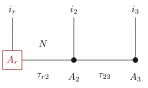 \(=\)

For a three-vertex path, \(\tau _{r2},\tau _{23}\in \Sigma \) are the two contracted configuration indices; the open legs carry \(i_r,i_2,i_3\). Only \(A_r\) contains the coefficient \(\psi \). The same definition applies to a vertex of any degree.
Fix \(\sigma \in \Sigma \). If all factors in \(\prod _{v\in V}A_v((\tau _e)_{e\ni v},\sigma (v))\) are nonzero, then \(\tau _e=\sigma \) for every \(e\in T\). Conversely, this virtual assignment satisfies all equality constraints.
For an active edge \(e=\{ u,v\} \), the local constraints give \(\tau _{p(u)}=\tau _e=\tau _{p(v)}\). Connectivity propagates these equalities along a walk between any two vertices. Hence there is one common configuration \(\tau \). The physical constraint at each \(v\) gives \(\tau (v)=\sigma (v)\), so \(\tau =\sigma \). The inactive edges have a unique index because their dimension is one. Substituting \(\tau _e=\sigma \) verifies the converse directly.
For every finite connected graph with \(|V|\ge 2\) and every \(\psi \colon \Sigma \to \mathbb {C}\), there are a spanning tree \(T\subseteq G\) and tensors with dimensions \(D_e=N\) on \(T\) and \(D_e=1\) off \(T\) such that
Every bond is positive and at most \(q^{|V|}\). If \(\psi \ne 0\), then \(c_A\ne 0\).
Every connected graph \(G\) with \(|V|\ge 2\) admits a spanning tree \(T\), whose connectedness provides an incident tree edge at each vertex. By Theorem 45.61.2, all terms of the contraction vanish except the assignment \(\tau _e=\sigma \). Its root factor is \(\psi (\sigma )\) and every other factor is one, giving (454). Since \(q\ge 1\), both possible bond dimensions are positive and at most \(N\).
A graph with a single vertex represents every coefficient function \(\psi \) by its single physical tensor, so every finite connected graph with \(|V|\ge 1\) admits an exact PEPS representation with bond dimensions in \([1, q^{|V|}]\). When \(V\) is empty, the contraction equals \(1\) for every tensor family.
For a single vertex \(v\), set \(A_v(i)=\psi (\sigma _i)\), where \(\sigma _i(v)=i\); since there are no edges, the contraction is \(A_v(\sigma (v))=\psi (\sigma )\). When \(V\) is empty, the unique virtual assignment has an empty product equal to \(1\).
The open \(w\times h\) nearest-neighbor grid is the Cartesian product of the path graphs on \(w\) and \(h\) vertices. It is connected if and only if \(w,h{\gt}0\), and for \(L\ge 2\) the \(L\times L\) vertex set has at least two elements.
Two vertices in the Cartesian product are adjacent when one coordinate agrees and the other differs by one. Each coordinate path is preconnected, and the Cartesian product of preconnected graphs is preconnected; the vertex set is nonempty if and only if \(w,h{\gt}0\). For \(L\ge 2\), the vertices \((0,0)\) and \((1,0)\) are distinct.
For \(q,L\ge 1\), every vector \(\psi \) on the open \(L\times L\) square grid admits an exact PEPS with bond dimensions \(1\le D_e\le q^{L^2}\) (and for \(L\ge 2\), with \(D_e=q^{L^2}\) on a spanning tree and \(D_e=1\) off that tree). If \(\| \psi \| =1\), the contracted state \(\Phi \) satisfies \(\Phi =\psi \), \(\| \Phi \| =1\), and \(\| \| \Phi \| ^{-1}\Phi -1\cdot \psi \| =0\).
Since the \(L\times L\) grid is connected and has \(L^2\) vertices, the existence of the exact PEPS follows from the connected-graph representation. When \(\| \psi \| =1\), the contracted state \(\Phi =\psi \) also has unit norm.
Fix \(q\ge 1\) and \(L_0\in \mathbb {N}\). For every \(0{\lt}L\le L_0\), every vector on the open \(L\times L\) square grid has an exact PEPS with bond dimensions \(1\le D_e\le C_0\), where \(C_0=q^{L_0^2}\). Consequently, for any \(C\in \mathbb {R}\) and \(r\ge 0\), the bond dimensions satisfy \(D_e\le \max \{ C,C_0\} L^r\), and for any \(\chi {\gt}0\), setting \(C_\chi =\max \{ C,C_0^{1/\chi }\} \) gives \(D_e\le (C_\chi L^r)^\chi \) for all \(0{\lt}L\le L_0\).
For \(0{\lt}L\le L_0\) and \(q\ge 1\), one has \(D_e\le q^{L^2}\le q^{L_0^2}=C_0\) (covering in particular the finite range \(2\le L{\lt}L_0\)). Since \(L^r\ge 1\), \(C_0\le \max \{ C,C_0\} L^r\), and for \(\chi {\gt}0\), \(C_0=(C_0^{1/\chi })^\chi \le (C_\chi L^r)^\chi \).
45.62 The finite-size approximation conclusion
As the finite-size part of [ 287 , Section 8 ] (07-assembly.tex, lines 203–214), fix integers \(q\ge 1\) and \(L_0\ge 0\), and real numbers \(C\) and \(c\ge 0\), and set \(C'=\max \{ C,q^{L_0^2}\} \). For every integer \(0{\lt}L\le L_0\) and every unit vector \(\Omega \) on the open \(L\times L\) square, there is a nonzero PEPS \(\Phi \) on that square with \(1\le D_e\le C'L^c\) on every edge and a real phase \(\theta \) such that \(\| \| \Phi \| ^{-1}\Phi -e^{i\theta }\Omega \| \le L^{-1}\).
The exact representation from Theorem 45.61.7 has the same coefficients as \(\Omega \), so \(\Phi =\Omega \). Consequently \(\| \Phi \| =1\) and \(\Phi \ne 0\), and setting \(\theta =0\) gives zero error, which is at most \(L^{-1}\).
Following the finite-size argument in [ 287 , Section 8 ] (07-assembly.tex, lines 203–214), fix integers \(q\ge 1\) and \(L_0\ge 0\), and real numbers \(C\) and \(c\ge 0\). There is a constant \(C'{\gt}0\) with \(C'\ge C\), chosen before \(L\) and \(\Omega \), such that for every integer \(2\le L{\lt}L_0\) and every unit vector \(\Omega \) on the open \(L\times L\) square, there is a nonzero PEPS \(\Phi \) on that square with \(1\le D_e\le C'L^c\) on every edge and a real phase \(\theta \) satisfying \(\| \| \Phi \| ^{-1}\Phi -e^{i\theta }\Omega \| \le L^{-1}\).
Setting \(C'=\max \{ C,q^{L_0^2}\} \) gives \(C'{\gt}0\) and \(C'\ge C\) because \(q\ge 1\) makes the second entry of the maximum positive; Theorem 45.62.1 then applies at each \(L\).
45.63 Removing finitely many exceptional sizes
For natural numbers \(q,L\), real numbers \(C,c\), and a vector \(\Omega \) in the physical space \((\mathbb C^q)^{\otimes L^2}\) of the open \(L\times L\) square, write \(\mathcal A_{C,c}(L,\Omega )\) if there are a nonzero PEPS \(\Phi \) on the original square graph and a real phase \(\theta \) such that every edge dimension satisfies \(1\le D_e\le CL^c\) and
For \(L=0\) the square has no edges, so the edge bound is vacuous, and the right-hand side \(L^{-1}\) is read with \(0^{-1}=0\).
For real \(J,\Delta \), let \(\mathcal G_{q,J,\Delta }(L)\) be the set of triples \((H,E_0,\Omega )\) with the following properties. The Hamiltonian is a sum of site terms and nearest-neighbor edge terms supported on their designated sites or endpoints, each of operator norm at most \(J\). Its total sum is Hermitian; individual terms need not be. The remaining conditions are
Several statements below hold for an arbitrary family of unit states \(\mathcal F\), which assigns to every \(L\) a set \(\mathcal F(L)\) of unit vectors on the open \(L\times L\) square. The ground vectors of the model form the family \(\mathcal F_{q,J,\Delta }\), where \(\Omega \in \mathcal F_{q,J,\Delta }(L)\) if \((H,E_0,\Omega )\in \mathcal G_{q,J,\Delta }(L)\) for some \(H\) and \(E_0\).
Let \(q,L\) be natural numbers, \(C,C',c\) real numbers with \(C\le C'\), and \(\Omega \) a vector on the open square. If \(\mathcal A_{C,c}(L,\Omega )\), then \(\mathcal A_{C',c}(L,\Omega )\).
Retaining the same PEPS and phase preserves the normalized vector and its approximation error, while \(L^c\ge 0\) implies \(D_e\le CL^c\le C'L^c\) on every edge.
Fix integers \(q\ge 1\), \(L\ge 2\) and \(L_0\ge 0\), real \(C\) and \(c\ge 0\), and a unit vector \(\Omega \) on the square of side \(L\). If \(\mathcal A_{C,c}(L,\Omega )\) holds whenever \(L\ge L_0\), then \(\mathcal A_{C',c}(L,\Omega )\) holds with \(C'=\max \{ C,q^{L_0^2}\} \).
Following the finite-size argument in [ 287 , Section 8 ] (07-assembly.tex, lines 203–214), fix integers \(q\ge 1\) and \(L_0\ge 0\), a family of unit states \(\mathcal F\), real \(C\), and \(c\ge 0\). Suppose \(\mathcal A_{C,c}(L,\Omega )\) holds for every integer \(L\ge \max \{ 2,L_0\} \) and every \(\Omega \in \mathcal F(L)\). There is one \(C'{\gt}0\) with \(C'\ge C\) such that \(\mathcal A_{C',c}(L,\Omega )\) holds for every integer \(L\ge 2\) and every \(\Omega \in \mathcal F(L)\). The exponent \(c\) is unchanged, and \(C'\) is independent of \(L\) and \(\Omega \). For the family \(\mathcal F_{q,J,\Delta }\), \(C'\) is independent of the Hamiltonian and the ground energy as well.
Take \(C'=\max \{ C,q^{L_0^2}\} \), which is positive and at least \(C\). Since every member of the family is a unit vector, Lemma 45.63.2 applies to every \(\Omega \in \mathcal F(L)\) with \(L\ge 2\).
The uniform polynomial approximation assertion
is equivalent to
In both assertions, the constants \(C,c\) are independent of the size, Hamiltonian, ground energy, and ground vector.
Assertion (457) implies (458) with \(L_0=0\) and the same constants. Conversely, for fixed \(q,J,\Delta \) and constants \(C,c,L_0\) satisfying (458), Theorem 45.63.3 produces a single positive prefactor \(C'\ge C\) valid for every \(L\ge 2\) with the same positive exponent \(c\), establishing (457).
45.63.1 Approximation from a compressed dyadic operator network
For large sizes, [ 287 , Section 8.1 ] (07-assembly.tex, lines 9–63) obtains from the protocol of its Proposition 7.1 and its compression theorem a party operator network with polynomial link dimensions whose operator is within \(CL^{-5}\) of \(|\Omega \rangle \langle \Omega |\) in trace norm. The statement below records this output, at constants fixed in advance, as an assumption and derives from it the approximation for all sufficiently large sizes. It is one step of the proof of Theorem 39.8.35, not that theorem.
Let \(L\ge 1\), \(C\ge 0\) and \(c\le c'\). If \(\mathcal A_{C,c}(L,\Omega )\), then \(\mathcal A_{C,c'}(L,\Omega )\).
Retaining the same PEPS and phase preserves the approximation error, while \(L\ge 1\) and \(C\ge 0\) yield \(CL^c\le CL^{c'}\).
Capturing the conclusion of [ 287 , Section 8.1 ] (07-assembly.tex, lines 53–63), together with the anchors of lines 102–114 and the network properties of Proposition 7.1 used in the proof of Lemma 8.2 (lines 128–131), fix an integer \(q\ge 2\), a family of states \(\mathcal F\), reals \(C,C_1,k\) and natural numbers \(B,\Delta _0,c,L_0\). Compressed dyadic operator networks exist for \(\mathcal F\) at these constants if for every integer \(L\ge \max \{ 2,L_0\} \) and every \(\Omega \in \mathcal F(L)\) there is an operator party network with the following properties. Every party is attached to a dyadic block inside the padded square, with at most \(B\) parties per block; every party has at most \(\Delta _0\) links; the two anchors of every link differ in each coordinate by at most \(c\) times the side of either endpoint block; every link dimension is at most \(C_1L^k\); and the operator \(\sigma \) of the network, with the physical pair of each party read at the fold of its anchor, satisfies
Following [ 287 , Section 8 ] (07-assembly.tex, lines 53–206) once the compressed network has been obtained, let \(\mathcal F\) be a family of unit states. If compressed dyadic operator networks exist for \(\mathcal F\) at the constants \(C,C_1,k,B,\Delta _0,c,L_0\) in the sense of Definition 45.63.1.2, and \(\chi =8(2c+1)B\Delta _0\), then \(\mathcal A_{\max \{ C_1,1\} ^\chi ,\max \{ k,0\} \chi +1}(L,\Omega )\) for every \(L\ge 2\) with \(L\ge \max \{ L_0,\lceil 2C\rceil \} \) and every \(\Omega \in \mathcal F(L)\).
Replacing \(C_1\) by \(\max \{ C_1,1\} \) and \(k\) by \(\max \{ k,0\} \) preserves the link bound since \(L\ge 1\). For \(L\ge \max \{ 2,L_0,\lceil 2C\rceil \} \) one has \(2C\le L\le L^4\), hence \(2CL^{-5}\le L^{-1}\le 1/2\) and \(CL^{-5}{\lt}1\). Theorem 45.8.1.4 with \(\eta =CL^{-5}\) gives \(\mathcal A_{C_1^\chi ,k\chi }(L,\Omega )\) with \(\chi =8(2c+1)B\Delta _0\), and Theorem 45.63.1.1 raises the exponent to \(k\chi +1{\gt}0\).
The compressed network itself comes from the protocol of [ 287 , Proposition 7.1 ] and the compression theorem [ 287 , Theorem 5.2 ] . The following statements carry out this step of [ 287 , Section 8.1 ] (07-assembly.tex, lines 45–63) from the protocol bounds of Definition 45.1.1.1 at given constants, which Proposition 45.1.1.2 supplies.
Let a protocol satisfy the bounds of Definition 45.1.1.1 with count constant \(C_N\) and error constant \(C_E\ge 0\) on a square of side \(L\ge 1\), for a unit vector \(\Omega \). Composing its changes gives one distributed construction, with the recorded expansions of its gates, whose physical density is that of the final vector, the physical configurations of the parties being identified with the configurations of the square. Let \(\tau \) be a distributed operator contraction on the parties of the protocol with \(\lVert \tau -\operatorname{Tr}_{\rm private}|\Psi _n\rangle \langle \Psi _n|\rVert _1\le \varepsilon \), link alphabets of size at most \(C_1L^\alpha \), at most \(\Delta _0\) links at each party, and links only between two parties of a common nonprivate gate. Then enumerating the link alphabets gives an operator party network on the dyadic anchors of the protocol with the same link bounds, separation constant \(b\), and, with the physical pair of each party read at the fold of its anchor,
The unit-square party of a genuine site has anchor equal to that site, which the fold fixes, and every other party has physical dimension one. Hence reading each party at the fold of its anchor recovers the configuration of the square, and Theorem 45.3.1.2 identifies \(\sigma \) with \(\tau \) in these coordinates. The trace norm is invariant under this relabelling, so the triangle inequality and the density estimate of Theorem 45.1.1.5 give the bound. The endpoints of a link are participants of a common nonprivate gate of some change, so the separation bound of the same theorem applies, and each party lies on at most \(\Delta _0\) links.
Let \(W\) be the circuit obtained by composing the \(T\) changes \(W_0,\ldots ,W_{T-1}\) of a protocol, with its initial and final register layouts identified with the input and output layouts of the protocol. Repeated occurrences of one gate are counted separately. Every nonprivate gate of \(W\) has the set of participating parties of a nonprivate gate of some \(W_t\) with \(t{\lt}T\). If the protocol satisfies the bounds of Definition 45.1.1.1 with expansion constant \(C_K\) and constants \(b,k,r\), then \(W\) has at most \(Tb\) nonprivate gates, every party participates in at most \(b\) of them, and every nonprivate gate of \(W\) has at most \(\lfloor C_KL^k\rfloor \) monomials, at most \(r\) pair effects in each monomial, and absolute coefficient sum at most \(C_KL^k\).
Identifying equal layouts changes neither the gates nor their participating sets, so it suffices to treat the composite of the changes. Its nonprivate gates are those of the changes, listed in order. Write \(N(X)\) for the number of nonprivate gates of a circuit \(X\) and \(n_p(X)\) for the number of them in which the party \(p\) participates. Hence \(N(W)=\sum _{t{\lt}T}N(W_t)\le Tb\), and \(n_p(W)=\sum _{t{\lt}T}n_p(W_t)\le b\) is the lifetime bound of the protocol. The monomial and expansion bounds hold for every change and therefore for every gate of the composite.
Fix \(q\ge 2\), a family of unit states \(\mathcal F\), a count constant \(C_N\), an expansion constant \(C_K\), an error constant \(C_E\) and constants \(b,k,r,L_0\). Suppose that for every \(L\ge \max \{ 2,L_0\} \) and every \(\Omega \in \mathcal F(L)\) there is a protocol satisfying the Section 8 bounds of Definition 45.1.1.1 with these constants. Then compressed dyadic operator networks exist for \(\mathcal F\), in the sense of Definition 45.63.1.2, at the error constant \(1+2C_NC_E+2C_E\), the link prefactor \(C_\Sigma (r,b,\max \{ C_N,0\} b,q,\max \{ C_K,0\} ,C_K)\), the link exponent \(\alpha _{\mathrm{net}}(r,b,3,0,k,k,5)\), the block bound \(b\), the degree bound \(2b(b-1)\), the separation constant \(b\) and the threshold \(L_0\).
For fixed \(q\) and \(\mathcal F\), the protocols across all sides \(L\ge \max \{ 2,L_0\} \) and all states of the family form a single family of distributed constructions indexed by their size. In this family the number of nonprivate gates is at most \(bC_NL^3\), each gate involves at most \(b\) parties, each party participates in at most \(b\) gates, every physical dimension is at most \(q\), and every gate is exactly the sum of its recorded expansion, with at most \(C_KL^k\) monomials, absolute coefficient sum at most \(C_KL^k\), and at most \(r\) pair effects per monomial. Theorem 45.48.18 in its coefficient-sum form, with \(p=5\) and coefficient-sum degree \(s=k\), then gives constants \(C_p=C_\Sigma (r,b,\max \{ C_N,0\} b,q,\max \{ C_K,0\} ,C_K)\) and \(\alpha =\alpha _{\mathrm{net}}(r,b,3,0,k,k,5)\), chosen before the family member, and for each protocol a distributed operator contraction within \(L^{-5}\) of its physical density, with link alphabets of size at most \(C_pL^\alpha \), at most \(2b(b-1)\) links at each party, and links only between parties of a common gate. Lemma 45.63.1.4 turns it into an operator party network with at most \(b\) parties per block, degree \(2b(b-1)\), separation constant \(b\), link dimensions at most \(C_pL^\alpha \), and
Here \(C_N\ge 0\), since there are at least one and at most \(C_NL^2\) parties, and \(C_E\ge 0\), since \(1-C_EL^{-57}\le \lVert \Xi \rVert \le 1\). The error constant \(1+2C_NC_E+2C_E\) does not involve the expansion constant.