Publications

Publications, preprints, and conference tutorials. See my full publication list on Google Scholar .

1,313 citations · h-index 14 · 19 publications

* Equal contribution

AI for science

🏆 Oral at NeurIPS 2025 AI4Science

Can Theoretical Physics Research Benefit from Language Agents?

Sirui Lu, Zhijing Jin, Terry Jingchen Zhang, Pavel Kos, Bernhard Schölkopf
ICML 2026 2026
Abstract
Large Language Models (LLMs) are rapidly advancing across diverse domains, yet their application in theoretical physics remains inadequate. While current models show competence in mathematical reasoning and code generation, we identify critical gaps in physical intuition, constraint satisfaction, and reliable reasoning that cannot be addressed through prompting alone. Physics demands approximation judgment, symmetry exploitation, and physical grounding that require AI agents specifically trained on physics reasoning patterns and equipped with physics-aware verification tools. We envision physics-specialized AI agents that handle multimodal data, propose physically consistent hypotheses, and autonomously verify theoretical results, and we call for collaborative efforts between physics and AI communities to build the specialized infrastructure necessary for AI-driven scientific discovery.
🏆 Discovered with TeXRA · 14,116 certified codes

Co-Designing Quantum Codes with Transversal Diagonal Gates via Multi-Agent Systems

Xi He, Sirui Lu, Bei Zeng,
arXiv:2510.20728 2025
Abstract
Exact scientific discovery requires more than heuristic search: candidate constructions must be turned into exact objects and checked independently. We extend TeXRA with an independent Lean 4 verification layer, turning it into a human-guided multi-agent platform that couples symbolic synthesis, combinatorial and linear-programming search, exact reconstruction of numerical candidates, and formal verification in Lean. Applying it to nonadditive quantum error-correcting codes with prescribed transversal diagonal gates, we obtain a Lean-certified catalogue of 14,116 distance-2 codes and resolve the transversal-T problem for several distance-3 codes, with all constructions, infinite families, and no-go results formalized and checked in Lean.

Quantum algorithms & simulation

Algorithms for Quantum Simulation at Finite Energies

Sirui Lu, Mari Carmen Bañuls, J. Ignacio Cirac,
PRX Quantum 2, 020321 2021
Abstract
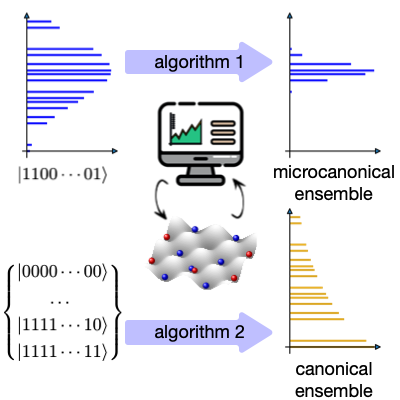
We introduce two kinds of quantum algorithms to explore microcanonical and canonical properties of many-body systems. The first is a hybrid quantum algorithm that, given an efficiently preparable state, computes expectation values in a finite energy interval around its mean energy, using a filtering operator similar to quantum phase estimation and recovering physical values through interferometric measurements. Its computational time scales polynomially with the number of qubits, the inverse variance, and the inverse error, and it does not require long-time evolution. The second is a quantum-assisted Monte Carlo sampling method for microcanonical and canonical ensemble quantities that circumvents the sign problem of classical quantum Monte Carlo. Both can run on small quantum computers and analog quantum simulators.

Machine learning for quantum physics

🏆 Editors' Suggestion

Tensor Networks and Efficient Descriptions of Classical Data

Sirui Lu, Márton Kanász-Nagy, Ivan Kukuljan, J. Ignacio Cirac,
Phys. Rev. A 111, 032409 2025
Abstract
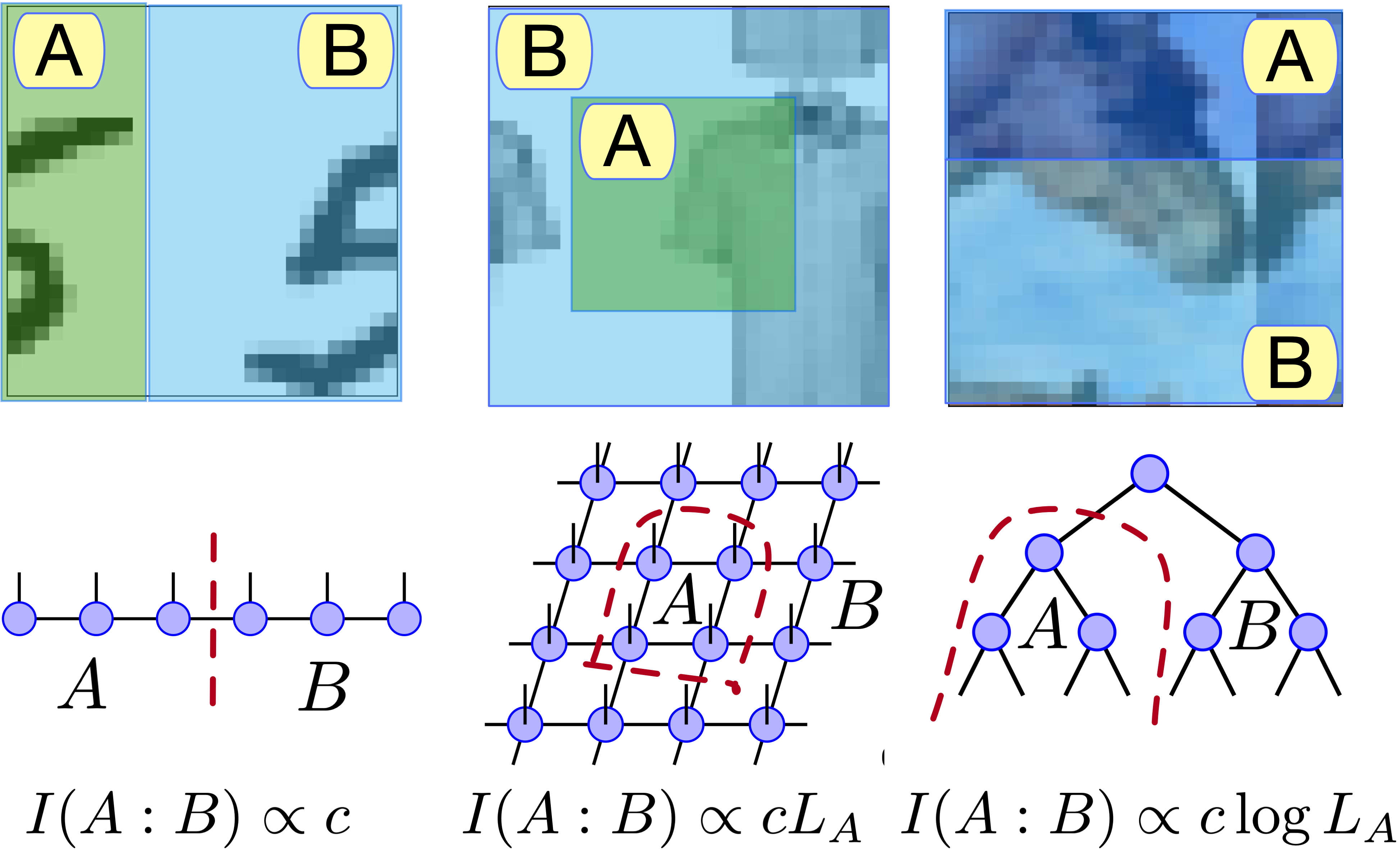
We investigate the potential of tensor network based machine learning methods to scale to large image and text data sets. For that, we study how the mutual information between a subregion and its complement scales with the subsystem size L, similarly to how it is done in quantum many-body physics. We find that for text, the mutual information scales as a power law with a close to volume law exponent, indicating that text cannot be efficiently described by 1D tensor networks. For images, the scaling is close to an area law, hinting that 2D tensor networks such as PEPS could have adequate expressibility. For the numerical analysis, we introduce a mutual information estimator based on autoregressive networks, and we also use convolutional neural networks in a neural estimator method.
🏆 Most-cited work

Quantum Adversarial Machine Learning

Sirui Lu, Lu-Ming Duan, Dong-Ling Deng,
Phys. Rev. Research 2, 033212 2020
Abstract
Adversarial machine learning studies vulnerabilities of machine-learning models in adversarial settings and develops techniques to make learning robust. We show that quantum classifiers, like their classical counterparts, are vulnerable to adversarial examples: adding carefully crafted, imperceptible perturbations to legitimate inputs leads to misclassification, demonstrated for classifying real-life images, phases of matter, and quantum data. We also show that practical defense strategies can be designed to counter a range of such attacks, bridging machine learning and quantum physics and offering guidance for implementing quantum classifiers on near-term and future quantum devices.

Quantum information & computation