
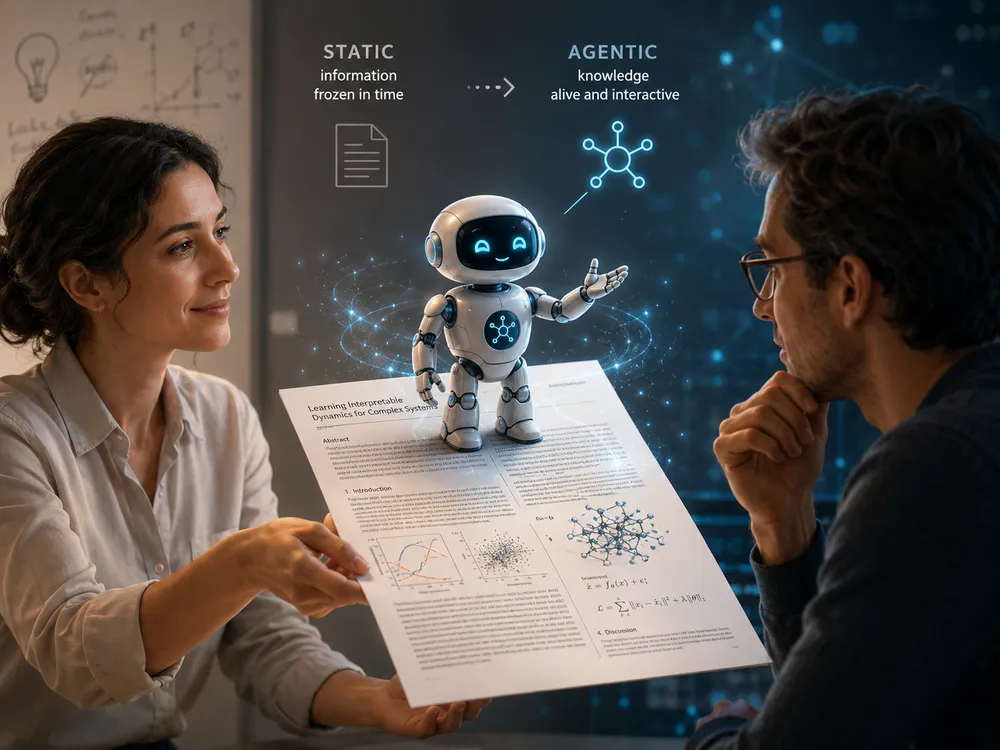
Counting from 1665, when the Royal Society founded Philosophical Transactions, the basic form of the academic paper has persisted for more than 360 years. Anyone who does research has probably had a similar experience: you read an excellent paper and want to build on it, only to get stuck on undocumented environment dependencies, missing scripts, or parameters that refuse to behave. A static PDF records “what was discovered,” but can hardly record “how it was actually done.”
The two of us recently proposed an idea — the Agentic Publication Protocol (APP). The idea is very simple: rather than publishing only a static PDF, package the manuscript, code, data, and runtime environment as a complete open-source repository, and at publication time build a dedicated AI agent for it, one that answers readers’ questions and helps them reproduce the results on the authors’ behalf.
In this article, we would like to share the motivation behind APP, the amusing experience of developing the protocol in a closed loop with a team of agents, and the far-reaching changes that paper agents representing individual works may bring in the future.
A shorter announcement of this work appears on Xiao-Liang Qi’s blog↗, together with a video introduction↗.
01 Why the traditional paper is no longer enough
In modern physics, information is increasingly regarded as a fundamental concept, perhaps even a deeper ingredient behind the laws of spacetime and matter. When studying a complex system, the key question is how its most important information is carried, copied, and processed. From the genetic material of biological evolution, to the language of human civilization, to today’s large models, every leap in the carrier of complex information has profoundly changed how knowledge accumulates and how groups collaborate.
The most fundamental change brought by large language models is that, for the first time, the tacit know-how of human practice has become replicable and shareable at scale. Books and papers readily transmit explicit knowledge — formulas, theorems, prose. But anyone who has done research knows that what truly decides whether a project moves forward is often the practical detail that never makes it into the text: how to find an entry point into a complex problem, how to fine-tune parameters, how to tell an error from new physics when anomalous data appears, under which extreme limits a derivation may fail. In the past, this kind of experience could only be passed down hand over hand from advisor to student, spread by word of mouth among labmates, or painfully rediscovered by each reader over months of trial and error.
Compared with the rapid advance of AI, the basic carrier of scholarly communication looks remarkably stagnant. For more than three centuries, the paper has remained a statically typeset narrative. In modern research — which depends heavily on algorithms, massive data, and precision simulation — this static carrier creates a widespread predicament: once published, a paper becomes a frozen historical artifact, and later improvements and feedback can hardly keep evolving the way open-source software does; the many code and environment details left out of the text are easily lost, making reproduction difficult for those who follow. As an empirical study published in PNAS in 2018 revealed, even in journals that explicitly require data sharing, the main conclusions of only 26% of the sampled papers could be successfully reproduced [1]. Often the authors are not deliberately withholding anything — as the philosopher Michael Polanyi put it, “we can know more than we can tell” [2] — and a great deal of practical experience simply vanishes as people move on.
Today, as AI agents begin to assist with — or even generate — papers in bulk, the reproducibility problem becomes more urgent. If the bar for publication is merely “the prose looks plausible,” cases where code and conclusions drift apart may multiply. Reviewers and follow-up researchers will spend enormous effort figuring out which code actually runs and which conclusions actually reproduce. Moreover, this rupture of tacit experience invisibly raises the barrier to entry, leaving young scholars without strong mentorship and students at less-resourced institutions chronically stuck. As Academician Weinan E and others have repeatedly pointed out, AI for Science is not only about faster computational tools — it is a reshaping of the entire ecology of scientific collaboration. In a previous article on the agentification of scientific research [3], one of us proposed a forward-looking corollary: if AI truly becomes a collaborator in research, then the evolution of scientific publishing from the static paper to the interactive research agent is an inevitable direction. Now, faced with the real demand for high reproducibility, turning that corollary into a workable, operational protocol has become an urgent task [4].
02 The core idea: an open-source repository as the publication, with a dedicated agent for the paper
Based on these considerations, the two of us proposed the Agentic Publication Protocol (APP) [4]. The core idea is direct: rather than publishing a standalone static PDF, publish the entire open-source repository — containing the manuscript, code, data, and environment — as the entity of publication, and build a dedicated agent for the paper.
APP shifts the center of gravity of a scholarly result from pure narrative to a real, runnable environment and codebase. The object of publication is directly a version-controlled public repository.
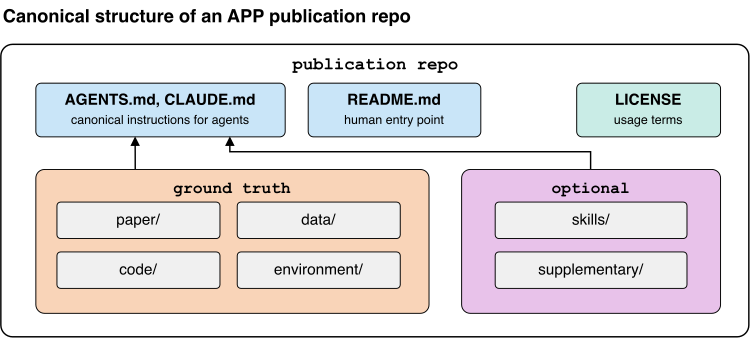
A standard APP repository has three layers (see figure above):
- The top layer is the human reader layer: the polished manuscript (
paper/), an overview guide (README.md), and an open-source license (LICENSE). - The middle layer is the objective facts layer: one-click figure reproduction code (
code/, with reproduction scripts and inputs/outputs strictly mapped to each figure), traceable raw data (data/), deterministic environment configuration (environment/), and research notes with hard-won lessons (supplementary/). - The core at the bottom is the agent interaction and attestation layer, centered on a standardized core instruction file —
AGENTS.md.
AGENTS.md specifies the paper agent’s role, the boundaries of its knowledge, and its standards of rigor, directing how the agent should draw on the real materials in the repository. Combined with the commit history, version tags, and manifest files of version control, APP ensures that every release is personally approved by the authors. When a reader opens the repository with their own agent, they instantly obtain a “paper-specific agent” fluent in every derivation and code detail of that work — the authors’ scholarly spokesperson.
03 How to use it: the authors’ publishing flow and the readers’ live interaction
To make publishing easy for authors, APP provides an automated assistant — publish-paper.
An author simply opens a supported large-model environment (such as Claude Code or OpenAI Codex) in the paper’s working directory and types /publish-paper. The agent then acts like an experienced scholarly assistant, guiding the author through five connected steps (see figure below):

First, it automatically tests the existing code, verifying that figures reproduce reliably and generating a reproduction report. Next, it organizes the source files and builds a public staging directory, stripping out drafts and private information. It then distills the core conclusions and methods to generate a well-formed AGENTS.md. The fourth step is a full audit of file structure and path integrity. Finally, once the author confirms, it applies a version tag (e.g. v1.0.0) and generates a release manifest with checksums.
For readers, literature study becomes very direct. After cloning the repository, a reader can simply ask the paper agent questions — about the physical assumptions behind a step in a theorem’s derivation, for the exact commands to reproduce a specific figure, or about whether modifying a model parameter might cause numerical divergence. The agent answers strictly from the real materials the authors left behind, and on the spot helps the reader run the code and verify the derivations.
04 How we built it: an amusing closed loop of agent self-iteration
In developing this protocol, we did something rather fun: instead of setting rules out of thin air, we led a team of AI agents with distinct roles and built an automated simulation sandbox with a closed-loop testing system in the development environment (see figure below).
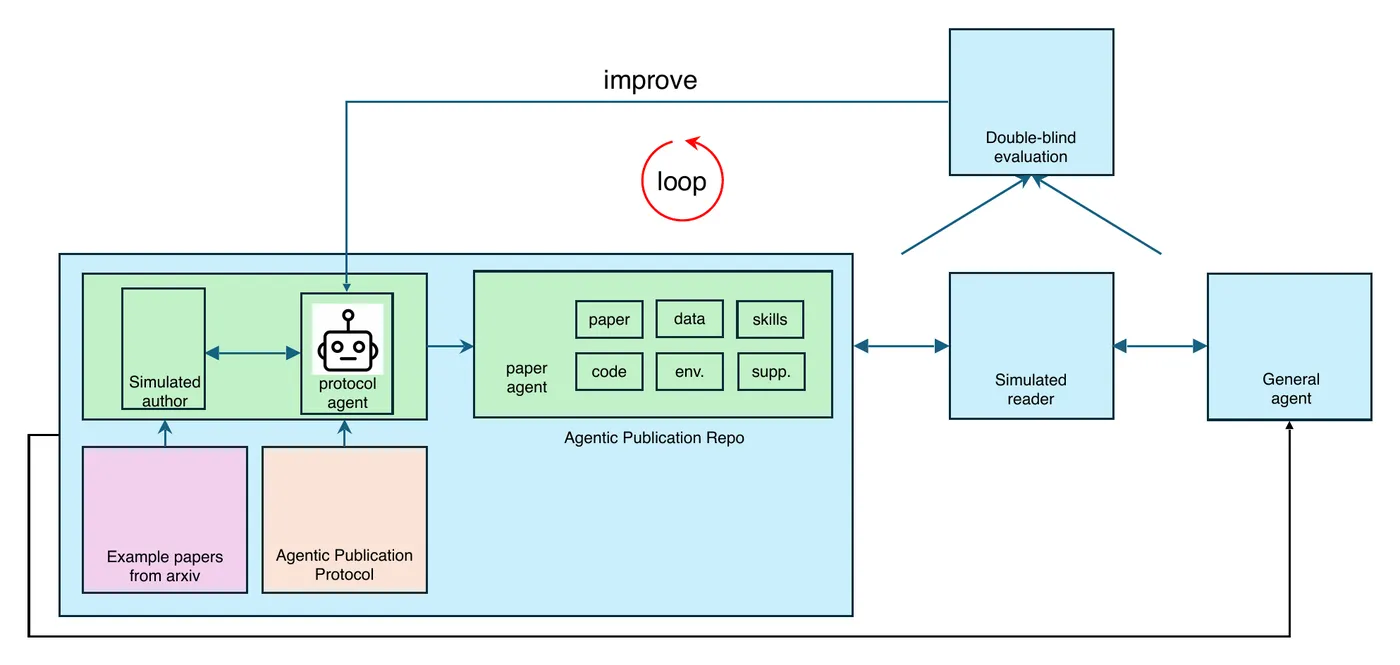
In this simulated system, several agents with clear divisions of labor cooperate with — and nitpick — each other:
- The “simulated author” owns a realistic early-stage research working directory, typically overflowing with unorganized drafts, debugging scripts, raw data, and temporary notes.
- The “publishing assistant” helps the simulated author organize files, generate
AGENTS.md, and build a standard candidate release repository. - The “simulated reader” is allowed to read only the paper’s main text, and on that basis poses a series of pointed, in-depth questions about derivations and code reproduction.
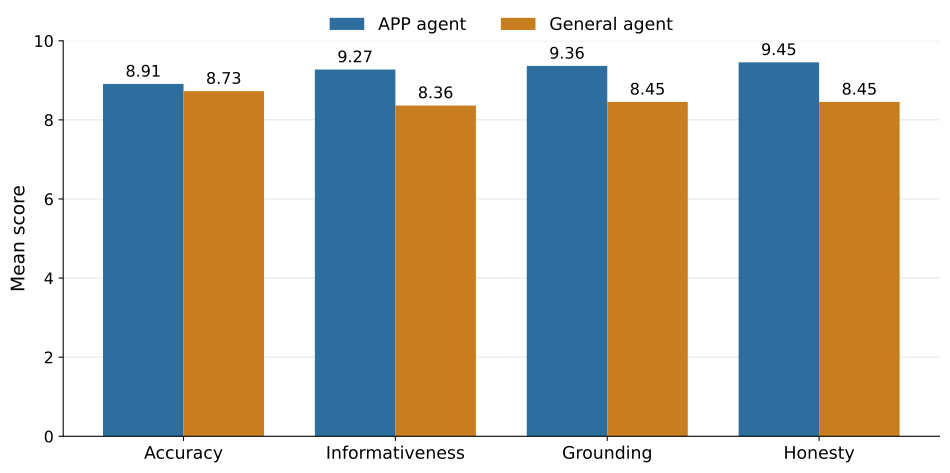
- The “double-blind evaluation expert” — under complete anonymity — compares the answer quality of the APP paper agent against a plain agent mounted directly on the raw workspace, scoring them on four dimensions: accuracy, informativeness, rigor and groundedness, and honesty, with failure diagnoses.
In early tests, we found that the paper agent often displayed some laughable weaknesses: it would sometimes rigidly recite the protocol template, and at other times try to fob off technical follow-up questions with generic paper abstracts instead of proactively pulling up the underlying code. Based on this feedback, we progressively refined the instruction specification, explicitly requiring the agent to answer from real code and data, and to frankly acknowledge its limits when a question falls outside its scope.
We ran multiple rounds of rigorous double-blind comparison on 11 frontier physics papers spanning tensor networks, topological flat bands, quantum circuit optimization, and more (see figure below). The results show that the APP paper agent won the blind test on all 11 papers, with an average score of 9.25 (versus 8.50 for the plain baseline agent), and the largest gaps appeared precisely in rigor and groundedness (9.36 vs. 8.45) and honesty (9.45 vs. 8.45).
The APP protocol has already seen its first real research releases. Readers can visit and clone their public repositories and interact with the paper-specific agents directly:
- Theory of nonreciprocal axion polaritons (Abhinava Chatterjee and Prof. Chao-Xing Liu, Penn State University, arXiv:2606.04341) [5]: https://github.com/AbhinavaPSU/Nonreciprocal-axion-polaritons↗
- Theory of anomalous Landau levels in topological flat bands (Prof. Chao-Xing Liu, Penn State University, arXiv:2607.10328) [6]: https://github.com/lcxlight/lk-anomalous-landau-levels↗
- Circuit structure theory of quantum error-correcting codes (Prof. Victor V. Albert, NIST and University of Maryland, arXiv:2608.05688) [7]: https://github.com/valbert4/two-fold-transversal↗
- Research on mechanistic interpretability of large models (Chuqiao Lin and Prof. Shivaji L. Sondhi, University of Oxford, with a Stanford University team) [8]: https://github.com/lccqqqqq/sae-feature-nonlocality↗
The full list of published APP papers, with updates, is maintained in the protocol community: https://github.com/LionSR/AgenticPublicationProtocol/discussions/36↗.
05 Toward an agent-driven research network
As one of us discussed in The Agentification of Scientific Research [3], agentic publication will bring several profound shifts:
First, papers become “alive,” enabling faster, continuous iteration. A traditional paper becomes a frozen historical artifact once published, whereas in the APP model a paper is a living project in the form of an open-source repository. Authors can keep maintaining code and notes as the research deepens, and peers can contribute new examples and extended analyses through pull requests, letting scientific results grow through dynamic interaction.
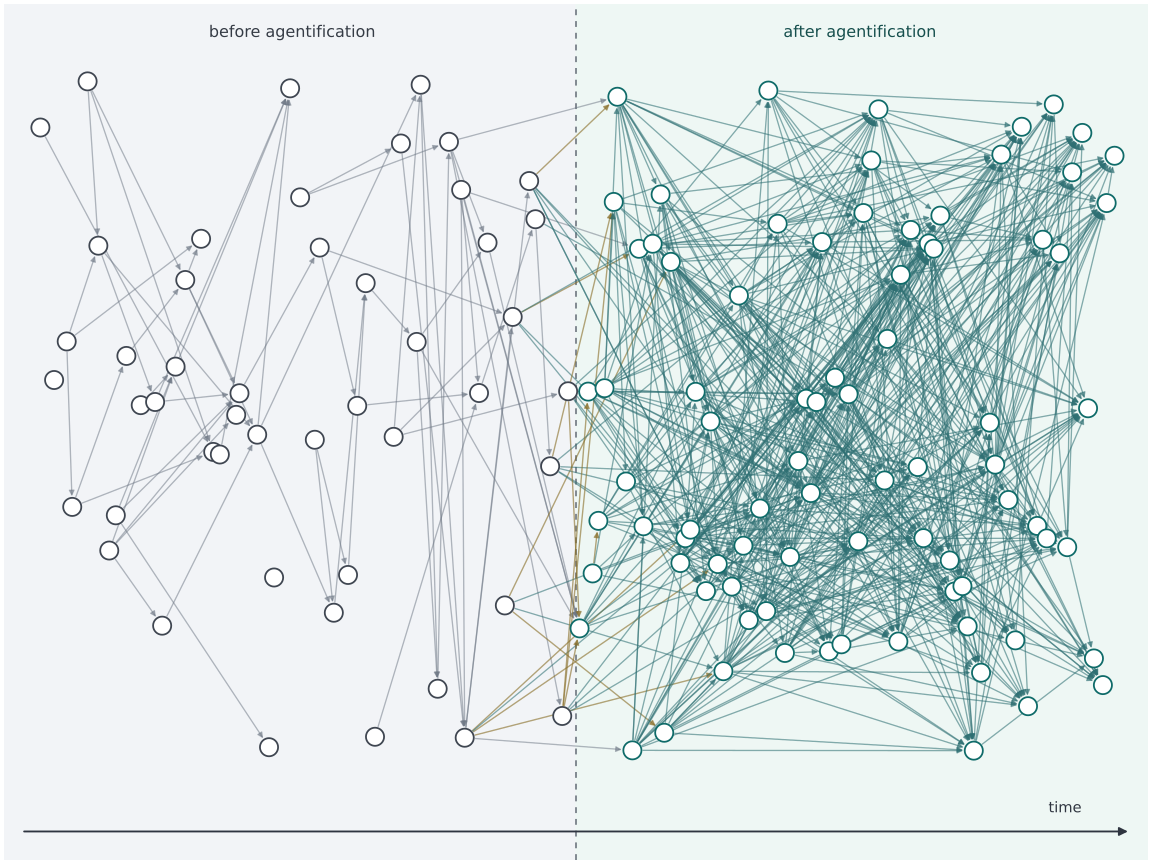
Second, direct collaboration between agents of different papers gives rise to automated and semi-automated scientific innovation. When every paper has its own dedicated agent, different results can talk to each other directly (see figure below). A researcher’s large-model assistant can orchestrate the agents of dozens of related papers, calling one another at the level of code and interfaces, automatically exploring method transfer and model hybridization, and forming a large-scale self-organizing human–machine collaboration network. This promises to let the accumulation and compounding of scientific knowledge break through the bottleneck of individual communication bandwidth, bringing about a phase transition in the dynamics of research.
Third, we need to explore evaluation and reward systems suited to the agent era. The existing measures of academic evaluation — citation counts and impact factors — have persisted for over a century. They can neither capture the real labor of code maintenance, environment setup, and data sharing, nor cope with the explosion of AI-assisted papers. As publications evolve into executable agent repositories, the scholarly community needs to explore new mechanisms of credit attribution — for example, measuring how often and how deeply a reproduction module is invoked by downstream work. Although we cannot foresee the final shape of such a system today, launching collective experiments through open protocols like APP itself accumulates experience for the future evolution of scientific institutions.
Fourth, lowering hidden barriers and democratizing research. Science has long had invisible walls of experience: students at top institutions can walk down the hall to ask their advisor or senior labmates, easily picking up debugging tricks that never appear in print; students at ordinary institutions or scholars crossing fields, even facing a fully open top-journal paper, are often stuck for weeks by a single environment error or parameter detail. Through APP, authors pour their practical experience, debugging skills, and interactive availability into the paper agent. No matter which university a reader belongs to, or whether they know the authors personally, opening the repository is equivalent to having a dedicated virtual mentor, online 24/7, who answers technical questions without reservation. This greatly levels the information gap between scholars and lets scientific innovation return to ideas and insight themselves.
06 Conclusion
Modernizing scientific publishing requires the whole scholarly community to build together. We have fully open-sourced the Agentic Publication Protocol — its specification, the complete publishing skill, the development and evaluation tools, and the benchmark dataset:
- Project homepage: https://xiaoliangqi.github.io/agentic-publication-protocol-dev.app/↗
- Preprint (arXiv): https://arxiv.org/abs/2606.27386↗
- Open-source APP protocol repository: https://github.com/LionSR/AgenticPublicationProtocol↗
- Development repository and paper-specific agent (the first APP-format paper): https://github.com/XiaoliangQi/agentic-publication-protocol-dev.app↗
- Evaluation dataset (Hugging Face): https://huggingface.co/datasets/phynics/agentic-publication-protocol-dataset↗
If you would also like to bring your paper “alive” and try this new way of publishing, simply open your agent (such as Claude Code or Codex) in the working directory containing your publication materials (drafts, code, data, etc.) and run:
/publish-paperLet us together welcome the new paradigm of scientific research in the agent era!
References
- Stodden, V., Seiler, J., & Ma, Z. (2018). An empirical analysis of journal policy effectiveness for computational reproducibility. Proceedings of the National Academy of Sciences, 115(11), 2584–2589.
- Polanyi, M. (1966). The Tacit Dimension. Doubleday & Company.
- Qi, X.-L. (2026). The agentification of scientific research: A physicist’s perspective. arXiv:2604.14718.
- Lu, S., & Qi, X.-L. (2026). Agentic Publication Protocol: An Attempt to Modernize Scientific Publication. arXiv:2606.27386.
- Chatterjee, A., & Liu, C.-X. (2026). Perfect Nonreciprocal Axion-polaritons. arXiv:2606.04341.
- Liu, C.-X. (2026). Lifshitz–Kosevich Theory of Anomalous Landau Levels in Topological Flat Bands. arXiv:2607.10328.
- Albert, V. V. (2026). Beyond transversality: structure of Clifford circuits for CSS codes. arXiv:2608.05688.
- Lin, C., Sondhi, S. L., & Qi, X.-L. (2026). Measuring Semantic Abstractness of SAE Features via Nonlocality. APP release, https://github.com/lccqqqqq/sae-feature-nonlocality↗.